SCHIZOPHRENIA
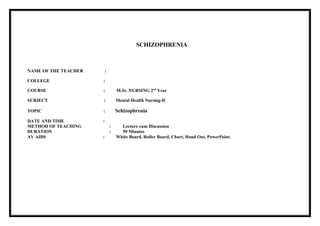
NAME OF THETEACHER :
COLLEGE :
COURSE : M.Sc. NURSING 2nd
Year
SUBJECT : Mental Health Nursing-II
TOPIC : Schizophrenia
DATE AND TIME :
METHOD OF TEACHING : Lecture cum Discussion
DURATION : 50 Minutes
AV AIDS : White Board, Roller Board, Chart, Hand Out, PowerPoint.
3.
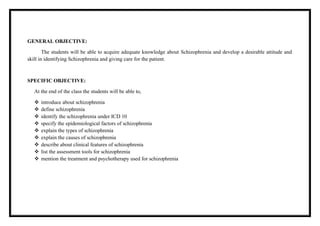
GENERAL OBJECTIVE:
The studentswill be able to acquire adequate knowledge about Schizophrenia and develop a desirable attitude and
skill in identifying Schizophrenia and giving care for the patient.
SPECIFIC OBJECTIVE:
At the end of the class the students will be able to,
introduce about schizophrenia
define schizophrenia
identify the schizophrenia under ICD 10
specify the epidemiological factors of schizophrenia
explain the types of schizophrenia
explain the causes of schizophrenia
describe about clinical features of schizophrenia
list the assessment tools for schizophrenia
mention the treatment and psychotherapy used for schizophrenia
4.
S.No Time Specific
Objective
Content
Typeof
Av Aids
Used
Teachers
Activity
Learners
Activity
Evaluation
1. 5 mins Introduce about
Schizophrenia
The term schizophrenia was
coined in 1908 by the Swiss psychiatrist
EugenBleuler. The word was derived
from the Greek “skhizo” (split) and
“phren” (mind). Over the years, much
debate has surrounded the concept of
schizophrenia. Various definitions of the
disorder have evolved, and numerous
treatment strategies have been proposed,
but none have proven to be uniformly
effective or sufficient.
Black
Board
Teaching Learning Introduce about
Schizophrenia
2. 5 mins Define
Schizophrenia
DEFINITION
Schizophrenia is a psychotic condition
characterized by a disturbance in thinking,
emotions, volitions and faculties in the presence
of clear consciousness, which usually leads to
social withdrawal.
Roller
chart
Teaching Learning What is meant by
schizophrenia?
3. 20 mins Identify the
Schizophrenia
under ICD 10
SCHIZOPHRENIA AND OTHER
PSYCHOTIC DISORDERS
CLASSIFICATION [ICD-10]
OHP Teaching Learning Classify about ICD
classification of
Schizophrenia?
5.
F20- F29 Schizophrenia
F20.0– Paranoid
F20.1 – Hebephrenic
F20.2 – Catatonic
F20.3 – Undifferentiated
F20.4 - Post Schizophrenic
F20.5 – Residual
F20.6 – Simple
F21 - Schizotypal Disorder
F22- Persistent Delusional Disorder
F23- Acute And Transient Psychotic Disorder
F24- Induced Delusional Disorder
F25- Schizoaffective Disorder
4 15 mins Specify the
epidemiological
factors of
Schizophrenia
Schizophrenia is the most common of all
psychiatric disorders and is prevalent in all
cultures across the world. About 15% of new
admissions in hospitals are schizophrenic
patients.
3 to 4 / 1ooo people in community
Equal for men and women [1 : 1 ]
Men - 15 to 25 yrs
women - 25 to 35 yrs
Low socio-economic groups
In 2016 ……
Prevalence - 1%
Incidence - 1.5 / 10,000
Men than women [ 1.4 : 1 ]
Power
Point
Teaching Learning Explain about
epidemiological factors
of Schizophrenia ?
6.
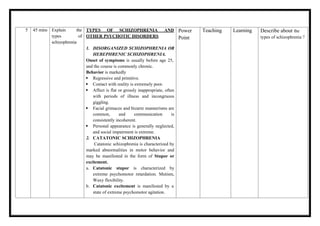
5 45 minsExplain the
types of
schizophrenia
TYPES OF SCHIZOPHRENIA AND
OTHER PSYCHOTIC DISORDERS
1. DISORGANIZED SCHIZOPHRENIA OR
HEBEPHRENIC SCHIZOPHRENIA.
Onset of symptoms is usually before age 25,
and the course is commonly chronic.
Behavior is markedly
Regressive and primitive.
Contact with reality is extremely poor.
Affect is flat or grossly inappropriate, often
with periods of illness and incongruous
giggling.
Facial grimaces and bizarre mannerisms are
common, and communication is
consistently incoherent.
Personal appearance is generally neglected,
and social impairment is extreme.
2. CATATONIC SCHIZOPHRENIA
Catatonic schizophrenia is characterized by
marked abnormalities in motor behavior and
may be manifested in the form of Stupor or
excitement.
a. Catatonic stupor is characterized by
extreme psychomotor retardation. Mutism,
Waxy flexibility.
b. Catatonic excitement is manifested by a
state of extreme psychomotor agitation.
Power
Point
Teaching Learning Describe about the
types of schizophrenia ?
7.
3. PARANOID SCHIZOPHRENIA
Paranoid schizophrenia is characterized
mainly by the presence of delusions of
persecution or grandeur and auditory
hallucinations related to a single theme.
The individual is often tense, suspicious,
and guarded, and may be argumentative,
hostile, and aggressive.
Onset of symptoms is usually later (perhaps in
the late 20s or 30s)
Behavior changes like
Less regression of mental faculties,
emotional response, and behavior is seen
than in the other subtypes of schizophrenia.
Social impairment may be minimal, and
there is some evidence that prognosis,
particularly with regard to occupational
functioning and capacity for independent
living, is promising.
3. UNDIFFERENTIATED
SCHIZOPHRENIA
Sometimes clients with schizophrenic
symptoms do not meet the criteria for any
of the subtypes, or they may meet the
criteria for more than one subtype.
These individuals may be given the
diagnosis of undifferentiated schizophrenia.
8.
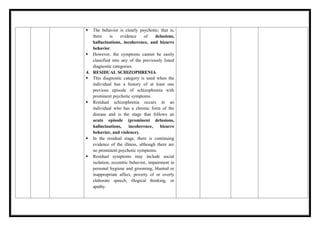
The behavioris clearly psychotic; that is,
there is evidence of delusions,
hallucinations, incoherence, and bizarre
behavior.
However, the symptoms cannot be easily
classified into any of the previously listed
diagnostic categories.
4. RESIDUAL SCHIZOPHRENIA
This diagnostic category is used when the
individual has a history of at least one
previous episode of schizophrenia with
prominent psychotic symptoms.
Residual schizophrenia occurs in an
individual who has a chronic form of the
disease and is the stage that follows an
acute episode (prominent delusions,
hallucinations, incoherence, bizarre
behavior, and violence).
In the residual stage, there is continuing
evidence of the illness, although there are
no prominent psychotic symptoms.
Residual symptoms may include social
isolation, eccentric behavior, impairment in
personal hygiene and grooming, blunted or
inappropriate affect, poverty of or overly
elaborate speech, illogical thinking, or
apathy.
9.
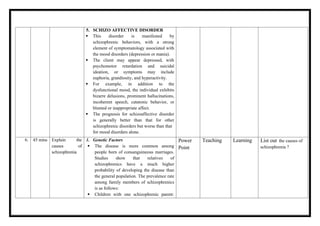
5. SCHIZO AFFECTIVEDISORDER
This disorder is manifested by
schizophrenic behaviors, with a strong
element of symptomatology associated with
the mood disorders (depression or mania).
The client may appear depressed, with
psychomotor retardation and suicidal
ideation, or symptoms may include
euphoria, grandiosity, and hyperactivity.
For example, in addition to the
dysfunctional mood, the individual exhibits
bizarre delusions, prominent hallucinations,
incoherent speech, catatonic behavior, or
blunted or inappropriate affect.
The prognosis for schizoaffective disorder
is generally better than that for other
schizophrenic disorders but worse than that
for mood disorders alone.
6. 45 mins Explain the
causes of
schizophrenia
1. Genetic Factors
The disease is more common among
people born of consanguineous marriages.
Studies show that relatives of
schizophrenics have a much higher
probability of developing the disease than
the general population. The prevalence rate
among family members of schizophrenics
is as follows:
Children with one schizophrenic parent:
Power
Point
Teaching Learning List out the causes of
schizophrenia ?
10.
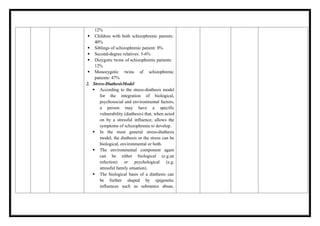
12%
Children withboth schizophrenic parents:
40%
Siblings of schizophrenic patient: 8%
Second-degree relatives: 5-6%
Dizygotic twins of schizophrenic patients:
12%
Monozygotic twins of schizophrenic
patients: 47%
2. Stress-DiathesisModel
According to the stress-diathesis model
for the integration of biological,
psychosocial and environmental factors,
a person may have a specific
vulnerability (diathesis) that, when acted
on by a stressful influence, allows the
symptoms of schizophrenia to develop.
In the most general stress-diathesis
model, the diathesis or the stress can be
biological, environmental or both.
The environmental component again
can be either biological (e.g.an
infection) or psychological (e.g.
stressful family situation).
The biological basis of a diathesis can
be further shaped by epigenetic
influences such as substance abuse,
11.
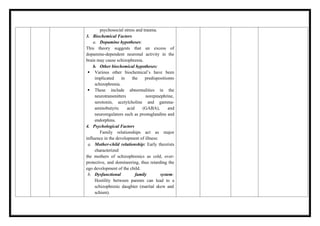
psychosocial stress andtrauma.
3. Biochemical Factors
a. Dopamine hypotheses:
This theory suggests that an excess of
dopamine-dependent neuronal activity in the
brain may cause schizophrenia.
b. Other biochemical hypotheses:
Various other biochemical’s have been
implicated in the predispositionto
schizophrenia.
These include abnormalities in the
neurotransmitters norepinephrine,
serotonin, acetylcholine and gamma-
aminobutyric acid (GABA), and
neuroregulators such as prostaglandins and
endorphins.
4. Psychological Factors
Family relationships act as major
influence in the development of illness:
a. Mother-child relationship: Early theorists
characterized
the mothers of schizophrenics as cold, over-
protective, and domineering, thus retarding the
ego development of the child.
b. Dysfunctional family system:
Hostility between parents can lead to a
schizophrenic daughter (marital skew and
schism).
12.
c. Double-bind communication(Bateson et
al, 1956):
Parents convey two or more conflicting
and incompatible messages at the same time.
5. Social Factors
Studies have shown that schizophrenia
is more prevalent in areas of high social
mobility and disorganization, especially among
members of very low social classes. Stressful
life events also can precipitate the disease in
predisposed individuals.
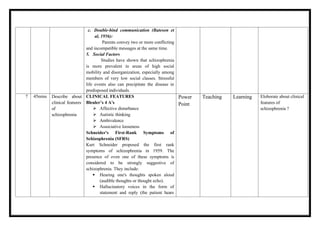
7 45mins Describe about
clinical features
of
schizophrenia
CLINICAL FEATURES
Bleuler’s 4 A’s
Affective disturbance
Autistic thinking
Ambivalence
Associative looseness
Schneider's First-Rank Symptoms of
Schizophrenia (SFRS)
Kurt Schneider proposed the first rank
symptoms of schizophrenia in 1959. The
presence of even one of these symptoms is
considered to be strongly suggestive of
schizophrenia. They include:
Hearing one's thoughts spoken aloud
(audible thoughts or thought echo).
Hallucinatory voices in the form of
statement and reply (the patient hears
Power
Point
Teaching Learning Eloborate about clinical
features of
schizophrenia ?
13.
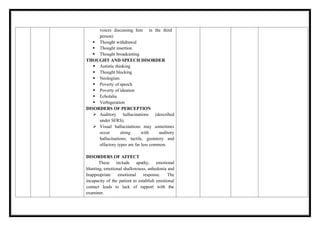
voices discussing himin the third
person)
Thought withdrawal
Thought insertion
Thought broadcasting
THOUGHT AND SPEECH DISORDER
Autistic thinking
Thought blocking
Neologism
Poverty of speech
Poverty of ideation
Echolalia
Verbigeration
DISORDERS OF PERCEPTION
Auditory hallucinations (described
under SFRS).
Visual hallucinations may sometimes
occur along with auditory
hallucinations; tactile, gustatory and
olfactory types are far less common.
DISORDERS OF AFFECT
These include apathy, emotional
blunting, emotional shallowness, anhedonia and
Inappropriate emotional response. The
incapacity of the patient to establish emotional
contact leads to lack of rapport with the
examiner.
14.
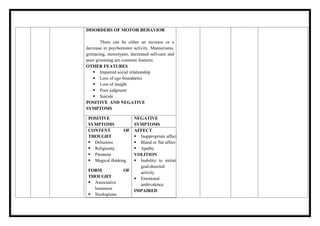
DISORDERS OF MOTORBEHAVIOR
There can be either an increase or a
decrease in psychomotor activity. Mannerisms,
grimacing, stereotypes, decreased self-care and
poor grooming are common features.
OTHER FEATURES
Impaired social relationship
Loss of ego boundaries
Loss of insight
Poor judgment
Suicide
POSITIVE AND NEGATIVE
SYMPTOMS
POSITIVE
SYMPTOMS
NEGATIVE
SYMPTOMS
CONTENT OF
THOUGHT
Delusions
Religiosity
Paranoia
Magical thinking
FORM OF
THOUGHT
Associative
looseness
Neologisms
AFFECT
Inappropriate affect
Bland or flat affect
Apathy
VOLITION
Inability to initiat
goal-directed
activity
Emotional
ambivalence
IMPAIRED
15.
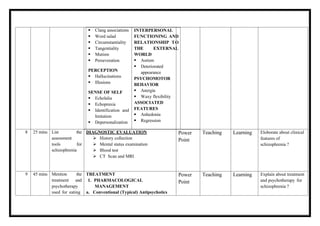
Clang associations
Word salad
Circumstantiality
Tangentiality
Mutism
Perseveration
PERCEPTION
Hallucinations
Illusions
SENSE OF SELF
Echolalia
Echopraxia
Identification and
Imitation
Depersonalization
INTERPERSONAL
FUNCTIONING AN
RELATIONSHIP T
THE EXTERNAL
WORLD
Autism
Deteriorated
appearance
PSYCHOMOTOR
BEHAVIOR
Anergia
Waxy flexibility
ASSOCIATED
FEATURES
Anhedonia
Regression
D
O
8 25 mins List the
assessment
tools for
schizophrenia
DIAGNOSTIC EVALUATION
History collection
Mental status examination
Blood test
CT Scan and MRI
Power
Point
Teaching Learning Eloborate about clinical
features of
schizophrenia ?
9 45 mins Mention the
treatment and
psychotherapy
used for eating
TREATMENT
1. PHARMACOLOGICAL
MANAGEMENT
a. Conventional (Typical) Antipsychotics
Power
Point
Teaching Learning Explain about treatment
and psychotherapy for
schizophrenia ?
16.
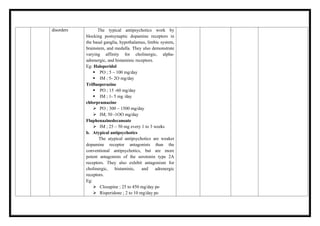
disorders The typicalantipsychotics work by
blocking postsynaptic dopamine receptors in
the basal ganglia, hypothalamus, limbic system,
brainstem, and medulla. They also demonstrate
varying affinity for cholinergic, alpha-
adrenergic, and histaminic receptors.
Eg: Haloperidol
PO ; 5 – 100 mg/day
IM ; 5- 2O mg/day
Trifluoperazine
PO ; 15 -60 mg/day
IM ; 1- 5 mg /day
chlorpramazine
PO ; 300 – 1500 mg/day
IM; 50 -1OO mg/day
Fluphenazinedecanoate
IM ; 25 – 50 mg every 1 to 3 weeks
b. Atypical antipsychotics
The atypical antipsychotics are weaker
dopamine receptor antagonists than the
conventional antipsychotics, but are more
potent antagonists of the serotonin type 2A
receptors. They also exhibit antagonism for
cholinergic, histaminic, and adrenergic
receptors.
Eg:
Clozapine ; 25 to 450 mg/day po
Risperidone ; 2 to 10 mg/day po
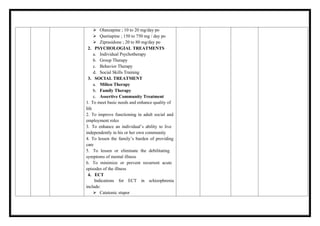
17.
Olanzapine ;10 to 20 mg/day po
Quetiapine ; 150 to 750 mg / day po
Ziprasidone ; 20 to 80 mg/day po
2. PSYCHOLOGIAL TREATMENTS
a. Individual Psychotherapy
b. Group Therapy
c. Behavior Therapy
d. Social Skills Training
3. SOCIAL TREATMENT
a. Milieu Therapy
b. Family Therapy
c. Assertive Community Treatment
1. To meet basic needs and enhance quality of
life
2. To improve functioning in adult social and
employment roles
3. To enhance an individual’s ability to live
independently in his or her own community
4. To lessen the family’s burden of providing
care
5. To lessen or eliminate the debilitating
symptoms of mental illness
6. To minimize or prevent recurrent acute
episodes of the illness
4. ECT
Indications for ECT in schizophrenia
include:
Catatonic stupor
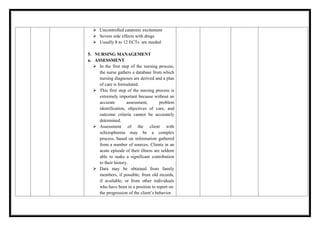
18.
Uncontrolled catatonicexcitement
Severe side effects with drugs
Usually 8 to 12 ECTs are needed
5. NURSING MANAGEMENT
a. ASSESSMENT
In the first step of the nursing process,
the nurse gathers a database from which
nursing diagnoses are derived and a plan
of care is formulated.
This first step of the nursing process is
extremely important because without an
accurate assessment, problem
identification, objectives of care, and
outcome criteria cannot be accurately
determined.
Assessment of the client with
schizophrenia may be a complex
process, based on information gathered
from a number of sources. Clients in an
acute episode of their illness are seldom
able to make a significant contribution
to their history.
Data may be obtained from family
members, if possible; from old records,
if available; or from other individuals
who have been in a position to report on
the progression of the client’s behavior.
19.
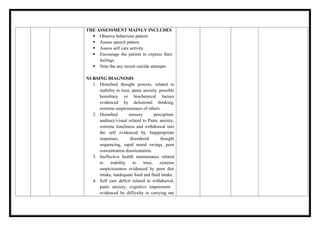
THE ASSESSMENT MAINLYINCLUDES
Observe behaviour pattern
Assess speech pattern
Assess self care activity
Encourage the patient to express their
feelings
Note the any recent suicide attempts
NURSING DIAGNOSIS
1. Disturbed thought process, related to
inability to trust, panic anxiety, possible
hereditary or biochemical factors
evidenced by delusional thinking,
extreme suspiciousness of others.
2. Disturbed sensory perception:
auditory/visual related to Panic anxiety,
extreme loneliness and withdrawal into
the self evidenced by Inappropriate
responses, disordered thought
sequencing, rapid mood swings, poor
concentration disorientation.
3. Ineffective health maintenance related
to inability to trust, extreme
suspiciousness evidenced by poor diet
intake, inadequate food and fluid intake.
4. Self care deficit related to withdrawal,
panic anxiety, cognitive impairment
evidenced by difficulty in carrying out
20.
task associative withhygiene, dressing,
grooming, eating.
5. Potential for violence, self directed or at
others related to command
hallucinations evidenced by self
destructivebehaviour.
6. Risk for self – inflicted or life-
threatening injury related to command
hallucinations evidenced by suicidal
ideas, attempts.
EVALUATION
In the final step of the nursing process, a
reassessment is conducted to determine if the
nursing actions have achieved the objectives of
care. Evaluation of the nursing actions for the
client there are:
Communication pattern
Behavior pattern
Self care activities
Food pattern
Taking medications
Evaluate the side effects of medication
21.
SUMMARY:
Till now Ihave discussed about the definition, criteria, types, epidemiology, causes, clinical features, assessment
methods, treatment and psychotherapy used for schizophrenia.
CONCLUSION:
I hope that you all understand about definition, ICD 10 criteria, types, epidemiology, causes, clinical features,
assessment methods, treatment and psychotherapy used for Schizophrenia.
ASSIGNMENT:
Write the nursing process for schizophrenia.
POST EVALUATION:
1. What is schizophrenia?
2. Identify the schizophrenia under ICD 10
3. What are the types of schizophrenia?
4. What are the epidemiological factors of schizophrenia?
5. What are the causes of schizophrenia?
6. Explain about clinical features of schizophrenia?
7. What are the assessment tools for used for schizophrenia?
22.
BIBLIOGRAPHY:
STUDENT REFERANCES:
1. Sreevani,R. A Guide to Mental Health and Psychiatric Nursing. 4th
ed. Jaypee Brothers Medical Publishers. New Delhi. 2016
2. K. Lalitha (2007),”Mental health and psychiatric nursing and Indian perspective” 1st
edition, Bangalore, VMG book house.
3. Niraj Ahuja, A short textbook of psychiatry, Jaypee brothers, New delhi, 2002.
4. Bimla Kapoor, Textbook of Psychiatric Nursing, Vol. I & II Kumar publishing house Delhi, 2001
TEACHER REFERANCES:
1. Dr. Ellakkuvana, Bhashara (2014),”DEBR’ s Mental health Nursing ”, first edition, Emmess publication.
2. CL Subash Indra Kumar (2014), “textbook of psychiatric and Mental health nursing”, 1st
edition, New Delhi, Emmess publication.
3. Stuart (GW), Principles and Practice of Psychiatric Nursing, Elsevier, 8th Edition, 2005
4. Mary C Townsend. “Psychiatric Mental Health Nursing”. Concept of care, 4th edition. F.A.Davis Co. Philadelphia 2003.
5. Sreevani, R. A Guide to Mental Health and Psychiatric Nursing. 4th
ed. Jaypee Brothers Medical Publishers. New Delhi. 2016
6. K. Lalitha (2007),”Mental health and psychiatric nursing and Indian perspective” 1st
edition, Bangalore, VMG book house.
7. Niraj Ahuja, A short textbook of psychiatry, Jaypee brothers, New delhi, 2002.
8. Bimla Kapoor, Textbook of Psychiatric Nursing, Vol. I & II Kumar publishing house Delhi, 2001
![S.No Time Specific
Objective
Content
Type of
Av Aids
Used
Teachers
Activity
Learners
Activity
Evaluation
1. 5 mins Introduce about
Schizophrenia
The term schizophrenia was
coined in 1908 by the Swiss psychiatrist
EugenBleuler. The word was derived
from the Greek “skhizo” (split) and
“phren” (mind). Over the years, much
debate has surrounded the concept of
schizophrenia. Various definitions of the
disorder have evolved, and numerous
treatment strategies have been proposed,
but none have proven to be uniformly
effective or sufficient.
Black
Board
Teaching Learning Introduce about
Schizophrenia
2. 5 mins Define
Schizophrenia
DEFINITION
Schizophrenia is a psychotic condition
characterized by a disturbance in thinking,
emotions, volitions and faculties in the presence
of clear consciousness, which usually leads to
social withdrawal.
Roller
chart
Teaching Learning What is meant by
schizophrenia?
3. 20 mins Identify the
Schizophrenia
under ICD 10
SCHIZOPHRENIA AND OTHER
PSYCHOTIC DISORDERS
CLASSIFICATION [ICD-10]
OHP Teaching Learning Classify about ICD
classification of
Schizophrenia?](https://image.slidesharecdn.com/lesson-plan-on-schizophrenia-250505170543-0fc52571/85/Lesson-Plan-on-Schizophrenia-for-msc-docx-4-320.jpg)
![F20- F29 Schizophrenia
F20.0 – Paranoid
F20.1 – Hebephrenic
F20.2 – Catatonic
F20.3 – Undifferentiated
F20.4 - Post Schizophrenic
F20.5 – Residual
F20.6 – Simple
F21 - Schizotypal Disorder
F22- Persistent Delusional Disorder
F23- Acute And Transient Psychotic Disorder
F24- Induced Delusional Disorder
F25- Schizoaffective Disorder
4 15 mins Specify the
epidemiological
factors of
Schizophrenia
Schizophrenia is the most common of all
psychiatric disorders and is prevalent in all
cultures across the world. About 15% of new
admissions in hospitals are schizophrenic
patients.
3 to 4 / 1ooo people in community
Equal for men and women [1 : 1 ]
Men - 15 to 25 yrs
women - 25 to 35 yrs
Low socio-economic groups
In 2016 ……
Prevalence - 1%
Incidence - 1.5 / 10,000
Men than women [ 1.4 : 1 ]
Power
Point
Teaching Learning Explain about
epidemiological factors
of Schizophrenia ?](https://image.slidesharecdn.com/lesson-plan-on-schizophrenia-250505170543-0fc52571/85/Lesson-Plan-on-Schizophrenia-for-msc-docx-5-320.jpg)



![schizophrenia [Autosaved].pptx [mental health nursing]](https://cdn.slidesharecdn.com/ss_thumbnails/schizofinalautosaved-250323084409-0f866c5d-thumbnail.jpg?width=640&height=640&fit=bounds)


