


SCHIZOPHRENIA
BY-Ms. KAJAL CHANDEL
INDEX
SR.NO CONTENT
1. Introduction of Schizophrenia
2. Historical background of Schizophrenia
3. Definition of Schizophrenia
4. Epidemiology and etiological factors of Schizophrenia
5. Types of Schizophrenia
6. Positive and Negative symptoms of Schizophrenia
7. Nursing management of Schizophrenia.
INTRODUCTION
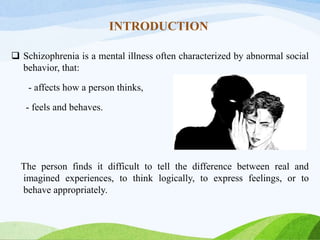
 Schizophrenia is a mental illness often characterized by abnormal social
behavior, that:
- affects how a person thinks,
- feels and behaves.
The person finds it difficult to tell the difference between real and
imagined experiences, to think logically, to express feelings, or to
behave appropriately.
HISTORICAL BACKGROUND
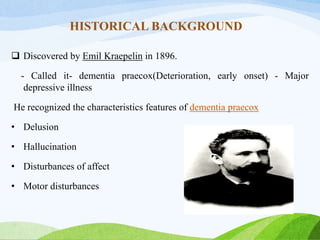
 Discovered by Emil Kraepelin in 1896.
- Called it- dementia praecox(Deterioration, early onset) - Major
depressive illness
He recognized the characteristics features of dementia praecox
• Delusion
• Hallucination
• Disturbances of affect
• Motor disturbances
CONTINUE…...
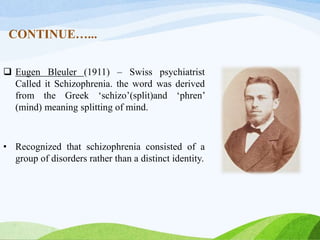
 Eugen Bleuler (1911) – Swiss psychiatrist
Called it Schizophrenia. the word was derived
from the Greek ‘schizo’(split)and ‘phren’
(mind) meaning splitting of mind.
• Recognized that schizophrenia consisted of a
group of disorders rather than a distinct identity.
Bleuler gave:
4 fundamental symptoms(4 A’s)
- Ambivalence
- Autism
- Affect disturbances
- Association disturbances
Accessory symptoms
- Delusion
- Hallucination
- Negativism
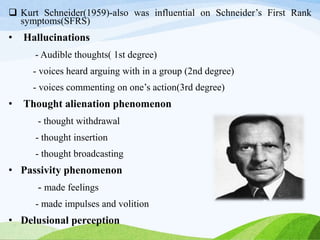
 Kurt Schneider(1959)-also was influential on Schneider’s First Rank
symptoms(SFRS)
• Hallucinations
- Audible thoughts( 1st degree)
- voices heard arguing with in a group (2nd degree)
- voices commenting on one’s action(3rd degree)
• Thought alienation phenomenon
- thought withdrawal
- thought insertion
- thought broadcasting
• Passivity phenomenon
- made feelings
- made impulses and volition
• Delusional perception
ICD-10 CLASSIFICATION
 F20-F29- Schizophrenia, schizotypal and delusional disorders.
• F20.0– Paranoid
• F20.1- Hebephrenic
• F20.2- Catatonic
• F20.3- Undifferentiated
• F20.4- Post- schizopherenic depression
• F20.5- Residual
• F20.6- Simple
• F20.7- other
CONTINUE…..
 F21- Schizotypal
 F22-persistent delusional disorders
 F23- Acute and Transient psychotic disorders
 F24- Induced delusional disorders
 F25- Schizoaffective disorders
 F26- Other non-organic psychotic disorders
 F29- Unspecified
DEFINITION
Schizophrenia are characterized in general by fundamental and characteristic
distortion of thinking, perception and by an inappropriate affect. Delusion
may affect thoughts and actions that are often bizarre. Hallucinations,
especially auditory are common. Mood is often shallow. Ambivalence may
appear.
Acc. to ICD-10.
It is a group of psychiatric symptoms (syndrome) characterized by
disturbance in thinking, behavior, mood, gross distortion of reality,
withdrawal from social interaction, disorganization and fragmentation of
perception, emotions.
Acc. To APA
 OCCURRENCE: occur in all types of society and places. Prevalence
rate varies from .3- 1%.
 AGE: rare in childhood, age varies between 15-45 yrs.
 GENDER RATIO: incidence in males and female is almost same.
 SOCIAL CLASS: reviewed literature showed that the incidence of
schizophrenia is higher in lower socioeconomic status group rather than
upper socioeconomic group.
ETIOLOGY
 BIOLOGICAL INFLUENCES:
• Genetics: Studies shows that relatives of
individuals with schizophrenia have a much
higher probability of developing a disease rather
than general population.
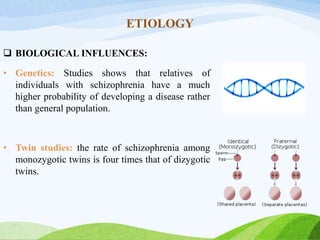
• Twin studies: the rate of schizophrenia among
monozygotic twins is four times that of dizygotic
twins.
CONTINUE…..
• Adoption studies: acc to investigators, children who were born to
mothers with schizophrenia were more likely to develop the illness.
studies also indicate that children born to non- schizophrenic parents,
but reared by parents affected with illness, do not seem to suffer from
schizophrenia.
CONTINUE…..
 BIO-CHEMICAL INFLUENCES:
• THE DOPAMINE HYPOTHESIS: This theory suggest that schizophrenia
may be caused by an excess of dopamine-dependent neuronal activity in
the brain. This excess activity may be related to increased production of
dopamine.
• Pharmacological support for this hypothesis exists. Amphetamines, which
increases level of dopamine, induce psychotic symptoms.
• Postmortem studies of brain of schizophrenic individuals have reported a
significant increase in the average no. of dopamine receptors.
CONTINUE…..
 OTHER BIOCHEMICAL HYPOTHESIS:
Abnormalities in the neurotransmitters
norepinepherine, serotonin, acetylcholine, GABA
etc.
 PHYSIOLOGICAL INFLUENCES:A no. of
physical factors have been identified.
• VIRAL INFECTION: Acc. To Sadock and
Sadock: an increased no. of physical anomalies at
birth, an increased rate of pregnancy, birth
complications, seasonality of birth consistent with
viral infection, seasonality of complications.
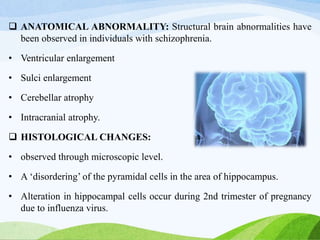
 ANATOMICAL ABNORMALITY: Structural brain abnormalities have
been observed in individuals with schizophrenia.
• Ventricular enlargement
• Sulci enlargement
• Cerebellar atrophy
• Intracranial atrophy.
 HISTOLOGICAL CHANGES:
• observed through microscopic level.
• A ‘disordering’ of the pyramidal cells in the area of hippocampus.
• Alteration in hippocampal cells occur during 2nd trimester of pregnancy
due to influenza virus.
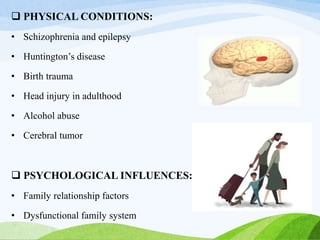
 PHYSICAL CONDITIONS:
• Schizophrenia and epilepsy
• Huntington’s disease
• Birth trauma
• Head injury in adulthood
• Alcohol abuse
• Cerebral tumor
 PSYCHOLOGICAL INFLUENCES:
• Family relationship factors
• Dysfunctional family system
CONTINUE…..
 ENVIORNMENTAL INFLUENCES:
• Sociocultural factors:
o Schizophrenia among lower socioeconomic classes
o Poverty
• Stressful life events
• Other Psychological factors:
o Impaired ego functioning
o Mother infant relationship
o Pathological communication
o Vitamin deficiency theory: Vit B1, B6, B12,Vit. C
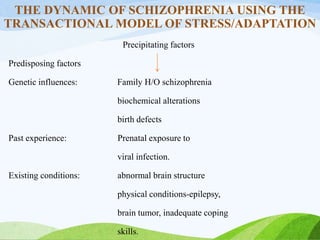
THE DYNAMIC OF SCHIZOPHRENIA USING THE
TRANSACTIONAL MODEL OF STRESS/ADAPTATION
Precipitating factors
Predisposing factors
Genetic influences: Family H/O schizophrenia
biochemical alterations
birth defects
Past experience: Prenatal exposure to
viral infection.
Existing conditions: abnormal brain structure
physical conditions-epilepsy,
brain tumor, inadequate coping
skills.
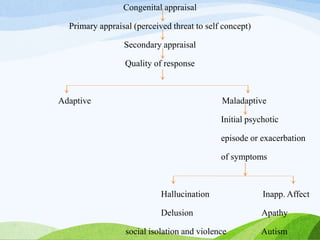
Congenital appraisal
Primary appraisal (perceived threat to self concept)
Secondary appraisal
Quality of response
Adaptive Maladaptive
Initial psychotic
episode or exacerbation
of symptoms
Hallucination Inapp. Affect
Delusion Apathy
social isolation and violence Autism
TYPES OF SCHIZOPHRENIA
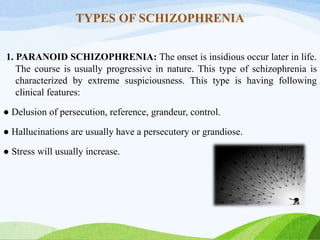
1. PARANOID SCHIZOPHRENIA: The onset is insidious occur later in life.
The course is usually progressive in nature. This type of schizophrenia is
characterized by extreme suspiciousness. This type is having following
clinical features:
● Delusion of persecution, reference, grandeur, control.
● Hallucinations are usually have a persecutory or grandiose.
● Stress will usually increase.
2. DISORGANIZED/ HEBEPHRENIC SCHIZOPHRENIA
Characterized by following clinical features :
● Disorganized thought process, incoherence, loosening of association,
delusion and hallucinations are frequently changed.
● Emotionally disturbances Example: Laughing at a funeral uncontrollably.
● Mannerism ‘Mirror Gazing’(for long periods of times) Poor physical
appearance, Hard to communicate with others, Difficulty forming complete
sentences because of disorganized thoughts, Worst prognosis, Sometimes
trouble completing simple tasks
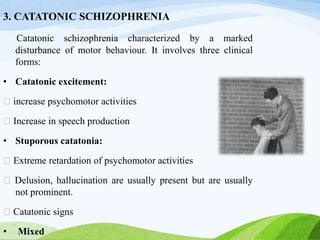
3. CATATONIC SCHIZOPHRENIA
Catatonic schizophrenia characterized by a marked
disturbance of motor behaviour. It involves three clinical
forms:
• Catatonic excitement:
increase psychomotor activities
Increase in speech production
• Stuporous catatonia:
Extreme retardation of psychomotor activities
Delusion, hallucination are usually present but are usually
not prominent.
Catatonic signs
• Mixed
4. UNDIFFERENTIATED SCHIZOPHRENIA
• When symptoms are not specific enough to fit into one category/type
• When features of no subtypes are fully present.
5. SIMPLE SCHIZOPHRENIA:
It is difficult to diagnose. It is characterized by :
- -ve symptoms
- vague hypochondriac symptoms
- delusion and hallucinations are usually absent
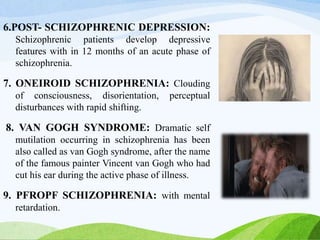
6.POST- SCHIZOPHRENIC DEPRESSION:
Schizophrenic patients develop depressive
features with in 12 months of an acute phase of
schizophrenia.
7. ONEIROID SCHIZOPHRENIA: Clouding
of consciousness, disorientation, perceptual
disturbances with rapid shifting.
8. VAN GOGH SYNDROME: Dramatic self
mutilation occurring in schizophrenia has been
also called as van Gogh syndrome, after the name
of the famous painter Vincent van Gogh who had
cut his ear during the active phase of illness.
9. PFROPF SCHIZOPHRENIA: with mental
retardation.
POSITIVE AND NEGATIVE
SYMPTOMS
POSITIVE NEGATIVE
- Content of thought -Affect
- Form of thought - Impaired interpersonal
- Perception functioning and relationship
-Sense of self Negative to external world
- Psychomotor behavior
- Associated features
- Anhedonia
POSITIVE SYMPTOMS
CONTENT OF THOUGHT:
o DELUSION:
Delusion of persecution
Delusion of Grandeur
Delusion of reference
Delusion of control
CONTINUE…..
o RELIGIOSITY: Excessive demonstration
of or obsession with religious ideas and
behavior.
o PARANOA: Extreme suspiciousness of
others and of their actions . e.g.: “I won’t eat
this food, I know it has been poisoned”.
CONTINUE…..
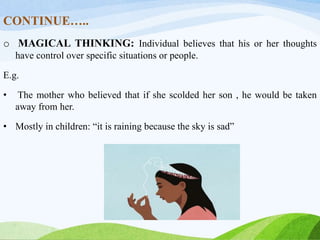
o MAGICAL THINKING: Individual believes that his or her thoughts
have control over specific situations or people.
E.g.
• The mother who believed that if she scolded her son , he would be taken
away from her.
• Mostly in children: “it is raining because the sky is sad”
o FORMATION OF THOUGHTS:
• Associative looseness
• Neologisms( I m going in new uniphorum of my friend )
• Abstract thinking
• Clang association: choice of word is governed by sounds. Formation OF
RHYMING..E.G: “ IT IS VERY COLD. So I M COLD AND BOLD”.
“THE GOLD HAS BEEN SOLD”
• Word salad- group of words r formed
• Circumstantialities
• Tangentiality
• Mutism
• Perseveration
CONTINUE….
o PERCEPTION
• Hallucination
o Auditory
o Visual
o Tactile
o Gustatory-taste
o Olfactory- smell
CONTINUE…..
• Illlusion
o SENSE OF SELF
Echolalia
Echopraxia
Depersonalization- feeling of unaware about himself.
NEGATIVE SYMPTOMS
o AFFECT – inappropriate affect - flat affect
o Apathy
o Avolition
o Ambivalence
CONTINUE…..
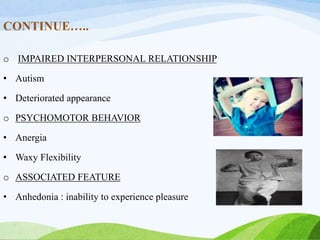
o IMPAIRED INTERPERSONAL RELATIONSHIP
• Autism
• Deteriorated appearance
o PSYCHOMOTOR BEHAVIOR
• Anergia
• Waxy Flexibility
o ASSOCIATED FEATURE
• Anhedonia : inability to experience pleasure
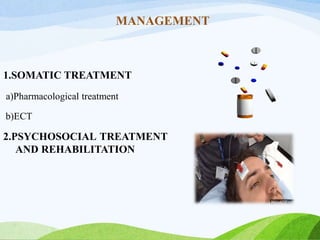
MANAGEMENT
1.SOMATIC TREATMENT
a)Pharmacological treatment
b)ECT
2.PSYCHOSOCIAL TREATMENT
AND REHABILITATION
PHARMACOLOGICAL TREATMENT
 Typical antipsychotic agents:
• Chlorpromazine - 40-400 mg
• Fluphenazine - 2.5-10 mg
• Haloperidol - 1-100 mg
• Thioridazine - 150-800 mg
• Perphenazine - 12-64 mg
CONTINUE…..
 Atypical antipsychotic agents:
• Aripiprazole - 10-30 mg
• Clozapine - 300-900 mg
• Olanzapine - 5-20 mg
• Risperidone - 4-8 mg
• Ziprasidone - 40-160 mg
2.PSYCHOSOCIAL TREATMENT AND
REHABILITATION
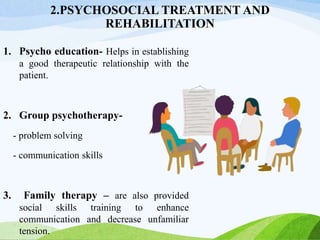
1. Psycho education- Helps in establishing
a good therapeutic relationship with the
patient.
2. Group psychotherapy-
- problem solving
- communication skills
3. Family therapy – are also provided
social skills training to enhance
communication and decrease unfamiliar
tension.
CONTINUE…..
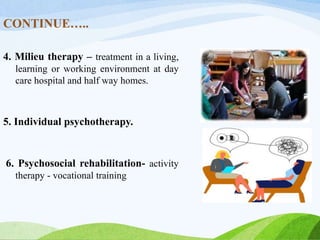
4. Milieu therapy – treatment in a living,
learning or working environment at day
care hospital and half way homes.
5. Individual psychotherapy.
6. Psychosocial rehabilitation- activity
therapy - vocational training
NURSING MANAGEMENT
 Risk for self-directed or other-directed violence related to
suspiciousness, increasing anxiety and agitation.
 Disturbed thought process related to disruption in cognitive activities
as evidenced by delusional thinking, suspiciousness.
 Disturbed sensory perception: auditory/visual related to panic anxiety,
withdrawal in to self as evidenced by inappropriate responses,
listening pose, rapid mood swings, poor concentration.
SUMMARIZATION
Today we have discussed in detail about:-
 Introduction of Schizophrenia
 Historical background of Schizophrenia
 Definition of Schizophrenia
 Epidemiology and etiological factors of Schizophrenia
 Types of Schizophrenia
 Positive and Negative symptoms of Schizophrenia
 Management of Schizophrenia
 Nursing management of Schizophrenia.
CONCLUSION
Our conclusion is that schizophrenia is a very serious illness. Often, people
don’t realize how serious this illness is. Sometimes people will make fun of
it. Schizophrenia is caused by having excess dopamine. A lot of homeless
people suffer from schizophrenia. Luckily a cure has been developed for this
disease. Up until 2003 there was no cure for Schizophrenia. It doesn’t matter
who you are, anyone can still get schizophrenia. Finally, if you see anyone
with all or most of these symptoms you should contact a doctor.
BIBLIOGRAPHY
1. Townsand MC., Textbook of psychiatric nursing, edn ,7th edn,
Pp- 78-84
2. Ahuja N., Textbook of psychiatry, edn – 6th , published by jaypee
brothers, Pp-58-73.
3. Dr.kapoor Bimla, psychiatric nursing, edn -5, published by
kumar publishing house, New Dehli , Pp-148-156.
• http://schizophrenia.emedtv.com/schizophrenia/types-of
schizophrenia-p2.html
• http://www.schizophrenia.com/presentations/stanford.
05/stanpres/
SCHIZOPHRENIA

SCHIZOPHRENIA

  • 1.
  • 2.
    INDEX SR.NO CONTENT 1. Introductionof Schizophrenia 2. Historical background of Schizophrenia 3. Definition of Schizophrenia 4. Epidemiology and etiological factors of Schizophrenia 5. Types of Schizophrenia 6. Positive and Negative symptoms of Schizophrenia 7. Nursing management of Schizophrenia.
  • 3.
    INTRODUCTION  Schizophrenia isa mental illness often characterized by abnormal social behavior, that: - affects how a person thinks, - feels and behaves. The person finds it difficult to tell the difference between real and imagined experiences, to think logically, to express feelings, or to behave appropriately.
  • 4.
    HISTORICAL BACKGROUND  Discoveredby Emil Kraepelin in 1896. - Called it- dementia praecox(Deterioration, early onset) - Major depressive illness He recognized the characteristics features of dementia praecox • Delusion • Hallucination • Disturbances of affect • Motor disturbances
  • 5.
    CONTINUE…...  Eugen Bleuler(1911) – Swiss psychiatrist Called it Schizophrenia. the word was derived from the Greek ‘schizo’(split)and ‘phren’ (mind) meaning splitting of mind. • Recognized that schizophrenia consisted of a group of disorders rather than a distinct identity.
  • 6.
    Bleuler gave: 4 fundamentalsymptoms(4 A’s) - Ambivalence - Autism - Affect disturbances - Association disturbances Accessory symptoms - Delusion - Hallucination - Negativism
  • 7.
     Kurt Schneider(1959)-alsowas influential on Schneider’s First Rank symptoms(SFRS) • Hallucinations - Audible thoughts( 1st degree) - voices heard arguing with in a group (2nd degree) - voices commenting on one’s action(3rd degree) • Thought alienation phenomenon - thought withdrawal - thought insertion - thought broadcasting • Passivity phenomenon - made feelings - made impulses and volition • Delusional perception
  • 8.
    ICD-10 CLASSIFICATION  F20-F29-Schizophrenia, schizotypal and delusional disorders. • F20.0– Paranoid • F20.1- Hebephrenic • F20.2- Catatonic • F20.3- Undifferentiated • F20.4- Post- schizopherenic depression • F20.5- Residual • F20.6- Simple • F20.7- other
  • 9.
    CONTINUE…..  F21- Schizotypal F22-persistent delusional disorders  F23- Acute and Transient psychotic disorders  F24- Induced delusional disorders  F25- Schizoaffective disorders  F26- Other non-organic psychotic disorders  F29- Unspecified
  • 10.
    DEFINITION Schizophrenia are characterizedin general by fundamental and characteristic distortion of thinking, perception and by an inappropriate affect. Delusion may affect thoughts and actions that are often bizarre. Hallucinations, especially auditory are common. Mood is often shallow. Ambivalence may appear. Acc. to ICD-10. It is a group of psychiatric symptoms (syndrome) characterized by disturbance in thinking, behavior, mood, gross distortion of reality, withdrawal from social interaction, disorganization and fragmentation of perception, emotions. Acc. To APA
  • 11.
     OCCURRENCE: occurin all types of society and places. Prevalence rate varies from .3- 1%.  AGE: rare in childhood, age varies between 15-45 yrs.  GENDER RATIO: incidence in males and female is almost same.  SOCIAL CLASS: reviewed literature showed that the incidence of schizophrenia is higher in lower socioeconomic status group rather than upper socioeconomic group.
  • 12.
    ETIOLOGY  BIOLOGICAL INFLUENCES: •Genetics: Studies shows that relatives of individuals with schizophrenia have a much higher probability of developing a disease rather than general population. • Twin studies: the rate of schizophrenia among monozygotic twins is four times that of dizygotic twins.
  • 13.
    CONTINUE….. • Adoption studies:acc to investigators, children who were born to mothers with schizophrenia were more likely to develop the illness. studies also indicate that children born to non- schizophrenic parents, but reared by parents affected with illness, do not seem to suffer from schizophrenia.
  • 14.
    CONTINUE…..  BIO-CHEMICAL INFLUENCES: •THE DOPAMINE HYPOTHESIS: This theory suggest that schizophrenia may be caused by an excess of dopamine-dependent neuronal activity in the brain. This excess activity may be related to increased production of dopamine. • Pharmacological support for this hypothesis exists. Amphetamines, which increases level of dopamine, induce psychotic symptoms. • Postmortem studies of brain of schizophrenic individuals have reported a significant increase in the average no. of dopamine receptors.
  • 15.
    CONTINUE…..  OTHER BIOCHEMICALHYPOTHESIS: Abnormalities in the neurotransmitters norepinepherine, serotonin, acetylcholine, GABA etc.  PHYSIOLOGICAL INFLUENCES:A no. of physical factors have been identified. • VIRAL INFECTION: Acc. To Sadock and Sadock: an increased no. of physical anomalies at birth, an increased rate of pregnancy, birth complications, seasonality of birth consistent with viral infection, seasonality of complications.
  • 16.
     ANATOMICAL ABNORMALITY:Structural brain abnormalities have been observed in individuals with schizophrenia. • Ventricular enlargement • Sulci enlargement • Cerebellar atrophy • Intracranial atrophy.  HISTOLOGICAL CHANGES: • observed through microscopic level. • A ‘disordering’ of the pyramidal cells in the area of hippocampus. • Alteration in hippocampal cells occur during 2nd trimester of pregnancy due to influenza virus.
  • 17.
     PHYSICAL CONDITIONS: •Schizophrenia and epilepsy • Huntington’s disease • Birth trauma • Head injury in adulthood • Alcohol abuse • Cerebral tumor  PSYCHOLOGICAL INFLUENCES: • Family relationship factors • Dysfunctional family system
  • 18.
    CONTINUE…..  ENVIORNMENTAL INFLUENCES: •Sociocultural factors: o Schizophrenia among lower socioeconomic classes o Poverty • Stressful life events • Other Psychological factors: o Impaired ego functioning o Mother infant relationship o Pathological communication o Vitamin deficiency theory: Vit B1, B6, B12,Vit. C
  • 19.
    THE DYNAMIC OFSCHIZOPHRENIA USING THE TRANSACTIONAL MODEL OF STRESS/ADAPTATION Precipitating factors Predisposing factors Genetic influences: Family H/O schizophrenia biochemical alterations birth defects Past experience: Prenatal exposure to viral infection. Existing conditions: abnormal brain structure physical conditions-epilepsy, brain tumor, inadequate coping skills.
  • 20.
    Congenital appraisal Primary appraisal(perceived threat to self concept) Secondary appraisal Quality of response Adaptive Maladaptive Initial psychotic episode or exacerbation of symptoms Hallucination Inapp. Affect Delusion Apathy social isolation and violence Autism
  • 21.
    TYPES OF SCHIZOPHRENIA 1.PARANOID SCHIZOPHRENIA: The onset is insidious occur later in life. The course is usually progressive in nature. This type of schizophrenia is characterized by extreme suspiciousness. This type is having following clinical features: ● Delusion of persecution, reference, grandeur, control. ● Hallucinations are usually have a persecutory or grandiose. ● Stress will usually increase.
  • 22.
    2. DISORGANIZED/ HEBEPHRENICSCHIZOPHRENIA Characterized by following clinical features : ● Disorganized thought process, incoherence, loosening of association, delusion and hallucinations are frequently changed. ● Emotionally disturbances Example: Laughing at a funeral uncontrollably. ● Mannerism ‘Mirror Gazing’(for long periods of times) Poor physical appearance, Hard to communicate with others, Difficulty forming complete sentences because of disorganized thoughts, Worst prognosis, Sometimes trouble completing simple tasks
  • 23.
    3. CATATONIC SCHIZOPHRENIA Catatonicschizophrenia characterized by a marked disturbance of motor behaviour. It involves three clinical forms: • Catatonic excitement: increase psychomotor activities Increase in speech production • Stuporous catatonia: Extreme retardation of psychomotor activities Delusion, hallucination are usually present but are usually not prominent. Catatonic signs • Mixed
  • 24.
    4. UNDIFFERENTIATED SCHIZOPHRENIA •When symptoms are not specific enough to fit into one category/type • When features of no subtypes are fully present. 5. SIMPLE SCHIZOPHRENIA: It is difficult to diagnose. It is characterized by : - -ve symptoms - vague hypochondriac symptoms - delusion and hallucinations are usually absent
  • 25.
    6.POST- SCHIZOPHRENIC DEPRESSION: Schizophrenicpatients develop depressive features with in 12 months of an acute phase of schizophrenia. 7. ONEIROID SCHIZOPHRENIA: Clouding of consciousness, disorientation, perceptual disturbances with rapid shifting. 8. VAN GOGH SYNDROME: Dramatic self mutilation occurring in schizophrenia has been also called as van Gogh syndrome, after the name of the famous painter Vincent van Gogh who had cut his ear during the active phase of illness. 9. PFROPF SCHIZOPHRENIA: with mental retardation.
  • 26.
    POSITIVE AND NEGATIVE SYMPTOMS POSITIVENEGATIVE - Content of thought -Affect - Form of thought - Impaired interpersonal - Perception functioning and relationship -Sense of self Negative to external world - Psychomotor behavior - Associated features - Anhedonia
  • 27.
    POSITIVE SYMPTOMS CONTENT OFTHOUGHT: o DELUSION: Delusion of persecution Delusion of Grandeur Delusion of reference Delusion of control
  • 28.
    CONTINUE….. o RELIGIOSITY: Excessivedemonstration of or obsession with religious ideas and behavior. o PARANOA: Extreme suspiciousness of others and of their actions . e.g.: “I won’t eat this food, I know it has been poisoned”.
  • 29.
    CONTINUE….. o MAGICAL THINKING:Individual believes that his or her thoughts have control over specific situations or people. E.g. • The mother who believed that if she scolded her son , he would be taken away from her. • Mostly in children: “it is raining because the sky is sad”
  • 30.
    o FORMATION OFTHOUGHTS: • Associative looseness • Neologisms( I m going in new uniphorum of my friend ) • Abstract thinking • Clang association: choice of word is governed by sounds. Formation OF RHYMING..E.G: “ IT IS VERY COLD. So I M COLD AND BOLD”. “THE GOLD HAS BEEN SOLD” • Word salad- group of words r formed • Circumstantialities • Tangentiality • Mutism • Perseveration
  • 31.
    CONTINUE…. o PERCEPTION • Hallucination oAuditory o Visual o Tactile o Gustatory-taste o Olfactory- smell
  • 32.
    CONTINUE….. • Illlusion o SENSEOF SELF Echolalia Echopraxia Depersonalization- feeling of unaware about himself.
  • 33.
    NEGATIVE SYMPTOMS o AFFECT– inappropriate affect - flat affect o Apathy o Avolition o Ambivalence
  • 34.
    CONTINUE….. o IMPAIRED INTERPERSONALRELATIONSHIP • Autism • Deteriorated appearance o PSYCHOMOTOR BEHAVIOR • Anergia • Waxy Flexibility o ASSOCIATED FEATURE • Anhedonia : inability to experience pleasure
  • 35.
  • 36.
    PHARMACOLOGICAL TREATMENT  Typicalantipsychotic agents: • Chlorpromazine - 40-400 mg • Fluphenazine - 2.5-10 mg • Haloperidol - 1-100 mg • Thioridazine - 150-800 mg • Perphenazine - 12-64 mg
  • 37.
    CONTINUE…..  Atypical antipsychoticagents: • Aripiprazole - 10-30 mg • Clozapine - 300-900 mg • Olanzapine - 5-20 mg • Risperidone - 4-8 mg • Ziprasidone - 40-160 mg
  • 38.
    2.PSYCHOSOCIAL TREATMENT AND REHABILITATION 1.Psycho education- Helps in establishing a good therapeutic relationship with the patient. 2. Group psychotherapy- - problem solving - communication skills 3. Family therapy – are also provided social skills training to enhance communication and decrease unfamiliar tension.
  • 39.
    CONTINUE….. 4. Milieu therapy– treatment in a living, learning or working environment at day care hospital and half way homes. 5. Individual psychotherapy. 6. Psychosocial rehabilitation- activity therapy - vocational training
  • 40.
    NURSING MANAGEMENT  Riskfor self-directed or other-directed violence related to suspiciousness, increasing anxiety and agitation.  Disturbed thought process related to disruption in cognitive activities as evidenced by delusional thinking, suspiciousness.  Disturbed sensory perception: auditory/visual related to panic anxiety, withdrawal in to self as evidenced by inappropriate responses, listening pose, rapid mood swings, poor concentration.
  • 41.
    SUMMARIZATION Today we havediscussed in detail about:-  Introduction of Schizophrenia  Historical background of Schizophrenia  Definition of Schizophrenia  Epidemiology and etiological factors of Schizophrenia  Types of Schizophrenia  Positive and Negative symptoms of Schizophrenia  Management of Schizophrenia  Nursing management of Schizophrenia.
  • 42.
    CONCLUSION Our conclusion isthat schizophrenia is a very serious illness. Often, people don’t realize how serious this illness is. Sometimes people will make fun of it. Schizophrenia is caused by having excess dopamine. A lot of homeless people suffer from schizophrenia. Luckily a cure has been developed for this disease. Up until 2003 there was no cure for Schizophrenia. It doesn’t matter who you are, anyone can still get schizophrenia. Finally, if you see anyone with all or most of these symptoms you should contact a doctor.
  • 44.
    BIBLIOGRAPHY 1. Townsand MC.,Textbook of psychiatric nursing, edn ,7th edn, Pp- 78-84 2. Ahuja N., Textbook of psychiatry, edn – 6th , published by jaypee brothers, Pp-58-73. 3. Dr.kapoor Bimla, psychiatric nursing, edn -5, published by kumar publishing house, New Dehli , Pp-148-156. • http://schizophrenia.emedtv.com/schizophrenia/types-of schizophrenia-p2.html • http://www.schizophrenia.com/presentations/stanford. 05/stanpres/