Schizophrenia is a psychotic condition characterized by a disturbance in thinking, Emotions, Volitions & Faculties in the Presence of clear consciousness, which usually leads to social withdrawal
HISTORY
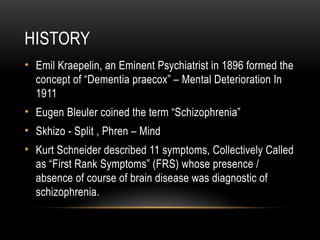
• Emil Kraepelin,an Eminent Psychiatrist in 1896 formed the
concept of “Dementia praecox” – Mental Deterioration In
1911
• Eugen Bleuler coined the term “Schizophrenia”
• Skhizo - Split , Phren – Mind
• Kurt Schneider described 11 symptoms, Collectively Called
as “First Rank Symptoms” (FRS) whose presence /
absence of course of brain disease was diagnostic of
schizophrenia.
3.
DEFINITION
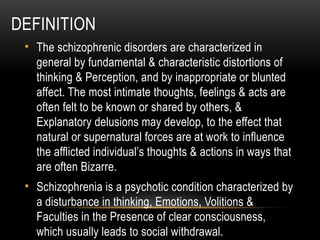
• The schizophrenicdisorders are characterized in
general by fundamental & characteristic distortions of
thinking & Perception, and by inappropriate or blunted
affect. The most intimate thoughts, feelings & acts are
often felt to be known or shared by others, &
Explanatory delusions may develop, to the effect that
natural or supernatural forces are at work to influence
the afflicted individual’s thoughts & actions in ways that
are often Bizarre.
• Schizophrenia is a psychotic condition characterized by
a disturbance in thinking, Emotions, Volitions &
Faculties in the Presence of clear consciousness,
which usually leads to social withdrawal.
4.
CLASSIFICATIONS
• DSM –IV CLASSIFICATION
• According to DSM – IV, At least 2 or more of characteristics
symptoms must be present for a particular portion / part of time
during a 1 month period.
Delusions
Hallucinations
Disorganized speech
Grossly disorganized / Catatonia behavior
Negative symptoms such as Flat Affect, Alogia / Avolition
EPIDEMIOLOGY
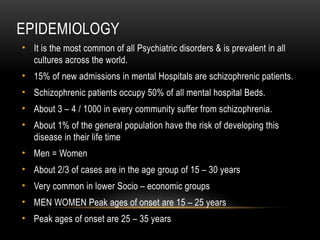
• It isthe most common of all Psychiatric disorders & is prevalent in all
cultures across the world.
• 15% of new admissions in mental Hospitals are schizophrenic patients.
• Schizophrenic patients occupy 50% of all mental hospital Beds.
• About 3 – 4 / 1000 in every community suffer from schizophrenia.
• About 1% of the general population have the risk of developing this
disease in their life time
• Men = Women
• About 2/3 of cases are in the age group of 15 – 30 years
• Very common in lower Socio – economic groups
• MEN WOMEN Peak ages of onset are 15 – 25 years
• Peak ages of onset are 25 – 35 years
7.
ETIOLOGY
BIOLOGICAL THEORIES
Biochemical theories
•Dopamine Hypotheses: An excess of Dopamine – Dependent neuronal
activity in the brain may cause schizophrenia
• Other Biochemical Hypotheses Abnormalities in the Neuro - transmitters
( Nor epinephrine, Serotonin, Acetylcholine & Gamma – amino butyric
acid [GABA] ) Abnormalities in the Neuro - regulators (Prostaglandins &
Endorphins)
Neuro structural theories
• Pre frontal Cortex & Limbic Cortex may never fully develop in the brains
of persons with schizophrenia
• CT & MRI studies of brain structure shows o Decreased brain volume o
Larger lateral & 3rd Ventricles o Atrophy in the Frontal lobe, cerebellum
& limbic Structures o Increased size of Sulci on the Surface of brain
8.
ETIOLOGY
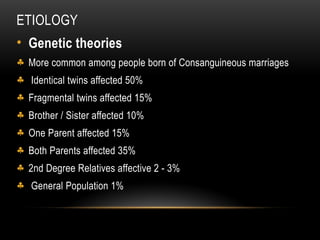
• Genetic theories
§More common among people born of Consanguineous marriages
§ Identical twins affected 50%
§ Fragmental twins affected 15%
§ Brother / Sister affected 10%
§ One Parent affected 15%
§ Both Parents affected 35%
§ 2nd Degree Relatives affective 2 - 3%
§ General Population 1%
9.
ETIOLOGY
• Perinatal RiskFactors
• Maternal Influenza
• Birth during Late winter / Early spring
• Complications of Pregnancy particularly during Labor & Delivery
10.
ETIOLOGY
PSYCHODYNAMIC THEORIES
Developmental theories
•According to Freud, In Psychosexual Development Oral Stage –
Regression present along with that Denial, Projection &
Reaction Formation
• The Individual have poor ego boundaries, Fragile ego,
Inadequate ego development, Super ego Dominance,
Regressed id ego, Love – Hate relationships & Arrested
Psychosexual Development
11.
ETIOLOGY
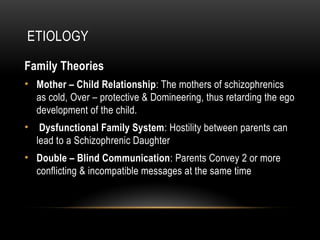
Family Theories
• Mother– Child Relationship: The mothers of schizophrenics
as cold, Over – protective & Domineering, thus retarding the ego
development of the child.
• Dysfunctional Family System: Hostility between parents can
lead to a Schizophrenic Daughter
• Double – Blind Communication: Parents Convey 2 or more
conflicting & incompatible messages at the same time
12.
ETIOLOGY
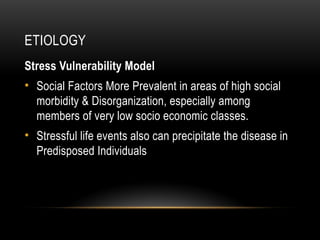
Stress Vulnerability Model
•Social Factors More Prevalent in areas of high social
morbidity & Disorganization, especially among
members of very low socio economic classes.
• Stressful life events also can precipitate the disease in
Predisposed Individuals
14.
PSYCHOPATHOLOGY
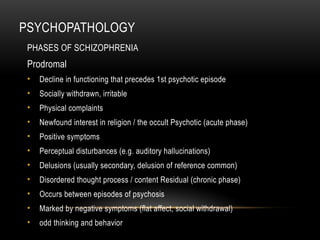
PHASES OF SCHIZOPHRENIA
Prodromal
•Decline in functioning that precedes 1st psychotic episode
• Socially withdrawn, irritable
• Physical complaints
• Newfound interest in religion / the occult Psychotic (acute phase)
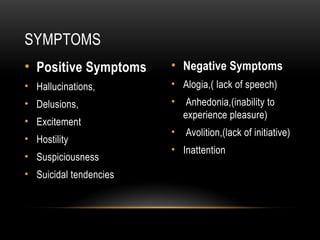
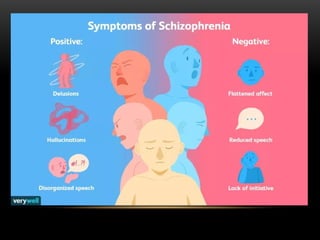
• Positive symptoms
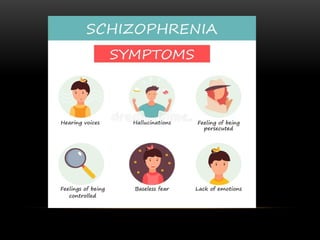
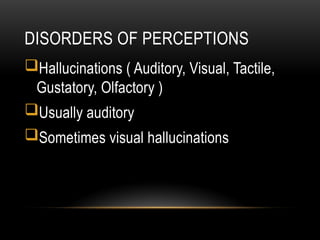
• Perceptual disturbances (e.g. auditory hallucinations)
• Delusions (usually secondary, delusion of reference common)
• Disordered thought process / content Residual (chronic phase)
• Occurs between episodes of psychosis
• Marked by negative symptoms (flat affect, social withdrawal)
• odd thinking and behavior
15.
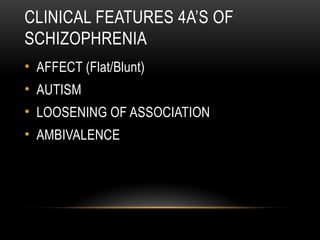
CLINICAL FEATURES 4A’SOF
SCHIZOPHRENIA
• AFFECT (Flat/Blunt)
• AUTISM
• LOOSENING OF ASSOCIATION
• AMBIVALENCE
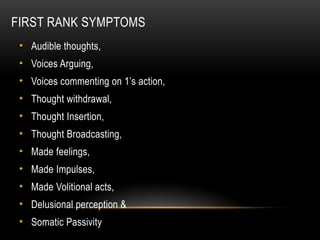
FIRST RANK SYMPTOMS
•Audible thoughts,
• Voices Arguing,
• Voices commenting on 1’s action,
• Thought withdrawal,
• Thought Insertion,
• Thought Broadcasting,
• Made feelings,
• Made Impulses,
• Made Volitional acts,
• Delusional perception &
• Somatic Passivity
20.
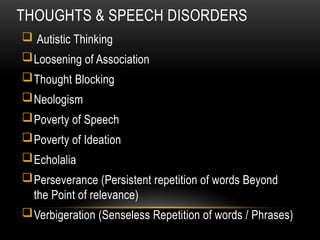
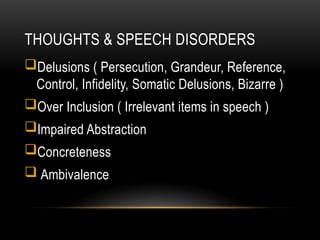
THOUGHTS & SPEECHDISORDERS
Autistic Thinking
Loosening of Association
Thought Blocking
Neologism
Poverty of Speech
Poverty of Ideation
Echolalia
Perseverance (Persistent repetition of words Beyond
the Point of relevance)
Verbigeration (Senseless Repetition of words / Phrases)
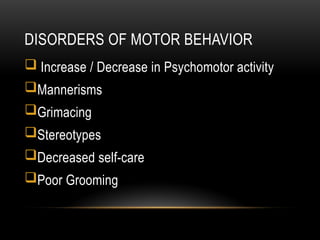
DISORDERS OF MOTORBEHAVIOR
Increase / Decrease in Psychomotor activity
Mannerisms
Grimacing
Stereotypes
Decreased self-care
Poor Grooming
25.
OTHER FEATURES
Decreasedin work Function
Decreased social relationships
Decreased Self care o Inability to Concentrate
Tension o Insomnia
Withdrawal Or Cognitive Deficits
Loss of Ego Boundaries, Loss of Insight
Poor Judgment
Suicide ( presence of associated depression, Command Hallucination,
Impulsive behavior or return of insight that causes the patient to
Comprehend the devastating nature of the illness & take his Life )
Usually no disturbance of Consciousness, Orientation, Attention,
Memory & Intelligence
No Underlying Organic Cause
26.
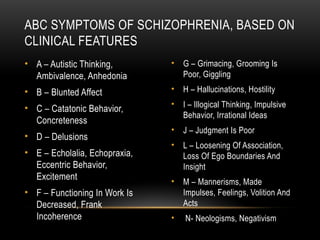
• A –Autistic Thinking,
Ambivalence, Anhedonia
• B – Blunted Affect
• C – Catatonic Behavior,
Concreteness
• D – Delusions
• E – Echolalia, Echopraxia,
Eccentric Behavior,
Excitement
• F – Functioning In Work Is
Decreased, Frank
Incoherence
• G – Grimacing, Grooming Is
Poor, Giggling
• H – Hallucinations, Hostility
• I – Illogical Thinking, Impulsive
Behavior, Irrational Ideas
• J – Judgment Is Poor
• L – Loosening Of Association,
Loss Of Ego Boundaries And
Insight
• M – Mannerisms, Made
Impulses, Feelings, Volition And
Acts
• N- Neologisms, Negativism
ABC SYMPTOMS OF SCHIZOPHRENIA, BASED ON
CLINICAL FEATURES
27.
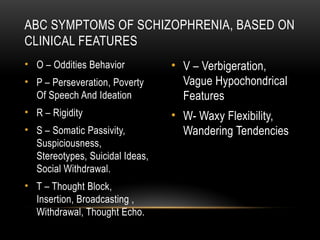
• O –Oddities Behavior
• P – Perseveration, Poverty
Of Speech And Ideation
• R – Rigidity
• S – Somatic Passivity,
Suspiciousness,
Stereotypes, Suicidal Ideas,
Social Withdrawal.
• T – Thought Block,
Insertion, Broadcasting ,
Withdrawal, Thought Echo.
• V – Verbigeration,
Vague Hypochondrical
Features
• W- Waxy Flexibility,
Wandering Tendencies
ABC SYMPTOMS OF SCHIZOPHRENIA, BASED ON
CLINICAL FEATURES
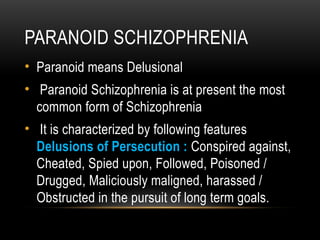
PARANOID SCHIZOPHRENIA
• Paranoidmeans Delusional
• Paranoid Schizophrenia is at present the most
common form of Schizophrenia
• It is characterized by following features
Delusions of Persecution : Conspired against,
Cheated, Spied upon, Followed, Poisoned /
Drugged, Maliciously maligned, harassed /
Obstructed in the pursuit of long term goals.
30.
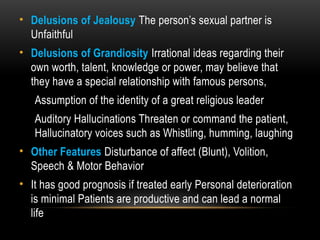
• Delusions ofJealousy The person’s sexual partner is
Unfaithful
• Delusions of Grandiosity Irrational ideas regarding their
own worth, talent, knowledge or power, may believe that
they have a special relationship with famous persons,
Assumption of the identity of a great religious leader
Auditory Hallucinations Threaten or command the patient,
Hallucinatory voices such as Whistling, humming, laughing
• Other Features Disturbance of affect (Blunt), Volition,
Speech & Motor Behavior
• It has good prognosis if treated early Personal deterioration
is minimal Patients are productive and can lead a normal
life
31.
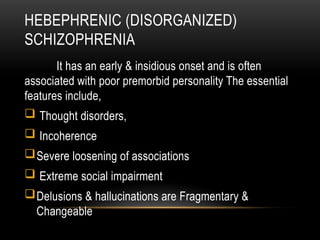
HEBEPHRENIC (DISORGANIZED)
SCHIZOPHRENIA
It hasan early & insidious onset and is often
associated with poor premorbid personality The essential
features include,
Thought disorders,
Incoherence
Severe loosening of associations
Extreme social impairment
Delusions & hallucinations are Fragmentary &
Changeable
32.
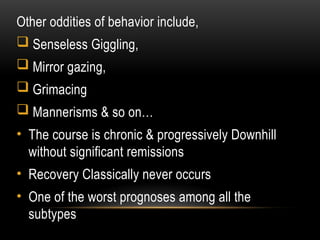
Other oddities ofbehavior include,
Senseless Giggling,
Mirror gazing,
Grimacing
Mannerisms & so on…
• The course is chronic & progressively Downhill
without significant remissions
• Recovery Classically never occurs
• One of the worst prognoses among all the
subtypes
33.
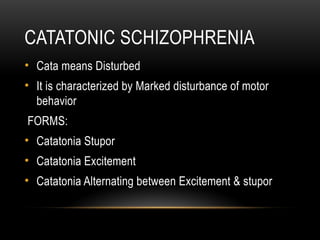
CATATONIC SCHIZOPHRENIA
• Catameans Disturbed
• It is characterized by Marked disturbance of motor
behavior
FORMS:
• Catatonia Stupor
• Catatonia Excitement
• Catatonia Alternating between Excitement & stupor
34.
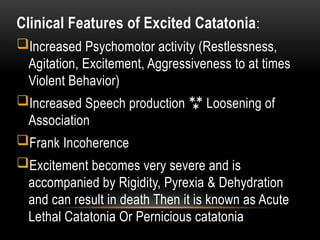
Clinical Features ofExcited Catatonia:
Increased Psychomotor activity (Restlessness,
Agitation, Excitement, Aggressiveness to at times
Violent Behavior)
Increased Speech production Loosening of
Association
Frank Incoherence
Excitement becomes very severe and is
accompanied by Rigidity, Pyrexia & Dehydration
and can result in death Then it is known as Acute
Lethal Catatonia Or Pernicious catatonia
35.
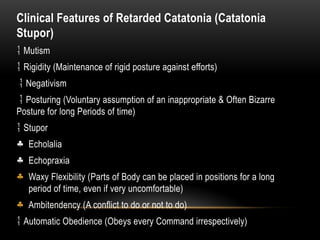
Clinical Features ofRetarded Catatonia (Catatonia
Stupor)
Mutism
Rigidity (Maintenance of rigid posture against efforts)
Negativism
Posturing (Voluntary assumption of an inappropriate & Often Bizarre
Posture for long Periods of time)
Stupor
§ Echolalia
§ Echopraxia
§ Waxy Flexibility (Parts of Body can be placed in positions for a long
period of time, even if very uncomfortable)
§ Ambitendency (A conflict to do or not to do)
Automatic Obedience (Obeys every Command irrespectively)
36.
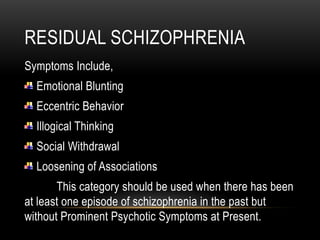
RESIDUAL SCHIZOPHRENIA
Symptoms Include,
EmotionalBlunting
Eccentric Behavior
Illogical Thinking
Social Withdrawal
Loosening of Associations
This category should be used when there has been
at least one episode of schizophrenia in the past but
without Prominent Psychotic Symptoms at Present.
37.
UNDIFFERENTIATED SCHIZOPHRENIA
• Thiscategory is diagnosed either when features
of no subtype are fully present or features of
more than one subtype are exhibited
38.
SIMPLE SCHIZOPHRENIA
Early &Insidious onset, Progressive Course & Presence of
characteristic negative symptoms,
Vague Hypochondrial Features,
Wandering Tendency,
Self Absorbed idleness,
Aimless activity,
It differs from residual schizophrenia in that there never has
been an episode with all the typical psychotic symptoms
Prognosis is very poor.
39.
POST – SCHIZOPHRENICDEPRESSION
• Depressive features develop in the presence of residual
or active features of schizophrenia & are associated
with an increased risk of suicide
40.
COURSE & PROGNOSIS
The classic course is one of the exacerbations & remissions
It described as the most crippling & devastating of all illnesses
Several studies have found that over the 5 – 10 years period
after the 1st psychiatric Hospitalization for schizophrenia,
only about 10 – 20 % of patients as having a good outcome
More than50% of patients have a poor outcome, with repeated
Hospitalizations.
41.
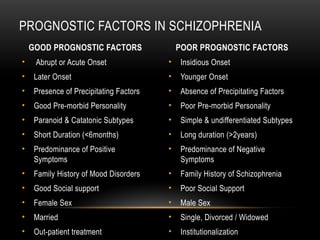
GOOD PROGNOSTIC FACTORS
•Abrupt or Acute Onset
• Later Onset
• Presence of Precipitating Factors
• Good Pre-morbid Personality
• Paranoid & Catatonic Subtypes
• Short Duration (<6months)
• Predominance of Positive
Symptoms
• Family History of Mood Disorders
• Good Social support
• Female Sex
• Married
• Out-patient treatment
POOR PROGNOSTIC FACTORS
• Insidious Onset
• Younger Onset
• Absence of Precipitating Factors
• Poor Pre-morbid Personality
• Simple & undifferentiated Subtypes
• Long duration (>2years)
• Predominance of Negative
Symptoms
• Family History of Schizophrenia
• Poor Social Support
• Male Sex
• Single, Divorced / Widowed
• Institutionalization
PROGNOSTIC FACTORS IN SCHIZOPHRENIA
42.
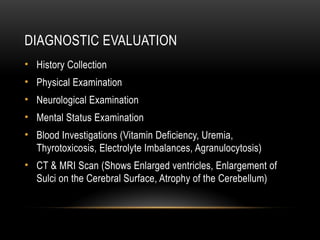
DIAGNOSTIC EVALUATION
• HistoryCollection
• Physical Examination
• Neurological Examination
• Mental Status Examination
• Blood Investigations (Vitamin Deficiency, Uremia,
Thyrotoxicosis, Electrolyte Imbalances, Agranulocytosis)
• CT & MRI Scan (Shows Enlarged ventricles, Enlargement of
Sulci on the Cerebral Surface, Atrophy of the Cerebellum)
44.
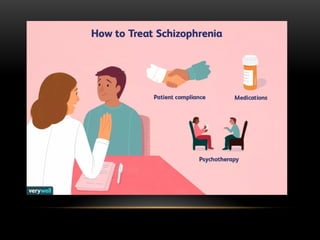
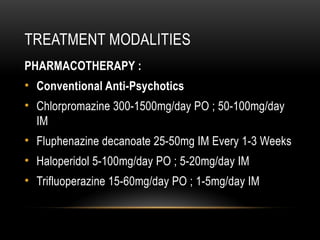
TREATMENT MODALITIES
PHARMACOTHERAPY :
•Conventional Anti-Psychotics
• Chlorpromazine 300-1500mg/day PO ; 50-100mg/day
IM
• Fluphenazine decanoate 25-50mg IM Every 1-3 Weeks
• Haloperidol 5-100mg/day PO ; 5-20mg/day IM
• Trifluoperazine 15-60mg/day PO ; 1-5mg/day IM
45.
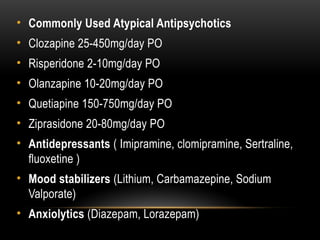
• Commonly UsedAtypical Antipsychotics
• Clozapine 25-450mg/day PO
• Risperidone 2-10mg/day PO
• Olanzapine 10-20mg/day PO
• Quetiapine 150-750mg/day PO
• Ziprasidone 20-80mg/day PO
• Antidepressants ( Imipramine, clomipramine, Sertraline,
fluoxetine )
• Mood stabilizers (Lithium, Carbamazepine, Sodium
Valporate)
• Anxiolytics (Diazepam, Lorazepam)
46.
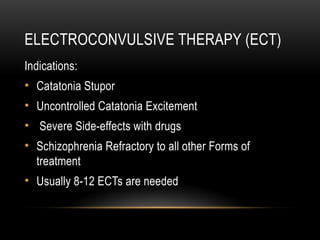
ELECTROCONVULSIVE THERAPY (ECT)
Indications:
•Catatonia Stupor
• Uncontrolled Catatonia Excitement
• Severe Side-effects with drugs
• Schizophrenia Refractory to all other Forms of
treatment
• Usually 8-12 ECTs are needed
PSYCHOSOCIAL REHABILITATION
• Activitytherapy to develop work habit
• Training in a new Vocation or retaining in a previous
Skills
• Vocational Guidance
• Independent Job Placement
50.
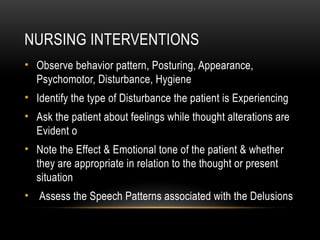
NURSING INTERVENTIONS
• Observebehavior pattern, Posturing, Appearance,
Psychomotor, Disturbance, Hygiene
• Identify the type of Disturbance the patient is Experiencing
• Ask the patient about feelings while thought alterations are
Evident o
• Note the Effect & Emotional tone of the patient & whether
they are appropriate in relation to the thought or present
situation
• Assess the Speech Patterns associated with the Delusions
51.
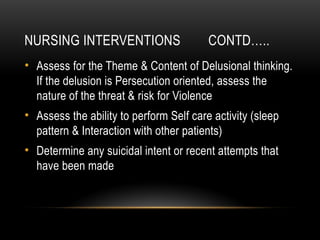
NURSING INTERVENTIONS CONTD…..
•Assess for the Theme & Content of Delusional thinking.
If the delusion is Persecution oriented, assess the
nature of the threat & risk for Violence
• Assess the ability to perform Self care activity (sleep
pattern & Interaction with other patients)
• Determine any suicidal intent or recent attempts that
have been made
52.
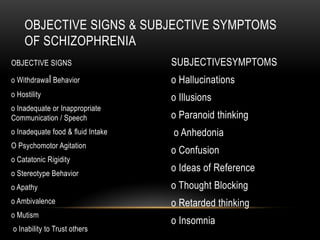
OBJECTIVE SIGNS
o WithdrawalBehavior
o Hostility
o Inadequate or Inappropriate
Communication / Speech
o Inadequate food & fluid Intake
O Psychomotor Agitation
o Catatonic Rigidity
o Stereotype Behavior
o Apathy
o Ambivalence
o Mutism
o Inability to Trust others
SUBJECTIVESYMPTOMS
o Hallucinations
o Illusions
o Paranoid thinking
o Anhedonia
o Confusion
o Ideas of Reference
o Thought Blocking
o Retarded thinking
o Insomnia
OBJECTIVE SIGNS & SUBJECTIVE SYMPTOMS
OF SCHIZOPHRENIA
53.
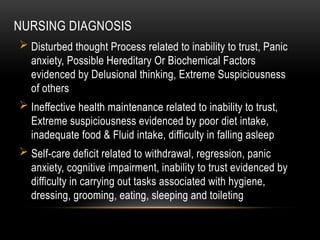
NURSING DIAGNOSIS
Disturbedthought Process related to inability to trust, Panic
anxiety, Possible Hereditary Or Biochemical Factors
evidenced by Delusional thinking, Extreme Suspiciousness
of others
Ineffective health maintenance related to inability to trust,
Extreme suspiciousness evidenced by poor diet intake,
inadequate food & Fluid intake, difficulty in falling asleep
Self-care deficit related to withdrawal, regression, panic
anxiety, cognitive impairment, inability to trust evidenced by
difficulty in carrying out tasks associated with hygiene,
dressing, grooming, eating, sleeping and toileting
54.
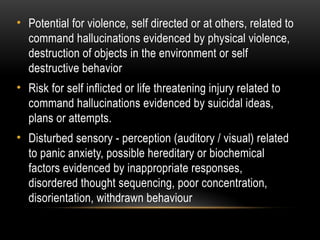
• Potential forviolence, self directed or at others, related to
command hallucinations evidenced by physical violence,
destruction of objects in the environment or self
destructive behavior
• Risk for self inflicted or life threatening injury related to
command hallucinations evidenced by suicidal ideas,
plans or attempts.
• Disturbed sensory - perception (auditory / visual) related
to panic anxiety, possible hereditary or biochemical
factors evidenced by inappropriate responses,
disordered thought sequencing, poor concentration,
disorientation, withdrawn behaviour
55.
• Social isolationrelated to inability to trust, panic anxiety,
delusional thinking, evidenced by withdrawal, sad, dull affect,
preoccupation with own thoughts, expression of feelings of
rejection of aloneness imposed by others.
• Impaired verbal communication related to panic anxiety,
disordered, unrealistic thinking, evidenced by loosening of
associations, echolalia, verbalizations that reflect concrete
thinking and poor eye contact.
• Ineffective family coping related to highly ambivalent family
relationships, impaired communication evidenced by
neglectful care of the patient, extreme denial or prolonged
over concern regarding his illness
56.
OTHER PSYCHOTIC DISORDERS
•The term psychosis is defined as gross
impairment in reality testing, marked disturbance
in personality with impaired social and
occupational functioning and presence of
characteristic symptoms like delusions and
hallucinations
PERSISTENT DELUSIONAL DISORDERS
•It is relatively stable & chronic course,
characterized by presence of well systematized
delusions of non – Bizarre type
• The emotional response & behavior of the
person is often understandable in the light of
Delusions
• The behavior outside the limits of delusions is
almost Normal
59.
CLINICAL FEATURES :
•Persistent Delusions (At least for 3 Months)
• Absence of significant / persistent hallucinations
• Absence of organic mental disorders,
Schizophrenia, Mood disorders Very often these
individuals are able to carry on a near normal
social & occupational life without arousing
suspicion regarding the delusional disorder
60.
ACUTE & TRANSIENTPSYCHOTIC
DISORDERS
• These disorders neither follow the course of
schizophrenia nor resemble mood disorders in
clinical picture & usually have a better prognosis
than schizophrenia
• The onset is abrupt or acute, associated with
identifiable acute stress A complete recovery
usually occurs within 2 – 3 months
61.
CLINICAL FEATURES
• Severaltypes of hallucinations, delusions,
changing in both type & intensity from day to day
or within the same day
• Marked emotional turmoil, which ranges from
intense feelings of happiness & ecstasy to anxiety
& irritability
• Do not fulfill the criteria for Schizophrenia
62.
INDUCED DELUSIONAL DISORDERS
•This is an uncommon Delusional disorder characterized
by, Sharing of delusions between usually 2 or
occasionally more persons, who usually have a closely
knit emotional bond.
• Only one has the ‘Genuine’ Delusions due to an
underlying psychiatric disorder On separation of the 2,
while the dependent individual may give up his
delusions,
• The patient with the ‘genuine’ Delusions Should then be
treated appropriately
63.
SCHIZOAFFECTIVE DISORDER
In thisdisorder, the symptoms of schizophrenia &
mood disorders are prominently present within the
same episode.
Types:
• Schizoaffective disorder – Depressed type
• Schizoaffective disorder – Manic type
• Schizoaffective Mixed type
64.
CAPGRAS SYNDROME (DELUSIONOF DOUBLE)
• It is characterized by delusional conviction that the other person
in the environment is not their real selves but is their own
doubles.
• It is one of the delusional misidentification syndromes
Treatment:
• Antipsychotics
• Mood stabilizers
• Antidepressants
• ECT
• Supportive Psychotherapy
65.
GERIATRIC CONSIDERATIONS
• Schizophrenia,a severe & persistent mental illness with an onset in
early adulthood, is not usually associated with older adults
• Prevalence was thought to decline with aging as a result of early
mortality, Decreased symptom severity & recovery
• Late – onset schizophrenia (after 45years) , More Prevalent in
women than in Men Characterized by Paranoid delusions.
• It has Varying in degree of Impairment, but the Psychopathology
decreases with age
• Psychotic Symptoms that appear in late life are usually associated
with depression or dementia, not schizophrenia
• Patients may respond to supportive therapy and low doses of
Atypical Antipsychotic Drugs.
66.
PSYCHO EDUCATION
• Explainthe patient & family that schizophrenia is a chronic
disorder with symptoms that affect the person’s thought process,
mood , emotions & Social functions throughout the person’s life
time
• Teach the patient & Family About the importance of medication
compliance and the therapeutic / Non – therapeutic effects of
antipsychotic medications
• Instruct the patient & Family to recognize impending symptom
exacerbation and to notify physician when the patient poses a
threat / danger to self or others& requires hospitalization
• Teach the patient & family to identify Psychosocial / family
stressors that may exacerbate symptoms of the disorder &
methods to prevent them
67.
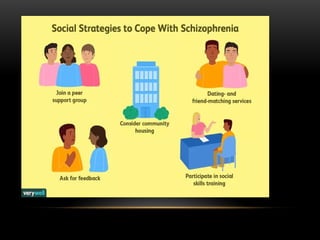
REHABILITATION
• The focusof psychiatric rehabilitation is strengthening self care &
promoting& improving quality of life through relapse prevention It
has improved outcomes by , Providing Community , Family
Support Services to decrease hospital Readmission rates &
increase Community Integration
• Social skills training
• Vocational Rehabilitation
• Half-Way Homes
• Long-term Homes
• Closer Supervision
• Day Hospitals, etc.,


![ETIOLOGY
BIOLOGICAL THEORIES
Biochemical theories
• Dopamine Hypotheses: An excess of Dopamine – Dependent neuronal
activity in the brain may cause schizophrenia
• Other Biochemical Hypotheses Abnormalities in the Neuro - transmitters
( Nor epinephrine, Serotonin, Acetylcholine & Gamma – amino butyric
acid [GABA] ) Abnormalities in the Neuro - regulators (Prostaglandins &
Endorphins)
Neuro structural theories
• Pre frontal Cortex & Limbic Cortex may never fully develop in the brains
of persons with schizophrenia
• CT & MRI studies of brain structure shows o Decreased brain volume o
Larger lateral & 3rd Ventricles o Atrophy in the Frontal lobe, cerebellum
& limbic Structures o Increased size of Sulci on the Surface of brain](https://image.slidesharecdn.com/schizophrenia-250515051309-3b6d2a86/85/SCHIZOPHRENIA-a-psychotic-condition-pptx-7-320.jpg)











![schizophrenia [Autosaved].pptx [mental health nursing]](https://cdn.slidesharecdn.com/ss_thumbnails/schizofinalautosaved-250323084409-0f866c5d-thumbnail.jpg?width=640&height=640&fit=bounds)


![Revised Topic- Schizophrenia [Autosaved].pptx](https://cdn.slidesharecdn.com/ss_thumbnails/schizophreniaautosaved-250310073514-5d1607b2-thumbnail.jpg?width=640&height=640&fit=bounds)


![APPROACH TO FEVER IN PEDIATRICS[1].pptTT](https://cdn.slidesharecdn.com/ss_thumbnails/approachtofeverinpediatrics1-260125081456-d559e079-thumbnail.jpg?width=640&height=640&fit=bounds)


