PHYSIOLOGY OF IMAGE FORMING
MECHANISM, PRINCIPLES OF
OPTICS AND OPTICAL
ABERRATION DRFECTS
By Shama Praveen
Physiology Department
OBJECTIVES
 ​Introduction
 Principles of Optics
 Reduced or Schematic eye
 Visual Acuity
 Visual Reflexes
 Optical Aberration
 Defects of the image forming
mechanism
INTRODUCTION
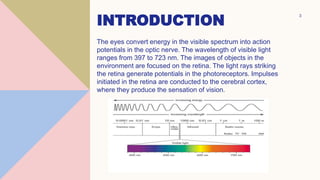
The eyes convert energy in the visible spectrum into action
potentials in the optic nerve. The wavelength of visible light
ranges from 397 to 723 nm. The images of objects in the
environment are focused on the retina. The light rays striking
the retina generate potentials in the photoreceptors. Impulses
initiated in the retina are conducted to the cerebral cortex,
where they produce the sensation of vision.
3
PRINCIPLES OF OPTICS
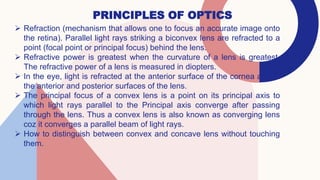
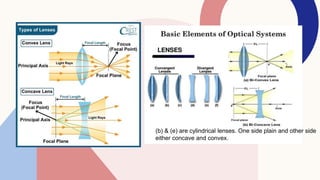
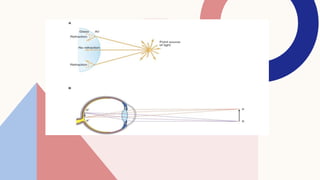
 Refraction (mechanism that allows one to focus an accurate image onto
the retina). Parallel light rays striking a biconvex lens are refracted to a
point (focal point or principal focus) behind the lens.
 Refractive power is greatest when the curvature of a lens is greatest.
The refractive power of a lens is measured in diopters.
 In the eye, light is refracted at the anterior surface of the cornea and at
the anterior and posterior surfaces of the lens.
 The principal focus of a convex lens is a point on its principal axis to
which light rays parallel to the Principal axis converge after passing
through the lens. Thus a convex lens is also known as converging lens
coz it converges a parallel beam of light rays.
 How to distinguish between convex and concave lens without touching
them.
(b) & (e) are cylindrical lenses. One side plain and other side
either concave and convex.
7
REDUCED OR SCHEMATIC EYE
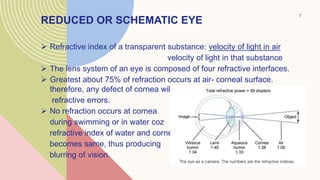
 Refractive index of a transparent substance: velocity of light in air
velocity of light in that substance
 The lens system of an eye is composed of four refractive interfaces.
 Greatest about 75% of refraction occurs at air- corneal surface.
therefore, any defect of cornea will lead to
refractive errors.
 No refraction occurs at cornea
during swimming or in water coz
refractive index of water and cornea
becomes same, thus producing
blurring of vision.
8
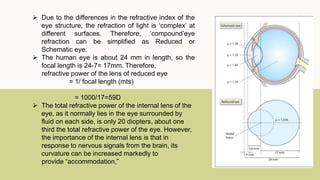
 Due to the differences in the refractive index of the
eye structure, the refraction of light is ‘complex’ at
different surfaces. Therefore, ‘compound’eye
refraction can be simplified as Reduced or
Schematic eye.
 The human eye is about 24 mm in length, so the
focal length is 24-7= 17mm. Therefore,
refractive power of the lens of reduced eye
= 1/ focal length (mts)
= 1000/17=59D
 The total refractive power of the internal lens of the
eye, as it normally lies in the eye surrounded by
fluid on each side, is only 20 diopters, about one
third the total refractive power of the eye. However,
the importance of the internal lens is that in
response to nervous signals from the brain, its
curvature can be increased markedly to
provide “accommodation,”
9
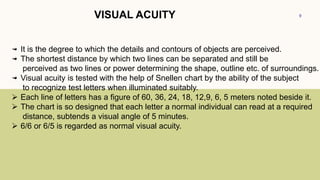
VISUAL ACUITY
It is the degree to which the details and contours of objects are perceived.
The shortest distance by which two lines can be separated and still be
perceived as two lines or power determining the shape, outline etc. of surroundings.
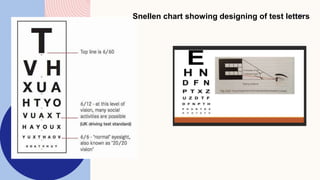
Visual acuity is tested with the help of Snellen chart by the ability of the subject
to recognize test letters when illuminated suitably.
 Each line of letters has a figure of 60, 36, 24, 18, 12,9, 6, 5 meters noted beside it.
 The chart is so designed that each letter a normal individual can read at a required
distance, subtends a visual angle of 5 minutes.
 6/6 or 6/5 is regarded as normal visual acuity.
10
Snellen chart showing designing of test letters
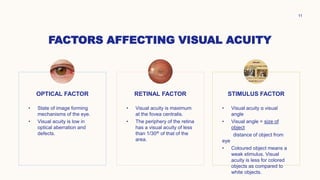
FACTORS AFFECTING VISUAL ACUITY
11
OPTICAL FACTOR
• State of image forming
mechanisms of the eye.
• Visual acuity is low in
optical aberration and
defects.
RETINAL FACTOR
• Visual acuity is maximum
at the fovea centralis.
• The periphery of the retina
has a visual acuity of less
than 1/30th of that of the
area.
STIMULUS FACTOR
• Visual acuity α visual
angle
• Visual angle = size of
object
distance of object from
eye
• Coloured object means a
weak stimulus. Visual
acuity is less for colored
objects as compared to
white objects.
VISUAL REFLEXES
12
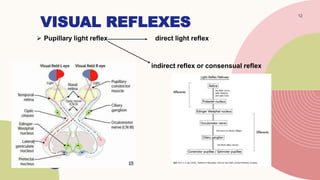
 Pupillary light reflex direct light reflex
indirect reflex or consensual reflex
ACCOMODATION
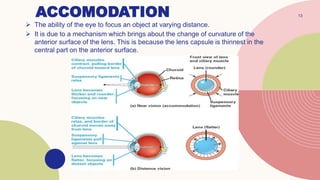
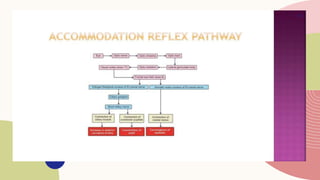
 The ability of the eye to focus an object at varying distance.
 It is due to a mechanism which brings about the change of curvature of the
anterior surface of the lens. This is because the lens capsule is thinnest in the
central part on the anterior surface.
13
14
APPLIED ASPECTS
Argyll Robertson pupil: In this condition, pupillary constriction in response
to a light stimulus is absent or decreased, while the response to accommodation
is present.
 It is associated clinically with lesions in or near aqueduct of sylvius and the
superior colliculi which interrupt the pathway of light reflex.
Reverse Argyll Robertson pupil: This is reverse of above condition.
Here pupillary constriction in response to light is present while the response to
accommodation is absent.
15
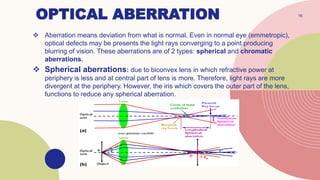
OPTICAL ABERRATION
 Aberration means deviation from what is normal. Even in normal eye (emmetropic),
optical defects may be presents the light rays converging to a point producing
blurring of vision. These aberrations are of 2 types: spherical and chromatic
aberrations.
 Spherical aberrations: due to biconvex lens in which refractive power at
periphery is less and at central part of lens is more. Therefore, light rays are more
divergent at the periphery. However, the iris which covers the outer part of the lens,
functions to reduce any spherical aberration.
16
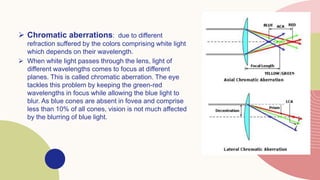
 Chromatic aberrations: due to different
refraction suffered by the colors comprising white light
which depends on their wavelength.
 When white light passes through the lens, light of
different wavelengths comes to focus at different
planes. This is called chromatic aberration. The eye
tackles this problem by keeping the green-red
wavelengths in focus while allowing the blue light to
blur. As blue cones are absent in fovea and comprise
less than 10% of all cones, vision is not much affected
by the blurring of blue light.
17
DEFECTS OF IMAGE FORMING MECHANISM
• Presbyopia (means loss of accommodation)
• Myopia or short sightedness (cannot see distant objects)
• Hypermetropia or hyperopia or long sightedness
(cannot see close objects clearly).
• Astigmatism (light rays are not brought to a point focus on the
retina)
18
PRESBYOPIA
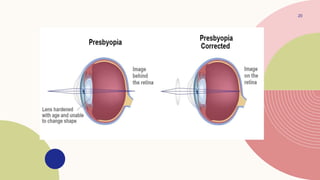
• An inadequacy of the accommodative power of the eye that occurs with
aging, usually after the age of 40 years . It occurs due to loss of lens
elasticity though a change in lens curvature and weakness of ciliary
muscles could also contribute. Because of reduced accommodation, the
near point recedes (becomes greater than 10 cm) and approaches the far
point.
• Due to increasing hardening of lens (sclerosis) near and far points of vision
become so close to each other that reading becomes difficult.
• The loss of elasticity of lens is due to denaturation of its proteinsby ultra
violet rays which are being absorbed by the lens.
• As a result of such irradiation the protein agglutinate and coagulate in the
presence of Ca+. Eventually the lens becomes swollen, hard and opaque
(called Cataract)
• It can be corrected by wearing glasses with bifocal lens.
19
20
MYOPIA
 Genetic in origin
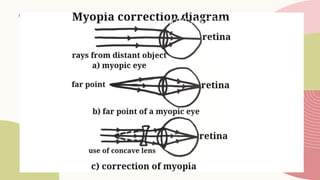
 Distant object are focused in front of retina.
 Either length of eyeball is too long (axial myopic eye) or refractive power of lens
increases (refractive myopic eye).
 As a result, far point and near point of vision are closely approximated. Therefore,
the range of accommodation decreases.
 It is corrected by concave glasses. This causes divergence of the incident rays.
The power of lens required gives a measure of the degree of myopia.
21
22
Presentation title
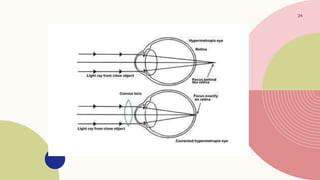
HYPERMETROPIA
• Parallel light rays from obect are focused behind the retina. It is because of either the
length of eyeball is too short (axial hypermetropic eye) or the refractive power of lens
decreases (refractive hypermetropic eye).
• Can see distant objects only while using some accommodation but cannot see
clearly close ones.
• Hypertrophy of ciliary muscles occurs because individual will be using the
accommodation all the times for seeing far objects. Sustained accommodation is tiring
and may cause severe headache and blurring of vision.
• The prolonged convergence of the visual axis associated with the accommodation,
finally leads to squint (strabismus)
• It can be corrected by convex glasses which causes convergence of incident
rays.
23
24
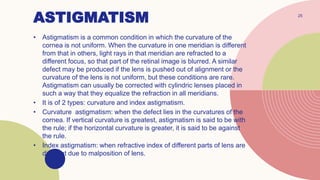
ASTIGMATISM
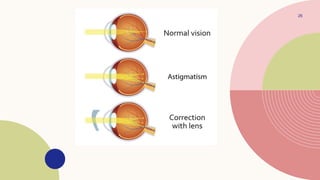
• Astigmatism is a common condition in which the curvature of the
cornea is not uniform. When the curvature in one meridian is different
from that in others, light rays in that meridian are refracted to a
different focus, so that part of the retinal image is blurred. A similar
defect may be produced if the lens is pushed out of alignment or the
curvature of the lens is not uniform, but these conditions are rare.
Astigmatism can usually be corrected with cylindric lenses placed in
such a way that they equalize the refraction in all meridians.
• It is of 2 types: curvature and index astigmatism.
• Curvature astigmatism: when the defect lies in the curvatures of the
cornea. If vertical curvature is greatest, astigmatism is said to be with
the rule; if the horizontal curvature is greater, it is said to be against
the rule.
• Index astigmatism: when refractive index of different parts of lens are
different due to malposition of lens.
25
26
THANK YOU

image forming mechanism, optical aberration

  • 1.
    PHYSIOLOGY OF IMAGEFORMING MECHANISM, PRINCIPLES OF OPTICS AND OPTICAL ABERRATION DRFECTS By Shama Praveen Physiology Department
  • 2.
    OBJECTIVES  ​Introduction  Principlesof Optics  Reduced or Schematic eye  Visual Acuity  Visual Reflexes  Optical Aberration  Defects of the image forming mechanism
  • 3.
    INTRODUCTION The eyes convertenergy in the visible spectrum into action potentials in the optic nerve. The wavelength of visible light ranges from 397 to 723 nm. The images of objects in the environment are focused on the retina. The light rays striking the retina generate potentials in the photoreceptors. Impulses initiated in the retina are conducted to the cerebral cortex, where they produce the sensation of vision. 3
  • 4.
    PRINCIPLES OF OPTICS Refraction (mechanism that allows one to focus an accurate image onto the retina). Parallel light rays striking a biconvex lens are refracted to a point (focal point or principal focus) behind the lens.  Refractive power is greatest when the curvature of a lens is greatest. The refractive power of a lens is measured in diopters.  In the eye, light is refracted at the anterior surface of the cornea and at the anterior and posterior surfaces of the lens.  The principal focus of a convex lens is a point on its principal axis to which light rays parallel to the Principal axis converge after passing through the lens. Thus a convex lens is also known as converging lens coz it converges a parallel beam of light rays.  How to distinguish between convex and concave lens without touching them.
  • 5.
    (b) & (e)are cylindrical lenses. One side plain and other side either concave and convex.
  • 7.
    7 REDUCED OR SCHEMATICEYE  Refractive index of a transparent substance: velocity of light in air velocity of light in that substance  The lens system of an eye is composed of four refractive interfaces.  Greatest about 75% of refraction occurs at air- corneal surface. therefore, any defect of cornea will lead to refractive errors.  No refraction occurs at cornea during swimming or in water coz refractive index of water and cornea becomes same, thus producing blurring of vision.
  • 8.
    8  Due tothe differences in the refractive index of the eye structure, the refraction of light is ‘complex’ at different surfaces. Therefore, ‘compound’eye refraction can be simplified as Reduced or Schematic eye.  The human eye is about 24 mm in length, so the focal length is 24-7= 17mm. Therefore, refractive power of the lens of reduced eye = 1/ focal length (mts) = 1000/17=59D  The total refractive power of the internal lens of the eye, as it normally lies in the eye surrounded by fluid on each side, is only 20 diopters, about one third the total refractive power of the eye. However, the importance of the internal lens is that in response to nervous signals from the brain, its curvature can be increased markedly to provide “accommodation,”
  • 9.
    9 VISUAL ACUITY It isthe degree to which the details and contours of objects are perceived. The shortest distance by which two lines can be separated and still be perceived as two lines or power determining the shape, outline etc. of surroundings. Visual acuity is tested with the help of Snellen chart by the ability of the subject to recognize test letters when illuminated suitably.  Each line of letters has a figure of 60, 36, 24, 18, 12,9, 6, 5 meters noted beside it.  The chart is so designed that each letter a normal individual can read at a required distance, subtends a visual angle of 5 minutes.  6/6 or 6/5 is regarded as normal visual acuity.
  • 10.
    10 Snellen chart showingdesigning of test letters
  • 11.
    FACTORS AFFECTING VISUALACUITY 11 OPTICAL FACTOR • State of image forming mechanisms of the eye. • Visual acuity is low in optical aberration and defects. RETINAL FACTOR • Visual acuity is maximum at the fovea centralis. • The periphery of the retina has a visual acuity of less than 1/30th of that of the area. STIMULUS FACTOR • Visual acuity α visual angle • Visual angle = size of object distance of object from eye • Coloured object means a weak stimulus. Visual acuity is less for colored objects as compared to white objects.
  • 12.
    VISUAL REFLEXES 12  Pupillarylight reflex direct light reflex indirect reflex or consensual reflex
  • 13.
    ACCOMODATION  The abilityof the eye to focus an object at varying distance.  It is due to a mechanism which brings about the change of curvature of the anterior surface of the lens. This is because the lens capsule is thinnest in the central part on the anterior surface. 13
  • 14.
  • 15.
    APPLIED ASPECTS Argyll Robertsonpupil: In this condition, pupillary constriction in response to a light stimulus is absent or decreased, while the response to accommodation is present.  It is associated clinically with lesions in or near aqueduct of sylvius and the superior colliculi which interrupt the pathway of light reflex. Reverse Argyll Robertson pupil: This is reverse of above condition. Here pupillary constriction in response to light is present while the response to accommodation is absent. 15
  • 16.
    OPTICAL ABERRATION  Aberrationmeans deviation from what is normal. Even in normal eye (emmetropic), optical defects may be presents the light rays converging to a point producing blurring of vision. These aberrations are of 2 types: spherical and chromatic aberrations.  Spherical aberrations: due to biconvex lens in which refractive power at periphery is less and at central part of lens is more. Therefore, light rays are more divergent at the periphery. However, the iris which covers the outer part of the lens, functions to reduce any spherical aberration. 16
  • 17.
     Chromatic aberrations:due to different refraction suffered by the colors comprising white light which depends on their wavelength.  When white light passes through the lens, light of different wavelengths comes to focus at different planes. This is called chromatic aberration. The eye tackles this problem by keeping the green-red wavelengths in focus while allowing the blue light to blur. As blue cones are absent in fovea and comprise less than 10% of all cones, vision is not much affected by the blurring of blue light. 17
  • 18.
    DEFECTS OF IMAGEFORMING MECHANISM • Presbyopia (means loss of accommodation) • Myopia or short sightedness (cannot see distant objects) • Hypermetropia or hyperopia or long sightedness (cannot see close objects clearly). • Astigmatism (light rays are not brought to a point focus on the retina) 18
  • 19.
    PRESBYOPIA • An inadequacyof the accommodative power of the eye that occurs with aging, usually after the age of 40 years . It occurs due to loss of lens elasticity though a change in lens curvature and weakness of ciliary muscles could also contribute. Because of reduced accommodation, the near point recedes (becomes greater than 10 cm) and approaches the far point. • Due to increasing hardening of lens (sclerosis) near and far points of vision become so close to each other that reading becomes difficult. • The loss of elasticity of lens is due to denaturation of its proteinsby ultra violet rays which are being absorbed by the lens. • As a result of such irradiation the protein agglutinate and coagulate in the presence of Ca+. Eventually the lens becomes swollen, hard and opaque (called Cataract) • It can be corrected by wearing glasses with bifocal lens. 19
  • 20.
  • 21.
    MYOPIA  Genetic inorigin  Distant object are focused in front of retina.  Either length of eyeball is too long (axial myopic eye) or refractive power of lens increases (refractive myopic eye).  As a result, far point and near point of vision are closely approximated. Therefore, the range of accommodation decreases.  It is corrected by concave glasses. This causes divergence of the incident rays. The power of lens required gives a measure of the degree of myopia. 21
  • 22.
  • 23.
    HYPERMETROPIA • Parallel lightrays from obect are focused behind the retina. It is because of either the length of eyeball is too short (axial hypermetropic eye) or the refractive power of lens decreases (refractive hypermetropic eye). • Can see distant objects only while using some accommodation but cannot see clearly close ones. • Hypertrophy of ciliary muscles occurs because individual will be using the accommodation all the times for seeing far objects. Sustained accommodation is tiring and may cause severe headache and blurring of vision. • The prolonged convergence of the visual axis associated with the accommodation, finally leads to squint (strabismus) • It can be corrected by convex glasses which causes convergence of incident rays. 23
  • 24.
  • 25.
    ASTIGMATISM • Astigmatism isa common condition in which the curvature of the cornea is not uniform. When the curvature in one meridian is different from that in others, light rays in that meridian are refracted to a different focus, so that part of the retinal image is blurred. A similar defect may be produced if the lens is pushed out of alignment or the curvature of the lens is not uniform, but these conditions are rare. Astigmatism can usually be corrected with cylindric lenses placed in such a way that they equalize the refraction in all meridians. • It is of 2 types: curvature and index astigmatism. • Curvature astigmatism: when the defect lies in the curvatures of the cornea. If vertical curvature is greatest, astigmatism is said to be with the rule; if the horizontal curvature is greater, it is said to be against the rule. • Index astigmatism: when refractive index of different parts of lens are different due to malposition of lens. 25
  • 26.
  • 27.