

Optometry- Profession in Nepal 
Gauri Shankar Shrestha, M.optom, FIACLE 
Assistant Professor
Introduction 
• Optometry is a health care profession that is 
autonomous, educated and regulated 
(licensed/Registered) 
• Optometrists are the primary healthcare 
practitioners of eye and visual system who 
provide comprehensive eye and vision care that 
includes refraction and dispensing, diagnosis and 
management of eye diseases and rehabilitation of 
conditions of the visual system.
Who are optometrists 
• Graduates from +2 science and has completed 
the Bachelor of Optometry and vision Science 
degree
Scope of Optometry 
• Refraction and Dispensing 
• Contact lens practice-Rose-K, OrthoK, 
• Low Vision and rehabilitative optometry 
• Orthoptist and vision therapist 
• Industrial optometry and environmental 
Vision and occupational optometrist 
• Primary eye care and therapeutic optometry
Scope of Optometry 
• Optometry and sports 
• Optical industry 
• Work in multi-National company 
• Academic- teaching 
• Research- Vision and optometry
Optometry in Nepal 
• Newest-1998 
• Before 1998 
– 1981-OA training 
– 1987-ophthalmology training 
• Human resources before 1998 
– Ophthal 
– OAs 
– Technicians 
– Orthoptists 
– Opticians
Optometry in Nepal 
• 17th Batch 
• 66 optometrists graduated 
• Foreign candidates: 3
Program goal 
• To produce competent, compassionate, and 
community oriented optometrists who is 
capable of 
– Providing eye and vision care 
– Identify ocular diseases and related systemic 
illness 
– Refer the ocular emergencies and surgical cases
Admission criteria 
• 50% aggregates 
– ISc biology from Tribhuvan University 
– +2 with Biology HSEC 
– A-level 
• Age: 25 years 
• Merit basis on entrance exam
Specialty courses 
• Ocular diseases 
• Refraction and dispensing 
• Low vision 
• Orthoptics 
• Contact lens 
• Pediatric optometry 
• Geriatric optometry 
• Community optometry 
• Elective posting-6-8 weeks
Professional Career 
• Successful independent practitioner (Global 
data) 
• Opportunity to be self employed either as a 
partner or a sole practitioner 
• Work at health care institutions 
• A responsible position in the community as a 
health professional
Professional career 
• Vision research, teaching and administration 
for various professional organizations 
• Work with ophthalmologists contributing in 
major part of ophthalmic practice 
• Work as optometrists in many overseas 
countries 
• Work in many ophthalmic products industry, 
social welfare organizations
Role in three levels of eye care 
• Primary eye care 
– VDC level (limited role) 
• Secondary eye care services 
– districts level –vision centers-Optometrists major 
role 
• Tertiary eye care services 
– Regional level-hospitals, centers and departments, 
Optometrists crucial role
Primary eye care services 
• Services that are required by many people most 
of the time to meet their non-specialized health 
problems 
• Function as the primary point of entry into the 
system 
• Role 
– A comprehensive range of diagnostics, therapeutics 
and preventive services 
– Health promotion and maintenance activities 
– Health campaigns
Primary eye care services 
• Referral 
– Within vertical dimension from the primary level 
to the secondary and tertiary levels 
• Aim 
– Provision of care to the right patient at the right 
time in the right places and for the right reason
Secondary eye care services 
• relative specialized services provided after 
referral to a consultant/specialist 
• Main service points 
• Vision centers, community hospitals
Tertiary eye care services 
• Tertiary care 
– Highly sophisticated services that require 
extensive technical capabilities and 
– Are almost always delivered on an in patient basis 
• Centralized at a major health complex 
• Low frequency of conditions require these 
services 
• A medical teaching hospital, eye hospitals or 
eye centers
Responsibilities 
• PECC 
– Community survey 
– School screening 
– Health campaign 
– Eye camps 
– Refraction, dispensing and treatment of common 
ocular diseases
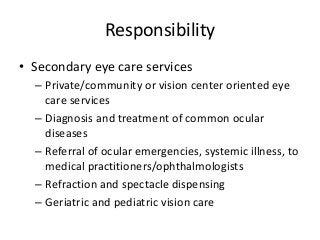
Responsibility 
• Secondary eye care services 
– Private/community or vision center oriented eye 
care services 
– Diagnosis and treatment of common ocular 
diseases 
– Referral of ocular emergencies, systemic illness, to 
medical practitioners/ophthalmologists 
– Refraction and spectacle dispensing 
– Geriatric and pediatric vision care
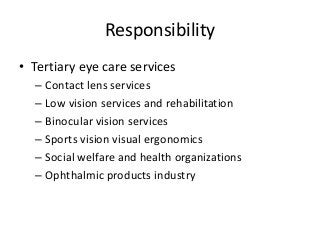
Responsibility 
• Tertiary eye care services 
– Contact lens services 
– Low vision services and rehabilitation 
– Binocular vision services 
– Sports vision visual ergonomics 
– Social welfare and health organizations 
– Ophthalmic products industry
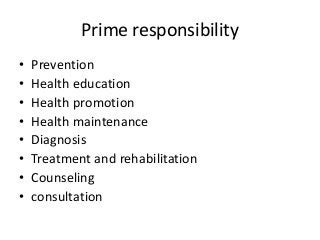
Prime responsibility 
• Prevention 
• Health education 
• Health promotion 
• Health maintenance 
• Diagnosis 
• Treatment and rehabilitation 
• Counseling 
• consultation
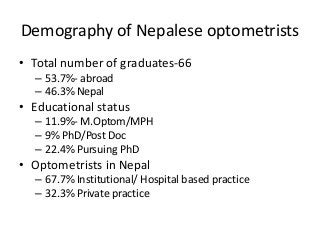
Demography of Nepalese optometrists 
• Total number of graduates-66 
– 53.7%- abroad 
– 46.3% Nepal 
• Educational status 
– 11.9%- M.Optom/MPH 
– 9% PhD/Post Doc 
– 22.4% Pursuing PhD 
• Optometrists in Nepal 
– 67.7% Institutional/ Hospital based practice 
– 32.3% Private practice
Nepalese Association of Optometrists 
• Optometrists formed an association in 2003 
named as “Nepalese Association of Optometrists 
(NAO)” 
• NAO is involved in school screening, eye check 
ups, health campaigns in community 
• Current Partners are Optometry Giving Sight, BP 
eye Foundation, Volunteer organization for 
services of humanity 
• NAO is member of World council of Optometry 
(WCO), Asia Pacific Council of Optometry (APCO)
Program Supported to Nepalese 
Optometrists by International agencies 
• The Sight Conservation of Children from 
Marginalised Communities of Nepal 
– Subodh Gyawali, OD, MPH, for OGS 
• Eye teaming and co-ordination among school 
children of Kathmandu 
– Subodh Gyawali, OD, MPH for OGS 
• Ocular morbidity among street children of 
Kathmandu Valley 
– GauriSh Shrestha, M.Optom, FIACLE for WCO
International conferences attended by 
Nepalese Optometrists 
• 2004-Wco conference, Florida 
• 2005-Asia pacific conference, Tokyo, Japan 
• 2007-APCO Conference in Goa, India 
• 2009-APCO conference in HongKong 
• 2011-APCO conference in Singapore 
• 2012-WCO conference in USA, Chicago 
• 2013- APCO conference in South Korea 
• 2013-BCA conference in UK 
• 2014-AAO conference in USA, Denver 
• 2014-IOA conference in India
Nepalese Optometrists research 
papers in International peer reviewed 
Journals 
• Journal of optometry 
• Clinical and experimental optometry 
• Optometry and visual science 
• Ophthalmic epidemiology 
• British Journal of Ophthalmology 
• Cornea 
• Investigative ophthalmology and visual sciences 
• The ocular surface
Nepalese Optometrists research 
papers in International peer reviewed 
Journals 
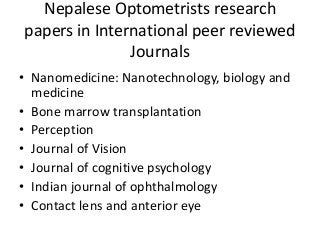
• Nanomedicine: Nanotechnology, biology and 
medicine 
• Bone marrow transplantation 
• Perception 
• Journal of Vision 
• Journal of cognitive psychology 
• Indian journal of ophthalmology 
• Contact lens and anterior eye
Nepalese Optometrists research 
papers in International peer reviewed 
Journals 
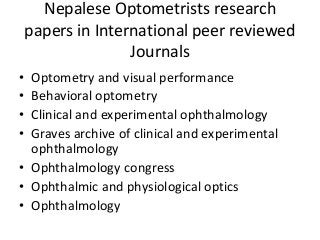
• Optometry and visual performance 
• Behavioral optometry 
• Clinical and experimental ophthalmology 
• Graves archive of clinical and experimental 
ophthalmology 
• Ophthalmology congress 
• Ophthalmic and physiological optics 
• Ophthalmology
Nepalese Optometrists research 
papers in International peer reviewed 
Journals 
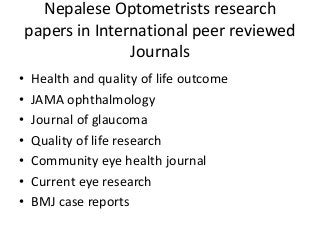
• Health and quality of life outcome 
• JAMA ophthalmology 
• Journal of glaucoma 
• Quality of life research 
• Community eye health journal 
• Current eye research 
• BMJ case reports
Nepalese Optometrists research 
papers in national peer reviewed 
Journals 
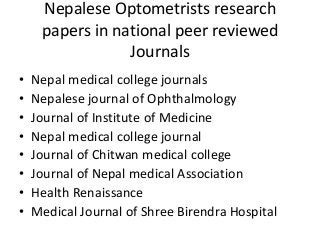
• Nepal medical college journals 
• Nepalese journal of Ophthalmology 
• Journal of Institute of Medicine 
• Nepal medical college journal 
• Journal of Chitwan medical college 
• Journal of Nepal medical Association 
• Health Renaissance 
• Medical Journal of Shree Birendra Hospital
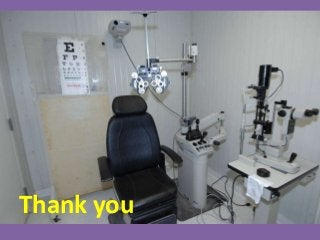
Thank you

Optometry profession

  • 1.
    Optometry- Profession inNepal Gauri Shankar Shrestha, M.optom, FIACLE Assistant Professor
  • 2.
    Introduction • Optometryis a health care profession that is autonomous, educated and regulated (licensed/Registered) • Optometrists are the primary healthcare practitioners of eye and visual system who provide comprehensive eye and vision care that includes refraction and dispensing, diagnosis and management of eye diseases and rehabilitation of conditions of the visual system.
  • 3.
    Who are optometrists • Graduates from +2 science and has completed the Bachelor of Optometry and vision Science degree
  • 4.
    Scope of Optometry • Refraction and Dispensing • Contact lens practice-Rose-K, OrthoK, • Low Vision and rehabilitative optometry • Orthoptist and vision therapist • Industrial optometry and environmental Vision and occupational optometrist • Primary eye care and therapeutic optometry
  • 5.
    Scope of Optometry • Optometry and sports • Optical industry • Work in multi-National company • Academic- teaching • Research- Vision and optometry
  • 6.
    Optometry in Nepal • Newest-1998 • Before 1998 – 1981-OA training – 1987-ophthalmology training • Human resources before 1998 – Ophthal – OAs – Technicians – Orthoptists – Opticians
  • 7.
    Optometry in Nepal • 17th Batch • 66 optometrists graduated • Foreign candidates: 3
  • 8.
    Program goal •To produce competent, compassionate, and community oriented optometrists who is capable of – Providing eye and vision care – Identify ocular diseases and related systemic illness – Refer the ocular emergencies and surgical cases
  • 9.
    Admission criteria •50% aggregates – ISc biology from Tribhuvan University – +2 with Biology HSEC – A-level • Age: 25 years • Merit basis on entrance exam
  • 10.
    Specialty courses •Ocular diseases • Refraction and dispensing • Low vision • Orthoptics • Contact lens • Pediatric optometry • Geriatric optometry • Community optometry • Elective posting-6-8 weeks
  • 11.
    Professional Career •Successful independent practitioner (Global data) • Opportunity to be self employed either as a partner or a sole practitioner • Work at health care institutions • A responsible position in the community as a health professional
  • 12.
    Professional career •Vision research, teaching and administration for various professional organizations • Work with ophthalmologists contributing in major part of ophthalmic practice • Work as optometrists in many overseas countries • Work in many ophthalmic products industry, social welfare organizations
  • 13.
    Role in threelevels of eye care • Primary eye care – VDC level (limited role) • Secondary eye care services – districts level –vision centers-Optometrists major role • Tertiary eye care services – Regional level-hospitals, centers and departments, Optometrists crucial role
  • 14.
    Primary eye careservices • Services that are required by many people most of the time to meet their non-specialized health problems • Function as the primary point of entry into the system • Role – A comprehensive range of diagnostics, therapeutics and preventive services – Health promotion and maintenance activities – Health campaigns
  • 15.
    Primary eye careservices • Referral – Within vertical dimension from the primary level to the secondary and tertiary levels • Aim – Provision of care to the right patient at the right time in the right places and for the right reason
  • 16.
    Secondary eye careservices • relative specialized services provided after referral to a consultant/specialist • Main service points • Vision centers, community hospitals
  • 17.
    Tertiary eye careservices • Tertiary care – Highly sophisticated services that require extensive technical capabilities and – Are almost always delivered on an in patient basis • Centralized at a major health complex • Low frequency of conditions require these services • A medical teaching hospital, eye hospitals or eye centers
  • 18.
    Responsibilities • PECC – Community survey – School screening – Health campaign – Eye camps – Refraction, dispensing and treatment of common ocular diseases
  • 19.
    Responsibility • Secondaryeye care services – Private/community or vision center oriented eye care services – Diagnosis and treatment of common ocular diseases – Referral of ocular emergencies, systemic illness, to medical practitioners/ophthalmologists – Refraction and spectacle dispensing – Geriatric and pediatric vision care
  • 20.
    Responsibility • Tertiaryeye care services – Contact lens services – Low vision services and rehabilitation – Binocular vision services – Sports vision visual ergonomics – Social welfare and health organizations – Ophthalmic products industry
  • 21.
    Prime responsibility •Prevention • Health education • Health promotion • Health maintenance • Diagnosis • Treatment and rehabilitation • Counseling • consultation
  • 22.
    Demography of Nepaleseoptometrists • Total number of graduates-66 – 53.7%- abroad – 46.3% Nepal • Educational status – 11.9%- M.Optom/MPH – 9% PhD/Post Doc – 22.4% Pursuing PhD • Optometrists in Nepal – 67.7% Institutional/ Hospital based practice – 32.3% Private practice
  • 23.
    Nepalese Association ofOptometrists • Optometrists formed an association in 2003 named as “Nepalese Association of Optometrists (NAO)” • NAO is involved in school screening, eye check ups, health campaigns in community • Current Partners are Optometry Giving Sight, BP eye Foundation, Volunteer organization for services of humanity • NAO is member of World council of Optometry (WCO), Asia Pacific Council of Optometry (APCO)
  • 24.
    Program Supported toNepalese Optometrists by International agencies • The Sight Conservation of Children from Marginalised Communities of Nepal – Subodh Gyawali, OD, MPH, for OGS • Eye teaming and co-ordination among school children of Kathmandu – Subodh Gyawali, OD, MPH for OGS • Ocular morbidity among street children of Kathmandu Valley – GauriSh Shrestha, M.Optom, FIACLE for WCO
  • 25.
    International conferences attendedby Nepalese Optometrists • 2004-Wco conference, Florida • 2005-Asia pacific conference, Tokyo, Japan • 2007-APCO Conference in Goa, India • 2009-APCO conference in HongKong • 2011-APCO conference in Singapore • 2012-WCO conference in USA, Chicago • 2013- APCO conference in South Korea • 2013-BCA conference in UK • 2014-AAO conference in USA, Denver • 2014-IOA conference in India
  • 26.
    Nepalese Optometrists research papers in International peer reviewed Journals • Journal of optometry • Clinical and experimental optometry • Optometry and visual science • Ophthalmic epidemiology • British Journal of Ophthalmology • Cornea • Investigative ophthalmology and visual sciences • The ocular surface
  • 27.
    Nepalese Optometrists research papers in International peer reviewed Journals • Nanomedicine: Nanotechnology, biology and medicine • Bone marrow transplantation • Perception • Journal of Vision • Journal of cognitive psychology • Indian journal of ophthalmology • Contact lens and anterior eye
  • 28.
    Nepalese Optometrists research papers in International peer reviewed Journals • Optometry and visual performance • Behavioral optometry • Clinical and experimental ophthalmology • Graves archive of clinical and experimental ophthalmology • Ophthalmology congress • Ophthalmic and physiological optics • Ophthalmology
  • 29.
    Nepalese Optometrists research papers in International peer reviewed Journals • Health and quality of life outcome • JAMA ophthalmology • Journal of glaucoma • Quality of life research • Community eye health journal • Current eye research • BMJ case reports
  • 30.
    Nepalese Optometrists research papers in national peer reviewed Journals • Nepal medical college journals • Nepalese journal of Ophthalmology • Journal of Institute of Medicine • Nepal medical college journal • Journal of Chitwan medical college • Journal of Nepal medical Association • Health Renaissance • Medical Journal of Shree Birendra Hospital
  • 31.