Product Data Sheet
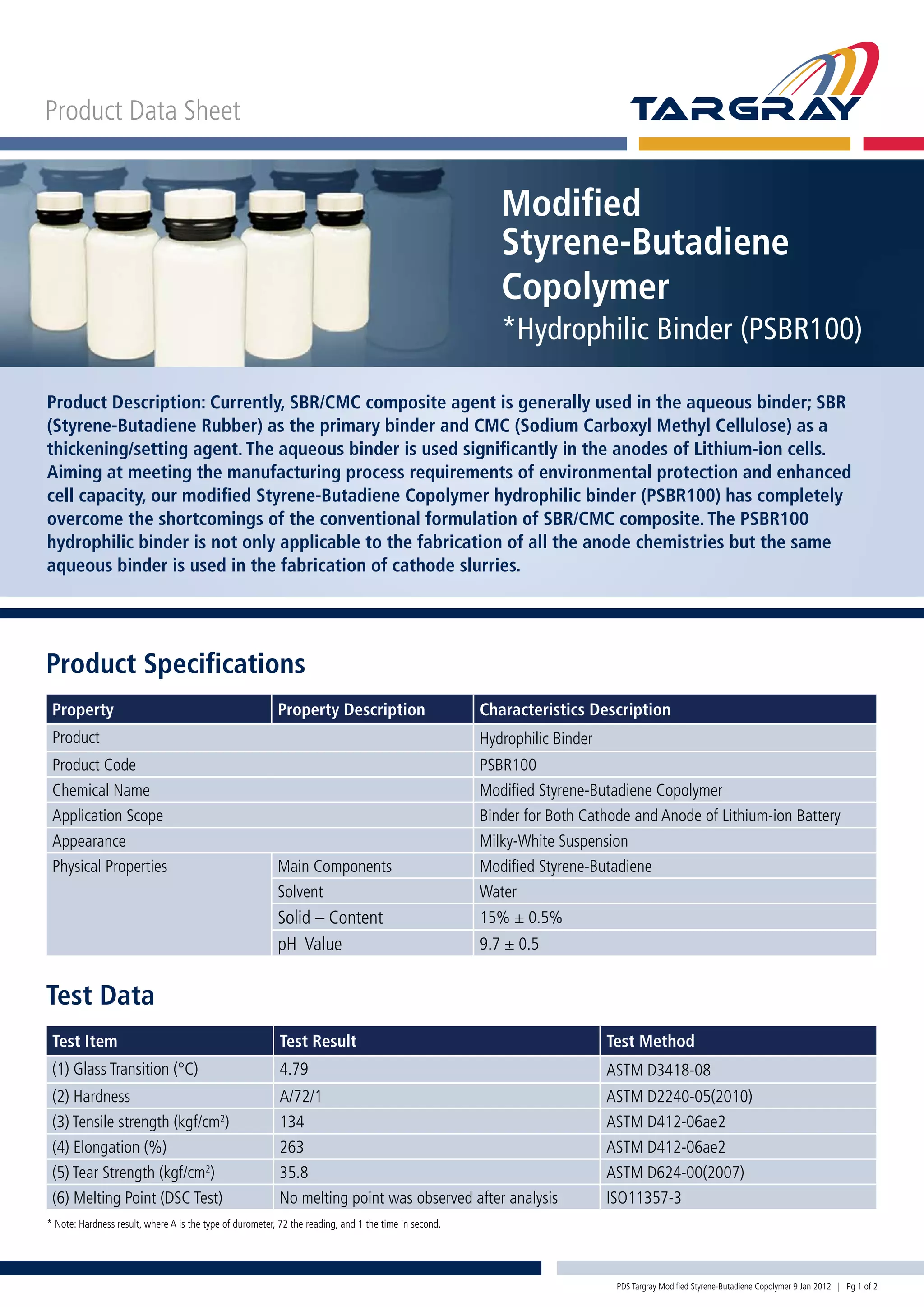
Modified
Styrene-Butadiene
Copolymer
*Hydrophilic Binder (PSBR100)
Product Description: Currently, SBR/CMC composite agent is generally used in the aqueous binder; SBR
(Styrene-Butadiene Rubber) as the primary binder and CMC (Sodium Carboxyl Methyl Cellulose) as a
thickening/setting agent. The aqueous binder is used significantly in the anodes of Lithium-ion cells.
Aiming at meeting the manufacturing process requirements of environmental protection and enhanced
cell capacity, our modified Styrene-Butadiene Copolymer hydrophilic binder (PSBR100) has completely
overcome the shortcomings of the conventional formulation of SBR/CMC composite. The PSBR100
hydrophilic binder is not only applicable to the fabrication of all the anode chemistries but the same
aqueous binder is used in the fabrication of cathode slurries.
Product Specifications
Property Property Description Characteristics Description
Product Hydrophilic Binder
Product Code PSBR100
Chemical Name Modified Styrene-Butadiene Copolymer
Application Scope Binder for Both Cathode and Anode of Lithium-ion Battery
Appearance Milky-White Suspension
Physical Properties Main Components Modified Styrene-Butadiene
Solvent Water
Solid – Content 15% ± 0.5%
pH Value 9.7 ± 0.5
PDS Targray Modified Styrene-Butadiene Copolymer 9 Jan 2012 | Pg 1 of 2
Test Data
Test Item Test Result Test Method
(1) Glass Transition (°C) 4.79 ASTM D3418-08
(2) Hardness A/72/1 ASTM D2240-05(2010)
(3) Tensile strength (kgf/cm2
) 134 ASTM D412-06ae2
(4) Elongation (%) 263 ASTM D412-06ae2
(5) Tear Strength (kgf/cm2
) 35.8 ASTM D624-00(2007)
(6) Melting Point (DSC Test) No melting point was observed after analysis ISO11357-3
* Note: Hardness result, where A is the type of durometer, 72 the reading, and 1 the time in second.
Montreal Head Office
18105 Transcanadienne, Kirkland, Quebec H9J 3Z4 Canada
Tel.: +1 514 695 8095 • Fax.: +1 514 695 0593
www.targray.com
Modified Styrene-Butadiene Copolymer Hydrophilic Binder PSBR100
Product Performance
The electrochemical characteristics of coin cells composed of electrodes using different binders are shown in Figures 1 and
2, respectively. Fig. 1 depicts the charge and discharge curves of a cathode made using the PSBR100 hydrophilic binder
whereas Fig. 2 depicts the charge and discharge curves of another cathode made using a PVDF binder.As compared to
the performance of the cathode using PVDF binder, the adoption of hydrophilic binder is capable of delivering completely
the capacity of the cathode material (approximately 140mAh/g as illustrated in Figure 1 and 2).The unique superiority of
hydrophilic binder has totally broken through the conventional restraints that an hydrophilic binder is not applicable for
use in the cathode.
PDS Targray Modified Styrene-Butadiene Copolymer 9 Jan 2012 | Pg 2 of 2
Product Advantages
The primary product advantages of the Hydrophilic binder are as follows:
•	 Use of a water solvent – environmental friendliness, process cleanliness and pollution-free
•	 Reduction of usage amount in the cathode slurry – only about 1.5% for cathode and 4% for anode, thus
	 effectively enhancing the overall cell capacity
•	 No need of environment control in the preparation – low facility requirements, thus reducing the cost of
	 plant and equipment
•	 Fast drying speed and lower drying temperature, thus substantially decreasing the electric power consumption needs
	 and speeding up the electrode production rate by 1 ~ 1.5 times
•	 Increasing electrode flexibility, thus facilitating the winding operation in the cell assembly
•	 After the electrode fabrication, no dry room in the cell assembly processes (only controlling the humidity in the
	 electrolyte filling operation)
•	 Applicability for both the open and closed formation of Lithium-ion cells
•	 No detectable difference in the electrochemical property as compared to the PVDF binder
Figure 1.
First Charge-Discharge Curves of a Cathode
made of Hydrophilic Binder
Figure 2.
First Charge-Discharge Curves of a Cathode
made of PVDF/NMP Binder

SBR Binder for Lithium-ion Battery Manufacturing

  • 1.
    Product Data Sheet Modified Styrene-Butadiene Copolymer *HydrophilicBinder (PSBR100) Product Description: Currently, SBR/CMC composite agent is generally used in the aqueous binder; SBR (Styrene-Butadiene Rubber) as the primary binder and CMC (Sodium Carboxyl Methyl Cellulose) as a thickening/setting agent. The aqueous binder is used significantly in the anodes of Lithium-ion cells. Aiming at meeting the manufacturing process requirements of environmental protection and enhanced cell capacity, our modified Styrene-Butadiene Copolymer hydrophilic binder (PSBR100) has completely overcome the shortcomings of the conventional formulation of SBR/CMC composite. The PSBR100 hydrophilic binder is not only applicable to the fabrication of all the anode chemistries but the same aqueous binder is used in the fabrication of cathode slurries. Product Specifications Property Property Description Characteristics Description Product Hydrophilic Binder Product Code PSBR100 Chemical Name Modified Styrene-Butadiene Copolymer Application Scope Binder for Both Cathode and Anode of Lithium-ion Battery Appearance Milky-White Suspension Physical Properties Main Components Modified Styrene-Butadiene Solvent Water Solid – Content 15% ± 0.5% pH Value 9.7 ± 0.5 PDS Targray Modified Styrene-Butadiene Copolymer 9 Jan 2012 | Pg 1 of 2 Test Data Test Item Test Result Test Method (1) Glass Transition (°C) 4.79 ASTM D3418-08 (2) Hardness A/72/1 ASTM D2240-05(2010) (3) Tensile strength (kgf/cm2 ) 134 ASTM D412-06ae2 (4) Elongation (%) 263 ASTM D412-06ae2 (5) Tear Strength (kgf/cm2 ) 35.8 ASTM D624-00(2007) (6) Melting Point (DSC Test) No melting point was observed after analysis ISO11357-3 * Note: Hardness result, where A is the type of durometer, 72 the reading, and 1 the time in second.
  • 2.
    Montreal Head Office 18105Transcanadienne, Kirkland, Quebec H9J 3Z4 Canada Tel.: +1 514 695 8095 • Fax.: +1 514 695 0593 www.targray.com Modified Styrene-Butadiene Copolymer Hydrophilic Binder PSBR100 Product Performance The electrochemical characteristics of coin cells composed of electrodes using different binders are shown in Figures 1 and 2, respectively. Fig. 1 depicts the charge and discharge curves of a cathode made using the PSBR100 hydrophilic binder whereas Fig. 2 depicts the charge and discharge curves of another cathode made using a PVDF binder.As compared to the performance of the cathode using PVDF binder, the adoption of hydrophilic binder is capable of delivering completely the capacity of the cathode material (approximately 140mAh/g as illustrated in Figure 1 and 2).The unique superiority of hydrophilic binder has totally broken through the conventional restraints that an hydrophilic binder is not applicable for use in the cathode. PDS Targray Modified Styrene-Butadiene Copolymer 9 Jan 2012 | Pg 2 of 2 Product Advantages The primary product advantages of the Hydrophilic binder are as follows: • Use of a water solvent – environmental friendliness, process cleanliness and pollution-free • Reduction of usage amount in the cathode slurry – only about 1.5% for cathode and 4% for anode, thus effectively enhancing the overall cell capacity • No need of environment control in the preparation – low facility requirements, thus reducing the cost of plant and equipment • Fast drying speed and lower drying temperature, thus substantially decreasing the electric power consumption needs and speeding up the electrode production rate by 1 ~ 1.5 times • Increasing electrode flexibility, thus facilitating the winding operation in the cell assembly • After the electrode fabrication, no dry room in the cell assembly processes (only controlling the humidity in the electrolyte filling operation) • Applicability for both the open and closed formation of Lithium-ion cells • No detectable difference in the electrochemical property as compared to the PVDF binder Figure 1. First Charge-Discharge Curves of a Cathode made of Hydrophilic Binder Figure 2. First Charge-Discharge Curves of a Cathode made of PVDF/NMP Binder