Environmental, Social
& Governance
The Need for Responsible Investment
For more info, contact us: xeraya@xeraya.com
Follow us: @xerayacapital
www.xeraya.com
Responsible Investment
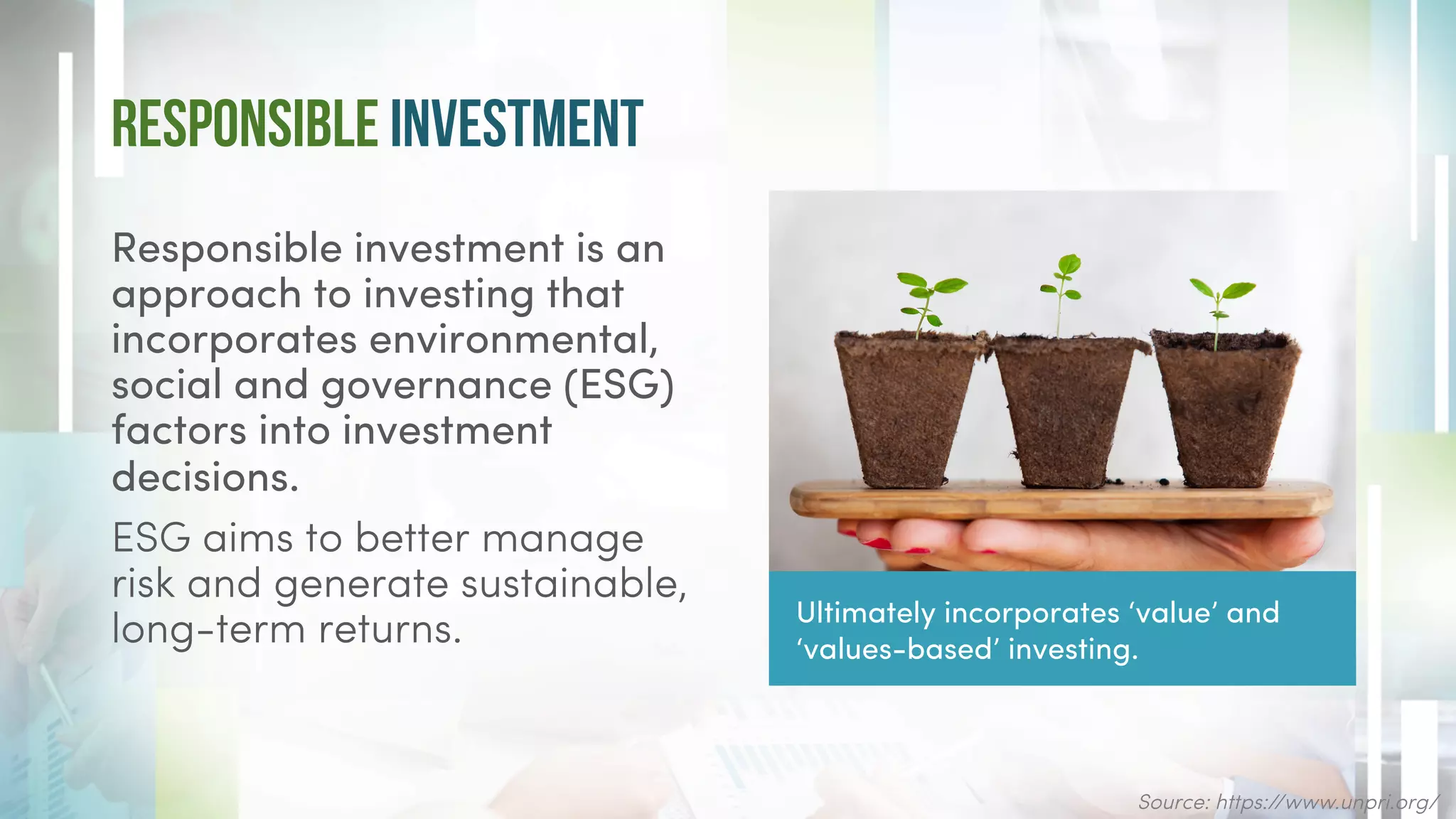
Responsible investment is an
approach to investing that
incorporates environmental,
social and governance (ESG)
factors into investment
decisions.
ESG aims to better manage
risk and generate sustainable,
long-term returns.
Source: https://www.unpri.org/
Ultimately incorporates ‘value’ and
‘values-based’ investing.
What is ESG?
Environmental, social and
governance (ESG) refers to the
3 central factors in measuring
the sustainability and ethical
impact of an investment.
ESG is for investments that
seek positive returns and long-
term impact on society,
environment and business
performance.
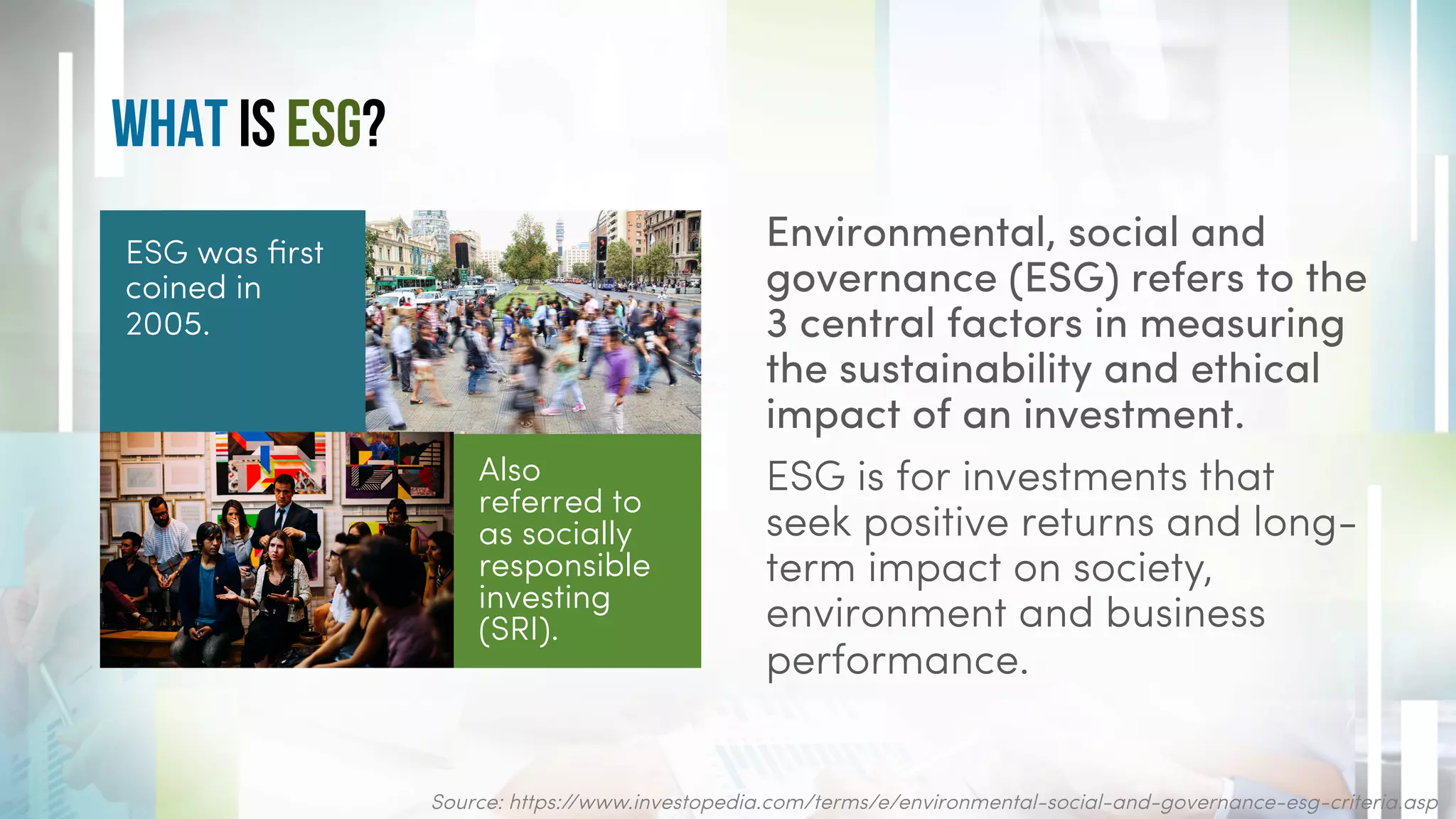
ESG was first
coined in
2005.
Source: https://www.investopedia.com/terms/e/environmental-social-and-governance-esg-criteria.asp
Also
referred to
as socially
responsible
investing
(SRI).
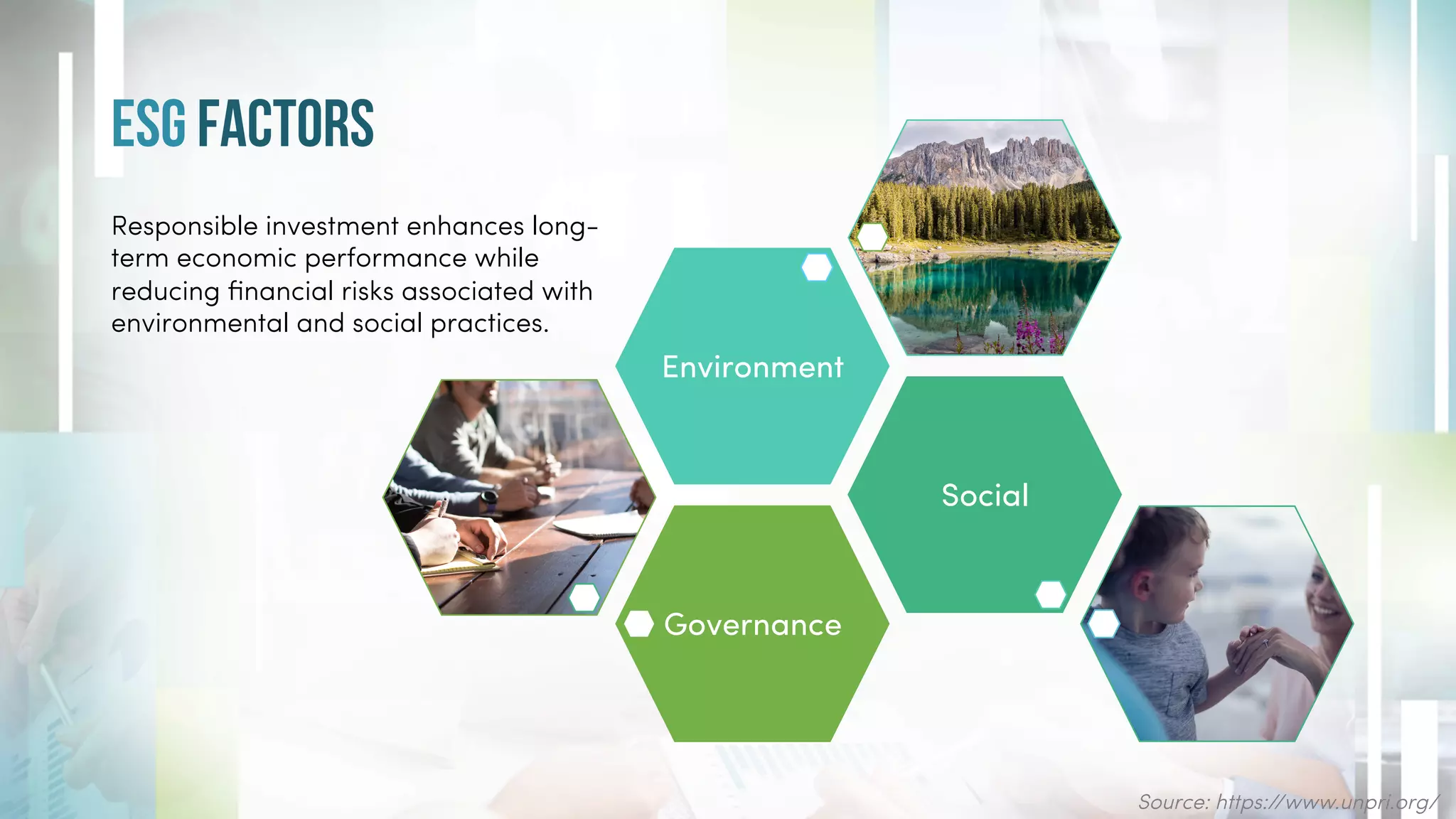
ESG Factors
Governance
Social
Environment
Responsible investment enhances long-
term economic performance while
reducing financial risks associated with
environmental and social practices.
Source: https://www.unpri.org/
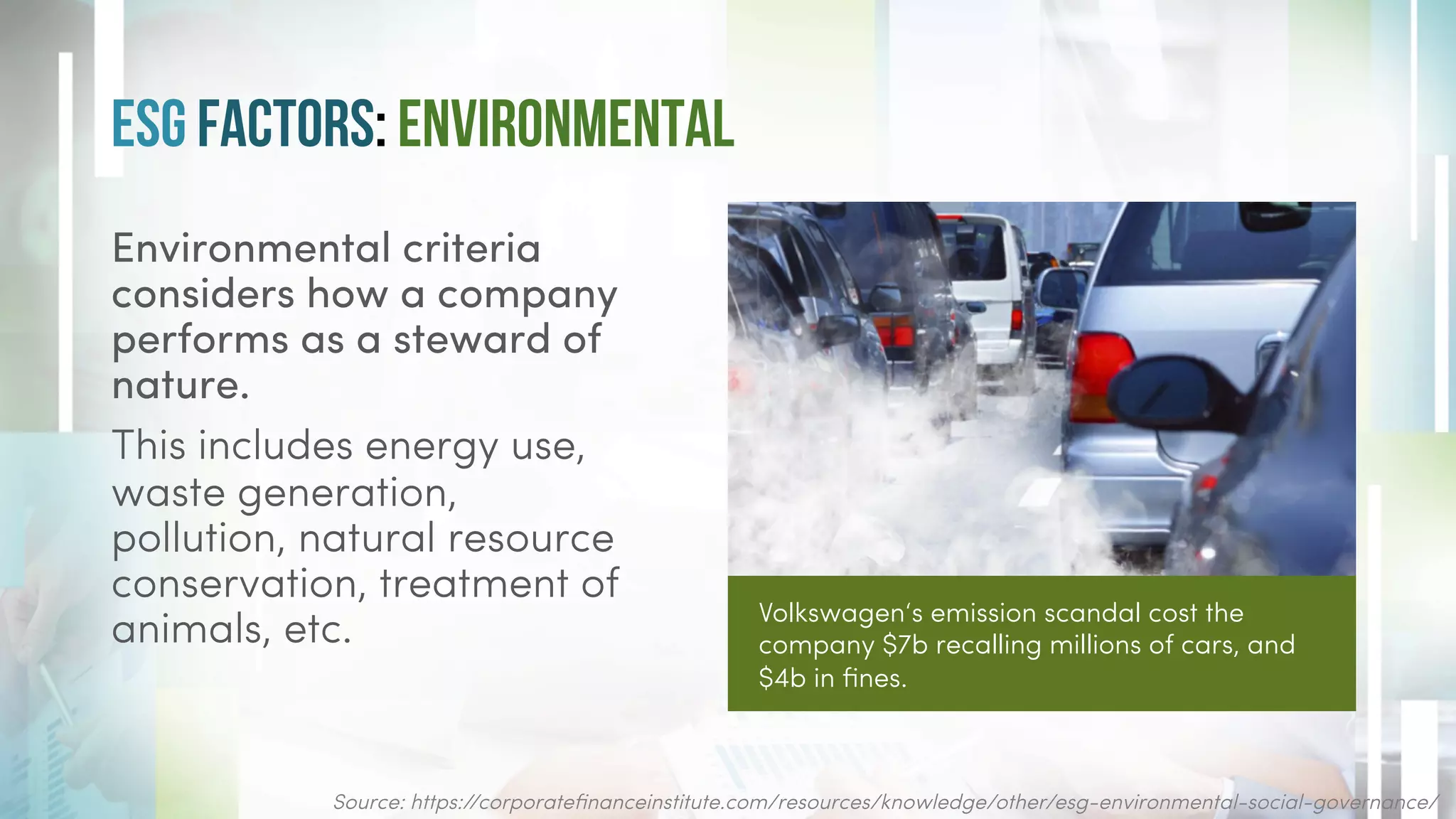
ESG Factors: Environmental
Environmental criteria
considers how a company
performs as a steward of
nature.
This includes energy use,
waste generation,
pollution, natural resource
conservation, treatment of
animals, etc.
Source: https://corporatefinanceinstitute.com/resources/knowledge/other/esg-environmental-social-governance/
Volkswagen‘s emission scandal cost the
company $7b recalling millions of cars, and
$4b in fines.
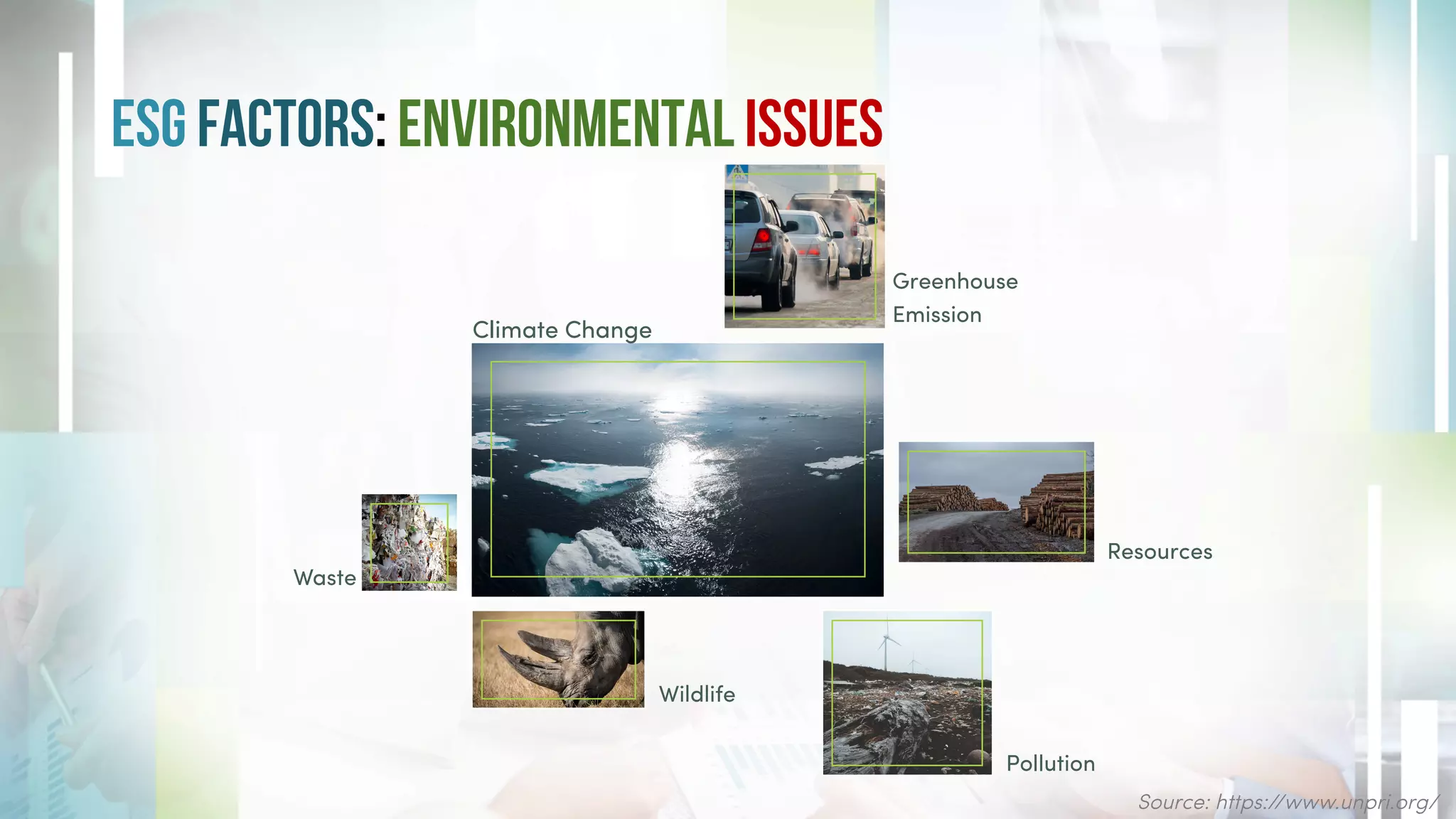
ESG Factors: Environmental ISSUES
Climate Change
Greenhouse
Emission
Resources
Waste
Pollution
Wildlife
Source: https://www.unpri.org/
Source: https://www.globalslaveryindex.org/
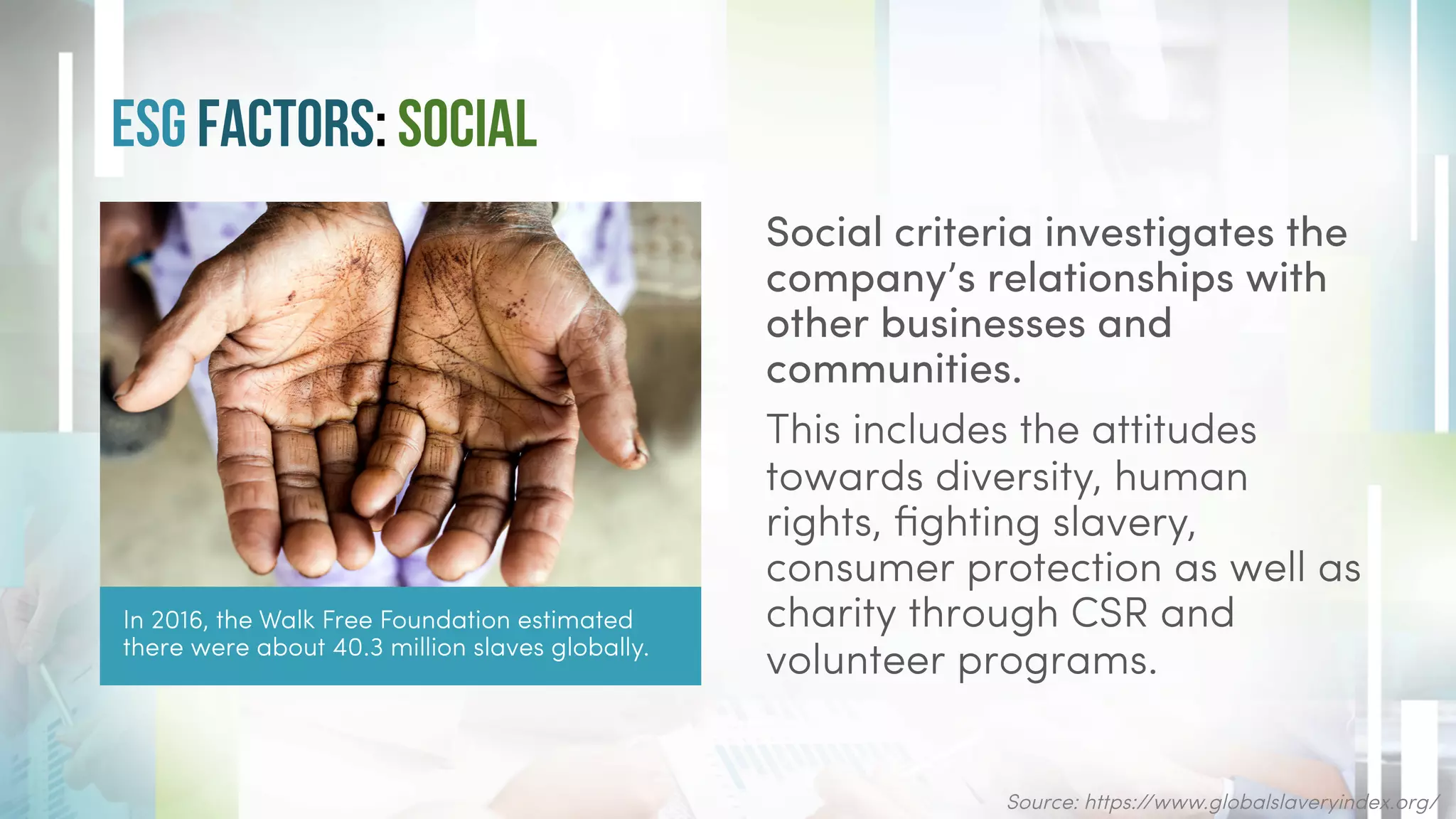
In 2016, the Walk Free Foundation estimated
there were about 40.3 million slaves globally.
ESG Factors: Social
Social criteria investigates the
company’s relationships with
other businesses and
communities.
This includes the attitudes
towards diversity, human
rights, fighting slavery,
consumer protection as well as
charity through CSR and
volunteer programs.
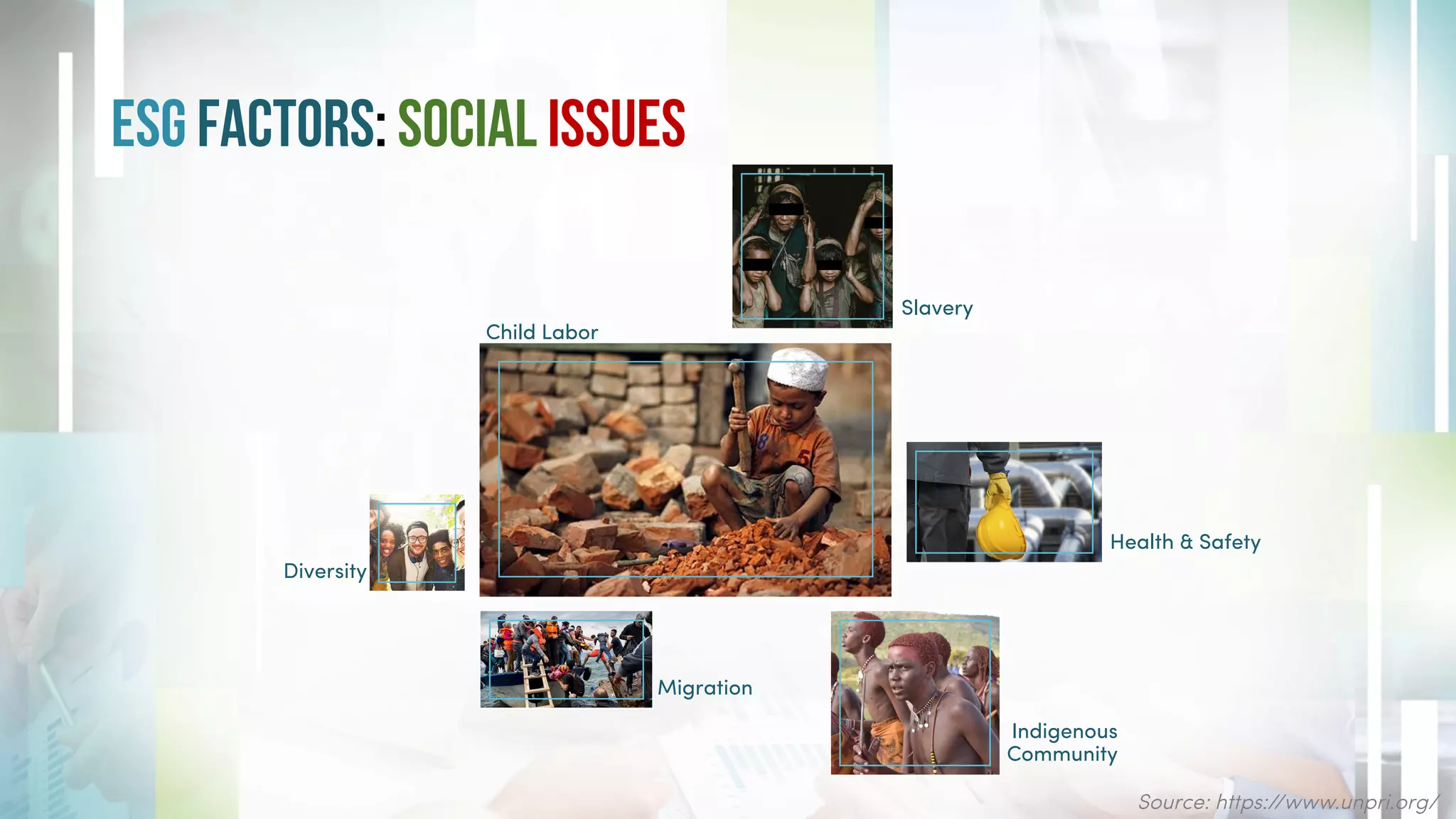
ESG Factors: Social ISSUES
Child Labor
Slavery
Health & Safety
Diversity
Indigenous
Community
Migration
Source: https://www.unpri.org/
ESG Factors: Governance
In governance, investors seek
companies that uses accurate
and transparent accounting
methods; and allows voting
on important issues.
Good governance avoid
conflicts of interest such as
bribery & corruption, crime
and other illegal practices.
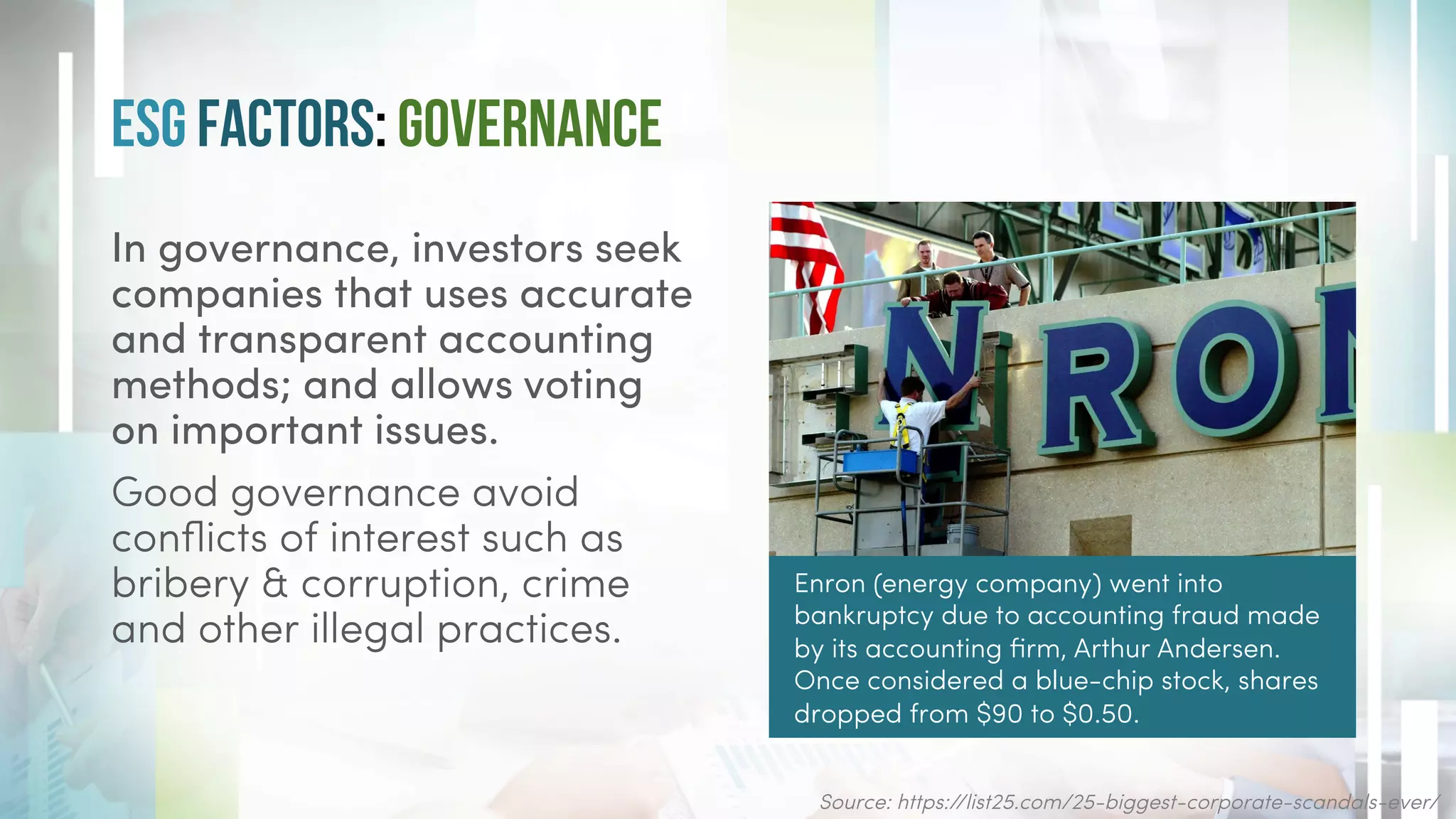
Enron (energy company) went into
bankruptcy due to accounting fraud made
by its accounting firm, Arthur Andersen.
Once considered a blue-chip stock, shares
dropped from $90 to $0.50.
Source: https://list25.com/25-biggest-corporate-scandals-ever/
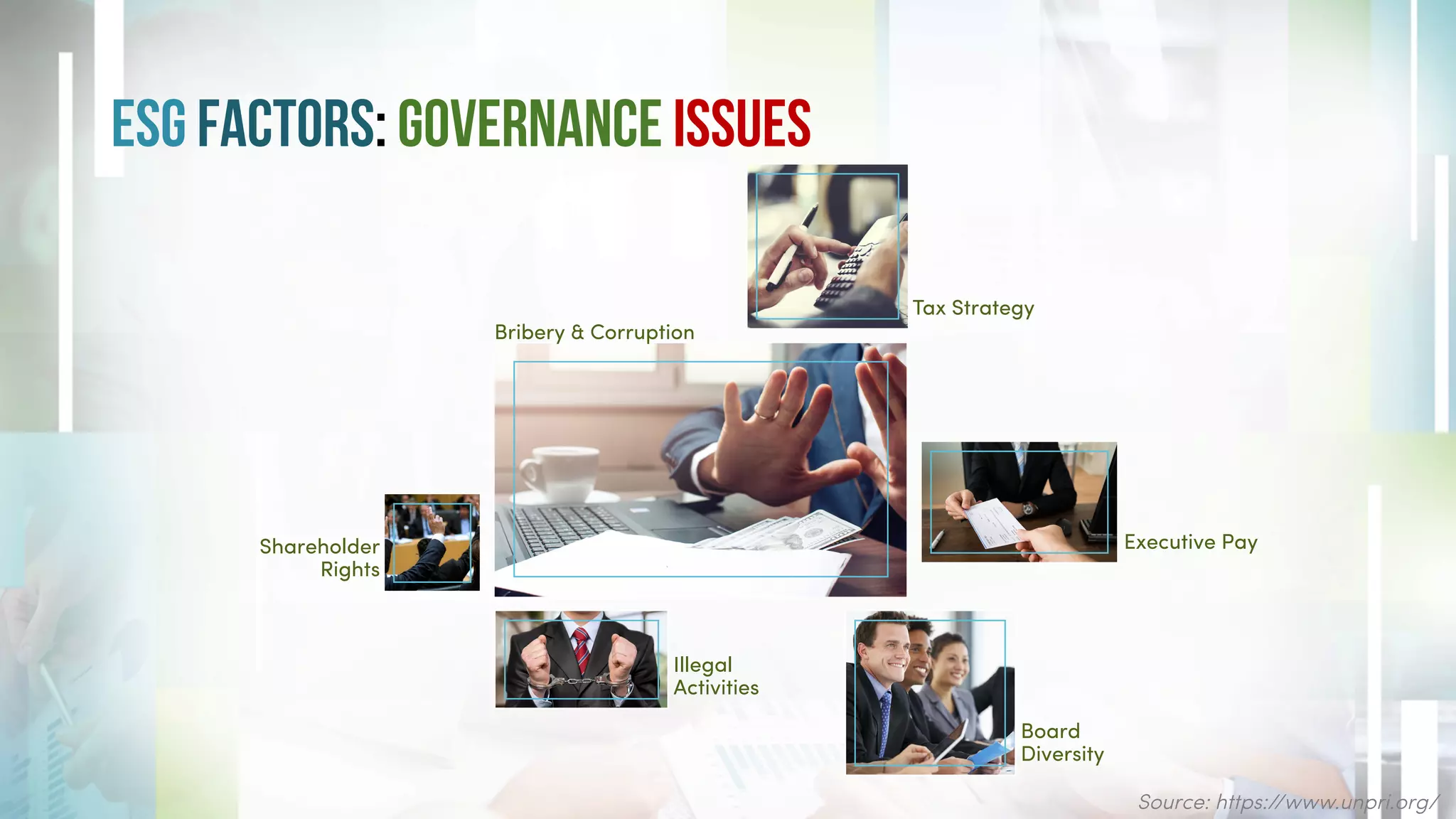
ESG Factors: Governance ISSUES
Bribery & Corruption
Tax Strategy
Executive PayShareholder
Rights
Board
Diversity
Illegal
Activities
Source: https://www.unpri.org/
Enter rinciples of responsible investment
The PRI is not associated with any
government; it is supported by, but not part
of, the United Nations (UN).
The PRI is the world’s leading
proponent of responsible
investment. It is truly
independent.
The PRI acts in the long-term
interests of its signatories, of
the financial markets and
economies in which they
operate and ultimately of the
environment and society as a
whole.
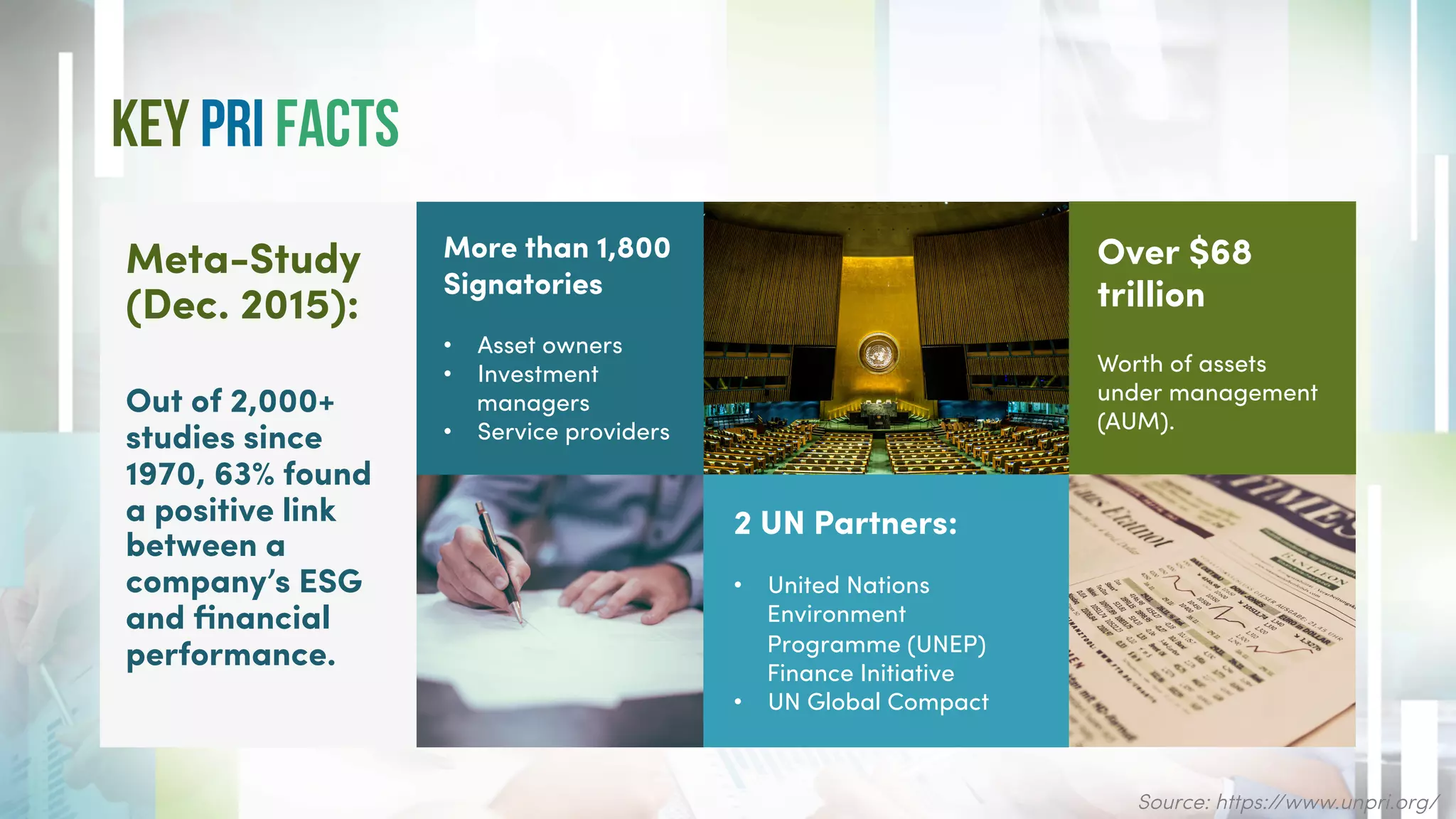
Meta-Study
(Dec. 2015):
Out of 2,000+
studies since
1970, 63% found
a positive link
between a
company’s ESG
and financial
performance.
Over $68
trillion
Worth of assets
under management
(AUM).
More than 1,800
Signatories
•  Asset owners
•  Investment
managers
•  Service providers
2 UN Partners:
•  United Nations
Environment
Programme (UNEP)
Finance Initiative
•  UN Global Compact
Key PRI Facts
Source: https://www.unpri.org/
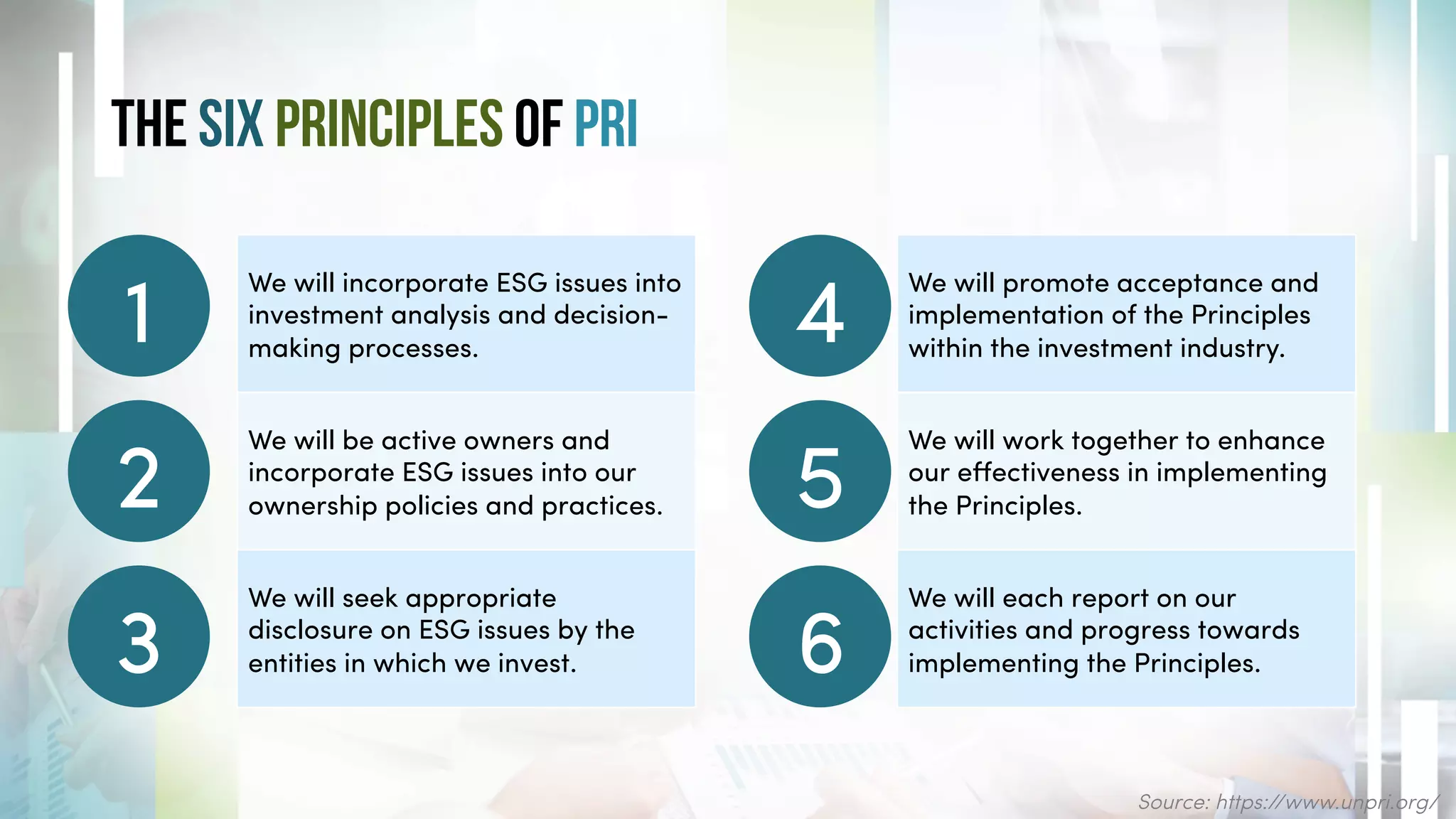
The six Principles of Pri
We will incorporate ESG issues into
investment analysis and decision-
making processes.
We will be active owners and
incorporate ESG issues into our
ownership policies and practices.
We will seek appropriate
disclosure on ESG issues by the
entities in which we invest.
Source: https://www.unpri.org/
We will promote acceptance and
implementation of the Principles
within the investment industry.
We will work together to enhance
our effectiveness in implementing
the Principles.
We will each report on our
activities and progress towards
implementing the Principles.
1
2
3
4
5
6
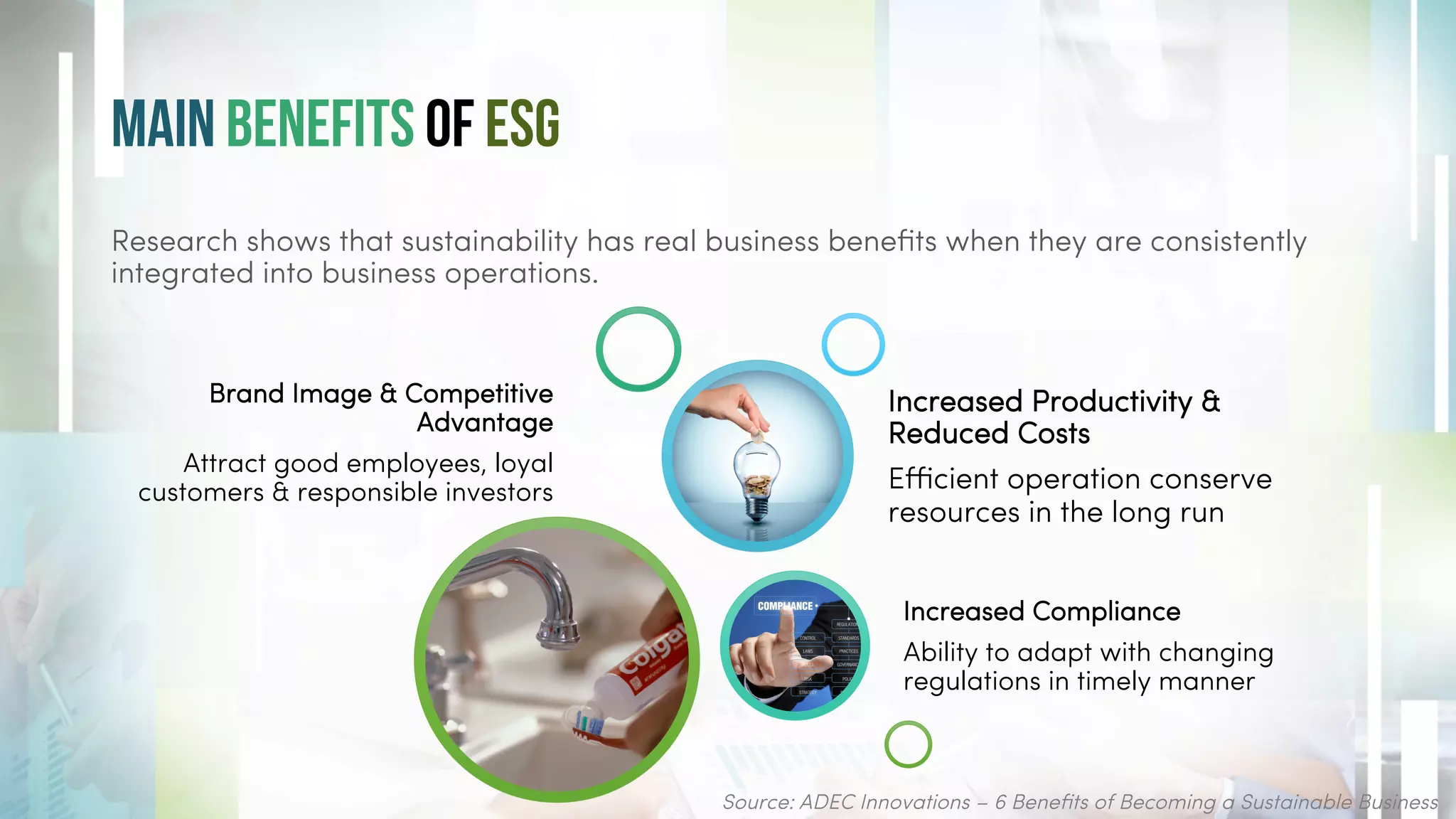
Main Benefits of ESG
Source: ADEC Innovations – 6 Benefits of Becoming a Sustainable Business
Brand Image & Competitive
Advantage
Attract good employees, loyal
customers & responsible investors
Increased Compliance
Ability to adapt with changing
regulations in timely manner
Increased Productivity &
Reduced Costs
Efficient operation conserve
resources in the long run
Research shows that sustainability has real business benefits when they are consistently
integrated into business operations.
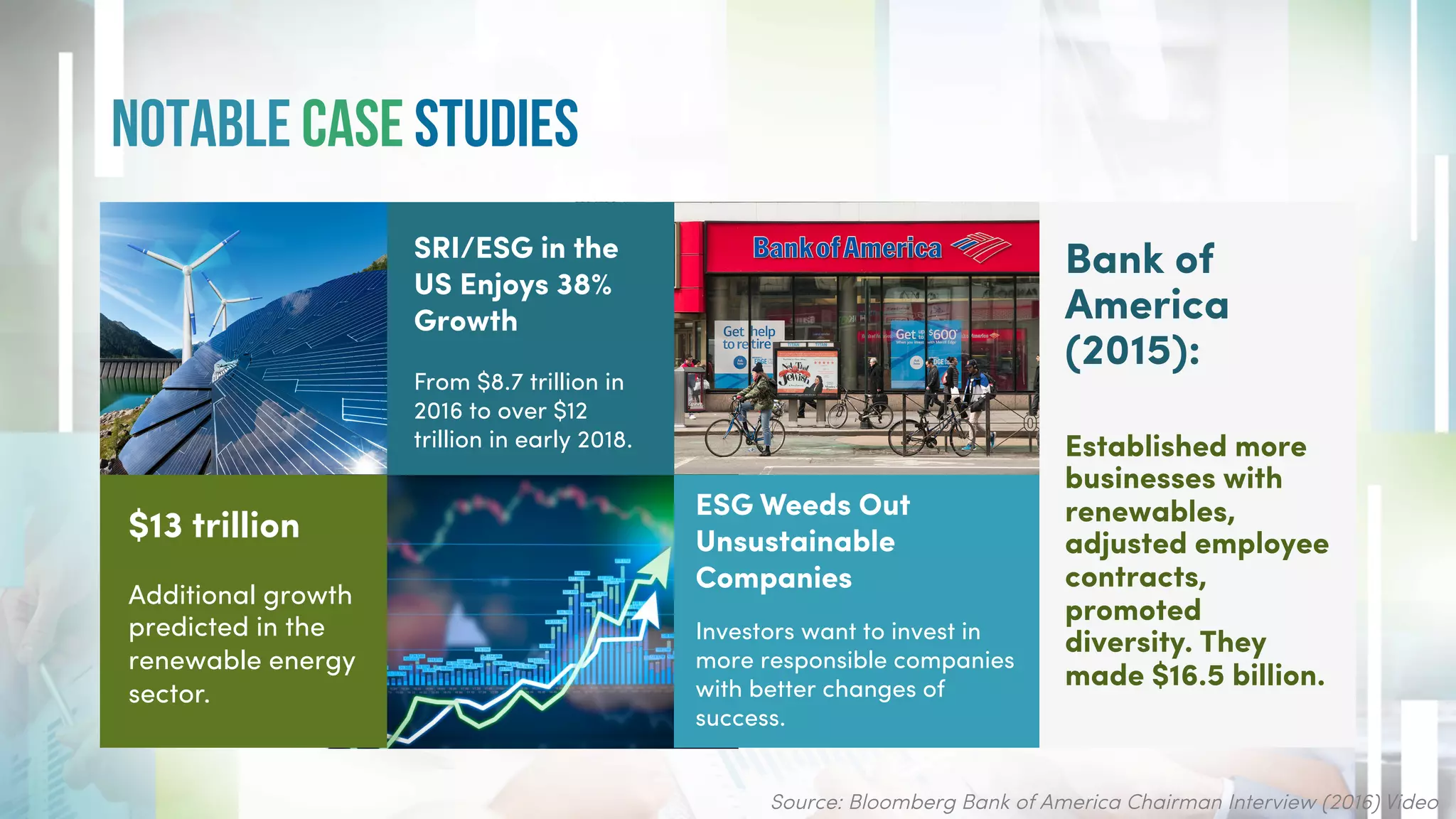
Bank of
America
(2015):
Established more
businesses with
renewables,
adjusted employee
contracts,
promoted
diversity. They
made $16.5 billion.
$13 trillion
Additional growth
predicted in the
renewable energy
sector.
SRI/ESG in the
US Enjoys 38%
Growth
From $8.7 trillion in
2016 to over $12
trillion in early 2018.
ESG Weeds Out
Unsustainable
Companies
Investors want to invest in
more responsible companies
with better changes of
success.
Notable Case Studies
Source: Bloomberg Bank of America Chairman Interview (2016) Video
Xeraya Capital: Proud Signatory PRI
As of 23rd March 2018, Xeraya Capital’s commitment to development
of a more stable, sustainable and responsible global financial system
became official.
We are one of 6 signatories in Malaysia, joining a worldwide network
of more than 1,800 fellow investors, all of whom have pledged to put
the Principles for Responsible Investment (PRI) into practice.
•  ESG or 'responsible growth', should be regarded as an
investment, not a cost.
•  ESG demands transparency and applying various standards
and policies to a company's operation, which greatly
increases compliance.
•  ESG weeds out unsustainable companies with outdated
practices and harmful side effects.
•  It helps to minimize risks for investors as they are constantly
seeking for more responsible companies with a greater
likelihood of success.
Conclusion
By xeraya capital
For more info, contact us: xeraya@xeraya.com
Follow us: @xerayacapital
www.xeraya.com

ESG: The Need for Responsible Investment

  • 1.
    Environmental, Social & Governance TheNeed for Responsible Investment For more info, contact us: xeraya@xeraya.com Follow us: @xerayacapital www.xeraya.com
  • 2.
    Responsible Investment Responsible investmentis an approach to investing that incorporates environmental, social and governance (ESG) factors into investment decisions. ESG aims to better manage risk and generate sustainable, long-term returns. Source: https://www.unpri.org/ Ultimately incorporates ‘value’ and ‘values-based’ investing.
  • 3.
    What is ESG? Environmental,social and governance (ESG) refers to the 3 central factors in measuring the sustainability and ethical impact of an investment. ESG is for investments that seek positive returns and long- term impact on society, environment and business performance. ESG was first coined in 2005. Source: https://www.investopedia.com/terms/e/environmental-social-and-governance-esg-criteria.asp Also referred to as socially responsible investing (SRI).
  • 4.
    ESG Factors Governance Social Environment Responsible investmentenhances long- term economic performance while reducing financial risks associated with environmental and social practices. Source: https://www.unpri.org/
  • 5.
    ESG Factors: Environmental Environmentalcriteria considers how a company performs as a steward of nature. This includes energy use, waste generation, pollution, natural resource conservation, treatment of animals, etc. Source: https://corporatefinanceinstitute.com/resources/knowledge/other/esg-environmental-social-governance/ Volkswagen‘s emission scandal cost the company $7b recalling millions of cars, and $4b in fines.
  • 6.
    ESG Factors: EnvironmentalISSUES Climate Change Greenhouse Emission Resources Waste Pollution Wildlife Source: https://www.unpri.org/
  • 7.
    Source: https://www.globalslaveryindex.org/ In 2016,the Walk Free Foundation estimated there were about 40.3 million slaves globally. ESG Factors: Social Social criteria investigates the company’s relationships with other businesses and communities. This includes the attitudes towards diversity, human rights, fighting slavery, consumer protection as well as charity through CSR and volunteer programs.
  • 8.
    ESG Factors: SocialISSUES Child Labor Slavery Health & Safety Diversity Indigenous Community Migration Source: https://www.unpri.org/
  • 9.
    ESG Factors: Governance Ingovernance, investors seek companies that uses accurate and transparent accounting methods; and allows voting on important issues. Good governance avoid conflicts of interest such as bribery & corruption, crime and other illegal practices. Enron (energy company) went into bankruptcy due to accounting fraud made by its accounting firm, Arthur Andersen. Once considered a blue-chip stock, shares dropped from $90 to $0.50. Source: https://list25.com/25-biggest-corporate-scandals-ever/
  • 10.
    ESG Factors: GovernanceISSUES Bribery & Corruption Tax Strategy Executive PayShareholder Rights Board Diversity Illegal Activities Source: https://www.unpri.org/
  • 11.
    Enter rinciples ofresponsible investment The PRI is not associated with any government; it is supported by, but not part of, the United Nations (UN). The PRI is the world’s leading proponent of responsible investment. It is truly independent. The PRI acts in the long-term interests of its signatories, of the financial markets and economies in which they operate and ultimately of the environment and society as a whole.
  • 12.
    Meta-Study (Dec. 2015): Out of2,000+ studies since 1970, 63% found a positive link between a company’s ESG and financial performance. Over $68 trillion Worth of assets under management (AUM). More than 1,800 Signatories •  Asset owners •  Investment managers •  Service providers 2 UN Partners: •  United Nations Environment Programme (UNEP) Finance Initiative •  UN Global Compact Key PRI Facts Source: https://www.unpri.org/
  • 13.
    The six Principlesof Pri We will incorporate ESG issues into investment analysis and decision- making processes. We will be active owners and incorporate ESG issues into our ownership policies and practices. We will seek appropriate disclosure on ESG issues by the entities in which we invest. Source: https://www.unpri.org/ We will promote acceptance and implementation of the Principles within the investment industry. We will work together to enhance our effectiveness in implementing the Principles. We will each report on our activities and progress towards implementing the Principles. 1 2 3 4 5 6
  • 14.
    Main Benefits ofESG Source: ADEC Innovations – 6 Benefits of Becoming a Sustainable Business Brand Image & Competitive Advantage Attract good employees, loyal customers & responsible investors Increased Compliance Ability to adapt with changing regulations in timely manner Increased Productivity & Reduced Costs Efficient operation conserve resources in the long run Research shows that sustainability has real business benefits when they are consistently integrated into business operations.
  • 15.
    Bank of America (2015): Established more businesseswith renewables, adjusted employee contracts, promoted diversity. They made $16.5 billion. $13 trillion Additional growth predicted in the renewable energy sector. SRI/ESG in the US Enjoys 38% Growth From $8.7 trillion in 2016 to over $12 trillion in early 2018. ESG Weeds Out Unsustainable Companies Investors want to invest in more responsible companies with better changes of success. Notable Case Studies Source: Bloomberg Bank of America Chairman Interview (2016) Video
  • 16.
    Xeraya Capital: ProudSignatory PRI As of 23rd March 2018, Xeraya Capital’s commitment to development of a more stable, sustainable and responsible global financial system became official. We are one of 6 signatories in Malaysia, joining a worldwide network of more than 1,800 fellow investors, all of whom have pledged to put the Principles for Responsible Investment (PRI) into practice.
  • 17.
    •  ESG or'responsible growth', should be regarded as an investment, not a cost. •  ESG demands transparency and applying various standards and policies to a company's operation, which greatly increases compliance. •  ESG weeds out unsustainable companies with outdated practices and harmful side effects. •  It helps to minimize risks for investors as they are constantly seeking for more responsible companies with a greater likelihood of success. Conclusion
  • 18.
    By xeraya capital Formore info, contact us: xeraya@xeraya.com Follow us: @xerayacapital www.xeraya.com