LITHIUM ION BATTERIES GOWTHAM. S
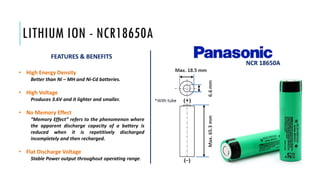
LITHIUM ION - NCR18650A
NCR 18650A
FEATURES & BENEFITS
• High Energy Density
Better than Ni – MH and Ni-Cd batteries.
• High Voltage
Produces 3.6V and it lighter and smaller.
• No Memory Effect
“Memory Effect” refers to the phenomenon where
the apparent discharge capacity of a battery is
reduced when it is repetitively discharged
incompletely and then recharged.
• Flat Discharge Voltage
Stable Power output throughout operating range.
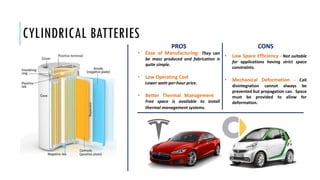
CYLINDRICAL BATTERIES
PROS CONS
• Ease of Manufacturing- They can
be mass produced and fabrication is
quite simple.
• Low Operating Cost
Lower watt-per-hour price.
• Better Thermal Management –
Free space is available to install
thermal management systems.
• Low Space Efficiency - Not suitable
for applications having strict space
constraints.
• Mechanical Deformation - Cell
disintegration cannot always be
prevented but propagation can. Space
must be provided to allow for
deformation.
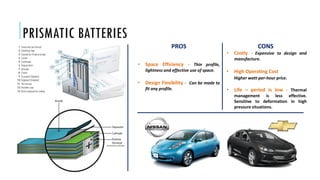
PRISMATIC BATTERIES
PROS CONS
• Space Efficiency - Thin profile,
lightness and effective use of space.
• Design Flexibility - Can be made to
fit any profile.
• Costly - Expensive to design and
manufacture.
• High Operating Cost
Higher watt-per-hour price.
• Life – period is low - Thermal
management is less effective.
Sensitive to deformation in high
pressure situations.
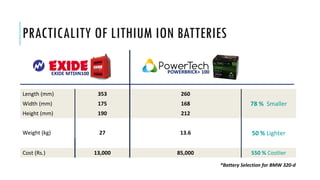
PRACTICALITY OF LITHIUM ION BATTERIES
Length (mm) 353 260
78 % SmallerWidth (mm) 175 168
Height (mm) 190 212
Weight (kg) 27 13.6 50 % Lighter
Cost (Rs.) 13,000 85,000 550 % Costlier
EXIDE MTDIN100 POWERBRICK+ 100
*Battery Selection for BMW 320-d
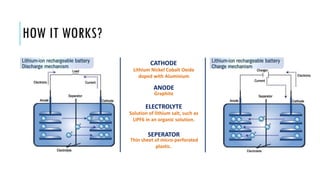
HOW IT WORKS?
CATHODE
Lithium Nickel Cobalt Oxide
doped with Aluminium
ANODE
Graphite
ELECTROLYTE
Solution of lithium salt, such as
LiPF6 in an organic solution.
SEPERATOR
Thin sheet of micro-perforated
plastic.
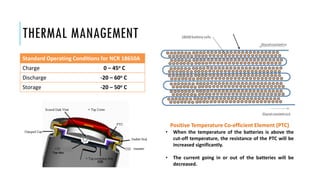
THERMAL MANAGEMENT
Standard Operating Conditions for NCR 18650A
Charge 0 – 45o C
Discharge -20 – 60o C
Storage -20 – 50o C
Positive Temperature Co-efficient Element (PTC)
• When the temperature of the batteries is above the
cut-off temperature, the resistance of the PTC will be
increased significantly.
• The current going in or out of the batteries will be
decreased.

Lithium ion battery

  • 1.
  • 2.
    LITHIUM ION -NCR18650A NCR 18650A FEATURES & BENEFITS • High Energy Density Better than Ni – MH and Ni-Cd batteries. • High Voltage Produces 3.6V and it lighter and smaller. • No Memory Effect “Memory Effect” refers to the phenomenon where the apparent discharge capacity of a battery is reduced when it is repetitively discharged incompletely and then recharged. • Flat Discharge Voltage Stable Power output throughout operating range.
  • 3.
    CYLINDRICAL BATTERIES PROS CONS •Ease of Manufacturing- They can be mass produced and fabrication is quite simple. • Low Operating Cost Lower watt-per-hour price. • Better Thermal Management – Free space is available to install thermal management systems. • Low Space Efficiency - Not suitable for applications having strict space constraints. • Mechanical Deformation - Cell disintegration cannot always be prevented but propagation can. Space must be provided to allow for deformation.
  • 4.
    PRISMATIC BATTERIES PROS CONS •Space Efficiency - Thin profile, lightness and effective use of space. • Design Flexibility - Can be made to fit any profile. • Costly - Expensive to design and manufacture. • High Operating Cost Higher watt-per-hour price. • Life – period is low - Thermal management is less effective. Sensitive to deformation in high pressure situations.
  • 5.
    PRACTICALITY OF LITHIUMION BATTERIES Length (mm) 353 260 78 % SmallerWidth (mm) 175 168 Height (mm) 190 212 Weight (kg) 27 13.6 50 % Lighter Cost (Rs.) 13,000 85,000 550 % Costlier EXIDE MTDIN100 POWERBRICK+ 100 *Battery Selection for BMW 320-d
  • 6.
    HOW IT WORKS? CATHODE LithiumNickel Cobalt Oxide doped with Aluminium ANODE Graphite ELECTROLYTE Solution of lithium salt, such as LiPF6 in an organic solution. SEPERATOR Thin sheet of micro-perforated plastic.
  • 7.
    THERMAL MANAGEMENT Standard OperatingConditions for NCR 18650A Charge 0 – 45o C Discharge -20 – 60o C Storage -20 – 50o C Positive Temperature Co-efficient Element (PTC) • When the temperature of the batteries is above the cut-off temperature, the resistance of the PTC will be increased significantly. • The current going in or out of the batteries will be decreased.