Sampling Techniques

               Module 5
Santa Rosa Science And Technology High
                School
            Basic Statistics
       Ms. Ma. Cristina C. Pegollo
Sample Problem

Suppose Ms. Bambasi wants to
 determine the weekly food
 expenditure of students, if there are
 1000 students and the guidance
 counselor decided to use only 100
 students as a sample, who will be
 included in the sample?
DEFINITION


Sampling technique is a
procedure used to determine
the individuals or members of a
sample.
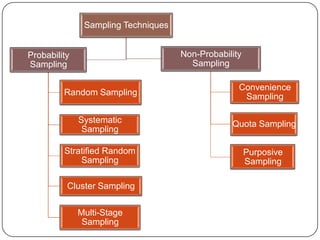
Sampling Techniques


Probability                          Non-Probability
Sampling                               Sampling

                                                   Convenience
         Random Sampling                            Sampling

              Systematic                         Quota Sampling
               Sampling

         Stratified Random                             Purposive
             Sampling                                  Sampling

          Cluster Sampling

              Multi-Stage
               Sampling
PROBABILITY Sampling
  each eligible member of the population
   has a specific and known chance of
      being included in the sample.
When using this technique, it is important
 to have a complete list of the members
             of the population
NON-PROBABILITY Sampling

Members of the sample size are drawn
   based on the judgment of the
             researcher.
Sometimes, referred to as subjective
              sampling.
Probability Sampling
1. Simple Random Sampling
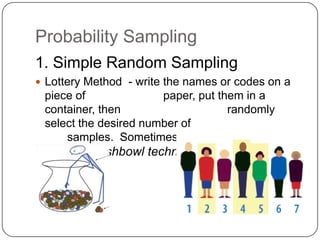
 Lottery Method - write the names or codes on a
 piece of              paper, put them in a
 container, then                    randomly
 select the desired number of
     samples. Sometimes referred to as the
            fishbowl technique.
Probability Sampling
1. Simple Random Sampling
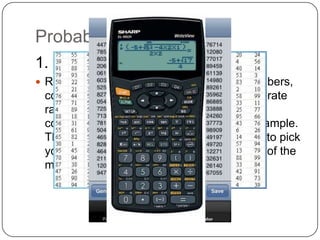
 Random Numbers – a table of random numbers,
 computer or calculator can be used to generate
 random numbers. This is perhaps a more
 convenient way of selecting your random sample.
 The randomly produced digits can be used to pick
 your samples. However, a complete listing of the
 members of the population is needed.
Probability Sampling
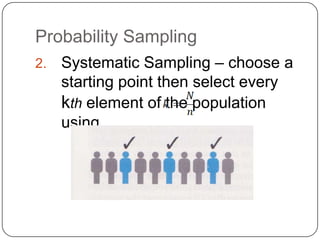
2.   Systematic Sampling – choose a
     starting point then select every
     kth element of the population
     using
Example
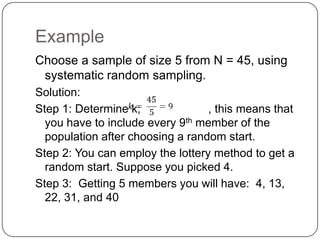
Choose a sample of size 5 from N = 45, using
 systematic random sampling.
Solution:
Step 1: Determine k;              , this means that
  you have to include every 9th member of the
  population after choosing a random start.
Step 2: You can employ the lottery method to get a
  random start. Suppose you picked 4.
Step 3: Getting 5 members you will have: 4, 13,
  22, 31, and 40
Probability Sampling
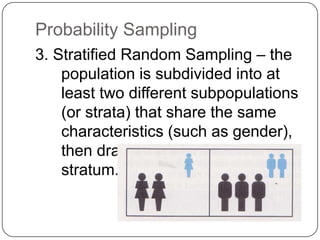
3. Stratified Random Sampling – the
    population is subdivided into at
    least two different subpopulations
    (or strata) that share the same
    characteristics (such as gender),
    then draw a sample from each
    stratum.
Example
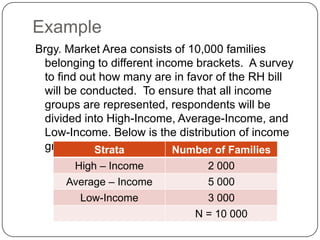
Brgy. Market Area consists of 10,000 families
 belonging to different income brackets. A survey
 to find out how many are in favor of the RH bill
 will be conducted. To ensure that all income
 groups are represented, respondents will be
 divided into High-Income, Average-Income, and
 Low-Income. Below is the distribution of income
 groups. Strata            Number of Families
      High – Income             2 000
     Average – Income           5 000
        Low-Income              3 000
                              N = 10 000
Cont…
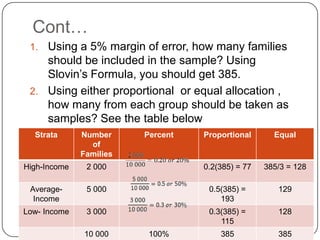
 1. Using a 5% margin of error, how many families
    should be included in the sample? Using
    Slovin’s Formula, you should get 385.
 2. Using either proportional or equal allocation ,
    how many from each group should be taken as
    samples? See the table below
  Strata      Number     Percent   Proportional      Equal
                of
              Families
High-Income    2 000               0.2(385) = 77   385/3 = 128

 Average-      5 000                0.5(385) =        129
  Income                               193
Low- Income    3 000                0.3(385) =        128
                                       115
              10 000      100%         385            385
Probability Sampling
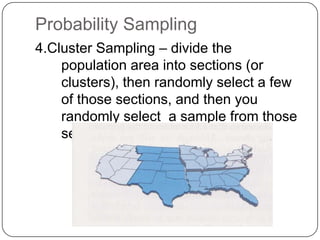
4.Cluster Sampling – divide the
    population area into sections (or
    clusters), then randomly select a few
    of those sections, and then you
    randomly select a sample from those
    selected sections.
Example
Suppose we want to determine the
 average daily expenses of families living
 in the City of Santa Rosa. Assume that
 there are 15 barangays. We can draw a
 random sample of 5 barangays using
 random sampling and then get a certain
 number of families from each of the 5
 barangays.
Probability Sampling
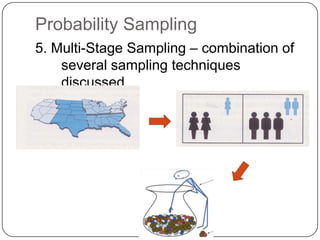
5. Multi-Stage Sampling – combination of
    several sampling techniques
    discussed.
Non-Probability Sampling
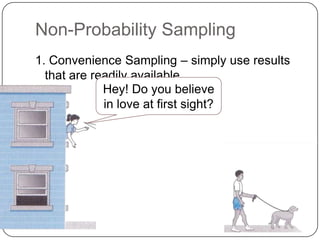
1. Convenience Sampling – simply use results
  that are readily available.
             Hey! Do you believe
             in love at first sight?
Non-Probability Sampling
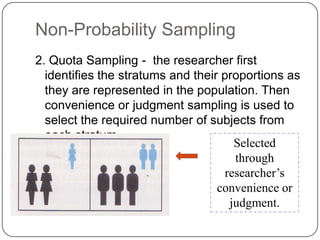
2. Quota Sampling - the researcher first
  identifies the stratums and their proportions as
  they are represented in the population. Then
  convenience or judgment sampling is used to
  select the required number of subjects from
  each stratum.
                                      Selected
                                      through
                                    researcher’s
                                   convenience or
                                     judgment.
Non-Probability Sampling
3. Purposive Sampling – selects members or
  elements based on the particular purpose of the
  experiment or study. This technique is useful for
  situations where you need to reach a targeted
  sample quickly and where sampling for
  proportionality is not the primary concern.
Sample Problem
 Suppose Ms. Bambasi wants to
  determine the weekly food expenditure
  of students, if there are 1000 students
  and the guidance counselor decided to
  use only 100 students as a sample, who
  will be included in the sample?
Activity. With your partner, help Ms.
Bambasi decide on which sampling
technique she should use in selecting
students for her sample. Present her
three choices. (Bond Paper)
Exercises:
Identify which sampling technique was used in the
  following scenarios.
1. When she wrote Women and Emoticons, author
    KC Pascual based conclusions on 4500
    responses from 100,000 questionnaires
    distributed to women.
2. The Guidance Counselor at Santa Rosa High
    School surveys all students from each of 20
    randomly selected classes.
3. A sociologist at the College of StaRSci selects
    15 men and 15 women from each of 4 Math
    Classes.
Cont…
4. IBM selects every 200th compact disk from the
   assembly line ad conducts a thorough test of
   quality.
5. The court secretary writes the name of each
   Municipal Judge on a separate card, shuffles
   the cards , and then draws 3 names.
6. The marketing manager of Ebay.ph tests a new
   sales strategy by randomly selecting 150
   consumers with less than P100 000 in gross
   income and 150 consumers with gross income
   of at least P100 000.
7. Pro-RH bill lobbyists polls 300 men and 300
   women about their views concerning the use of
   contraceptives.
Cont.
8.  A market researcher for Champion Detergent
    interviews all passengers on each of 10
    randomly selected PUVs.
9. A medical researcher from Multiliver Phils.
    interviews all leukemia patients in each of 20
    randomly selected hospitals.
10. In conducting research for the evening news, a
    reported for ABC-CBN interviews 15 people as
    they leave SM Santa Rosa.
B. Solve the following
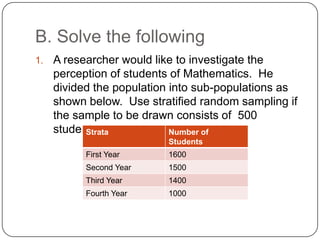
1.   A researcher would like to investigate the
     perception of students of Mathematics. He
     divided the population into sub-populations as
     shown below. Use stratified random sampling if
     the sample to be drawn consists of 500
     students.
           Strata           Number of
                          Students
           First Year     1600
           Second Year    1500
           Third Year     1400
           Fourth Year    1000
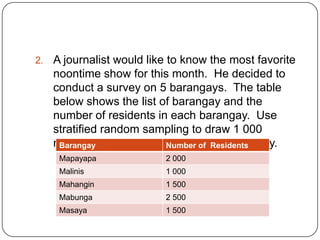
2.   A journalist would like to know the most favorite
     noontime show for this month. He decided to
     conduct a survey on 5 barangays. The table
     below shows the list of barangay and the
     number of residents in each barangay. Use
     stratified random sampling to draw 1 000
     residents who will be included in the survey.
      Barangay               Number of Residents
      Mapayapa             2 000
      Malinis              1 000
      Mahangin             1 500
      Mabunga              2 500
      Masaya               1 500

Sampling techniquesmod5

  • 1.
    Sampling Techniques Module 5 Santa Rosa Science And Technology High School Basic Statistics Ms. Ma. Cristina C. Pegollo
  • 2.
    Sample Problem Suppose Ms.Bambasi wants to determine the weekly food expenditure of students, if there are 1000 students and the guidance counselor decided to use only 100 students as a sample, who will be included in the sample?
  • 3.
    DEFINITION Sampling technique isa procedure used to determine the individuals or members of a sample.
  • 4.
    Sampling Techniques Probability Non-Probability Sampling Sampling Convenience Random Sampling Sampling Systematic Quota Sampling Sampling Stratified Random Purposive Sampling Sampling Cluster Sampling Multi-Stage Sampling
  • 5.
    PROBABILITY Sampling each eligible member of the population has a specific and known chance of being included in the sample. When using this technique, it is important to have a complete list of the members of the population
  • 6.
    NON-PROBABILITY Sampling Members ofthe sample size are drawn based on the judgment of the researcher. Sometimes, referred to as subjective sampling.
  • 7.
    Probability Sampling 1. SimpleRandom Sampling  Lottery Method - write the names or codes on a piece of paper, put them in a container, then randomly select the desired number of samples. Sometimes referred to as the fishbowl technique.
  • 8.
    Probability Sampling 1. SimpleRandom Sampling  Random Numbers – a table of random numbers, computer or calculator can be used to generate random numbers. This is perhaps a more convenient way of selecting your random sample. The randomly produced digits can be used to pick your samples. However, a complete listing of the members of the population is needed.
  • 9.
    Probability Sampling 2. Systematic Sampling – choose a starting point then select every kth element of the population using
  • 10.
    Example Choose a sampleof size 5 from N = 45, using systematic random sampling. Solution: Step 1: Determine k; , this means that you have to include every 9th member of the population after choosing a random start. Step 2: You can employ the lottery method to get a random start. Suppose you picked 4. Step 3: Getting 5 members you will have: 4, 13, 22, 31, and 40
  • 11.
    Probability Sampling 3. StratifiedRandom Sampling – the population is subdivided into at least two different subpopulations (or strata) that share the same characteristics (such as gender), then draw a sample from each stratum.
  • 12.
    Example Brgy. Market Areaconsists of 10,000 families belonging to different income brackets. A survey to find out how many are in favor of the RH bill will be conducted. To ensure that all income groups are represented, respondents will be divided into High-Income, Average-Income, and Low-Income. Below is the distribution of income groups. Strata Number of Families High – Income 2 000 Average – Income 5 000 Low-Income 3 000 N = 10 000
  • 13.
    Cont… 1. Usinga 5% margin of error, how many families should be included in the sample? Using Slovin’s Formula, you should get 385. 2. Using either proportional or equal allocation , how many from each group should be taken as samples? See the table below Strata Number Percent Proportional Equal of Families High-Income 2 000 0.2(385) = 77 385/3 = 128 Average- 5 000 0.5(385) = 129 Income 193 Low- Income 3 000 0.3(385) = 128 115 10 000 100% 385 385
  • 14.
    Probability Sampling 4.Cluster Sampling– divide the population area into sections (or clusters), then randomly select a few of those sections, and then you randomly select a sample from those selected sections.
  • 15.
    Example Suppose we wantto determine the average daily expenses of families living in the City of Santa Rosa. Assume that there are 15 barangays. We can draw a random sample of 5 barangays using random sampling and then get a certain number of families from each of the 5 barangays.
  • 16.
    Probability Sampling 5. Multi-StageSampling – combination of several sampling techniques discussed.
  • 17.
    Non-Probability Sampling 1. ConvenienceSampling – simply use results that are readily available. Hey! Do you believe in love at first sight?
  • 18.
    Non-Probability Sampling 2. QuotaSampling - the researcher first identifies the stratums and their proportions as they are represented in the population. Then convenience or judgment sampling is used to select the required number of subjects from each stratum. Selected through researcher’s convenience or judgment.
  • 19.
    Non-Probability Sampling 3. PurposiveSampling – selects members or elements based on the particular purpose of the experiment or study. This technique is useful for situations where you need to reach a targeted sample quickly and where sampling for proportionality is not the primary concern.
  • 20.
    Sample Problem SupposeMs. Bambasi wants to determine the weekly food expenditure of students, if there are 1000 students and the guidance counselor decided to use only 100 students as a sample, who will be included in the sample? Activity. With your partner, help Ms. Bambasi decide on which sampling technique she should use in selecting students for her sample. Present her three choices. (Bond Paper)
  • 21.
    Exercises: Identify which samplingtechnique was used in the following scenarios. 1. When she wrote Women and Emoticons, author KC Pascual based conclusions on 4500 responses from 100,000 questionnaires distributed to women. 2. The Guidance Counselor at Santa Rosa High School surveys all students from each of 20 randomly selected classes. 3. A sociologist at the College of StaRSci selects 15 men and 15 women from each of 4 Math Classes.
  • 22.
    Cont… 4. IBM selectsevery 200th compact disk from the assembly line ad conducts a thorough test of quality. 5. The court secretary writes the name of each Municipal Judge on a separate card, shuffles the cards , and then draws 3 names. 6. The marketing manager of Ebay.ph tests a new sales strategy by randomly selecting 150 consumers with less than P100 000 in gross income and 150 consumers with gross income of at least P100 000. 7. Pro-RH bill lobbyists polls 300 men and 300 women about their views concerning the use of contraceptives.
  • 23.
    Cont. 8. Amarket researcher for Champion Detergent interviews all passengers on each of 10 randomly selected PUVs. 9. A medical researcher from Multiliver Phils. interviews all leukemia patients in each of 20 randomly selected hospitals. 10. In conducting research for the evening news, a reported for ABC-CBN interviews 15 people as they leave SM Santa Rosa.
  • 24.
    B. Solve thefollowing 1. A researcher would like to investigate the perception of students of Mathematics. He divided the population into sub-populations as shown below. Use stratified random sampling if the sample to be drawn consists of 500 students. Strata Number of Students First Year 1600 Second Year 1500 Third Year 1400 Fourth Year 1000
  • 25.
    2. A journalist would like to know the most favorite noontime show for this month. He decided to conduct a survey on 5 barangays. The table below shows the list of barangay and the number of residents in each barangay. Use stratified random sampling to draw 1 000 residents who will be included in the survey. Barangay Number of Residents Mapayapa 2 000 Malinis 1 000 Mahangin 1 500 Mabunga 2 500 Masaya 1 500