Unlocking Difficulties:
Direction: Arrangethe scramble letters to form a correct
word base on the definition below.
ALOPTONIPU
1. Refers to the entire group that is
under study or investigation.
Unlocking Difficulties:
PLAMINGS
3. Itis a process used in statistical
analysis in which a predetermined
number of observations are taken from
a larger population.
5.
For today’s lesson,we have the following objectives:
1. Identify the different random sampling.
2. Illustrate the random sampling; and
3. Appreciate the importance of random
sampling in real -life
6.
Group Activity:
The classwill be divided into 4. Each
group will be given a task to accomplish
for 5 minutes. Ater that, a representative
from each group will present the output
in front.
7.
Analyze the followingscenarios then answer the questions
that follow.
Group 1: As of May 6, 2020, the Department of Health
recorded 131,786 unique individuals who got tested for the
COVID-19 out of approximately 109,369,019 Filipinos.
Guide Questions:
1. Identify the population.
2. How many elements are there in the population?
3. Who are the samples?
4. How many samples are selected?
8.
Group 2: Themunicipality of Cabusao has 400 family beneficiaries of
the government’s Social Amelioration spend their money during
community quarantine. He Program (SAP). The Municipal mayor
decides to survey how these recipients write each of the names of the
beneficiaries in small pieces of paper. He rolls and put them in a box
then draws 50 names to answer the survey questionnaire.
Guide Questions:
1. Identify the population.
2. How many elements are there in the population?
3. Who are the samples?
4. How many samples are selected?
9.
Group 3: Thecanteen owner of San Pedro NHS wants to
conduct a survey about the food they sell specifically
targeting Grade 11 students, who have approximately 160
enrollees. The canteen owner decided to have 60 students
who will answer the survey by proportionally selecting
them randomly per section.
Guide Questions:
1. Identify the population.
2. How many elements are there in the population?
3. Who are the samples?
4. How many samples are selected?
10.
Group 4: Adeveloper of a massively multiplayer online
role-playing game (MMORPG) wants to gather feedback on
a new update. They send a survey to a randomly selected
group of 5000 players from their database of 1 million
active players.
Guide Questions:
1. Identify the population.
2. How many elements are there in the population?
3. Who are the samples?
4. How many samples are selected?
11.
A population refersto the entire group that
is under study or investigation.
In research, the population does not always
refer to people. It may mean a group
containing elements of anything you want to
study, such as objects, events, organizations,
countries, species, organisms, etc.
12.
A sample isa subset taken from a
population, either by random or nonrandom
sampling techniques.
13.
Sampling is aprocess used in statistical
analysis in which a predetermined number
of observations are taken from a larger
population .
Example 1.
A researcherwants to study the
academic performance in Mathematics of
students in a certain school. The school has
a population of 12 000 students. If the
researcher allows a margin of error of 5%,
how many students must be included in his
sample?
A random samplingis a selection of n
elements derived from a population N,
which is the subject of the investigation or
experiment, where each sample point has
an equal chance of being selected using
the appropriate sampling technique.
18.
Types of RandomSampling Techniques
1. Simple Random sampling – sampling
technique where every member of the
population has an equal chance of being
selected.
19.
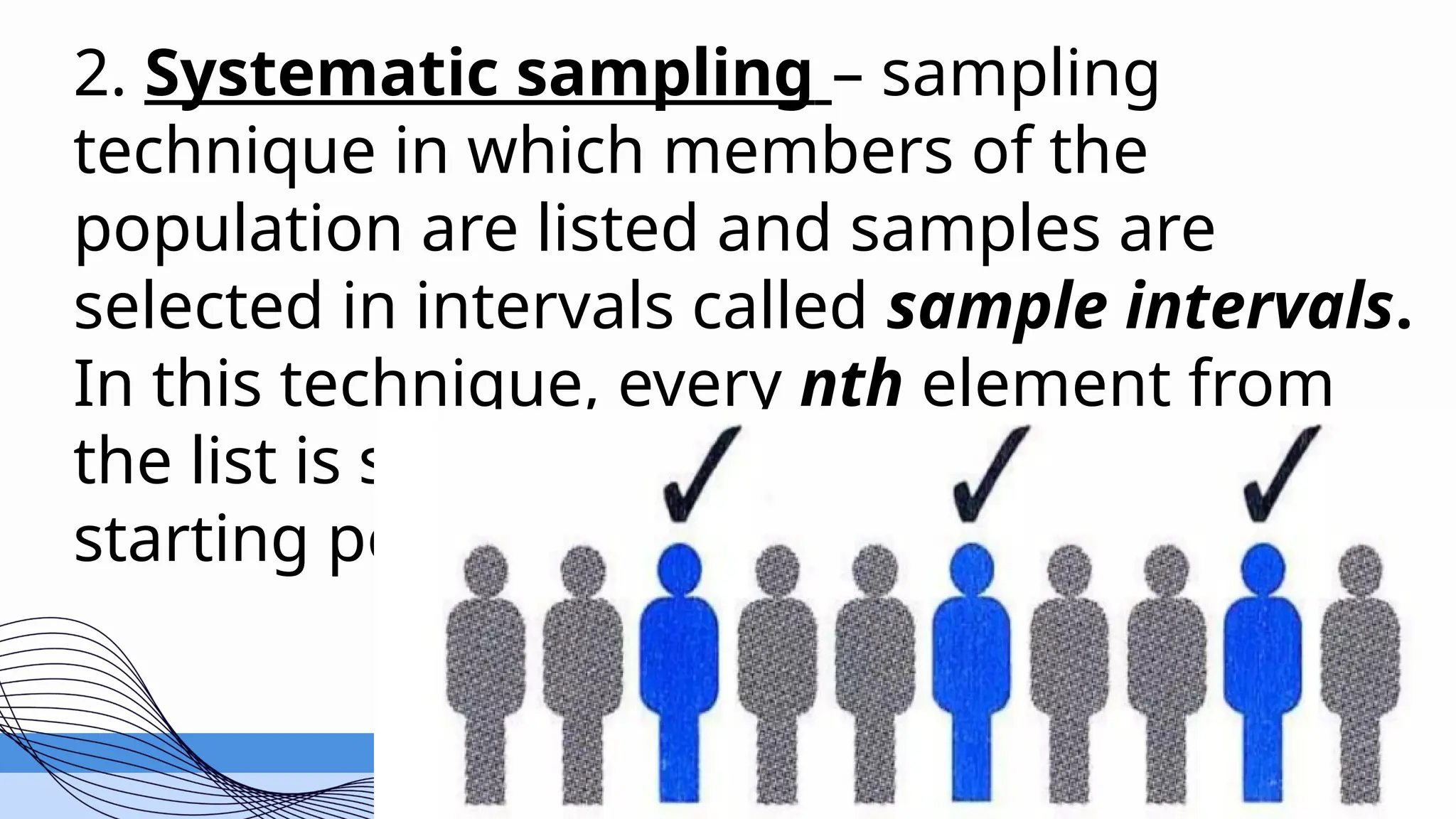
2. Systematic sampling– sampling
technique in which members of the
population are listed and samples are
selected in intervals called sample intervals.
In this technique, every nth element from
the list is selected from a randomly selected
starting point.
20.
3. Stratified randomsampling – sampling
procedure wherein the members of the
population are grouped based on their
homogeneity. This technique is used when
there are a number of distinct subgroups in
the population, within each of which is
required that there is full representation.
22.
Example:
Using stratified randomsampling, select a
sample of 400 students from the population which
are grouped according to the cities they come
from. The table shows the number of students per
city.
23.
Solution: To determinethe number of students to be taken as sample
from each city, we divide the number of students per city by total
population (N= 28,000) multiply the result by the total sample size (n=
400).
24.
4. Cluster sampling– sometimes called area
sampling, it is applied on a geographical
basis. It is generally done by first sampling at
the higher levels before going down to the
lower levels.
25.
5. Multi-stage sampling– done using a
combination of different sampling
techniques.
For example, when selecting respondents for a
national election survey, we can use the lottery
method first for regions and cities. We can then
use stratified sampling to determine the number
of respondents from selected areas and clusters.
27.
Given the differentsituations, identify the
random sampling technique used for each item
and justify your answer.
Group Activity:
28.
1. You aregiven a list of all graduating students in
your school. You decide to survey every 10th
student on the list and ask them the organization
that they belong.
2. You wishto make a comparison of the
gender differences in Mathematics
performance. You divide the population into
two groups, male and female, and randomly
pick respondents from each of the group
3. You assignnumbers to the members of
the population and then use draw lots to
obtain your samples to answer your survey
on the most popular festivals in the country
4. You randomlypick five out of fifteen
barangays to conduct your survey in your
municipality or city about their best
environment-friendly practices. –
Questions:
1.What is theimportance of random sampling in
each survey design.
Random sampling is important because it
minimizes bias and ensures the sample accurately
represents the population, leading to more reliable
survey results.
38.
2.How the conceptslearned in the lesson can be
applied to real-life situations and decision-making
processes.
39.
2.How the conceptslearned in the lesson can be
applied to real-life situations and decision-making
processes.
The concepts of sampling and data analysis
can be applied to various real-life situations, such as
market research, quality control, public opinion
polls, medical research, and environmental studies,
to make informed decisions based on representative
data.
3. What isthe reason why we do sampling?
We do sampling because it's often impractical
or impossible to study an entire population. It's
more efficient and cost-effective to study a
representative sample.
4.In what areas/disciplinecan you apply the
concept and types of random sampling? Why.
Random sampling is applicable in statistics,
social sciences, medicine, environmental science,
business, and engineering because it provides a
way to obtain unbiased and representative data
from large populations, enabling reliable
generalizations and informed decision-making.
Editor's Notes
#11 The population refers to the whole group under study or investigation. In
research, the population does not always refer to people. It may mean a group
containing elements of anything you want to study, such as objects, events,
organizations, countries, species, organisms, etc.
#14 To determine the desired number of samples needed given a certain number of population, there are different formulas can be used, one of which is Slovin’s Formula.
#18 There are no rules that dictate where and how you will start the selection process, as long as you do not intentionally look for a specific number. In this method, the samples can be selected through:
a. Lottery Method Every member is assigned a unique number. These numbers are put in a jar and thoroughly mixed. After that, the researcher picks some numbers without looking at it and those people are included in the study.
b. Use of Table of Random Numbers This table consists of a series of digits (0-9) that are generated randomly. The numbers are arranged in rows and columns and can be read in any direction. All the digits are equally probable.
#19 For example, if we want to draw a 200 sample from a population of 6,000, we can select every 3rd person in the list. In practice, the numbers between 1 and 30 will be chosen randomly to act as the starting point.
#20 The sample is constructed by classifying the population into subpopulations or strata on the basis of certain characteristics of the population, such as age, gender or socio-economic status. The selection of elements is then done separately from within each stratum, usually by random or systematic sampling methods.
#24 For example, samples are taken randomly from the provinces first, followed by cities, municipalities or barangays, and then from households.
#25 . For example, when selecting respondents for a national election survey, we can use the lottery method first for regions and cities. We can then use stratified sampling to determine the number of respondents from selected areas and clusters.