Learning Objectives
1
 Distinguish between probability and non-probability
sampling
 Identify factors to consider when determining sample size
 Differentiate the techniques of probability sampling
methods
 Able to select appropriate sampling method for different
studies
Sampling
2
Sampling
 Studying an entire population is not always
feasible, primarily due to constraints like time,
expenses, and resource limitations.
 Researchers answer research questions using a
sample of participants.
3
What is Sampling?
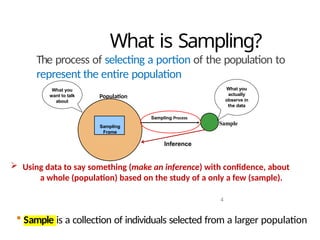
The process of selecting a portion of the population to
represent the entire population
4
Population
Sample
 Using data to say something (make an inference) with confidence, about
a whole (population) based on the study of a only a few (sample).
Sampling
Frame
Sampling Process
What you
want to talk
about
What you
actually
observe in
the data
Inference
 Sample is a collection of individuals selected from a larger population
Sampling Terminology
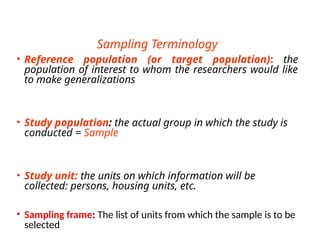
• Reference population (or target population): the
population of interest to whom the researchers would like
to make generalizations
• Study population: the actual group in which the study is
conducted = Sample
• Study unit: the units on which information will be
collected: persons, housing units, etc.
• Sampling frame: The list of units from which the sample is to be
selected
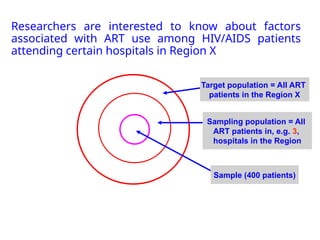
Researchers are interested to know about factors
associated with ART use among HIV/AIDS patients
attending certain hospitals in Region X
Target population = All ART
patients in the Region X
Sampling population = All
ART patients in, e.g. 3,
hospitals in the Region
Sample (400 patients)
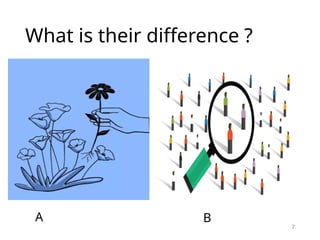
What is their difference ?
7
A B
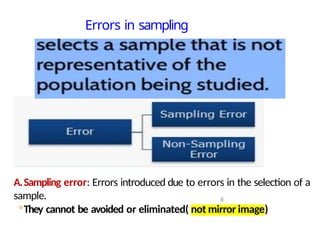
Errors in sampling
8
A.Sampling error: Errors introduced due to errors in the selection of a
sample.
◦They cannot be avoided or eliminated( not mirror image)
Sampling Error…
Difference in characteristics of a sample and population
from which the sample is drawn.
Can minimized by using ;
appropriate sampling techniques,
increasing the sample size,
Employing appropriate statistical methods
9
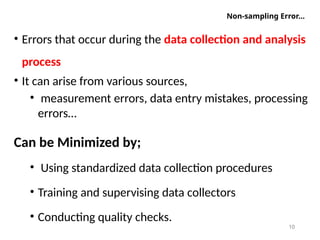
Non-sampling Error…
• Errors that occur during the data collection and analysis
process
• It can arise from various sources,
• measurement errors, data entry mistakes, processing
errors…
Can be Minimized by;
• Using standardized data collection procedures
• Training and supervising data collectors
• Conducting quality checks.
10
11
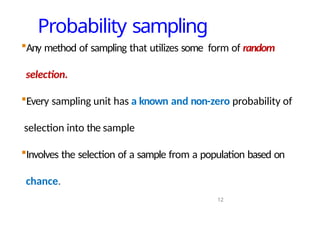
Probability sampling
12
Any method of sampling that utilizes some form of random
selection.
Every sampling unit has a known and non-zero probability of
selection into the sample
Involves the selection of a sample from a population based on
chance.
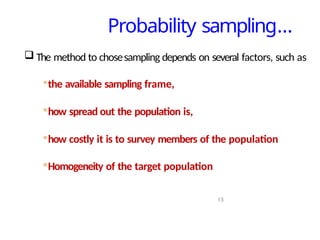
Probability sampling…
13
 The method to chosesampling depends on several factors, such as
◦the available sampling frame,
◦how spread out the population is,
◦how costly it is to survey members of the population
◦Homogeneity of the target population
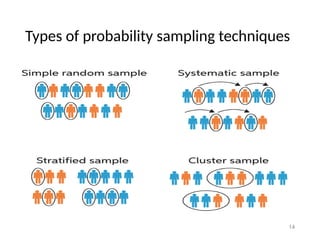
Types of probability sampling techniques
14
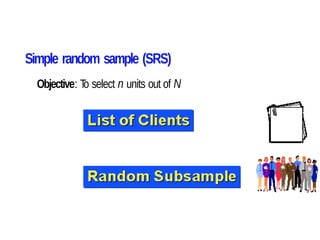
Simple random sample (SRS)
15
Objective: T
o select n units out of N
Simple random sampling…
16
Therequired number of individuals are selected at random from
the sampling frame, a list or a database of all individuals in the
population
Each member of a population has an equal chance of being included
in the sample.
To use a SRS method:
◦Make a numbered list of all the units in the population
◦Each unit should be numbered from 1 to N (where N is the size of
the population).
Simple random
sampling
17
The randomness of the sample is ensured by:
◦Use of “lottery’ methods
◦Table of random numbers
◦Computer programs
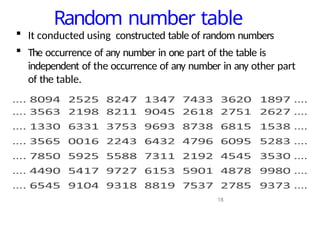
Random number table
18
 It conducted using constructed table of random numbers
 The occurrence of any number in one part of the table is
independent of the occurrence of any number in any other part
of the table.
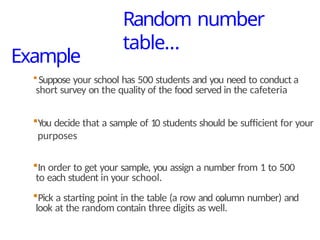
Example
19
Suppose your school has 500 students and you need to conduct a
short survey on the quality of the food served in the cafeteria
You decide that a sample of 10 students should be sufficient for your
purposes
In order to get your sample, you assign a number from 1 to 500
to each student in your school.
Pick a starting point in the table (a row and column number) and
look at the random contain three digits as well.
Random number
table…
Limitations of SRS
20
◦Requires a sampling frame.
◦Difficult if the reference population is dispersed.
◦Minority subgroups of interest may not be selected
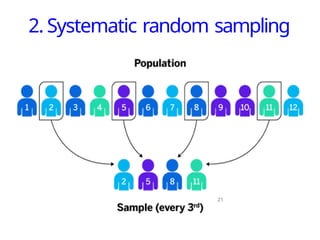
2. Systematic random sampling
21
Systematic random sampling…
 Selection of individuals from the sampling frame systematically
rather than randomly
 Taking individuals at fixed intervals (every kth) based on the sampling
fraction.
 The starting point is chosen at random
• Important if the reference population is arranged in some order:
• Order of registration of patients
• Numerical number of house numbers
• Student’s registration books
Steps in systematic random
sampling
23
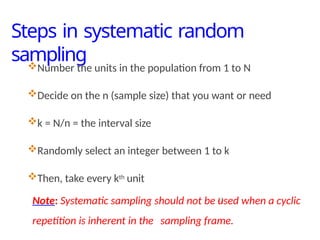
Number the units in the population from 1 to N
Decide on the n (sample size) that you want or need
k = N/n = the interval size
Randomly select an integer between 1 to k
Then, take every kth unit
Note: Systematic sampling should not be used when a cyclic
repetition is inherent in the sampling frame.
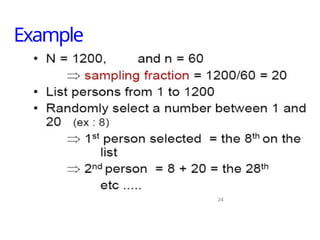
Example
24
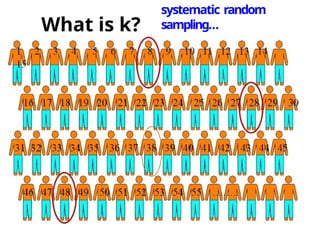
What is k?
25
3
8
systematic random
sampling…
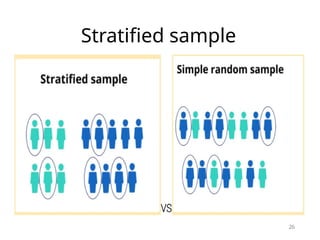
Stratified sample
26
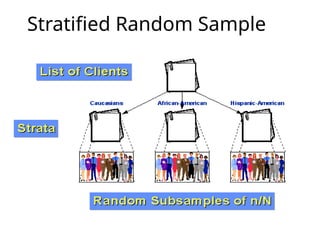
Stratified Random Sample
Stratified random sampling
• It is done when the population is known to be have
heterogeneity with regard to some factors and those factors
are used for stratification.
• Using stratified sampling, the population is divided into
homogeneous, mutually exclusive groups called strata, and
• A population can be stratified by any variable that is available
for all units prior to sampling (e.g., age, sex, province of
residence, income, etc.).
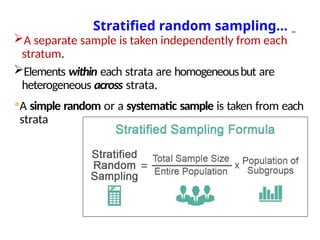
A separate sample is taken independently from each
stratum.
Elements within each strata are homogeneousbut are
heterogeneous across strata.
◦A simple random or a systematic sample is taken from each
strata
Stratified random sampling…
Advantages of stratified sampling
• Every unit in a stratum has the same chance of being
selected.
• Adequate representation of minority subgroups of
interest can be ensured by stratification and by varying
the sampling fraction between strata as required.
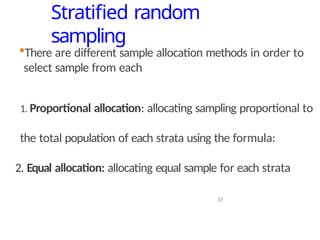
Stratified random
sampling
31
1. Proportional allocation: allocating sampling proportional to
the total population of each strata using the formula:
2. Equal allocation: allocating equal sample for each strata
There are different sample allocation methods in order to
select sample from each
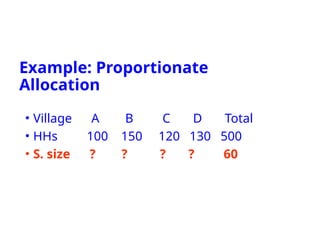
Example: Proportionate
Allocation
• Village A B C D Total
• HHs 100 150 120 130 500
• S. size ? ? ? ? 60
Cluster sampling
33
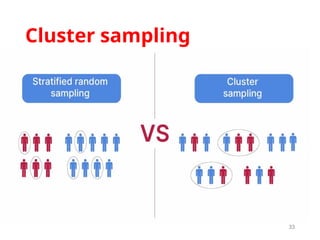
Cluster sampling
 Cluster sampling is the most widely used to reduce the cost.
 The clusters should be homogeneous, unlike stratified
sampling where the strata are heterogeneous
 Cluster sampling is a probability sampling method in which
you divide a population into clusters, such as districts or
schools, and then randomly select some of these clusters as
your sample.
Steps in cluster sampling
• A number of clusters are selected randomly to represent the
total population, and then all units within selected clusters
are included in the sample.
• No units from non-selected clusters are included in the
sample—they are represented by those from selected
clusters.
• This differs from stratified sampling, where some units are
selected from each group.
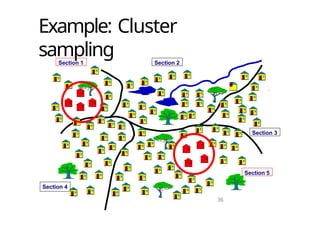
Example: Cluster
sampling
36
Section 4
Section 5
Section 3
Section 2
Section 1
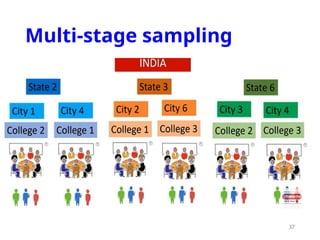
Multi-stage sampling
37
Multi-stage sampling
• Similar to the cluster sampling, except that it involves picking a
sample from within each chosen cluster, rather than including all
units in the cluster.
• This type of sampling requires at least two stages.
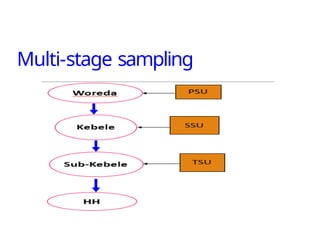
• The primary sampling unit (PSU) is the sampling unit in the first
sampling stage.
• The secondary sampling unit (SSU) is the sampling unit in the
second sampling stage, etc.
Multi-stage sampling
39
• In the first stage, large groups or clusters are identified and
selected.
• These clusters contain more population units than are needed
for the final sample.
• In the second stage, population units are picked from within the
selected clusters (using any of the possible probability sampling
methods) for a final sample.
• multi-stage sampling still saves a great amount of time and effort
by not having to create a list of all the units in a population.
• To reduce sampling error we use design effect.
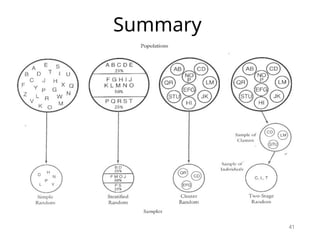
Summary
41
Non-probability sampling
 Nonprobability sampling does not involve random selection
 Units selected from a population using a subjective (i.e.
non-random) method.
 Most sampling methods are purposive in nature because
we usually approach the sampling problem with a specific
plan in mind.
 Non-probability sampling strategies are used when it is
practically impossible to use probability sampling
strategies.
 they are quick, inexpensive and convenient.
43
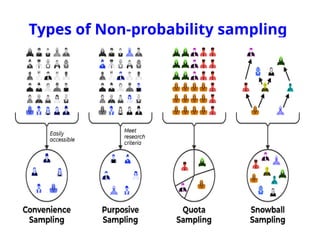
Types of Non-probability sampling
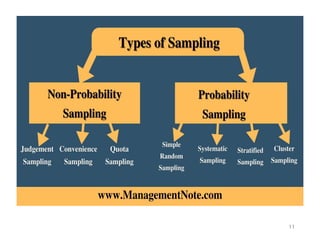
The most common types of non-probability
sampling
• Convenience sampling (or haphazard sampling)
• Purposive sampling (or judgment sampling)
• Quota sampling
• Snowball sampling (or respondent-driven
sampling)
Types of non-probability
sampling
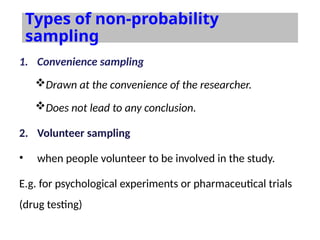
1. Convenience sampling
Drawn at the convenience of the researcher.
Does not lead to any conclusion.
2. Volunteer sampling
• when people volunteer to be involved in the study.
E.g. for psychological experiments or pharmaceutical trials
(drug testing)
Types of non-probability sampling
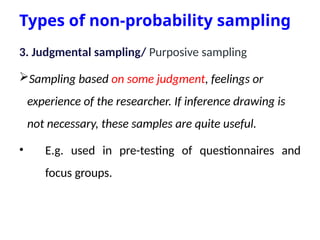
3. Judgmental sampling/ Purposive sampling
Sampling based on some judgment, feelings or
experience of the researcher. If inference drawing is
not necessary, these samples are quite useful.
• E.g. used in pre-testing of questionnaires and
focus groups.
Types of non-probability sampling
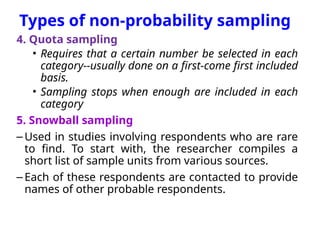
4. Quota sampling
• Requires that a certain number be selected in each
category--usually done on a first-come first included
basis.
• Sampling stops when enough are included in each
category
5. Snowball sampling
– Used in studies involving respondents who are rare
to find. To start with, the researcher compiles a
short list of sample units from various sources.
– Each of these respondents are contacted to provide
names of other probable respondents.
48

sampling.pptxhhhhbvhyghgughbhghvhvgjvnvfg

  • 1.
    Learning Objectives 1  Distinguishbetween probability and non-probability sampling  Identify factors to consider when determining sample size  Differentiate the techniques of probability sampling methods  Able to select appropriate sampling method for different studies
  • 2.
  • 3.
    Sampling  Studying anentire population is not always feasible, primarily due to constraints like time, expenses, and resource limitations.  Researchers answer research questions using a sample of participants. 3
  • 4.
    What is Sampling? Theprocess of selecting a portion of the population to represent the entire population 4 Population Sample  Using data to say something (make an inference) with confidence, about a whole (population) based on the study of a only a few (sample). Sampling Frame Sampling Process What you want to talk about What you actually observe in the data Inference  Sample is a collection of individuals selected from a larger population
  • 5.
    Sampling Terminology • Referencepopulation (or target population): the population of interest to whom the researchers would like to make generalizations • Study population: the actual group in which the study is conducted = Sample • Study unit: the units on which information will be collected: persons, housing units, etc. • Sampling frame: The list of units from which the sample is to be selected
  • 6.
    Researchers are interestedto know about factors associated with ART use among HIV/AIDS patients attending certain hospitals in Region X Target population = All ART patients in the Region X Sampling population = All ART patients in, e.g. 3, hospitals in the Region Sample (400 patients)
  • 7.
    What is theirdifference ? 7 A B
  • 8.
    Errors in sampling 8 A.Samplingerror: Errors introduced due to errors in the selection of a sample. ◦They cannot be avoided or eliminated( not mirror image)
  • 9.
    Sampling Error… Difference incharacteristics of a sample and population from which the sample is drawn. Can minimized by using ; appropriate sampling techniques, increasing the sample size, Employing appropriate statistical methods 9
  • 10.
    Non-sampling Error… • Errorsthat occur during the data collection and analysis process • It can arise from various sources, • measurement errors, data entry mistakes, processing errors… Can be Minimized by; • Using standardized data collection procedures • Training and supervising data collectors • Conducting quality checks. 10
  • 11.
  • 12.
    Probability sampling 12 Any methodof sampling that utilizes some form of random selection. Every sampling unit has a known and non-zero probability of selection into the sample Involves the selection of a sample from a population based on chance.
  • 13.
    Probability sampling… 13  Themethod to chosesampling depends on several factors, such as ◦the available sampling frame, ◦how spread out the population is, ◦how costly it is to survey members of the population ◦Homogeneity of the target population
  • 14.
    Types of probabilitysampling techniques 14
  • 15.
    Simple random sample(SRS) 15 Objective: T o select n units out of N
  • 16.
    Simple random sampling… 16 Therequirednumber of individuals are selected at random from the sampling frame, a list or a database of all individuals in the population Each member of a population has an equal chance of being included in the sample. To use a SRS method: ◦Make a numbered list of all the units in the population ◦Each unit should be numbered from 1 to N (where N is the size of the population).
  • 17.
    Simple random sampling 17 The randomnessof the sample is ensured by: ◦Use of “lottery’ methods ◦Table of random numbers ◦Computer programs
  • 18.
    Random number table 18 It conducted using constructed table of random numbers  The occurrence of any number in one part of the table is independent of the occurrence of any number in any other part of the table.
  • 19.
    Example 19 Suppose your schoolhas 500 students and you need to conduct a short survey on the quality of the food served in the cafeteria You decide that a sample of 10 students should be sufficient for your purposes In order to get your sample, you assign a number from 1 to 500 to each student in your school. Pick a starting point in the table (a row and column number) and look at the random contain three digits as well. Random number table…
  • 20.
    Limitations of SRS 20 ◦Requiresa sampling frame. ◦Difficult if the reference population is dispersed. ◦Minority subgroups of interest may not be selected
  • 21.
  • 22.
    Systematic random sampling… Selection of individuals from the sampling frame systematically rather than randomly  Taking individuals at fixed intervals (every kth) based on the sampling fraction.  The starting point is chosen at random • Important if the reference population is arranged in some order: • Order of registration of patients • Numerical number of house numbers • Student’s registration books
  • 23.
    Steps in systematicrandom sampling 23 Number the units in the population from 1 to N Decide on the n (sample size) that you want or need k = N/n = the interval size Randomly select an integer between 1 to k Then, take every kth unit Note: Systematic sampling should not be used when a cyclic repetition is inherent in the sampling frame.
  • 24.
  • 25.
    What is k? 25 3 8 systematicrandom sampling…
  • 26.
  • 27.
  • 28.
    Stratified random sampling •It is done when the population is known to be have heterogeneity with regard to some factors and those factors are used for stratification. • Using stratified sampling, the population is divided into homogeneous, mutually exclusive groups called strata, and • A population can be stratified by any variable that is available for all units prior to sampling (e.g., age, sex, province of residence, income, etc.).
  • 29.
    A separate sampleis taken independently from each stratum. Elements within each strata are homogeneousbut are heterogeneous across strata. ◦A simple random or a systematic sample is taken from each strata Stratified random sampling…
  • 30.
    Advantages of stratifiedsampling • Every unit in a stratum has the same chance of being selected. • Adequate representation of minority subgroups of interest can be ensured by stratification and by varying the sampling fraction between strata as required.
  • 31.
    Stratified random sampling 31 1. Proportionalallocation: allocating sampling proportional to the total population of each strata using the formula: 2. Equal allocation: allocating equal sample for each strata There are different sample allocation methods in order to select sample from each
  • 32.
    Example: Proportionate Allocation • VillageA B C D Total • HHs 100 150 120 130 500 • S. size ? ? ? ? 60
  • 33.
  • 34.
    Cluster sampling  Clustersampling is the most widely used to reduce the cost.  The clusters should be homogeneous, unlike stratified sampling where the strata are heterogeneous  Cluster sampling is a probability sampling method in which you divide a population into clusters, such as districts or schools, and then randomly select some of these clusters as your sample.
  • 35.
    Steps in clustersampling • A number of clusters are selected randomly to represent the total population, and then all units within selected clusters are included in the sample. • No units from non-selected clusters are included in the sample—they are represented by those from selected clusters. • This differs from stratified sampling, where some units are selected from each group.
  • 36.
    Example: Cluster sampling 36 Section 4 Section5 Section 3 Section 2 Section 1
  • 37.
  • 38.
    Multi-stage sampling • Similarto the cluster sampling, except that it involves picking a sample from within each chosen cluster, rather than including all units in the cluster. • This type of sampling requires at least two stages. • The primary sampling unit (PSU) is the sampling unit in the first sampling stage. • The secondary sampling unit (SSU) is the sampling unit in the second sampling stage, etc.
  • 39.
  • 40.
    • In thefirst stage, large groups or clusters are identified and selected. • These clusters contain more population units than are needed for the final sample. • In the second stage, population units are picked from within the selected clusters (using any of the possible probability sampling methods) for a final sample. • multi-stage sampling still saves a great amount of time and effort by not having to create a list of all the units in a population. • To reduce sampling error we use design effect.
  • 41.
  • 42.
    Non-probability sampling  Nonprobabilitysampling does not involve random selection  Units selected from a population using a subjective (i.e. non-random) method.  Most sampling methods are purposive in nature because we usually approach the sampling problem with a specific plan in mind.  Non-probability sampling strategies are used when it is practically impossible to use probability sampling strategies.  they are quick, inexpensive and convenient.
  • 43.
  • 44.
    The most commontypes of non-probability sampling • Convenience sampling (or haphazard sampling) • Purposive sampling (or judgment sampling) • Quota sampling • Snowball sampling (or respondent-driven sampling)
  • 45.
    Types of non-probability sampling 1.Convenience sampling Drawn at the convenience of the researcher. Does not lead to any conclusion. 2. Volunteer sampling • when people volunteer to be involved in the study. E.g. for psychological experiments or pharmaceutical trials (drug testing)
  • 46.
    Types of non-probabilitysampling 3. Judgmental sampling/ Purposive sampling Sampling based on some judgment, feelings or experience of the researcher. If inference drawing is not necessary, these samples are quite useful. • E.g. used in pre-testing of questionnaires and focus groups.
  • 47.
    Types of non-probabilitysampling 4. Quota sampling • Requires that a certain number be selected in each category--usually done on a first-come first included basis. • Sampling stops when enough are included in each category 5. Snowball sampling – Used in studies involving respondents who are rare to find. To start with, the researcher compiles a short list of sample units from various sources. – Each of these respondents are contacted to provide names of other probable respondents.
  • 48.

Editor's Notes

  • #27 Advantages • Every unit in a stratum has the same chance of being selected. • Using the same sampling fraction for all strata ensures proportionate representation in the sample of the characteristic being stratified. • Adequate representation of minority subgroups of interest can be ensured by stratification and by varying the sampling fraction between strata as required. Disadvantages • The sampling frame of the entire population has to be prepared separately for each stratum. • Varying the sampling fraction between strata, to ensure selection of sufficient numbers in minority subgroups for study, affects the proportiona I representativeness of the subgroups in the sample as a whole.