Mr. MUSTAQ MULLA, M. Com, NET, K-SET
Teaching Assistant
P.G. Department of Studies in Commerce
Rani Channamma University Belagavi
Post Gradate Centre, Jamkhandi.
mustak.mulla44@gmail.com
I N T R O D U C T I O N
Population / Universe: The statistics denotes the
aggregate from which sample (items) are taken.
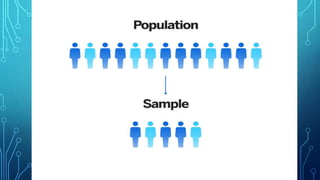
A population consists of all the objects or events of
a certain type about which researchers seek
knowledge or information.
A population can be defined as one with all the
people or items that the characteristic one wishes to
Sampling frame : is a list of which
potential respondents are drawn.
A sample: a sample is a Items, group of
people, or objects that are taken from a
larger population for measurement
“The representative of the Entre Papulation”
S a m p l e U n i t s
“A sampling unit is an individual person”,
A single element or group of elements subject to selection
in the sample.
 Primary Sampling Unit (PSU) : A unit selected in the first stage
of sampling.
 Secondary Sampling Unit :A unit selected in the second stage
of sampling.
 Tertiary Sampling Unit : A unit selected in the third stage of
sampling.
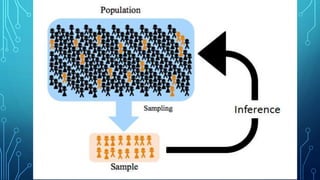
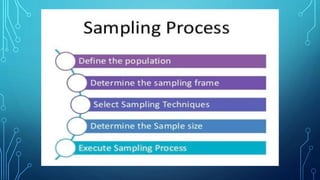
SAMPL ING
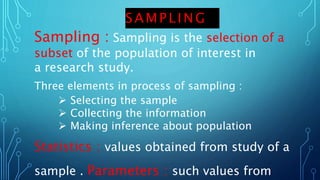
Sampling : Sampling is the selection of a
subset of the population of interest in
a research study.
Three elements in process of sampling :
 Selecting the sample
 Collecting the information
 Making inference about population
Statistics : values obtained from study of a
sample . Parameters : such values from
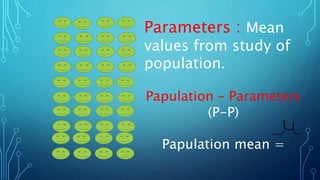
Parameters : Mean
values from study of
population.
Papulation – Parameters
(P-P)
Papulation mean =
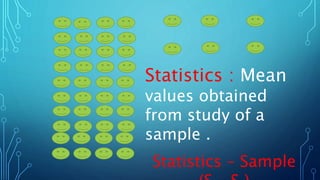
Statistics : Mean
values obtained
from study of a
sample .
Statistics – Sample
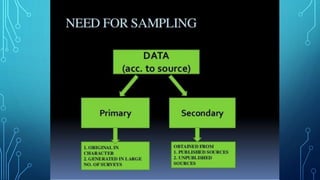
NEED FOR SAMPLING
When secondary data are not available for
the problem under study , primary data is
collected.
•Two methods –
• Census method or complete
enumeration method
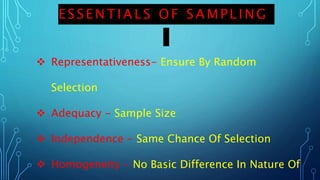
ESSENTIALS OF SAMPLING
 Representativeness- Ensure By Random
Selection
 Adequacy - Sample Size
 Independence - Same Chance Of Selection
 Homogeneity - No Basic Difference In Nature Of
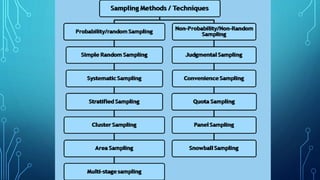
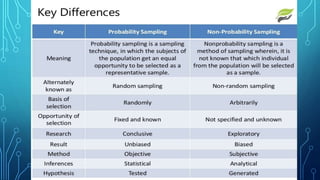
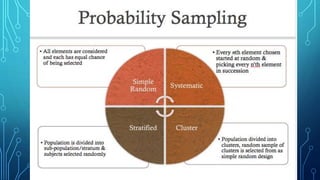
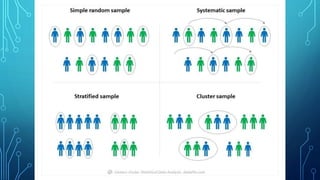
Probability Sampling
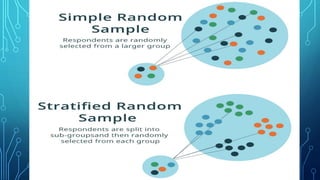
The sampling method in which all the members of the
population has a pre-specified and an equal chance to
be a part of the sample.
This technique is based on the randomization principle,
wherein the procedure is so designed, which guarantees
that each and every individual of the population has an
equal selection opportunity.
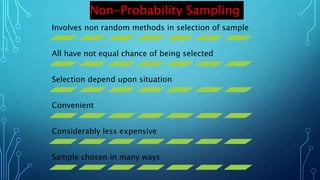
Involves non random methods in selection of sample
All have not equal chance of being selected
Selection depend upon situation
Convenient
Considerably less expensive
Sample chosen in many ways
Non-Probability Sampling
903674080
1
Mustak.mulla44@gmail
.com
Mr. MUSTAQ MULLA, M. Com, NET, K-SET
Teaching Assistant
P.G. Department of Studies in Commerce,
RCUB, P G Centre Jamkhandi.

Sampling techniques- Probability Sampling

  • 1.
    Mr. MUSTAQ MULLA,M. Com, NET, K-SET Teaching Assistant P.G. Department of Studies in Commerce Rani Channamma University Belagavi Post Gradate Centre, Jamkhandi. mustak.mulla44@gmail.com
  • 3.
    I N TR O D U C T I O N Population / Universe: The statistics denotes the aggregate from which sample (items) are taken. A population consists of all the objects or events of a certain type about which researchers seek knowledge or information. A population can be defined as one with all the people or items that the characteristic one wishes to
  • 4.
    Sampling frame :is a list of which potential respondents are drawn. A sample: a sample is a Items, group of people, or objects that are taken from a larger population for measurement “The representative of the Entre Papulation”
  • 5.
    S a mp l e U n i t s “A sampling unit is an individual person”, A single element or group of elements subject to selection in the sample.  Primary Sampling Unit (PSU) : A unit selected in the first stage of sampling.  Secondary Sampling Unit :A unit selected in the second stage of sampling.  Tertiary Sampling Unit : A unit selected in the third stage of sampling.
  • 8.
    SAMPL ING Sampling :Sampling is the selection of a subset of the population of interest in a research study. Three elements in process of sampling :  Selecting the sample  Collecting the information  Making inference about population Statistics : values obtained from study of a sample . Parameters : such values from
  • 9.
    Parameters : Mean valuesfrom study of population. Papulation – Parameters (P-P) Papulation mean =
  • 10.
    Statistics : Mean valuesobtained from study of a sample . Statistics – Sample
  • 12.
    NEED FOR SAMPLING Whensecondary data are not available for the problem under study , primary data is collected. •Two methods – • Census method or complete enumeration method
  • 13.
    ESSENTIALS OF SAMPLING Representativeness- Ensure By Random Selection  Adequacy - Sample Size  Independence - Same Chance Of Selection  Homogeneity - No Basic Difference In Nature Of
  • 17.
    Probability Sampling The samplingmethod in which all the members of the population has a pre-specified and an equal chance to be a part of the sample. This technique is based on the randomization principle, wherein the procedure is so designed, which guarantees that each and every individual of the population has an equal selection opportunity.
  • 19.
    Involves non randommethods in selection of sample All have not equal chance of being selected Selection depend upon situation Convenient Considerably less expensive Sample chosen in many ways Non-Probability Sampling
  • 35.
    903674080 1 Mustak.mulla44@gmail .com Mr. MUSTAQ MULLA,M. Com, NET, K-SET Teaching Assistant P.G. Department of Studies in Commerce, RCUB, P G Centre Jamkhandi.