Trading and Settlement System in
Stock Exchanges
Prepared By
Mr. MUSTAQ MULLA, Teaching Assistant at SRFGCC
Rani Channamma University Belagavi.
2
Indian Stock Exchanges: BSE
1.Listing of Securities Meaning; Merits and Demerits –
2.Listing Requirements –
3.Listing Procedure –
4.Listing Conditions of BSE and
5.Delisting. BSE - Different Trading Systems - Share Groups on BSE
6.BOLT System - Different Types of Settlements - Pay-in and Pay-out -
Bad and Short Delivery - Auction.
Content
Mr. MUSTAQ MULLA, Teaching Assistant at SRFGCC
Rani Channamma University Belagavi.
3
Listing of Securities
Meaning of Listing of Securities
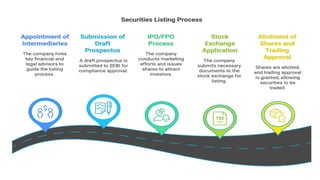
Listing of securities refers to the process of including a company's
shares, bonds, or other financial instruments on a recognized stock
exchange for trading.
It enables investors to buy and sell these securities in a regulated and
transparent market. Companies must comply with regulatory
requirements set by stock exchanges to get their securities listed.
Mr. MUSTAQ MULLA, Teaching Assistant at SRFGCC
Rani Channamma University Belagavi.
4
Listing Requirements
Listing requirements are the eligibility criteria that companies must
fulfill before their securities can be listed on stock exchanges. These
requirements ensure transparency, investor protection, and market
stability. In India, the Securities and Exchange Board of India (SEBI)
regulates listing norms, while stock exchanges like BSE (Bombay
Stock Exchange) and NSE (National Stock Exchange) enforce specific
conditions.
Mr. MUSTAQ MULLA, Teaching Assistant at SRFGCC
Rani Channamma University Belagavi.
5
Eligibility Criteria for Listing
A. Minimum Capital and Net Worth Requirements
•The company must meet minimum paid-up capital and net worth
criteria to ensure financial stability.
•For example:
• BSE (Main Board) requires a minimum post-issue paid-up capital of
₹10 crores and net tangible assets of ₹3 crores.
• NSE (Main Board) requires a minimum paid-up capital of ₹25 crores
and a minimum market capitalization of ₹100 crores.
Mr. MUSTAQ MULLA, Teaching Assistant at SRFGCC
Rani Channamma University Belagavi.
6
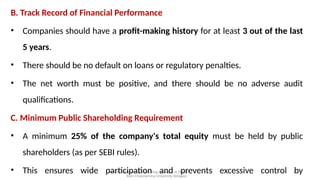
B. Track Record of Financial Performance
• Companies should have a profit-making history for at least 3 out of the last
5 years.
• There should be no default on loans or regulatory penalties.
• The net worth must be positive, and there should be no adverse audit
qualifications.
C. Minimum Public Shareholding Requirement
• A minimum 25% of the company's total equity must be held by public
shareholders (as per SEBI rules).
• This ensures wide participation and prevents excessive control by
Mr. MUSTAQ MULLA, Teaching Assistant at SRFGCC
Rani Channamma University Belagavi.
7
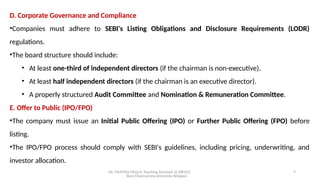
D. Corporate Governance and Compliance
•Companies must adhere to SEBI's Listing Obligations and Disclosure Requirements (LODR)
regulations.
•The board structure should include:
• At least one-third of independent directors (if the chairman is non-executive).
• At least half independent directors (if the chairman is an executive director).
• A properly structured Audit Committee and Nomination & Remuneration Committee.
E. Offer to Public (IPO/FPO)
•The company must issue an Initial Public Offering (IPO) or Further Public Offering (FPO) before
listing.
•The IPO/FPO process should comply with SEBI's guidelines, including pricing, underwriting, and
investor allocation.
Mr. MUSTAQ MULLA, Teaching Assistant at SRFGCC
Rani Channamma University Belagavi.
8
Mr. MUSTAQ MULLA, Teaching Assistant at SRFGCC
Rani Channamma University Belagavi.
9
Mr. MUSTAQ MULLA, Teaching Assistant at SRFGCC
Rani Channamma University Belagavi.
10
Mr. MUSTAQ MULLA, Teaching Assistant at SRFGCC
Rani Channamma University Belagavi.
11
Mr. MUSTAQ MULLA, Teaching Assistant at SRFGCC
Rani Channamma University Belagavi.
12
Mr. MUSTAQ MULLA, Teaching Assistant at SRFGCC
Rani Channamma University Belagavi.
13
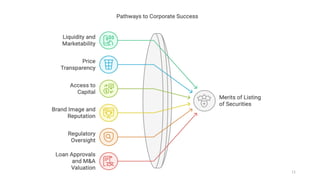
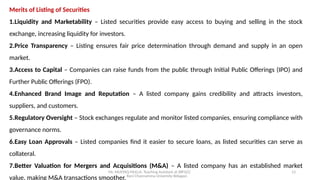
Merits of Listing of Securities
1.Liquidity and Marketability – Listed securities provide easy access to buying and selling in the stock
exchange, increasing liquidity for investors.
2.Price Transparency – Listing ensures fair price determination through demand and supply in an open
market.
3.Access to Capital – Companies can raise funds from the public through Initial Public Offerings (IPO) and
Further Public Offerings (FPO).
4.Enhanced Brand Image and Reputation – A listed company gains credibility and attracts investors,
suppliers, and customers.
5.Regulatory Oversight – Stock exchanges regulate and monitor listed companies, ensuring compliance with
governance norms.
6.Easy Loan Approvals – Listed companies find it easier to secure loans, as listed securities can serve as
collateral.
7.Better Valuation for Mergers and Acquisitions (M&A) – A listed company has an established market
value, making M&A transactions smoother.
Mr. MUSTAQ MULLA, Teaching Assistant at SRFGCC
Rani Channamma University Belagavi.
14
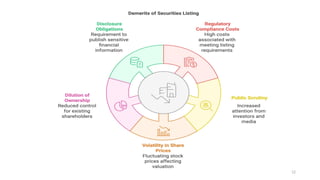
Demerits of Listing of Securities
1.Regulatory Compliance Costs – Companies must comply with strict listing
requirements, leading to high compliance and reporting costs.
2.Public Scrutiny – Listed companies are subject to greater scrutiny from investors,
regulators, and media.
3.Volatility in Share Prices – Stock prices fluctuate due to market trends, impacting
the company’s valuation.
4.Dilution of Ownership – Issuing more shares to raise capital may dilute the control
of existing shareholders.
5.Obligation to Disclose Financial Information – Listed companies must publish
regular financial statements, which may reveal sensitive business information.
Mr. MUSTAQ MULLA, Teaching Assistant at SRFGCC
Rani Channamma University Belagavi.
15
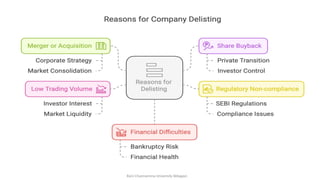
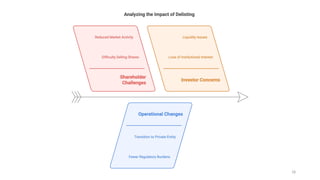
Delisting of Securities
Meaning of Delisting
Delisting refers to removing a company’s securities from a stock exchange, meaning they
can no longer be publicly traded. It can be voluntary (initiated by the company) or
involuntary (imposed by the exchange due to non-compliance).
Types of Delisting
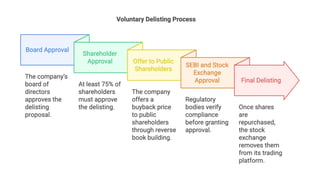
1.Voluntary Delisting – A company delists its securities for reasons such as restructuring,
mergers, or buybacks.
2.Compulsory Delisting – The stock exchange forces delisting due to regulatory non-
compliance, fraud, or non-performance.
Mr. MUSTAQ MULLA, Teaching Assistant at SRFGCC
Rani Channamma University Belagavi.
16
Mr. MUSTAQ MULLA, Teaching Assistant at SRFGCC
Rani Channamma University Belagavi.
17
Mr. MUSTAQ MULLA, Teaching Assistant at SRFGCC
Rani Channamma University Belagavi.
18
Mr. MUSTAQ MULLA, Teaching Assistant at SRFGCC
Rani Channamma University Belagavi.
19
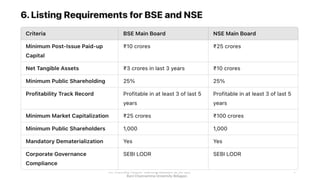
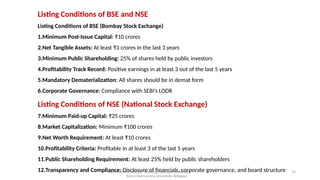
Listing Conditions of BSE and NSE
Listing Conditions of BSE (Bombay Stock Exchange)
1.Minimum Post-Issue Capital: ₹10 crores
2.Net Tangible Assets: At least ₹3 crores in the last 3 years
3.Minimum Public Shareholding: 25% of shares held by public investors
4.Profitability Track Record: Positive earnings in at least 3 out of the last 5 years
5.Mandatory Dematerialization: All shares should be in demat form
6.Corporate Governance: Compliance with SEBI’s LODR
Listing Conditions of NSE (National Stock Exchange)
7.Minimum Paid-up Capital: ₹25 crores
8.Market Capitalization: Minimum ₹100 crores
9.Net Worth Requirement: At least ₹10 crores
10.Profitability Criteria: Profitable in at least 3 of the last 5 years
11.Public Shareholding Requirement: At least 25% held by public shareholders
12.Transparency and Compliance: Disclosure of financials, corporate governance, and board structure
Mr. MUSTAQ MULLA, Teaching Assistant at SRFGCC
Rani Channamma University Belagavi.
20
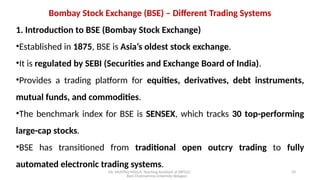
Bombay Stock Exchange (BSE) – Different Trading Systems
1. Introduction to BSE (Bombay Stock Exchange)
•Established in 1875, BSE is Asia’s oldest stock exchange.
•It is regulated by SEBI (Securities and Exchange Board of India).
•Provides a trading platform for equities, derivatives, debt instruments,
mutual funds, and commodities.
•The benchmark index for BSE is SENSEX, which tracks 30 top-performing
large-cap stocks.
•BSE has transitioned from traditional open outcry trading to fully
automated electronic trading systems.
Mr. MUSTAQ MULLA, Teaching Assistant at SRFGCC
Rani Channamma University Belagavi.
21
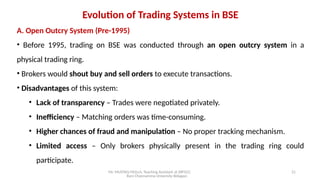
Evolution of Trading Systems in BSE
A. Open Outcry System (Pre-1995)
• Before 1995, trading on BSE was conducted through an open outcry system in a
physical trading ring.
• Brokers would shout buy and sell orders to execute transactions.
• Disadvantages of this system:
• Lack of transparency – Trades were negotiated privately.
• Inefficiency – Matching orders was time-consuming.
• Higher chances of fraud and manipulation – No proper tracking mechanism.
• Limited access – Only brokers physically present in the trading ring could
participate.
Mr. MUSTAQ MULLA, Teaching Assistant at SRFGCC
Rani Channamma University Belagavi.
22
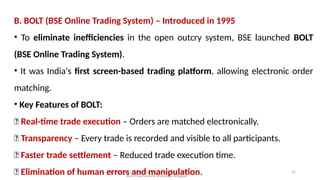
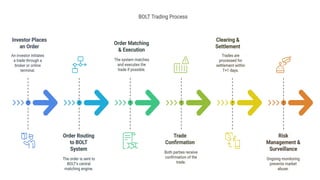
B. BOLT (BSE Online Trading System) – Introduced in 1995
• To eliminate inefficiencies in the open outcry system, BSE launched BOLT
(BSE Online Trading System).
• It was India's first screen-based trading platform, allowing electronic order
matching.
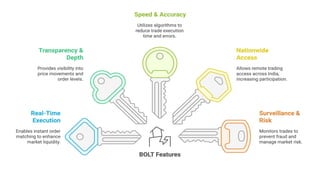
• Key Features of BOLT:
✅ Real-time trade execution – Orders are matched electronically.
✅ Transparency – Every trade is recorded and visible to all participants.
✅ Faster trade settlement – Reduced trade execution time.
✅ Elimination of human errors and manipulation.
Mr. MUSTAQ MULLA, Teaching Assistant at SRFGCC
Rani Channamma University Belagavi.
23
Mr. MUSTAQ MULLA, Teaching Assistant at SRFGCC
Rani Channamma University Belagavi.
24
Mr. MUSTAQ MULLA, Teaching Assistant at SRFGCC
Rani Channamma University Belagavi.
25
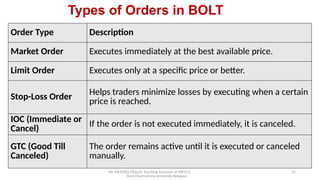
Order Type Description
Market Order Executes immediately at the best available price.
Limit Order Executes only at a specific price or better.
Stop-Loss Order Helps traders minimize losses by executing when a certain
price is reached.
IOC (Immediate or
Cancel)
If the order is not executed immediately, it is canceled.
GTC (Good Till
Canceled)
The order remains active until it is executed or canceled
manually.
Types of Orders in BOLT
Mr. MUSTAQ MULLA, Teaching Assistant at SRFGCC
Rani Channamma University Belagavi.
26
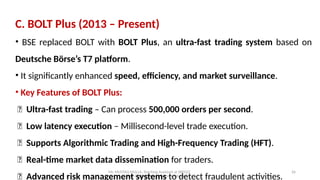
C. BOLT Plus (2013 – Present)
• BSE replaced BOLT with BOLT Plus, an ultra-fast trading system based on
Deutsche Börse’s T7 platform.
• It significantly enhanced speed, efficiency, and market surveillance.
• Key Features of BOLT Plus:
✅ Ultra-fast trading – Can process 500,000 orders per second.
✅ Low latency execution – Millisecond-level trade execution.
✅ Supports Algorithmic Trading and High-Frequency Trading (HFT).
✅ Real-time market data dissemination for traders.
✅ Advanced risk management systems to detect fraudulent activities.
Mr. MUSTAQ MULLA, Teaching Assistant at SRFGCC
Rani Channamma University Belagavi.
27
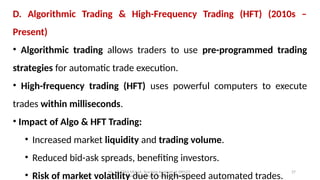
D. Algorithmic Trading & High-Frequency Trading (HFT) (2010s –
Present)
• Algorithmic trading allows traders to use pre-programmed trading
strategies for automatic trade execution.
• High-frequency trading (HFT) uses powerful computers to execute
trades within milliseconds.
• Impact of Algo & HFT Trading:
• Increased market liquidity and trading volume.
• Reduced bid-ask spreads, benefiting investors.
• Risk of market volatility due to high-speed automated trades.
Mr. MUSTAQ MULLA, Teaching Assistant at SRFGCC
Rani Channamma University Belagavi.
28
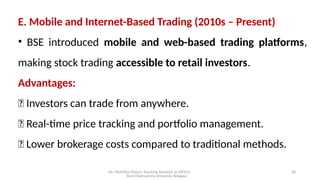
E. Mobile and Internet-Based Trading (2010s – Present)
• BSE introduced mobile and web-based trading platforms,
making stock trading accessible to retail investors.
Advantages:
✅ Investors can trade from anywhere.
✅ Real-time price tracking and portfolio management.
✅ Lower brokerage costs compared to traditional methods.
Mr. MUSTAQ MULLA, Teaching Assistant at SRFGCC
Rani Channamma University Belagavi.
29
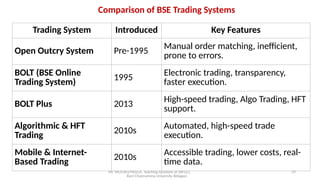
Comparison of BSE Trading Systems
Trading System Introduced Key Features
Open Outcry System Pre-1995 Manual order matching, inefficient,
prone to errors.
BOLT (BSE Online
Trading System) 1995 Electronic trading, transparency,
faster execution.
BOLT Plus 2013 High-speed trading, Algo Trading, HFT
support.
Algorithmic & HFT
Trading 2010s Automated, high-speed trade
execution.
Mobile & Internet-
Based Trading 2010s
Accessible trading, lower costs, real-
time data.
Mr. MUSTAQ MULLA, Teaching Assistant at SRFGCC
Rani Channamma University Belagavi.
30
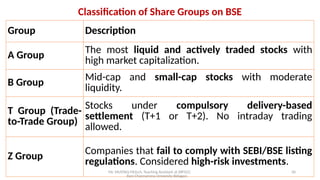
Classification of Share Groups on BSE
Group Description
A Group The most liquid and actively traded stocks with
high market capitalization.
B Group Mid-cap and small-cap stocks with moderate
liquidity.
T Group (Trade-
to-Trade Group)
Stocks under compulsory delivery-based
settlement (T+1 or T+2). No intraday trading
allowed.
Z Group Companies that fail to comply with SEBI/BSE listing
regulations. Considered high-risk investments.
Mr. MUSTAQ MULLA, Teaching Assistant at SRFGCC
Rani Channamma University Belagavi.
31
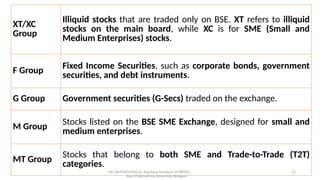
XT/XC
Group
Illiquid stocks that are traded only on BSE. XT refers to illiquid
stocks on the main board, while XC is for SME (Small and
Medium Enterprises) stocks.
F Group Fixed Income Securities, such as corporate bonds, government
securities, and debt instruments.
G Group Government securities (G-Secs) traded on the exchange.
M Group Stocks listed on the BSE SME Exchange, designed for small and
medium enterprises.
MT Group
Stocks that belong to both SME and Trade-to-Trade (T2T)
categories.
Mr. MUSTAQ MULLA, Teaching Assistant at SRFGCC
Rani Channamma University Belagavi.
32
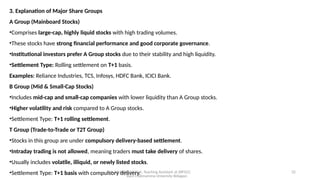
3. Explanation of Major Share Groups
A Group (Mainboard Stocks)
•Comprises large-cap, highly liquid stocks with high trading volumes.
•These stocks have strong financial performance and good corporate governance.
•Institutional investors prefer A Group stocks due to their stability and high liquidity.
•Settlement Type: Rolling settlement on T+1 basis.
Examples: Reliance Industries, TCS, Infosys, HDFC Bank, ICICI Bank.
B Group (Mid & Small-Cap Stocks)
•Includes mid-cap and small-cap companies with lower liquidity than A Group stocks.
•Higher volatility and risk compared to A Group stocks.
•Settlement Type: T+1 rolling settlement.
T Group (Trade-to-Trade or T2T Group)
•Stocks in this group are under compulsory delivery-based settlement.
•Intraday trading is not allowed, meaning traders must take delivery of shares.
•Usually includes volatile, illiquid, or newly listed stocks.
•Settlement Type: T+1 basis with compulsory delivery.
Mr. MUSTAQ MULLA, Teaching Assistant at SRFGCC
Rani Channamma University Belagavi.
33
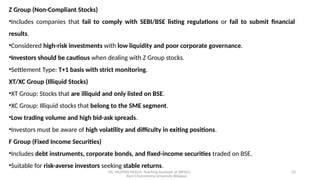
Z Group (Non-Compliant Stocks)
•Includes companies that fail to comply with SEBI/BSE listing regulations or fail to submit financial
results.
•Considered high-risk investments with low liquidity and poor corporate governance.
•Investors should be cautious when dealing with Z Group stocks.
•Settlement Type: T+1 basis with strict monitoring.
XT/XC Group (Illiquid Stocks)
•XT Group: Stocks that are illiquid and only listed on BSE.
•XC Group: Illiquid stocks that belong to the SME segment.
•Low trading volume and high bid-ask spreads.
•Investors must be aware of high volatility and difficulty in exiting positions.
F Group (Fixed Income Securities)
•Includes debt instruments, corporate bonds, and fixed-income securities traded on BSE.
•Suitable for risk-averse investors seeking stable returns.
Mr. MUSTAQ MULLA, Teaching Assistant at SRFGCC
Rani Channamma University Belagavi.
34
G Group (Government Securities - G-Secs)
•Includes government bonds and treasury securities.
•Considered the safest investment as they are backed by the Government of India.
M Group (BSE SME Exchange Stocks)
•Includes stocks listed on the BSE SME Exchange (Small and Medium Enterprises).
•SME stocks have lower liquidity but high growth potential.
MT Group (SME + T2T Stocks)
•Includes SME stocks that are also in the Trade-to-Trade (T2T) category.
•Strict trading rules, ensuring only genuine investors participate.
Mr. MUSTAQ MULLA, Teaching Assistant at SRFGCC
Rani Channamma University Belagavi.
35
Different Types of Settlements in BSE
Settlements refer to the process of transferring
securities and funds between buyers and sellers after
a trade is executed. The BSE follows a T+1 rolling
settlement cycle, meaning trades executed on a given
day are settled on the next trading day (T+1).
Mr. MUSTAQ MULLA, Teaching Assistant at SRFGCC
Rani Channamma University Belagavi.
36
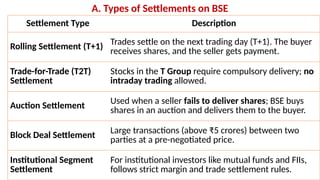
A. Types of Settlements on BSE
Settlement Type Description
Rolling Settlement (T+1) Trades settle on the next trading day (T+1). The buyer
receives shares, and the seller gets payment.
Trade-for-Trade (T2T)
Settlement
Stocks in the T Group require compulsory delivery; no
intraday trading allowed.
Auction Settlement Used when a seller fails to deliver shares; BSE buys
shares in an auction and delivers them to the buyer.
Block Deal Settlement Large transactions (above ₹5 crores) between two
parties at a pre-negotiated price.
Institutional Segment
Settlement
For institutional investors like mutual funds and FIIs,
follows strict margin and trade settlement rules.
Mr. MUSTAQ MULLA, Teaching Assistant at SRFGCC
Rani Channamma University Belagavi.
37
Pay-in and Pay-out Process
A. Pay-in (Funds/Shares Transfer to Clearing House)
•Pay-in refers to the obligation of the buyer to pay funds and the
seller to deliver securities.
•The process occurs on T+1 settlement day, where:
• Buyers transfer funds to the clearing corporation (ICCL - Indian
Clearing Corporation Ltd.).
• Sellers transfer securities to ICCL.
Mr. MUSTAQ MULLA, Teaching Assistant at SRFGCC
Rani Channamma University Belagavi.
38
B. Pay-out (Funds/Shares Transfer to Beneficiary Accounts)
•Pay-out is the process where securities and funds are
credited to the buyer and seller accounts.
•The clearing corporation:
• Credits shares to the buyer’s demat account.
• Credits funds to the seller’s bank account.
•Happens on the same T+1 day as the pay-in process.
Mr. MUSTAQ MULLA, Teaching Assistant at SRFGCC
Rani Channamma University Belagavi.
39
Bad Delivery & Short Delivery in BSE
The Bombay Stock Exchange (BSE) has a structured clearing
and settlement system to ensure smooth trade execution.
However, in certain cases, sellers may fail to deliver shares
correctly or default on their commitments. These scenarios
lead to Bad Delivery and Short Delivery, which require
corrective actions to protect buyers and maintain market
integrity.
Mr. MUSTAQ MULLA, Teaching Assistant at SRFGCC
Rani Channamma University Belagavi.
40
1. Bad Delivery in BSE
A. What is Bad Delivery?
•Bad delivery occurs when securities delivered by the seller
do not meet exchange requirements, making them invalid
for settlement.
•The clearing corporation (ICCL - Indian Clearing Corporation
Ltd.) verifies all securities during the pay-in process. If issues
are detected, the trade is rejected as bad delivery.
Mr. MUSTAQ MULLA, Teaching Assistant at SRFGCC
Rani Channamma University Belagavi.
41
Mr. MUSTAQ MULLA, Teaching Assistant at SRFGCC
Rani Channamma University Belagavi.
42
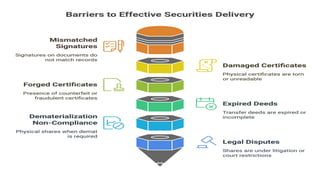
B. Common Reasons for Bad Delivery
1 ️
1️⃣Mismatched Signatures – The signature on the transfer document does not match the
records.
2️⃣Damaged or Mutilated Certificates – Physical share certificates that are torn, defaced, or
unreadable.
3 ️
3️⃣Forgery or Fake Certificates – Counterfeit or fraudulent stock certificates.
4️⃣Expired or Invalid Transfer Deeds – If the transfer deed attached to a physical certificate
has expired or is incomplete.
5 ️
5️⃣Non-Compliance with Dematerialization Rules – Shares delivered in physical form when
they should be in demat form.
6️⃣Legal Disputes on Securities – If shares are under litigation or court orders restrict their
Mr. MUSTAQ MULLA, Teaching Assistant at SRFGCC
Rani Channamma University Belagavi.
43
C. Resolution of Bad Delivery
🔹 The clearing corporation rejects bad deliveries and
informs the seller to rectify the issue.
🔹 The seller must correct the issue and re-submit
securities within the stipulated time.
🔹 If the seller fails to rectify, the buyer may receive cash
compensation or replacement shares through the
exchange.
Mr. MUSTAQ MULLA, Teaching Assistant at SRFGCC
Rani Channamma University Belagavi.
44
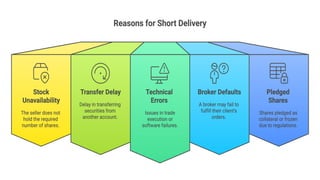
2. Short Delivery in BSE
A. What is Short Delivery?
•Short delivery occurs when the seller fails to deliver shares
on the settlement date (T+1).
•This happens when a trader sells shares they do not own or
fails to arrange the securities in time for settlement
Mr. MUSTAQ MULLA, Teaching Assistant at SRFGCC
Rani Channamma University Belagavi.
45
Mr. MUSTAQ MULLA, Teaching Assistant at SRFGCC
Rani Channamma University Belagavi.
46
What is an Auction in BSE?
An auction is conducted by the exchange when a seller defaults on their
delivery obligation. This process allows the exchange to purchase the
missing securities from other market participants and deliver them to the
buyer.
Key Reasons for Auction:
✅ Short Delivery – Seller fails to deliver shares by the settlement date.
✅ Non-Delivery in Trade-for-Trade (T2T) Group – Some stocks require
compulsory delivery; failure results in auction.
✅ Penalty Imposition – To maintain market discipline and ensure fair play.
Mr. MUSTAQ MULLA, Teaching Assistant at SRFGCC
Rani Channamma University Belagavi.
47
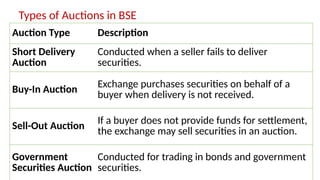
Types of Auctions in BSE
Auction Type Description
Short Delivery
Auction
Conducted when a seller fails to deliver
securities.
Buy-In Auction Exchange purchases securities on behalf of a
buyer when delivery is not received.
Sell-Out Auction
If a buyer does not provide funds for settlement,
the exchange may sell securities in an auction.
Government
Securities Auction
Conducted for trading in bonds and government
securities.
Mr. MUSTAQ MULLA, Teaching Assistant at SRFGCC
Rani Channamma University Belagavi.
48
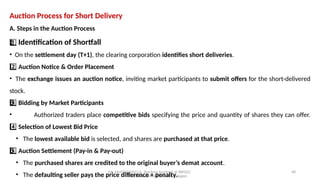
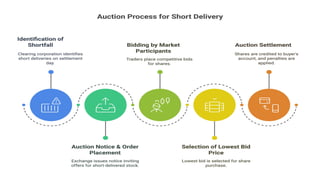
Auction Process for Short Delivery
A. Steps in the Auction Process
1 ️
1️⃣Identification of Shortfall
• On the settlement day (T+1), the clearing corporation identifies short deliveries.
2️⃣Auction Notice & Order Placement
• The exchange issues an auction notice, inviting market participants to submit offers for the short-delivered
stock.
3 ️
3️⃣Bidding by Market Participants
• Authorized traders place competitive bids specifying the price and quantity of shares they can offer.
4️⃣Selection of Lowest Bid Price
• The lowest available bid is selected, and shares are purchased at that price.
5 ️
5️⃣Auction Settlement (Pay-in & Pay-out)
• The purchased shares are credited to the original buyer’s demat account.
• The defaulting seller pays the price difference + penalty.
Mr. MUSTAQ MULLA, Teaching Assistant at SRFGCC
Rani Channamma University Belagavi.
49
Mr. MUSTAQ MULLA, Teaching Assistant at SRFGCC
Rani Channamma University Belagavi.
50
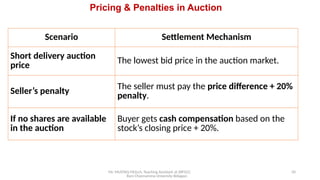
Scenario Settlement Mechanism
Short delivery auction
price The lowest bid price in the auction market.
Seller’s penalty
The seller must pay the price difference + 20%
penalty.
If no shares are available
in the auction
Buyer gets cash compensation based on the
stock’s closing price + 20%.
Pricing & Penalties in Auction
Mr. MUSTAQ MULLA, Teaching Assistant at SRFGCC
Rani Channamma University Belagavi.
51
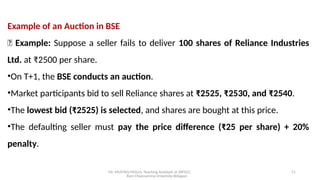
Example of an Auction in BSE
🔹 Example: Suppose a seller fails to deliver 100 shares of Reliance Industries
Ltd. at ₹2500 per share.
•On T+1, the BSE conducts an auction.
•Market participants bid to sell Reliance shares at ₹2525, ₹2530, and ₹2540.
•The lowest bid (₹2525) is selected, and shares are bought at this price.
•The defaulting seller must pay the price difference (₹25 per share) + 20%
penalty.
Mr. MUSTAQ MULLA, Teaching Assistant at SRFGCC
Rani Channamma University Belagavi.
52
Mr. MUSTAQ MULLA, Teaching Assistant at SRFGCC
Rani Channamma University Belagavi.
53