INTRODUCTION TO
FINANCIAL MANAGEMENT:-
Mr.MUSTAQ MULLA
UGC-NET,K-SET, (Ph.D.)
Teaching Assistant,
Department of studies and Research in Commerce,
Sangolli Rayanna First Grade Constituent College,
Rani Channamma University, Belagavi
Dividend Decision Policy
2.
Walter's Model
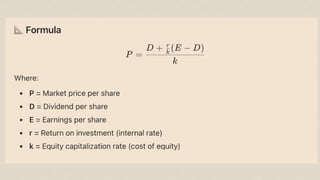
James E.Walter developed one of the earliest and most
straightforward models demonstrating the relevance of dividend
policy. Walter's model suggests that the optimal dividend policy
depends on the relationship between the firm's internal rate of
return (r) and its cost of capital (k).
3.
Assumptions of Walter'sModel
Walter's model rests on several key assumptions:
1. Internal Financing Only: The firm finances all investments through retained
earnings; external financing (debt or equity) is not used.
2. Constant r and k: The firm's internal rate of return (r) and cost of capital (k)
are constant.
3. 100% Payout or Retention: All earnings are either distributed as dividends
or reinvested in the firm.
4. Infinite Time Horizon: The firm has an infinite life.
5. No Taxes: There are no taxes on dividends or capital gains.
4.
Implications of Walter'sModel
Walter's model provides insights into the optimal dividend policy based on the relationship
between 'r' and 'k':
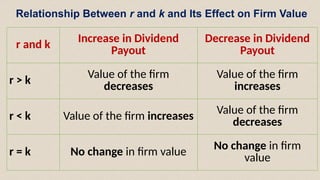
r > k (Growth Firm): If the firm's internal rate of return is greater than its cost of capital, the
firm should retain all earnings and reinvest them. This will lead to a higher stock price. In
this case, the optimal dividend payout ratio is zero.
r < k (Declining Firm): If the firm's internal rate of return is less than its cost of capital, the
firm should distribute all earnings as dividends. This will maximize the stock price. In this
case, the optimal dividend payout ratio is 100%.
r = k (Normal Firm): If the firm's internal rate of return is equal to its cost of capital, the
dividend policy is irrelevant. The market price of the share will be the same regardless of
the dividend payout ratio.
5.
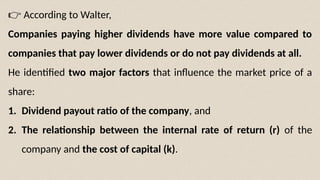
👉 According toWalter,
Companies paying higher dividends have more value compared to
companies that pay lower dividends or do not pay dividends at all.
He identified two major factors that influence the market price of a
share:
1. Dividend payout ratio of the company, and
2. The relationship between the internal rate of return (r) of the
company and the cost of capital (k).
6.
r and k
Increasein Dividend
Payout
Decrease in Dividend
Payout
r > k
Value of the firm
decreases
Value of the firm
increases
r < k Value of the firm increases
Value of the firm
decreases
r = k No change in firm value
No change in firm
value
Relationship Between r and k and Its Effect on Firm Value
8.
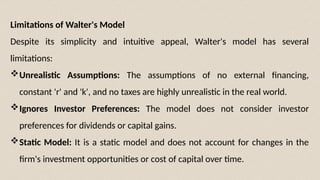
Limitations of Walter'sModel
Despite its simplicity and intuitive appeal, Walter's model has several
limitations:
Unrealistic Assumptions: The assumptions of no external financing,
constant 'r' and 'k', and no taxes are highly unrealistic in the real world.
Ignores Investor Preferences: The model does not consider investor
preferences for dividends or capital gains.
Static Model: It is a static model and does not account for changes in the
firm's investment opportunities or cost of capital over time.
9.
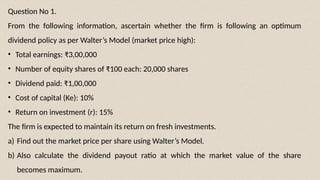
Question No 1.
Fromthe following information, ascertain whether the firm is following an optimum
dividend policy as per Walter’s Model (market price high):
• Total earnings: ₹3,00,000
• Number of equity shares of ₹100 each: 20,000 shares
• Dividend paid: ₹1,00,000
• Cost of capital (Ke): 10%
• Return on investment (r): 15%
The firm is expected to maintain its return on fresh investments.
a) Find out the market price per share using Walter’s Model.
b) Also calculate the dividend payout ratio at which the market value of the share
becomes maximum.
10.
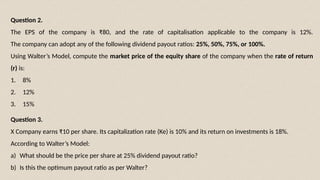
Question 3.
X Companyearns ₹10 per share. Its capitalization rate (Ke) is 10% and its return on investments is 18%.
According to Walter’s Model:
a) What should be the price per share at 25% dividend payout ratio?
b) Is this the optimum payout ratio as per Walter?
Question 2.
The EPS of the company is ₹80, and the rate of capitalisation applicable to the company is 12%.
The company can adopt any of the following dividend payout ratios: 25%, 50%, 75%, or 100%.
Using Walter’s Model, compute the market price of the equity share of the company when the rate of return
(r) is:
1. 8%
2. 12%
3. 15%
11.
Limitations of Walter'sModel
Despite its simplicity and intuitive appeal, Walter's model has several limitations:
Unrealistic Assumptions: The assumptions of no external financing, constant 'r' and 'k',
and no taxes are highly unrealistic in the real world.
Ignores Investor Preferences: The model does not consider investor preferences for
dividends or capital gains.
Static Model: It is a static model and does not account for changes in the firm's investment
opportunities or cost of capital over time.