Modern Management Techniques
B.Com I Semester
Swaleha M Algur. SRFGCC, RCU Belagavi Dept. of Commerce
1
Unit – I
INTRODUCTION
CONTENT
• Concept and nature of management
• Types of managers
• Responsibilities and skills of professional managers, functions of management, Fayol’s
Principles of management
• Administration vs Management, management process
• Levels of management
• Challenges of Modern managers to manage the business organization.
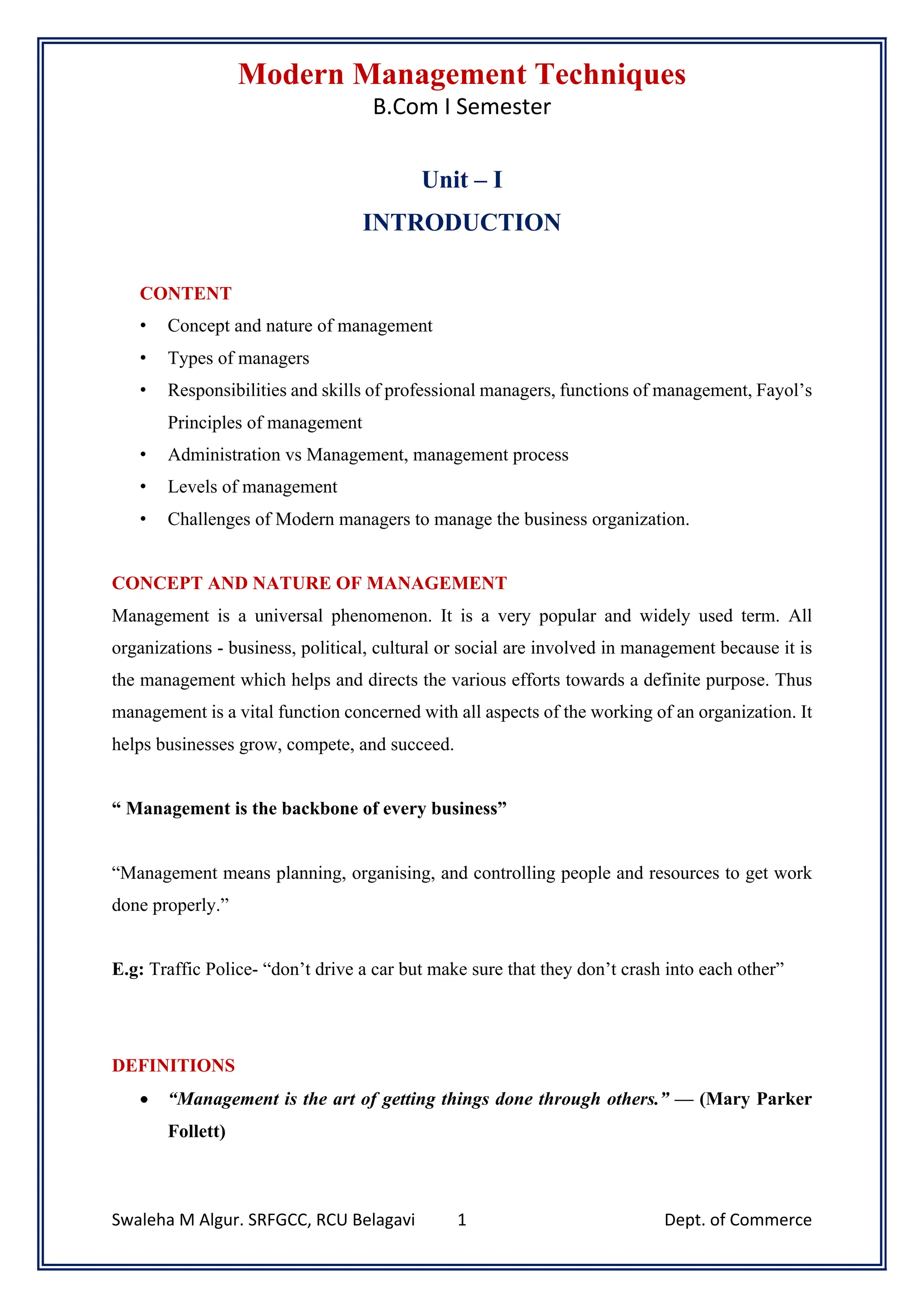
CONCEPT AND NATURE OF MANAGEMENT
Management is a universal phenomenon. It is a very popular and widely used term. All
organizations - business, political, cultural or social are involved in management because it is
the management which helps and directs the various efforts towards a definite purpose. Thus
management is a vital function concerned with all aspects of the working of an organization. It
helps businesses grow, compete, and succeed.
“ Management is the backbone of every business”
“Management means planning, organising, and controlling people and resources to get work
done properly.”
E.g: Traffic Police- “don’t drive a car but make sure that they don’t crash into each other”
DEFINITIONS
• “Management is the art of getting things done through others.” — (Mary Parker
Follett)
Modern Management Techniques
B.Com I Semester
Swaleha M Algur. SRFGCC, RCU Belagavi Dept. of Commerce
2
• Harold Koontz, “Management is an art of getting things done through and with the
people in formally organized groups. It is an art of creating an environment in which
people can perform and individuals and can co-operate towards attainment of group
goals”.
• F.W. Taylor, “Management is the art of knowing what you want to do in the best and
cheapest way “.
• Mary Parker Follet “Management is an art of getting things done though people”.
• Henry Fayol “To manage is to forecast and plan, to organize, to command, to co-
ordinate and to control.”
NATURE OF MANAGEMENT
• It is a Universal Activity: Management is relevant in every sphere of activity. It is
relevant in army, government, private household work etc. the work can be done in a
more systematic manner with the application of the techniques of management. The
material and human resources can be effectively handled and the goal can be attained
with maximum efficiently.
• It is goal oriented: Management focuses attention on the attainment of specific
objectives. For Ex. a business may aim for a particular level of sales. This can be
achieved by proper forecast of sales by planning production by fixing the targets.
• It is an Intellectual activity: the practice of management requires application of mind
and intelligence. Every work needs to be properly planned and Execute work has to be
assigned to different Individuals and responsible have to be fixed on them. Ex. in a
manufacturing unit production finance and marketing are the important activities
performed. It has to work in proper co-ordination with the other departments. Then only
objectives of the firm can be achieved.
• It is a process: it is process consisting of various stages/ functions. Planning is the
starting point of management and control is its last stage.
• Management is both art and science: the practice of science needs knowledge of
theory and formulae. But the practice of art requires skill management is social science.
It focuses attention on the behavior of individuals and groups. The theoretical
knowledge may not help always that time they require skill. Ex if the workers in a
Modern Management Techniques
B.Com I Semester
Swaleha M Algur. SRFGCC, RCU Belagavi Dept. of Commerce
3
factory demand more pay and threaten to go on strike if their demand is not considered.
Here the skill of the manager will help to avert the strike then it’s theoretical.
• It is a social process: management deals with the behavior of individuals and groups.
In a work place individuals work as a team. The behavior of an individual is bound to
be different while he is part of a group Eg.: an individual worker may be forced to join
a strike program because of the union.
• It is an on going activity: It is a continuous process planning, organizing etc have
unlimited use. Management will exist as long as there are human activities.
• It is intangible: It is invisible cannot be seen. But it can be felt.
IMPORTANCE OF MANAGEMENT
1. Achieving Goals: Management helps an organization set clear objectives and achieve
them efficiently.
2. Optimum Use of Resources: It ensures proper use of human, financial, and material
resources — reduces wastage and cost.
3. Encourages Teamwork: It creates coordination among employees and motivates them
to work together.
4. Improves Efficiency: Through good planning and supervision, management improves
work performance and productivity.
5. Helps in Adapting to Change: Management helps a business face changing market
trends and competition.
6. Reduces Costs: By using resources wisely and avoiding duplication of work,
management saves money.
7. Maintains Discipline and Order: It sets clear rules, duties, and responsibilities for
employees.
8. Encourages Innovation: Good management promotes creative ideas and
improvements.
9. Helps in Growth and Expansion: It plans for future development and prepares the
organization for growth.
Modern Management Techniques
B.Com I Semester
Swaleha M Algur. SRFGCC, RCU Belagavi Dept. of Commerce
4
10. Provides Stability: Management brings stability even during uncertainties by solving
problems and making timely decisions.
MANAGERS
ManagerAny person who performs the functions of planning, organisation, staffing, directing
and controlling for the accomplishment of pre-determined organisation goals is called a
manager.
Manager does not actually do the work but guides others to do things correctly. In other words,
manager does not build factory or install machines and operate them or sell goods in the market
but She/He directs the efforts of others at lower levels of an organisation. The primary job of a
manager is the management of people. The job of manager is very difficult and requires some
significant qualities to get the possible results. The manager should have the capacity and
capabilities to meet the challenges of his/her job.
DEFINITION
• According to Peter Drucker (Father of Modern Management):
“A manager is one who has the responsibility to plan, organize, integrate, motivate, and
measure.”
• “According to Koontz, a manager is a person who gets work done through others in an
organized way.”
ROLES OF A MANAGER
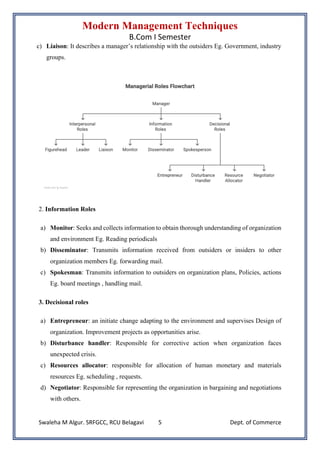
Mintzberg has identified ten roles of a manager which are grouped into three categories.
1. Interpersonal Roles
a) Figure head : Manager performs symbolic duties required by the status of his office,
making speeches, bestowing honors, welcoming official visitors; distributing gifts to
retiring employees are Examples of such ceremonial and social duties
b) Leader : The manager relationship with his own subordinates. The manager sets an
Example legitimizes the power of subordinates and brings their needs in accord with those
of his organization.
Modern Management Techniques
B.Com I Semester
Swaleha M Algur. SRFGCC, RCU Belagavi Dept. of Commerce
5
c) Liaison: It describes a manager’s relationship with the outsiders Eg. Government, industry
groups.
2. Information Roles
a) Monitor: Seeks and collects information to obtain thorough understanding of organization
and environment Eg. Reading periodicals
b) Disseminator: Transmits information received from outsiders or insiders to other
organization members Eg. forwarding mail.
c) Spokesman: Transmits information to outsiders on organization plans, Policies, actions
Eg. board meetings , handling mail.
3. Decisional roles
a) Entrepreneur: an initiate change adapting to the environment and supervises Design of
organization. Improvement projects as opportunities arise.
b) Disturbance handler: Responsible for corrective action when organization faces
unexpected crisis.
c) Resources allocator: responsible for allocation of human monetary and materials
resources Eg. scheduling , requests.
d) Negotiator: Responsible for representing the organization in bargaining and negotiations
with others.
Modern Management Techniques
B.Com I Semester
Swaleha M Algur. SRFGCC, RCU Belagavi Dept. of Commerce
6
RESPONSIBILITIES OF MANAGER:
Responsibility is the obligation of a person to perform assigned duties to the best of his abilities.
The following are the responsibilities:
1) Daily operations: The primary role of a manager is to ensure the daily functioning of a
departement of group of employees.
2) Staffing: Most employers expect their managers to interview, hire, and train new
employees.
3) Set goals: A manager articulates both short and long term goals to ensure a company's
longevity.
4) Laisoning: Although a manager typically oversees a group of employees, managers also
effectively communicate with their bosses and convey the necessary information to the
various company parties.
5) Administration: Managers complete administrative work and correspond with other
departments.
6) Delegation: Effective managers have confidence in their employees and delegate tasks
according to the department's needs.
7) Motivate: As a leader, a manager motivates staff and creates an environment where
employees thrive.
8) Enforcing policy: Managers enforce company policy to cultivate an environment that
makes employees hold one another accountable for their actions.
9) Training: If new technologies or systems are introduced to business. employers turn to
managers to train employees.
10) Evaluation: To encourage satisfactory work, managers evaluate data and employees
performance.
CHARACTERISTICS OF QUALITY MANAGERS
Manager is a person who has the ability or strength to coordinate, motivate and guide all the
personnel working under him so as to make sure they attain the organizational goal in the most
efficient manner possible.
Modern Management Techniques
B.Com I Semester
Swaleha M Algur. SRFGCC, RCU Belagavi Dept. of Commerce
7
Qualities of a Good manager
1. Good Education
2. Technical Knowledge
3. Personality
4. Communication skills
5. Honesty
6. Positive thinking
7. Control Management
8. Motivation
9. Guide
10. Leadership qualities
11. Coordinate
12. Decision making (planning,
forecasting)
13. Innovative
14. Good analysis
15. Risk taking
SKILLS OF PROFESSIONAL MANAGER :
Skills refer to practical ability or expertness required in an action or doing something. In order
to perform the duties, manager must posses certain skills.
Types of Skills of Professionals Manager
A) General Skills B) Management Skills
A) GENERAL SKILLS:
To be an effective business manager, consider sharpening the following skills.
1) Coaching: In the business world, managers coach employees to help them perform in their
positions more efficiently.
2) Organisation: Although departments vary in size, managers are responsible for the
performances of other employees, meaning that managers maintain an organised work
environment.
3) Budget development: Many Managers oversee business financials, meaning that
managers have the skills to make budgets.
4) Handling pressure: The business world is often competitive and high pressure, so an
effective manager handles that pressure and thirves in a high stakes environment.
5) Adaptation: The business sector is constantly changing, and managers adapt to alternative
technologies, management structures and forms of communication.
Modern Management Techniques
B.Com I Semester
Swaleha M Algur. SRFGCC, RCU Belagavi Dept. of Commerce
8
6) Initiative: Managers do not always wait for their boss to give them directions. Instead, they
take the initiative and begin projects when necessary.
7) Collaboration: The best ideas are often created during collaborative efforts, meaning that
managers take the time to work with their employees, other managers, and their bosses.
8) Project Management: To ensure success, managers oversee every step of a project and
intervene when necessary.
B) MANAGEMENT SKILLS:
According to American social and organisational Psychologist Robert Katz, the basic three
types of management skills viz.
1) Technical skills
2) Conceptual skills
3) Human or Inter personal skills and management skills: These skills are further divided
into
1) Planning
2) Communication
3) Decision making
4) Delegation
5) Problem solving
6) Motivating
7) Commercial awareness
8) Monitoring
➢ Technical Skills: These Technical skills involve skills that give the managers the ability
and the skills not only involve operating machines and software, production tools, and pieces
of equipment, but also the skills needed to boost sales, design different types of products and
services, and market the services and the products. E.g. Production manager must know the
type of raw materials to be used, the proportion the production process and the knowledge of
handling the various m/c.
➢ Human skills: The human or the interpersonal skills are the skills that present the managers'
ability to interact, work or relate effectively with people. These skills enable the managers to
make use of human potential in the company and motivate the employees for better results.
Modern Management Techniques
B.Com I Semester
Swaleha M Algur. SRFGCC, RCU Belagavi Dept. of Commerce
9
The ability to tactfully deal with human beings and mould their behavior at work in the desired
manner to help attain the common objectives of the enterprises most effectively and efficiently.
It requires an understanding of human behavior and it is necessary for motivating people.
➢ Conceptual Skills: It is concerned with concepts or ideas. Conceptual means ability to view
the enterprise as whole in totality. To analyze the implications of relevant external
environmental factors economic, social, political, technological etc. for the successful
functioning of the enterprise. These involve the skills managers present in terms of the
knowledge and ability for abstract thinking and formulating ideas. The manager is able to see
an entire concept, analyze and diagnose a problem, and find creative solutions.
Functions of Management
Management is what management does. It is the art of getting things done through and with
people in formally organized groups. We manage an organisation to achieve certain objectives
and goals.
Many Management experts have discussed the functions of management. But there is no
unanimity among them about the classification of managerial functions. The chief reason for
this lack of unanimity is that the different management experts discussed the management
functions by studying different organisations and from different angles.
Different authors have given different managerial functions. Henry Fayol, the Father of
principles of management was the first to define specific functions of management. In his
words, "To manage is to forecast and plan, to organise, to command, to co-ordinate and to
control."
Henry Fayol has classified Managerial Functions as follows:
1. Forecasting and planning,
2. Organising,
3. Commanding
4. Coordination, and
5. Control.
Modern Management Techniques
B.Com I Semester
Swaleha M Algur. SRFGCC, RCU Belagavi Dept. of Commerce
10
Luther Gulick used the word POSDCORB to describe various functions.
1. Planning (P).
2. Organising, (0)
3. Staffing (S),
4. Directing (D),
5. Controlling (Co),
6. Reporting (R), and
7. Budgeting (B).
Ralph Davis gave three functions of management planning, organising and Control. He was
of the view that command and co-ordination facilitate control so these should be part of it.
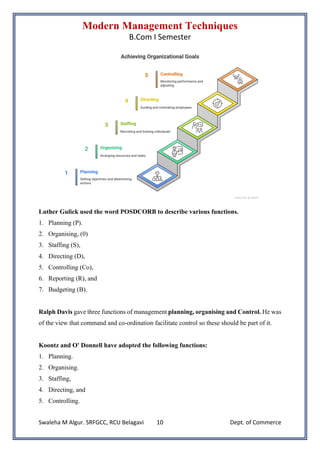
Koontz and O' Donnell have adopted the following functions:
1. Planning.
2. Organising.
3. Staffing,
4. Directing, and
5. Controlling.
Modern Management Techniques
B.Com I Semester
Swaleha M Algur. SRFGCC, RCU Belagavi Dept. of Commerce
11
Earnest Dale has included innovation and representation to the earlier mentioned functions.
G.R. Terry classified managerial functions under four heads
1) Planning,
2) Organising,
3) Actuating and
4) Controlling.
It can be seen that there is no agreement about specific functions to be performed by the
management. However, the following comprehensive classification can be given of various
managerial functions:
1. Planning,
2. Organising,
3. Staffing,
4. Directing
a) Leadership,
b) Communication,
c) Motivation and
d) Supervision.
5. Coordinating, and
6. Controlling
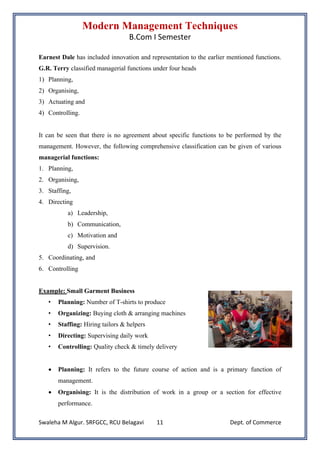
Example: Small Garment Business
• Planning: Number of T-shirts to produce
• Organizing: Buying cloth & arranging machines
• Staffing: Hiring tailors & helpers
• Directing: Supervising daily work
• Controlling: Quality check & timely delivery
• Planning: It refers to the future course of action and is a primary function of
management.
• Organising: It is the distribution of work in a group or a section for effective
performance.
Modern Management Techniques
B.Com I Semester
Swaleha M Algur. SRFGCC, RCU Belagavi Dept. of Commerce
12
• Staffing: It consists of activities related to the selection and placement of right people
for right jobs.
• Directing: This is a process where the manager influences the work of his sub-
ordinates. It includes guidance, supervision and motivational aspects of the employees.
• Co-ordinating: It is a process of synchronizing activities of various people in the
organisation in order to achieve goals.
• Motivating: Motivation is one of the key factors for the speedy and effective
performance of employees which is taken care of by resourceful leaders.
• Controlling: It deals with the process of verifying that the achieved goals are in order
with the pre-planned objectives. In case of deviation corrective measures are taken.
• Innovation: It includes developing new services, techniques, products and so on to
cater to the changing need of the consumers and the market.
• Representation: It is a function where a manager has to deal with the customers,
suppliers, government officials, banks, financial institutions, trade unions etc. as a
representative of the company.
• Decision-making: It helps in functioning of organisations as every employee has to
take certain decisions on everyday basis.
• Communication: It refers to the exchange of information for the frictionless regulation
of job and coordination of the activities.
HENRY FAYOL PRINCIPLES OF MANAGEMENT
Henry Faylol is known as the 'father of modern management theory' gave new perception of
the concept of managent. He introduced General Theory that can be applied to all level of
management and every department. Henry Fayol (1841-1925) a French industralist, developed
a general theory of administration that could be applied to any field of organised activity.
Fayol suggested following principles of Management:
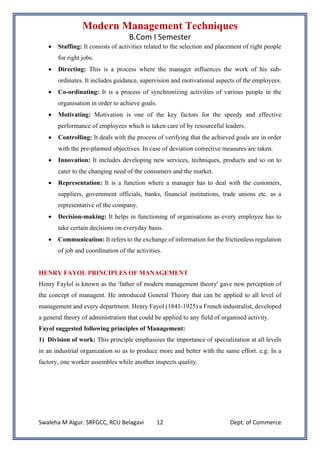
1) Division of work: This principle emphasizes the importance of specialization at all levels
in an industrial organization so as to produce more and better with the same effort. e.g: In a
factory, one worker assembles while another inspects quality.
Modern Management Techniques
B.Com I Semester
Swaleha M Algur. SRFGCC, RCU Belagavi Dept. of Commerce
13
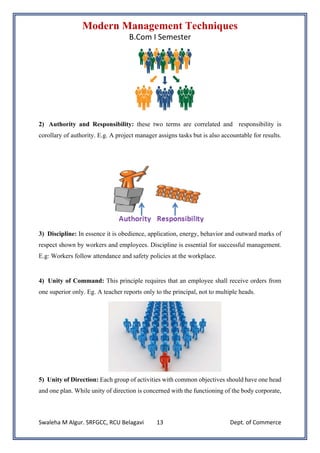
2) Authority and Responsibility: these two terms are correlated and responsibility is
corollary of authority. E.g. A project manager assigns tasks but is also accountable for results.
3) Discipline: In essence it is obedience, application, energy, behavior and outward marks of
respect shown by workers and employees. Discipline is essential for successful management.
E.g: Workers follow attendance and safety policies at the workplace.
4) Unity of Command: This principle requires that an employee shall receive orders from
one superior only. Eg. A teacher reports only to the principal, not to multiple heads.
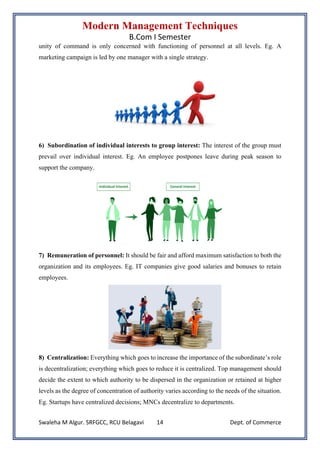
5) Unity of Direction: Each group of activities with common objectives should have one head
and one plan. While unity of direction is concerned with the functioning of the body corporate,
Modern Management Techniques
B.Com I Semester
Swaleha M Algur. SRFGCC, RCU Belagavi Dept. of Commerce
14
unity of command is only concerned with functioning of personnel at all levels. Eg. A
marketing campaign is led by one manager with a single strategy.
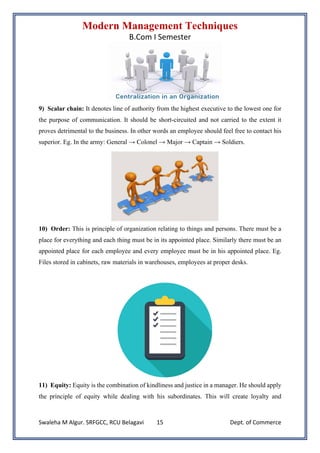
6) Subordination of individual interests to group interest: The interest of the group must
prevail over individual interest. Eg. An employee postpones leave during peak season to
support the company.
7) Remuneration of personnel: It should be fair and afford maximum satisfaction to both the
organization and its employees. Eg. IT companies give good salaries and bonuses to retain
employees.
8) Centralization: Everything which goes to increase the importance of the subordinate’s role
is decentralization; everything which goes to reduce it is centralized. Top management should
decide the extent to which authority to be dispersed in the organization or retained at higher
levels as the degree of concentration of authority varies according to the needs of the situation.
Eg. Startups have centralized decisions; MNCs decentralize to departments.
Modern Management Techniques
B.Com I Semester
Swaleha M Algur. SRFGCC, RCU Belagavi Dept. of Commerce
15
9) Scalar chain: It denotes line of authority from the highest executive to the lowest one for
the purpose of communication. It should be short-circuited and not carried to the extent it
proves detrimental to the business. In other words an employee should feel free to contact his
superior. Eg. In the army: General → Colonel → Major → Captain → Soldiers.
10) Order: This is principle of organization relating to things and persons. There must be a
place for everything and each thing must be in its appointed place. Similarly there must be an
appointed place for each employee and every employee must be in his appointed place. Eg.
Files stored in cabinets, raw materials in warehouses, employees at proper desks.
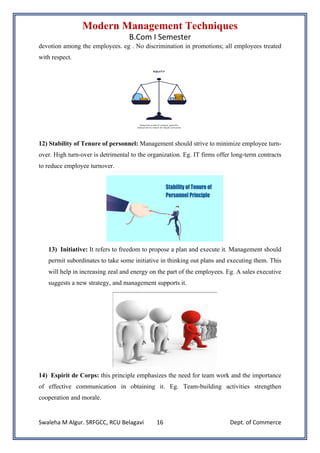
11) Equity: Equity is the combination of kindliness and justice in a manager. He should apply
the principle of equity while dealing with his subordinates. This will create loyalty and
Modern Management Techniques
B.Com I Semester
Swaleha M Algur. SRFGCC, RCU Belagavi Dept. of Commerce
16
devotion among the employees. eg . No discrimination in promotions; all employees treated
with respect.
12) Stability of Tenure of personnel: Management should strive to minimize employee turn-
over. High turn-over is detrimental to the organization. Eg. IT firms offer long-term contracts
to reduce employee turnover.
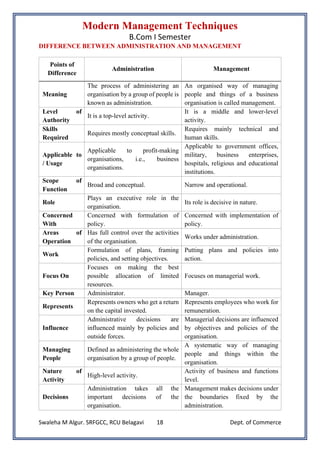
13) Initiative: It refers to freedom to propose a plan and execute it. Management should
permit subordinates to take some initiative in thinking out plans and executing them. This
will help in increasing zeal and energy on the part of the employees. Eg. A sales executive
suggests a new strategy, and management supports it.
14) Espirit de Corps: this principle emphasizes the need for team work and the importance
of effective communication in obtaining it. Eg. Team-building activities strengthen
cooperation and morale.
Modern Management Techniques
B.Com I Semester
Swaleha M Algur. SRFGCC, RCU Belagavi Dept. of Commerce
17
MANAGEMENT AND ADMINISTRATION:
MANAGEMENT:
Management is defined as an act of managing people and their work, for achieving a common
goal by using the organization's resources. It creates an environment under which the manager
and his subordinates can work together for the attainment of group objective. Planning,
organizing, leading, motivating, controlling, coordination and decision making are the major
activities performed by the management. Management brings together 5M's of the
organization, ie. Men, Material, Machines, Methods and Money.
ADMINISTRATION:
The administration is a systematic process of administering the management of a business
organization, an educational institution. The main function of administration is the formation
of plans, policies, and procedure, setting up of goals and objectives, enforcing rules and
regulations, etc. Administration lays down the fundamental framework of an organization,
within which the management of the organization functions.
Modern Management Techniques
B.Com I Semester
Swaleha M Algur. SRFGCC, RCU Belagavi Dept. of Commerce
18
DIFFERENCE BETWEEN ADMINISTRATION AND MANAGEMENT
Points of
Difference
Administration Management
Meaning
The process of administering an
organisation by a group of people is
known as administration.
An organised way of managing
people and things of a business
organisation is called management.
Level of
Authority
It is a top-level activity.
It is a middle and lower-level
activity.
Skills
Required
Requires mostly conceptual skills.
Requires mainly technical and
human skills.
Applicable to
/ Usage
Applicable to profit-making
organisations, i.e., business
organisations.
Applicable to government offices,
military, business enterprises,
hospitals, religious and educational
institutions.
Scope of
Function
Broad and conceptual. Narrow and operational.
Role
Plays an executive role in the
organisation.
Its role is decisive in nature.
Concerned
With
Concerned with formulation of
policy.
Concerned with implementation of
policy.
Areas of
Operation
Has full control over the activities
of the organisation.
Works under administration.
Work
Formulation of plans, framing
policies, and setting objectives.
Putting plans and policies into
action.
Focus On
Focuses on making the best
possible allocation of limited
resources.
Focuses on managerial work.
Key Person Administrator. Manager.
Represents
Represents owners who get a return
on the capital invested.
Represents employees who work for
remuneration.
Influence
Administrative decisions are
influenced mainly by policies and
outside forces.
Managerial decisions are influenced
by objectives and policies of the
organisation.
Managing
People
Defined as administering the whole
organisation by a group of people.
A systematic way of managing
people and things within the
organisation.
Nature of
Activity
High-level activity.
Activity of business and functions
level.
Decisions
Administration takes all the
important decisions of the
organisation.
Management makes decisions under
the boundaries fixed by the
administration.
Modern Management Techniques
B.Com I Semester
Swaleha M Algur. SRFGCC, RCU Belagavi Dept. of Commerce
19
LEVELS OF MANAGEMENT
The term Levels of Management refers to the line of division that exists between various
managerial positions in an organization. As the size of the company and workforce increases,
the number of levels in management increases along with it, and vice versa. The different
Levels of Management can determine the chain of command within an organization, as well as
the amount of authority and typically decision-making influence accrued by all managerial
positions.
In other words, in an organization people are arranged in a hierarchy. Hierarchy means putting
people in superior subordinate relationships. These relationships are called levels of
management in an organization.
A) Top Level Management: the top level management derives its powers and authority
directly from the owners of the enterprise. They are Board of Directors, Chairman,
Managing Directors, COO, CEO etc.
Functions
1. They are setting out the fundamental objectives of the enterprises.
2. They frame major policies for the business.
3. They design the strategies for the attainment of organizational objectives.
4. They appoint key managerial personnel for the middle management.
Modern Management Techniques
B.Com I Semester
Swaleha M Algur. SRFGCC, RCU Belagavi Dept. of Commerce
20
5. Develop master plans in areas of finance, human resource, technology, marketing and
other functions of organization.
6. To represent the business outside, particularly in discussing business problems with the
Government trade association and so on.
B) Middle Level Management: they are departmental managers (Head of Department) like
Production managers, Marketing managers, Personnel managers, Finance manager,
Regional manager and other managers.
Functions:
1. They play the role of a linking pin between top level management and the lower level
management.
2. They explain the objectives, strategies, policies laid down by the top level management
to the low level management.
3. Communicates the problems, suggestions and view points of the lower management to
the top management.
4. They prepare the departmental plans.
5. They submit reports on the performance at various departments to the top management.
6. They offer suggestions and recommendations to the top management for the betterment
of overall management of the enterprise.
C) Lower Level of Management: It is called as operating level management or supervisory
level. This is the level where actual operational work for the enterprise in the areas of
production, finance, marketing, personnel, etc is performed by workers. This level of
management consists of manger like supervisors, the foreman, the sales officers the
accountants the sectional officers.
Functions:
1. They do day to day operational planning in view of the instructions given by the middle
level management.
2. They provide necessary instructions to operators for the best performance of their
assigned jobs.
Modern Management Techniques
B.Com I Semester
Swaleha M Algur. SRFGCC, RCU Belagavi Dept. of Commerce
21
3. They supervise the work of operators to ensure that their performance is in accordance
with the standards laid down in plans.
4. They submit reports on the performance of operating staffs to the middle management.
5. They operate as a channel of communication between the middle management and the
operators.
6. The problems, suggestions and recommendations of operators are informed by them to
the middle management.
In conclusion, levels of management help every organization to work in a systematic and
organized way. By dividing responsibilities among top, middle, and lower levels,
management ensures smooth communication, better supervision, and effective control. Each
level has its own important role, but all levels work together towards the common goal of the
business — success and growth.
Good management at all levels leads to better planning, motivated employees, quality output,
and higher profits. So, understanding levels of management is very important for any student
of business or commerce.”
CHALLENGES FACED BY MODERN MANAGERS
1. Uncertainty about Future: Accurately predicting the future is the biggest challenge
for modern managers. The global financial crisis and the current pandemic are
examples of events that created uncertainty.
2. Wellbeing of Employees: Employee wellbeing is critical, as stress, burnout, and health
issues impact productivity. Managers are responsible for ensuring work-life balance
and creating a supportive environment.
3. Leading Former Peers: Managing people who were once peers can create tension.
Managers must establish authority without losing trust.
4. Balancing the New Workload: Managers face the dual responsibility of completing
personal tasks and managing their team. Balancing both effectively is a challenge.
Modern Management Techniques
B.Com I Semester
Swaleha M Algur. SRFGCC, RCU Belagavi Dept. of Commerce
22
5. Managing Team Achievement: Managers must ensure the team is aligned toward
goals, with clear expectations and accountability to measure achievements.
6. Making Difficult Decisions: Decision-making is one of the toughest challenges.
Managers often face pressure when choices affect employees and organizational
outcomes.
7. Motivating and Inspiring: Managers are responsible for motivating team members to
achieve targets, fostering commitment, and inspiring creativity.
8. Managing People Accountability: Managers need to ensure accountability by giving
regular feedback, setting consequences, and recognizing achievements.
9. Coaching and Developing Others: Managers are expected to help employees grow by
coaching them and providing opportunities to develop skills and knowledge.
10. Communicating More Effectively: Communication is vital in managing people.
Managers must ensure clarity, openness, and transparency in interactions.
11. Delegating and Task-Building: Delegating tasks effectively requires trust and the
ability to assign responsibilities based on employee strengths.
12. Managing Interpersonal Conflicts: Conflicts among employees are natural.
Managers need to resolve disputes fairly and prevent escalation.

MMT Unit-01 Introduction to Management.pdf

  • 1.
    Modern Management Techniques B.ComI Semester Swaleha M Algur. SRFGCC, RCU Belagavi Dept. of Commerce 1 Unit – I INTRODUCTION CONTENT • Concept and nature of management • Types of managers • Responsibilities and skills of professional managers, functions of management, Fayol’s Principles of management • Administration vs Management, management process • Levels of management • Challenges of Modern managers to manage the business organization. CONCEPT AND NATURE OF MANAGEMENT Management is a universal phenomenon. It is a very popular and widely used term. All organizations - business, political, cultural or social are involved in management because it is the management which helps and directs the various efforts towards a definite purpose. Thus management is a vital function concerned with all aspects of the working of an organization. It helps businesses grow, compete, and succeed. “ Management is the backbone of every business” “Management means planning, organising, and controlling people and resources to get work done properly.” E.g: Traffic Police- “don’t drive a car but make sure that they don’t crash into each other” DEFINITIONS • “Management is the art of getting things done through others.” — (Mary Parker Follett)
  • 2.
    Modern Management Techniques B.ComI Semester Swaleha M Algur. SRFGCC, RCU Belagavi Dept. of Commerce 2 • Harold Koontz, “Management is an art of getting things done through and with the people in formally organized groups. It is an art of creating an environment in which people can perform and individuals and can co-operate towards attainment of group goals”. • F.W. Taylor, “Management is the art of knowing what you want to do in the best and cheapest way “. • Mary Parker Follet “Management is an art of getting things done though people”. • Henry Fayol “To manage is to forecast and plan, to organize, to command, to co- ordinate and to control.” NATURE OF MANAGEMENT • It is a Universal Activity: Management is relevant in every sphere of activity. It is relevant in army, government, private household work etc. the work can be done in a more systematic manner with the application of the techniques of management. The material and human resources can be effectively handled and the goal can be attained with maximum efficiently. • It is goal oriented: Management focuses attention on the attainment of specific objectives. For Ex. a business may aim for a particular level of sales. This can be achieved by proper forecast of sales by planning production by fixing the targets. • It is an Intellectual activity: the practice of management requires application of mind and intelligence. Every work needs to be properly planned and Execute work has to be assigned to different Individuals and responsible have to be fixed on them. Ex. in a manufacturing unit production finance and marketing are the important activities performed. It has to work in proper co-ordination with the other departments. Then only objectives of the firm can be achieved. • It is a process: it is process consisting of various stages/ functions. Planning is the starting point of management and control is its last stage. • Management is both art and science: the practice of science needs knowledge of theory and formulae. But the practice of art requires skill management is social science. It focuses attention on the behavior of individuals and groups. The theoretical knowledge may not help always that time they require skill. Ex if the workers in a
  • 3.
    Modern Management Techniques B.ComI Semester Swaleha M Algur. SRFGCC, RCU Belagavi Dept. of Commerce 3 factory demand more pay and threaten to go on strike if their demand is not considered. Here the skill of the manager will help to avert the strike then it’s theoretical. • It is a social process: management deals with the behavior of individuals and groups. In a work place individuals work as a team. The behavior of an individual is bound to be different while he is part of a group Eg.: an individual worker may be forced to join a strike program because of the union. • It is an on going activity: It is a continuous process planning, organizing etc have unlimited use. Management will exist as long as there are human activities. • It is intangible: It is invisible cannot be seen. But it can be felt. IMPORTANCE OF MANAGEMENT 1. Achieving Goals: Management helps an organization set clear objectives and achieve them efficiently. 2. Optimum Use of Resources: It ensures proper use of human, financial, and material resources — reduces wastage and cost. 3. Encourages Teamwork: It creates coordination among employees and motivates them to work together. 4. Improves Efficiency: Through good planning and supervision, management improves work performance and productivity. 5. Helps in Adapting to Change: Management helps a business face changing market trends and competition. 6. Reduces Costs: By using resources wisely and avoiding duplication of work, management saves money. 7. Maintains Discipline and Order: It sets clear rules, duties, and responsibilities for employees. 8. Encourages Innovation: Good management promotes creative ideas and improvements. 9. Helps in Growth and Expansion: It plans for future development and prepares the organization for growth.
  • 4.
    Modern Management Techniques B.ComI Semester Swaleha M Algur. SRFGCC, RCU Belagavi Dept. of Commerce 4 10. Provides Stability: Management brings stability even during uncertainties by solving problems and making timely decisions. MANAGERS ManagerAny person who performs the functions of planning, organisation, staffing, directing and controlling for the accomplishment of pre-determined organisation goals is called a manager. Manager does not actually do the work but guides others to do things correctly. In other words, manager does not build factory or install machines and operate them or sell goods in the market but She/He directs the efforts of others at lower levels of an organisation. The primary job of a manager is the management of people. The job of manager is very difficult and requires some significant qualities to get the possible results. The manager should have the capacity and capabilities to meet the challenges of his/her job. DEFINITION • According to Peter Drucker (Father of Modern Management): “A manager is one who has the responsibility to plan, organize, integrate, motivate, and measure.” • “According to Koontz, a manager is a person who gets work done through others in an organized way.” ROLES OF A MANAGER Mintzberg has identified ten roles of a manager which are grouped into three categories. 1. Interpersonal Roles a) Figure head : Manager performs symbolic duties required by the status of his office, making speeches, bestowing honors, welcoming official visitors; distributing gifts to retiring employees are Examples of such ceremonial and social duties b) Leader : The manager relationship with his own subordinates. The manager sets an Example legitimizes the power of subordinates and brings their needs in accord with those of his organization.
  • 5.
    Modern Management Techniques B.ComI Semester Swaleha M Algur. SRFGCC, RCU Belagavi Dept. of Commerce 5 c) Liaison: It describes a manager’s relationship with the outsiders Eg. Government, industry groups. 2. Information Roles a) Monitor: Seeks and collects information to obtain thorough understanding of organization and environment Eg. Reading periodicals b) Disseminator: Transmits information received from outsiders or insiders to other organization members Eg. forwarding mail. c) Spokesman: Transmits information to outsiders on organization plans, Policies, actions Eg. board meetings , handling mail. 3. Decisional roles a) Entrepreneur: an initiate change adapting to the environment and supervises Design of organization. Improvement projects as opportunities arise. b) Disturbance handler: Responsible for corrective action when organization faces unexpected crisis. c) Resources allocator: responsible for allocation of human monetary and materials resources Eg. scheduling , requests. d) Negotiator: Responsible for representing the organization in bargaining and negotiations with others.
  • 6.
    Modern Management Techniques B.ComI Semester Swaleha M Algur. SRFGCC, RCU Belagavi Dept. of Commerce 6 RESPONSIBILITIES OF MANAGER: Responsibility is the obligation of a person to perform assigned duties to the best of his abilities. The following are the responsibilities: 1) Daily operations: The primary role of a manager is to ensure the daily functioning of a departement of group of employees. 2) Staffing: Most employers expect their managers to interview, hire, and train new employees. 3) Set goals: A manager articulates both short and long term goals to ensure a company's longevity. 4) Laisoning: Although a manager typically oversees a group of employees, managers also effectively communicate with their bosses and convey the necessary information to the various company parties. 5) Administration: Managers complete administrative work and correspond with other departments. 6) Delegation: Effective managers have confidence in their employees and delegate tasks according to the department's needs. 7) Motivate: As a leader, a manager motivates staff and creates an environment where employees thrive. 8) Enforcing policy: Managers enforce company policy to cultivate an environment that makes employees hold one another accountable for their actions. 9) Training: If new technologies or systems are introduced to business. employers turn to managers to train employees. 10) Evaluation: To encourage satisfactory work, managers evaluate data and employees performance. CHARACTERISTICS OF QUALITY MANAGERS Manager is a person who has the ability or strength to coordinate, motivate and guide all the personnel working under him so as to make sure they attain the organizational goal in the most efficient manner possible.
  • 7.
    Modern Management Techniques B.ComI Semester Swaleha M Algur. SRFGCC, RCU Belagavi Dept. of Commerce 7 Qualities of a Good manager 1. Good Education 2. Technical Knowledge 3. Personality 4. Communication skills 5. Honesty 6. Positive thinking 7. Control Management 8. Motivation 9. Guide 10. Leadership qualities 11. Coordinate 12. Decision making (planning, forecasting) 13. Innovative 14. Good analysis 15. Risk taking SKILLS OF PROFESSIONAL MANAGER : Skills refer to practical ability or expertness required in an action or doing something. In order to perform the duties, manager must posses certain skills. Types of Skills of Professionals Manager A) General Skills B) Management Skills A) GENERAL SKILLS: To be an effective business manager, consider sharpening the following skills. 1) Coaching: In the business world, managers coach employees to help them perform in their positions more efficiently. 2) Organisation: Although departments vary in size, managers are responsible for the performances of other employees, meaning that managers maintain an organised work environment. 3) Budget development: Many Managers oversee business financials, meaning that managers have the skills to make budgets. 4) Handling pressure: The business world is often competitive and high pressure, so an effective manager handles that pressure and thirves in a high stakes environment. 5) Adaptation: The business sector is constantly changing, and managers adapt to alternative technologies, management structures and forms of communication.
  • 8.
    Modern Management Techniques B.ComI Semester Swaleha M Algur. SRFGCC, RCU Belagavi Dept. of Commerce 8 6) Initiative: Managers do not always wait for their boss to give them directions. Instead, they take the initiative and begin projects when necessary. 7) Collaboration: The best ideas are often created during collaborative efforts, meaning that managers take the time to work with their employees, other managers, and their bosses. 8) Project Management: To ensure success, managers oversee every step of a project and intervene when necessary. B) MANAGEMENT SKILLS: According to American social and organisational Psychologist Robert Katz, the basic three types of management skills viz. 1) Technical skills 2) Conceptual skills 3) Human or Inter personal skills and management skills: These skills are further divided into 1) Planning 2) Communication 3) Decision making 4) Delegation 5) Problem solving 6) Motivating 7) Commercial awareness 8) Monitoring ➢ Technical Skills: These Technical skills involve skills that give the managers the ability and the skills not only involve operating machines and software, production tools, and pieces of equipment, but also the skills needed to boost sales, design different types of products and services, and market the services and the products. E.g. Production manager must know the type of raw materials to be used, the proportion the production process and the knowledge of handling the various m/c. ➢ Human skills: The human or the interpersonal skills are the skills that present the managers' ability to interact, work or relate effectively with people. These skills enable the managers to make use of human potential in the company and motivate the employees for better results.
  • 9.
    Modern Management Techniques B.ComI Semester Swaleha M Algur. SRFGCC, RCU Belagavi Dept. of Commerce 9 The ability to tactfully deal with human beings and mould their behavior at work in the desired manner to help attain the common objectives of the enterprises most effectively and efficiently. It requires an understanding of human behavior and it is necessary for motivating people. ➢ Conceptual Skills: It is concerned with concepts or ideas. Conceptual means ability to view the enterprise as whole in totality. To analyze the implications of relevant external environmental factors economic, social, political, technological etc. for the successful functioning of the enterprise. These involve the skills managers present in terms of the knowledge and ability for abstract thinking and formulating ideas. The manager is able to see an entire concept, analyze and diagnose a problem, and find creative solutions. Functions of Management Management is what management does. It is the art of getting things done through and with people in formally organized groups. We manage an organisation to achieve certain objectives and goals. Many Management experts have discussed the functions of management. But there is no unanimity among them about the classification of managerial functions. The chief reason for this lack of unanimity is that the different management experts discussed the management functions by studying different organisations and from different angles. Different authors have given different managerial functions. Henry Fayol, the Father of principles of management was the first to define specific functions of management. In his words, "To manage is to forecast and plan, to organise, to command, to co-ordinate and to control." Henry Fayol has classified Managerial Functions as follows: 1. Forecasting and planning, 2. Organising, 3. Commanding 4. Coordination, and 5. Control.
  • 10.
    Modern Management Techniques B.ComI Semester Swaleha M Algur. SRFGCC, RCU Belagavi Dept. of Commerce 10 Luther Gulick used the word POSDCORB to describe various functions. 1. Planning (P). 2. Organising, (0) 3. Staffing (S), 4. Directing (D), 5. Controlling (Co), 6. Reporting (R), and 7. Budgeting (B). Ralph Davis gave three functions of management planning, organising and Control. He was of the view that command and co-ordination facilitate control so these should be part of it. Koontz and O' Donnell have adopted the following functions: 1. Planning. 2. Organising. 3. Staffing, 4. Directing, and 5. Controlling.
  • 11.
    Modern Management Techniques B.ComI Semester Swaleha M Algur. SRFGCC, RCU Belagavi Dept. of Commerce 11 Earnest Dale has included innovation and representation to the earlier mentioned functions. G.R. Terry classified managerial functions under four heads 1) Planning, 2) Organising, 3) Actuating and 4) Controlling. It can be seen that there is no agreement about specific functions to be performed by the management. However, the following comprehensive classification can be given of various managerial functions: 1. Planning, 2. Organising, 3. Staffing, 4. Directing a) Leadership, b) Communication, c) Motivation and d) Supervision. 5. Coordinating, and 6. Controlling Example: Small Garment Business • Planning: Number of T-shirts to produce • Organizing: Buying cloth & arranging machines • Staffing: Hiring tailors & helpers • Directing: Supervising daily work • Controlling: Quality check & timely delivery • Planning: It refers to the future course of action and is a primary function of management. • Organising: It is the distribution of work in a group or a section for effective performance.
  • 12.
    Modern Management Techniques B.ComI Semester Swaleha M Algur. SRFGCC, RCU Belagavi Dept. of Commerce 12 • Staffing: It consists of activities related to the selection and placement of right people for right jobs. • Directing: This is a process where the manager influences the work of his sub- ordinates. It includes guidance, supervision and motivational aspects of the employees. • Co-ordinating: It is a process of synchronizing activities of various people in the organisation in order to achieve goals. • Motivating: Motivation is one of the key factors for the speedy and effective performance of employees which is taken care of by resourceful leaders. • Controlling: It deals with the process of verifying that the achieved goals are in order with the pre-planned objectives. In case of deviation corrective measures are taken. • Innovation: It includes developing new services, techniques, products and so on to cater to the changing need of the consumers and the market. • Representation: It is a function where a manager has to deal with the customers, suppliers, government officials, banks, financial institutions, trade unions etc. as a representative of the company. • Decision-making: It helps in functioning of organisations as every employee has to take certain decisions on everyday basis. • Communication: It refers to the exchange of information for the frictionless regulation of job and coordination of the activities. HENRY FAYOL PRINCIPLES OF MANAGEMENT Henry Faylol is known as the 'father of modern management theory' gave new perception of the concept of managent. He introduced General Theory that can be applied to all level of management and every department. Henry Fayol (1841-1925) a French industralist, developed a general theory of administration that could be applied to any field of organised activity. Fayol suggested following principles of Management: 1) Division of work: This principle emphasizes the importance of specialization at all levels in an industrial organization so as to produce more and better with the same effort. e.g: In a factory, one worker assembles while another inspects quality.
  • 13.
    Modern Management Techniques B.ComI Semester Swaleha M Algur. SRFGCC, RCU Belagavi Dept. of Commerce 13 2) Authority and Responsibility: these two terms are correlated and responsibility is corollary of authority. E.g. A project manager assigns tasks but is also accountable for results. 3) Discipline: In essence it is obedience, application, energy, behavior and outward marks of respect shown by workers and employees. Discipline is essential for successful management. E.g: Workers follow attendance and safety policies at the workplace. 4) Unity of Command: This principle requires that an employee shall receive orders from one superior only. Eg. A teacher reports only to the principal, not to multiple heads. 5) Unity of Direction: Each group of activities with common objectives should have one head and one plan. While unity of direction is concerned with the functioning of the body corporate,
  • 14.
    Modern Management Techniques B.ComI Semester Swaleha M Algur. SRFGCC, RCU Belagavi Dept. of Commerce 14 unity of command is only concerned with functioning of personnel at all levels. Eg. A marketing campaign is led by one manager with a single strategy. 6) Subordination of individual interests to group interest: The interest of the group must prevail over individual interest. Eg. An employee postpones leave during peak season to support the company. 7) Remuneration of personnel: It should be fair and afford maximum satisfaction to both the organization and its employees. Eg. IT companies give good salaries and bonuses to retain employees. 8) Centralization: Everything which goes to increase the importance of the subordinate’s role is decentralization; everything which goes to reduce it is centralized. Top management should decide the extent to which authority to be dispersed in the organization or retained at higher levels as the degree of concentration of authority varies according to the needs of the situation. Eg. Startups have centralized decisions; MNCs decentralize to departments.
  • 15.
    Modern Management Techniques B.ComI Semester Swaleha M Algur. SRFGCC, RCU Belagavi Dept. of Commerce 15 9) Scalar chain: It denotes line of authority from the highest executive to the lowest one for the purpose of communication. It should be short-circuited and not carried to the extent it proves detrimental to the business. In other words an employee should feel free to contact his superior. Eg. In the army: General → Colonel → Major → Captain → Soldiers. 10) Order: This is principle of organization relating to things and persons. There must be a place for everything and each thing must be in its appointed place. Similarly there must be an appointed place for each employee and every employee must be in his appointed place. Eg. Files stored in cabinets, raw materials in warehouses, employees at proper desks. 11) Equity: Equity is the combination of kindliness and justice in a manager. He should apply the principle of equity while dealing with his subordinates. This will create loyalty and
  • 16.
    Modern Management Techniques B.ComI Semester Swaleha M Algur. SRFGCC, RCU Belagavi Dept. of Commerce 16 devotion among the employees. eg . No discrimination in promotions; all employees treated with respect. 12) Stability of Tenure of personnel: Management should strive to minimize employee turn- over. High turn-over is detrimental to the organization. Eg. IT firms offer long-term contracts to reduce employee turnover. 13) Initiative: It refers to freedom to propose a plan and execute it. Management should permit subordinates to take some initiative in thinking out plans and executing them. This will help in increasing zeal and energy on the part of the employees. Eg. A sales executive suggests a new strategy, and management supports it. 14) Espirit de Corps: this principle emphasizes the need for team work and the importance of effective communication in obtaining it. Eg. Team-building activities strengthen cooperation and morale.
  • 17.
    Modern Management Techniques B.ComI Semester Swaleha M Algur. SRFGCC, RCU Belagavi Dept. of Commerce 17 MANAGEMENT AND ADMINISTRATION: MANAGEMENT: Management is defined as an act of managing people and their work, for achieving a common goal by using the organization's resources. It creates an environment under which the manager and his subordinates can work together for the attainment of group objective. Planning, organizing, leading, motivating, controlling, coordination and decision making are the major activities performed by the management. Management brings together 5M's of the organization, ie. Men, Material, Machines, Methods and Money. ADMINISTRATION: The administration is a systematic process of administering the management of a business organization, an educational institution. The main function of administration is the formation of plans, policies, and procedure, setting up of goals and objectives, enforcing rules and regulations, etc. Administration lays down the fundamental framework of an organization, within which the management of the organization functions.
  • 18.
    Modern Management Techniques B.ComI Semester Swaleha M Algur. SRFGCC, RCU Belagavi Dept. of Commerce 18 DIFFERENCE BETWEEN ADMINISTRATION AND MANAGEMENT Points of Difference Administration Management Meaning The process of administering an organisation by a group of people is known as administration. An organised way of managing people and things of a business organisation is called management. Level of Authority It is a top-level activity. It is a middle and lower-level activity. Skills Required Requires mostly conceptual skills. Requires mainly technical and human skills. Applicable to / Usage Applicable to profit-making organisations, i.e., business organisations. Applicable to government offices, military, business enterprises, hospitals, religious and educational institutions. Scope of Function Broad and conceptual. Narrow and operational. Role Plays an executive role in the organisation. Its role is decisive in nature. Concerned With Concerned with formulation of policy. Concerned with implementation of policy. Areas of Operation Has full control over the activities of the organisation. Works under administration. Work Formulation of plans, framing policies, and setting objectives. Putting plans and policies into action. Focus On Focuses on making the best possible allocation of limited resources. Focuses on managerial work. Key Person Administrator. Manager. Represents Represents owners who get a return on the capital invested. Represents employees who work for remuneration. Influence Administrative decisions are influenced mainly by policies and outside forces. Managerial decisions are influenced by objectives and policies of the organisation. Managing People Defined as administering the whole organisation by a group of people. A systematic way of managing people and things within the organisation. Nature of Activity High-level activity. Activity of business and functions level. Decisions Administration takes all the important decisions of the organisation. Management makes decisions under the boundaries fixed by the administration.
  • 19.
    Modern Management Techniques B.ComI Semester Swaleha M Algur. SRFGCC, RCU Belagavi Dept. of Commerce 19 LEVELS OF MANAGEMENT The term Levels of Management refers to the line of division that exists between various managerial positions in an organization. As the size of the company and workforce increases, the number of levels in management increases along with it, and vice versa. The different Levels of Management can determine the chain of command within an organization, as well as the amount of authority and typically decision-making influence accrued by all managerial positions. In other words, in an organization people are arranged in a hierarchy. Hierarchy means putting people in superior subordinate relationships. These relationships are called levels of management in an organization. A) Top Level Management: the top level management derives its powers and authority directly from the owners of the enterprise. They are Board of Directors, Chairman, Managing Directors, COO, CEO etc. Functions 1. They are setting out the fundamental objectives of the enterprises. 2. They frame major policies for the business. 3. They design the strategies for the attainment of organizational objectives. 4. They appoint key managerial personnel for the middle management.
  • 20.
    Modern Management Techniques B.ComI Semester Swaleha M Algur. SRFGCC, RCU Belagavi Dept. of Commerce 20 5. Develop master plans in areas of finance, human resource, technology, marketing and other functions of organization. 6. To represent the business outside, particularly in discussing business problems with the Government trade association and so on. B) Middle Level Management: they are departmental managers (Head of Department) like Production managers, Marketing managers, Personnel managers, Finance manager, Regional manager and other managers. Functions: 1. They play the role of a linking pin between top level management and the lower level management. 2. They explain the objectives, strategies, policies laid down by the top level management to the low level management. 3. Communicates the problems, suggestions and view points of the lower management to the top management. 4. They prepare the departmental plans. 5. They submit reports on the performance at various departments to the top management. 6. They offer suggestions and recommendations to the top management for the betterment of overall management of the enterprise. C) Lower Level of Management: It is called as operating level management or supervisory level. This is the level where actual operational work for the enterprise in the areas of production, finance, marketing, personnel, etc is performed by workers. This level of management consists of manger like supervisors, the foreman, the sales officers the accountants the sectional officers. Functions: 1. They do day to day operational planning in view of the instructions given by the middle level management. 2. They provide necessary instructions to operators for the best performance of their assigned jobs.
  • 21.
    Modern Management Techniques B.ComI Semester Swaleha M Algur. SRFGCC, RCU Belagavi Dept. of Commerce 21 3. They supervise the work of operators to ensure that their performance is in accordance with the standards laid down in plans. 4. They submit reports on the performance of operating staffs to the middle management. 5. They operate as a channel of communication between the middle management and the operators. 6. The problems, suggestions and recommendations of operators are informed by them to the middle management. In conclusion, levels of management help every organization to work in a systematic and organized way. By dividing responsibilities among top, middle, and lower levels, management ensures smooth communication, better supervision, and effective control. Each level has its own important role, but all levels work together towards the common goal of the business — success and growth. Good management at all levels leads to better planning, motivated employees, quality output, and higher profits. So, understanding levels of management is very important for any student of business or commerce.” CHALLENGES FACED BY MODERN MANAGERS 1. Uncertainty about Future: Accurately predicting the future is the biggest challenge for modern managers. The global financial crisis and the current pandemic are examples of events that created uncertainty. 2. Wellbeing of Employees: Employee wellbeing is critical, as stress, burnout, and health issues impact productivity. Managers are responsible for ensuring work-life balance and creating a supportive environment. 3. Leading Former Peers: Managing people who were once peers can create tension. Managers must establish authority without losing trust. 4. Balancing the New Workload: Managers face the dual responsibility of completing personal tasks and managing their team. Balancing both effectively is a challenge.
  • 22.
    Modern Management Techniques B.ComI Semester Swaleha M Algur. SRFGCC, RCU Belagavi Dept. of Commerce 22 5. Managing Team Achievement: Managers must ensure the team is aligned toward goals, with clear expectations and accountability to measure achievements. 6. Making Difficult Decisions: Decision-making is one of the toughest challenges. Managers often face pressure when choices affect employees and organizational outcomes. 7. Motivating and Inspiring: Managers are responsible for motivating team members to achieve targets, fostering commitment, and inspiring creativity. 8. Managing People Accountability: Managers need to ensure accountability by giving regular feedback, setting consequences, and recognizing achievements. 9. Coaching and Developing Others: Managers are expected to help employees grow by coaching them and providing opportunities to develop skills and knowledge. 10. Communicating More Effectively: Communication is vital in managing people. Managers must ensure clarity, openness, and transparency in interactions. 11. Delegating and Task-Building: Delegating tasks effectively requires trust and the ability to assign responsibilities based on employee strengths. 12. Managing Interpersonal Conflicts: Conflicts among employees are natural. Managers need to resolve disputes fairly and prevent escalation.