Sampling Plan
Prepared by
Saifur Rahman
Co-founder, LightCastle Partners
Things to Discuss
• Key Terminologies
• Sampling Design Process
• Sampling Classification (Scheme)
• Different Sampling Methods
• Sample size Calculation
Population
Sample
Key Terminologies
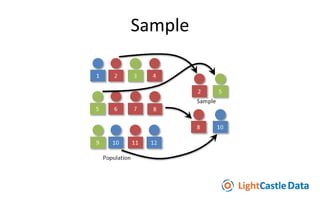
• Population:
– a set which includes all measurements of
interest to the researcher (The collection of all
responses, measurements, or counts that are
of interest)
• Sample:
– A subset of the population
Study
Population
Target
Population
Sample
Key Terminologies
• Study(Sampling) Population
– The population to be studied/ to which the investigator wants to
generalize his results
• Sampling Unit
– smallest unit from which sample can be selected
• Sampling frame
– List of all the sampling units from which sample is drawn
• Sampling scheme
– Method of selecting sampling units from sampling frame
• Sampling fraction
– Ratio between sample size and population size
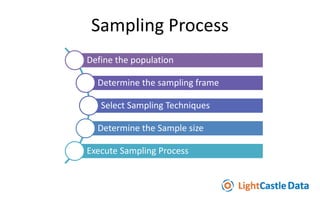
Sampling Process
Define the population
Determine the sampling frame
Select Sampling Techniques
Determine the Sample size
Execute Sampling Process
Influencing Factors
• Factors that influence sample design
– Research Type
– Element Type
– Population size
– Participation (response)
– Available Resources
– Constraints/ limitations
• When might you sample the entire population?
– When your population is very small
– When you have extensive resources
– When you don’t expect a very high response
Sampling Classifications
Probability Sampling
– Simple random sample
– Systematic sample
– Stratified sample
– Cluster sample
– Multistage sample
Non-Probability Sampling
– Convenience sample
– Judgmental/ Purposive
sample
– Quota sample
– Snowball sample
Each member of the population has
a known non-zero probability of
being selected, and this probability
can be accurately determined.
Members are selected from the
population in some nonrandom
manner or where the probability of
selection can't be accurately
determined
PROBABILITY SAMPLING
Simple Random Sampling
• Each element in the
population has a
known and equal
probability of
selection.
Systematic Sampling
• Arranging the target
population according
to some ordering
scheme and then
selecting elements at
regular intervals
through that ordered
list.
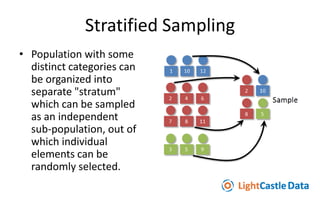
Stratified Sampling
• Population with some
distinct categories can
be organized into
separate "stratum"
which can be sampled
as an independent
sub-population, out of
which individual
elements can be
randomly selected.
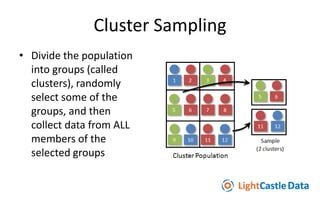
Cluster Sampling
• Divide the population
into groups (called
clusters), randomly
select some of the
groups, and then
collect data from ALL
members of the
selected groups
Cluster Sampling
Section 4
Section 5
Section 3
Section 2Section 1
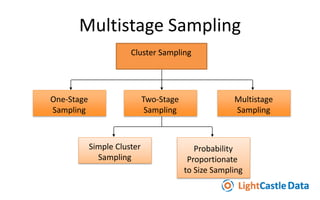
Multistage Sampling
Cluster Sampling
One-Stage
Sampling
Multistage
Sampling
Two-Stage
Sampling
Simple Cluster
Sampling
Probability
Proportionate
to Size Sampling
NON-PROBABILITY SAMPLING
Convenience Sampling
• Convenience sampling attempts to obtain a sample of
convenient elements. Often, respondents are selected
because they happen to be in the right place at the
right time.
– use of students, and members of social organizations
– mall intercept interviews without qualifying the
respondents
– department stores using charge account lists
– “people on the street” interviews
Purposive (Judgmental) Sampling
• Judgmental sampling is a form of convenience
sampling in which the population elements are
selected based on the judgment of the researcher.
– test markets
– purchase engineers selected in industrial marketing
research
– bellwether precincts selected in voting behavior research
– expert witnesses used in court
Quota Sampling
• Quota sampling may be viewed as two-stage restricted judgmental sampling.
– The first stage consists of developing control categories, or quotas, of population elements.
– In the second stage, sample elements are selected based on convenience or judgment.
Population Sample
composition composition
Control
Characteristic Percentage Percentage Number
Sex
Male 48 48 480
Female 52 52 520
____ ____ ____
100 100 1000
Snowball Sampling
• In snowball sampling, an initial group of respondents
is selected, usually at random.
– After being interviewed, these respondents are asked to
identify others who belong to the target population of
interest.
– Subsequent respondents are selected based on the
referrals.
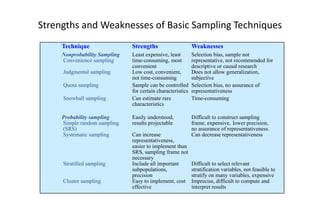
Technique Strengths Weaknesses
Nonprobability Sampling
Convenience sampling
Least expensive, least
time-consuming, most
convenient
Selection bias, sample not
representative, not recommended for
descriptive or causal research
Judgmental sampling Low cost, convenient,
not time-consuming
Does not allow generalization,
subjective
Quota sampling Sample can be controlled
for certain characteristics
Selection bias, no assurance of
representativeness
Snowball sampling Can estimate rare
characteristics
Time-consuming
Probability sampling
Simple random sampling
(SRS)
Easily understood,
results projectable
Difficult to construct sampling
frame, expensive, lower precision,
no assurance of representativeness.
Systematic sampling Can increase
representativeness,
easier to implement than
SRS, sampling frame not
necessary
Can decrease representativeness
Stratified sampling Include all important
subpopulations,
precision
Difficult to select relevant
stratification variables, not feasible to
stratify on many variables, expensive
Cluster sampling Easy to implement, cost
effective
Imprecise, difficult to compute and
interpret results
Strengths and Weaknesses of Basic Sampling Techniques
Errors in sample
• Systematic error (or bias)
– Inaccurate response (information bias)
– Selection bias
• Sampling error (random error)
Sample size
Quantitative Qualitative
2D
2σ2Z
n 
2
2
2
2
1
D
)xFσ(σ
n


2
2
D
π)π(1Z
n


2
D
F)P-(1P2
n 
Few more terminologies
Market Research At Your Fingertips
www.lightcastledata.com
Purpose
Pg 28
An online survey platform that allows companies to conduct
consumer research in real time – enabling fast decisions.
Mar Tech – LC Data
Pg 29
Incentives for Companies
Pg 30
Fast turnaround Cost savings Real time analyticsAccurate data
Incentives for Respondents
Pg 31
Feel good effect –
opinion matters
Easy money

Sampling Plan

  • 1.
    Sampling Plan Prepared by SaifurRahman Co-founder, LightCastle Partners
  • 2.
    Things to Discuss •Key Terminologies • Sampling Design Process • Sampling Classification (Scheme) • Different Sampling Methods • Sample size Calculation
  • 3.
  • 4.
  • 5.
    Key Terminologies • Population: –a set which includes all measurements of interest to the researcher (The collection of all responses, measurements, or counts that are of interest) • Sample: – A subset of the population Study Population Target Population Sample
  • 6.
    Key Terminologies • Study(Sampling)Population – The population to be studied/ to which the investigator wants to generalize his results • Sampling Unit – smallest unit from which sample can be selected • Sampling frame – List of all the sampling units from which sample is drawn • Sampling scheme – Method of selecting sampling units from sampling frame • Sampling fraction – Ratio between sample size and population size
  • 7.
    Sampling Process Define thepopulation Determine the sampling frame Select Sampling Techniques Determine the Sample size Execute Sampling Process
  • 8.
    Influencing Factors • Factorsthat influence sample design – Research Type – Element Type – Population size – Participation (response) – Available Resources – Constraints/ limitations • When might you sample the entire population? – When your population is very small – When you have extensive resources – When you don’t expect a very high response
  • 9.
    Sampling Classifications Probability Sampling –Simple random sample – Systematic sample – Stratified sample – Cluster sample – Multistage sample Non-Probability Sampling – Convenience sample – Judgmental/ Purposive sample – Quota sample – Snowball sample Each member of the population has a known non-zero probability of being selected, and this probability can be accurately determined. Members are selected from the population in some nonrandom manner or where the probability of selection can't be accurately determined
  • 10.
  • 11.
    Simple Random Sampling •Each element in the population has a known and equal probability of selection.
  • 12.
    Systematic Sampling • Arrangingthe target population according to some ordering scheme and then selecting elements at regular intervals through that ordered list.
  • 13.
    Stratified Sampling • Populationwith some distinct categories can be organized into separate "stratum" which can be sampled as an independent sub-population, out of which individual elements can be randomly selected.
  • 14.
    Cluster Sampling • Dividethe population into groups (called clusters), randomly select some of the groups, and then collect data from ALL members of the selected groups
  • 15.
    Cluster Sampling Section 4 Section5 Section 3 Section 2Section 1
  • 16.
  • 17.
  • 18.
    Convenience Sampling • Conveniencesampling attempts to obtain a sample of convenient elements. Often, respondents are selected because they happen to be in the right place at the right time. – use of students, and members of social organizations – mall intercept interviews without qualifying the respondents – department stores using charge account lists – “people on the street” interviews
  • 19.
    Purposive (Judgmental) Sampling •Judgmental sampling is a form of convenience sampling in which the population elements are selected based on the judgment of the researcher. – test markets – purchase engineers selected in industrial marketing research – bellwether precincts selected in voting behavior research – expert witnesses used in court
  • 20.
    Quota Sampling • Quotasampling may be viewed as two-stage restricted judgmental sampling. – The first stage consists of developing control categories, or quotas, of population elements. – In the second stage, sample elements are selected based on convenience or judgment. Population Sample composition composition Control Characteristic Percentage Percentage Number Sex Male 48 48 480 Female 52 52 520 ____ ____ ____ 100 100 1000
  • 21.
    Snowball Sampling • Insnowball sampling, an initial group of respondents is selected, usually at random. – After being interviewed, these respondents are asked to identify others who belong to the target population of interest. – Subsequent respondents are selected based on the referrals.
  • 22.
    Technique Strengths Weaknesses NonprobabilitySampling Convenience sampling Least expensive, least time-consuming, most convenient Selection bias, sample not representative, not recommended for descriptive or causal research Judgmental sampling Low cost, convenient, not time-consuming Does not allow generalization, subjective Quota sampling Sample can be controlled for certain characteristics Selection bias, no assurance of representativeness Snowball sampling Can estimate rare characteristics Time-consuming Probability sampling Simple random sampling (SRS) Easily understood, results projectable Difficult to construct sampling frame, expensive, lower precision, no assurance of representativeness. Systematic sampling Can increase representativeness, easier to implement than SRS, sampling frame not necessary Can decrease representativeness Stratified sampling Include all important subpopulations, precision Difficult to select relevant stratification variables, not feasible to stratify on many variables, expensive Cluster sampling Easy to implement, cost effective Imprecise, difficult to compute and interpret results Strengths and Weaknesses of Basic Sampling Techniques
  • 23.
    Errors in sample •Systematic error (or bias) – Inaccurate response (information bias) – Selection bias • Sampling error (random error)
  • 24.
    Sample size Quantitative Qualitative 2D 2σ2Z n 2 2 2 2 1 D )xFσ(σ n   2 2 D π)π(1Z n   2 D F)P-(1P2 n 
  • 25.
  • 27.
    Market Research AtYour Fingertips www.lightcastledata.com
  • 28.
    Purpose Pg 28 An onlinesurvey platform that allows companies to conduct consumer research in real time – enabling fast decisions.
  • 29.
    Mar Tech –LC Data Pg 29
  • 30.
    Incentives for Companies Pg30 Fast turnaround Cost savings Real time analyticsAccurate data
  • 31.
    Incentives for Respondents Pg31 Feel good effect – opinion matters Easy money