
Business Research Methods
Unit IV
• Sampling: Basic Concepts: Defining the Universe, Concepts of
Statistical Population, Sample, Characteristics of a good sample.
Sampling Frame (practical approach for determining the sample,
frame expected), Sampling errors, Non Sampling errors, Methods to
reduce the errors, Sample Size , constraints, Non Response.
• Probability Sample: Simple Random Sample, Systematic Sample,
Stratified Random Sample, Area Sampling & Cluster Sampling.
• Non Probability Sample: Judgment Sampling, Convenience
Sampling, Purposive Sampling, Quota Sampling & Snowballing
Sampling methods. Determining size of the sample – Practical
considerations in sampling and sample size, sample size
determination.
Defining the Universe,
• A population can be defined as including all
people or items with the characteristic one
wishes to understand.
• Because there is very rarely enough time or
money to gather information from everyone
or everything in a universe(population), the
goal becomes finding a representative sample
(or subset) of that population.
Sampling Frame
• In statistics, a sampling frame is the source
material or device from which a sample is
drawn. It is a list of all those within a
population who can be sampled, and may
include individuals, households or
institutions.
Characteristics of Good Sample
• Goal-oriented
• Accurate representative of the universe
• Proportional
• Random selection
• Economical
• Practical
• Actual information provider
Characteristics of Good Sample
(a) Sample design must result in a truly
representative sample.
(b) Sample design must be such which results in a
small sampling error.
(c) Sample design must be viable in the context of
funds available for the research study.
(d) Sample design must be such so that systematic
bias can be controlled in a better way.
(e) Sample should be such that the results of the
sample study can be applied, in general, for the
universe with a reasonable level of confidence
Sampling errors
• Systematic bias and Sampling error
• A systematic bias results from errors in the
sampling procedures, and it cannot be
reduced or eliminated by increasing the
sample size. At best the causes responsible for
these errors can be detected and corrected.
Sampling errors
• Reasons for Systematic Error
– Inappropriate sampling frame
– Defective measuring device
– Non-respondents
– Indeterminacy principle
– Natural bias in the reporting of data
Sampling errors
• Sampling errors are the random variations in
the sample estimates around the true
population parameters.
• Sampling error decreases with the increase in
the size of the sample, and it happens to be of
a smaller magnitude in case of homogeneous
population.
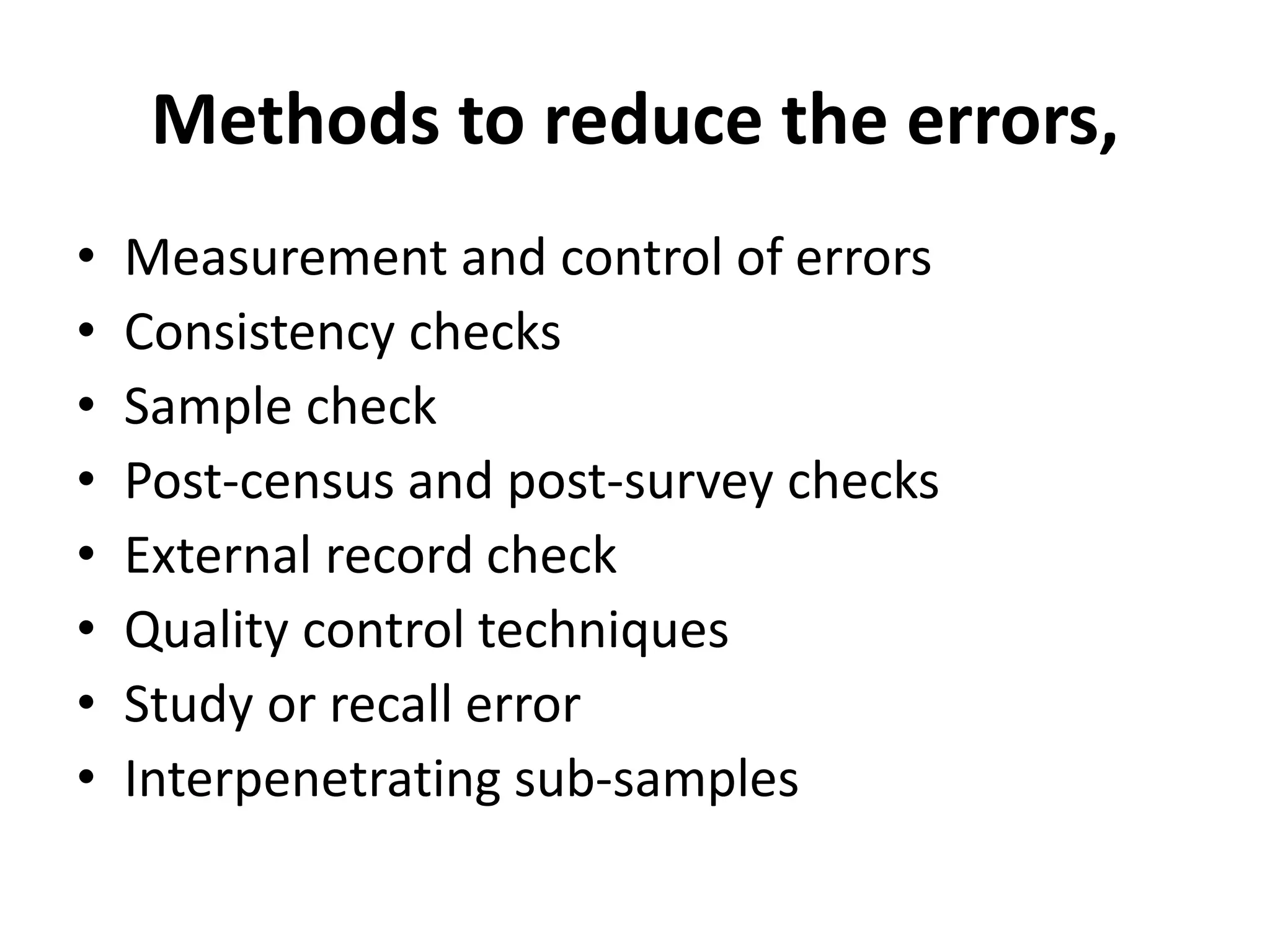
Methods to reduce the errors,
• Measurement and control of errors
• Consistency checks
• Sample check
• Post-census and post-survey checks
• External record check
• Quality control techniques
• Study or recall error
• Interpenetrating sub-samples
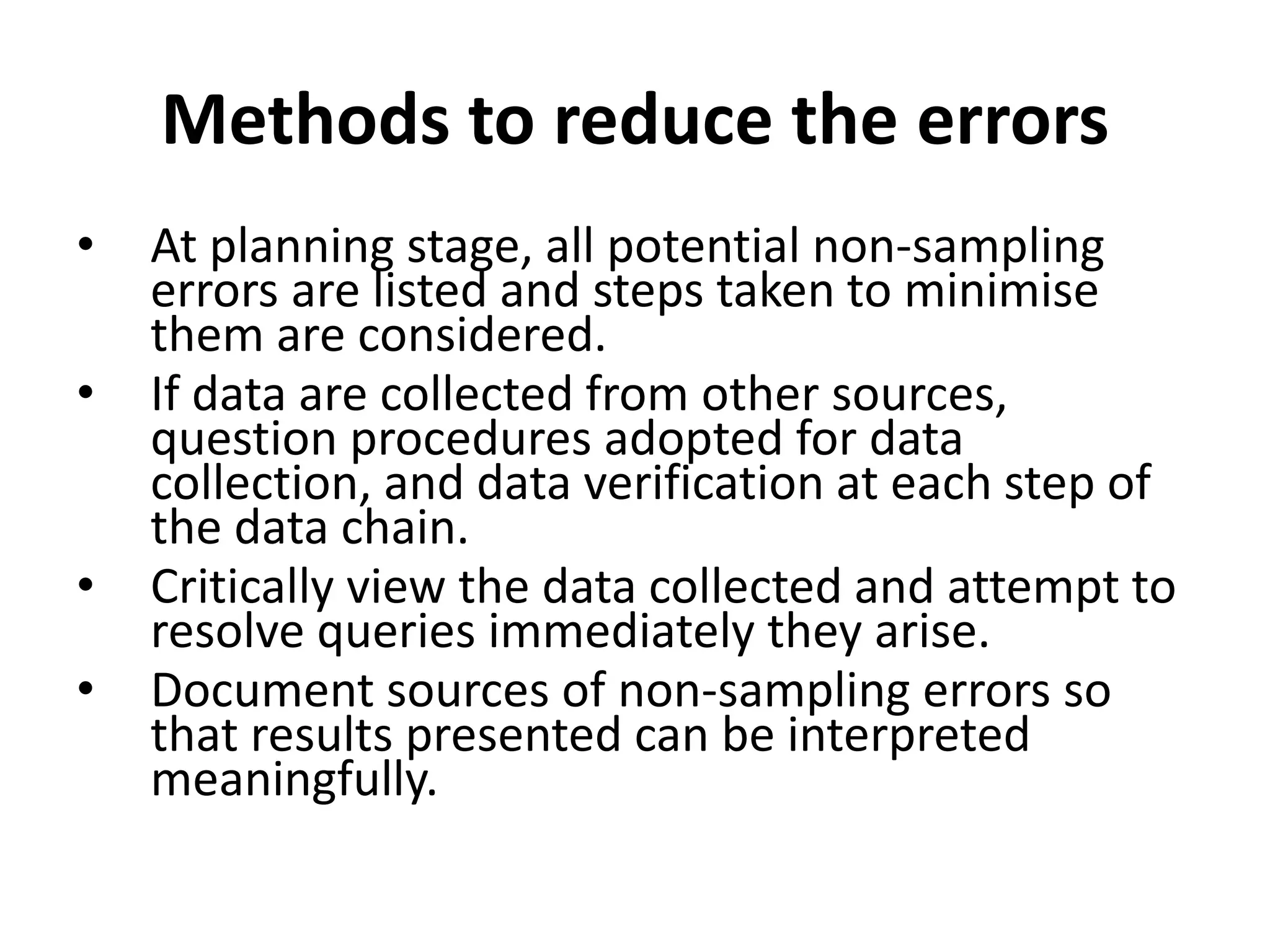
Methods to reduce the errors
• At planning stage, all potential non-sampling
errors are listed and steps taken to minimise
them are considered.
• If data are collected from other sources,
question procedures adopted for data
collection, and data verification at each step of
the data chain.
• Critically view the data collected and attempt to
resolve queries immediately they arise.
• Document sources of non-sampling errors so
that results presented can be interpreted
meaningfully.
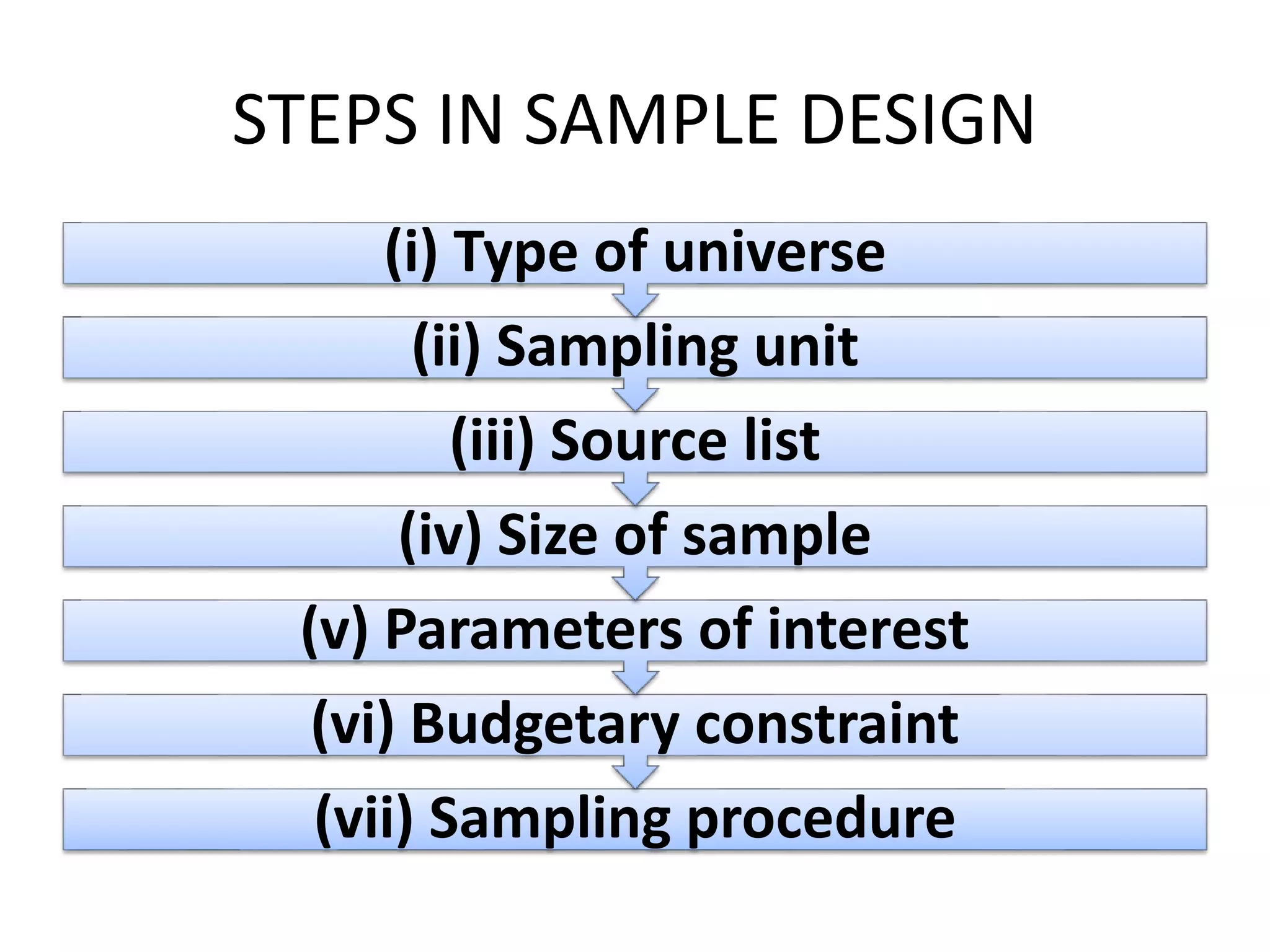
STEPS IN SAMPLE DESIGN
(vii) Sampling procedure
(vi) Budgetary constraint
(v) Parameters of interest
(iv) Size of sample
(iii) Source list
(ii) Sampling unit
(i) Type of universe
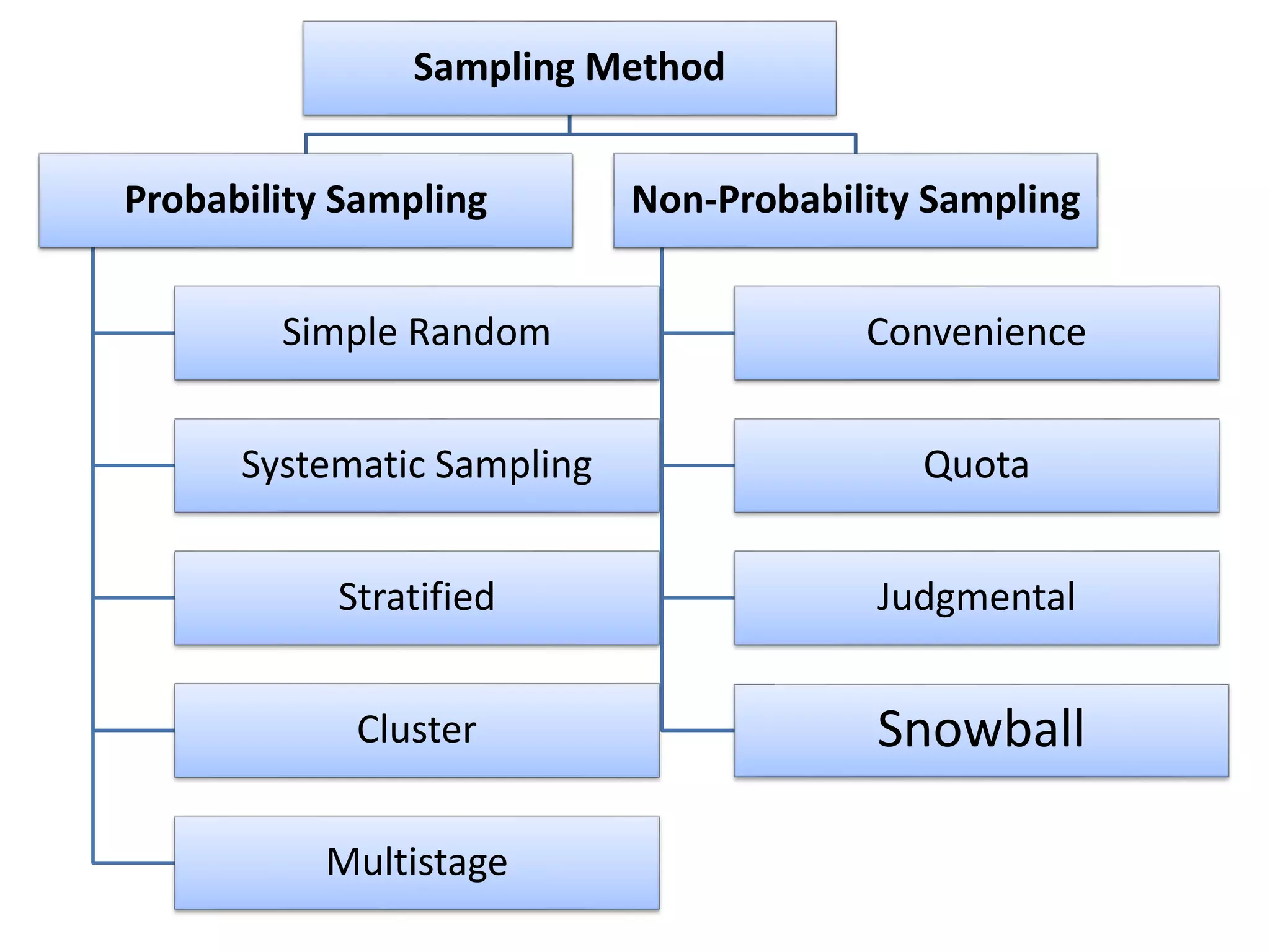
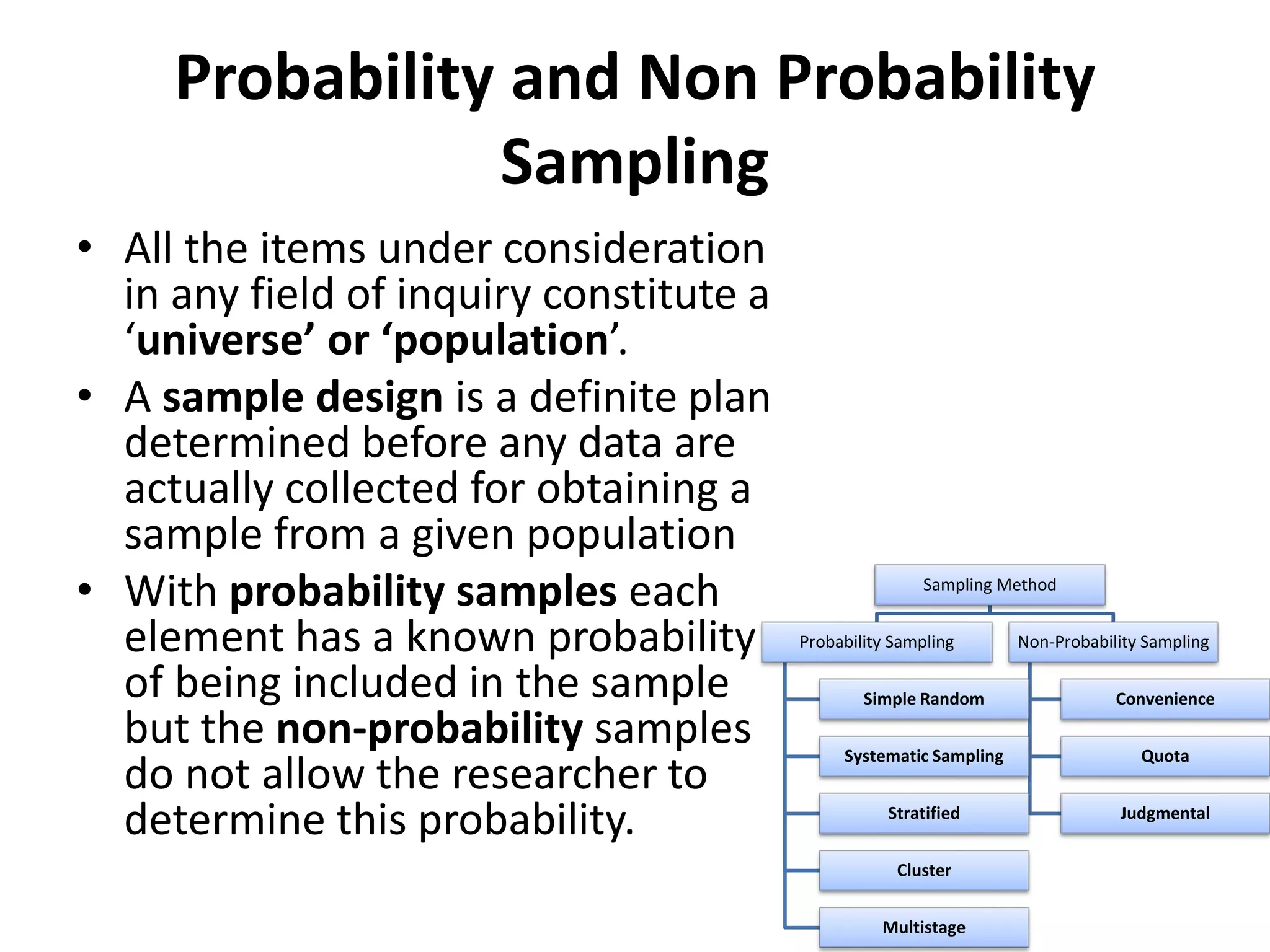
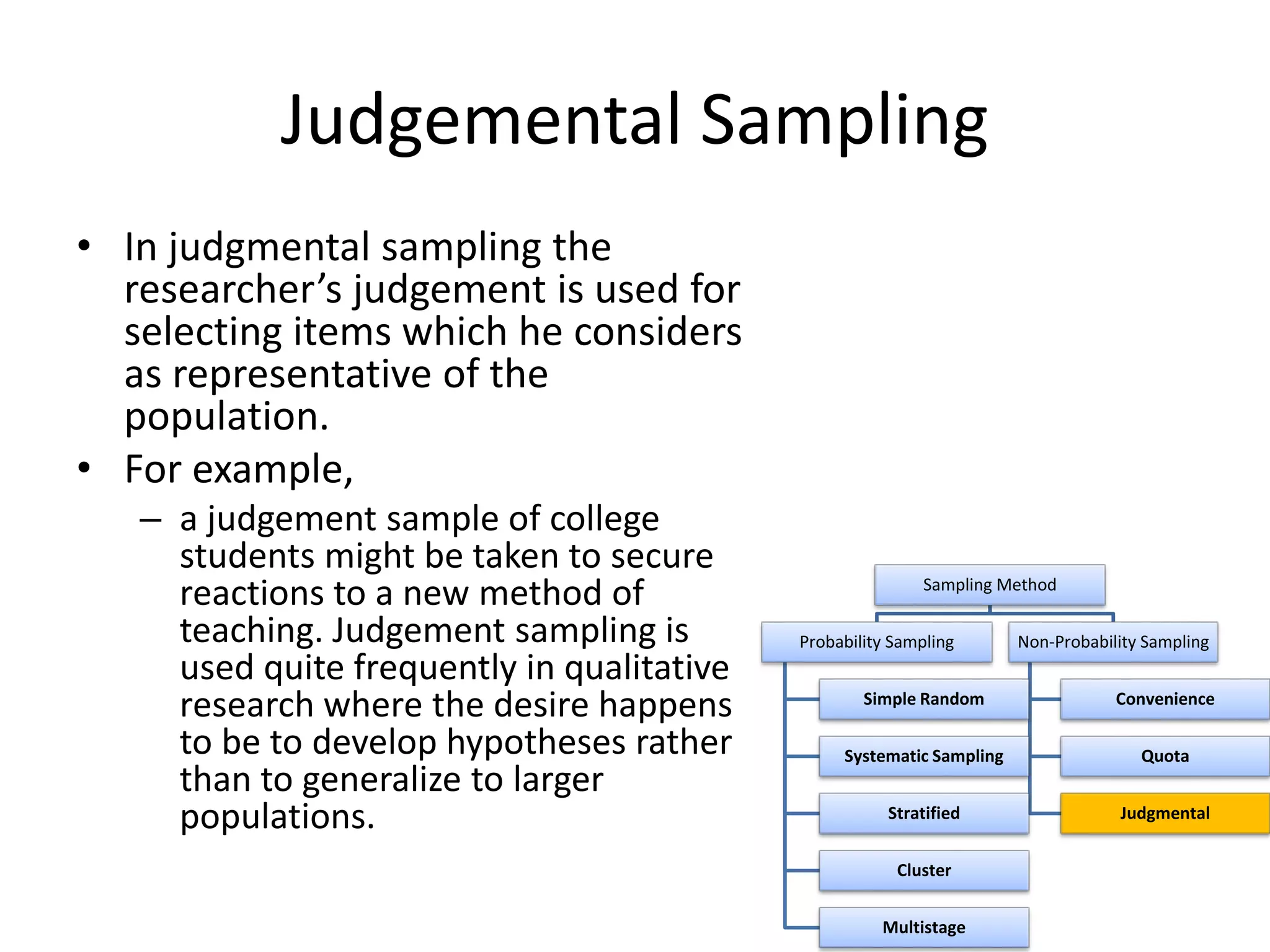
Sampling Method
Probability Sampling
Simple Random
Systematic Sampling
Stratified
Cluster
Multistage
Non-Probability Sampling
Convenience
Quota
Judgmental
Snowball
Probability and Non Probability
Sampling
• All the items under consideration
in any field of inquiry constitute a
‘universe’ or ‘population’.
• A sample design is a definite plan
determined before any data are
actually collected for obtaining a
sample from a given population
• With probability samples each
element has a known probability
of being included in the sample
but the non-probability samples
do not allow the researcher to
determine this probability.
Sampling Method
Probability Sampling
Simple Random
Systematic Sampling
Stratified
Cluster
Multistage
Non-Probability Sampling
Convenience
Quota
Judgmental
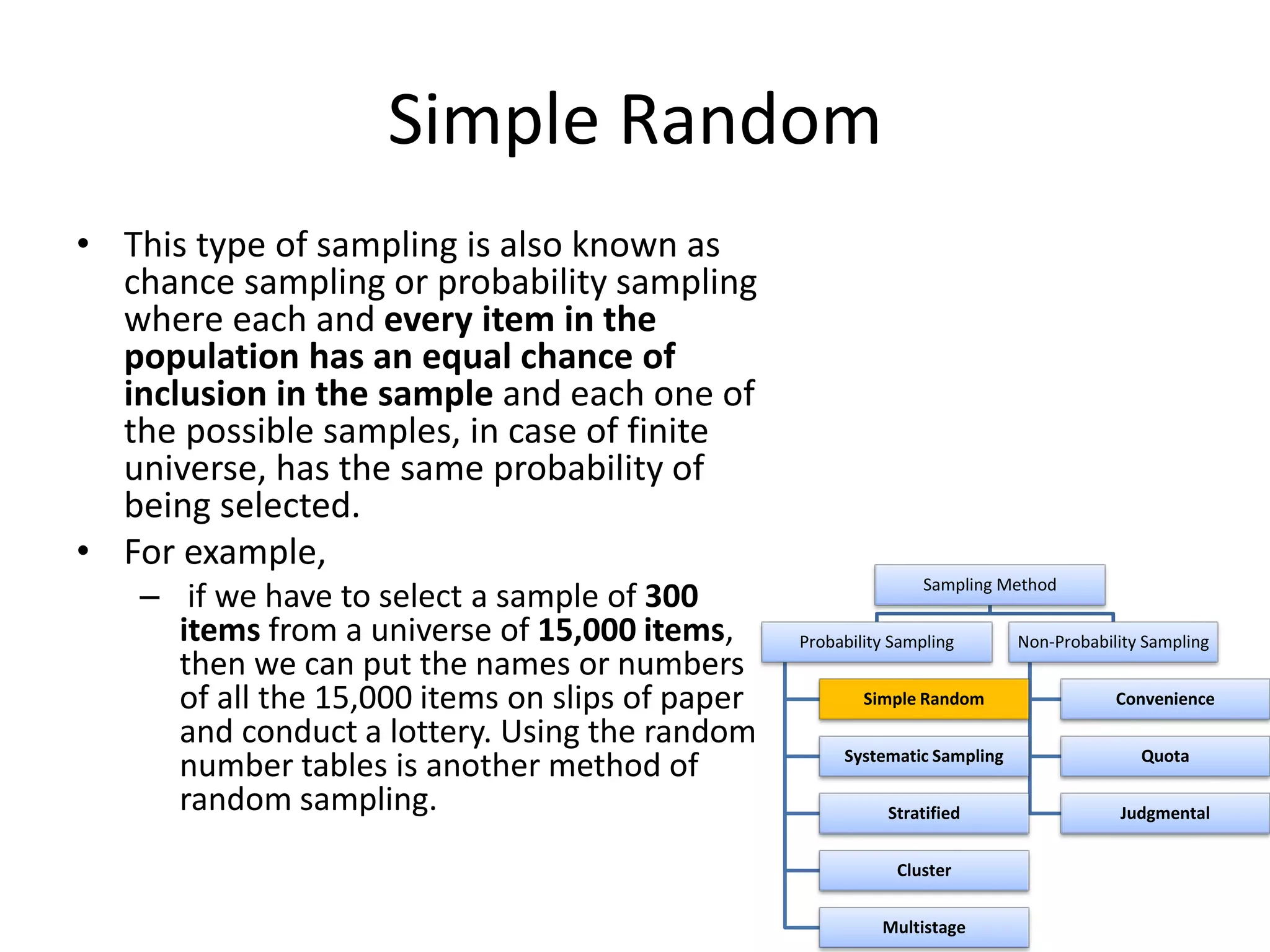
Simple Random
• This type of sampling is also known as
chance sampling or probability sampling
where each and every item in the
population has an equal chance of
inclusion in the sample and each one of
the possible samples, in case of finite
universe, has the same probability of
being selected.
• For example,
– if we have to select a sample of 300
items from a universe of 15,000 items,
then we can put the names or numbers
of all the 15,000 items on slips of paper
and conduct a lottery. Using the random
number tables is another method of
random sampling.
Sampling Method
Probability Sampling
Simple Random
Systematic Sampling
Stratified
Cluster
Multistage
Non-Probability Sampling
Convenience
Quota
Judgmental
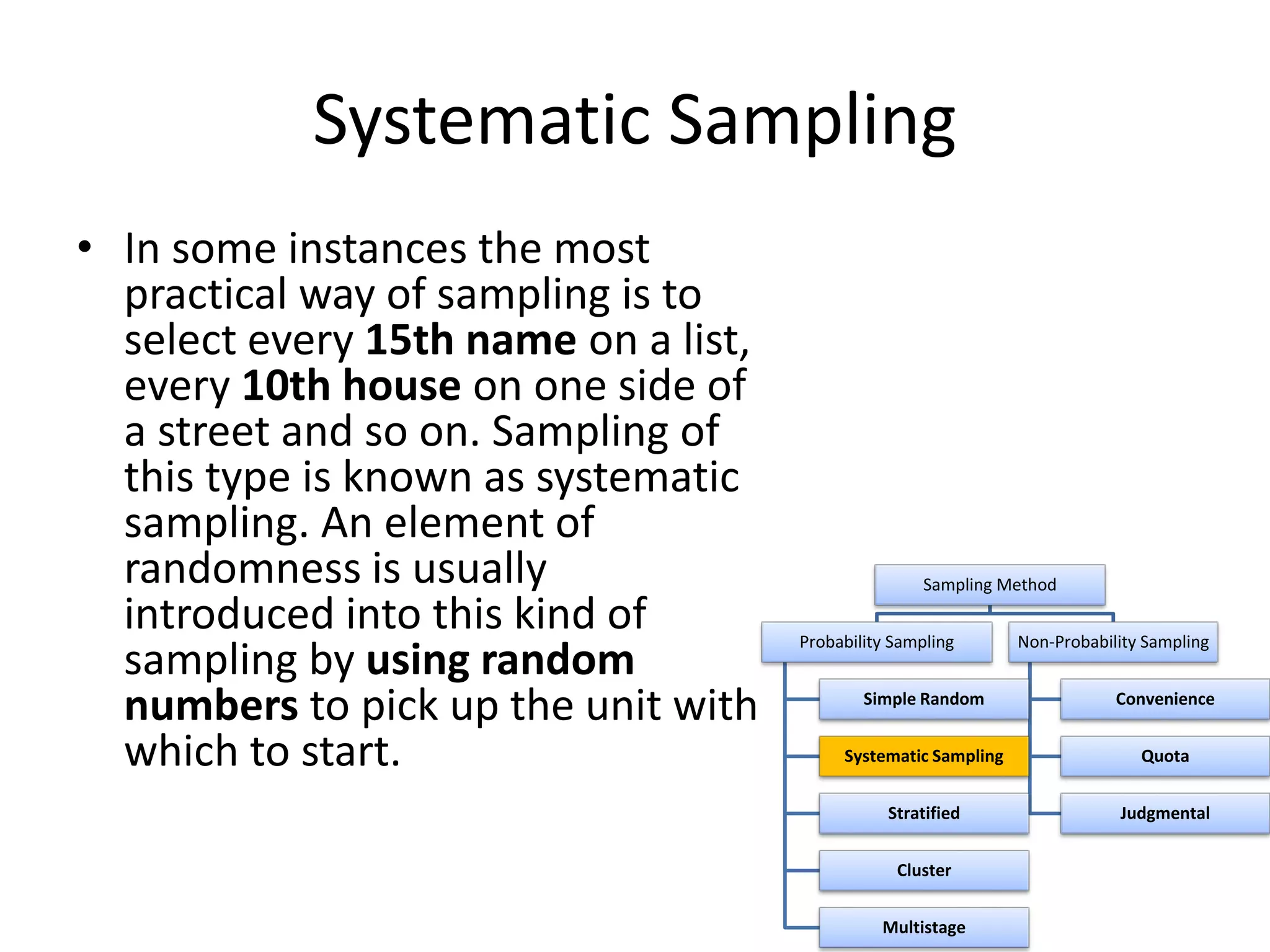
Systematic Sampling
• In some instances the most
practical way of sampling is to
select every 15th name on a list,
every 10th house on one side of
a street and so on. Sampling of
this type is known as systematic
sampling. An element of
randomness is usually
introduced into this kind of
sampling by using random
numbers to pick up the unit with
which to start.
Sampling Method
Probability Sampling
Simple Random
Systematic Sampling
Stratified
Cluster
Multistage
Non-Probability Sampling
Convenience
Quota
Judgmental
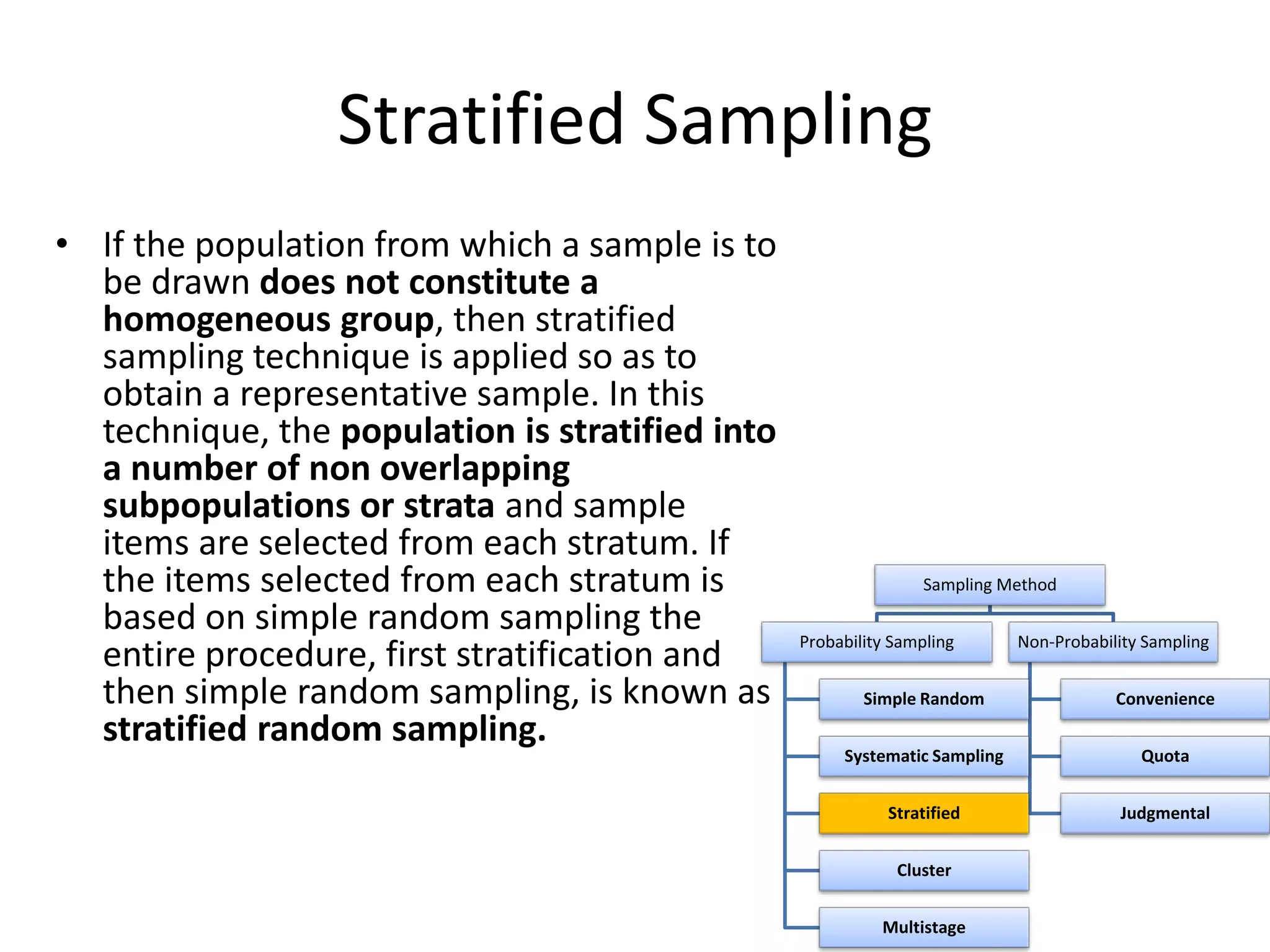
Stratified Sampling
• If the population from which a sample is to
be drawn does not constitute a
homogeneous group, then stratified
sampling technique is applied so as to
obtain a representative sample. In this
technique, the population is stratified into
a number of non overlapping
subpopulations or strata and sample
items are selected from each stratum. If
the items selected from each stratum is
based on simple random sampling the
entire procedure, first stratification and
then simple random sampling, is known as
stratified random sampling.
Sampling Method
Probability Sampling
Simple Random
Systematic Sampling
Stratified
Cluster
Multistage
Non-Probability Sampling
Convenience
Quota
Judgmental
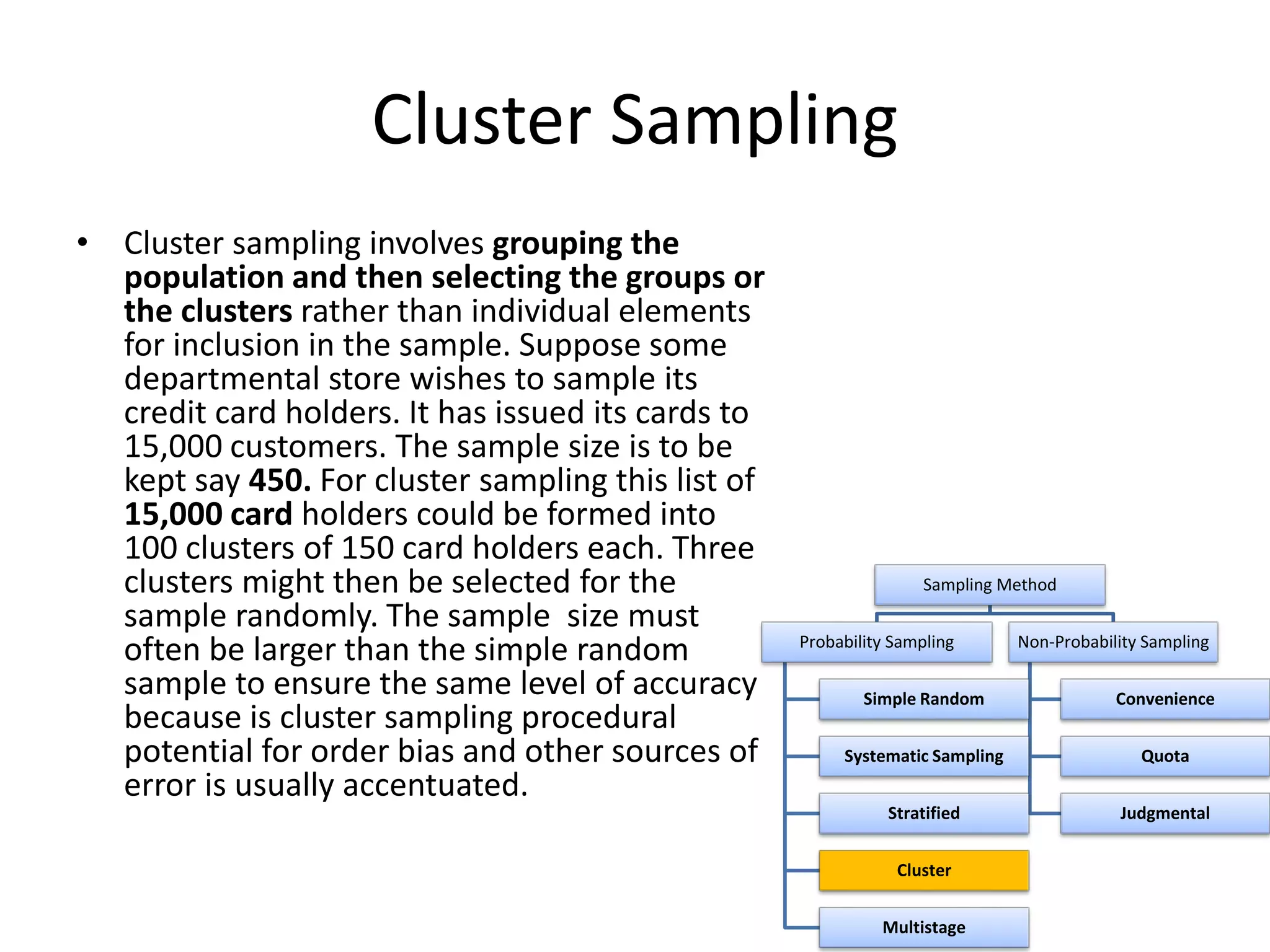
Cluster Sampling
• Cluster sampling involves grouping the
population and then selecting the groups or
the clusters rather than individual elements
for inclusion in the sample. Suppose some
departmental store wishes to sample its
credit card holders. It has issued its cards to
15,000 customers. The sample size is to be
kept say 450. For cluster sampling this list of
15,000 card holders could be formed into
100 clusters of 150 card holders each. Three
clusters might then be selected for the
sample randomly. The sample size must
often be larger than the simple random
sample to ensure the same level of accuracy
because is cluster sampling procedural
potential for order bias and other sources of
error is usually accentuated.
Sampling Method
Probability Sampling
Simple Random
Systematic Sampling
Stratified
Cluster
Multistage
Non-Probability Sampling
Convenience
Quota
Judgmental
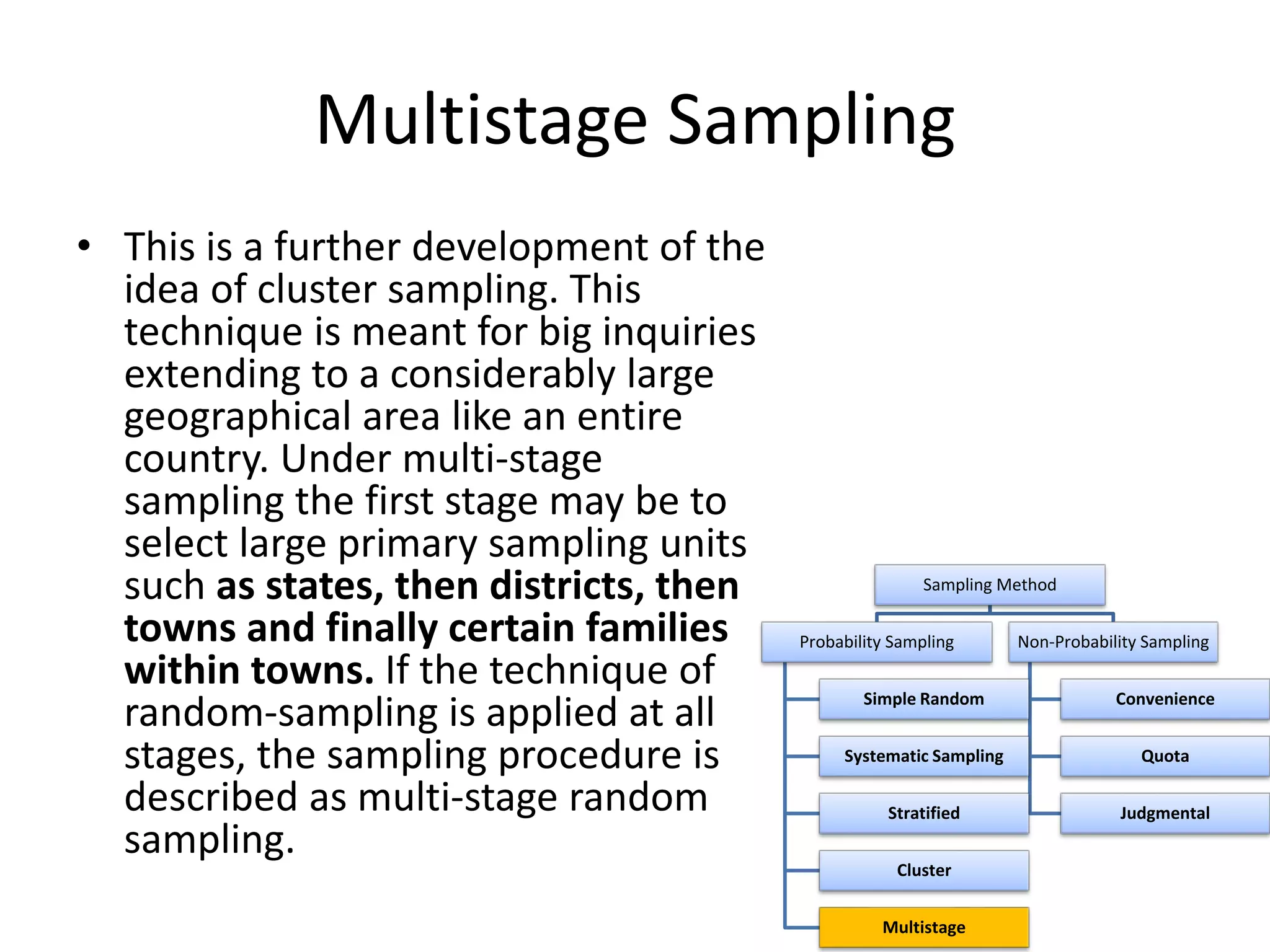
Multistage Sampling
• This is a further development of the
idea of cluster sampling. This
technique is meant for big inquiries
extending to a considerably large
geographical area like an entire
country. Under multi-stage
sampling the first stage may be to
select large primary sampling units
such as states, then districts, then
towns and finally certain families
within towns. If the technique of
random-sampling is applied at all
stages, the sampling procedure is
described as multi-stage random
sampling.
Sampling Method
Probability Sampling
Simple Random
Systematic Sampling
Stratified
Cluster
Multistage
Non-Probability Sampling
Convenience
Quota
Judgmental
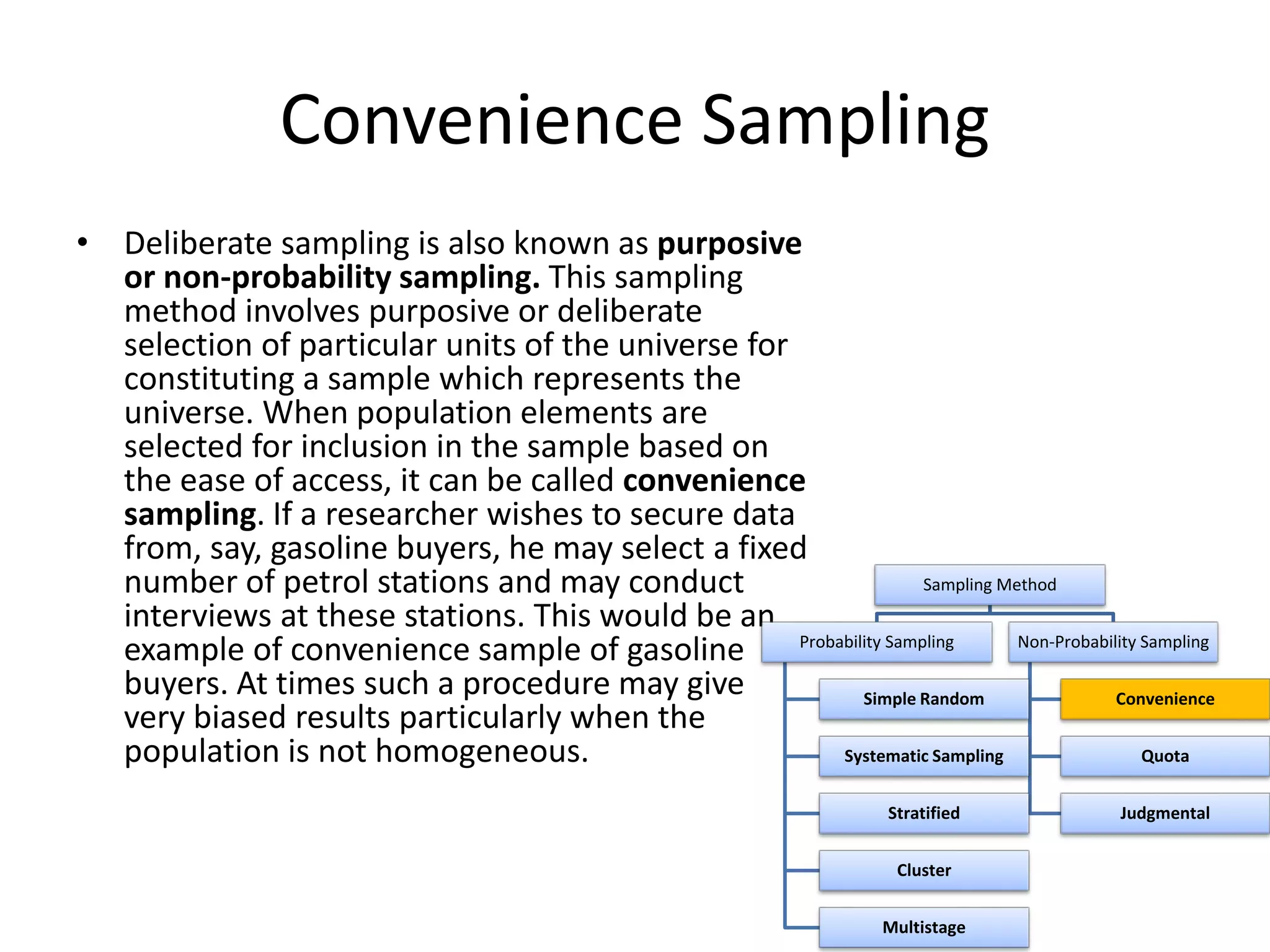
Convenience Sampling
• Deliberate sampling is also known as purposive
or non-probability sampling. This sampling
method involves purposive or deliberate
selection of particular units of the universe for
constituting a sample which represents the
universe. When population elements are
selected for inclusion in the sample based on
the ease of access, it can be called convenience
sampling. If a researcher wishes to secure data
from, say, gasoline buyers, he may select a fixed
number of petrol stations and may conduct
interviews at these stations. This would be an
example of convenience sample of gasoline
buyers. At times such a procedure may give
very biased results particularly when the
population is not homogeneous.
Sampling Method
Probability Sampling
Simple Random
Systematic Sampling
Stratified
Cluster
Multistage
Non-Probability Sampling
Convenience
Quota
Judgmental
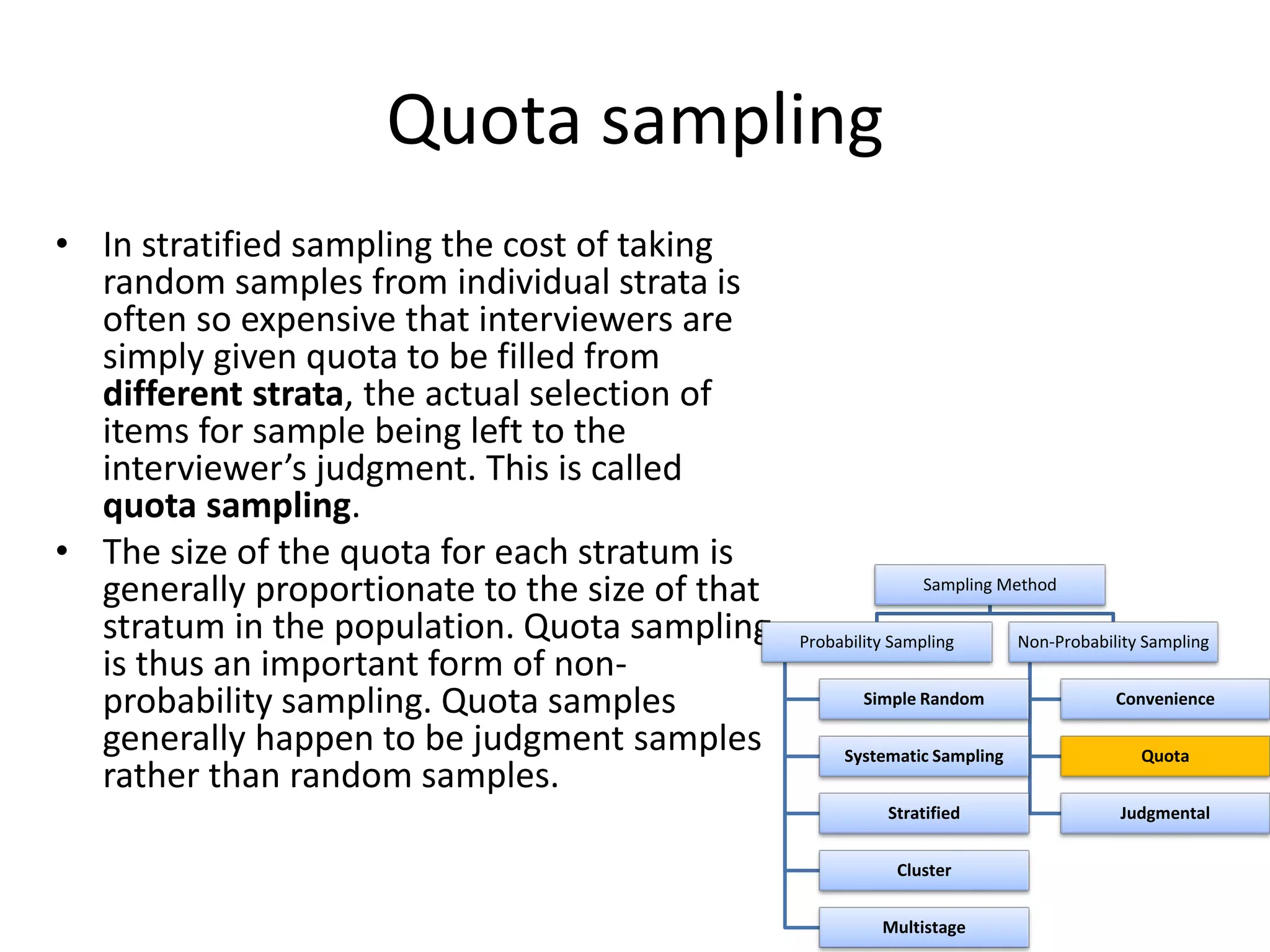
Quota sampling
• In stratified sampling the cost of taking
random samples from individual strata is
often so expensive that interviewers are
simply given quota to be filled from
different strata, the actual selection of
items for sample being left to the
interviewer’s judgment. This is called
quota sampling.
• The size of the quota for each stratum is
generally proportionate to the size of that
stratum in the population. Quota sampling
is thus an important form of non-
probability sampling. Quota samples
generally happen to be judgment samples
rather than random samples.
Sampling Method
Probability Sampling
Simple Random
Systematic Sampling
Stratified
Cluster
Multistage
Non-Probability Sampling
Convenience
Quota
Judgmental
Judgemental Sampling
• In judgmental sampling the
researcher’s judgement is used for
selecting items which he considers
as representative of the
population.
• For example,
– a judgement sample of college
students might be taken to secure
reactions to a new method of
teaching. Judgement sampling is
used quite frequently in qualitative
research where the desire happens
to be to develop hypotheses rather
than to generalize to larger
populations.
Sampling Method
Probability Sampling
Simple Random
Systematic Sampling
Stratified
Cluster
Multistage
Non-Probability Sampling
Convenience
Quota
Judgmental
Sample Size Determination
• Size of the sample should be determined by a
researcher keeping in view the following points:
– Nature of universe
– Number of classes proposed
– Nature of study
– Type of sampling
– Standard of accuracy and acceptable confidence level
– Availability of finance.
Sample Size Determination
• Other considerations:
– Nature of units,
– Size of the population,
– Size of questionnaire,
– Availability of trained investigators,
– The conditions under which the sample is being
conducted,
– The time available for completion of the study
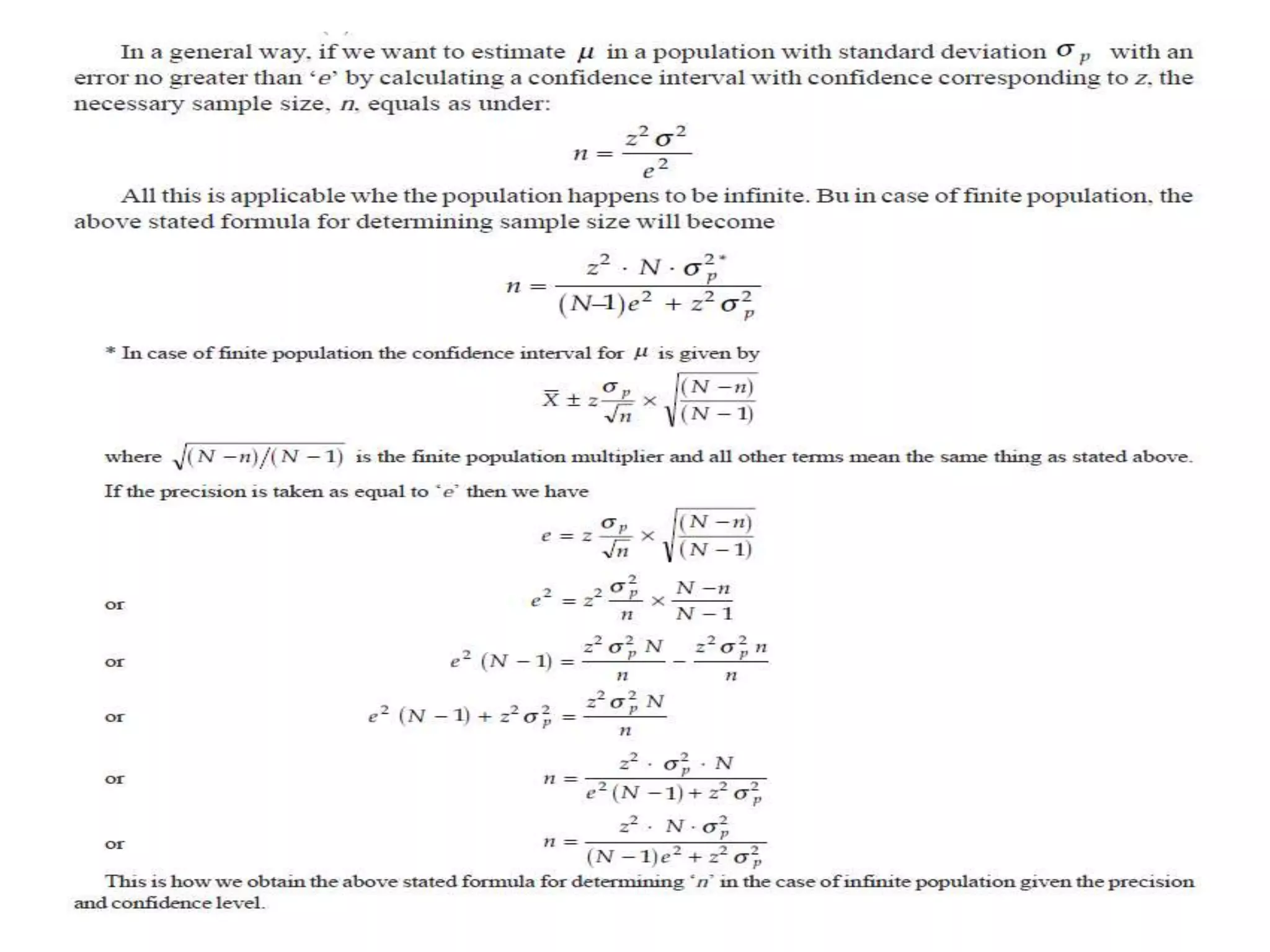
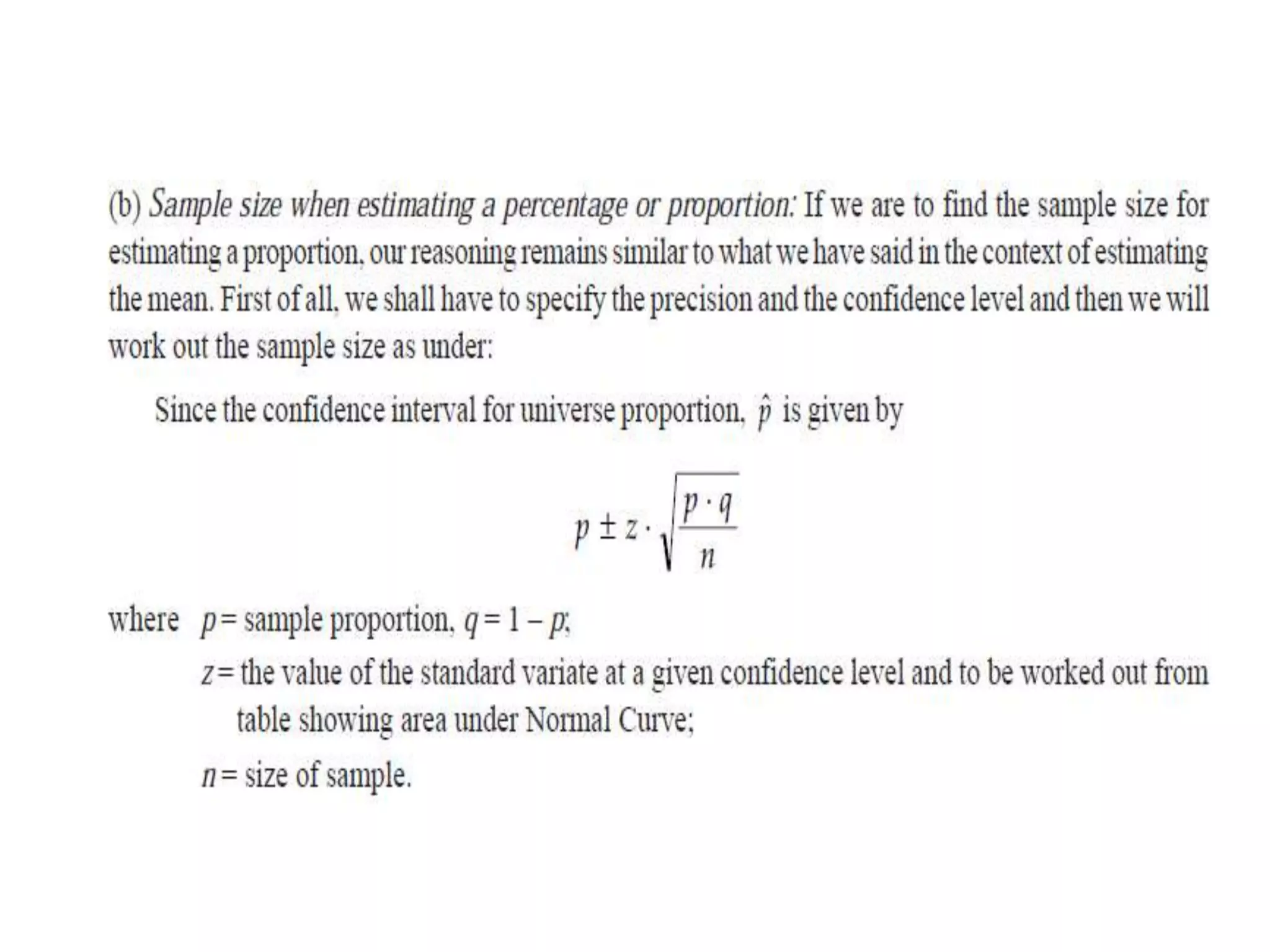
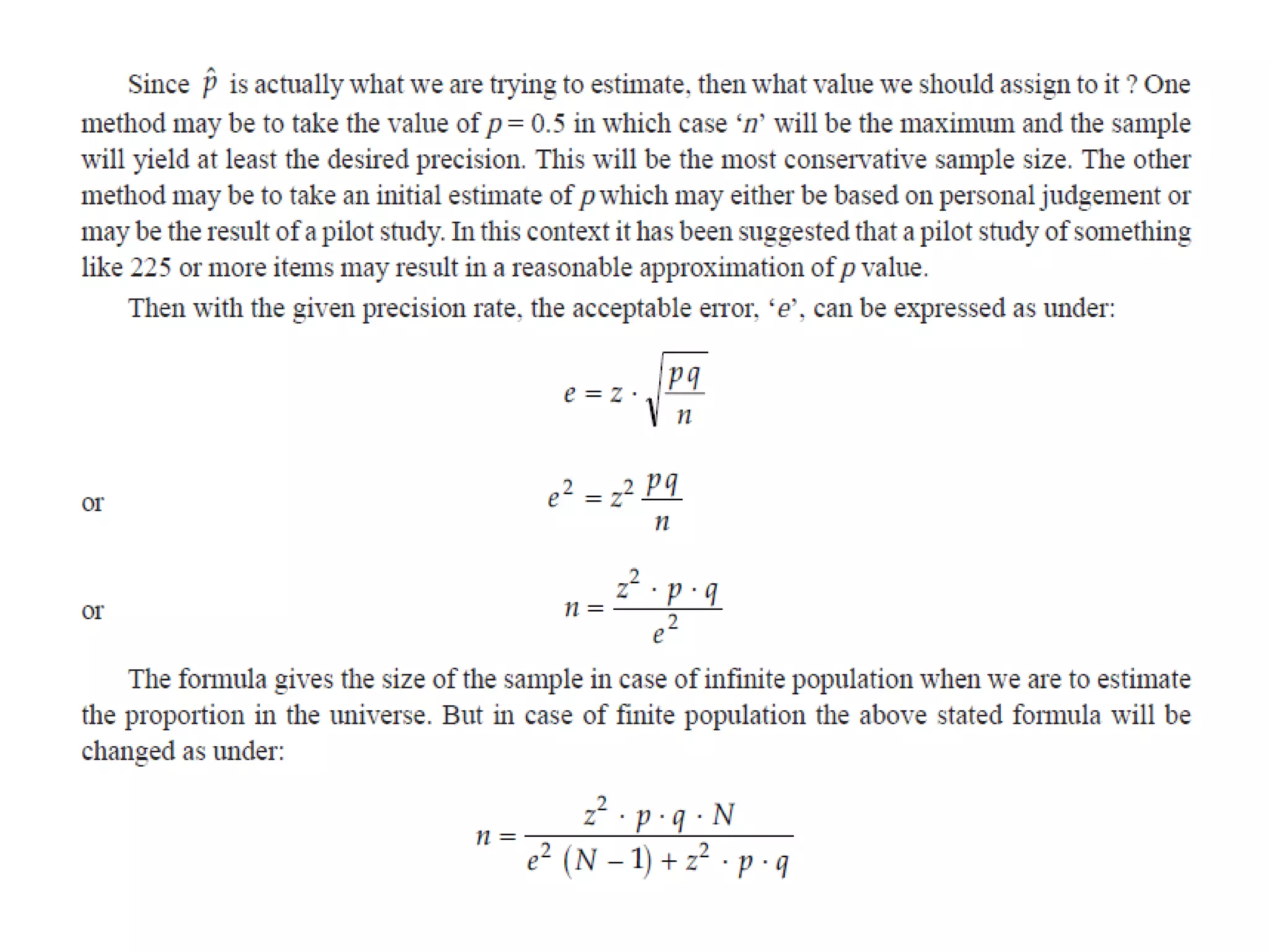
• Please refer to the page number 174 – 180 of
the CR Kothari Book.
Business Research Methods Unit IV

Business Research Methods Unit IV

  • 1.
  • 2.
    • Sampling: BasicConcepts: Defining the Universe, Concepts of Statistical Population, Sample, Characteristics of a good sample. Sampling Frame (practical approach for determining the sample, frame expected), Sampling errors, Non Sampling errors, Methods to reduce the errors, Sample Size , constraints, Non Response. • Probability Sample: Simple Random Sample, Systematic Sample, Stratified Random Sample, Area Sampling & Cluster Sampling. • Non Probability Sample: Judgment Sampling, Convenience Sampling, Purposive Sampling, Quota Sampling & Snowballing Sampling methods. Determining size of the sample – Practical considerations in sampling and sample size, sample size determination.
  • 3.
    Defining the Universe, •A population can be defined as including all people or items with the characteristic one wishes to understand. • Because there is very rarely enough time or money to gather information from everyone or everything in a universe(population), the goal becomes finding a representative sample (or subset) of that population.
  • 4.
    Sampling Frame • Instatistics, a sampling frame is the source material or device from which a sample is drawn. It is a list of all those within a population who can be sampled, and may include individuals, households or institutions.
  • 5.
    Characteristics of GoodSample • Goal-oriented • Accurate representative of the universe • Proportional • Random selection • Economical • Practical • Actual information provider
  • 6.
    Characteristics of GoodSample (a) Sample design must result in a truly representative sample. (b) Sample design must be such which results in a small sampling error. (c) Sample design must be viable in the context of funds available for the research study. (d) Sample design must be such so that systematic bias can be controlled in a better way. (e) Sample should be such that the results of the sample study can be applied, in general, for the universe with a reasonable level of confidence
  • 7.
    Sampling errors • Systematicbias and Sampling error • A systematic bias results from errors in the sampling procedures, and it cannot be reduced or eliminated by increasing the sample size. At best the causes responsible for these errors can be detected and corrected.
  • 8.
    Sampling errors • Reasonsfor Systematic Error – Inappropriate sampling frame – Defective measuring device – Non-respondents – Indeterminacy principle – Natural bias in the reporting of data
  • 9.
    Sampling errors • Samplingerrors are the random variations in the sample estimates around the true population parameters. • Sampling error decreases with the increase in the size of the sample, and it happens to be of a smaller magnitude in case of homogeneous population.
  • 10.
    Methods to reducethe errors, • Measurement and control of errors • Consistency checks • Sample check • Post-census and post-survey checks • External record check • Quality control techniques • Study or recall error • Interpenetrating sub-samples
  • 11.
    Methods to reducethe errors • At planning stage, all potential non-sampling errors are listed and steps taken to minimise them are considered. • If data are collected from other sources, question procedures adopted for data collection, and data verification at each step of the data chain. • Critically view the data collected and attempt to resolve queries immediately they arise. • Document sources of non-sampling errors so that results presented can be interpreted meaningfully.
  • 12.
    STEPS IN SAMPLEDESIGN (vii) Sampling procedure (vi) Budgetary constraint (v) Parameters of interest (iv) Size of sample (iii) Source list (ii) Sampling unit (i) Type of universe
  • 13.
    Sampling Method Probability Sampling SimpleRandom Systematic Sampling Stratified Cluster Multistage Non-Probability Sampling Convenience Quota Judgmental Snowball
  • 14.
    Probability and NonProbability Sampling • All the items under consideration in any field of inquiry constitute a ‘universe’ or ‘population’. • A sample design is a definite plan determined before any data are actually collected for obtaining a sample from a given population • With probability samples each element has a known probability of being included in the sample but the non-probability samples do not allow the researcher to determine this probability. Sampling Method Probability Sampling Simple Random Systematic Sampling Stratified Cluster Multistage Non-Probability Sampling Convenience Quota Judgmental
  • 15.
    Simple Random • Thistype of sampling is also known as chance sampling or probability sampling where each and every item in the population has an equal chance of inclusion in the sample and each one of the possible samples, in case of finite universe, has the same probability of being selected. • For example, – if we have to select a sample of 300 items from a universe of 15,000 items, then we can put the names or numbers of all the 15,000 items on slips of paper and conduct a lottery. Using the random number tables is another method of random sampling. Sampling Method Probability Sampling Simple Random Systematic Sampling Stratified Cluster Multistage Non-Probability Sampling Convenience Quota Judgmental
  • 16.
    Systematic Sampling • Insome instances the most practical way of sampling is to select every 15th name on a list, every 10th house on one side of a street and so on. Sampling of this type is known as systematic sampling. An element of randomness is usually introduced into this kind of sampling by using random numbers to pick up the unit with which to start. Sampling Method Probability Sampling Simple Random Systematic Sampling Stratified Cluster Multistage Non-Probability Sampling Convenience Quota Judgmental
  • 17.
    Stratified Sampling • Ifthe population from which a sample is to be drawn does not constitute a homogeneous group, then stratified sampling technique is applied so as to obtain a representative sample. In this technique, the population is stratified into a number of non overlapping subpopulations or strata and sample items are selected from each stratum. If the items selected from each stratum is based on simple random sampling the entire procedure, first stratification and then simple random sampling, is known as stratified random sampling. Sampling Method Probability Sampling Simple Random Systematic Sampling Stratified Cluster Multistage Non-Probability Sampling Convenience Quota Judgmental
  • 18.
    Cluster Sampling • Clustersampling involves grouping the population and then selecting the groups or the clusters rather than individual elements for inclusion in the sample. Suppose some departmental store wishes to sample its credit card holders. It has issued its cards to 15,000 customers. The sample size is to be kept say 450. For cluster sampling this list of 15,000 card holders could be formed into 100 clusters of 150 card holders each. Three clusters might then be selected for the sample randomly. The sample size must often be larger than the simple random sample to ensure the same level of accuracy because is cluster sampling procedural potential for order bias and other sources of error is usually accentuated. Sampling Method Probability Sampling Simple Random Systematic Sampling Stratified Cluster Multistage Non-Probability Sampling Convenience Quota Judgmental
  • 19.
    Multistage Sampling • Thisis a further development of the idea of cluster sampling. This technique is meant for big inquiries extending to a considerably large geographical area like an entire country. Under multi-stage sampling the first stage may be to select large primary sampling units such as states, then districts, then towns and finally certain families within towns. If the technique of random-sampling is applied at all stages, the sampling procedure is described as multi-stage random sampling. Sampling Method Probability Sampling Simple Random Systematic Sampling Stratified Cluster Multistage Non-Probability Sampling Convenience Quota Judgmental
  • 20.
    Convenience Sampling • Deliberatesampling is also known as purposive or non-probability sampling. This sampling method involves purposive or deliberate selection of particular units of the universe for constituting a sample which represents the universe. When population elements are selected for inclusion in the sample based on the ease of access, it can be called convenience sampling. If a researcher wishes to secure data from, say, gasoline buyers, he may select a fixed number of petrol stations and may conduct interviews at these stations. This would be an example of convenience sample of gasoline buyers. At times such a procedure may give very biased results particularly when the population is not homogeneous. Sampling Method Probability Sampling Simple Random Systematic Sampling Stratified Cluster Multistage Non-Probability Sampling Convenience Quota Judgmental
  • 21.
    Quota sampling • Instratified sampling the cost of taking random samples from individual strata is often so expensive that interviewers are simply given quota to be filled from different strata, the actual selection of items for sample being left to the interviewer’s judgment. This is called quota sampling. • The size of the quota for each stratum is generally proportionate to the size of that stratum in the population. Quota sampling is thus an important form of non- probability sampling. Quota samples generally happen to be judgment samples rather than random samples. Sampling Method Probability Sampling Simple Random Systematic Sampling Stratified Cluster Multistage Non-Probability Sampling Convenience Quota Judgmental
  • 22.
    Judgemental Sampling • Injudgmental sampling the researcher’s judgement is used for selecting items which he considers as representative of the population. • For example, – a judgement sample of college students might be taken to secure reactions to a new method of teaching. Judgement sampling is used quite frequently in qualitative research where the desire happens to be to develop hypotheses rather than to generalize to larger populations. Sampling Method Probability Sampling Simple Random Systematic Sampling Stratified Cluster Multistage Non-Probability Sampling Convenience Quota Judgmental
  • 23.
    Sample Size Determination •Size of the sample should be determined by a researcher keeping in view the following points: – Nature of universe – Number of classes proposed – Nature of study – Type of sampling – Standard of accuracy and acceptable confidence level – Availability of finance.
  • 24.
    Sample Size Determination •Other considerations: – Nature of units, – Size of the population, – Size of questionnaire, – Availability of trained investigators, – The conditions under which the sample is being conducted, – The time available for completion of the study
  • 27.
    • Please referto the page number 174 – 180 of the CR Kothari Book.

Editor's Notes

  • #6 FEATURES / ATTRIBUTES OF A GOOD / RELIABLE SAMPLE: (1) Goal-oriented: A sample design should be goal oriented. It is means and should be oriented to the research objectives and fitted to the survey conditions. (2) Accurate representative of the universe: A sample should be an accurate representative of the universe from which it is taken. There are different methods for selecting a sample. It will be truly representative only when it represents all types of units or groups in the total population in fair proportions. In brief sample should be selected carefully as improper sampling is a source of error in the survey. (3) Proportional: A sample should be proportional. It should be large enough to represent the universe properly. The sample size should be sufficiently large to provide statistical stability or reliability. The sample size should give accuracy required for the purpose of particular study. (4) Random selection: A sample should be selected at random. This means that any item in the group has a full and equal chance of being selected and included in the sample. This makes the selected sample truly representative in character. (5) Economical: A sample should be economical. The objectives of the survey should be achieved with minimum cost and effort. (6) Practical: A sample design should be practical. The sample design should be simple i.e. it should be capable of being understood and followed in the fieldwork. (7) Actual information provider: A sample should be designed so as to provide actual information required for the study and also provide an adequate basis for the measurement of its own reliability.
  • #10 Sampling errors are the random variations in the sample estimates around the true population parameters. Since they occur randomly and are equally likely to be in either direction, their nature happens to be of compensatory type and the expected value of such errors happens to be equal to zero. Sampling error decreases with the increase in the size of the sample, and it happens to be of a smaller magnitude in case of homogeneous population. Sampling error can be measured for a given sample design and size. The measurement of sampling error is usually called the ‘precision of the sampling plan’. If we increase the sample size, the precision can be improved. But increasing the size of the sample has its own limitations viz., a large sized sample increases the cost of collecting data and also enhances the systematic bias. Thus the effective way to increase precision is usually to select a better sampling design which has a smaller sampling error for a given sample size at a given cost. In practice, however, people prefer a less precise design because it is easier to adopt the same and also because of the fact that systematic bias can be controlled in a better way in such a design. In brief, while selecting a sampling procedure, researcher must ensure that the procedure causes a relatively small sampling error and helps to control the systematic bias in a better way.
  • #13 (i) Type of universe: The first step in developing any sample design is to clearly define the set of objects, technically called the Universe, to be studied. The universe can be finite or infinite. In finite universe the number of items is certain, but in case of an infinite universe the number of items is infinite, i.e., we cannot have any idea about the total number of items. The population of a city, the number of workers in a factory and the like are examples of finite universes, whereas the number of stars in the sky, listeners of a specific radio programme, throwing of a dice etc. are examples of infinite universes. (ii) Sampling unit: A decision has to be taken concerning a sampling unit before selecting sample. Sampling unit may be a geographical one such as state, district, village, etc., or a construction unit such as house, flat, etc., or it may be a social unit such as family, club, school, etc., or it may be an individual. The researcher will have to decide one or more of such units that he has to select for his study. (iii) Source list: It is also known as ‘sampling frame’ from which sample is to be drawn. It contains the names of all items of a universe (in case of finite universe only). If source list is not available, researcher has to prepare it. Such a list should be comprehensive, correct, reliable and appropriate. It is extremely important for the source list to be as representative of the population as possible. (iv) Size of sample: This refers to the number of items to be selected from the universe to constitute a sample. This a major problem before a researcher. The size of sample should neither be excessively large, nor too small. It should be optimum. An optimum sample is one which fulfills the requirements of efficiency, representativeness, reliability and flexibility. While deciding the size of sample, researcher must determine the desired precision as also an acceptable confidence level for the estimate. The size of population variance needs to be considered as in case of larger variance usually a bigger sample is needed. The size of population must be kept in view for this also limits the sample size. The parameters of interest in a research study must be kept in view, while deciding the size of the sample. Costs too dictate the size of sample that we can draw. As such, budgetary constraint must invariably be taken into consideration when we decide the sample size. (v) Parameters of interest: In determining the sample design, one must consider the question of the specific population parameters which are of interest. For instance, we may be interested in estimating the proportion of persons with some characteristic in the population, or we may be interested in knowing some average or the other measure concerning the population. There may also be important sub-groups in the population about whom we
  • #16 Simple random sampling: This type of sampling is also known as chance sampling or probability sampling where each and every item in the population has an equal chance of inclusion in the sample and each one of the possible samples, in case of finite universe, has the same probability of being selected. For example, if we have to select a sample of 300 items from a universe of 15,000 items, then we can put the names or numbers of all the 15,000 items on slips of paper and conduct a lottery. Using the random number tables is another method of random sampling. To select the sample, each item is assigned a number from 1 to 15,000. Then, 300 five digit random numbers are selected from the table. To do this we select some random starting point and then a systematic pattern is used in proceeding through the table. We might start in the 4th row, second column and proceed down the column to the bottom of the table and then move to the top of the next column to the right. When a number exceeds the limit of the numbers in the frame, in our case over 15,000, it is simply passed over and the next number selected that does fall within the relevant range. Since the numbers were placed in the table in a completely random fashion, the resulting sample is random. This procedure gives each item an equal probability of being selected. In case of infinite population, the selection of each item in a random sample is controlled by the same probability and that successive selections are independent of one another.
  • #17 Systematic sampling: In some instances the most practical way of sampling is to select every 15th name on a list, every 10th house on one side of a street and so on. Sampling of this type is known as systematic sampling. An element of randomness is usually introduced into this kind of sampling by using random numbers to pick up the unit with which to start. This procedure is useful when sampling frame is available in the form of a list. In such a design the selection process starts by picking some random point in the list and then every nth element is selected until the desired number is secured.
  • #18 Stratified sampling: If the population from which a sample is to be drawn does not constitute a homogeneous group, then stratified sampling technique is applied so as to obtain a representative sample. In this technique, the population is stratified into a number of nonoverlapping subpopulations or strata and sample items are selected from each stratum. If the items selected from each stratum is based on simple random sampling the entire procedure, first stratification and then simple random sampling, is known as stratified random sampling.
  • #19 Cluster sampling and area sampling: Cluster sampling involves grouping the population and then selecting the groups or the clusters rather than individual elements for inclusion in the sample. Suppose some departmental store wishes to sample its credit card holders. It has issued its cards to 15,000 customers. The sample size is to be kept say 450. For cluster sampling this list of 15,000 card holders could be formed into 100 clusters of 150 card holders each. Three clusters might then be selected for the sample randomly. The sample size must often be larger than the simple random sample to ensure the same level of accuracy because is cluster sampling procedural potential for order bias and other sources of error is usually accentuated. The clustering approach can, however, make the sampling procedure relatively easier and increase the efficiency of field work, specially in the case of personal interviews.
  • #20 Multi-stage sampling: This is a further development of the idea of cluster sampling. This technique is meant for big inquiries extending to a considerably large geographical area like an entire country. Under multi-stage sampling the first stage may be to select large primary sampling units such as states, then districts, then towns and finally certain families within towns. If the technique of random-sampling is applied at all stages, the sampling procedure is described as multi-stage random sampling.
  • #21 Deliberate sampling is also known as purposive or non-probability sampling. This sampling method involves purposive or deliberate selection of particular units of the universe for constituting a sample which represents the universe. When population elements are selected for inclusion in the sample based on the ease of access, it can be called convenience sampling. If a researcher wishes to secure data from, say, gasoline buyers, he may select a fixed number of petrol stations and may conduct interviews at these stations. This would be an example of convenience sample of gasoline buyers. At times such a procedure may give very biased results particularly when the population is not homogeneous.
  • #22 in judgement sampling the researcher’s judgement is used for selecting items which he considers as representative of the population. For example, a judgement sample of college students might be taken to secure reactions to a new method of teaching. Judgement sampling is used quite frequently in qualitative research where the desire happens to be to develop hypotheses rather than to generalize to larger populations.
  • #23 in judgement sampling the researcher’s judgement is used for selecting items which he considers as representative of the population. For example, a judgement sample of college students might be taken to secure reactions to a new method of teaching. Judgement sampling is used quite frequently in qualitative research where the desire happens to be to develop hypotheses rather than to generalise to larger populations.
  • #24 In sampling analysis the most ticklish question is: What should be the size of the sample or how large or small should be ‘n’? If the sample size (‘n’) is too small, it may not serve to achieve the objectives and if it is too large, we may incur huge cost and waste resources. As a general rule, one can say that the sample must be of an optimum size i.e., it should neither be excessively large nor too small. Technically, the sample size should be large enough to give a confidence interval of desired width and as such the size of the sample must be chosen by some logical process before sample is taken from the universe. Size of the sample should be determined by a researcher keeping in view the following points: (i) Nature of universe: Universe may be either homogenous or heterogeneous in nature. If the items of the universe are homogenous, a small sample can serve the purpose. But if the items are heterogeneous, a large sample would be required. Technically, this can be termed as the dispersion factor. (ii) Number of classes proposed: If many class-groups (groups and sub-groups) are to be formed, a large sample would be required because a small sample might not be able to give a reasonable number of items in each class-group. (iii) Nature of study: If items are to be intensively and continuously studied, the sample should be small. For a general survey the size of the sample should be large, but a small sample is considered appropriate in technical surveys. (iv) Type of sampling: Sampling technique plays an important part in determining the size of the sample. A small random sample is apt to be much superior to a larger but badly selected sample. (v) Standard of accuracy and acceptable confidence level: If the standard of accuracy or the level of precision is to be kept high, we shall require relatively larger sample. For doubling the accuracy for a fixed significance level, the sample size has to be increased fourfold. (vi) Availability of finance: In prctice, size of the sample depends upon the amount of money available for the study purposes. This factor should be kept in view while determining the size of sample for large samples result in increasing the cost of sampling estimates. (vii) Other considerations: Nature of units, size of the population, size of questionnaire, availability of trained investigators, the conditions under which the sample is being conducted, the time available for completion of the study are a few other considerations to which a researcher must pay attention while selecting the size of the sample.