Sampling Methods
By
Dr. Dinesh kumar Meena, Pharm.D
Ph.D Research Scholar
Department of Medical Pharmacology,
Jawaharlal Institute of Postgraduate Medical Education & Research (JIPMER), India
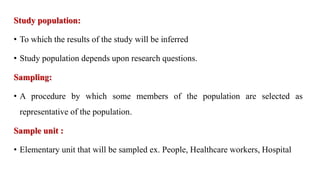
Study population:
• To which the results of the study will be inferred
• Study population depends upon research questions.
Sampling:
• A procedure by which some members of the population are selected as
representative of the population.
Sample unit :
• Elementary unit that will be sampled ex. People, Healthcare workers, Hospital
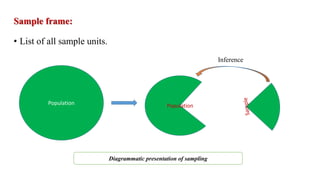
Sample frame:
• List of all sample units.
Population Population
Inference
Diagrammatic presentation of sampling
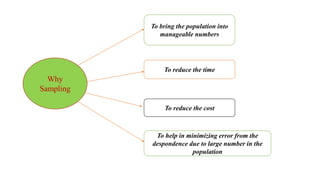
Why
Sampling
To bring the population into
manageable numbers
To reduce the time
To reduce the cost
To help in minimizing error from the
despondence due to large number in the
population
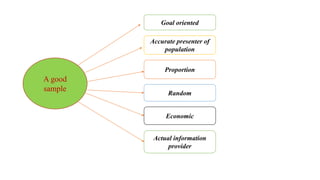
A good
sample
Goal oriented
Accurate presenter of
population
Proportion
Random
Economic
Actual information
provider
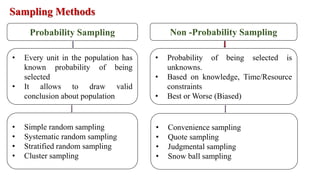
Sampling Methods
Probability Sampling Non -Probability Sampling
• Every unit in the population has
known probability of being
selected
• It allows to draw valid
conclusion about population
• Probability of being selected is
unknowns.
• Based on knowledge, Time/Resource
constraints
• Best or Worse (Biased)
• Simple random sampling
• Systematic random sampling
• Stratified random sampling
• Cluster sampling
• Convenience sampling
• Quote sampling
• Judgmental sampling
• Snow ball sampling
Probability sampling Methods
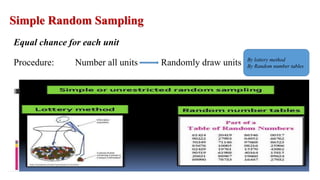
Simple Random Sampling
Equal chance for each unit
Procedure: Number all units Randomly draw units By lottery method
By Random number tables
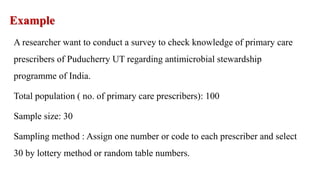
Example
A researcher want to conduct a survey to check knowledge of primary care
prescribers of Puducherry UT regarding antimicrobial stewardship
programme of India.
Total population ( no. of primary care prescribers): 100
Sample size: 30
Sampling method : Assign one number or code to each prescriber and select
30 by lottery method or random table numbers.
Pros Cons
• Strong external validity
• More efficient
• Expensive
• Not always possible
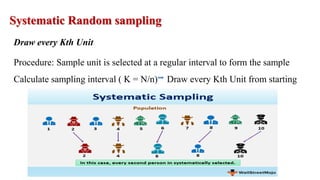
Systematic Random sampling
Draw every Kth Unit
Procedure: Sample unit is selected at a regular interval to form the sample
Calculate sampling interval ( K = N/n) Draw every Kth Unit from starting
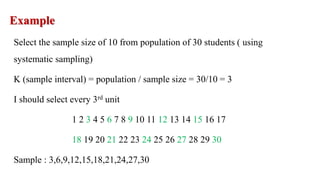
Example
Select the sample size of 10 from population of 30 students ( using
systematic sampling)
K (sample interval) = population / sample size = 30/10 = 3
I should select every 3rd unit
1 2 3 4 5 6 7 8 9 10 11 12 13 14 15 16 17
18 19 20 21 22 23 24 25 26 27 28 29 30
Sample : 3,6,9,12,15,18,21,24,27,30
Pros Cons
• Strong external validity
• More efficient
• Not always possible
Stratified sampling
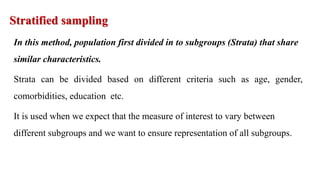
In this method, population first divided in to subgroups (Strata) that share
similar characteristics.
Strata can be divided based on different criteria such as age, gender,
comorbidities, education etc.
It is used when we expect that the measure of interest to vary between
different subgroups and we want to ensure representation of all subgroups.
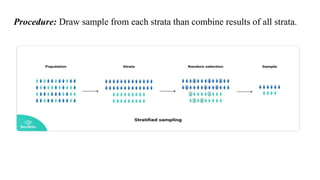
Procedure: Draw sample from each strata than combine results of all strata.
Example
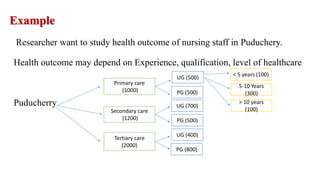
Researcher want to study health outcome of nursing staff in Puduchery.
Health outcome may depend on Experience, qualification, level of healthcare
Puducherry
Primary care
(1000)
Secondary care
(1200)
Tertiary care
(2000)
UG (500)
PG (500)
UG (700)
PG (500)
UG (400)
PG (800)
< 5 years (100)
> 10 years
(100)
5-10 Years
(300)
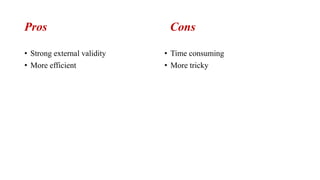
Pros Cons
• Strong external validity
• More efficient
• Time consuming
• More tricky
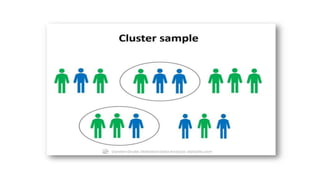
Cluster Sampling
Subgroup of population (clusters) are used as sample unit rather than an
individual
The population is divided into subgroups (clusters) which are selected
randomly to be included in the study.
These clusters can be treated as small population which have all the
attributes of population.
Cluster sampling of more efficient for studies which are conducted in wide
geographical region.
Example
Government want to conduct survey regarding people’s belief on Covid-19
vaccination in town of 36 blocks/sectors.
Sample size: 9 clusters
Procedure:
Select 9 blocks out of 21 blocks ( randomly/stratified). Survey all the
residents of each block
Pros Cons
• Strong external validity • Time consuming
• More tricky
• Not always possible
Non Probability sampling
Convenience sampling
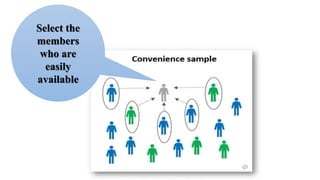
• Samples are selected from the population based on researcher’s
convenience.
• Researcher follow convince sampling because the time and cost of
collecting information is reduced.
Select the
members
who are
easily
available
Example
Researcher want to study antibiotic prescribing pattern at primary health
centres. For which he need to select minimum 1 HF from each geographical
location i.e. east, west, south & north. For his convenience, from each
location he selected those HF which were nearby and easy to travel.
Pros Cons
• Feasibility • Subject to bias
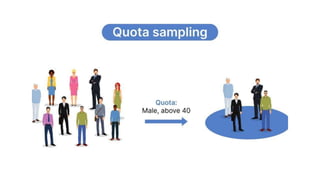
Quote sampling
• Researcher create a sample by involving individual who represent a
population.
• Researcher chose these individuals based on specific characteristics.
Procedure:
Population first classified in subgroups ( quotes ) based on criteria.
Sample elements are selected based on convenient sampling.
Examples
A researcher wants to survey individuals about what toothpaste brand they
prefer to use in Puducherry city. He considers a sample size of 500
researcher can divide the population by quotas as:
• Gender: 250 males and 250 females
• Age: 100 respondents each between the ages of 16-20, 21-30, 31-40, 41-50,
and 51+
Pros Cons
• Representation
• Mitigates confounds (eliminate
potential confounds)
• Subject to bias
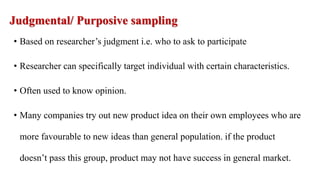
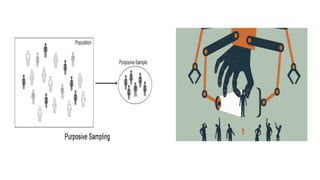
Judgmental/ Purposive sampling
• Based on researcher’s judgment i.e. who to ask to participate
• Researcher can specifically target individual with certain characteristics.
• Often used to know opinion.
• Many companies try out new product idea on their own employees who are
more favourable to new ideas than general population. if the product
doesn’t pass this group, product may not have success in general market.
Pros Cons
Efficient • Subject to bias
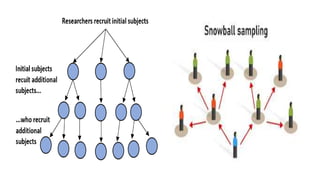
Snowball sampling
• Technique in which researcher pick first few samples and either recruit
them or ask them to recommend other subjects they know who fits in
inclusion criteria.
• Also know as chain-referral sampling
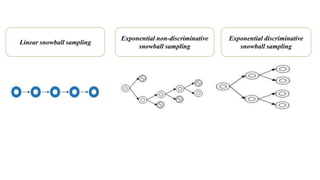
Linear snowball sampling
Exponential non-discriminative
snowball sampling
Exponential discriminative
snowball sampling
Examples
Rare diseases:
There are many less-researched diseases. There may be a restricted number
of individuals suffering from rare diseases. Using snowball sampling,
researchers can get in touch with these hard to contact sufferers and convince
them to participate in the survey.
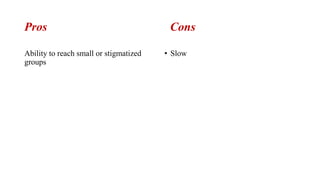
Pros Cons
Ability to reach small or stigmatized
groups
• Slow
Thank You

Sampling methods

  • 1.
    Sampling Methods By Dr. Dineshkumar Meena, Pharm.D Ph.D Research Scholar Department of Medical Pharmacology, Jawaharlal Institute of Postgraduate Medical Education & Research (JIPMER), India
  • 2.
    Study population: • Towhich the results of the study will be inferred • Study population depends upon research questions. Sampling: • A procedure by which some members of the population are selected as representative of the population. Sample unit : • Elementary unit that will be sampled ex. People, Healthcare workers, Hospital
  • 3.
    Sample frame: • Listof all sample units. Population Population Inference Diagrammatic presentation of sampling
  • 4.
    Why Sampling To bring thepopulation into manageable numbers To reduce the time To reduce the cost To help in minimizing error from the despondence due to large number in the population
  • 5.
    A good sample Goal oriented Accuratepresenter of population Proportion Random Economic Actual information provider
  • 6.
    Sampling Methods Probability SamplingNon -Probability Sampling • Every unit in the population has known probability of being selected • It allows to draw valid conclusion about population • Probability of being selected is unknowns. • Based on knowledge, Time/Resource constraints • Best or Worse (Biased) • Simple random sampling • Systematic random sampling • Stratified random sampling • Cluster sampling • Convenience sampling • Quote sampling • Judgmental sampling • Snow ball sampling
  • 7.
  • 8.
    Simple Random Sampling Equalchance for each unit Procedure: Number all units Randomly draw units By lottery method By Random number tables
  • 9.
    Example A researcher wantto conduct a survey to check knowledge of primary care prescribers of Puducherry UT regarding antimicrobial stewardship programme of India. Total population ( no. of primary care prescribers): 100 Sample size: 30 Sampling method : Assign one number or code to each prescriber and select 30 by lottery method or random table numbers.
  • 10.
    Pros Cons • Strongexternal validity • More efficient • Expensive • Not always possible
  • 11.
    Systematic Random sampling Drawevery Kth Unit Procedure: Sample unit is selected at a regular interval to form the sample Calculate sampling interval ( K = N/n) Draw every Kth Unit from starting
  • 12.
    Example Select the samplesize of 10 from population of 30 students ( using systematic sampling) K (sample interval) = population / sample size = 30/10 = 3 I should select every 3rd unit 1 2 3 4 5 6 7 8 9 10 11 12 13 14 15 16 17 18 19 20 21 22 23 24 25 26 27 28 29 30 Sample : 3,6,9,12,15,18,21,24,27,30
  • 13.
    Pros Cons • Strongexternal validity • More efficient • Not always possible
  • 14.
    Stratified sampling In thismethod, population first divided in to subgroups (Strata) that share similar characteristics. Strata can be divided based on different criteria such as age, gender, comorbidities, education etc. It is used when we expect that the measure of interest to vary between different subgroups and we want to ensure representation of all subgroups.
  • 15.
    Procedure: Draw samplefrom each strata than combine results of all strata.
  • 16.
    Example Researcher want tostudy health outcome of nursing staff in Puduchery. Health outcome may depend on Experience, qualification, level of healthcare Puducherry Primary care (1000) Secondary care (1200) Tertiary care (2000) UG (500) PG (500) UG (700) PG (500) UG (400) PG (800) < 5 years (100) > 10 years (100) 5-10 Years (300)
  • 17.
    Pros Cons • Strongexternal validity • More efficient • Time consuming • More tricky
  • 18.
    Cluster Sampling Subgroup ofpopulation (clusters) are used as sample unit rather than an individual The population is divided into subgroups (clusters) which are selected randomly to be included in the study. These clusters can be treated as small population which have all the attributes of population. Cluster sampling of more efficient for studies which are conducted in wide geographical region.
  • 20.
    Example Government want toconduct survey regarding people’s belief on Covid-19 vaccination in town of 36 blocks/sectors. Sample size: 9 clusters Procedure: Select 9 blocks out of 21 blocks ( randomly/stratified). Survey all the residents of each block
  • 21.
    Pros Cons • Strongexternal validity • Time consuming • More tricky • Not always possible
  • 22.
  • 23.
    Convenience sampling • Samplesare selected from the population based on researcher’s convenience. • Researcher follow convince sampling because the time and cost of collecting information is reduced.
  • 24.
  • 25.
    Example Researcher want tostudy antibiotic prescribing pattern at primary health centres. For which he need to select minimum 1 HF from each geographical location i.e. east, west, south & north. For his convenience, from each location he selected those HF which were nearby and easy to travel.
  • 26.
    Pros Cons • Feasibility• Subject to bias
  • 27.
    Quote sampling • Researchercreate a sample by involving individual who represent a population. • Researcher chose these individuals based on specific characteristics. Procedure: Population first classified in subgroups ( quotes ) based on criteria. Sample elements are selected based on convenient sampling.
  • 29.
    Examples A researcher wantsto survey individuals about what toothpaste brand they prefer to use in Puducherry city. He considers a sample size of 500 researcher can divide the population by quotas as: • Gender: 250 males and 250 females • Age: 100 respondents each between the ages of 16-20, 21-30, 31-40, 41-50, and 51+
  • 30.
    Pros Cons • Representation •Mitigates confounds (eliminate potential confounds) • Subject to bias
  • 31.
    Judgmental/ Purposive sampling •Based on researcher’s judgment i.e. who to ask to participate • Researcher can specifically target individual with certain characteristics. • Often used to know opinion. • Many companies try out new product idea on their own employees who are more favourable to new ideas than general population. if the product doesn’t pass this group, product may not have success in general market.
  • 33.
    Pros Cons Efficient •Subject to bias
  • 34.
    Snowball sampling • Techniquein which researcher pick first few samples and either recruit them or ask them to recommend other subjects they know who fits in inclusion criteria. • Also know as chain-referral sampling
  • 36.
    Linear snowball sampling Exponentialnon-discriminative snowball sampling Exponential discriminative snowball sampling
  • 37.
    Examples Rare diseases: There aremany less-researched diseases. There may be a restricted number of individuals suffering from rare diseases. Using snowball sampling, researchers can get in touch with these hard to contact sufferers and convince them to participate in the survey.
  • 38.
    Pros Cons Ability toreach small or stigmatized groups • Slow
  • 39.