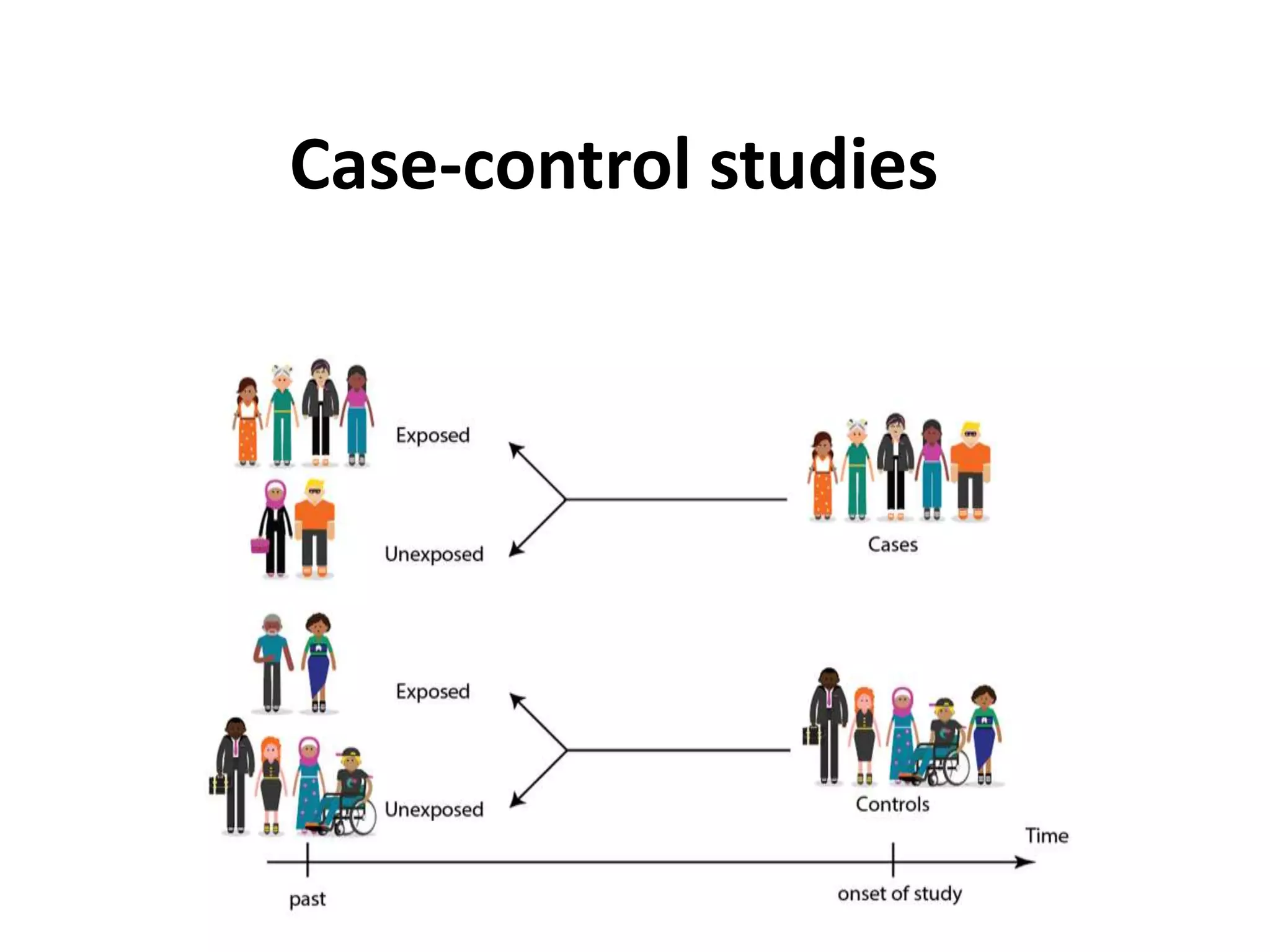
Case-control studies
Introduction
• Observational study
• Investigator does not alter the exposure status
• Investigator measures:
– Exposure and outcome in the study participants
– Association
Study Design
• Participants selected based on their outcome
status.
• Participants with outcome of interest are
referred as cases and those without referred
as controls.
• Investigator then asses the exposure in both
the groups.
Contd…
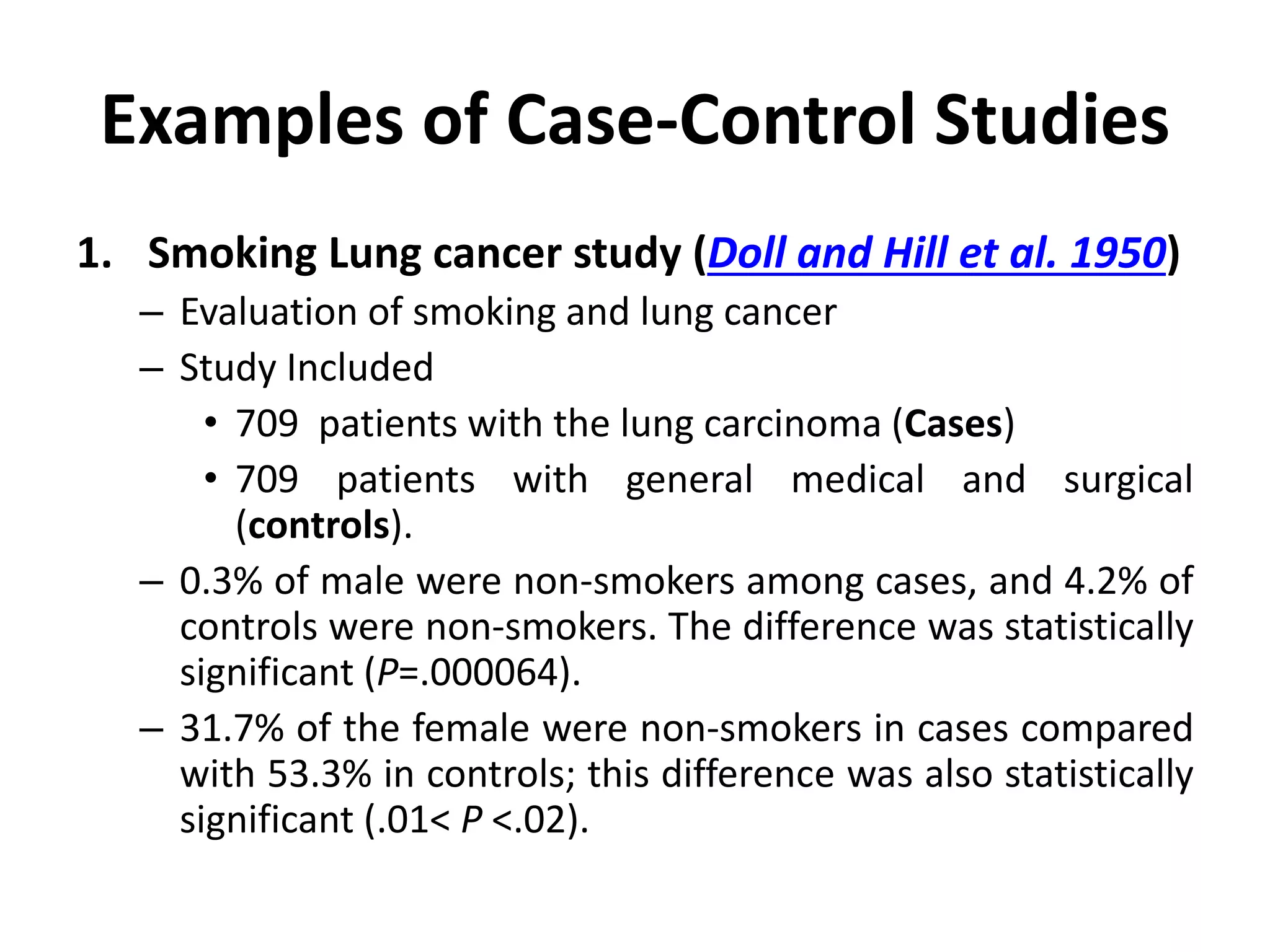
Examples of Case-Control Studies
1. Smoking Lung cancer study (Doll and Hill et al. 1950)
– Evaluation of smoking and lung cancer
– Study Included
• 709 patients with the lung carcinoma (Cases)
• 709 patients with general medical and surgical
(controls).
– 0.3% of male were non-smokers among cases, and 4.2% of
controls were non-smokers. The difference was statistically
significant (P=.000064).
– 31.7% of the female were non-smokers in cases compared
with 53.3% in controls; this difference was also statistically
significant (.01< P <.02).
Contd..
• Melanoma and tanning (Lazovic et al., 2010)
– Studies association between melanoma and tanning
– Cases - 1167 individuals with invasive cutaneous melanoma.
– Controls-1101
– Data were collected from self administered questionnaires and
telephone interviews.
• Outcome
• melanoma was higher in individuals who used UVB enhances and
primarily UVA emitting devices.
• The risk of melanoma also increased with increase in years of use,
hours of use, and sessions.
Contd..
• Risk factors for erysipelas (Pitché et al, 2015)
– Assess the factors associated with leg erysipelas in 8
countries sub-Saharan Africa.
– A multi-centre study.
– Recruited two controls for each case;
– These were matched for age (+/-5 years) and sex.
– Study included 364 cases and 728 controls.
• Outcome:
– Leg erysipelas was associated with obesity,
lympoedema, neglected traumatic wound, toe-web
intertrigo, and voluntary cosmetic depigmentation.
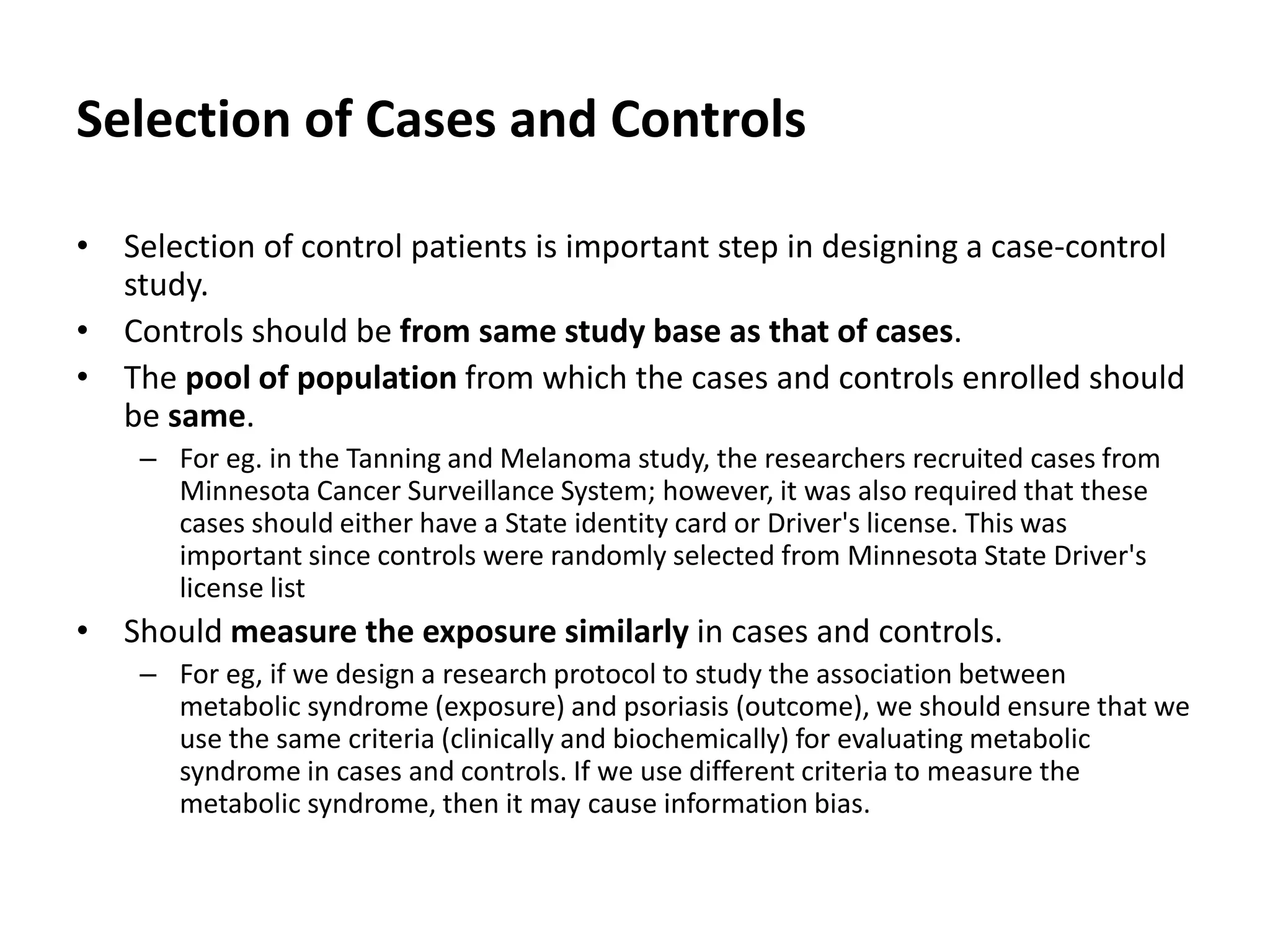
Selection of Cases and Controls
• Selection of control patients is important step in designing a case-control
study.
• Controls should be from same study base as that of cases.
• The pool of population from which the cases and controls enrolled should
be same.
– For eg. in the Tanning and Melanoma study, the researchers recruited cases from
Minnesota Cancer Surveillance System; however, it was also required that these
cases should either have a State identity card or Driver's license. This was
important since controls were randomly selected from Minnesota State Driver's
license list
• Should measure the exposure similarly in cases and controls.
– For eg, if we design a research protocol to study the association between
metabolic syndrome (exposure) and psoriasis (outcome), we should ensure that we
use the same criteria (clinically and biochemically) for evaluating metabolic
syndrome in cases and controls. If we use different criteria to measure the
metabolic syndrome, then it may cause information bias.
Types of controls
• Selection of controls from variety of groups
– General population;
– relatives or friends; or
– hospital patients.
Contd..
• Hospital controls
– Easy to recruit
– More likely to have similar quality of medical records.
– Important source of controls is patients attending the hospital for diseases
other than the outcome of interest.
• Relatives or friends
– Relatively easy to recruit.
– Another source of controls is a list of friends referred by the cases.
– These controls are easy to recruit and they are also more likely to be similar to
the cases in socio-economic status and other demographic factors.
– However, they are also more likely to have similar behaviours (alcohol use,
smoking etc.);
– thus, it may not be prudent to use these as controls if we want to study the
effect of these exposures on the outcome.
Contd..
• Population controls:
– These controls can be easily conducted the list of all individuals
is available.
– For example, list from state identity cards, voter's registration
list, etc.,
– In the Tanning and melanoma study, the researchers used
population controls.
– They were identified from Minnesota state driver's list.
– We may have to use sampling methods to recruit controls from
the population. A main advantage is that these controls are
likely to satisfy the ‘study-base’ principle (described above) as
suggested by Wacholder and colleagues. However, they can be
expensive and time consuming. Furthermore, many of these
controls will not be inclined to participate in the study; thus, the
response rate may be very low
Matching in a Case-Control Study
• Often used in case-control control studies to ensure that the
cases and controls are similar in certain characteristics.
• Eg. in the smoking and lung cancer study, the authors selected
controls that were similar in age and sex to carcinoma cases.
• It is a useful technique to increase the efficiency of study.
• Other Examples
– 1) control that is matched for sex and age (+/- 2 years). Thus, if 40 year
male patient with psoriasis is enrolled for the study as a case, we will
enroll a 38-42 year male patient without psoriasis.
– ‘individual matching’:- if you have 45 males among cases, you should
also have 45 males among controls.
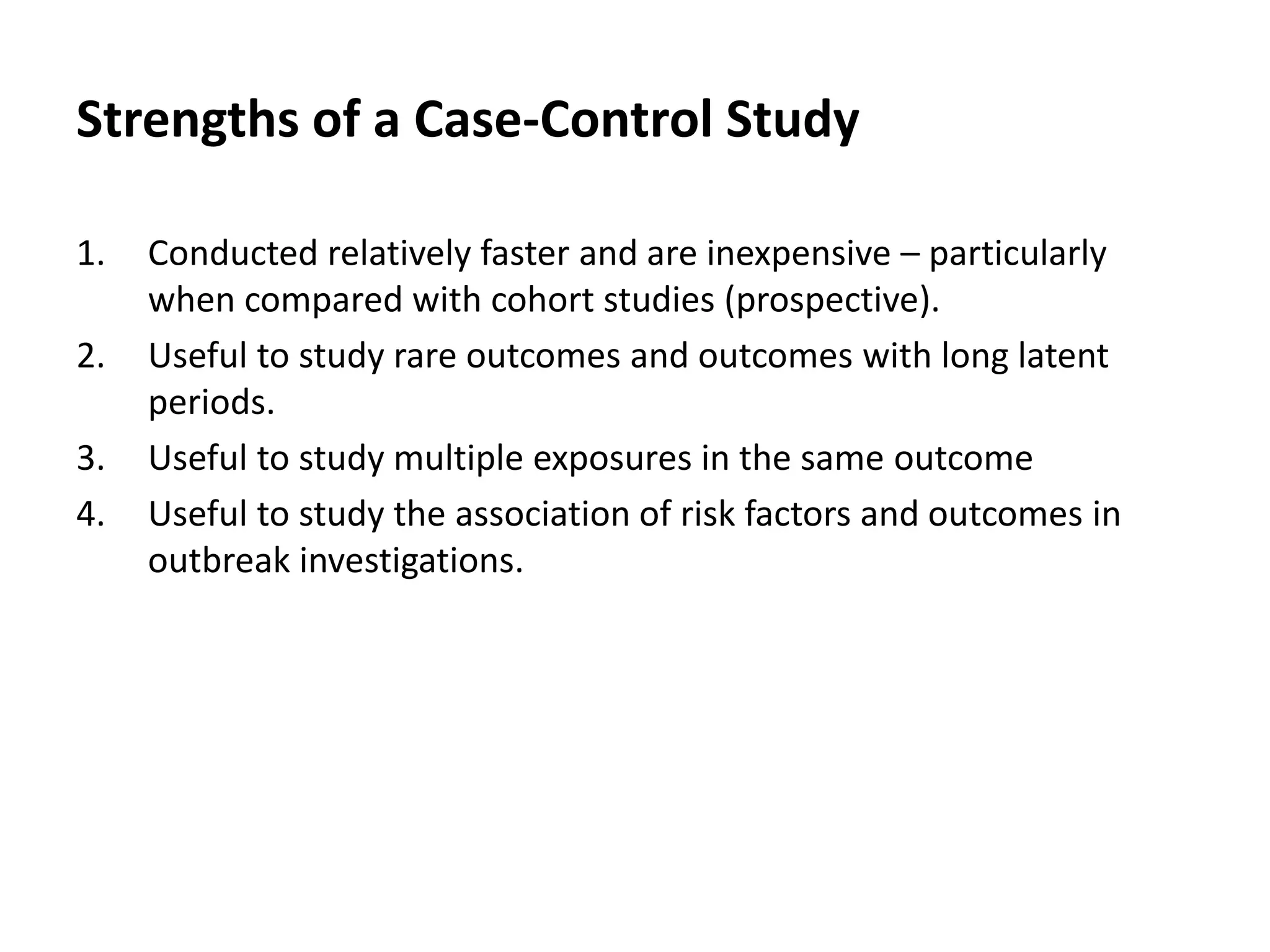
Strengths of a Case-Control Study
1. Conducted relatively faster and are inexpensive – particularly
when compared with cohort studies (prospective).
2. Useful to study rare outcomes and outcomes with long latent
periods.
3. Useful to study multiple exposures in the same outcome
4. Useful to study the association of risk factors and outcomes in
outbreak investigations.
Limitations of a Case-control Study
• Not useful to study rare exposures.
• Not able to estimate the incidence or prevalence in a case-
control study.
• Not useful to study multiple outcomes.
• Sometimes the temporality of the exposure and outcome may
not be clearly established.
• The case-control studies are also prone to certain biases.
• Individuals may not be able to recall all exposures accurately.
Analysis
• Odds Ratio:
– is a reasonable measure of the relative risk
– If OR is greater than 1, the outcome is more likely in those exposed
compared with those who are not exposed. However, we will require
confidence intervals to comment on further interpretation of the OR.
• Other analysis:
– One can use logistic regression models for multivariate analysis in
case-control studies.
– It is important to note that conditional logistic regressions may be
useful for matched case-control studies.
Additional Points in A Case-Control Study
• How many controls can I have for each case ?
– The most optimum case-to-control ratio is 1:1
– Optimal ration 4:1 (controls vs cases)
• One should not use the word case-control study for a
randomised controlled trial (even though you have a
control group in the study).
• Every study with a control group is not a case-control
study.
• For a study to be classified as a case-control study, the
study should be an observational study and the
participants should be recruited based on their outcome
status.
Contd..
• Should I call case-control studies prospective or
retrospective studies?
– Porta (2014) suggested that even though the term
‘retrospective’ was used for case-control studies, the
study participants are often recruited prospectively.
– if we sample the participants based on the outcome
and study the exposures in both these groups, it is a
case-control study.
– If we sample the study participants based on exposure
and move towards the outcome, it is a cohort study
Summary
• Participants are recruited on the basis of disease status.
• Participants with outcome of interest referred to as cases, whereas others
do not have the outcome of interest are referred to as controls.
• The investigator then assesses the exposure in both these groups.
• Case-control studies are less expensive and quicker to conduct compared
with prospective cohort studies at least.
• The measure of association in this type of study is an odds ratio.
• This type of design is useful for rare outcomes and those with long latent
periods. However, they may also be prone to certain biases – selection
bias and recall bias.

Case control studies

  • 1.
  • 2.
    Introduction • Observational study •Investigator does not alter the exposure status • Investigator measures: – Exposure and outcome in the study participants – Association
  • 3.
    Study Design • Participantsselected based on their outcome status. • Participants with outcome of interest are referred as cases and those without referred as controls. • Investigator then asses the exposure in both the groups.
  • 4.
  • 5.
    Examples of Case-ControlStudies 1. Smoking Lung cancer study (Doll and Hill et al. 1950) – Evaluation of smoking and lung cancer – Study Included • 709 patients with the lung carcinoma (Cases) • 709 patients with general medical and surgical (controls). – 0.3% of male were non-smokers among cases, and 4.2% of controls were non-smokers. The difference was statistically significant (P=.000064). – 31.7% of the female were non-smokers in cases compared with 53.3% in controls; this difference was also statistically significant (.01< P <.02).
  • 6.
    Contd.. • Melanoma andtanning (Lazovic et al., 2010) – Studies association between melanoma and tanning – Cases - 1167 individuals with invasive cutaneous melanoma. – Controls-1101 – Data were collected from self administered questionnaires and telephone interviews. • Outcome • melanoma was higher in individuals who used UVB enhances and primarily UVA emitting devices. • The risk of melanoma also increased with increase in years of use, hours of use, and sessions.
  • 7.
    Contd.. • Risk factorsfor erysipelas (Pitché et al, 2015) – Assess the factors associated with leg erysipelas in 8 countries sub-Saharan Africa. – A multi-centre study. – Recruited two controls for each case; – These were matched for age (+/-5 years) and sex. – Study included 364 cases and 728 controls. • Outcome: – Leg erysipelas was associated with obesity, lympoedema, neglected traumatic wound, toe-web intertrigo, and voluntary cosmetic depigmentation.
  • 8.
    Selection of Casesand Controls • Selection of control patients is important step in designing a case-control study. • Controls should be from same study base as that of cases. • The pool of population from which the cases and controls enrolled should be same. – For eg. in the Tanning and Melanoma study, the researchers recruited cases from Minnesota Cancer Surveillance System; however, it was also required that these cases should either have a State identity card or Driver's license. This was important since controls were randomly selected from Minnesota State Driver's license list • Should measure the exposure similarly in cases and controls. – For eg, if we design a research protocol to study the association between metabolic syndrome (exposure) and psoriasis (outcome), we should ensure that we use the same criteria (clinically and biochemically) for evaluating metabolic syndrome in cases and controls. If we use different criteria to measure the metabolic syndrome, then it may cause information bias.
  • 9.
    Types of controls •Selection of controls from variety of groups – General population; – relatives or friends; or – hospital patients.
  • 10.
    Contd.. • Hospital controls –Easy to recruit – More likely to have similar quality of medical records. – Important source of controls is patients attending the hospital for diseases other than the outcome of interest. • Relatives or friends – Relatively easy to recruit. – Another source of controls is a list of friends referred by the cases. – These controls are easy to recruit and they are also more likely to be similar to the cases in socio-economic status and other demographic factors. – However, they are also more likely to have similar behaviours (alcohol use, smoking etc.); – thus, it may not be prudent to use these as controls if we want to study the effect of these exposures on the outcome.
  • 11.
    Contd.. • Population controls: –These controls can be easily conducted the list of all individuals is available. – For example, list from state identity cards, voter's registration list, etc., – In the Tanning and melanoma study, the researchers used population controls. – They were identified from Minnesota state driver's list. – We may have to use sampling methods to recruit controls from the population. A main advantage is that these controls are likely to satisfy the ‘study-base’ principle (described above) as suggested by Wacholder and colleagues. However, they can be expensive and time consuming. Furthermore, many of these controls will not be inclined to participate in the study; thus, the response rate may be very low
  • 12.
    Matching in aCase-Control Study • Often used in case-control control studies to ensure that the cases and controls are similar in certain characteristics. • Eg. in the smoking and lung cancer study, the authors selected controls that were similar in age and sex to carcinoma cases. • It is a useful technique to increase the efficiency of study. • Other Examples – 1) control that is matched for sex and age (+/- 2 years). Thus, if 40 year male patient with psoriasis is enrolled for the study as a case, we will enroll a 38-42 year male patient without psoriasis. – ‘individual matching’:- if you have 45 males among cases, you should also have 45 males among controls.
  • 13.
    Strengths of aCase-Control Study 1. Conducted relatively faster and are inexpensive – particularly when compared with cohort studies (prospective). 2. Useful to study rare outcomes and outcomes with long latent periods. 3. Useful to study multiple exposures in the same outcome 4. Useful to study the association of risk factors and outcomes in outbreak investigations.
  • 14.
    Limitations of aCase-control Study • Not useful to study rare exposures. • Not able to estimate the incidence or prevalence in a case- control study. • Not useful to study multiple outcomes. • Sometimes the temporality of the exposure and outcome may not be clearly established. • The case-control studies are also prone to certain biases. • Individuals may not be able to recall all exposures accurately.
  • 15.
    Analysis • Odds Ratio: –is a reasonable measure of the relative risk – If OR is greater than 1, the outcome is more likely in those exposed compared with those who are not exposed. However, we will require confidence intervals to comment on further interpretation of the OR. • Other analysis: – One can use logistic regression models for multivariate analysis in case-control studies. – It is important to note that conditional logistic regressions may be useful for matched case-control studies.
  • 16.
    Additional Points inA Case-Control Study • How many controls can I have for each case ? – The most optimum case-to-control ratio is 1:1 – Optimal ration 4:1 (controls vs cases) • One should not use the word case-control study for a randomised controlled trial (even though you have a control group in the study). • Every study with a control group is not a case-control study. • For a study to be classified as a case-control study, the study should be an observational study and the participants should be recruited based on their outcome status.
  • 17.
    Contd.. • Should Icall case-control studies prospective or retrospective studies? – Porta (2014) suggested that even though the term ‘retrospective’ was used for case-control studies, the study participants are often recruited prospectively. – if we sample the participants based on the outcome and study the exposures in both these groups, it is a case-control study. – If we sample the study participants based on exposure and move towards the outcome, it is a cohort study
  • 18.
    Summary • Participants arerecruited on the basis of disease status. • Participants with outcome of interest referred to as cases, whereas others do not have the outcome of interest are referred to as controls. • The investigator then assesses the exposure in both these groups. • Case-control studies are less expensive and quicker to conduct compared with prospective cohort studies at least. • The measure of association in this type of study is an odds ratio. • This type of design is useful for rare outcomes and those with long latent periods. However, they may also be prone to certain biases – selection bias and recall bias.