WEEK 2
WE WILL LEARN
• Sampling Error
• Types of Statistics
• Types of Variables
• Class Practice
SAMPLING ERROR
• Because populations are typically very large, it usually is not possible to
measure everyone in the population. Therefore, a sample is selected to
represent the population. By analyzing the results from the sample, we
hope to make general statements about the population. Typically,
researchers use sample statistics as the basis for drawing conclusions
about population parameters. One problem with using samples,
however, is that a sample provides only limited information about the
population. Although samples are generally representative of their
populations, a sample is not expected to give a perfectly accurate
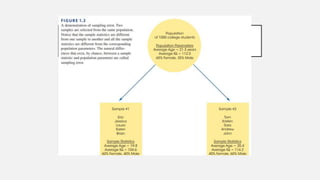
picture of the whole population. There usually is some discrepancy
between a sample statistic and the corresponding population parameter.
This discrepancy is called sampling error, and it creates the fundamental
problem inferential statistics must always address.
SAMPLING ERROR
• Sampling error is the naturally occurring discrepancy, or error, that
exists between a sample statistic and the corresponding population
parameter.
EXAMPLE
DESCRIPTIVE AND INFERENTIAL
STATISTICAL METHODS
• Although researchers have developed a variety of different statistical
procedures to organize and interpret data, these different procedures
can be classified into two general categories. The first category,
descriptive statistics, consists of statistical procedures that are used to
simplify and summarize data.
• Descriptive statistics are statistical procedures used to summarize,
organize, and simplify data.
• Descriptive statistics are techniques that take raw scores and organize or
summarize them in a form that is more manageable. Often the scores
are organized in a table or a graph so that it is possible to see the entire
set of scores.
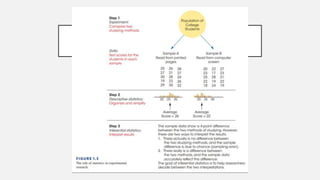
• The second general category of statistical techniques is called inferential
statistics. Inferential statistics are methods that use sample data to make
general statements about a population.
• Inferential statistics consist of techniques that allow us to study
and then make generalizations about the populations from which
were selected.
EXAMPLE
EXAMPLE
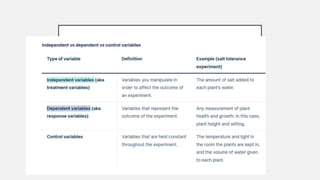
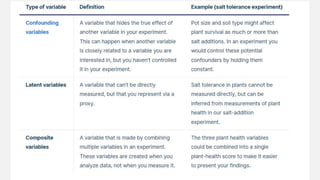
• If you want to test whether some plant species are more salt-tolerant
than others, some key variables you might measure include the amount
of salt you add to the water, the species of plants being studied, and
variables related to plant health like growth and wilting.
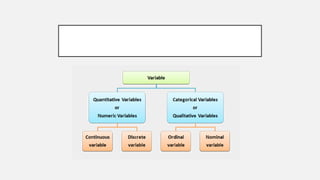
TYPES OF VARIABLES
CLASS PRACTICE
• You all are requested to do some thinking and come up with 5 examples
indicating IV, and DV.
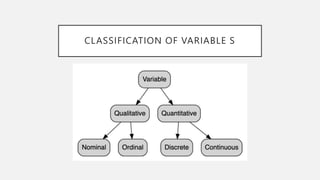
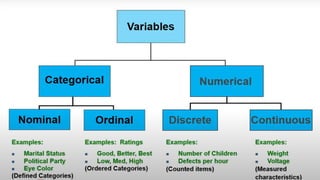
CLASSIFICATION OF VARIABLE S
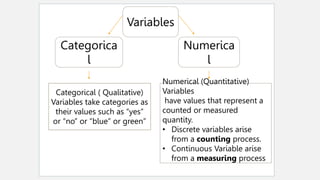
Variables
Categorica
l
Numerica
l
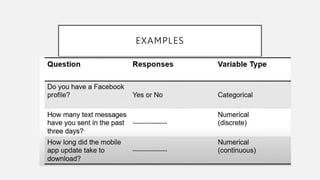
Categorical ( Qualitative)
Variables take categories as
their values such as “yes”
or “no” or “blue” or green”
Numerical (Quantitative)
Variables
have values that represent a
counted or measured
quantity.
• Discrete variables arise
from a counting process.
• Continuous Variable arise
from a measuring process
EXAMPLES
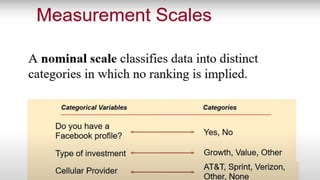
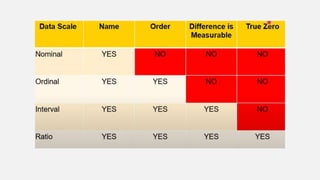
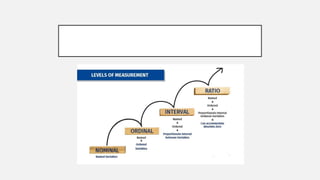
NOMINAL SCALE
• Assigning numbers to objects where different numbers
indicate different objects.
• The numbers have no real meaning other than
differentiating between objects.
• Example: Gender, Male=1, Female=2
Baseball uniform number
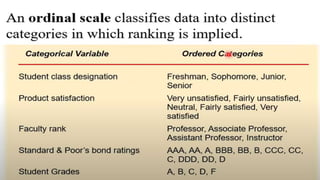
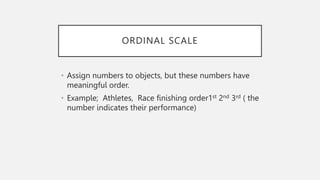
ORDINAL SCALE
• Assign numbers to objects, but these numbers have
meaningful order.
• Example; Athletes, Race finishing order1st 2nd 3rd ( the
number indicates their performance)
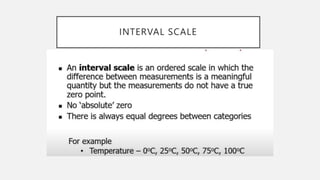
INTERVAL SCALE
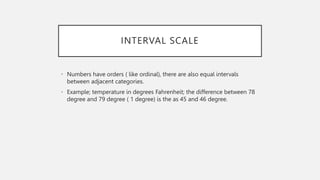
INTERVAL SCALE
• Numbers have orders ( like ordinal), there are also equal intervals
between adjacent categories.
• Example; temperature in degrees Fahrenheit; the difference between 78
degree and 79 degree ( 1 degree) is the as 45 and 46 degree.
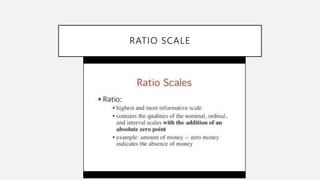
RATIO SCALE
RATIO SCALE
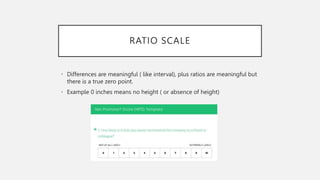
• Differences are meaningful ( like interval), plus ratios are meaningful but
there is a true zero point.
• Example 0 inches means no height ( or absence of height)
• THANK YOU!

Sampling error

  • 1.
  • 2.
    WE WILL LEARN •Sampling Error • Types of Statistics • Types of Variables • Class Practice
  • 3.
    SAMPLING ERROR • Becausepopulations are typically very large, it usually is not possible to measure everyone in the population. Therefore, a sample is selected to represent the population. By analyzing the results from the sample, we hope to make general statements about the population. Typically, researchers use sample statistics as the basis for drawing conclusions about population parameters. One problem with using samples, however, is that a sample provides only limited information about the population. Although samples are generally representative of their populations, a sample is not expected to give a perfectly accurate picture of the whole population. There usually is some discrepancy between a sample statistic and the corresponding population parameter. This discrepancy is called sampling error, and it creates the fundamental problem inferential statistics must always address.
  • 4.
    SAMPLING ERROR • Samplingerror is the naturally occurring discrepancy, or error, that exists between a sample statistic and the corresponding population parameter.
  • 5.
  • 6.
    DESCRIPTIVE AND INFERENTIAL STATISTICALMETHODS • Although researchers have developed a variety of different statistical procedures to organize and interpret data, these different procedures can be classified into two general categories. The first category, descriptive statistics, consists of statistical procedures that are used to simplify and summarize data. • Descriptive statistics are statistical procedures used to summarize, organize, and simplify data.
  • 7.
    • Descriptive statisticsare techniques that take raw scores and organize or summarize them in a form that is more manageable. Often the scores are organized in a table or a graph so that it is possible to see the entire set of scores. • The second general category of statistical techniques is called inferential statistics. Inferential statistics are methods that use sample data to make general statements about a population. • Inferential statistics consist of techniques that allow us to study and then make generalizations about the populations from which were selected.
  • 8.
  • 9.
    EXAMPLE • If youwant to test whether some plant species are more salt-tolerant than others, some key variables you might measure include the amount of salt you add to the water, the species of plants being studied, and variables related to plant health like growth and wilting.
  • 10.
  • 12.
    CLASS PRACTICE • Youall are requested to do some thinking and come up with 5 examples indicating IV, and DV.
  • 13.
  • 15.
    Variables Categorica l Numerica l Categorical ( Qualitative) Variablestake categories as their values such as “yes” or “no” or “blue” or green” Numerical (Quantitative) Variables have values that represent a counted or measured quantity. • Discrete variables arise from a counting process. • Continuous Variable arise from a measuring process
  • 16.
  • 19.
    NOMINAL SCALE • Assigningnumbers to objects where different numbers indicate different objects. • The numbers have no real meaning other than differentiating between objects. • Example: Gender, Male=1, Female=2 Baseball uniform number
  • 21.
    ORDINAL SCALE • Assignnumbers to objects, but these numbers have meaningful order. • Example; Athletes, Race finishing order1st 2nd 3rd ( the number indicates their performance)
  • 22.
  • 23.
    INTERVAL SCALE • Numbershave orders ( like ordinal), there are also equal intervals between adjacent categories. • Example; temperature in degrees Fahrenheit; the difference between 78 degree and 79 degree ( 1 degree) is the as 45 and 46 degree.
  • 24.
  • 25.
    RATIO SCALE • Differencesare meaningful ( like interval), plus ratios are meaningful but there is a true zero point. • Example 0 inches means no height ( or absence of height)
  • 28.