Depressive Disorders
Comer, Abnormal
Psychology, 8e
DSM-5 Update
Slides & Handouts by Karen Clay Rhines, Ph.D.
American Public University System
Depression
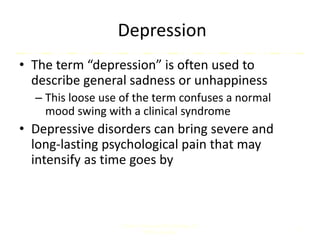
• The term “depression” is often used to
describe general sadness or unhappiness
– This loose use of the term confuses a normal
mood swing with a clinical syndrome
• Depressive disorders can bring severe and
long-lasting psychological pain that may
intensify as time goes by
Comer, Abnormal Psychology, 8e
DSM-5 Update
2
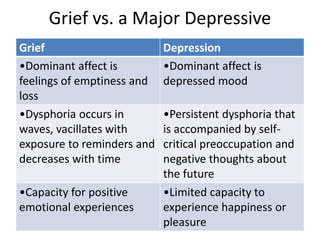
Grief vs. a Major Depressive
Grief Depression
•Dominant affect is
feelings of emptiness and
loss
•Dominant affect is
depressed mood
•Dysphoria occurs in
waves, vacillates with
exposure to reminders and
decreases with time
•Persistent dysphoria that
is accompanied by self-
critical preoccupation and
negative thoughts about
the future
•Capacity for positive
emotional experiences
•Limited capacity to
experience happiness or
pleasure
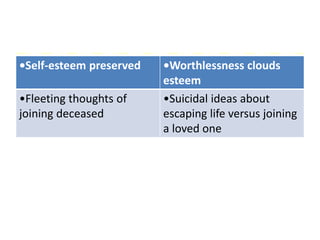
•Self-esteem preserved •Worthlessness clouds
esteem
•Fleeting thoughts of
joining deceased
•Suicidal ideas about
escaping life versus joining
a loved one
What Causes
Depression?
• Stress may be a trigger for depression
– People with depression experience a greater
number of stressful life events during the month
just before the onset of their symptoms
– The current explanations of unipolar depression
point to biological, psychological, and
sociocultural factors
Comer, Abnormal Psychology, 8e
DSM-5 Update
5
What Causes Depression?
The Biological View
• Genetic factors
– Family pedigree, twin, adoption, and molecular
biology gene studies suggest that some people
inherit a biological predisposition
• Researchers have found that as many as 20% of
relatives of those with depression are themselves
depressed, compared with fewer than 10% of the
general population
Comer, Abnormal Psychology, 8e
DSM-5 Update
6
What Cause Depression?
The Biological View
• Genetic factors
– Twin studies demonstrate a strong genetic
component:
• Concordance rates for identical (MZ) twins = 46%
• Concordance rates for fraternal (DZ) twins = 20%
– Adoption studies also have implicated a genetic
factor in cases of severe unipolar depression
Comer, Abnormal Psychology, 8e
DSM-5 Update
7
What Causes Depression?
The Biological View
• Biochemical factors
– NTs: serotonin and norepinephrine
• In the 1950s, medications for high blood pressure were
found to cause depression
– Some lowered serotonin, others lowered norepinephrine
• The discovery of truly effective antidepressant
medications, which relieved depression by increasing
either serotonin or norepinephrine, confirmed the NT
role
• Depression likely involves not just serotonin nor
norepinephrine… a complicated interaction is at work,
and other NTs may be involved
Comer, Abnormal Psychology, 8e
DSM-5 Update
8
What Causes Depression?
The Biological View
• Biochemical factors
– Endocrine system / hormone release
• People with depression have been found to have
abnormal levels of cortisol
– Released by the adrenal glands during times of stress
• People with depression have been found to have
abnormal melatonin secretion
• Other researchers are investigating deficiencies of
important proteins within neurons as tied to depression
Comer, Abnormal Psychology, 8e
DSM-5 Update
9
What Causes Depression?
The Biological View
• Immune System
– This system is the body’s network of activities and
cells that fight off bacteria and other foreign
invaders
– When stressed, the immune system may become
dysregulated, which some believe may help
produce depression
• Support for this explanation is circumstantial but
compelling
Comer, Abnormal Psychology, 8e
DSM-5 Update
10
What Causes Depression?
The Psychological Views
• Three main models:
– Psychodynamic model
• No strong research support
– Behavioral model
• Modest research support
– Cognitive views
• Considerable research support
Comer, Abnormal Psychology, 8e
DSM-5 Update
11
What Causes Depression?
The Psychological Views
• Psychodynamic view
– Link between depression and grief
• When a loved one dies, an unconscious process begins
and the mourner regresses to the oral stage and
experiences introjection – a directing of feelings for the
loved one onto oneself
– For most people, introjection is temporary
– For some, grief worsens over time; if grief is severe and long-
lasting, depression results
– Those with oral stage issues (unmet or excessively met needs)
are at greater risk for developing depression
Comer, Abnormal Psychology, 8e
DSM-5 Update
12
• Instead of actual loss, some people
experience “symbolic” (or imagined) loss
instead
• Newer psychoanalysts (object relations
theorists) propose that depression results
when people’s relationships leave them
feeling unsafe and insecure
What Causes Depression?
The Psychological Views
• Behavioral view
– Depression results from changes in rewards and
punishments people receive in their lives
• Lewinsohn suggests that the positive rewards in life
dwindle for some people, leading them to perform
fewer and fewer constructive behaviors, and they spiral
toward depression
– Research supports the relationship between the
number of rewards received and the presence or
absence of depression
• Social rewards are especially important
Comer, Abnormal Psychology, 8e
DSM-5 Update
14
What Causes Depression?
The Psychological Views
• Cognitive views
– Two main theories:
• Negative thinking
• Learned helplessness
Comer, Abnormal Psychology, 8e
DSM-5 Update
15
What Causes Depression?
The Psychological Views
• Cognitive views
– Negative thinking
• Beck theorizes four interrelated cognitive components
combine to produce unipolar depression:
– Maladaptive attitudes
» Self-defeating attitudes are developed during childhood
» Beck suggests that upsetting situations later in life can
trigger an extended round of negative thinking
Comer, Abnormal Psychology, 8e
DSM-5 Update
16
What Causes Depression?
The Psychological Views
• Cognitive views
– This negative thinking typically takes three forms,
called the cognitive triad:
• Individuals repeatedly interpret (1) their experiences,
(2) themselves, and (3) their futures in negative ways,
leading to depression
Comer, Abnormal Psychology, 8e
DSM-5 Update
17
What Causes Depression?
The Psychological Views
• Cognitive views
– Negative thinking
• Depressed people also make errors in their thinking,
including:
– Arbitrary inferences
– Minimization of the positive and magnification of the negative
• Depressed people also experience automatic thoughts
– A steady train of unpleasant thoughts that suggest inadequacy
and hopelessness
Comer, Abnormal Psychology, 8e
DSM-5 Update
18
What Cause Depression?
The Psychological Views
• Cognitive views
– Learned helplessness
• This theory asserts that people become depressed
when they think that:
– They no longer have control over the reinforcements (rewards
and punishments) in their lives
– They themselves are responsible for this helpless state
Comer, Abnormal Psychology, 8e
DSM-5 Update
19
What Causes Depression?
The Psychological Views
• Cognitive views
– Learned helplessness
• Theory is based on Seligman’s work with laboratory
dogs
– Dogs subjected to uncontrollable shock were later placed in a
shuttle box
– Even when presented with an opportunity to escape, dogs
that had experienced uncontrollable shocks made no attempt
to do so
– Seligman theorized that the dogs had “learned” to be
“helpless” to do anything to change negative situations, and
drew parallels to human depression
Comer, Abnormal Psychology, 8e
DSM-5 Update
20
What Causes Depression?
The Psychological Views
• Cognitive views
– Learned helplessness
• There has been significant research support for this
model
– Human subjects who undergo helplessness training score
higher on depression scales and demonstrate passivity in
laboratory trials
Comer, Abnormal Psychology, 8e
DSM-5 Update
21
What Causes Depression?
The Psychological Views
• Cognitive views
– Learned helplessness
• Recent versions of the theory focus on attributions
– Internal attributions that are global and stable lead to greater
feelings of helplessness and possibly depression
» Example: “It’s all my fault” [internal]. “I ruin everything I
touch” [global] “and I always will” [stable].
– If people make other kinds of attributions, this reaction is
unlikely
» Example: “She had a role in this also” [external], “the way
I’ve behaved the past couple weeks blew this
relationship” [specific]. “I don’t know what got into me –
I don’t usually act like that” [unstable].
Comer, Abnormal Psychology, 8e
DSM-5 Update
22

Depression.ppt

  • 1.
    Depressive Disorders Comer, Abnormal Psychology,8e DSM-5 Update Slides & Handouts by Karen Clay Rhines, Ph.D. American Public University System
  • 2.
    Depression • The term“depression” is often used to describe general sadness or unhappiness – This loose use of the term confuses a normal mood swing with a clinical syndrome • Depressive disorders can bring severe and long-lasting psychological pain that may intensify as time goes by Comer, Abnormal Psychology, 8e DSM-5 Update 2
  • 3.
    Grief vs. aMajor Depressive Grief Depression •Dominant affect is feelings of emptiness and loss •Dominant affect is depressed mood •Dysphoria occurs in waves, vacillates with exposure to reminders and decreases with time •Persistent dysphoria that is accompanied by self- critical preoccupation and negative thoughts about the future •Capacity for positive emotional experiences •Limited capacity to experience happiness or pleasure
  • 4.
    •Self-esteem preserved •Worthlessnessclouds esteem •Fleeting thoughts of joining deceased •Suicidal ideas about escaping life versus joining a loved one
  • 5.
    What Causes Depression? • Stressmay be a trigger for depression – People with depression experience a greater number of stressful life events during the month just before the onset of their symptoms – The current explanations of unipolar depression point to biological, psychological, and sociocultural factors Comer, Abnormal Psychology, 8e DSM-5 Update 5
  • 6.
    What Causes Depression? TheBiological View • Genetic factors – Family pedigree, twin, adoption, and molecular biology gene studies suggest that some people inherit a biological predisposition • Researchers have found that as many as 20% of relatives of those with depression are themselves depressed, compared with fewer than 10% of the general population Comer, Abnormal Psychology, 8e DSM-5 Update 6
  • 7.
    What Cause Depression? TheBiological View • Genetic factors – Twin studies demonstrate a strong genetic component: • Concordance rates for identical (MZ) twins = 46% • Concordance rates for fraternal (DZ) twins = 20% – Adoption studies also have implicated a genetic factor in cases of severe unipolar depression Comer, Abnormal Psychology, 8e DSM-5 Update 7
  • 8.
    What Causes Depression? TheBiological View • Biochemical factors – NTs: serotonin and norepinephrine • In the 1950s, medications for high blood pressure were found to cause depression – Some lowered serotonin, others lowered norepinephrine • The discovery of truly effective antidepressant medications, which relieved depression by increasing either serotonin or norepinephrine, confirmed the NT role • Depression likely involves not just serotonin nor norepinephrine… a complicated interaction is at work, and other NTs may be involved Comer, Abnormal Psychology, 8e DSM-5 Update 8
  • 9.
    What Causes Depression? TheBiological View • Biochemical factors – Endocrine system / hormone release • People with depression have been found to have abnormal levels of cortisol – Released by the adrenal glands during times of stress • People with depression have been found to have abnormal melatonin secretion • Other researchers are investigating deficiencies of important proteins within neurons as tied to depression Comer, Abnormal Psychology, 8e DSM-5 Update 9
  • 10.
    What Causes Depression? TheBiological View • Immune System – This system is the body’s network of activities and cells that fight off bacteria and other foreign invaders – When stressed, the immune system may become dysregulated, which some believe may help produce depression • Support for this explanation is circumstantial but compelling Comer, Abnormal Psychology, 8e DSM-5 Update 10
  • 11.
    What Causes Depression? ThePsychological Views • Three main models: – Psychodynamic model • No strong research support – Behavioral model • Modest research support – Cognitive views • Considerable research support Comer, Abnormal Psychology, 8e DSM-5 Update 11
  • 12.
    What Causes Depression? ThePsychological Views • Psychodynamic view – Link between depression and grief • When a loved one dies, an unconscious process begins and the mourner regresses to the oral stage and experiences introjection – a directing of feelings for the loved one onto oneself – For most people, introjection is temporary – For some, grief worsens over time; if grief is severe and long- lasting, depression results – Those with oral stage issues (unmet or excessively met needs) are at greater risk for developing depression Comer, Abnormal Psychology, 8e DSM-5 Update 12
  • 13.
    • Instead ofactual loss, some people experience “symbolic” (or imagined) loss instead • Newer psychoanalysts (object relations theorists) propose that depression results when people’s relationships leave them feeling unsafe and insecure
  • 14.
    What Causes Depression? ThePsychological Views • Behavioral view – Depression results from changes in rewards and punishments people receive in their lives • Lewinsohn suggests that the positive rewards in life dwindle for some people, leading them to perform fewer and fewer constructive behaviors, and they spiral toward depression – Research supports the relationship between the number of rewards received and the presence or absence of depression • Social rewards are especially important Comer, Abnormal Psychology, 8e DSM-5 Update 14
  • 15.
    What Causes Depression? ThePsychological Views • Cognitive views – Two main theories: • Negative thinking • Learned helplessness Comer, Abnormal Psychology, 8e DSM-5 Update 15
  • 16.
    What Causes Depression? ThePsychological Views • Cognitive views – Negative thinking • Beck theorizes four interrelated cognitive components combine to produce unipolar depression: – Maladaptive attitudes » Self-defeating attitudes are developed during childhood » Beck suggests that upsetting situations later in life can trigger an extended round of negative thinking Comer, Abnormal Psychology, 8e DSM-5 Update 16
  • 17.
    What Causes Depression? ThePsychological Views • Cognitive views – This negative thinking typically takes three forms, called the cognitive triad: • Individuals repeatedly interpret (1) their experiences, (2) themselves, and (3) their futures in negative ways, leading to depression Comer, Abnormal Psychology, 8e DSM-5 Update 17
  • 18.
    What Causes Depression? ThePsychological Views • Cognitive views – Negative thinking • Depressed people also make errors in their thinking, including: – Arbitrary inferences – Minimization of the positive and magnification of the negative • Depressed people also experience automatic thoughts – A steady train of unpleasant thoughts that suggest inadequacy and hopelessness Comer, Abnormal Psychology, 8e DSM-5 Update 18
  • 19.
    What Cause Depression? ThePsychological Views • Cognitive views – Learned helplessness • This theory asserts that people become depressed when they think that: – They no longer have control over the reinforcements (rewards and punishments) in their lives – They themselves are responsible for this helpless state Comer, Abnormal Psychology, 8e DSM-5 Update 19
  • 20.
    What Causes Depression? ThePsychological Views • Cognitive views – Learned helplessness • Theory is based on Seligman’s work with laboratory dogs – Dogs subjected to uncontrollable shock were later placed in a shuttle box – Even when presented with an opportunity to escape, dogs that had experienced uncontrollable shocks made no attempt to do so – Seligman theorized that the dogs had “learned” to be “helpless” to do anything to change negative situations, and drew parallels to human depression Comer, Abnormal Psychology, 8e DSM-5 Update 20
  • 21.
    What Causes Depression? ThePsychological Views • Cognitive views – Learned helplessness • There has been significant research support for this model – Human subjects who undergo helplessness training score higher on depression scales and demonstrate passivity in laboratory trials Comer, Abnormal Psychology, 8e DSM-5 Update 21
  • 22.
    What Causes Depression? ThePsychological Views • Cognitive views – Learned helplessness • Recent versions of the theory focus on attributions – Internal attributions that are global and stable lead to greater feelings of helplessness and possibly depression » Example: “It’s all my fault” [internal]. “I ruin everything I touch” [global] “and I always will” [stable]. – If people make other kinds of attributions, this reaction is unlikely » Example: “She had a role in this also” [external], “the way I’ve behaved the past couple weeks blew this relationship” [specific]. “I don’t know what got into me – I don’t usually act like that” [unstable]. Comer, Abnormal Psychology, 8e DSM-5 Update 22