INTELLIGENCE,
CREATIVITY AND FLOW
Topic 8
Intelligence
 Intelligence is a mental quality that consists of the abilities to learn from experience,
adapt to new situations, understand and handle abstract concepts, and use knowledge
to manipulate one’s environment.
Gardner's Eight Intelligences
 Linguistic Intelligence: Proficiency in language and verbal communication.
 Logical-Mathematical Intelligence: Ability to reason logically and perform mathematical
calculations.
 Spatial Intelligence: Aptitude for visual and spatial thinking and understanding
relationships between objects.
 Musical Intelligence: Skill in musical abilities, such as pitch, rhythm, and composition.
 Bodily-Kinesthetic Intelligence: Expertise in controlling body movements and handling
objects.
 Interpersonal Intelligence: Capability to understand and interact effectively with others.
 Intrapersonal Intelligence: Self-awareness and understanding of one's own emotions,
motivations, and goals.
 Naturalistic Intelligence: Sensitivity and knowledge about the natural world and its
phenomena.
Emotional Intelligence
The Four-Branch Model of Emotional Intelligence
 Branch 1: Perceiving Emotion
 Ability to identify emotion in a person’s physical and
psychological states
 Ability to identify emotion in other people
 Ability to express emotions accurately and to express
needs related to them
 Ability to discriminate between accurate/honest and
inaccurate/dishonest feelings
 Branch 2: Using Emotions to Facilitate
Thought
 Ability to redirect and prioritize thinking on the basis
of associated feelings
 Ability to generate emotions to facilitate judgment
and memory
 Ability to capitalize on mood changes to appreciate
multiple points of view
 Ability to use emotional states to facilitate problem
solving and creativity
 Branch 3: Understanding Emotions
 Ability to understand relationships among various
emotions
 Ability to perceive the causes and consequences of
emotions
 Ability to understand complex feelings, emotional
blends, and contradictory states
 Ability to understand transitions among emotions
 Branch 4: Managing Emotions
 Ability to be open to feelings, both pleasant and
unpleasant
 Ability to monitor and reflect on emotions
 Ability to engage, prolong, or detach from an
emotional state
 Ability to manage emotions in oneself
 Ability to manage emotions in others
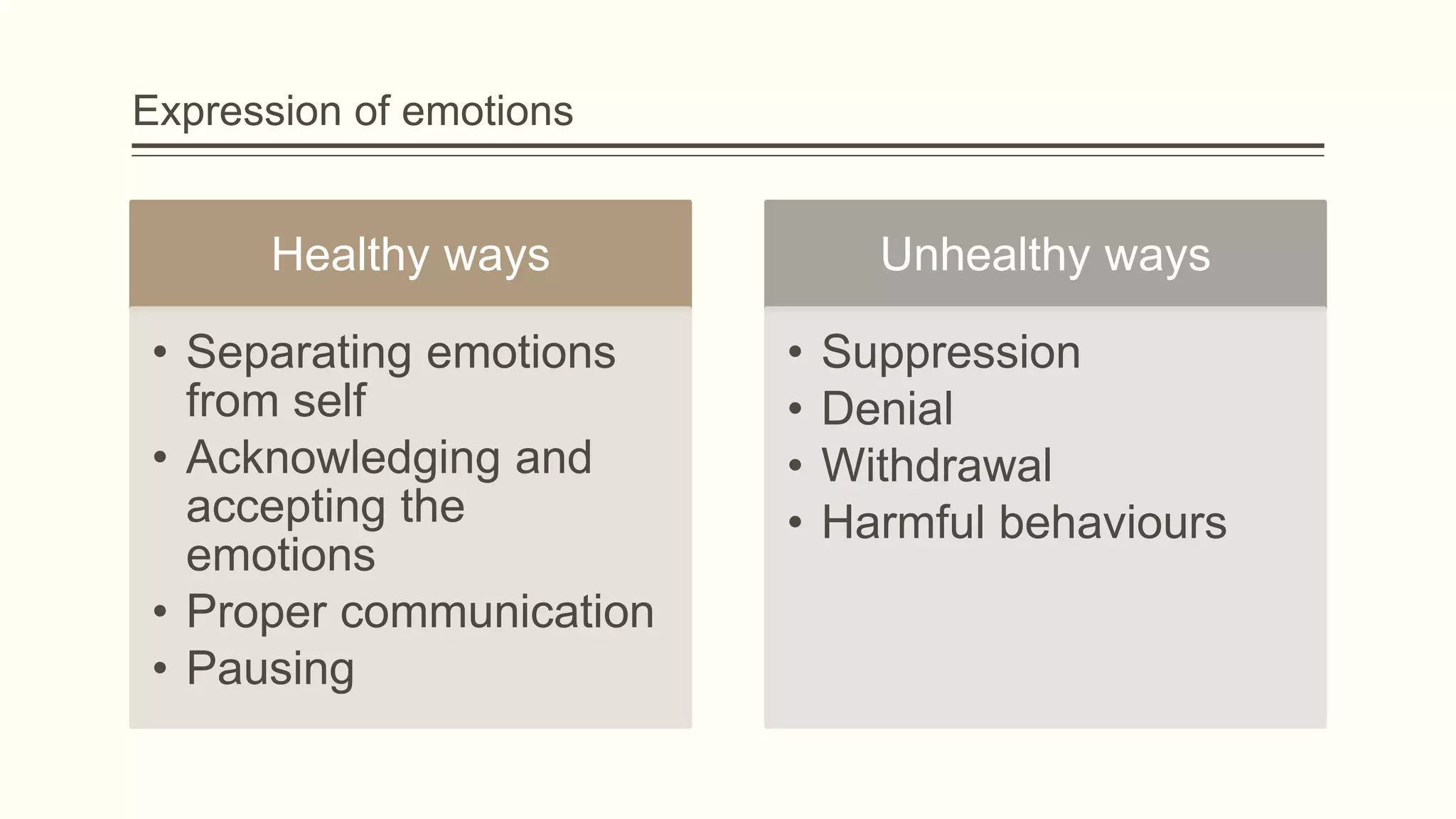
Expression of emotions
Healthy ways
• Separating emotions
from self
• Acknowledging and
accepting the
emotions
• Proper communication
• Pausing
Unhealthy ways
• Suppression
• Denial
• Withdrawal
• Harmful behaviours
What is Emotional Hijack?
 Jumping to conclusions
 Exploding, withdrawing, shutting down
 Extreme aggression
 Regret of past action once calmed down
 Action with strong impact on others
Emotional Storytelling
 Emotional Storytelling gives us an opportunity to discover meaning, find healing, and
establish or re-establish an identity, all integral factors for success and happiness.
 Individuals who engage in Emotional Storytelling are brave people who recognize
issues they would like to address in their lives.
 Problems emerge in everyone’s lives due to a variety of factors; in Emotional
Storytelling, there is no point in assigning fault to anyone or anything.
 Emotional Storytelling separates people from their problems, viewing them as whole
and functional individuals who engage in thought patterns or behavior that they would
like to change.
 The problem is the problem, the person is not the problem.
 Emotional Storytelling help us to be able to answer “HOW ARE YOU?”
WHAT IS SHAME FOR YOU?
"Shame is being the victim of a scam and losing my life savings."
"Shame is struggling with addiction."
"Shame is being fired from my dream job and having to start over."
"Shame is being the only one in my family who didn't graduate from university."
"Shame is struggling with my weight and constantly feeling judged."
"Shame is being unable to provide for my family during tough times."
"Shame is being arrested and going to jail."
"Shame is being a survivor of domestic abuse and feeling guilty for not leaving sooner."
Shame resilience theory
 We are all capable of overcoming shame through building shame resilience. And
according shame resilience theory (SRT), we can learn and develop the following:
 Capacity to recognize our experiences of shame
 Ability to move through shame constructively, maintaining our authenticity and growing from
our experiences
 Stronger, more meaningful connections with people in our lives
Practicing Empathy
 Work on listening to people without interrupting
 Pay attention to body language and other types of nonverbal communication
 Try to understand people, even when you don't agree with them
 Ask people questions to learn more about them and their lives
 Imagine yourself in another person's shoes
 Strengthen your connection with others to learn more about how they feel
 Seek to identify biases you may have and how they affect your empathy for others
 Look for ways in which you are similar to others versus focusing on differences
 Be willing to be vulnerable, opening up about how you feel
 Engage in new experiences, giving you better insight into how others in that situation may
feel
Socioemotional Selectivity Theory
 Socioemotional Selectivity Theory suggests that as people age they become more
selective in the goals they pursue, with older people prioritizing goals that will lead to
meaning and positive emotions and younger people pursuing goals that will lead to the
acquisition of knowledge.
 Socioemotional selectivity theory demonstrates that the human ability to perceive time
impacts motivation.
 Older adults have a bias towards positive stimuli, a phenomenon called the positivity
effect.
 The positivity effect suggests that, in contrast to young adults, older adults tend to pay more attention to
and remember positive information over negative information.
 Older adults with higher levels of cognitive control tend to exhibit the strongest
preference for positive stimuli.
 Thus, the positivity effect appears to be the result of older adults using their cognitive resources to
selectively process information that will meet their goal to experience more positive and less negative
emotion.
21
Tools
 Chair
 Water bottle
 Pliers
 Paper
 https://www.youtube.com/watch?v=
LgLxI6FibSY
TWO STRING PROBLEM
Two String Problem – Solution
 https://www.youtube.com/watch?v=e1d33TJauC8
22
Creativity
Componential Theory of Creativity
 The theory specifies that creativity requires a confluence of
four components: Creativity should be highest when:
 1) an intrinsically motivated person with
 2) high domain expertise and
 3) high skill in creative thinking
 4) an environment high in supports for creativity
Nurturing Creativity
 Encourage collaboration
 Provide opportunities for experimentation
 Encourage a growth mindset
 Promote a culture of feedback
 Let go of control
Do you ever get involved in something so deeply that
nothing else seems to matter and you lose track of
time?
Flow: Being in the zone
 Flow denotes the holistic sensation presents when we act with total involvement
 It is the state in which action follows upon action according to an internal logic which
seems to need no conscious intervention on our part.
 We experience it as a unified flowing from one moment to the next, in which we feel in
control of our actions, and in which there is little distinction between self and
environment; between stimulus and response or between past, present and future.
 mental state of flow is described "being completely involved in an activity for its own
sake. The ego falls away. Time flies. Every action, movement, and thought follows
inevitably from the previous one. Your whole being is involved, and you're using your
skills to the utmost."
The autotelic personality and Flow
 People with certain personality traits may be better able to achieve flow than the
average person.
 These traits include curiosity, persistence, low egotism, and a high propensity to
perform activities for intrinsic reasons.
 Being autotelic means having a self-contained activity, without the expectation of future
benefit, but simply to be experienced.
 people with an autotelic personality have a greater preference for "high-action-
opportunity, high-skills situations that stimulate them and encourage growth" compared
to those without an autotelic personality.
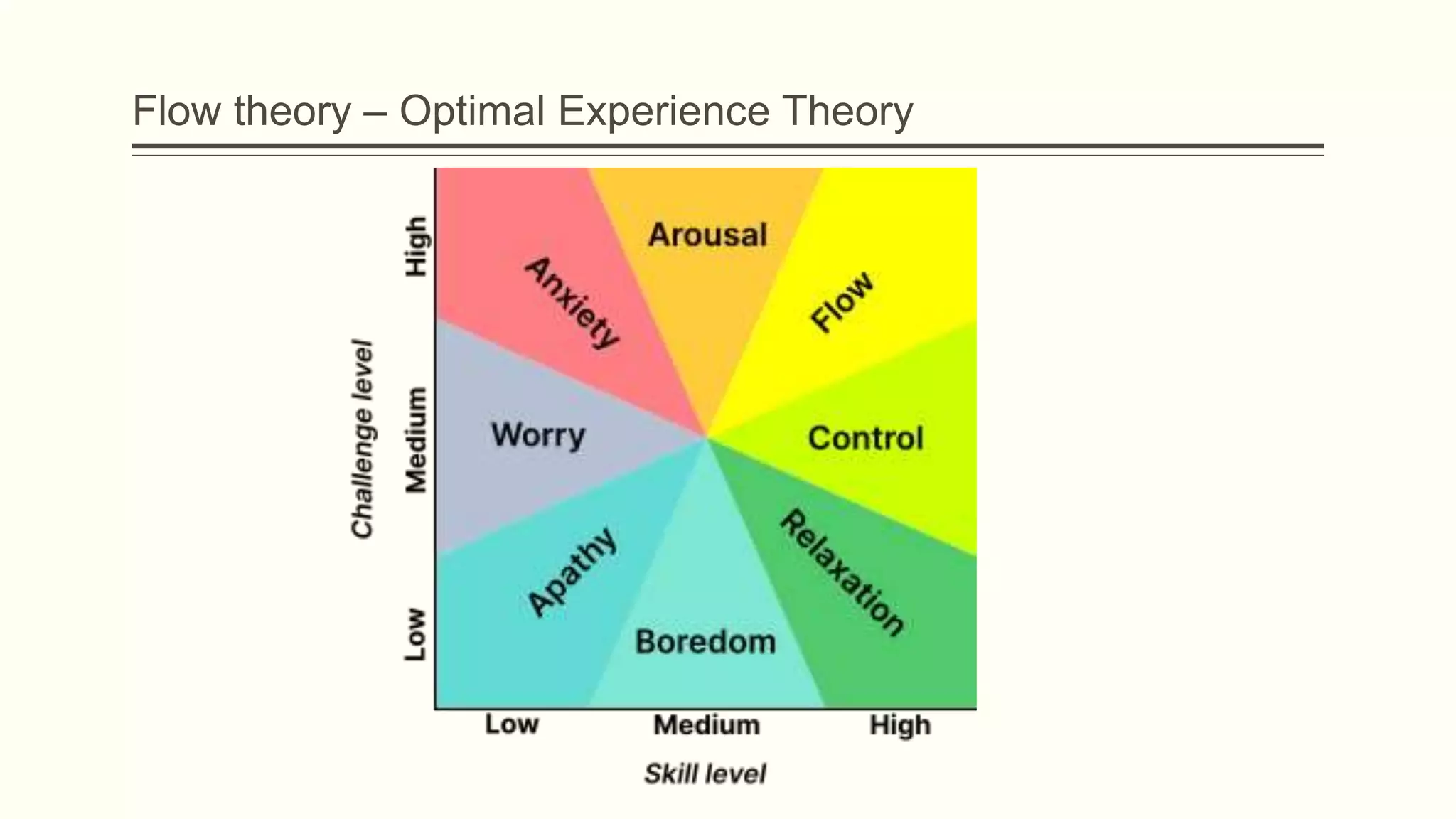
 Experimental evidence shows that a balance between individual skills, and demands
of the task (compared to boredom and overload) only elicits the flow experience in
individuals having an internal locus of control
Characteristics of Flow
 The merging of action & awareness: you don’t see yourself as separate from what you
are doing.
 Complete concentration on the task: This concentration appears effortless, however,
and is not associated with mental strain or aggressive efforts to control or repress thinking.
 Lack of worry results in a sense of control: This focus allows the person to feel as if
they are in complete control of their actions.
 A loss of self-consciousness: we are not trapped in an internal conflict between various
options
 Timelessness: Time may seems to pass more quickly than usual
 Autotelic nature of experience: The experience is done for its own sake rather than a
means to another goal
 A challenging activity that requires skill: It is only when the demands of the situation
present challenge to the person’s skills that flow is possible.
Flow theory – Optimal Experience Theory
Neuroscientific Explanation of Flow State
 Dopaminergic pathways
 This is the system of gratification.
 Dopamine energizes, increases creativity and diminishes feelings of fatigue or resistance.
 The adaptive gain theory
 The release of norepinephrine in two phases
 The phasic state corresponds with focused, precise behavior and task-relevant decision making.
 The tonic state is associated with fluctuating attention and distractibility.
 During flow, there is intermediate tonic activity, which causes strong phasic activity. Hence, the
modulation of norepinephrine release affects the cortical circuits for task performance and allows for
sustained attention in flow.
 Transient Hyperfrontality Hypothesis
 Temporary downregulation of prefrontal cortex
 Lower activity of default mode network (system of the awareness of thought and self-consciousness). It
links to the absence of worrying
How to produce more flow in life?
 Find a way to challenge oneself, make the task more interesting and pay attention to
what one is doing.
 We enter a state of deep flow only when two conditions are met.
 The first is when the demands are so high that we must force ourselves to pay strictest attention to the
task from moment to moment.
 The second is when the demands of the task force us to move beyond a state where self-
consciousness divides our attention between the task and an ongoing self-evaluation of how we are
performing it.
 When we are just beginning to learn a new skill, our awareness is so heightened that
we cannot just relax and let the activity happen. When we become more proficient, we
can stop thinking about how to do it and simply do the task.

Intelligence creativity and flow.pptx

  • 1.
  • 2.
    Intelligence  Intelligence isa mental quality that consists of the abilities to learn from experience, adapt to new situations, understand and handle abstract concepts, and use knowledge to manipulate one’s environment.
  • 3.
    Gardner's Eight Intelligences Linguistic Intelligence: Proficiency in language and verbal communication.  Logical-Mathematical Intelligence: Ability to reason logically and perform mathematical calculations.  Spatial Intelligence: Aptitude for visual and spatial thinking and understanding relationships between objects.  Musical Intelligence: Skill in musical abilities, such as pitch, rhythm, and composition.  Bodily-Kinesthetic Intelligence: Expertise in controlling body movements and handling objects.  Interpersonal Intelligence: Capability to understand and interact effectively with others.  Intrapersonal Intelligence: Self-awareness and understanding of one's own emotions, motivations, and goals.  Naturalistic Intelligence: Sensitivity and knowledge about the natural world and its phenomena.
  • 4.
  • 5.
    The Four-Branch Modelof Emotional Intelligence  Branch 1: Perceiving Emotion  Ability to identify emotion in a person’s physical and psychological states  Ability to identify emotion in other people  Ability to express emotions accurately and to express needs related to them  Ability to discriminate between accurate/honest and inaccurate/dishonest feelings  Branch 2: Using Emotions to Facilitate Thought  Ability to redirect and prioritize thinking on the basis of associated feelings  Ability to generate emotions to facilitate judgment and memory  Ability to capitalize on mood changes to appreciate multiple points of view  Ability to use emotional states to facilitate problem solving and creativity  Branch 3: Understanding Emotions  Ability to understand relationships among various emotions  Ability to perceive the causes and consequences of emotions  Ability to understand complex feelings, emotional blends, and contradictory states  Ability to understand transitions among emotions  Branch 4: Managing Emotions  Ability to be open to feelings, both pleasant and unpleasant  Ability to monitor and reflect on emotions  Ability to engage, prolong, or detach from an emotional state  Ability to manage emotions in oneself  Ability to manage emotions in others
  • 7.
    Expression of emotions Healthyways • Separating emotions from self • Acknowledging and accepting the emotions • Proper communication • Pausing Unhealthy ways • Suppression • Denial • Withdrawal • Harmful behaviours
  • 8.
    What is EmotionalHijack?  Jumping to conclusions  Exploding, withdrawing, shutting down  Extreme aggression  Regret of past action once calmed down  Action with strong impact on others
  • 14.
    Emotional Storytelling  EmotionalStorytelling gives us an opportunity to discover meaning, find healing, and establish or re-establish an identity, all integral factors for success and happiness.  Individuals who engage in Emotional Storytelling are brave people who recognize issues they would like to address in their lives.  Problems emerge in everyone’s lives due to a variety of factors; in Emotional Storytelling, there is no point in assigning fault to anyone or anything.  Emotional Storytelling separates people from their problems, viewing them as whole and functional individuals who engage in thought patterns or behavior that they would like to change.  The problem is the problem, the person is not the problem.  Emotional Storytelling help us to be able to answer “HOW ARE YOU?”
  • 15.
    WHAT IS SHAMEFOR YOU?
  • 16.
    "Shame is beingthe victim of a scam and losing my life savings." "Shame is struggling with addiction." "Shame is being fired from my dream job and having to start over." "Shame is being the only one in my family who didn't graduate from university." "Shame is struggling with my weight and constantly feeling judged." "Shame is being unable to provide for my family during tough times." "Shame is being arrested and going to jail." "Shame is being a survivor of domestic abuse and feeling guilty for not leaving sooner."
  • 17.
    Shame resilience theory We are all capable of overcoming shame through building shame resilience. And according shame resilience theory (SRT), we can learn and develop the following:  Capacity to recognize our experiences of shame  Ability to move through shame constructively, maintaining our authenticity and growing from our experiences  Stronger, more meaningful connections with people in our lives
  • 18.
    Practicing Empathy  Workon listening to people without interrupting  Pay attention to body language and other types of nonverbal communication  Try to understand people, even when you don't agree with them  Ask people questions to learn more about them and their lives  Imagine yourself in another person's shoes  Strengthen your connection with others to learn more about how they feel  Seek to identify biases you may have and how they affect your empathy for others  Look for ways in which you are similar to others versus focusing on differences  Be willing to be vulnerable, opening up about how you feel  Engage in new experiences, giving you better insight into how others in that situation may feel
  • 19.
    Socioemotional Selectivity Theory Socioemotional Selectivity Theory suggests that as people age they become more selective in the goals they pursue, with older people prioritizing goals that will lead to meaning and positive emotions and younger people pursuing goals that will lead to the acquisition of knowledge.  Socioemotional selectivity theory demonstrates that the human ability to perceive time impacts motivation.  Older adults have a bias towards positive stimuli, a phenomenon called the positivity effect.  The positivity effect suggests that, in contrast to young adults, older adults tend to pay more attention to and remember positive information over negative information.  Older adults with higher levels of cognitive control tend to exhibit the strongest preference for positive stimuli.  Thus, the positivity effect appears to be the result of older adults using their cognitive resources to selectively process information that will meet their goal to experience more positive and less negative emotion.
  • 21.
    21 Tools  Chair  Waterbottle  Pliers  Paper  https://www.youtube.com/watch?v= LgLxI6FibSY TWO STRING PROBLEM
  • 22.
    Two String Problem– Solution  https://www.youtube.com/watch?v=e1d33TJauC8 22
  • 23.
  • 24.
    Componential Theory ofCreativity  The theory specifies that creativity requires a confluence of four components: Creativity should be highest when:  1) an intrinsically motivated person with  2) high domain expertise and  3) high skill in creative thinking  4) an environment high in supports for creativity
  • 25.
    Nurturing Creativity  Encouragecollaboration  Provide opportunities for experimentation  Encourage a growth mindset  Promote a culture of feedback  Let go of control
  • 26.
    Do you everget involved in something so deeply that nothing else seems to matter and you lose track of time?
  • 27.
    Flow: Being inthe zone  Flow denotes the holistic sensation presents when we act with total involvement  It is the state in which action follows upon action according to an internal logic which seems to need no conscious intervention on our part.  We experience it as a unified flowing from one moment to the next, in which we feel in control of our actions, and in which there is little distinction between self and environment; between stimulus and response or between past, present and future.  mental state of flow is described "being completely involved in an activity for its own sake. The ego falls away. Time flies. Every action, movement, and thought follows inevitably from the previous one. Your whole being is involved, and you're using your skills to the utmost."
  • 28.
    The autotelic personalityand Flow  People with certain personality traits may be better able to achieve flow than the average person.  These traits include curiosity, persistence, low egotism, and a high propensity to perform activities for intrinsic reasons.  Being autotelic means having a self-contained activity, without the expectation of future benefit, but simply to be experienced.  people with an autotelic personality have a greater preference for "high-action- opportunity, high-skills situations that stimulate them and encourage growth" compared to those without an autotelic personality.  Experimental evidence shows that a balance between individual skills, and demands of the task (compared to boredom and overload) only elicits the flow experience in individuals having an internal locus of control
  • 29.
    Characteristics of Flow The merging of action & awareness: you don’t see yourself as separate from what you are doing.  Complete concentration on the task: This concentration appears effortless, however, and is not associated with mental strain or aggressive efforts to control or repress thinking.  Lack of worry results in a sense of control: This focus allows the person to feel as if they are in complete control of their actions.  A loss of self-consciousness: we are not trapped in an internal conflict between various options  Timelessness: Time may seems to pass more quickly than usual  Autotelic nature of experience: The experience is done for its own sake rather than a means to another goal  A challenging activity that requires skill: It is only when the demands of the situation present challenge to the person’s skills that flow is possible.
  • 30.
    Flow theory –Optimal Experience Theory
  • 31.
    Neuroscientific Explanation ofFlow State  Dopaminergic pathways  This is the system of gratification.  Dopamine energizes, increases creativity and diminishes feelings of fatigue or resistance.  The adaptive gain theory  The release of norepinephrine in two phases  The phasic state corresponds with focused, precise behavior and task-relevant decision making.  The tonic state is associated with fluctuating attention and distractibility.  During flow, there is intermediate tonic activity, which causes strong phasic activity. Hence, the modulation of norepinephrine release affects the cortical circuits for task performance and allows for sustained attention in flow.  Transient Hyperfrontality Hypothesis  Temporary downregulation of prefrontal cortex  Lower activity of default mode network (system of the awareness of thought and self-consciousness). It links to the absence of worrying
  • 32.
    How to producemore flow in life?  Find a way to challenge oneself, make the task more interesting and pay attention to what one is doing.  We enter a state of deep flow only when two conditions are met.  The first is when the demands are so high that we must force ourselves to pay strictest attention to the task from moment to moment.  The second is when the demands of the task force us to move beyond a state where self- consciousness divides our attention between the task and an ongoing self-evaluation of how we are performing it.  When we are just beginning to learn a new skill, our awareness is so heightened that we cannot just relax and let the activity happen. When we become more proficient, we can stop thinking about how to do it and simply do the task.

Editor's Notes

  • #2 NOTE: To change the image on this slide, select the picture and delete it. Then click the Pictures icon in the placeholder to insert your own image.