ALDERSGATE COLLEGE ​Instructional Module in Educational Statistics
Module 1: INTRODUCTION TO STATISTICS 
Prerequisite Skills: ​∙ ​Be able to understand definitions
∙ ​Skill in applying deductive and
inductive reasoning
Instructors: ​Emerson Y. Castañeto
Overview  
This module presents topics introductory and basics to applied statistics. Words pertinent to the study of statistics
are defined to facilitate better understanding of the course.
Objectives  
At the end of this lesson, students are expected to:
1. realize the importance and application of Statistics in real life.
2. differentiate inferential statistics from descriptive statistics and give examples of each
3. differentiate samples from population and give examples of each
4. define parameter and statistics
5. classify data as either quantitative or qualitative
6. determine whether a variable is discrete or continuous
7. discuss the level of measurements
Learning Focus  
Statistics ​is a scientific body of knowledge that deals with:
∙ ​collection of data
∙ ​organization and presentation of data
∙ ​analysis and interpretation of data
Importance of Statistics  
Some of the functions of statistics can be as follows:
∙ ​To present facts in a definite form.
∙ ​Statistics facilitates comparisons.
∙ ​Statistics gives guidance in the formulation of suitable policies.
∙ ​Statistics can be formulated well in advance for predictions.
∙ ​Statistical methods are helpful in formulating, testing hypothesis and develop new theories.
Division Of Statistics  
1. ​DESCRIPTIVE STATISTICS ​is a statistical procedure concerned with describing the characteristics and
properties of a group of persons, place or things; it is based on easily verifiable facts.
Descriptive Statistics organizes the presentation, description, and interpretation of data gathered. It
includes the study of relationship among variables.
Prepared by ​Emerson Y. Castañeto ​Page 1
ALDERSGATE COLLEGE ​Instructional Module in Educational Statistics
Descriptive statistics can answer question such as:
1. How many students are interested to take Statistics online?
2. What are the highest and the lowest scores obtained by applicants in a test?
3. What are the characteristics of the most likable professors according to students?
4. Who performed better in the entrance examination?
5. What proportion of XYZ college students likes Mathematics?
2. ​INFERENTIAL STATISTICS is a statistical procedure used to draw inferences for the population on the
basis of the information obtained from the sample. It involves generalizing from sample to populations,
performing estimations ​and ​hypothesis tests​, ​determining relationship among variables​, and ​making
predictions.
Inferential statistics draws inferences about the population based on the data gathered from samples
using the techniques of descriptive statistics. The backbone of inferential statistics is descriptive statistics.
Inferential statistics can answer questions like:
1. Is there a significant difference in the academic performance of male and female students in Statistics?
2. Is there a significant difference between the proportions of students who are interested to take
Statistics online and those who are not?
3. Is there a significant correlation between the educational and job performance rating? 4. Is there a
significant difference between the weights of 20 students before and after six months of attending
aerobics?
5. Is there a significant difference between the mean GPAs of CA, HRM, CDA and HRIM students?
Definition
∙ ​POPULATION​ refers to the large collection of objects, place or things.
∙ ​PARAMETER​ is any ​numerical value ​which describes a population.
Example: ​There are 8,756 students enrolled in Nursing
N = 8,756 ​is a parameter
∙ ​SAMPLE ​is a small portion or part of a population; a representative of the population in a research study. ​∙
STATISTIC​ is any numerical value which describes a sample
Example: ​Of the 8,756 students enrolled in Nursing, 2,893 are male
n = 2,893 ​is a statistic
Definition
∙ ​DATA ​are facts, or a set of information gathered or under study.
∙ ​QUANTITATIVE DATA ​are numerical in nature and therefore meaningful arithmetic can be done. It
involves numbers and can be obtained by counting
Example: ​age, weekly allowance, monthly salary
∙ ​QUALITATIVE DATA ​are data attributes which cannot be subjected to meaningful arithmetic. These are
attributed or characteristics such as sex, educational attainment, feelings or opinion
Example: gender, Size of T-shirt, brand of cars
Definition
Quantitative or numerical data gathered about the population or sample can be further classified into
either discrete of continuous.
∙ ​DISCRETE DATA​ assume exact values only and can be obtained by counting.
Example: ​number of student, score in an examination, number of book in a shelf
Prepared by ​Emerson Y. Castañeto ​Page 2
ALDERSGATE COLLEGE ​Instructional Module in Educational Statistics
∙ ​CONTINUOUS DATA​ assume infinite values within a specified interval and can be obtained by
measurement.
Example: ​height a PBA player, length of waistline
Definition
∙ ​CONSTANT ​is a characteristic or property of a population or sample which makes the members similar to
each other.
Example: ​Gender in a class of all boys is constant
∙ ​VARIABLE ​is a characteristic or property of population or sample which makes the members different from
each other.
Example: ​Gender in a coed school is variable
Researchers are not interested in constants since they do not make the subjects of research different
from one another. They are specifically interested in variables.
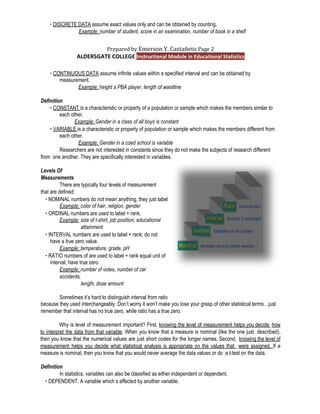
Levels Of
Measurements
There are typically four levels of measurement
that are defined:
∙ ​NOMINAL numbers do not mean anything, they just label
Example: ​color of hair, religion, gender
∙ ​ORDINAL numbers are used to label + rank.
Example:​ size of t-shirt, job position, educational
attainment
∙ ​INTERVAL numbers are used to label + rank; do not
have a true zero value.
Example: ​temperature, grade, pH
∙ ​RATIO numbers of are used to label + rank equal unit of
interval; have true zero.
Example: ​number of votes, number of car
accidents,
length, dose amount
Sometimes it’s hard to distinguish interval from ratio
because they used interchangeably. Don’t worry it won’t make you lose your grasp of other statistical terms…just
remember that interval has no true zero, while ratio has a true zero.
Why is level of measurement important? First, ​knowing the level of measurement helps you decide ​how
to interpret the data from that variable​. When you know that a measure is nominal (like the one just described),
then you know that the numerical values are just short codes for the longer names. Second, ​knowing the level of
measurement helps you decide what statistical analysis is appropriate on the values that ​were assigned. ​If a
measure is nominal, then you know that you would never average the data values or do a t-test on the data.
Definition
In statistics, variables can also be classified as either independent or dependent.
∙ ​DEPENDENT. A variable which s affected by another variable.
Example: ​test scores
∙ ​INDEPENDENT. A variable which affects the dependent variable.
Example: ​number of hours spent in studying
Prepared by ​Emerson Y. Castañeto ​Page 3

Module 1 introduction to statistics

  • 1.
    ALDERSGATE COLLEGE ​InstructionalModule in Educational Statistics Module 1: INTRODUCTION TO STATISTICS  Prerequisite Skills: ​∙ ​Be able to understand definitions ∙ ​Skill in applying deductive and inductive reasoning Instructors: ​Emerson Y. Castañeto Overview   This module presents topics introductory and basics to applied statistics. Words pertinent to the study of statistics are defined to facilitate better understanding of the course. Objectives   At the end of this lesson, students are expected to: 1. realize the importance and application of Statistics in real life. 2. differentiate inferential statistics from descriptive statistics and give examples of each 3. differentiate samples from population and give examples of each 4. define parameter and statistics 5. classify data as either quantitative or qualitative 6. determine whether a variable is discrete or continuous 7. discuss the level of measurements Learning Focus   Statistics ​is a scientific body of knowledge that deals with: ∙ ​collection of data ∙ ​organization and presentation of data ∙ ​analysis and interpretation of data Importance of Statistics   Some of the functions of statistics can be as follows: ∙ ​To present facts in a definite form. ∙ ​Statistics facilitates comparisons. ∙ ​Statistics gives guidance in the formulation of suitable policies. ∙ ​Statistics can be formulated well in advance for predictions. ∙ ​Statistical methods are helpful in formulating, testing hypothesis and develop new theories. Division Of Statistics   1. ​DESCRIPTIVE STATISTICS ​is a statistical procedure concerned with describing the characteristics and properties of a group of persons, place or things; it is based on easily verifiable facts. Descriptive Statistics organizes the presentation, description, and interpretation of data gathered. It includes the study of relationship among variables.
  • 2.
    Prepared by ​EmersonY. Castañeto ​Page 1 ALDERSGATE COLLEGE ​Instructional Module in Educational Statistics Descriptive statistics can answer question such as: 1. How many students are interested to take Statistics online? 2. What are the highest and the lowest scores obtained by applicants in a test? 3. What are the characteristics of the most likable professors according to students? 4. Who performed better in the entrance examination? 5. What proportion of XYZ college students likes Mathematics? 2. ​INFERENTIAL STATISTICS is a statistical procedure used to draw inferences for the population on the basis of the information obtained from the sample. It involves generalizing from sample to populations, performing estimations ​and ​hypothesis tests​, ​determining relationship among variables​, and ​making predictions. Inferential statistics draws inferences about the population based on the data gathered from samples using the techniques of descriptive statistics. The backbone of inferential statistics is descriptive statistics. Inferential statistics can answer questions like: 1. Is there a significant difference in the academic performance of male and female students in Statistics? 2. Is there a significant difference between the proportions of students who are interested to take Statistics online and those who are not? 3. Is there a significant correlation between the educational and job performance rating? 4. Is there a significant difference between the weights of 20 students before and after six months of attending aerobics? 5. Is there a significant difference between the mean GPAs of CA, HRM, CDA and HRIM students? Definition ∙ ​POPULATION​ refers to the large collection of objects, place or things. ∙ ​PARAMETER​ is any ​numerical value ​which describes a population. Example: ​There are 8,756 students enrolled in Nursing N = 8,756 ​is a parameter ∙ ​SAMPLE ​is a small portion or part of a population; a representative of the population in a research study. ​∙ STATISTIC​ is any numerical value which describes a sample Example: ​Of the 8,756 students enrolled in Nursing, 2,893 are male n = 2,893 ​is a statistic Definition ∙ ​DATA ​are facts, or a set of information gathered or under study. ∙ ​QUANTITATIVE DATA ​are numerical in nature and therefore meaningful arithmetic can be done. It involves numbers and can be obtained by counting Example: ​age, weekly allowance, monthly salary ∙ ​QUALITATIVE DATA ​are data attributes which cannot be subjected to meaningful arithmetic. These are attributed or characteristics such as sex, educational attainment, feelings or opinion Example: gender, Size of T-shirt, brand of cars Definition Quantitative or numerical data gathered about the population or sample can be further classified into either discrete of continuous.
  • 3.
    ∙ ​DISCRETE DATA​assume exact values only and can be obtained by counting. Example: ​number of student, score in an examination, number of book in a shelf Prepared by ​Emerson Y. Castañeto ​Page 2 ALDERSGATE COLLEGE ​Instructional Module in Educational Statistics ∙ ​CONTINUOUS DATA​ assume infinite values within a specified interval and can be obtained by measurement. Example: ​height a PBA player, length of waistline Definition ∙ ​CONSTANT ​is a characteristic or property of a population or sample which makes the members similar to each other. Example: ​Gender in a class of all boys is constant ∙ ​VARIABLE ​is a characteristic or property of population or sample which makes the members different from each other. Example: ​Gender in a coed school is variable Researchers are not interested in constants since they do not make the subjects of research different from one another. They are specifically interested in variables. Levels Of Measurements There are typically four levels of measurement that are defined: ∙ ​NOMINAL numbers do not mean anything, they just label Example: ​color of hair, religion, gender ∙ ​ORDINAL numbers are used to label + rank. Example:​ size of t-shirt, job position, educational attainment ∙ ​INTERVAL numbers are used to label + rank; do not have a true zero value. Example: ​temperature, grade, pH ∙ ​RATIO numbers of are used to label + rank equal unit of interval; have true zero. Example: ​number of votes, number of car accidents, length, dose amount Sometimes it’s hard to distinguish interval from ratio because they used interchangeably. Don’t worry it won’t make you lose your grasp of other statistical terms…just remember that interval has no true zero, while ratio has a true zero. Why is level of measurement important? First, ​knowing the level of measurement helps you decide ​how to interpret the data from that variable​. When you know that a measure is nominal (like the one just described), then you know that the numerical values are just short codes for the longer names. Second, ​knowing the level of measurement helps you decide what statistical analysis is appropriate on the values that ​were assigned. ​If a measure is nominal, then you know that you would never average the data values or do a t-test on the data. Definition In statistics, variables can also be classified as either independent or dependent. ∙ ​DEPENDENT. A variable which s affected by another variable.
  • 4.
    Example: ​test scores ∙​INDEPENDENT. A variable which affects the dependent variable. Example: ​number of hours spent in studying Prepared by ​Emerson Y. Castañeto ​Page 3