Dr. Murlidhar Paliwal
Associate professor and Head, Department of Samhita and Sanskrit
Institute of Medical Sciences, Banaras Hindu University, Varanasi
Salient Features of Ayurveda Samhitas
Contents
 Introduction
 Meaning of the term ‘Samhita’
 Ashtanga Ayurveda in Samhitas
 Salient features of Samhitas
 Discussion
 Conclusion
Introduction
 Ayurveda, the system of medicine and more over the science of
life, is eternal.
 Ayurveda, shakha, vidya, sutra, gyana, shastra, lakshana and
tantra are the synonyms1.
 It is the Upaveda of Atharvaveda and Punyatama-Veda as
quoted by Acharya Charak.
_________
1. तत्रायुर्वेदः शाखा वर्वद्या सूत्रं ज्ञानं शास्त्त्रं लक्षणं तन्त्त्रमित्यनर्ाान्त्त॥ि
-च॥कसंहिता सूत्रस्त्र्ान-30/31
 Ayurveda is Pancham-Veda as per Acharya Kashyapa.
 The glory of Ayurveda is because of the rich and
authentic knowledge.
 The source of rich and authentic knowledge is none
other than Ayurveda-Samhitas.
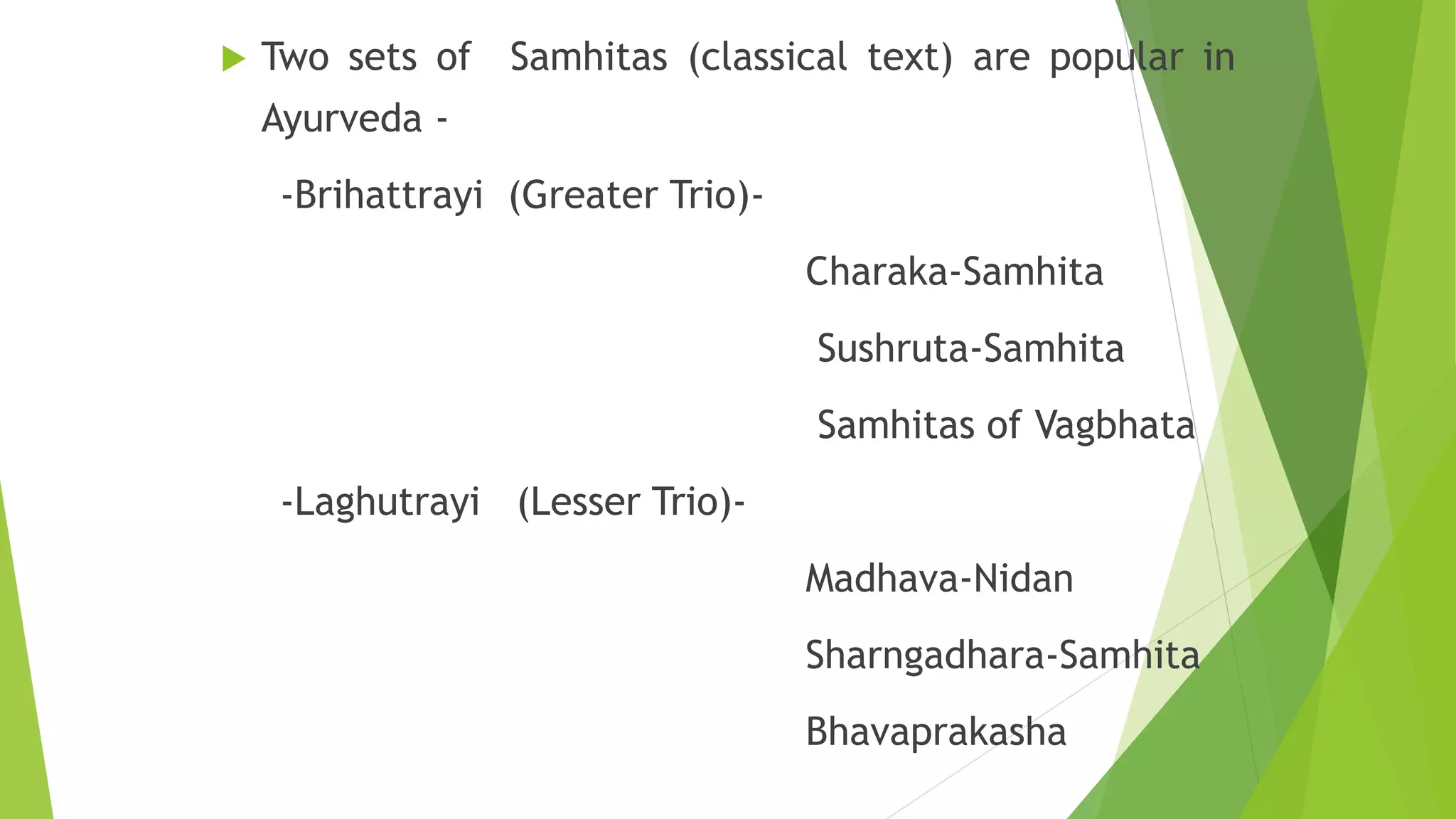
 Two sets of Samhitas (classical text) are popular in
Ayurveda -
-Brihattrayi (Greater Trio)-
Charaka-Samhita
Sushruta-Samhita
Samhitas of Vagbhata
-Laghutrayi (Lesser Trio)-
Madhava-Nidan
Sharngadhara-Samhita
Bhavaprakasha
Meaning of the term ‘Samhita’
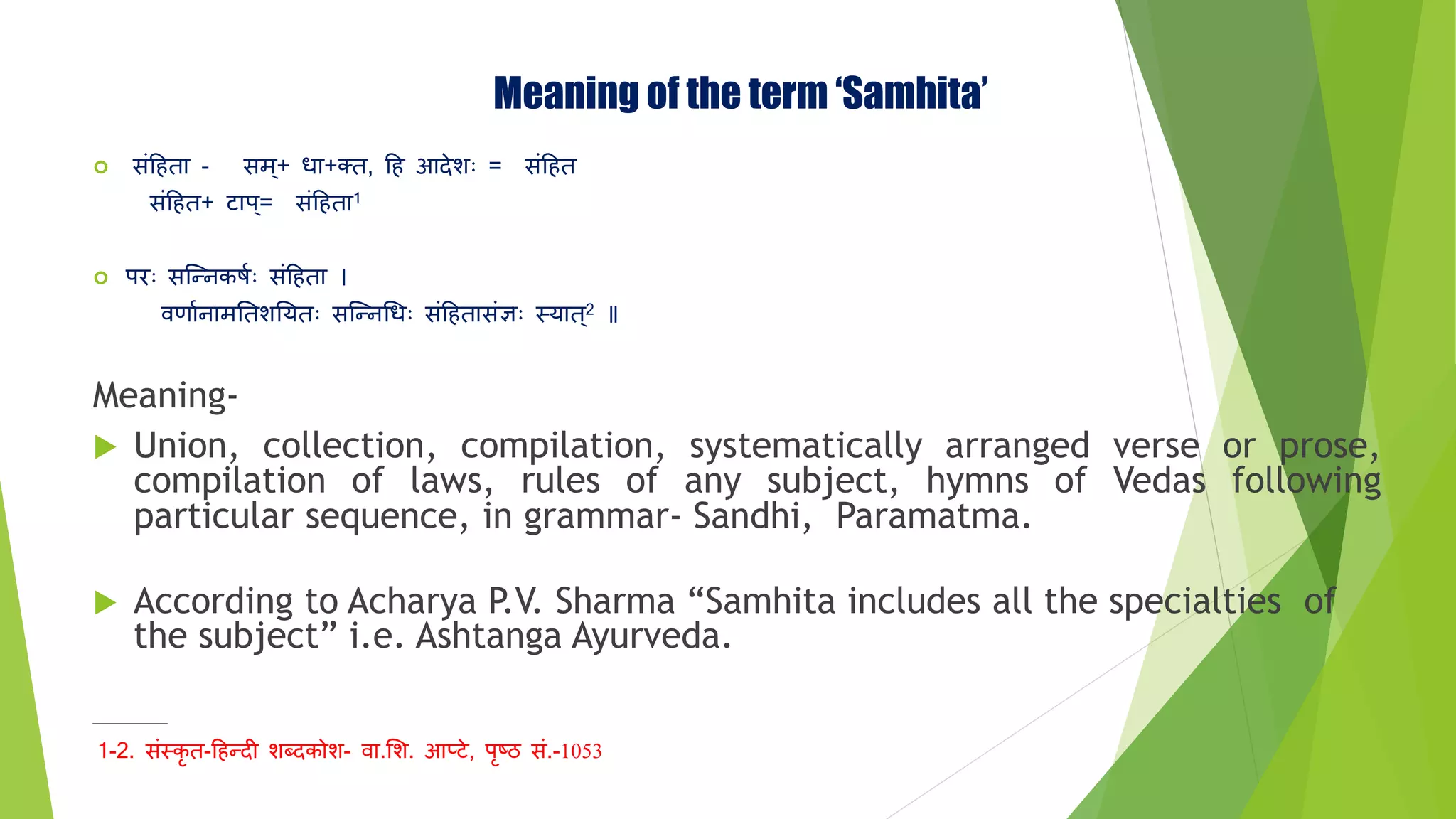
 संहिता - सि+ धा+क्त, हि आदेशः = संहित
संहित+ टाप= संहिता1
 प॥ः सन्न्त्नकर्ाः संहिता ।
र्वणाानािततशतयतः सन्न्त्नधधः संहितासंज्ञः स्त्यात2
Meaning-
 Union, collection, compilation, systematically arranged verse or prose,
compilation of laws, rules of any subject, hymns of Vedas following
particular sequence, in grammar- Sandhi, Paramatma.
 According to Acharya P.V. Sharma “Samhita includes all the specialties of
the subject” i.e. Ashtanga Ayurveda.
_______
1-2. संस्त्कृ त-हिन्त्दी शब्दकोश- र्वा.मश. आप्टे, पृष्ठ सं.-1053
Ashtanga Ayurveda in Samhitas
Ashtanga Ayurveda means eight clinical specialties of Ayurveda. These are as follows 1-
1. Shalya-Tantra (Surgery)
2. Shalakya-Tantra ( ENT & Ophthalmology)
3. Kayachikitsa (Internal medicine)
4.Bhutavidya (Demonology)
5. Kaumarbhritya (Pediatrics)
6.Agadtantra (Toxicology)
7. Rasayan-Tantra (Rejuvenation)
8. Vajikarana-Tantra (Virilification)
All the major Samhitas includes the subject matter of Ashtanga-Ayurveda.
__________
1. तद्यर्ा- शल्यं शालाक्यं, कायधचककत्सा,भूतवर्वद्या,कौिा॥भृत्यं, अगदतन्त्त्रं, ॥सायनतन्त्त्रं, र्वाजीक॥णतन्त्त्रमितत
-सुश्रुतसंहिता सूत्रस्त्र्ान-1/7
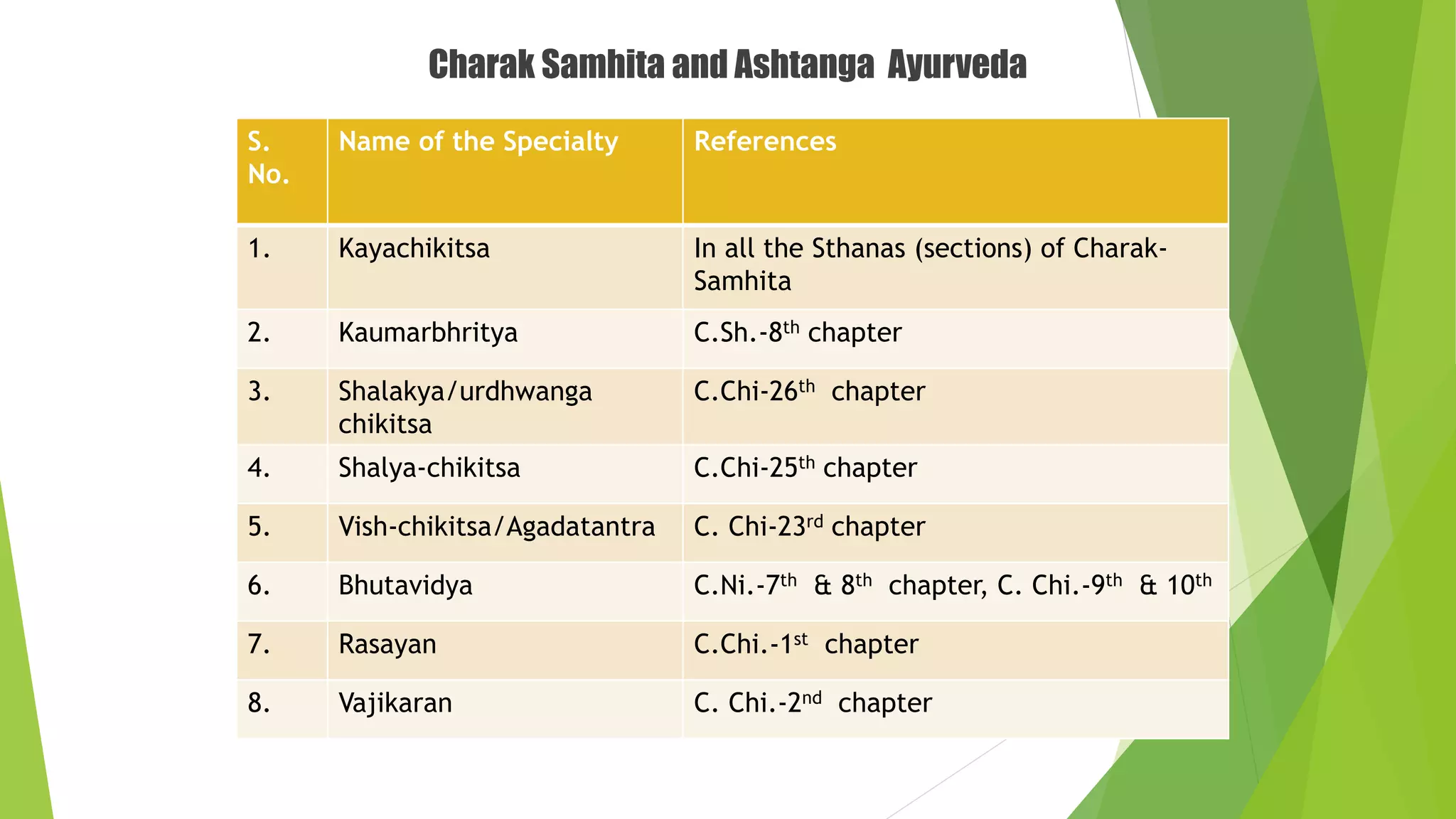
Charak Samhita and Ashtanga Ayurveda
Serial No. Name of the
specialties
References
S.
No.
Name of the Specialty References
1. Kayachikitsa In all the Sthanas (sections) of Charak-
Samhita
2. Kaumarbhritya C.Sh.-8th chapter
3. Shalakya/urdhwanga
chikitsa
C.Chi-26th chapter
4. Shalya-chikitsa C.Chi-25th chapter
5. Vish-chikitsa/Agadatantra C. Chi-23rd chapter
6. Bhutavidya C.Ni.-7th & 8th chapter, C. Chi.-9th & 10th
7. Rasayan C.Chi.-1st chapter
8. Vajikaran C. Chi.-2nd chapter
Sushrut-Samhita and Ashtanga Ayurveda1
1. Sushrut-Samhita Sutrasthan-3/42-44
S.
No.
Name of the
Specialty
References
1. Kayachikitsa Sushruta Samhita Chikitsasthan-31st -40th chapter,
Sushruta Uttartantra-39th -59th chapter
2. Kaumarbhrity
a
Sushruta Samhita Sharirsthan-10th chapter ,
Bhutavidya
3. Shalakya Sushruta Samhita Uttartantra-1st -26th chapters
4. Shalya-
chikitsa
Sushruta Samhita Sutrasthan to Chikitsasthan
5. Vish-chikitsa Sushruta Samhita -Kalpasthana
6. Bhutavidya Sushruta Samhita Uttartantra-27th -37th chapters
7. Rasayan Sushruta Samhita Chikitsasthan- -27,28,29 &30th
chapters
8. Vajikaran Sushruta Samhita Chikitsasthan-26th chapter
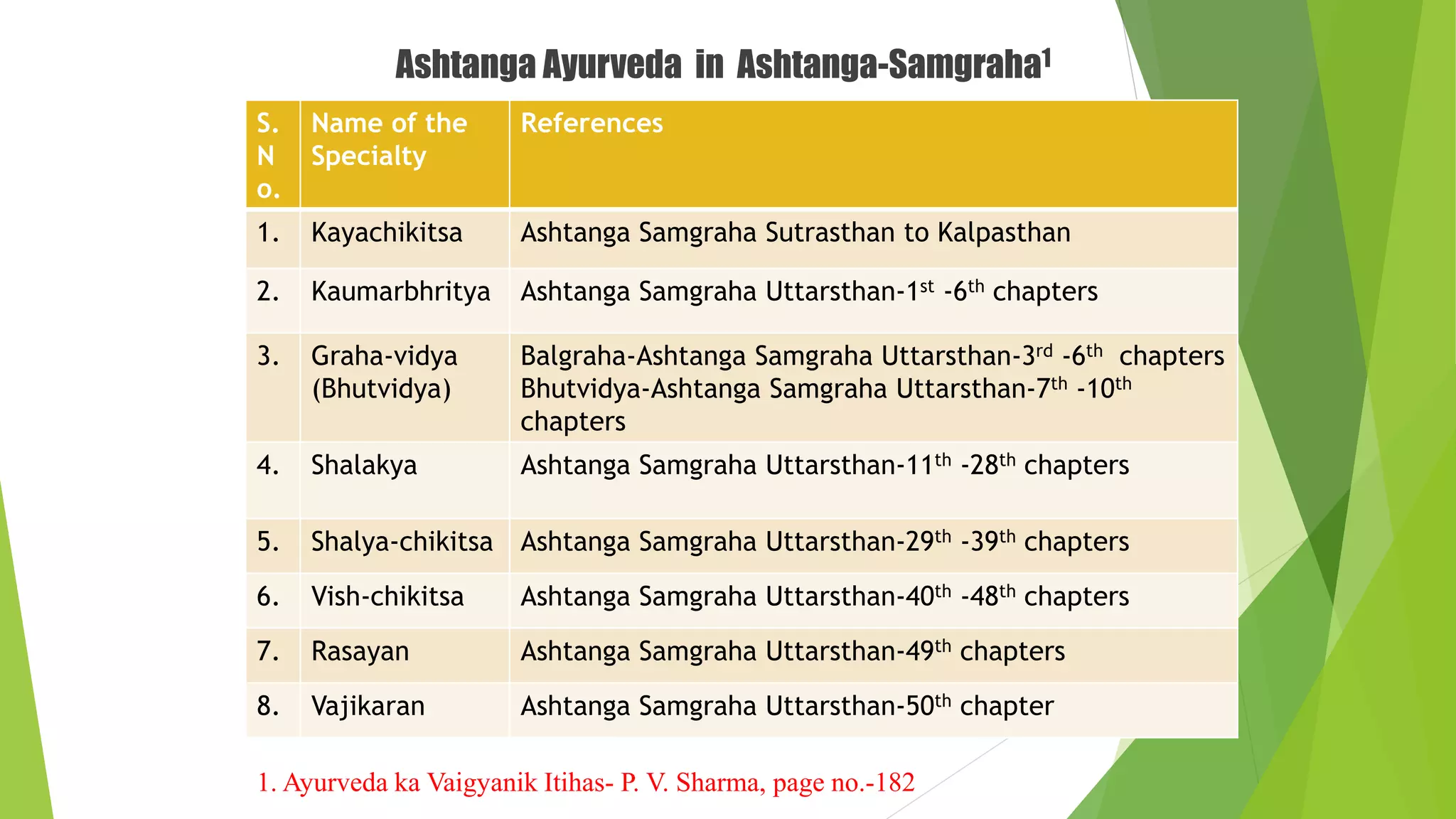
Ashtanga Ayurveda in Ashtanga-Samgraha1
1. Ayurveda ka Vaigyanik Itihas- P. V. Sharma, page no.-182
S.
N
o.
Name of the
Specialty
References
1. Kayachikitsa Ashtanga Samgraha Sutrasthan to Kalpasthan
2. Kaumarbhritya Ashtanga Samgraha Uttarsthan-1st -6th chapters
3. Graha-vidya
(Bhutvidya)
Balgraha-Ashtanga Samgraha Uttarsthan-3rd -6th chapters
Bhutvidya-Ashtanga Samgraha Uttarsthan-7th -10th
chapters
4. Shalakya Ashtanga Samgraha Uttarsthan-11th -28th chapters
5. Shalya-chikitsa Ashtanga Samgraha Uttarsthan-29th -39th chapters
6. Vish-chikitsa Ashtanga Samgraha Uttarsthan-40th -48th chapters
7. Rasayan Ashtanga Samgraha Uttarsthan-49th chapters
8. Vajikaran Ashtanga Samgraha Uttarsthan-50th chapter
Salient Features of Samhitas
 Ayurveda-Samhita means compendia having systematically
arranged text comprising of Ashtanga-Ayurveda.
 These are endowed with peculiar characteristic features
which are advocated for the ideal medical text1. Such as-
(अ) सुििद्यशस्त्र्वीधी॥पुरुर्ासेवर्वति
(which are followed by great, illustrious and wise physicians)
(आ) अर्ाबिुलि
(abundance of subject matter)
(इ) आप्तजनपून्जति
(respected by reputed personalities)
______________
1. वर्ववर्वधातन हि शास्त्त्राणण मभर्जां ...........तदमभप्रपद्येत शास्त्त्रि
-च॥कसंहिता वर्विानस्त्र्ान-8/3
(ई) त्रत्रवर्वधमशष्यबुद्धधहिति
(conducive to the intellectual development of three types of
disciples)
(उ) अपगतपुनरुक्तदोर्ि
(free from defects of repetition)
(ऊ) आर्ाि
(written by seers and sages)
(ए) सुप्रणीतसूत्रभाष्यसंग्रिक्रिि
(well placed aphorism together with commentaries in proper
sequence)
(ओ) स्त्र्वाधा॥ि
(elegant ideas to convey)
(औ) अनर्वपतततशब्दिकष्टशब्दि
(which are free from vulgar and difficult words)
(क) पुष्कलामभधानि
(which have clear and unambiguous subject matter)
(ख) क्रिागतार्ाि
(which convey subject matter in proper order)
(ग) अर्ातत्त्र्ववर्वतनश्चयप्रधानि
(which have determination of real objects)
(घ) संगतार्ािसंकु लप्रक॥णि
(which are relevant and free from confusion related to
context)
(ङ) आशुप्रबोधकि
(Which convey ideas quickly)
(च) लक्षणर्वच्च
(Which are equipped with definitions)
(छ) उदाि॥णर्वच्च
(Which are equipped with examples)
Along with all these features , Ayurveda Samhitas possess the
following salient features also-
Specific style of dialogue and interpretations
 Description of Ashtanga-Ayurveda
 Ideal guru-shishya interaction- as we see in Charak Samhita
 Organization of different seminars and symposia
 Placement of the views of other scholars and their logical
acceptance or rejection
 Description of the text following the “samas-vyas shaili’ i.e.
Pattern of brief and detail description.
 Unique pattern of proposition of the chapter, discussion,
summary and colophon.
 Close interrelationship of the subject matter of the one
chapter with another and one section with another section.
 Absence of doubts and ambiguity
Scientific way of discussions
 Each and every topic is described rationally following
the
cause and effect theory.
 Every statement in Samhitas is followed by valid logics.
 Due respect is given to the view of different scholars
 Abundance of questioning and Friendly discussions
(Sandhaya-Sambhasha)- a scientific temperament
 Abundance of experiments, observations and examination
Valid fundamental doctrines
 Ayurveda Samhitas advocate the fundamental
doctrines which are time tested and valid through
the ages. Theses are as follows-
Triguna siddhanta
Panchamahabhuta siddhanta
Tridosha siddhanta
Dosha,dhatu and mala siddhanta
Agni, koshtha and prakriti siddhanta
Loka-purusha samya siddhanta
Shatpadartha-siddhanta
Vyadhi siddhanta
Dwividh-upakrama siddhanta
Shadupakrama-siddhanta
Broader aspect & Unique approach
 Ayurveda Samhitas possess broader view in all the aspects
such as-
Concept of Ayu- Chaturvidha Ayu
Concept of Health- Multidimensional health
Concept of disease- Doshaja as well as Karmaja diseases
Concept of treatment- rational as well as divine therapy
Laukiki-chikitsa as well as naishthiki-
chiktsa
Concept of this life and life beyond
Base or foundation of the Ayurveda
 Samhitas are the initial written documents of the Ayurveda.
 These are considered significant similar to root of the plant,
means Ayurveda chikitsa is developed and flourished on the base
of Samhitas such as-
Charak-Samhita deals with Ashtanga Ayurveda mainly for Kayachikitsa
Sushrut-Samhita deals with Ashtanga Ayurveda mainly for Shalya-Tantra
Kashyapa-Samhita deals with Ashtanga Ayurveda mainly for Kaumarbhritya
Nimi-tantra mainly for shalakya Tantra
Inculcate the idea- “सर्वपारिषदमिदं शास्त्रि्”
 Ayurveda Samhitas includes the useful subject matter of different
disciplines which makes samhitas a “सर्वपारिषदमिदं शास्त्रि ्”.
 It is the symbol of the observance of Vidya-kalpana in Samhitas
which makes any text complete and beneficial.
 Samhitas are endowed with the subject matter of Veda, Upanishad,
Puranas, Smriti granthas, Philosophy, Astrology, vyakarana and many
other texts along with chikitsa
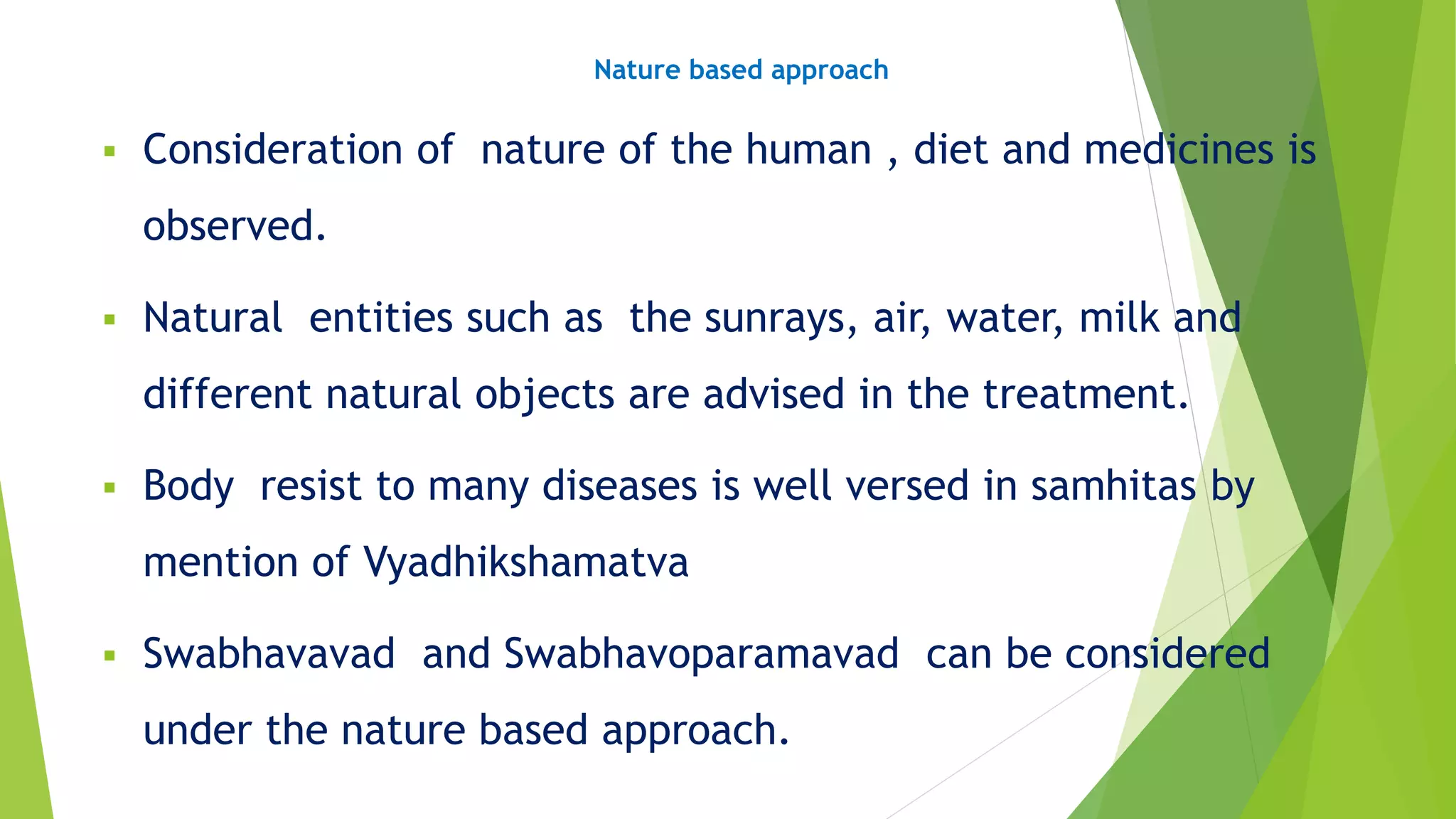
Nature based approach
 Consideration of nature of the human , diet and medicines is
observed.
 Natural entities such as the sunrays, air, water, milk and
different natural objects are advised in the treatment.
 Body resist to many diseases is well versed in samhitas by
mention of Vyadhikshamatva
 Swabhavavad and Swabhavoparamavad can be considered
under the nature based approach.
Proper emphasis on individualized medicine
 Charak-Samhita declares very firmly that only that medicine can
be the best one which is considered individually.
 Prakriti based chikitsa in Ayurveda is one of the examples of
individualized medicine.
 Individualized medicine is discussed considering the dosha,
Bheshaj, body strength, season, sharir, vaya, satmya etc.
 Quantity of diet and exercise has not been fixed by Ayurvedists
which shows the individualized approach .
Rationality in all the context
 Ayurveda Samhitas are endowed with rationality in all the context
 Different rules of diet and life style for healthy and diseased
persons shows the rationality.
 Treatment is advised according to stage of the disease. Indication
and contra indication changes even in same disease according to
stage of disease.
 General and exceptional instructions available in samhitas show
the rationality.
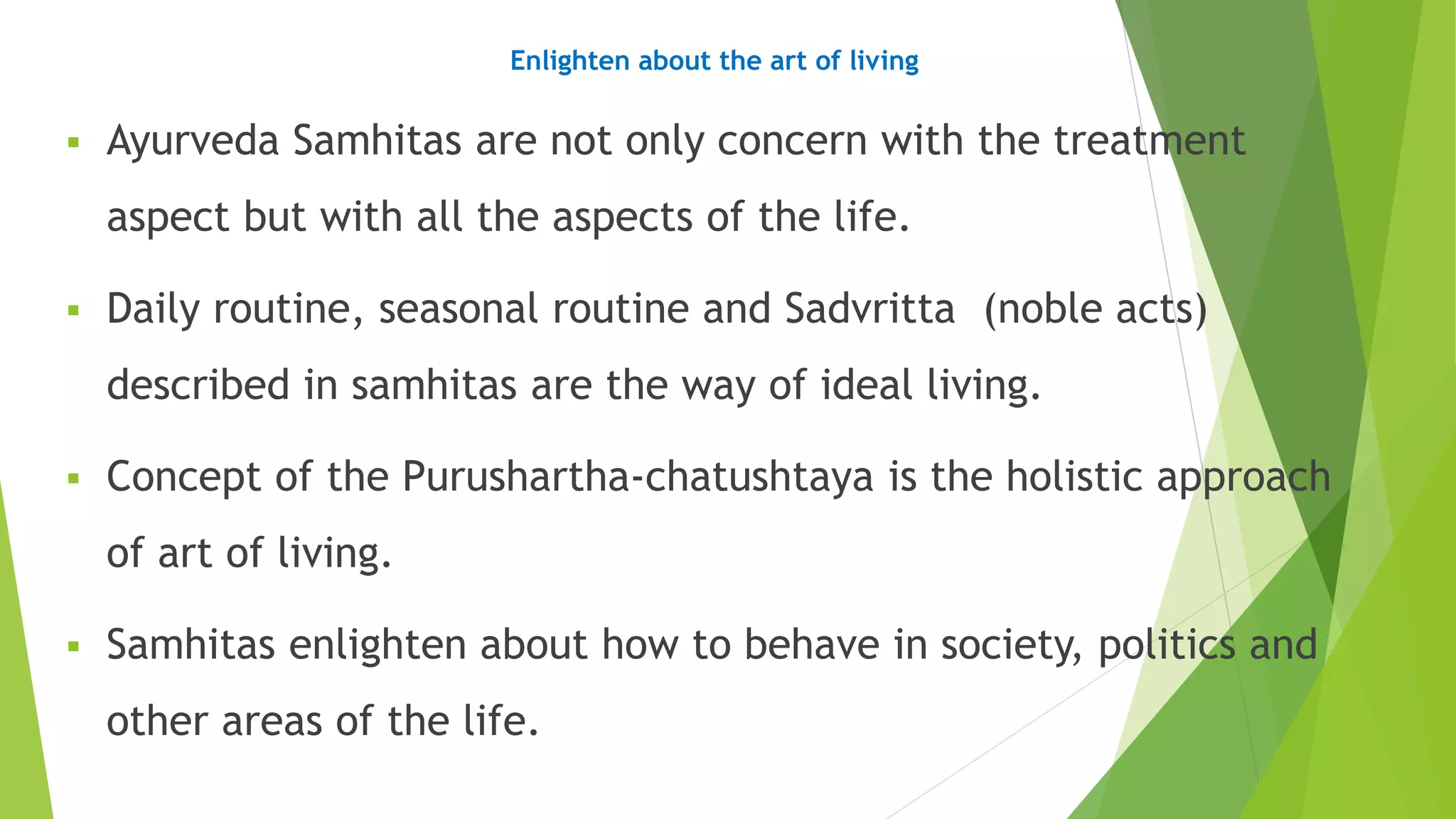
Enlighten about the art of living
 Ayurveda Samhitas are not only concern with the treatment
aspect but with all the aspects of the life.
 Daily routine, seasonal routine and Sadvritta (noble acts)
described in samhitas are the way of ideal living.
 Concept of the Purushartha-chatushtaya is the holistic approach
of art of living.
 Samhitas enlighten about how to behave in society, politics and
other areas of the life.
Learning and teaching methodology
 Charak Samhita Enlighten about the teaching methods such as-
To explain the content of the text
To interpret the text
To provide its gist
-Charak Samhita Sutrasthan-30/16
 Charak Samhita Enlighten about the learning methods also such as-
Arthagya (knower of the subject matter)
Vicharagya ( One who is acquainted with interpretations)
Chikitsa-kushal (efficient in clinical practice)
-Charak Samhita Siddhisthan-12/
 View of the Acharya Sushruta regarding the teaching methods is
as follows-
Teacher should instruct the every word
Teacher should instruct the part of a verse
Teacher should instruct the full verse
As per ability of the disciples
Make them repeat every word, part of the verse and complete
verse
Chanting should not be very fast, not very slow
-Sushrut Samhita Sutrasthan-3/54
Guideline for writing the text
 Ayurveda Samhitas provide guidelines for writing the text also
such as-
Anubandha Chatushtaya- Abhidheya,prayojan,sambandha and adhikari
Panchavayava vakya- Pratigya, hetu Drishtanta, upanaya ,Nigamana
Characteristic features of ideal text –Charaka Samhita Vimansthan-8
Absence of Nigraha sthan
Absence of Vakya-dosha/Tantradosha
Application of kalpana,arthashraya,tantrayukti etc.
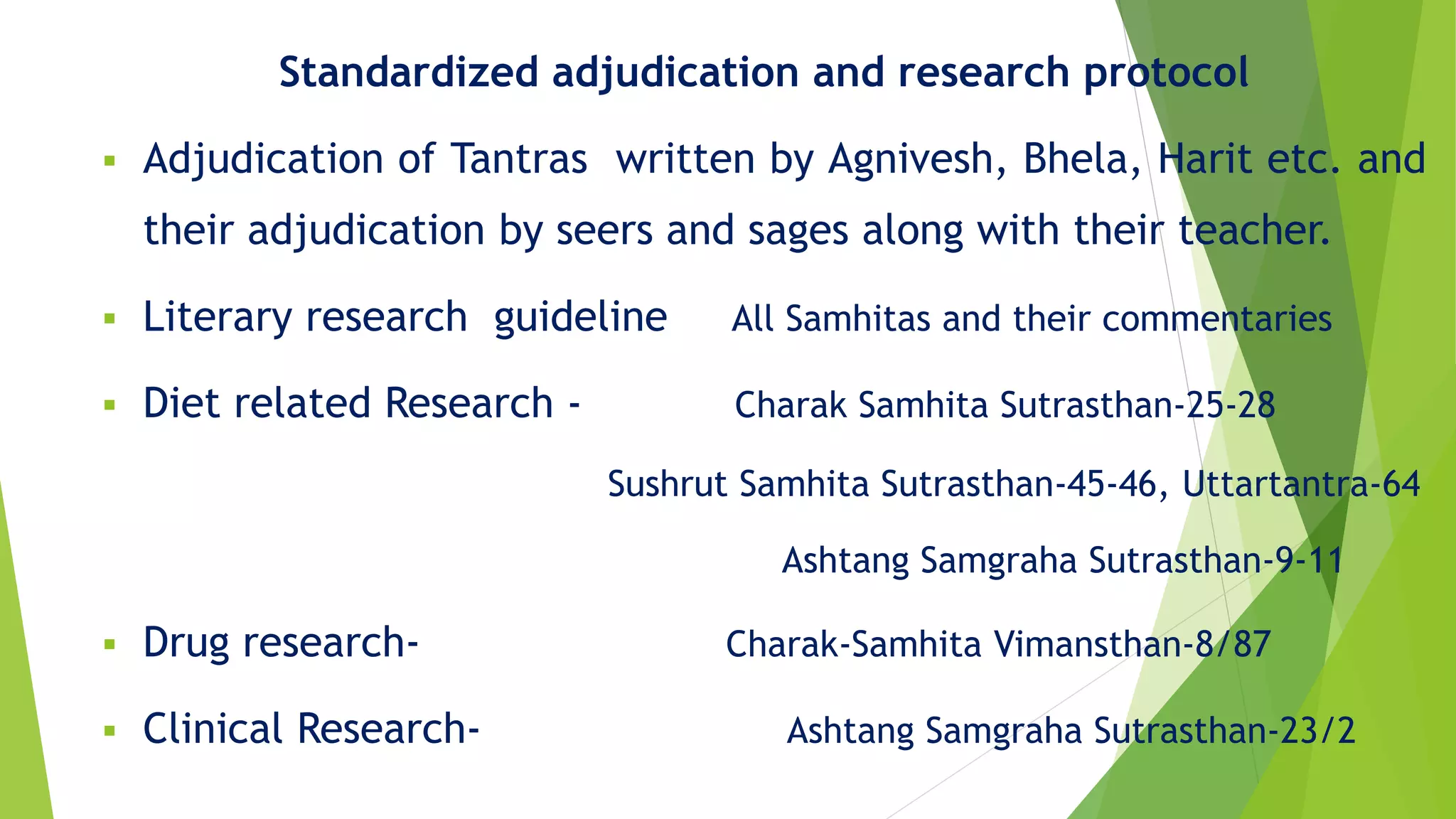
Standardized adjudication and research protocol
 Adjudication of Tantras written by Agnivesh, Bhela, Harit etc. and
their adjudication by seers and sages along with their teacher.
 Literary research guideline All Samhitas and their commentaries
 Diet related Research - Charak Samhita Sutrasthan-25-28
Sushrut Samhita Sutrasthan-45-46, Uttartantra-64
Ashtang Samgraha Sutrasthan-9-11
 Drug research- Charak-Samhita Vimansthan-8/87
 Clinical Research- Ashtang Samgraha Sutrasthan-23/2
Discussion
Is there any need of change in Samhitas ?
 Yes
1. Need to make rational modifications
2. Sufficient possibilities of additions
3 Needs more explanations
4. Attitude of Samhita based researches
5. Teaching of Samhitas in IPD & OPD
Conclusion
 Samhitas are endowed with auto-update system inbuilt.
 Samhitas advocate mainly about two significant aspects i.e. the
fundamental principles and practical applications.
 In this regard, one thing is worth mentioning that fundamental principles
never get change.
 Practical applications in relation to the dose, duration, type of
preparations and mode of use may be changed in different time periods.
 It is the matter of research to find out the better way of applications.
 We have very good heritage of Ayurvedic knowledge in the form of
Ayurveda-Samhitas. It should be our prime preference to preserve, protect
and enrich the Ayurveda-Samhitas.
 Significance of literature quoted by a scholar is worth mentioning in this
context-
“The decline of literature indicates the decline of a nation”.
-Johann Wolfgang von Goethe
Thanks

Salient features of Ayurveda Samhitas

  • 1.
    Dr. Murlidhar Paliwal Associateprofessor and Head, Department of Samhita and Sanskrit Institute of Medical Sciences, Banaras Hindu University, Varanasi Salient Features of Ayurveda Samhitas
  • 2.
    Contents  Introduction  Meaningof the term ‘Samhita’  Ashtanga Ayurveda in Samhitas  Salient features of Samhitas  Discussion  Conclusion
  • 3.
    Introduction  Ayurveda, thesystem of medicine and more over the science of life, is eternal.  Ayurveda, shakha, vidya, sutra, gyana, shastra, lakshana and tantra are the synonyms1.  It is the Upaveda of Atharvaveda and Punyatama-Veda as quoted by Acharya Charak. _________ 1. तत्रायुर्वेदः शाखा वर्वद्या सूत्रं ज्ञानं शास्त्त्रं लक्षणं तन्त्त्रमित्यनर्ाान्त्त॥ि -च॥कसंहिता सूत्रस्त्र्ान-30/31
  • 4.
     Ayurveda isPancham-Veda as per Acharya Kashyapa.  The glory of Ayurveda is because of the rich and authentic knowledge.  The source of rich and authentic knowledge is none other than Ayurveda-Samhitas.
  • 5.
     Two setsof Samhitas (classical text) are popular in Ayurveda - -Brihattrayi (Greater Trio)- Charaka-Samhita Sushruta-Samhita Samhitas of Vagbhata -Laghutrayi (Lesser Trio)- Madhava-Nidan Sharngadhara-Samhita Bhavaprakasha
  • 6.
    Meaning of theterm ‘Samhita’  संहिता - सि+ धा+क्त, हि आदेशः = संहित संहित+ टाप= संहिता1  प॥ः सन्न्त्नकर्ाः संहिता । र्वणाानािततशतयतः सन्न्त्नधधः संहितासंज्ञः स्त्यात2 Meaning-  Union, collection, compilation, systematically arranged verse or prose, compilation of laws, rules of any subject, hymns of Vedas following particular sequence, in grammar- Sandhi, Paramatma.  According to Acharya P.V. Sharma “Samhita includes all the specialties of the subject” i.e. Ashtanga Ayurveda. _______ 1-2. संस्त्कृ त-हिन्त्दी शब्दकोश- र्वा.मश. आप्टे, पृष्ठ सं.-1053
  • 7.
    Ashtanga Ayurveda inSamhitas Ashtanga Ayurveda means eight clinical specialties of Ayurveda. These are as follows 1- 1. Shalya-Tantra (Surgery) 2. Shalakya-Tantra ( ENT & Ophthalmology) 3. Kayachikitsa (Internal medicine) 4.Bhutavidya (Demonology) 5. Kaumarbhritya (Pediatrics) 6.Agadtantra (Toxicology) 7. Rasayan-Tantra (Rejuvenation) 8. Vajikarana-Tantra (Virilification) All the major Samhitas includes the subject matter of Ashtanga-Ayurveda. __________ 1. तद्यर्ा- शल्यं शालाक्यं, कायधचककत्सा,भूतवर्वद्या,कौिा॥भृत्यं, अगदतन्त्त्रं, ॥सायनतन्त्त्रं, र्वाजीक॥णतन्त्त्रमितत -सुश्रुतसंहिता सूत्रस्त्र्ान-1/7
  • 8.
    Charak Samhita andAshtanga Ayurveda Serial No. Name of the specialties References S. No. Name of the Specialty References 1. Kayachikitsa In all the Sthanas (sections) of Charak- Samhita 2. Kaumarbhritya C.Sh.-8th chapter 3. Shalakya/urdhwanga chikitsa C.Chi-26th chapter 4. Shalya-chikitsa C.Chi-25th chapter 5. Vish-chikitsa/Agadatantra C. Chi-23rd chapter 6. Bhutavidya C.Ni.-7th & 8th chapter, C. Chi.-9th & 10th 7. Rasayan C.Chi.-1st chapter 8. Vajikaran C. Chi.-2nd chapter
  • 9.
    Sushrut-Samhita and AshtangaAyurveda1 1. Sushrut-Samhita Sutrasthan-3/42-44 S. No. Name of the Specialty References 1. Kayachikitsa Sushruta Samhita Chikitsasthan-31st -40th chapter, Sushruta Uttartantra-39th -59th chapter 2. Kaumarbhrity a Sushruta Samhita Sharirsthan-10th chapter , Bhutavidya 3. Shalakya Sushruta Samhita Uttartantra-1st -26th chapters 4. Shalya- chikitsa Sushruta Samhita Sutrasthan to Chikitsasthan 5. Vish-chikitsa Sushruta Samhita -Kalpasthana 6. Bhutavidya Sushruta Samhita Uttartantra-27th -37th chapters 7. Rasayan Sushruta Samhita Chikitsasthan- -27,28,29 &30th chapters 8. Vajikaran Sushruta Samhita Chikitsasthan-26th chapter
  • 10.
    Ashtanga Ayurveda inAshtanga-Samgraha1 1. Ayurveda ka Vaigyanik Itihas- P. V. Sharma, page no.-182 S. N o. Name of the Specialty References 1. Kayachikitsa Ashtanga Samgraha Sutrasthan to Kalpasthan 2. Kaumarbhritya Ashtanga Samgraha Uttarsthan-1st -6th chapters 3. Graha-vidya (Bhutvidya) Balgraha-Ashtanga Samgraha Uttarsthan-3rd -6th chapters Bhutvidya-Ashtanga Samgraha Uttarsthan-7th -10th chapters 4. Shalakya Ashtanga Samgraha Uttarsthan-11th -28th chapters 5. Shalya-chikitsa Ashtanga Samgraha Uttarsthan-29th -39th chapters 6. Vish-chikitsa Ashtanga Samgraha Uttarsthan-40th -48th chapters 7. Rasayan Ashtanga Samgraha Uttarsthan-49th chapters 8. Vajikaran Ashtanga Samgraha Uttarsthan-50th chapter
  • 11.
    Salient Features ofSamhitas  Ayurveda-Samhita means compendia having systematically arranged text comprising of Ashtanga-Ayurveda.  These are endowed with peculiar characteristic features which are advocated for the ideal medical text1. Such as- (अ) सुििद्यशस्त्र्वीधी॥पुरुर्ासेवर्वति (which are followed by great, illustrious and wise physicians) (आ) अर्ाबिुलि (abundance of subject matter) (इ) आप्तजनपून्जति (respected by reputed personalities) ______________ 1. वर्ववर्वधातन हि शास्त्त्राणण मभर्जां ...........तदमभप्रपद्येत शास्त्त्रि -च॥कसंहिता वर्विानस्त्र्ान-8/3
  • 12.
    (ई) त्रत्रवर्वधमशष्यबुद्धधहिति (conducive tothe intellectual development of three types of disciples) (उ) अपगतपुनरुक्तदोर्ि (free from defects of repetition) (ऊ) आर्ाि (written by seers and sages) (ए) सुप्रणीतसूत्रभाष्यसंग्रिक्रिि (well placed aphorism together with commentaries in proper sequence)
  • 13.
    (ओ) स्त्र्वाधा॥ि (elegant ideasto convey) (औ) अनर्वपतततशब्दिकष्टशब्दि (which are free from vulgar and difficult words) (क) पुष्कलामभधानि (which have clear and unambiguous subject matter) (ख) क्रिागतार्ाि (which convey subject matter in proper order) (ग) अर्ातत्त्र्ववर्वतनश्चयप्रधानि (which have determination of real objects)
  • 14.
    (घ) संगतार्ािसंकु लप्रक॥णि (whichare relevant and free from confusion related to context) (ङ) आशुप्रबोधकि (Which convey ideas quickly) (च) लक्षणर्वच्च (Which are equipped with definitions) (छ) उदाि॥णर्वच्च (Which are equipped with examples)
  • 15.
    Along with allthese features , Ayurveda Samhitas possess the following salient features also- Specific style of dialogue and interpretations  Description of Ashtanga-Ayurveda  Ideal guru-shishya interaction- as we see in Charak Samhita  Organization of different seminars and symposia  Placement of the views of other scholars and their logical acceptance or rejection
  • 16.
     Description ofthe text following the “samas-vyas shaili’ i.e. Pattern of brief and detail description.  Unique pattern of proposition of the chapter, discussion, summary and colophon.  Close interrelationship of the subject matter of the one chapter with another and one section with another section.  Absence of doubts and ambiguity
  • 17.
    Scientific way ofdiscussions  Each and every topic is described rationally following the cause and effect theory.  Every statement in Samhitas is followed by valid logics.  Due respect is given to the view of different scholars  Abundance of questioning and Friendly discussions (Sandhaya-Sambhasha)- a scientific temperament  Abundance of experiments, observations and examination
  • 18.
    Valid fundamental doctrines Ayurveda Samhitas advocate the fundamental doctrines which are time tested and valid through the ages. Theses are as follows- Triguna siddhanta Panchamahabhuta siddhanta Tridosha siddhanta Dosha,dhatu and mala siddhanta
  • 19.
    Agni, koshtha andprakriti siddhanta Loka-purusha samya siddhanta Shatpadartha-siddhanta Vyadhi siddhanta Dwividh-upakrama siddhanta Shadupakrama-siddhanta
  • 20.
    Broader aspect &Unique approach  Ayurveda Samhitas possess broader view in all the aspects such as- Concept of Ayu- Chaturvidha Ayu Concept of Health- Multidimensional health Concept of disease- Doshaja as well as Karmaja diseases Concept of treatment- rational as well as divine therapy Laukiki-chikitsa as well as naishthiki- chiktsa Concept of this life and life beyond
  • 21.
    Base or foundationof the Ayurveda  Samhitas are the initial written documents of the Ayurveda.  These are considered significant similar to root of the plant, means Ayurveda chikitsa is developed and flourished on the base of Samhitas such as- Charak-Samhita deals with Ashtanga Ayurveda mainly for Kayachikitsa Sushrut-Samhita deals with Ashtanga Ayurveda mainly for Shalya-Tantra Kashyapa-Samhita deals with Ashtanga Ayurveda mainly for Kaumarbhritya Nimi-tantra mainly for shalakya Tantra
  • 22.
    Inculcate the idea-“सर्वपारिषदमिदं शास्त्रि्”  Ayurveda Samhitas includes the useful subject matter of different disciplines which makes samhitas a “सर्वपारिषदमिदं शास्त्रि ्”.  It is the symbol of the observance of Vidya-kalpana in Samhitas which makes any text complete and beneficial.  Samhitas are endowed with the subject matter of Veda, Upanishad, Puranas, Smriti granthas, Philosophy, Astrology, vyakarana and many other texts along with chikitsa
  • 23.
    Nature based approach Consideration of nature of the human , diet and medicines is observed.  Natural entities such as the sunrays, air, water, milk and different natural objects are advised in the treatment.  Body resist to many diseases is well versed in samhitas by mention of Vyadhikshamatva  Swabhavavad and Swabhavoparamavad can be considered under the nature based approach.
  • 24.
    Proper emphasis onindividualized medicine  Charak-Samhita declares very firmly that only that medicine can be the best one which is considered individually.  Prakriti based chikitsa in Ayurveda is one of the examples of individualized medicine.  Individualized medicine is discussed considering the dosha, Bheshaj, body strength, season, sharir, vaya, satmya etc.  Quantity of diet and exercise has not been fixed by Ayurvedists which shows the individualized approach .
  • 25.
    Rationality in allthe context  Ayurveda Samhitas are endowed with rationality in all the context  Different rules of diet and life style for healthy and diseased persons shows the rationality.  Treatment is advised according to stage of the disease. Indication and contra indication changes even in same disease according to stage of disease.  General and exceptional instructions available in samhitas show the rationality.
  • 26.
    Enlighten about theart of living  Ayurveda Samhitas are not only concern with the treatment aspect but with all the aspects of the life.  Daily routine, seasonal routine and Sadvritta (noble acts) described in samhitas are the way of ideal living.  Concept of the Purushartha-chatushtaya is the holistic approach of art of living.  Samhitas enlighten about how to behave in society, politics and other areas of the life.
  • 27.
    Learning and teachingmethodology  Charak Samhita Enlighten about the teaching methods such as- To explain the content of the text To interpret the text To provide its gist -Charak Samhita Sutrasthan-30/16  Charak Samhita Enlighten about the learning methods also such as- Arthagya (knower of the subject matter) Vicharagya ( One who is acquainted with interpretations) Chikitsa-kushal (efficient in clinical practice) -Charak Samhita Siddhisthan-12/
  • 28.
     View ofthe Acharya Sushruta regarding the teaching methods is as follows- Teacher should instruct the every word Teacher should instruct the part of a verse Teacher should instruct the full verse As per ability of the disciples Make them repeat every word, part of the verse and complete verse Chanting should not be very fast, not very slow -Sushrut Samhita Sutrasthan-3/54
  • 29.
    Guideline for writingthe text  Ayurveda Samhitas provide guidelines for writing the text also such as- Anubandha Chatushtaya- Abhidheya,prayojan,sambandha and adhikari Panchavayava vakya- Pratigya, hetu Drishtanta, upanaya ,Nigamana Characteristic features of ideal text –Charaka Samhita Vimansthan-8 Absence of Nigraha sthan Absence of Vakya-dosha/Tantradosha Application of kalpana,arthashraya,tantrayukti etc.
  • 30.
    Standardized adjudication andresearch protocol  Adjudication of Tantras written by Agnivesh, Bhela, Harit etc. and their adjudication by seers and sages along with their teacher.  Literary research guideline All Samhitas and their commentaries  Diet related Research - Charak Samhita Sutrasthan-25-28 Sushrut Samhita Sutrasthan-45-46, Uttartantra-64 Ashtang Samgraha Sutrasthan-9-11  Drug research- Charak-Samhita Vimansthan-8/87  Clinical Research- Ashtang Samgraha Sutrasthan-23/2
  • 31.
    Discussion Is there anyneed of change in Samhitas ?  Yes 1. Need to make rational modifications 2. Sufficient possibilities of additions 3 Needs more explanations 4. Attitude of Samhita based researches 5. Teaching of Samhitas in IPD & OPD
  • 32.
    Conclusion  Samhitas areendowed with auto-update system inbuilt.  Samhitas advocate mainly about two significant aspects i.e. the fundamental principles and practical applications.  In this regard, one thing is worth mentioning that fundamental principles never get change.  Practical applications in relation to the dose, duration, type of preparations and mode of use may be changed in different time periods.
  • 33.
     It isthe matter of research to find out the better way of applications.  We have very good heritage of Ayurvedic knowledge in the form of Ayurveda-Samhitas. It should be our prime preference to preserve, protect and enrich the Ayurveda-Samhitas.  Significance of literature quoted by a scholar is worth mentioning in this context- “The decline of literature indicates the decline of a nation”. -Johann Wolfgang von Goethe
  • 34.