offered by
Centre for IKS (under the aegis of NEP Committee)
Vasanta College for Women
INTRODUCTION TO INDIAN
KNOWLEDGE SYSTEMS
Add-on Course
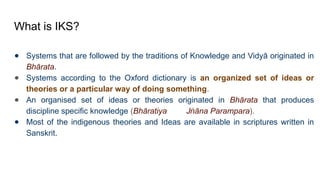
What is IKS?
● Systems that are followed by the traditions of Knowledge and Vidyā originated in
Bhārata.
● Systems according to the Oxford dictionary is an organized set of ideas or
theories or a particular way of doing something.
● An organised set of ideas or theories originated in Bhārata that produces
discipline specific knowledge (Bhāratiya J āna Parampara
ṅ ).
● Most of the indigenous theories and Ideas are available in scriptures written in
Sanskrit.
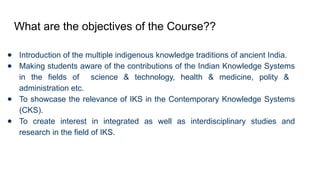
What are the objectives of the Course??
● Introduction of the multiple indigenous knowledge traditions of ancient India.
● Making students aware of the contributions of the Indian Knowledge Systems
in the fields of science & technology, health & medicine, polity &
administration etc.
● To showcase the relevance of IKS in the Contemporary Knowledge Systems
(CKS).
● To create interest in integrated as well as interdisciplinary studies and
research in the field of IKS.
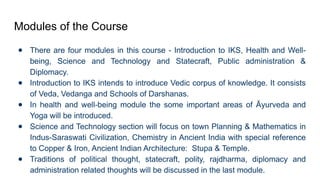
Modules of the Course
● There are four modules in this course - Introduction to IKS, Health and Well-
being, Science and Technology and Statecraft, Public administration &
Diplomacy.
● Introduction to IKS intends to introduce Vedic corpus of knowledge. It consists
of Veda, Vedanga and Schools of Darshanas.
● In health and well-being module the some important areas of Āyurveda and
Yoga will be introduced.
● Science and Technology section will focus on town Planning & Mathematics in
Indus-Saraswati Civilization, Chemistry in Ancient India with special reference
to Copper & Iron, Ancient Indian Architecture: Stupa & Temple.
● Traditions of political thought, statecraft, polity, rajdharma, diplomacy and
administration related thoughts will be discussed in the last module.
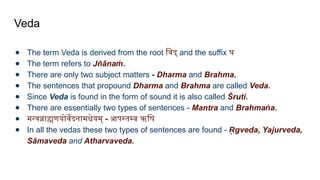
Veda
● The term Veda is derived from the root विद् and the suffix घ
● The term refers to Jñānaṁ.
● There are only two subject matters - Dharma and Brahma.
● The sentences that propound Dharma and Brahma are called Veda.
● Since Veda is found in the form of sound it is also called Śruti.
● There are essentially two types of sentences - Mantra and Brahma a
ṅ .
● मन्त्रब्राह्मणयोर्वेदनामधेयम् - आपस्तम्ब ऋषि
● In all the vedas these two types of sentences are found - gveda, Yajurveda,
R
̥
Sāmaveda and Atharvaveda.
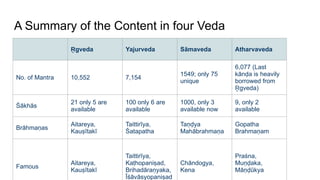
A Summary of the Content in four Veda
gveda
R
̥ Yajurveda Sāmaveda Atharvaveda
No. of Mantra 10,552 7,154
1549; only 75
unique
6,077 (Last
kānḍa is heavily
borrowed from
gveda)
R
̥
Śākhās
21 only 5 are
available
100 only 6 are
available
1000, only 3
available now
9, only 2
available
Brāhmaṇas
Aitareya,
Kauṣītakī
Taittirīya,
Śatapatha
Taṇḍya
Mahābrahmaṇa
Gopatha
Brahmaṇam
Famous
Aitareya,
Kauṣītakī
Taittirīya,
Kaṭhopaniṣad,
Brihadāraṇyaka,
Īśāvāsyopaniṣad
Chāndogya,
Kena
Praśna,
Muṇḍaka,
Māṇḍūkya
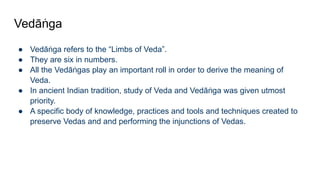
Vedā ga
ṅ
● Vedā ga refers to the “Limbs of Veda”.
ṅ
● They are six in numbers.
● All the Vedā gas play an important roll in order to derive the meaning of
ṅ
Veda.
● In ancient Indian tradition, study of Veda and Vedā ga was given utmost
ṅ
priority.
● A specific body of knowledge, practices and tools and techniques created to
preserve Vedas and and performing the injunctions of Vedas.
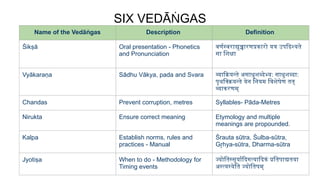
SIX VEDĀ GAS
Ṅ
Name of the Vedā gas
ṅ Description Definition
Śikṣā Oral presentation - Phonetics
and Pronunciation
वर्णस्वराद्युच्चारणप्रकारो यत्र उपदिश्यते
सा शिक्षा
Vyākaraṇa Sādhu Vākya, pada and Svara व्याक्रियन्ते असाधुशब्देभ्य: साधुशब्दा:
पृथक्क्रियन्ते येन नियम विशेषेण तत्
व्याकरणम्
Chandas Prevent corruption, metres Syllables- Pāda-Metres
Nirukta Ensure correct meaning Etymology and multiple
meanings are propounded.
Kalpa Establish norms, rules and
practices - Manual
Śrauta sūtra, Śulba-sūtra,
G hya-sūtra, Dharma-sūtra
r
̥
Jyotiṣa When to do - Methodology for
Timing events
ज्योतिस्सूर्यादिगत्यादिकं प्रतिपाद्यतया
अस्त्यस्येति ज्योतिषम्
ĀYURVEDA
● It is the upaveda of gveda/Atharveveda.
R
̥
● तदिदं शाश्वतं पुण्यं स्वर्ग्यं यशस्यमायुष्यं वृत्तिकरं चेति (सु.सं. 1/19)
The āyurveda is a medium which is eternal, virtuous, extremely pious and
leads to long life with simultaneously taking care of the livelihood (of the
practitioner).
● Etymologically, it is आयुषो वेदः which resembles as the śāṣtra elucidating the
concept of life (of an individual as well as the concept of life as a whole.).
● This āyu is of four types - हितायुः, अहितायुः, सुखायुः दुखायुश्च |
● प्रयोजनं चास्य (आयुर्वेदस्य) स्वस्थस्य, स्वास्थ्यस्य रक्षणम्, आतुरस्य विकारप्रशमनञ्च | (च। सू
३०/२६)
The āyurveda is meant to cater the concept of health, health of an
individual, diagnose the diseases and to wipe them off (completely).
ĀYURVEDA: Evolution and development
(आयुर्वेद की उत्पत्ति एवं विकास)
● The upadeśa (theory) of āyurveda is comprised through two ways - दैवीय:
लौकिकश्च |
● दैवीयः - Lord Brahmā - Dakśa Prajāpati - Aśvinīkumāra - Īndra
● लौकिकः - Bharadvāja - Ātreya - Agniveśa, Jatukarṇa, Parāśara, Hārīta and
Kśārapāṇi - Bhela. (तेनायुरमितं लेभे भरद्वाजः सुखान्वितम् च। सू १/१६)
● अग्निवेश संहिता (कायचिकित्साधारित चरक संहिता इसी का प्रतिसंस्कार)
● Suśruta sa hitā depicts a different version as - Dhanvantari classified the
ṁ
Brahma sa hitā (made by Lord Brahmā) into eight folds and made the
ṁ
āyurveda as aṣṭā ga āyurveda. (Śalya, Śālākya, Kāyacikitsā, Bhūtavidyā,
ṁ
Kaumārabh tya, Agada, Rasāyana and Vājīkaraṇa).
r
̥
AṢṬĀ GĀYURVEDA - Eight folds of āyurveda
Ṁ
● Śalya - This fold of āyurveda connects the surgical medication and is
quickest method to heal the wounds etc. (śalyatantrasamuccaya,
sauśrutī, śalyasamnvaya/pradīpikā)
● Śālākya - It includes the upper part of the body, specifically throat,
ear, eyes, nose etc. (śālākyatantra, sālākyavijñāna, netrarogavijñāna,
netracikitsā and śālākyaśāstra)
● Kāyacikitsā - It is the complete fold of āyurveda which deals about
the complete body. (carakarsa hitā, jatukarṇasa hitā,
ṁ ṁ
kśārapāṇisa hitā and bhelasa hitā)
ṁ ṁ
● Bhūtavidyā - It deals about the mental ailments. (carakarsa hitā,
ṁ
suśrutasa hitā, aṣṭā gah daya, mādhavanidāna and
ṁ ṁ r
̥
mānasarogavijñāna)
….AṢṬĀ GĀYURVEDA - Eight folds of āyurveda
Ṁ
● Kaumārabh tya
r
̥ - It is the paediatric fold of āyurveda and is
considered as the most pious amongst all the folds of āyurveda.
(Kāśyapasa hitā)
ṁ
● Agada - Bites of the animals, etc. are treated under this fold of
āyurveda. (carakarsa hitā, suśrutasa hitā, agadatantra, viṣacikitsā,
ṁ ṁ
vyavahārāyurveda, etc.)
● Rasāyana - It is related to rejuvenation and geriatrics.
(rasāyanatantra, rasāyana darśana)
● Vājīkaraṇa - The science of aphrodisiac and sexology has been
discussed here. (kucamāratantra, ana gara ga, carakarsa hitā,
ṅ ṅ ṁ
suśrutasa hitā, aṣṭā gah daya)
ṁ ṁ r
̥
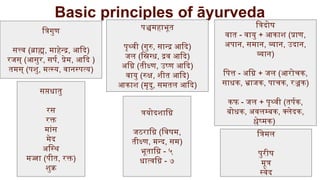
Basic principles of āyurveda
त्रिगुण
सत्त्व (ब्राह्म, माहेन्द्र, आदि)
रजस् (आसुर, सर्प, प्रेम, आदि )
तमस् (पशु, मत्स्य, वानस्पत्य)
पञ्चमहाभूत
पृथ्वी (गुरु, सान्द्र आदि)
जल (स्निग्ध, द्रव आदि)
अग्नि (तीक्ष्ण, उष्ण आदि)
वायु (रुक्ष, शीत आदि)
आकाश (मृदु, समतल आदि)
सप्तधातु
रस
रक्त
मांस
मेद
अस्थि
मज्जा (पीत, रक्त)
शुक्र
त्रयोदशाग्नि
जठराग्नि (विषम,
तीक्ष्ण, मन्द, सम)
भूताग्नि - ५
धात्वग्नि - ७
त्रिमल
पुरीष
मूत्र
स्वेद
त्रिदोष
वात - वायु + आकाश (प्राण,
अपान, समान, व्यान, उदान,
व्यान)
पित्त - अग्नि + जल (आरोचक,
साधक, भ्राजक, पाचक, रञ्जक)
कफ - जल + पृथ्वी (तर्पक,
बोधक, अवलम्बक, क्लेदक,
श्लेष्मक)
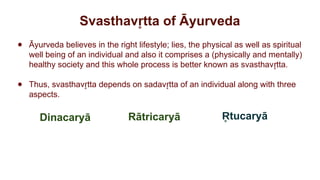
Svasthav tta of Āyurveda
r
̥
● Āyurveda believes in the right lifestyle; lies, the physical as well as spiritual
well being of an individual and also it comprises a (physically and mentally)
healthy society and this whole process is better known as svasthav tta.
r
̥
● Thus, svasthav tta depends on sadav tta of an individual along with three
r
̥ r
̥
aspects.
Dinacaryā tucaryā
R
̥
Rātricaryā

Introduction to the Indian Knowledge System

  • 1.
    offered by Centre forIKS (under the aegis of NEP Committee) Vasanta College for Women INTRODUCTION TO INDIAN KNOWLEDGE SYSTEMS Add-on Course
  • 2.
    What is IKS? ●Systems that are followed by the traditions of Knowledge and Vidyā originated in Bhārata. ● Systems according to the Oxford dictionary is an organized set of ideas or theories or a particular way of doing something. ● An organised set of ideas or theories originated in Bhārata that produces discipline specific knowledge (Bhāratiya J āna Parampara ṅ ). ● Most of the indigenous theories and Ideas are available in scriptures written in Sanskrit.
  • 3.
    What are theobjectives of the Course?? ● Introduction of the multiple indigenous knowledge traditions of ancient India. ● Making students aware of the contributions of the Indian Knowledge Systems in the fields of science & technology, health & medicine, polity & administration etc. ● To showcase the relevance of IKS in the Contemporary Knowledge Systems (CKS). ● To create interest in integrated as well as interdisciplinary studies and research in the field of IKS.
  • 4.
    Modules of theCourse ● There are four modules in this course - Introduction to IKS, Health and Well- being, Science and Technology and Statecraft, Public administration & Diplomacy. ● Introduction to IKS intends to introduce Vedic corpus of knowledge. It consists of Veda, Vedanga and Schools of Darshanas. ● In health and well-being module the some important areas of Āyurveda and Yoga will be introduced. ● Science and Technology section will focus on town Planning & Mathematics in Indus-Saraswati Civilization, Chemistry in Ancient India with special reference to Copper & Iron, Ancient Indian Architecture: Stupa & Temple. ● Traditions of political thought, statecraft, polity, rajdharma, diplomacy and administration related thoughts will be discussed in the last module.
  • 5.
    Veda ● The termVeda is derived from the root विद् and the suffix घ ● The term refers to Jñānaṁ. ● There are only two subject matters - Dharma and Brahma. ● The sentences that propound Dharma and Brahma are called Veda. ● Since Veda is found in the form of sound it is also called Śruti. ● There are essentially two types of sentences - Mantra and Brahma a ṅ . ● मन्त्रब्राह्मणयोर्वेदनामधेयम् - आपस्तम्ब ऋषि ● In all the vedas these two types of sentences are found - gveda, Yajurveda, R ̥ Sāmaveda and Atharvaveda.
  • 6.
    A Summary ofthe Content in four Veda gveda R ̥ Yajurveda Sāmaveda Atharvaveda No. of Mantra 10,552 7,154 1549; only 75 unique 6,077 (Last kānḍa is heavily borrowed from gveda) R ̥ Śākhās 21 only 5 are available 100 only 6 are available 1000, only 3 available now 9, only 2 available Brāhmaṇas Aitareya, Kauṣītakī Taittirīya, Śatapatha Taṇḍya Mahābrahmaṇa Gopatha Brahmaṇam Famous Aitareya, Kauṣītakī Taittirīya, Kaṭhopaniṣad, Brihadāraṇyaka, Īśāvāsyopaniṣad Chāndogya, Kena Praśna, Muṇḍaka, Māṇḍūkya
  • 7.
    Vedā ga ṅ ● Vedāga refers to the “Limbs of Veda”. ṅ ● They are six in numbers. ● All the Vedā gas play an important roll in order to derive the meaning of ṅ Veda. ● In ancient Indian tradition, study of Veda and Vedā ga was given utmost ṅ priority. ● A specific body of knowledge, practices and tools and techniques created to preserve Vedas and and performing the injunctions of Vedas.
  • 8.
    SIX VEDĀ GAS Ṅ Nameof the Vedā gas ṅ Description Definition Śikṣā Oral presentation - Phonetics and Pronunciation वर्णस्वराद्युच्चारणप्रकारो यत्र उपदिश्यते सा शिक्षा Vyākaraṇa Sādhu Vākya, pada and Svara व्याक्रियन्ते असाधुशब्देभ्य: साधुशब्दा: पृथक्क्रियन्ते येन नियम विशेषेण तत् व्याकरणम् Chandas Prevent corruption, metres Syllables- Pāda-Metres Nirukta Ensure correct meaning Etymology and multiple meanings are propounded. Kalpa Establish norms, rules and practices - Manual Śrauta sūtra, Śulba-sūtra, G hya-sūtra, Dharma-sūtra r ̥ Jyotiṣa When to do - Methodology for Timing events ज्योतिस्सूर्यादिगत्यादिकं प्रतिपाद्यतया अस्त्यस्येति ज्योतिषम्
  • 10.
    ĀYURVEDA ● It isthe upaveda of gveda/Atharveveda. R ̥ ● तदिदं शाश्वतं पुण्यं स्वर्ग्यं यशस्यमायुष्यं वृत्तिकरं चेति (सु.सं. 1/19) The āyurveda is a medium which is eternal, virtuous, extremely pious and leads to long life with simultaneously taking care of the livelihood (of the practitioner). ● Etymologically, it is आयुषो वेदः which resembles as the śāṣtra elucidating the concept of life (of an individual as well as the concept of life as a whole.). ● This āyu is of four types - हितायुः, अहितायुः, सुखायुः दुखायुश्च | ● प्रयोजनं चास्य (आयुर्वेदस्य) स्वस्थस्य, स्वास्थ्यस्य रक्षणम्, आतुरस्य विकारप्रशमनञ्च | (च। सू ३०/२६) The āyurveda is meant to cater the concept of health, health of an individual, diagnose the diseases and to wipe them off (completely).
  • 11.
    ĀYURVEDA: Evolution anddevelopment (आयुर्वेद की उत्पत्ति एवं विकास) ● The upadeśa (theory) of āyurveda is comprised through two ways - दैवीय: लौकिकश्च | ● दैवीयः - Lord Brahmā - Dakśa Prajāpati - Aśvinīkumāra - Īndra ● लौकिकः - Bharadvāja - Ātreya - Agniveśa, Jatukarṇa, Parāśara, Hārīta and Kśārapāṇi - Bhela. (तेनायुरमितं लेभे भरद्वाजः सुखान्वितम् च। सू १/१६) ● अग्निवेश संहिता (कायचिकित्साधारित चरक संहिता इसी का प्रतिसंस्कार) ● Suśruta sa hitā depicts a different version as - Dhanvantari classified the ṁ Brahma sa hitā (made by Lord Brahmā) into eight folds and made the ṁ āyurveda as aṣṭā ga āyurveda. (Śalya, Śālākya, Kāyacikitsā, Bhūtavidyā, ṁ Kaumārabh tya, Agada, Rasāyana and Vājīkaraṇa). r ̥
  • 12.
    AṢṬĀ GĀYURVEDA -Eight folds of āyurveda Ṁ ● Śalya - This fold of āyurveda connects the surgical medication and is quickest method to heal the wounds etc. (śalyatantrasamuccaya, sauśrutī, śalyasamnvaya/pradīpikā) ● Śālākya - It includes the upper part of the body, specifically throat, ear, eyes, nose etc. (śālākyatantra, sālākyavijñāna, netrarogavijñāna, netracikitsā and śālākyaśāstra) ● Kāyacikitsā - It is the complete fold of āyurveda which deals about the complete body. (carakarsa hitā, jatukarṇasa hitā, ṁ ṁ kśārapāṇisa hitā and bhelasa hitā) ṁ ṁ ● Bhūtavidyā - It deals about the mental ailments. (carakarsa hitā, ṁ suśrutasa hitā, aṣṭā gah daya, mādhavanidāna and ṁ ṁ r ̥ mānasarogavijñāna)
  • 13.
    ….AṢṬĀ GĀYURVEDA -Eight folds of āyurveda Ṁ ● Kaumārabh tya r ̥ - It is the paediatric fold of āyurveda and is considered as the most pious amongst all the folds of āyurveda. (Kāśyapasa hitā) ṁ ● Agada - Bites of the animals, etc. are treated under this fold of āyurveda. (carakarsa hitā, suśrutasa hitā, agadatantra, viṣacikitsā, ṁ ṁ vyavahārāyurveda, etc.) ● Rasāyana - It is related to rejuvenation and geriatrics. (rasāyanatantra, rasāyana darśana) ● Vājīkaraṇa - The science of aphrodisiac and sexology has been discussed here. (kucamāratantra, ana gara ga, carakarsa hitā, ṅ ṅ ṁ suśrutasa hitā, aṣṭā gah daya) ṁ ṁ r ̥
  • 14.
    Basic principles ofāyurveda त्रिगुण सत्त्व (ब्राह्म, माहेन्द्र, आदि) रजस् (आसुर, सर्प, प्रेम, आदि ) तमस् (पशु, मत्स्य, वानस्पत्य) पञ्चमहाभूत पृथ्वी (गुरु, सान्द्र आदि) जल (स्निग्ध, द्रव आदि) अग्नि (तीक्ष्ण, उष्ण आदि) वायु (रुक्ष, शीत आदि) आकाश (मृदु, समतल आदि) सप्तधातु रस रक्त मांस मेद अस्थि मज्जा (पीत, रक्त) शुक्र त्रयोदशाग्नि जठराग्नि (विषम, तीक्ष्ण, मन्द, सम) भूताग्नि - ५ धात्वग्नि - ७ त्रिमल पुरीष मूत्र स्वेद त्रिदोष वात - वायु + आकाश (प्राण, अपान, समान, व्यान, उदान, व्यान) पित्त - अग्नि + जल (आरोचक, साधक, भ्राजक, पाचक, रञ्जक) कफ - जल + पृथ्वी (तर्पक, बोधक, अवलम्बक, क्लेदक, श्लेष्मक)
  • 15.
    Svasthav tta ofĀyurveda r ̥ ● Āyurveda believes in the right lifestyle; lies, the physical as well as spiritual well being of an individual and also it comprises a (physically and mentally) healthy society and this whole process is better known as svasthav tta. r ̥ ● Thus, svasthav tta depends on sadav tta of an individual along with three r ̥ r ̥ aspects. Dinacaryā tucaryā R ̥ Rātricaryā