Concept of Agni
Dr. Aniket A. Shilwant
Assistant Professor
Sharir Kriya Dept.
GJPIASR, CVM University
Anand, Gujarat
Mail Id. ayuraniket18@gmail.com
Table of Contents
Concept of Agni – Etymology
Synonyms of Agni
Definition of Agni
Types of Agni
 Jatharagni
 Panchbhautikagni
 Dhatwagni
Subtypes of Jatharagni
 Vishamagni
 Tikshnagni
 Mandagni
 Samagni
Location of Agni
Functions of Agni
Relations of Agni
Importance of Agni
Dr. Aniket A. Shilwant, GJPIASR
2
Dr. Aniket A. Shilwant, GJPIASR
3
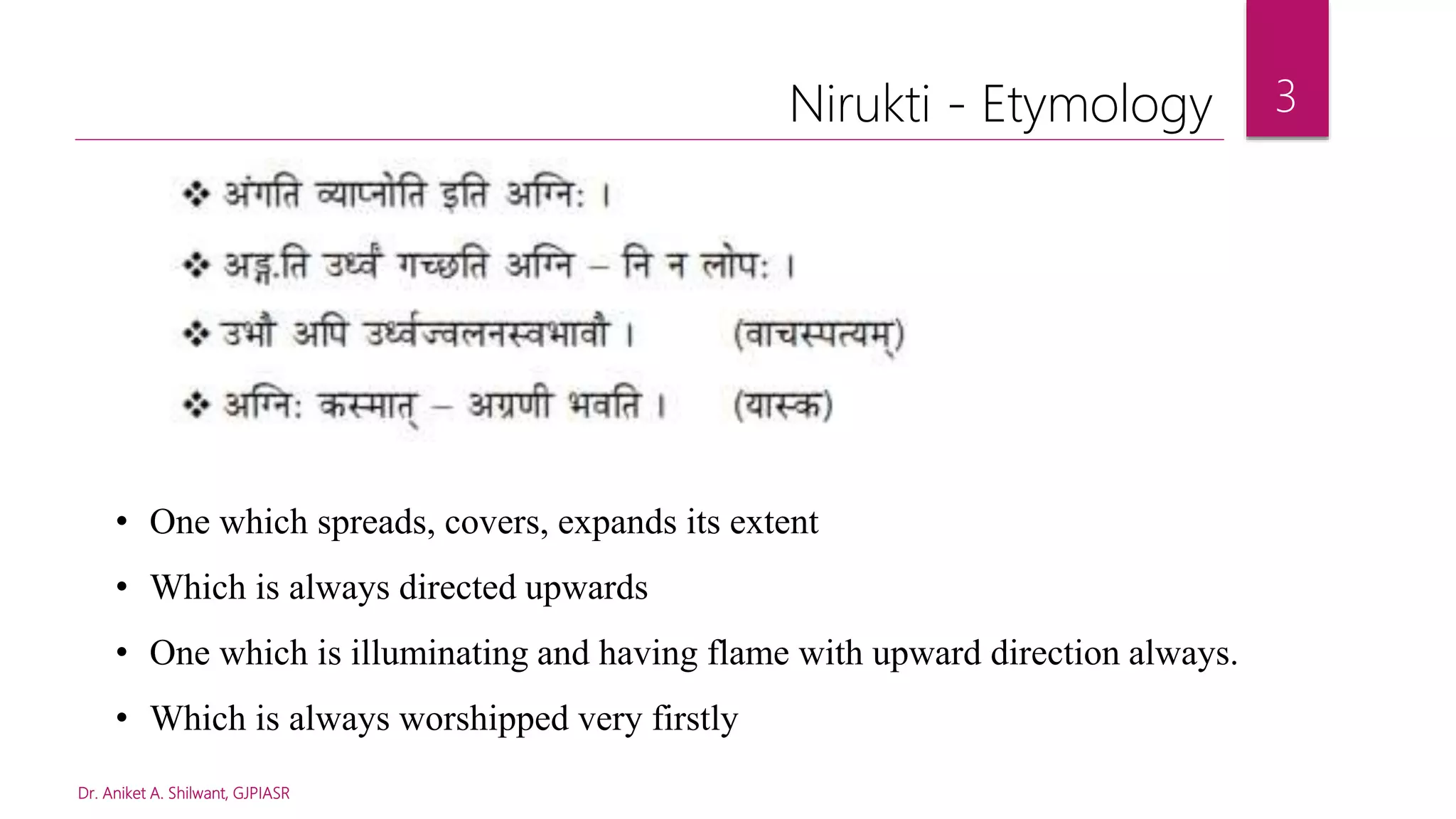
Nirukti - Etymology
• One which spreads, covers, expands its extent
• Which is always directed upwards
• One which is illuminating and having flame with upward direction always.
• Which is always worshipped very firstly
Dr. Aniket A. Shilwant, GJPIASR
4
Synonyms
Dr. Aniket A. Shilwant, GJPIASR
5
Vyakhya – Definition
The heat produced by the metabolic activity occurring due to combined mutual
interactions between –
 Dosha – the physiological entity
 Dhatu – the static and dynamic platform in form of formed elements (tissues)
 Mala – the resultant metabolic waste produced thereafter
Dr. Aniket A. Shilwant, GJPIASR
6
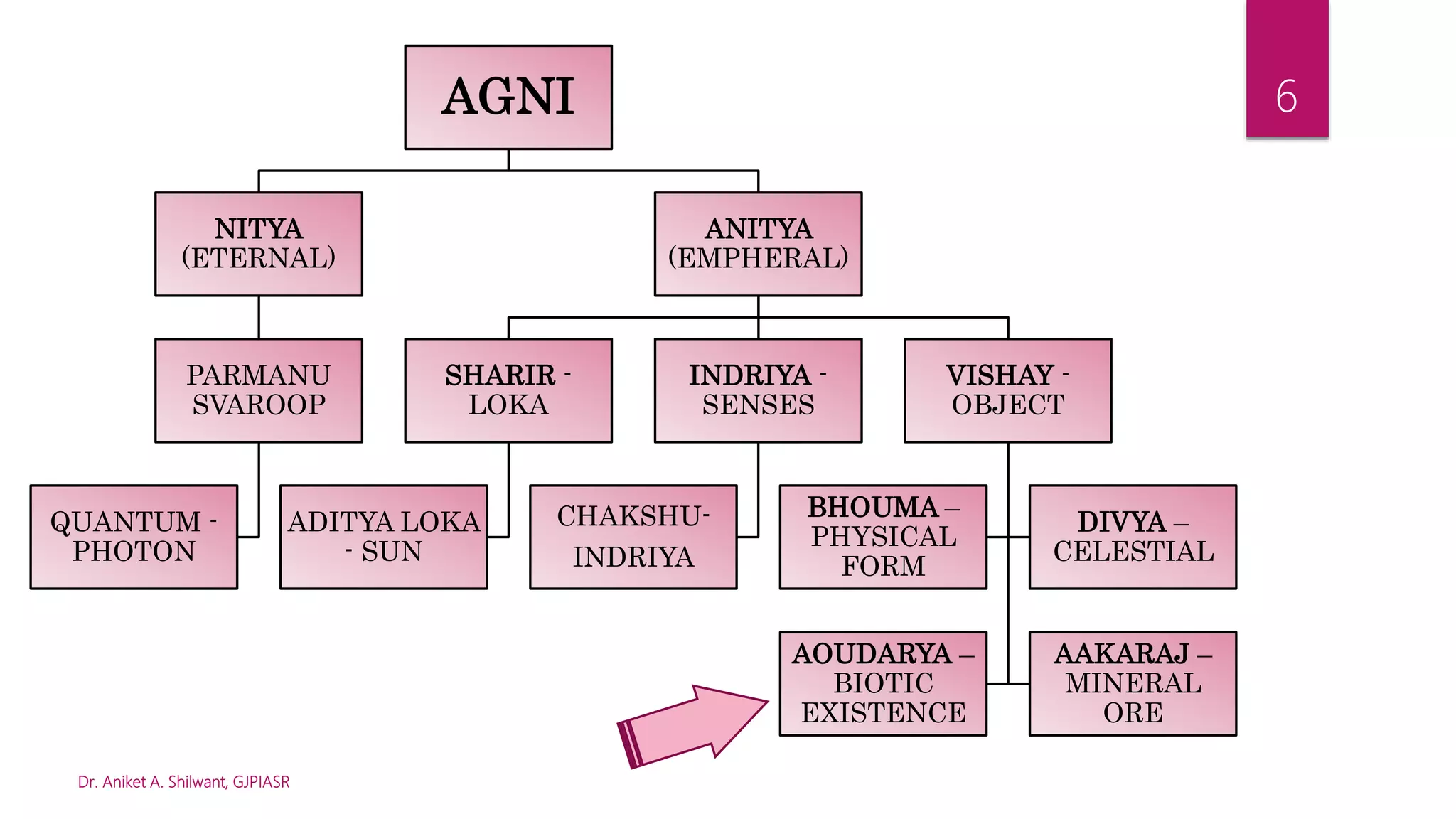
AGNI
NITYA
(ETERNAL)
PARMANU
SVAROOP
QUANTUM -
PHOTON
ANITYA
(EMPHERAL)
SHARIR -
LOKA
ADITYA LOKA
- SUN
INDRIYA -
SENSES
CHAKSHU-
INDRIYA
VISHAY -
OBJECT
BHOUMA –
PHYSICAL
FORM
DIVYA –
CELESTIAL
AOUDARYA –
BIOTIC
EXISTENCE
AAKARAJ –
MINERAL
ORE
Dr. Aniket A. Shilwant, GJPIASR
7
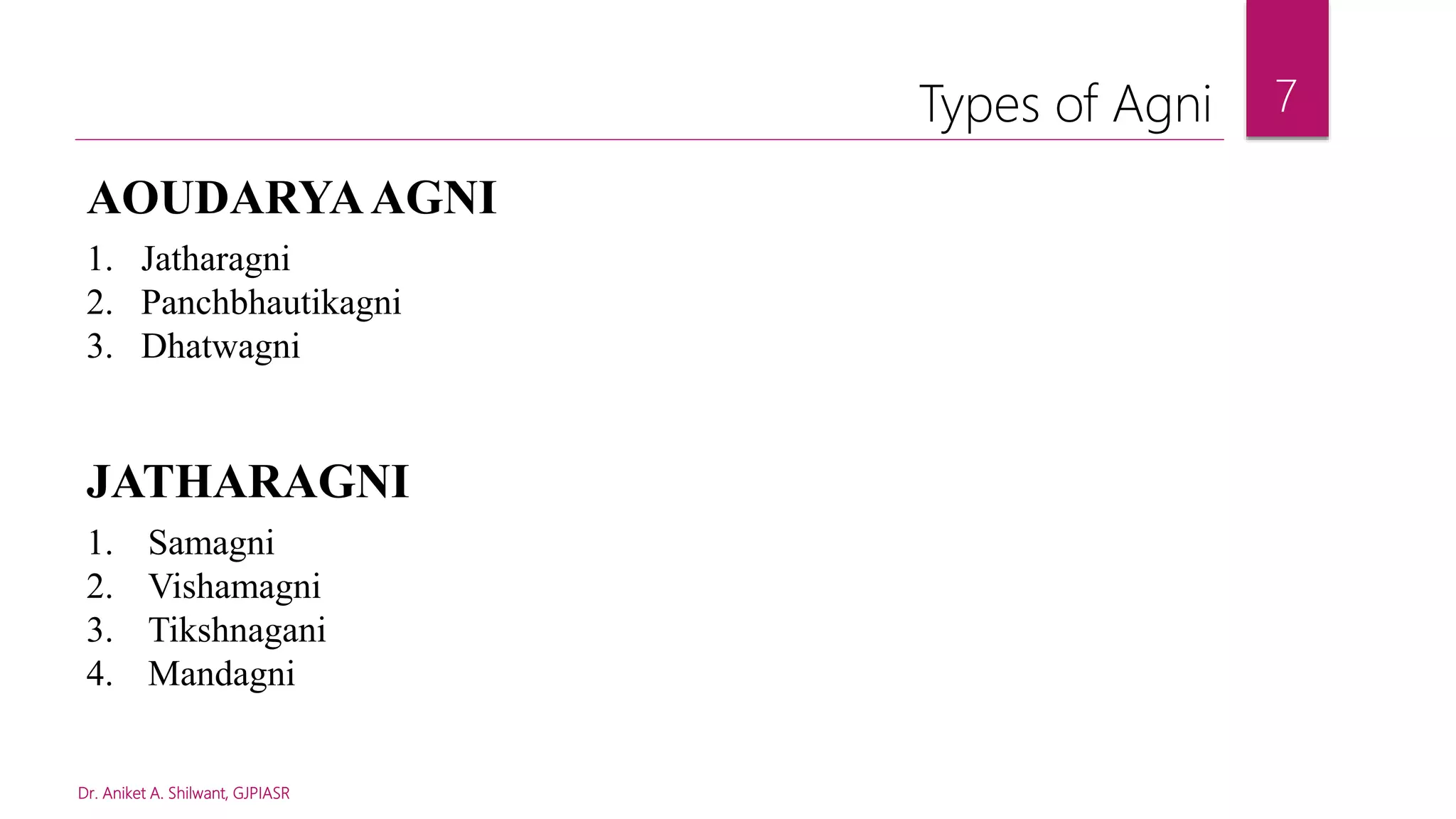
Types of Agni
AOUDARYAAGNI
1. Jatharagni
2. Panchbhautikagni
3. Dhatwagni
JATHARAGNI
1. Samagni
2. Vishamagni
3. Tikshnagani
4. Mandagni
Dr. Aniket A. Shilwant, GJPIASR
8
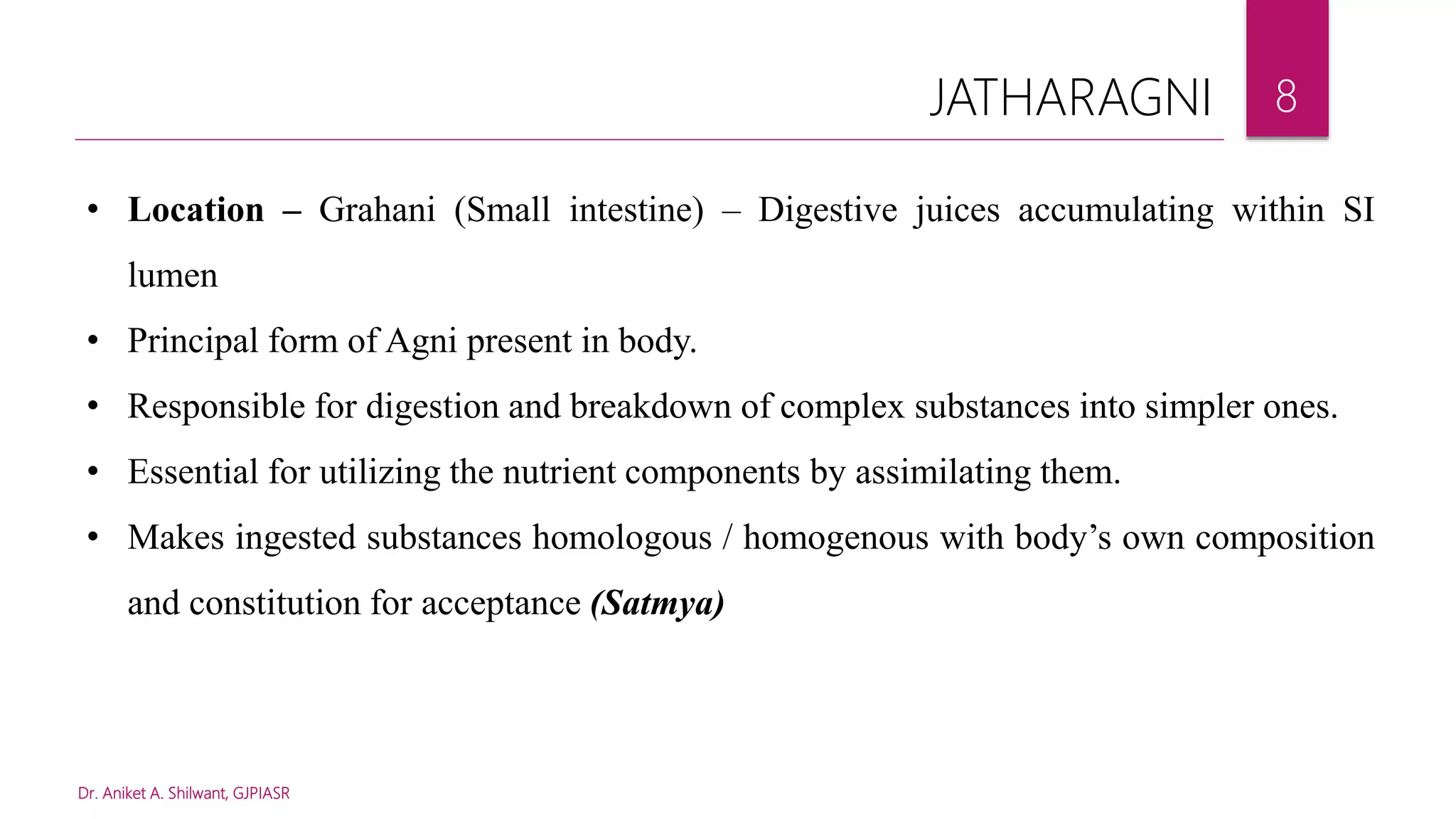
• Location – Grahani (Small intestine) – Digestive juices accumulating within SI
lumen
• Principal form of Agni present in body.
• Responsible for digestion and breakdown of complex substances into simpler ones.
• Essential for utilizing the nutrient components by assimilating them.
• Makes ingested substances homologous / homogenous with body’s own composition
and constitution for acceptance (Satmya)
JATHARAGNI
Dr. Aniket A. Shilwant, GJPIASR
9
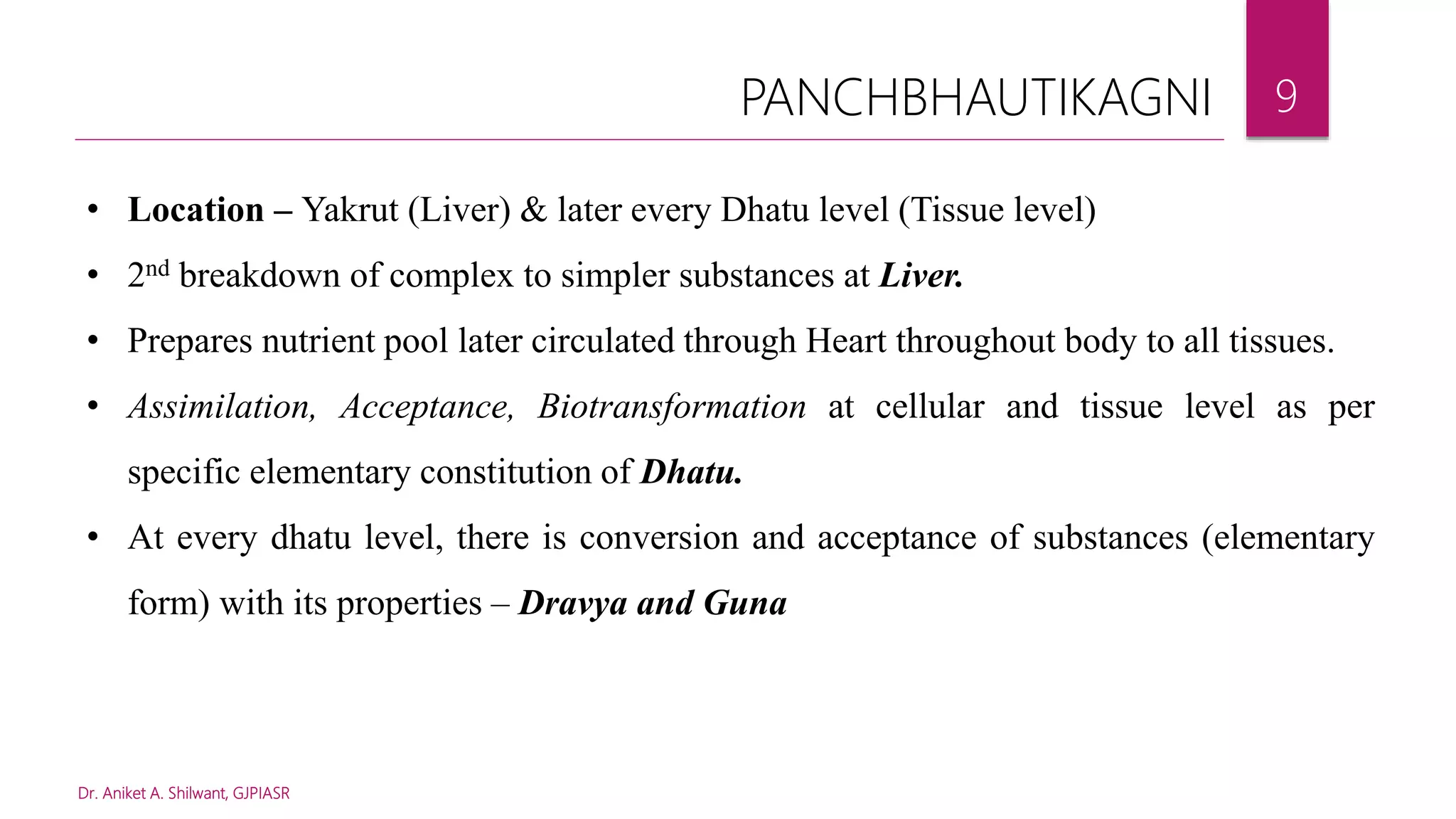
• Location – Yakrut (Liver) & later every Dhatu level (Tissue level)
• 2nd breakdown of complex to simpler substances at Liver.
• Prepares nutrient pool later circulated through Heart throughout body to all tissues.
• Assimilation, Acceptance, Biotransformation at cellular and tissue level as per
specific elementary constitution of Dhatu.
• At every dhatu level, there is conversion and acceptance of substances (elementary
form) with its properties – Dravya and Guna
PANCHBHAUTIKAGNI
Dr. Aniket A. Shilwant, GJPIASR
10
• Specific & Selective in nature
PANCHBHAUTIKAGNI
Dr. Aniket A. Shilwant, GJPIASR
11
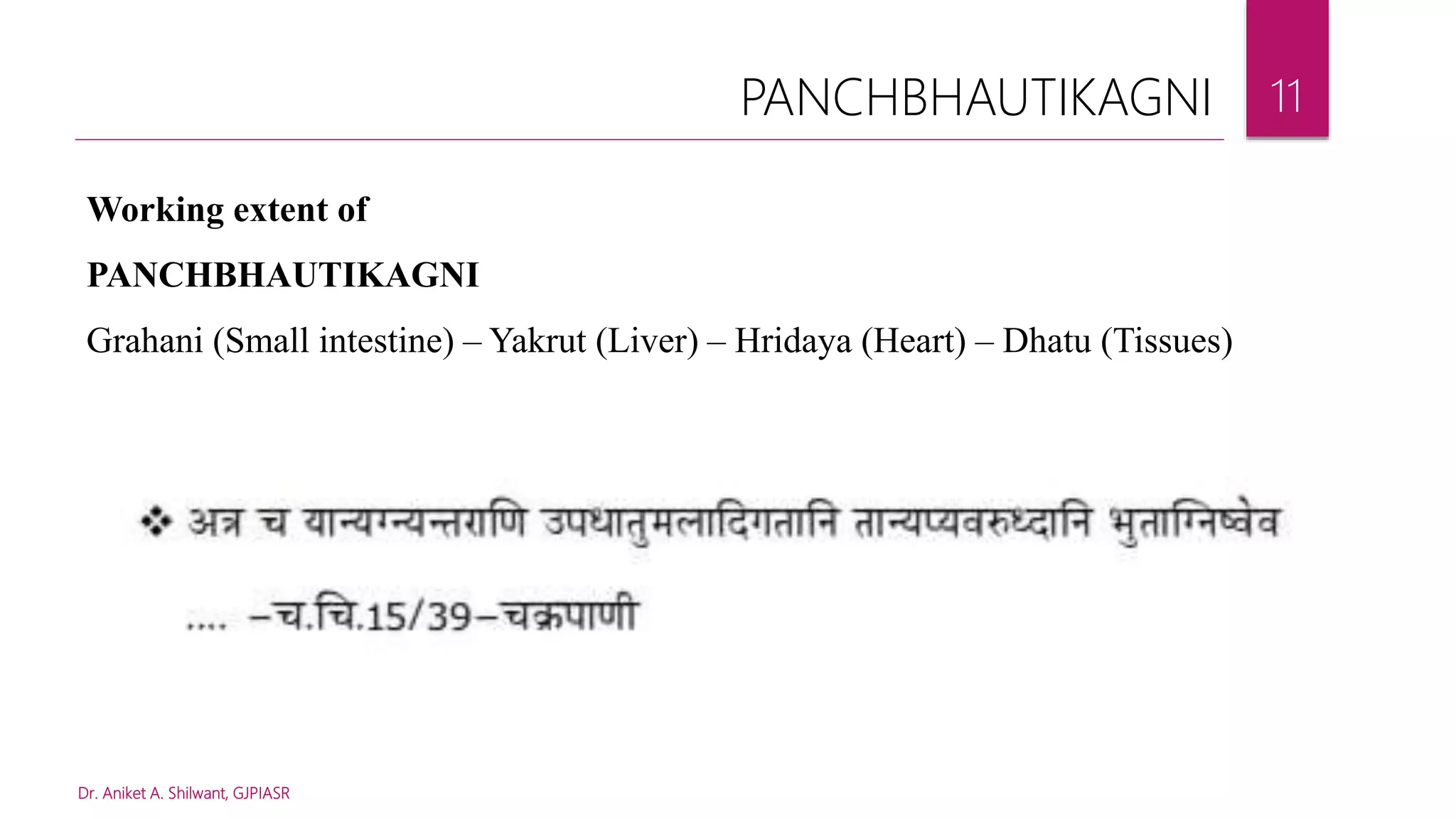
Working extent of
PANCHBHAUTIKAGNI
Grahani (Small intestine) – Yakrut (Liver) – Hridaya (Heart) – Dhatu (Tissues)
PANCHBHAUTIKAGNI
Dr. Aniket A. Shilwant, GJPIASR
12
• Location – Every Dhatu level (Tissue level)
• Acceptance of nutrient substances (Dravya) with its properties (Guna) at every tissue
level as per physical constitution of Dhatu.
• Responsible for metabolic rate.
• Subtle form of Jatharagni only.
• Directly proportional with Jatharagni.
DHATWAGNI
Dr. Aniket A. Shilwant, GJPIASR
13
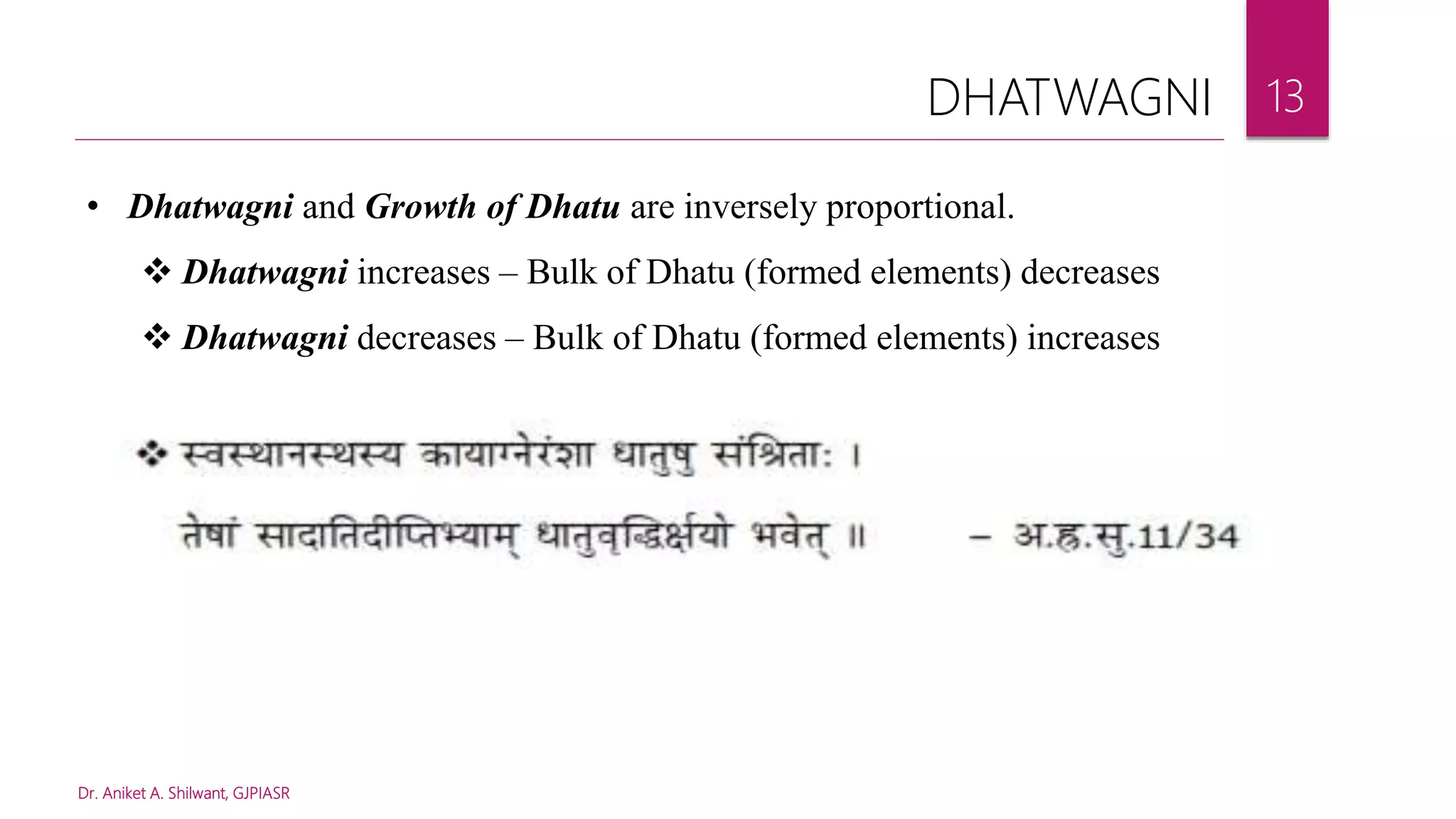
• Dhatwagni and Growth of Dhatu are inversely proportional.
 Dhatwagni increases – Bulk of Dhatu (formed elements) decreases
 Dhatwagni decreases – Bulk of Dhatu (formed elements) increases
DHATWAGNI
Dr. Aniket A. Shilwant, GJPIASR
14
Subtypes of JATHARAGNI
• Functionally active state of Samana Vayu is responsible for deviation of normal
functioning of Jatharagni.
• Leads to four different variable situations affecting digestive process.
1. Irregularity – Vishama – Samana Vayu dominated by properties of Vata Dosha
2. Erroneous – Tikshna – Samana Vayu dominated by properties of Pitta Dosha
3. Sluggish – Manda – Samana Vayu dominated by properties of Kapha Dosha
4. Optimal – Sama – Samana Vayu optimally, equally balanced by all three Dosha
Dr. Aniket A. Shilwant, GJPIASR
15
VISHAMAGNI
• Vata Dosha Dominance over Samana Vayu
• Irregularity in digestive juice secretions.
• Irregularity in intestinal secretions and movements.
• Irregularities in digestion process.
• May leads to instability of gut flora, more dryness in gut – Krura Koshta
• Therapeutically needs internal oleation (Snehapana) upto 7 days.
Dr. Aniket A. Shilwant, GJPIASR
16
TIKSHNAGNI
• Pitta Dosha Dominance over Samana Vayu
• Erroneous digestive juice secretions.
• Increased irritability, sensitivity and intestinal motility of intestinal gut mucosa.
• Reduced retention ability, holding capacity.
• Fast and rapid completion of digestion process.
• May leads to tenderness in gut – Mrudu Koshta
• Therapeutically needs internal oleation (Snehapana) upto 3 days.
Dr. Aniket A. Shilwant, GJPIASR
17
MANDAGNI
• Kapha Dosha Dominance over Samana Vayu
• Slow, sluggish and scanty digestive juice secretions.
• Increased over stability, excess of retention ability of intestinal gut mucosa.
• Slow and sluggish digestion process.
• May leads to over stability, thickening of gut – Madhya Koshta
• Therapeutically needs internal oleation (Snehapana) upto 5days.
Dr. Aniket A. Shilwant, GJPIASR
18
SAMAGNI
• Balanced state of Dosha over Samana Vayu.
• Desired and required digestive juice secretions.
• Optimal condition of intestinal lumen.
• Normalcy of gut – Madhya Koshta
Dr. Aniket A. Shilwant, GJPIASR
19
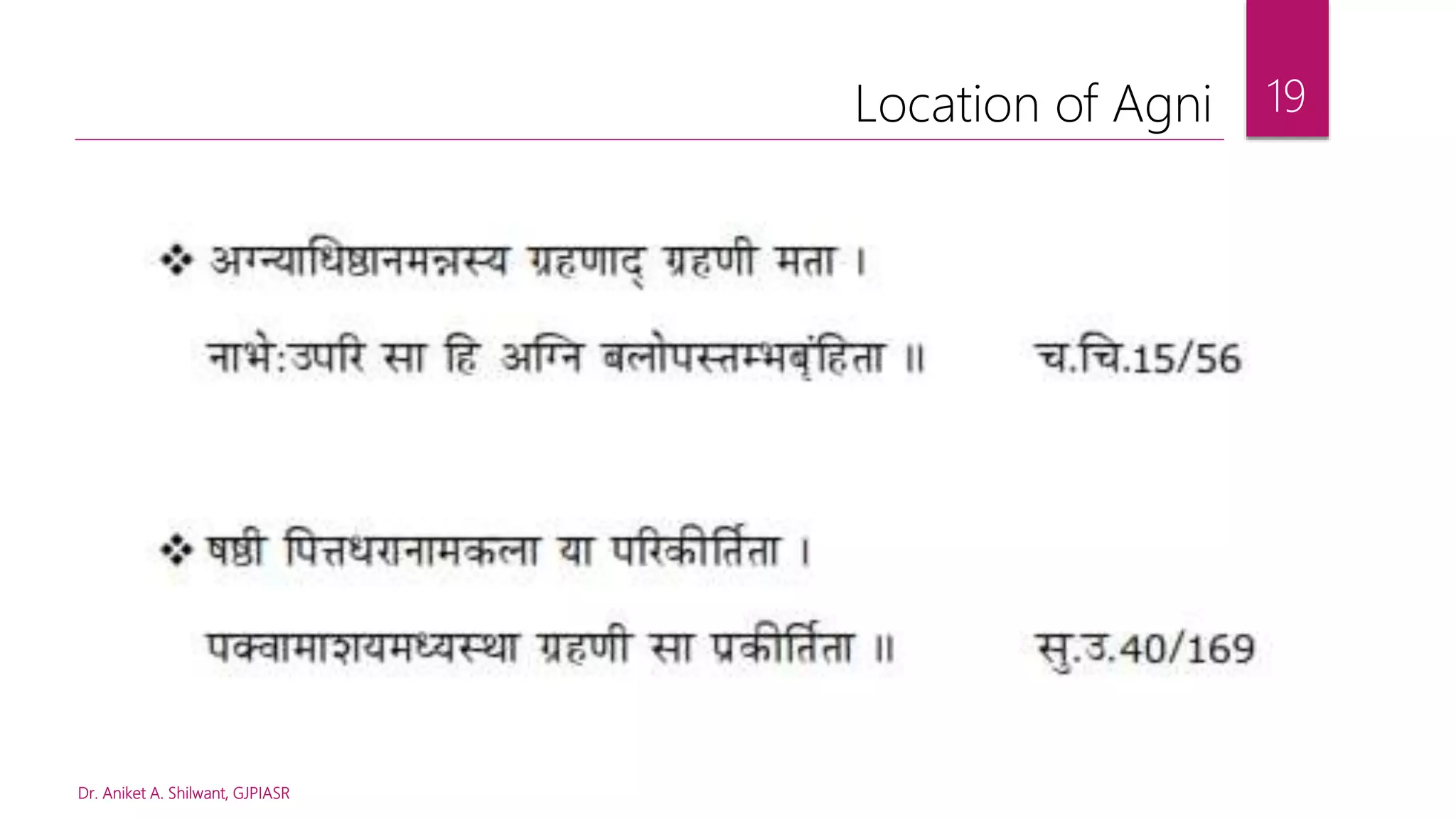
Location of Agni
Dr. Aniket A. Shilwant, GJPIASR
20
Functions of Agni
Dr. Aniket A. Shilwant, GJPIASR
21
Functions of Agni
 Ayu – Extent of life
 Varna – Skin complexion, luster
 Bala – Strength, Stamina, Valor
 Swasthya – Health
 Utsaha – Enthusiasm
 Upchaya – Anabolism and relative metabolic activities, processes
 Prabha – Luster
 Oja – Essence of tissues
 Teja – Active and Potent principle
 Prana – Vitality of life
Dr. Aniket A. Shilwant, GJPIASR
22
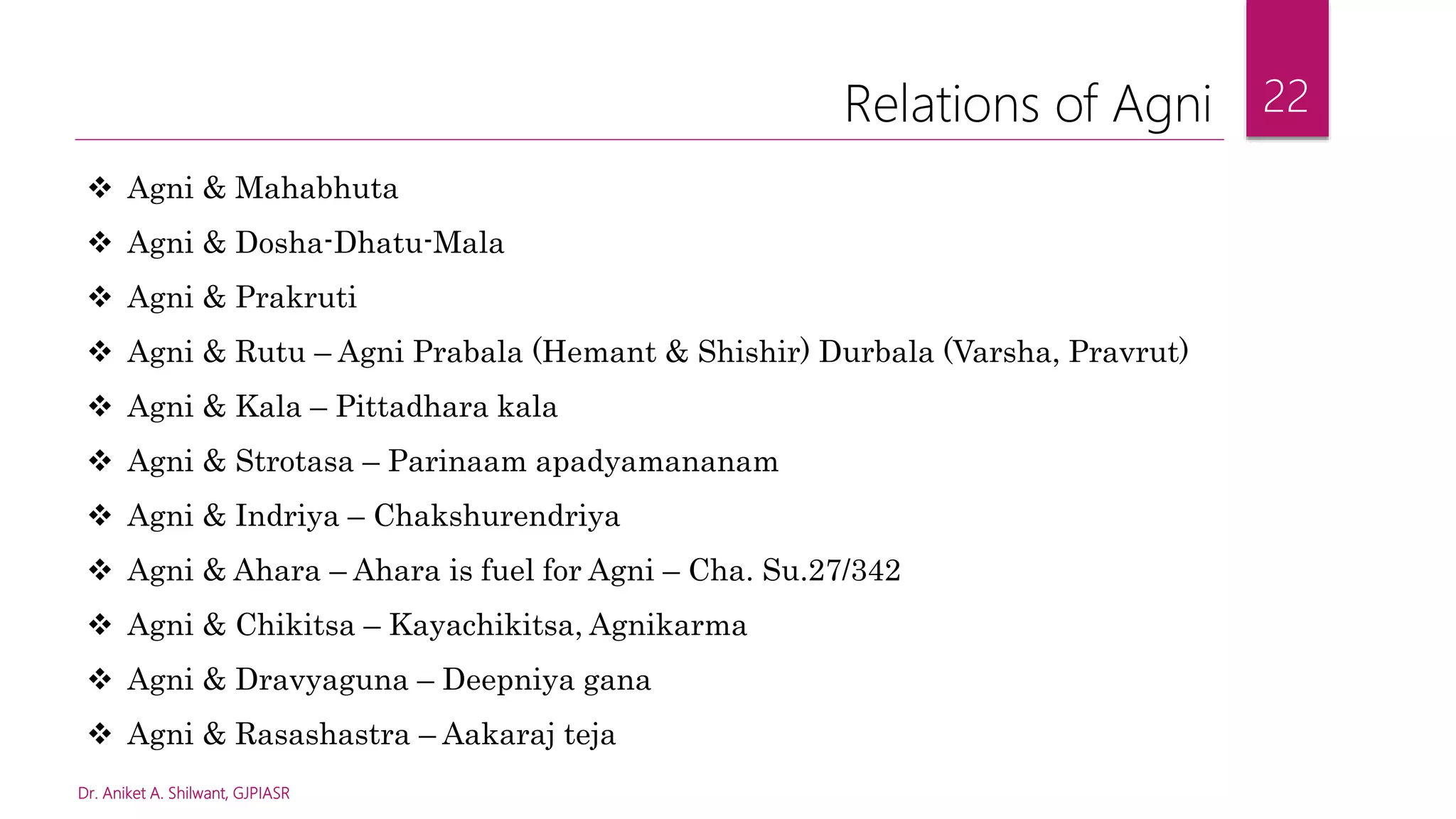
Relations of Agni
 Agni & Mahabhuta
 Agni & Dosha-Dhatu-Mala
 Agni & Prakruti
 Agni & Rutu – Agni Prabala (Hemant & Shishir) Durbala (Varsha, Pravrut)
 Agni & Kala – Pittadhara kala
 Agni & Strotasa – Parinaam apadyamananam
 Agni & Indriya – Chakshurendriya
 Agni & Ahara – Ahara is fuel for Agni – Cha. Su.27/342
 Agni & Chikitsa – Kayachikitsa, Agnikarma
 Agni & Dravyaguna – Deepniya gana
 Agni & Rasashastra – Aakaraj teja
Dr. Aniket A. Shilwant, GJPIASR
23
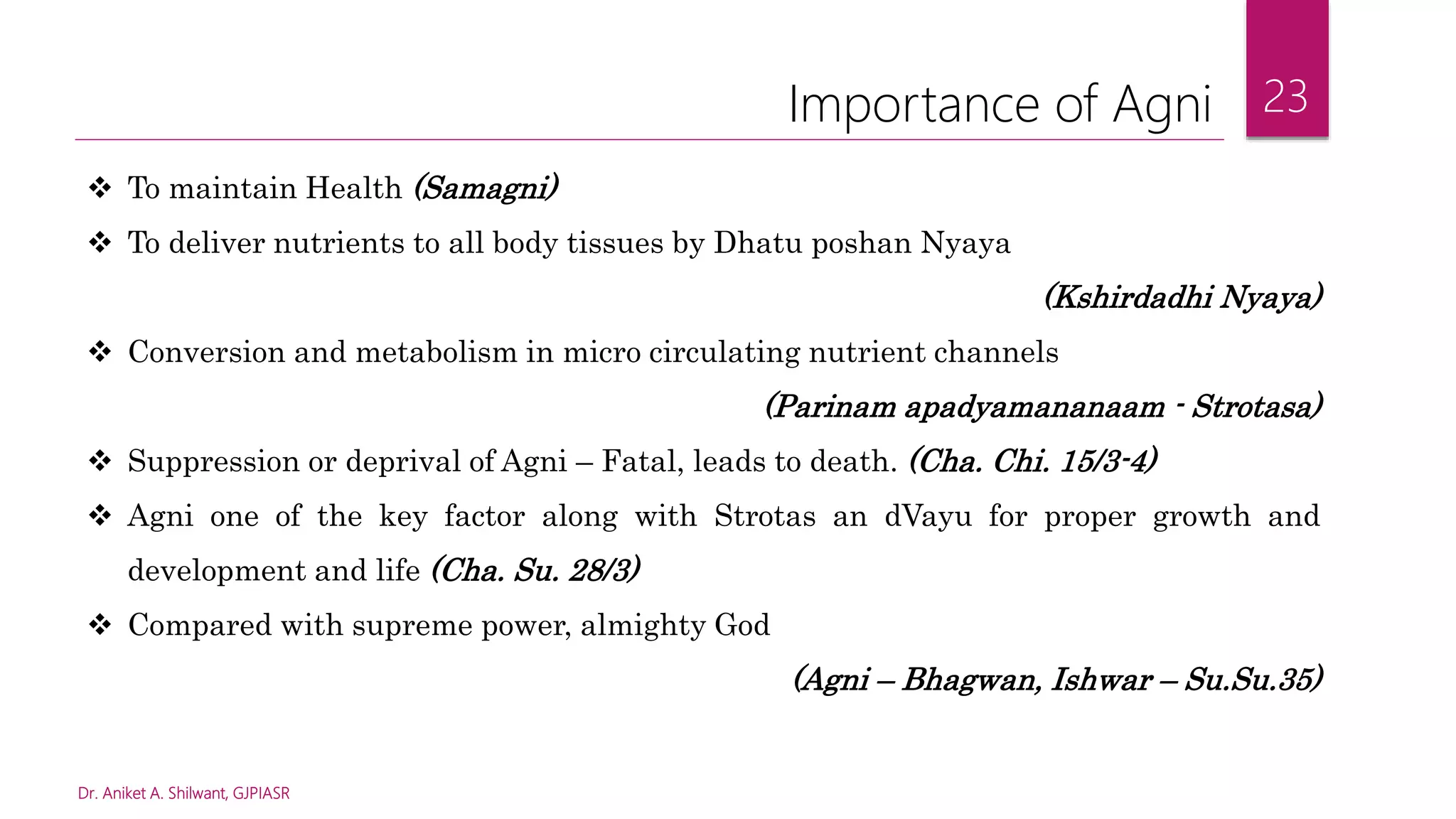
Importance of Agni
 To maintain Health (Samagni)
 To deliver nutrients to all body tissues by Dhatu poshan Nyaya
(Kshirdadhi Nyaya)
 Conversion and metabolism in micro circulating nutrient channels
(Parinam apadyamananaam - Strotasa)
 Suppression or deprival of Agni – Fatal, leads to death. (Cha. Chi. 15/3-4)
 Agni one of the key factor along with Strotas an dVayu for proper growth and
development and life (Cha. Su. 28/3)
 Compared with supreme power, almighty God
(Agni – Bhagwan, Ishwar – Su.Su.35)
Dr. Aniket A. Shilwant, GJPIASR
24
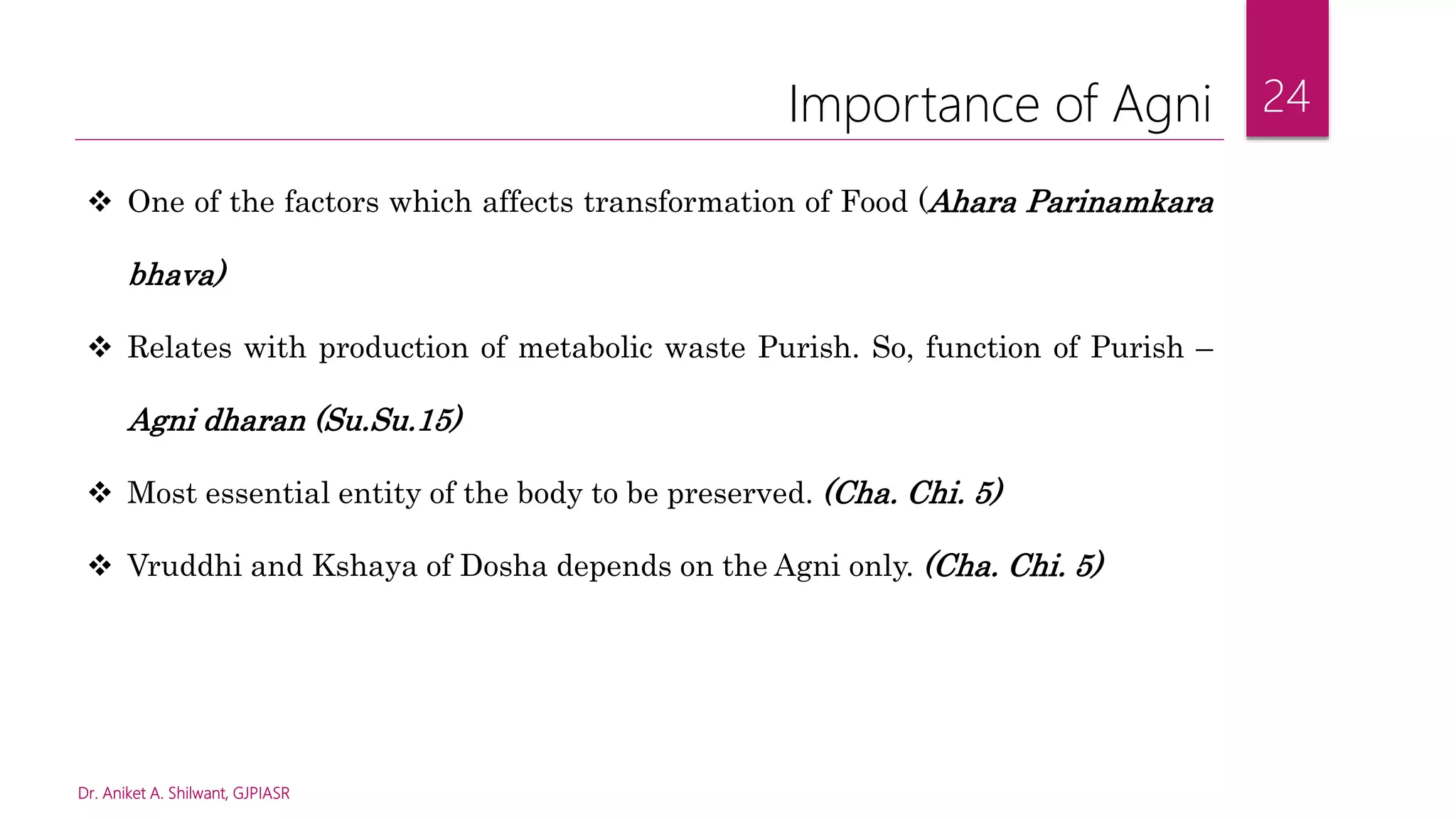
Importance of Agni
 One of the factors which affects transformation of Food (Ahara Parinamkara
bhava)
 Relates with production of metabolic waste Purish. So, function of Purish –
Agni dharan (Su.Su.15)
 Most essential entity of the body to be preserved. (Cha. Chi. 5)
 Vruddhi and Kshaya of Dosha depends on the Agni only. (Cha. Chi. 5)
Dr. Aniket A. Shilwant, GJPIASR
25
Clinical significance of Agni
 Agni dipan – One of the important treatment protocol
 Suppression of Agni is reason behind almost all the diseases.
(Ash. Hri. Ni. 12/1)
 Agni (Anala) one of the Dashvidha Parikshya bhava (Cha.Vi.8)
 Weak or poor Agni leads to production of Ama (Ash. Hri. Ni. 13/25)
 Kayachikitsa – Agni chikitsa
 Agnikarma – Treatment modality
 Agni responsible for movement of Dosha from Koshta to Shakha
(Cha. Su. 28/31)
Thank You All !!!
Dr. Aniket A. Shilwant
Assistant Professor
Sharir Kriya Dept.
GJP-IASR, CVM University
Email –
ayuraniket18@gmail.com
http://ayugjac.edu.in/Staff_CV.aspx?dl=dn3Mja19480dn3Mja19
http://scholar.google.co.in/citations?user=636K2sMAAAAJ&hl=en
https://www.researchgate.net/profile/Aniket_Shilwant

CONCEPT OF AGNI IN AYUVREDA

  • 1.
    Concept of Agni Dr.Aniket A. Shilwant Assistant Professor Sharir Kriya Dept. GJPIASR, CVM University Anand, Gujarat Mail Id. ayuraniket18@gmail.com
  • 2.
    Table of Contents Conceptof Agni – Etymology Synonyms of Agni Definition of Agni Types of Agni  Jatharagni  Panchbhautikagni  Dhatwagni Subtypes of Jatharagni  Vishamagni  Tikshnagni  Mandagni  Samagni Location of Agni Functions of Agni Relations of Agni Importance of Agni Dr. Aniket A. Shilwant, GJPIASR 2
  • 3.
    Dr. Aniket A.Shilwant, GJPIASR 3 Nirukti - Etymology • One which spreads, covers, expands its extent • Which is always directed upwards • One which is illuminating and having flame with upward direction always. • Which is always worshipped very firstly
  • 4.
    Dr. Aniket A.Shilwant, GJPIASR 4 Synonyms
  • 5.
    Dr. Aniket A.Shilwant, GJPIASR 5 Vyakhya – Definition The heat produced by the metabolic activity occurring due to combined mutual interactions between –  Dosha – the physiological entity  Dhatu – the static and dynamic platform in form of formed elements (tissues)  Mala – the resultant metabolic waste produced thereafter
  • 6.
    Dr. Aniket A.Shilwant, GJPIASR 6 AGNI NITYA (ETERNAL) PARMANU SVAROOP QUANTUM - PHOTON ANITYA (EMPHERAL) SHARIR - LOKA ADITYA LOKA - SUN INDRIYA - SENSES CHAKSHU- INDRIYA VISHAY - OBJECT BHOUMA – PHYSICAL FORM DIVYA – CELESTIAL AOUDARYA – BIOTIC EXISTENCE AAKARAJ – MINERAL ORE
  • 7.
    Dr. Aniket A.Shilwant, GJPIASR 7 Types of Agni AOUDARYAAGNI 1. Jatharagni 2. Panchbhautikagni 3. Dhatwagni JATHARAGNI 1. Samagni 2. Vishamagni 3. Tikshnagani 4. Mandagni
  • 8.
    Dr. Aniket A.Shilwant, GJPIASR 8 • Location – Grahani (Small intestine) – Digestive juices accumulating within SI lumen • Principal form of Agni present in body. • Responsible for digestion and breakdown of complex substances into simpler ones. • Essential for utilizing the nutrient components by assimilating them. • Makes ingested substances homologous / homogenous with body’s own composition and constitution for acceptance (Satmya) JATHARAGNI
  • 9.
    Dr. Aniket A.Shilwant, GJPIASR 9 • Location – Yakrut (Liver) & later every Dhatu level (Tissue level) • 2nd breakdown of complex to simpler substances at Liver. • Prepares nutrient pool later circulated through Heart throughout body to all tissues. • Assimilation, Acceptance, Biotransformation at cellular and tissue level as per specific elementary constitution of Dhatu. • At every dhatu level, there is conversion and acceptance of substances (elementary form) with its properties – Dravya and Guna PANCHBHAUTIKAGNI
  • 10.
    Dr. Aniket A.Shilwant, GJPIASR 10 • Specific & Selective in nature PANCHBHAUTIKAGNI
  • 11.
    Dr. Aniket A.Shilwant, GJPIASR 11 Working extent of PANCHBHAUTIKAGNI Grahani (Small intestine) – Yakrut (Liver) – Hridaya (Heart) – Dhatu (Tissues) PANCHBHAUTIKAGNI
  • 12.
    Dr. Aniket A.Shilwant, GJPIASR 12 • Location – Every Dhatu level (Tissue level) • Acceptance of nutrient substances (Dravya) with its properties (Guna) at every tissue level as per physical constitution of Dhatu. • Responsible for metabolic rate. • Subtle form of Jatharagni only. • Directly proportional with Jatharagni. DHATWAGNI
  • 13.
    Dr. Aniket A.Shilwant, GJPIASR 13 • Dhatwagni and Growth of Dhatu are inversely proportional.  Dhatwagni increases – Bulk of Dhatu (formed elements) decreases  Dhatwagni decreases – Bulk of Dhatu (formed elements) increases DHATWAGNI
  • 14.
    Dr. Aniket A.Shilwant, GJPIASR 14 Subtypes of JATHARAGNI • Functionally active state of Samana Vayu is responsible for deviation of normal functioning of Jatharagni. • Leads to four different variable situations affecting digestive process. 1. Irregularity – Vishama – Samana Vayu dominated by properties of Vata Dosha 2. Erroneous – Tikshna – Samana Vayu dominated by properties of Pitta Dosha 3. Sluggish – Manda – Samana Vayu dominated by properties of Kapha Dosha 4. Optimal – Sama – Samana Vayu optimally, equally balanced by all three Dosha
  • 15.
    Dr. Aniket A.Shilwant, GJPIASR 15 VISHAMAGNI • Vata Dosha Dominance over Samana Vayu • Irregularity in digestive juice secretions. • Irregularity in intestinal secretions and movements. • Irregularities in digestion process. • May leads to instability of gut flora, more dryness in gut – Krura Koshta • Therapeutically needs internal oleation (Snehapana) upto 7 days.
  • 16.
    Dr. Aniket A.Shilwant, GJPIASR 16 TIKSHNAGNI • Pitta Dosha Dominance over Samana Vayu • Erroneous digestive juice secretions. • Increased irritability, sensitivity and intestinal motility of intestinal gut mucosa. • Reduced retention ability, holding capacity. • Fast and rapid completion of digestion process. • May leads to tenderness in gut – Mrudu Koshta • Therapeutically needs internal oleation (Snehapana) upto 3 days.
  • 17.
    Dr. Aniket A.Shilwant, GJPIASR 17 MANDAGNI • Kapha Dosha Dominance over Samana Vayu • Slow, sluggish and scanty digestive juice secretions. • Increased over stability, excess of retention ability of intestinal gut mucosa. • Slow and sluggish digestion process. • May leads to over stability, thickening of gut – Madhya Koshta • Therapeutically needs internal oleation (Snehapana) upto 5days.
  • 18.
    Dr. Aniket A.Shilwant, GJPIASR 18 SAMAGNI • Balanced state of Dosha over Samana Vayu. • Desired and required digestive juice secretions. • Optimal condition of intestinal lumen. • Normalcy of gut – Madhya Koshta
  • 19.
    Dr. Aniket A.Shilwant, GJPIASR 19 Location of Agni
  • 20.
    Dr. Aniket A.Shilwant, GJPIASR 20 Functions of Agni
  • 21.
    Dr. Aniket A.Shilwant, GJPIASR 21 Functions of Agni  Ayu – Extent of life  Varna – Skin complexion, luster  Bala – Strength, Stamina, Valor  Swasthya – Health  Utsaha – Enthusiasm  Upchaya – Anabolism and relative metabolic activities, processes  Prabha – Luster  Oja – Essence of tissues  Teja – Active and Potent principle  Prana – Vitality of life
  • 22.
    Dr. Aniket A.Shilwant, GJPIASR 22 Relations of Agni  Agni & Mahabhuta  Agni & Dosha-Dhatu-Mala  Agni & Prakruti  Agni & Rutu – Agni Prabala (Hemant & Shishir) Durbala (Varsha, Pravrut)  Agni & Kala – Pittadhara kala  Agni & Strotasa – Parinaam apadyamananam  Agni & Indriya – Chakshurendriya  Agni & Ahara – Ahara is fuel for Agni – Cha. Su.27/342  Agni & Chikitsa – Kayachikitsa, Agnikarma  Agni & Dravyaguna – Deepniya gana  Agni & Rasashastra – Aakaraj teja
  • 23.
    Dr. Aniket A.Shilwant, GJPIASR 23 Importance of Agni  To maintain Health (Samagni)  To deliver nutrients to all body tissues by Dhatu poshan Nyaya (Kshirdadhi Nyaya)  Conversion and metabolism in micro circulating nutrient channels (Parinam apadyamananaam - Strotasa)  Suppression or deprival of Agni – Fatal, leads to death. (Cha. Chi. 15/3-4)  Agni one of the key factor along with Strotas an dVayu for proper growth and development and life (Cha. Su. 28/3)  Compared with supreme power, almighty God (Agni – Bhagwan, Ishwar – Su.Su.35)
  • 24.
    Dr. Aniket A.Shilwant, GJPIASR 24 Importance of Agni  One of the factors which affects transformation of Food (Ahara Parinamkara bhava)  Relates with production of metabolic waste Purish. So, function of Purish – Agni dharan (Su.Su.15)  Most essential entity of the body to be preserved. (Cha. Chi. 5)  Vruddhi and Kshaya of Dosha depends on the Agni only. (Cha. Chi. 5)
  • 25.
    Dr. Aniket A.Shilwant, GJPIASR 25 Clinical significance of Agni  Agni dipan – One of the important treatment protocol  Suppression of Agni is reason behind almost all the diseases. (Ash. Hri. Ni. 12/1)  Agni (Anala) one of the Dashvidha Parikshya bhava (Cha.Vi.8)  Weak or poor Agni leads to production of Ama (Ash. Hri. Ni. 13/25)  Kayachikitsa – Agni chikitsa  Agnikarma – Treatment modality  Agni responsible for movement of Dosha from Koshta to Shakha (Cha. Su. 28/31)
  • 26.
    Thank You All!!! Dr. Aniket A. Shilwant Assistant Professor Sharir Kriya Dept. GJP-IASR, CVM University Email – ayuraniket18@gmail.com http://ayugjac.edu.in/Staff_CV.aspx?dl=dn3Mja19480dn3Mja19 http://scholar.google.co.in/citations?user=636K2sMAAAAJ&hl=en https://www.researchgate.net/profile/Aniket_Shilwant