Concept of Srotas
Dr. Sangeeta Gehlot, Professor
Dr. Vandana Verma, Assistant Professor
Department of Kriya Sharir, Faculty of
Ayurveda, IMS, BHU, Varanasi, India
Introduction
 Holistic biology of Ayurveda is based on Triguna,
Panchamahabhuta, Tridosha, Saptadhatu, Ojas, Agni and Srotas.
 In Ayurveda the term Srotas is used as dynamic inner transport
system of body-mind-spirit organization in addition to circulatory
system, which provides platform for activities of other important
bio-factors like Triguna, three Dosha, seven Dhatus, Ojas, Agni
and Manas.
 Ayurveda believes that the entire range of biological
processes in health and disease depend on functional state of
the Srotas system. Inappropriate lifestyle and food is the
cause for alteration in functional state of Srotas leading to
development of various disorders.
 Thus understanding of the fundamental and applied aspect of
Srotas is essential to understand Ayurvedic biology, disease
processes and its management.
Srotas
 The word Srotas is derived from sanskrita root- “Sru-gatau”(Sru + tasi = srotas)
which means moving, filtering, flowing, leaking, secreting etc.
 Charak has defined it as “Sravanata Srotamsi” means the structure through
which sravanam (secretion/exchange) takes place.
 Chakrapani has explained that Sravanat means Sravanam of Rasadi Poshya
Dhatu.
 The word Srotas is used as a generic term indicating all the macro and micro
channels and pathways operating in the living organism.

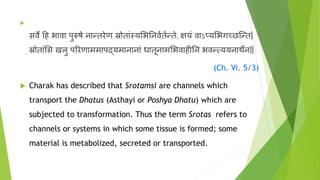
सर्वे हि भार्वा पुरुषे नान्तरेण स्रोताांस्यभभननर्ववतवन्ते, क्षयां र्वाऽप्यभभगच्छन्न्त|
स्रोताांभस खलु पररणाममापद्यमानानाां धातूनामभभर्वािीनन भर्वन््ययनार्थेन||
(Ch. Vi. 5/3)
 Charak has described that Srotamsi are channels which
transport the Dhatus (Asthayi or Poshya Dhatu) which are
subjected to transformation. Thus the term Srotas refers to
channels or systems in which some tissue is formed; some
material is metabolized, secreted or transported.
Srotas
 “Srotomayam hi shariram” means that living body is a channel system and /or is
comprised of innumerable channels designed as inner transport system for divergent
function, gross and subtle, biological and energetic.
बिसानाभमर्व सूक्ष्माणण दूरां प्रवर्वसृतानन च|
द्र्वाराणण स्रोतसाां देिे रसो यैरुपचीयते|| (A.Hri.3/46)
 Acharya Sushruta and Vagbhat both have compared Srotas to the
extremely fine passages and pores present in the lotus stem,
through which Rasadi Poshya Dhatu circulate all over the body
and provide nutrition to body (Su.Sha.9/10, A.Hri.Sha.6/46).
Synonyms of Srotas
 Sira (vein)
 Dhamani (arteries)
 Rasayani (lymphatics)
 Rasavahini (capillaries)
 Nadi (Tubular conduits)
 Pantha (passages)
 Sthana (sites, locus)
 Ashayas (repositories)
 Niketa (resorts)
 Marga (pathways, tracts)
 Samvrita-asamvrita (open or blind
passages)
 Sharir chidra (body orifices,
openings,)
स्रोताांभस, भसरााः, धमन्याः, रसायन्याः, रसर्वाहिन्याः, नाड्याः,
पन्र्थानाः, मागावाः, शरीरन्च्छद्राणण, सांर्वृतासांर्वृतानन,
स्र्थानानन, आशयााः, ननके ताश्चेनत शरीरधा्र्वर्वकाशानाां
लक्ष्यालक्ष्याणाां नामानन भर्वन्न्त| (Ch.Vi.5/9)
 These synonyms refers to various functional
aspect of Srotas.
 Sthula Srotas are named after the specific
substance they carry.
 Analysis of several of its important synonyms
shows that the word Srotas is used as generic
term indicating all macro and micro channels
and pathways operating in the living body.
Classification of Srotas:
 The number of Srotamsi are as
the number of bio factors
operating in the life process .
 Sukshma (subtle)- Innumerable
 Sthula (gross) –Numerable
 Bahirmukha (Aperture or natural
opening) - 9 in male, 11 in
females (Su.Sha.5/10)
 Antarmukha (Su.Sha.9/12)
यार्वन्ताः पुरुषे मूनतवमन्तो भार्ववर्वशेषास्तार्वन्त एर्वान्स्मन ्
स्रोतसाां प्रकारवर्वशेषााः| (Ch.Vi.5/3)
अवप चैके स्रोतसामेर्व समुदयां पुरुषभमच्छन्न्त, सर्ववगत्र्वात ्
सर्ववसर्र्वाच्च दोषप्रकोपणप्रशमनानाम्|
न ्र्वेतदेर्वां, यस्य हि स्रोताांभस, यच्च र्विन्न्त, यच्चार्विन्न्त,
यत्र चार्वन्स्र्थतानन, सर्वं तदन्यत्तेभ्याः||
अनतििु्र्वात ् खलु के चचदपररसङ्ख्येयान्याचक्षते स्रोताांभस,
पररसङ्ख्येयानन पुनरन्ये||
(Ch.Vi.5/4,5)
Characteristics of Srotas:
1.Colour- Colour of Srotas is similar to
that of dhatu they carry.
2. Size- Anu (atomic in size or
microscopic)
Sthula (Gross or macroscopic)
3.Shape– Vritta (circular)
Deergha (long) eg. Muscle fiber
Pratana (reticulated)eg. Neuron
स्र्वधातुसमर्वणावनन र्वृत्तस्र्थूलान्यणूनन च|
स्रोताांभस दीर्ावण्याकृ ्या प्रतानसद्दृशशानन च||
(A.Hri.3/43)
 This verse refers to characteristics of
cell and cell organelle with space in
terms of size, shape, colour found in
different tissues.
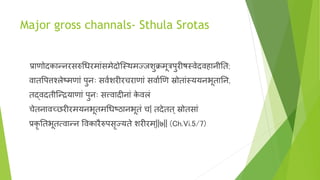
Major gross channals- Sthula Srotas
प्राणोदकान्नरसरुचधरमाांसमेदोन्स्र्थमज्जशुक्रमूत्रपुरीषस्र्वेदर्विानीनत;
र्वातवपत्तश्लेष्मणाां पुनाः सर्ववशरीरचराणाां सर्वावणण स्रोताांस्ययनभूतानन,
तद्र्वदतीन्न्द्रयाणाां पुनाः सत्त्र्वादीनाां के र्वलां
चेतनार्वच्छरीरमयनभूतमचधष्ठानभूतां च| तदेतत् स्रोतसाां
प्रकृ नतभूत्र्वान्न वर्वकारैरुपसृज्यते शरीरम्||७|| (Ch.Vi.5/7)
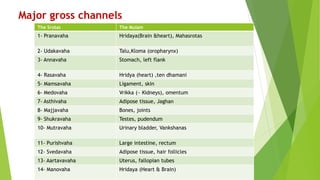
Major gross channels
The Srotas The Mulam
1- Pranavaha Hridaya(Brain &heart), Mahasrotas
2- Udakavaha Talu,Kloma (oropharynx)
3- Annavaha Stomach, left flank
4- Rasavaha Hridya (heart) ,ten dhamani
5- Mamsavaha Ligament, skin
6- Medovaha Vrikka (~ Kidneys), omentum
7- Asthivaha Adipose tissue, Jaghan
8- Majjavaha Bones, joints
9- Shukravaha Testes, pudendum
10- Mutravaha Urinary bladder, Vankshanas
11- Purishvaha Large intestine, rectum
12- Svedavaha Adipose tissue, hair follicles
13- Aartavavaha Uterus, fallopian tubes
14- Manovaha Hridaya (Heart & Brain)
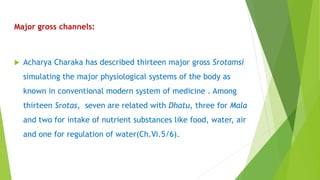
Major gross channels:
 Acharya Charaka has described thirteen major gross Srotamsi
simulating the major physiological systems of the body as
known in conventional modern system of medicine . Among
thirteen Srotas, seven are related with Dhatu, three for Mala
and two for intake of nutrient substances like food, water, air
and one for regulation of water(Ch.Vi.5/6).
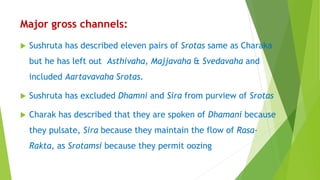
Major gross channels:
 Sushruta has described eleven pairs of Srotas same as Charaka
but he has left out Asthivaha, Majjavaha & Svedavaha and
included Aartavavaha Srotas.
 Sushruta has excluded Dhamni and Sira from purview of Srotas
 Charak has described that they are spoken of Dhamani because
they pulsate, Sira because they maintain the flow of Rasa-
Rakta, as Srotamsi because they permit oozing
Major gross channels:
 In addition to these gross material channels another important
channel is Manovaha Srotas which carries impulses of thoughts and
emotions (Ch.Chi 9/5).
 No separate Srotas has been described for three Sharirika Dosha as
they pervade the entire body and move through different kind of
Srotamsi.
 C.Dwarikanath has explained that Hridya(heart), Dhamani (arteries),
Sira(veins) Srotamsi (capillaries) are the component of a single
vascular system which regulate the proper flow of blood and nutrition
supply to and clearance of waste products from Sthayi Dhatu.
Moolasthan of Srotas:
 Sthula Srotas along with their Mulam(root) have been described for the
purpose of the study of pathology and clinical medicine.
 Charaka has described Srotas Mula or origin and symptomatology of
pathological involvement of Srotamsi in Nija type of diseases(idiopathic or
constitutional diseases as opposed to Aagantuja or traumatic).
 While Sushruta has described Srotamsi in the context of injuries
(Srotoviddha) as may inflicted on their Mula.
Moolasthan of Srotas:
 Chakrapani has desribed Mulam as-“Mulamiti Prabhava Sthanam”, meaning
thereby that Mula of a srotas is the anatomical and physiological seat of the
respective srotas, the main seat of the pathology of that channel, the principal
seat of manifestation of disease.
 The cause of morbidity of Srotamsi and their manifestation, pertaining diseases has
been also explained.
 The set of channels is apparently described as the major seat of diseases which can
be clinically examined in a patient by physician for diagnostic purposes.
Moolasthan of Srotas:
 Charaka has described Srotas Mula or origin and symptomatology of
pathological involvement of Srotamsi in Nija type of diseases
(idiopathic or constitutional diseases as opposed to aagantuja or
traumatic).
 While Sushruta has described Srotamsi in the context of injuries
(Srotoviddha) as may inflict on their Mula.
Function of Srotamsi
 Srotamsi are not only the passage or channels for flow of various
substances but Srotamsi are specific in their functions.
 Each Srotas provides nutrition to their respective Dhatu only with
requisite quantities not others (Ch. Chi. 8/39, Ch.Vi 5/3, and
Ch.Su.28/5). Transformation (metabolism) of Poshya Dhatu occurs in
Srotas (C.Vi 5/3, C.Ci.8/39)
Function of Srotamsi
 Srotas serves as medium through which both Prasada (nutrient)
Dhatu as well as Mala Dhatu (waste product or product of
degradation) are transported, as structure through the pores of
which nutrient and waste product pass to and from the Sthayi
Dhatu.
 All the Dosha, Dhatu & Mala are dependent on Srotas for their
formation, transportation & destruction.
Function of Srotamsi
 Srotamsi are specific to the carrier substance which they
transport.
 This concept of Srotamsi supports even the latest descriptions in
contemporary science such a receptor theory in terms of their
specificity and membrane biology.
 The Srotas system plays a key role in physiology including
pathophysiology and pharmacophysiology.
Pranavaha Srotasa
तत्र प्राणर्विानाां स्रोतसाां हृदयां मूलां मिास्रोतश्च, प्रदुष्टानाां तु खल्र्वेषाभमदां वर्वशेषवर्वज्ञानां
भर्वनत; तद्यर्था- अनतसृष्टमनतिद्धां कु वपतमल्पाल्पमभीक्ष्णां र्वा
सशब्दशूलमुच््र्वसन्तां दृशष््र्वा प्राणर्विान्यस्य स्रोताांभस प्रदुष्टानीनत वर्वद्यात्| (Ch.
Vi.5/7)
 Heart and gastrointestinal tract are the roots of Pranavaha Srotas
प्राणवहानामिति प्राणसंज्ञकवािवहानाि्
एिच्च प्राणाख्यववमिष्टस्य वायोवविमिष्टस्रोि: II (Chakrapani on Ch. Vi.5/7)
 Pranavaha Srotas here stands for the Srotas which transports particular
type of Vata i.e Prana Vata
 Control of Spitting, sneezing, belching, respiration and deglutition are the
functions of Prana Vata
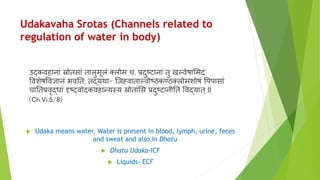
Udakavaha Srotas (Channels related to
regulation of water in body)
उदकर्विानाां स्रोतसाां तालुमूलां क्लोम च, प्रदुष्टानाां तु खल्र्वेषाभमदां
वर्वशेषवर्वज्ञानां भर्वनत; तद्यर्था- न्जह्र्वाताल्र्वोष्ठकण्ठक्लोमशोषां वपपासाां
चानतप्रर्वृद्धाां दृशष््र्वोदकर्विान्यस्य स्रोताांभस प्रदुष्टानीनत वर्वद्यात् II
(Ch.Vi.5/8)
 Udaka means water. Water is present in blood, lymph, urine, feces
and sweat and also in Dhatu
 Dhatu Udaka-ICF
 Liquids- ECF
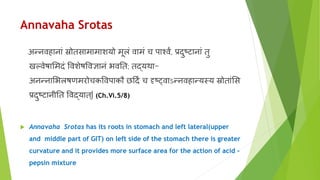
Annavaha Srotas
अन्नर्विानाां स्रोतसामामाशयो मूलां र्वामां च पाश्र्वं, प्रदुष्टानाां तु
खल्र्वेषाभमदां वर्वशेषवर्वज्ञानां भर्वनत; तद्यर्था-
अनन्नाभभलषणमरोचकवर्वपाकौ छहदं च दृशष््र्वाऽन्नर्विान्यस्य स्रोताांभस
प्रदुष्टानीनत वर्वद्यात्| (Ch.Vi.5/8)
 Annavaha Srotas has its roots in stomach and left lateral(upper
and middle part of GIT) on left side of the stomach there is greater
curvature and it provides more surface area for the action of acid -
pepsin mixture
Pureeshavaha Srotas
पुरीषर्विानाां स्रोतसाां पक्र्वाशयो मूलां स्र्थूलगुदां [३] च, प्रदुष्टानाां तु खल्र्वेषाभमदां
वर्वशेषवर्वज्ञानां भर्वनत; तद्यर्था- कृ च्रेणाल्पाल्पां सशब्दशूलमनतद्रर्वमनतग्रचर्थतमनतििु
चोपवर्वशन्तां दृशष््र्वा पुरीषर्विान्यस्य स्रोताांभस प्रदुष्टानीनत वर्वद्यात्| (Ch.Vi.5/8)
 Purishvaha Srotas has its roots in large intestine and rectum.
(lower part of GIT)
Rasavaha Srotas
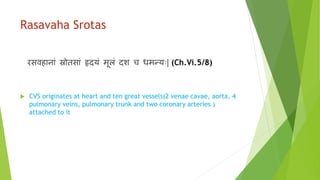
रसर्विानाां स्रोतसाां हृदयां मूलां दश च धमन्याः| (Ch.Vi.5/8)
 CVS originates at heart and ten great vessels(2 venae cavae, aorta, 4
pulmonary veins, pulmonary trunk and two coronary arteries )
attached to it
Rasavaha Srotas
 रसतीनत रसो द्रर्वधातुरूच्यते, तेन रूचधरादीनामावप द्रर्वयाणाां ग्रिणां
भर्वनत (Chakrapani on Ch.Chi.15/36)
 आिारस्य सम्यक् पररणतस्य यस्तेजोभूत: सार: परमसूक्ष्म; स रस
इ्युच्यते, तस्य ह्र्दयम्स्र्थानम्(Su.Su14/3 )
Raktavaha Srotasa
शोणणतर्विानाां स्रोतसाां यकृ न्मूलां प्लीिा च| (Ch.Vi. 5/8)
 The roots of hemopoietic system are liver and spleen
 Raktavaahi Dhamani (Sushruta)
Mansavaha Srotasa
माांसर्विानाां च स्रोतसाां स्नायुमूवलां ्र्वक् च| (Ch.Vi.5/8)
 Tendons, skin, Raktavaahi Dhamani
 Smooth muscles are present in the walls of hollow structures-gut, blood vessels, ducts,
ureters, uterus, bladder and bronchial tree
Medovaha Srotas
मेदोर्विानाां स्रोतसाां र्वृक्कौ मूलां र्वपार्विनां च| (Ch.Vi.5/8)
 Includes adipose tissue, circulating lipids (free fatty acids and lipoproteins)
 Roots are Kidney and omentum
Asthivaha Srotas
 अन्स्र्थर्विानाां स्रोतसाां मेदो मूलां जर्नां च|
(Ch.Vi.5/8)
Shukravaha Srotasa
शुक्रर्विानाां स्रोतसाां र्वृषणौ मूलां शेफश्च| (Ch.Vi.5/8)
 Roots are testicles and penis
 Testis synthesizes the hormone testosterone and site of spermatogenesis
 Penis is the copulatory organ through which seminal fluid is deposited in the vagina of
female
Mutravaha Srotasa (Urinary System)
मूत्रर्विानाां स्रोतसाां िन्स्तमूवलां र्वङ्खक्षणौ [२] च, प्रदुष्टानाां तु खल्र्वेषाभमदां
वर्वशेषवर्वज्ञानां भर्वनत; तद्यर्था- अनतसृष्टमनतिद्धां
प्रकु वपतमल्पाल्पमभीक्ष्णां र्वा ििलां सशूलां मूत्रयन्तां दृशष््र्वा
मूत्रर्विान्यस्य स्रोताांभस प्रदुष्टानीनत वर्वद्यात्|
 Roots are urinary bladder and inguinal region
 Dysuria, passing of less or excessive urine indicates the Mutravaha
Srotoduhsti.
Svedavaha Srotas
स्र्वेदर्विानाां स्रोतसाां मेदो मूलां लोमकू पाश्च, प्रदुष्टानाां तु खल्र्वेषाभमदां
वर्वशेषवर्वज्ञानां भर्वनत; तद्यर्था- अस्र्वेदनमनतस्र्वेदनां
पारुष्यमनतश्लक्ष्णतामङ्खगस्य पररदािां लोमिषं च दृशष््र्वा
स्र्वेदर्विान्यस्य स्रोताांभस प्रदुष्टानीनत वर्वद्यात्|| (Ch.Vi.5/8)
 The roots of Svedavaha Srotas are adipose tissue and hair follicle
adipose tissue acts as an insulator for heat exchange between the
body and environment. It helps in maintaining the body temperature
and excretion of waste.
Srotodushti causes (Factors responsible for
vitiation of Srotas )
आिारश्च वर्विारश्च याः स्याद्दोषगुणैाः समाः|
धातुभभवर्ववगुणश्चावप स्रोतसाां स प्रदूषकाः|| (Ch.Vi.5/23)
1- Diet and behavior having qualities similar to those of Dosha causes
vitiation of dosh.
2- Diet and behavior having qualities contradictory to Dhatu.
 Vitiated Dosha causes vitiation of Dhatus and vice-versa.
 When vitiated Doshas gets lodged in deformed Srotamsi produce the stage of
Sthansamshraya
Srotovaigunya (Srtucural and functional
derangement of Srotas)
अनतप्रर्वृवत्ताः सङ्खगो र्वा भसराणाां ग्रन्र्थयोऽवप र्वा|
वर्वमागवगमनां चावप स्रोतसाां दुन्ष्टलक्षणम्||(Ch.Vi.5/24)
 There are four categories of pathological manifestation of Sthula
Srotas viz.
1- Atipravritti ( hyperfunctiong or excessive flow)
2- Sanga (hypofunctioning, reduced flow ,obstruction)
3- Sira-granthi (Glandular growth in blood vessels)
4- Vimargagaman ( flow other than its own channel)
Srotovaigunya (Srtucural and functional
derangement of Srotas)
 These four categories of pathology can be identified in different
systems of the body, both at gross as well as subtle level.
 The Srotodushti is considered as the sheet of all pathological
processes.
 The range of above mentioned causative factors precipitate a
pathology mediating through the phenomenon of Agni and Srotas.
 Diarrhea, GER, Constipation, Vesicoureteral reflex, Reverse
peristalsis, Abnormal presentation, Udavarta, Intestinal obstruction,
Ectopic Pregnancy, VSD, Patent ductus arteriosus
Srotovaigunya (Srtucural and functional
derangement of Srotas)
Arundutta has illustrated the phenomenon of
Atipravritti with the example of-
Mutravaha Srotas , an excessive flow of urine –
bahumutrata-as in prameha
Purishvaha Srotas, excessive flow of feces in atisara
Sanga as found
- in Mutrakrichra (less flow or retention of urine)
- in Udavarta ( retention of feces)
or voiding of small quantities of feces at frequent interval.
Conclusion:
The description of Srotas refers to a range of structures, functions and concepts in different
context. Srotas could not be expressed by any single structure or entity as it is a Physio-
anatomical term referring from extreme gross to most subtle entity in living body as –
 to whole body as a single complex Srotas.
 each gross physiological system such as gastrointestinal system.
 Major tracts in body
 as one Srotas a single tubular structure like nephron,
 each single cell of the body or sub-cellular structures & membrane
 the receptor mechanism and networks,
 pathways carrying emotions and Chetna.
Conclusion:
 Srotamsi represent the inner transport system of the body in addition to that of
Circulatory System. Srotamsi indicate all macro, micro level descriptions pertaining to
exchange, transportation, excretion.
 Srotamsi include all range of structural and functional units from gross to subtlest
designed to carry specific material, molecules, messages, impulses, emotions and
thoughts.
Conclusion:
 Sthula srotas along with their Mulam have been described for the purpose of
the study of pathology and clinical medicine.
 The transport of biological entities, physiological regulatory factors,
nourishment of tissues, and bioavailability of medicaments depends on the
integrity of Srotamsi.
 Understanding the concept of Srotamsi and Srotovaigunya facilitates the
Vaidya to take decisions accurately with respect to treatment and prognosis.
Thanks

Concept of Shortas

  • 1.
    Concept of Srotas Dr.Sangeeta Gehlot, Professor Dr. Vandana Verma, Assistant Professor Department of Kriya Sharir, Faculty of Ayurveda, IMS, BHU, Varanasi, India
  • 2.
    Introduction  Holistic biologyof Ayurveda is based on Triguna, Panchamahabhuta, Tridosha, Saptadhatu, Ojas, Agni and Srotas.  In Ayurveda the term Srotas is used as dynamic inner transport system of body-mind-spirit organization in addition to circulatory system, which provides platform for activities of other important bio-factors like Triguna, three Dosha, seven Dhatus, Ojas, Agni and Manas.
  • 3.
     Ayurveda believesthat the entire range of biological processes in health and disease depend on functional state of the Srotas system. Inappropriate lifestyle and food is the cause for alteration in functional state of Srotas leading to development of various disorders.  Thus understanding of the fundamental and applied aspect of Srotas is essential to understand Ayurvedic biology, disease processes and its management.
  • 4.
    Srotas  The wordSrotas is derived from sanskrita root- “Sru-gatau”(Sru + tasi = srotas) which means moving, filtering, flowing, leaking, secreting etc.  Charak has defined it as “Sravanata Srotamsi” means the structure through which sravanam (secretion/exchange) takes place.  Chakrapani has explained that Sravanat means Sravanam of Rasadi Poshya Dhatu.  The word Srotas is used as a generic term indicating all the macro and micro channels and pathways operating in the living organism.
  • 5.
     सर्वे हि भार्वापुरुषे नान्तरेण स्रोताांस्यभभननर्ववतवन्ते, क्षयां र्वाऽप्यभभगच्छन्न्त| स्रोताांभस खलु पररणाममापद्यमानानाां धातूनामभभर्वािीनन भर्वन््ययनार्थेन|| (Ch. Vi. 5/3)  Charak has described that Srotamsi are channels which transport the Dhatus (Asthayi or Poshya Dhatu) which are subjected to transformation. Thus the term Srotas refers to channels or systems in which some tissue is formed; some material is metabolized, secreted or transported.
  • 6.
    Srotas  “Srotomayam hishariram” means that living body is a channel system and /or is comprised of innumerable channels designed as inner transport system for divergent function, gross and subtle, biological and energetic.
  • 7.
    बिसानाभमर्व सूक्ष्माणण दूरांप्रवर्वसृतानन च| द्र्वाराणण स्रोतसाां देिे रसो यैरुपचीयते|| (A.Hri.3/46)  Acharya Sushruta and Vagbhat both have compared Srotas to the extremely fine passages and pores present in the lotus stem, through which Rasadi Poshya Dhatu circulate all over the body and provide nutrition to body (Su.Sha.9/10, A.Hri.Sha.6/46).
  • 8.
    Synonyms of Srotas Sira (vein)  Dhamani (arteries)  Rasayani (lymphatics)  Rasavahini (capillaries)  Nadi (Tubular conduits)  Pantha (passages)  Sthana (sites, locus)  Ashayas (repositories)  Niketa (resorts)  Marga (pathways, tracts)  Samvrita-asamvrita (open or blind passages)  Sharir chidra (body orifices, openings,) स्रोताांभस, भसरााः, धमन्याः, रसायन्याः, रसर्वाहिन्याः, नाड्याः, पन्र्थानाः, मागावाः, शरीरन्च्छद्राणण, सांर्वृतासांर्वृतानन, स्र्थानानन, आशयााः, ननके ताश्चेनत शरीरधा्र्वर्वकाशानाां लक्ष्यालक्ष्याणाां नामानन भर्वन्न्त| (Ch.Vi.5/9)  These synonyms refers to various functional aspect of Srotas.  Sthula Srotas are named after the specific substance they carry.  Analysis of several of its important synonyms shows that the word Srotas is used as generic term indicating all macro and micro channels and pathways operating in the living body.
  • 9.
    Classification of Srotas: The number of Srotamsi are as the number of bio factors operating in the life process .  Sukshma (subtle)- Innumerable  Sthula (gross) –Numerable  Bahirmukha (Aperture or natural opening) - 9 in male, 11 in females (Su.Sha.5/10)  Antarmukha (Su.Sha.9/12) यार्वन्ताः पुरुषे मूनतवमन्तो भार्ववर्वशेषास्तार्वन्त एर्वान्स्मन ् स्रोतसाां प्रकारवर्वशेषााः| (Ch.Vi.5/3) अवप चैके स्रोतसामेर्व समुदयां पुरुषभमच्छन्न्त, सर्ववगत्र्वात ् सर्ववसर्र्वाच्च दोषप्रकोपणप्रशमनानाम्| न ्र्वेतदेर्वां, यस्य हि स्रोताांभस, यच्च र्विन्न्त, यच्चार्विन्न्त, यत्र चार्वन्स्र्थतानन, सर्वं तदन्यत्तेभ्याः|| अनतििु्र्वात ् खलु के चचदपररसङ्ख्येयान्याचक्षते स्रोताांभस, पररसङ्ख्येयानन पुनरन्ये|| (Ch.Vi.5/4,5)
  • 10.
    Characteristics of Srotas: 1.Colour-Colour of Srotas is similar to that of dhatu they carry. 2. Size- Anu (atomic in size or microscopic) Sthula (Gross or macroscopic) 3.Shape– Vritta (circular) Deergha (long) eg. Muscle fiber Pratana (reticulated)eg. Neuron स्र्वधातुसमर्वणावनन र्वृत्तस्र्थूलान्यणूनन च| स्रोताांभस दीर्ावण्याकृ ्या प्रतानसद्दृशशानन च|| (A.Hri.3/43)  This verse refers to characteristics of cell and cell organelle with space in terms of size, shape, colour found in different tissues.
  • 11.
    Major gross channals-Sthula Srotas प्राणोदकान्नरसरुचधरमाांसमेदोन्स्र्थमज्जशुक्रमूत्रपुरीषस्र्वेदर्विानीनत; र्वातवपत्तश्लेष्मणाां पुनाः सर्ववशरीरचराणाां सर्वावणण स्रोताांस्ययनभूतानन, तद्र्वदतीन्न्द्रयाणाां पुनाः सत्त्र्वादीनाां के र्वलां चेतनार्वच्छरीरमयनभूतमचधष्ठानभूतां च| तदेतत् स्रोतसाां प्रकृ नतभूत्र्वान्न वर्वकारैरुपसृज्यते शरीरम्||७|| (Ch.Vi.5/7)
  • 12.
    Major gross channels TheSrotas The Mulam 1- Pranavaha Hridaya(Brain &heart), Mahasrotas 2- Udakavaha Talu,Kloma (oropharynx) 3- Annavaha Stomach, left flank 4- Rasavaha Hridya (heart) ,ten dhamani 5- Mamsavaha Ligament, skin 6- Medovaha Vrikka (~ Kidneys), omentum 7- Asthivaha Adipose tissue, Jaghan 8- Majjavaha Bones, joints 9- Shukravaha Testes, pudendum 10- Mutravaha Urinary bladder, Vankshanas 11- Purishvaha Large intestine, rectum 12- Svedavaha Adipose tissue, hair follicles 13- Aartavavaha Uterus, fallopian tubes 14- Manovaha Hridaya (Heart & Brain)
  • 13.
    Major gross channels: Acharya Charaka has described thirteen major gross Srotamsi simulating the major physiological systems of the body as known in conventional modern system of medicine . Among thirteen Srotas, seven are related with Dhatu, three for Mala and two for intake of nutrient substances like food, water, air and one for regulation of water(Ch.Vi.5/6).
  • 14.
    Major gross channels: Sushruta has described eleven pairs of Srotas same as Charaka but he has left out Asthivaha, Majjavaha & Svedavaha and included Aartavavaha Srotas.  Sushruta has excluded Dhamni and Sira from purview of Srotas  Charak has described that they are spoken of Dhamani because they pulsate, Sira because they maintain the flow of Rasa- Rakta, as Srotamsi because they permit oozing
  • 15.
    Major gross channels: In addition to these gross material channels another important channel is Manovaha Srotas which carries impulses of thoughts and emotions (Ch.Chi 9/5).  No separate Srotas has been described for three Sharirika Dosha as they pervade the entire body and move through different kind of Srotamsi.  C.Dwarikanath has explained that Hridya(heart), Dhamani (arteries), Sira(veins) Srotamsi (capillaries) are the component of a single vascular system which regulate the proper flow of blood and nutrition supply to and clearance of waste products from Sthayi Dhatu.
  • 16.
    Moolasthan of Srotas: Sthula Srotas along with their Mulam(root) have been described for the purpose of the study of pathology and clinical medicine.  Charaka has described Srotas Mula or origin and symptomatology of pathological involvement of Srotamsi in Nija type of diseases(idiopathic or constitutional diseases as opposed to Aagantuja or traumatic).  While Sushruta has described Srotamsi in the context of injuries (Srotoviddha) as may inflicted on their Mula.
  • 17.
    Moolasthan of Srotas: Chakrapani has desribed Mulam as-“Mulamiti Prabhava Sthanam”, meaning thereby that Mula of a srotas is the anatomical and physiological seat of the respective srotas, the main seat of the pathology of that channel, the principal seat of manifestation of disease.  The cause of morbidity of Srotamsi and their manifestation, pertaining diseases has been also explained.  The set of channels is apparently described as the major seat of diseases which can be clinically examined in a patient by physician for diagnostic purposes.
  • 18.
    Moolasthan of Srotas: Charaka has described Srotas Mula or origin and symptomatology of pathological involvement of Srotamsi in Nija type of diseases (idiopathic or constitutional diseases as opposed to aagantuja or traumatic).  While Sushruta has described Srotamsi in the context of injuries (Srotoviddha) as may inflict on their Mula.
  • 19.
    Function of Srotamsi Srotamsi are not only the passage or channels for flow of various substances but Srotamsi are specific in their functions.  Each Srotas provides nutrition to their respective Dhatu only with requisite quantities not others (Ch. Chi. 8/39, Ch.Vi 5/3, and Ch.Su.28/5). Transformation (metabolism) of Poshya Dhatu occurs in Srotas (C.Vi 5/3, C.Ci.8/39)
  • 20.
    Function of Srotamsi Srotas serves as medium through which both Prasada (nutrient) Dhatu as well as Mala Dhatu (waste product or product of degradation) are transported, as structure through the pores of which nutrient and waste product pass to and from the Sthayi Dhatu.  All the Dosha, Dhatu & Mala are dependent on Srotas for their formation, transportation & destruction.
  • 21.
    Function of Srotamsi Srotamsi are specific to the carrier substance which they transport.  This concept of Srotamsi supports even the latest descriptions in contemporary science such a receptor theory in terms of their specificity and membrane biology.  The Srotas system plays a key role in physiology including pathophysiology and pharmacophysiology.
  • 22.
    Pranavaha Srotasa तत्र प्राणर्विानाांस्रोतसाां हृदयां मूलां मिास्रोतश्च, प्रदुष्टानाां तु खल्र्वेषाभमदां वर्वशेषवर्वज्ञानां भर्वनत; तद्यर्था- अनतसृष्टमनतिद्धां कु वपतमल्पाल्पमभीक्ष्णां र्वा सशब्दशूलमुच््र्वसन्तां दृशष््र्वा प्राणर्विान्यस्य स्रोताांभस प्रदुष्टानीनत वर्वद्यात्| (Ch. Vi.5/7)  Heart and gastrointestinal tract are the roots of Pranavaha Srotas प्राणवहानामिति प्राणसंज्ञकवािवहानाि् एिच्च प्राणाख्यववमिष्टस्य वायोवविमिष्टस्रोि: II (Chakrapani on Ch. Vi.5/7)  Pranavaha Srotas here stands for the Srotas which transports particular type of Vata i.e Prana Vata  Control of Spitting, sneezing, belching, respiration and deglutition are the functions of Prana Vata
  • 23.
    Udakavaha Srotas (Channelsrelated to regulation of water in body) उदकर्विानाां स्रोतसाां तालुमूलां क्लोम च, प्रदुष्टानाां तु खल्र्वेषाभमदां वर्वशेषवर्वज्ञानां भर्वनत; तद्यर्था- न्जह्र्वाताल्र्वोष्ठकण्ठक्लोमशोषां वपपासाां चानतप्रर्वृद्धाां दृशष््र्वोदकर्विान्यस्य स्रोताांभस प्रदुष्टानीनत वर्वद्यात् II (Ch.Vi.5/8)  Udaka means water. Water is present in blood, lymph, urine, feces and sweat and also in Dhatu  Dhatu Udaka-ICF  Liquids- ECF
  • 24.
    Annavaha Srotas अन्नर्विानाां स्रोतसामामाशयोमूलां र्वामां च पाश्र्वं, प्रदुष्टानाां तु खल्र्वेषाभमदां वर्वशेषवर्वज्ञानां भर्वनत; तद्यर्था- अनन्नाभभलषणमरोचकवर्वपाकौ छहदं च दृशष््र्वाऽन्नर्विान्यस्य स्रोताांभस प्रदुष्टानीनत वर्वद्यात्| (Ch.Vi.5/8)  Annavaha Srotas has its roots in stomach and left lateral(upper and middle part of GIT) on left side of the stomach there is greater curvature and it provides more surface area for the action of acid - pepsin mixture
  • 25.
    Pureeshavaha Srotas पुरीषर्विानाां स्रोतसाांपक्र्वाशयो मूलां स्र्थूलगुदां [३] च, प्रदुष्टानाां तु खल्र्वेषाभमदां वर्वशेषवर्वज्ञानां भर्वनत; तद्यर्था- कृ च्रेणाल्पाल्पां सशब्दशूलमनतद्रर्वमनतग्रचर्थतमनतििु चोपवर्वशन्तां दृशष््र्वा पुरीषर्विान्यस्य स्रोताांभस प्रदुष्टानीनत वर्वद्यात्| (Ch.Vi.5/8)  Purishvaha Srotas has its roots in large intestine and rectum. (lower part of GIT)
  • 26.
    Rasavaha Srotas रसर्विानाां स्रोतसाांहृदयां मूलां दश च धमन्याः| (Ch.Vi.5/8)  CVS originates at heart and ten great vessels(2 venae cavae, aorta, 4 pulmonary veins, pulmonary trunk and two coronary arteries ) attached to it
  • 27.
    Rasavaha Srotas  रसतीनतरसो द्रर्वधातुरूच्यते, तेन रूचधरादीनामावप द्रर्वयाणाां ग्रिणां भर्वनत (Chakrapani on Ch.Chi.15/36)  आिारस्य सम्यक् पररणतस्य यस्तेजोभूत: सार: परमसूक्ष्म; स रस इ्युच्यते, तस्य ह्र्दयम्स्र्थानम्(Su.Su14/3 )
  • 28.
    Raktavaha Srotasa शोणणतर्विानाां स्रोतसाांयकृ न्मूलां प्लीिा च| (Ch.Vi. 5/8)  The roots of hemopoietic system are liver and spleen  Raktavaahi Dhamani (Sushruta)
  • 29.
    Mansavaha Srotasa माांसर्विानाां चस्रोतसाां स्नायुमूवलां ्र्वक् च| (Ch.Vi.5/8)  Tendons, skin, Raktavaahi Dhamani  Smooth muscles are present in the walls of hollow structures-gut, blood vessels, ducts, ureters, uterus, bladder and bronchial tree
  • 30.
    Medovaha Srotas मेदोर्विानाां स्रोतसाांर्वृक्कौ मूलां र्वपार्विनां च| (Ch.Vi.5/8)  Includes adipose tissue, circulating lipids (free fatty acids and lipoproteins)  Roots are Kidney and omentum
  • 31.
    Asthivaha Srotas  अन्स्र्थर्विानाांस्रोतसाां मेदो मूलां जर्नां च| (Ch.Vi.5/8)
  • 32.
    Shukravaha Srotasa शुक्रर्विानाां स्रोतसाांर्वृषणौ मूलां शेफश्च| (Ch.Vi.5/8)  Roots are testicles and penis  Testis synthesizes the hormone testosterone and site of spermatogenesis  Penis is the copulatory organ through which seminal fluid is deposited in the vagina of female
  • 33.
    Mutravaha Srotasa (UrinarySystem) मूत्रर्विानाां स्रोतसाां िन्स्तमूवलां र्वङ्खक्षणौ [२] च, प्रदुष्टानाां तु खल्र्वेषाभमदां वर्वशेषवर्वज्ञानां भर्वनत; तद्यर्था- अनतसृष्टमनतिद्धां प्रकु वपतमल्पाल्पमभीक्ष्णां र्वा ििलां सशूलां मूत्रयन्तां दृशष््र्वा मूत्रर्विान्यस्य स्रोताांभस प्रदुष्टानीनत वर्वद्यात्|  Roots are urinary bladder and inguinal region  Dysuria, passing of less or excessive urine indicates the Mutravaha Srotoduhsti.
  • 34.
    Svedavaha Srotas स्र्वेदर्विानाां स्रोतसाांमेदो मूलां लोमकू पाश्च, प्रदुष्टानाां तु खल्र्वेषाभमदां वर्वशेषवर्वज्ञानां भर्वनत; तद्यर्था- अस्र्वेदनमनतस्र्वेदनां पारुष्यमनतश्लक्ष्णतामङ्खगस्य पररदािां लोमिषं च दृशष््र्वा स्र्वेदर्विान्यस्य स्रोताांभस प्रदुष्टानीनत वर्वद्यात्|| (Ch.Vi.5/8)  The roots of Svedavaha Srotas are adipose tissue and hair follicle adipose tissue acts as an insulator for heat exchange between the body and environment. It helps in maintaining the body temperature and excretion of waste.
  • 35.
    Srotodushti causes (Factorsresponsible for vitiation of Srotas ) आिारश्च वर्विारश्च याः स्याद्दोषगुणैाः समाः| धातुभभवर्ववगुणश्चावप स्रोतसाां स प्रदूषकाः|| (Ch.Vi.5/23) 1- Diet and behavior having qualities similar to those of Dosha causes vitiation of dosh. 2- Diet and behavior having qualities contradictory to Dhatu.  Vitiated Dosha causes vitiation of Dhatus and vice-versa.  When vitiated Doshas gets lodged in deformed Srotamsi produce the stage of Sthansamshraya
  • 36.
    Srotovaigunya (Srtucural andfunctional derangement of Srotas) अनतप्रर्वृवत्ताः सङ्खगो र्वा भसराणाां ग्रन्र्थयोऽवप र्वा| वर्वमागवगमनां चावप स्रोतसाां दुन्ष्टलक्षणम्||(Ch.Vi.5/24)  There are four categories of pathological manifestation of Sthula Srotas viz. 1- Atipravritti ( hyperfunctiong or excessive flow) 2- Sanga (hypofunctioning, reduced flow ,obstruction) 3- Sira-granthi (Glandular growth in blood vessels) 4- Vimargagaman ( flow other than its own channel)
  • 37.
    Srotovaigunya (Srtucural andfunctional derangement of Srotas)  These four categories of pathology can be identified in different systems of the body, both at gross as well as subtle level.  The Srotodushti is considered as the sheet of all pathological processes.  The range of above mentioned causative factors precipitate a pathology mediating through the phenomenon of Agni and Srotas.  Diarrhea, GER, Constipation, Vesicoureteral reflex, Reverse peristalsis, Abnormal presentation, Udavarta, Intestinal obstruction, Ectopic Pregnancy, VSD, Patent ductus arteriosus
  • 38.
    Srotovaigunya (Srtucural andfunctional derangement of Srotas) Arundutta has illustrated the phenomenon of Atipravritti with the example of- Mutravaha Srotas , an excessive flow of urine – bahumutrata-as in prameha Purishvaha Srotas, excessive flow of feces in atisara Sanga as found - in Mutrakrichra (less flow or retention of urine) - in Udavarta ( retention of feces) or voiding of small quantities of feces at frequent interval.
  • 39.
    Conclusion: The description ofSrotas refers to a range of structures, functions and concepts in different context. Srotas could not be expressed by any single structure or entity as it is a Physio- anatomical term referring from extreme gross to most subtle entity in living body as –  to whole body as a single complex Srotas.  each gross physiological system such as gastrointestinal system.  Major tracts in body  as one Srotas a single tubular structure like nephron,  each single cell of the body or sub-cellular structures & membrane  the receptor mechanism and networks,  pathways carrying emotions and Chetna.
  • 40.
    Conclusion:  Srotamsi representthe inner transport system of the body in addition to that of Circulatory System. Srotamsi indicate all macro, micro level descriptions pertaining to exchange, transportation, excretion.  Srotamsi include all range of structural and functional units from gross to subtlest designed to carry specific material, molecules, messages, impulses, emotions and thoughts.
  • 41.
    Conclusion:  Sthula srotasalong with their Mulam have been described for the purpose of the study of pathology and clinical medicine.  The transport of biological entities, physiological regulatory factors, nourishment of tissues, and bioavailability of medicaments depends on the integrity of Srotamsi.  Understanding the concept of Srotamsi and Srotovaigunya facilitates the Vaidya to take decisions accurately with respect to treatment and prognosis.
  • 42.