WELCOME
1
KARYA-KARANA
SIDDHANTA / VADA
2
INTRODUCTION
à€Żà€€à€ƒ à€žà€°à„à€”à€Șà€Ÿà€°à€żà€·à€Šà€źà€żà€Šà€‚ à€¶à€Ÿà€žà„à€€à„à€°à€‚, à€€à„‡à€šà€Ÿà€Żà„à€°à„à„‡à€Šà€Ÿà€”à€°à„à€°à„à€Šà„à€§à€°à„à„ˆà€¶à„‡à€”à€·à€•à€žà€Ÿà€™à„à€–à„à€Żà€Ÿà€Šà€Šà€Šà€¶à€”à€šà€­à„‡à€Šà„‡à€š
à€”à€°à„à€°à„à€Šà„à€§à€Ÿà€°à„à€„à„‹à€œà€źà€­à€§à„€à€Żà€żà€Ÿà€šà„‹ à€š à€Șà„‚à€°à„à€Ÿà€”à€Șà€żà€”à€°à„à€żà„‹à€§à€żà€Ÿà€°à„à€čà€€à„€à€€à„à€Żà€°à„à€„à€”à€ƒ|
(Ca.Su-8/3 Chakrapani)
Ayurveda Shastra is said to be “Sarvaparisada” which means Ayurveda being
an independent Shastra has incorporated few concepts and fundamentals from
different texts like Vedas, Upanishads, Darshana Shastra etc.,
Though the concepts are borrowed from texts as it is but, the purpose is being
altered in Ayurveda as per the Prayojana (i.e., aim)
3
Darshana thought begins from the origin of this universe, and of
Ayurveda also.
Universe is nothing but modification of Guna.
The modification is of Karana into Karya
Anything in and off this world is produced by some Karana.
Every karana (cause) has an Karya (effect), and this karya (effect)
may be a karana (cause) for another karya (effect).
Right from Srushti to evolvement of human being to Rogotpatti at
each and every event Karya Karana Siddhanta can be found.
4
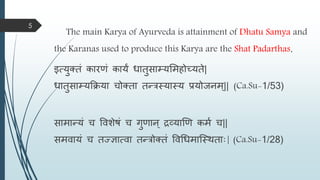
The main Karya of Ayurveda is attainment of Dhatu Samya and
the Karanas used to produce this Karya are the Shat Padarthas.
à€‡à€€à„à€Żà„à€•à„à€€à€‚ à€•à€Ÿà€°à€Łà€‚ à€•à€Ÿà€Żà€‚ à€§à€Ÿà€€à„à€žà€Ÿà€źà„à€Żà€źà€żà€čà„‹à€šà„à€Żà€€à„‡|
à€§à€Ÿà€€à„à€žà€Ÿà€źà„à€Żà€•à„à€°à€żà€Żà€Ÿ à€šà„‹à€•à„à€€à€Ÿ à€€à€šà„à€€à„à€°à€žà„à€Żà€Ÿà€žà„à€Ż à€Șà„à€°à€Żà„‹à€œà€šà€żà„|| (Ca.Su-1/53)
à€žà€Ÿà€żà€Ÿà€šà„à€€à„à€Żà€‚ à€š à€”à€żà€¶à„‡à€·à€‚ à€š à€—à„à€Łà€Ÿà€š à„ à€Šà„à€°à€”à„à€Żà€Ÿà€Łà€Ł à€•à€żà€ź à€š||
à€žà€żà€żà€Ÿà€Żà€‚ à€š à€€à€œà„à€œà„à€žà€Ÿà€€à„à€żà€Ÿ à€€à€šà„à€€à„à€°à„‹à€•à„à€€à€‚ à€”à€żà€§à€§à€żà€Ÿà€žà„à€žà„à€żà€€à€Ÿà€Ÿà€ƒ| (Ca.Su-1/28)
5
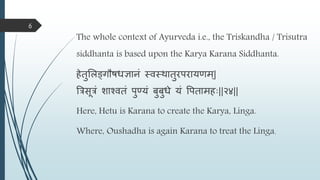
The whole context of Ayurveda i.e., the Triskandha / Trisutra
siddhanta is based upon the Karya Karana Siddhanta.
à€čà„‡à€€à„à€źà€żà€™à„à€—à„Œà€·à€§à€žà€Ÿà€šà€‚ à€žà„à€żà€žà„à€żà€Ÿà€€à„à€°à€Șà€°à€Ÿà€Żà€Łà€żà„|
à€€à„à€°à€°à€žà„‚à€°à€‚ à€¶à€Ÿà€¶à„à€żà€€à€‚ à€Șà„à€Łà„à€Żà€‚ à€Źà„à€Źà„à€§à„‡ à€Żà€‚ à€”à€Șà€€à€Ÿà€żà€čà€Ÿà€ƒ||à„šà„Ș||
Here, Hetu is Karana to create the Karya, Linga.
Where, Oushadha is again Karana to treat the Linga.
6
The theory of Karya Karana Siddhanta is accepted by all the
sciences and philosophies, hence it is considered as
Sarvatantra Siddhanta.
But, regarding the mode of manifestation of Karya from
Karana various postulations have been made.
Some of the postulations are;
Satkaryavada, Asatkaryavada, Parinamavada, Arambhavada,
Paramanuvada, Vivartavada, Kshanabhanguravada,
Swabhavavada, Pilupaka, Pitharapaka, Anekantavada,
Swabhavoparamavada.
7
KARANA BHEDA
There are three types of Karana as per Tarka Sangraha;
1. Samavayi Karana (Inherent or Intimate Cause)
2. Asamavayi Karana (Non inherent or Non intimate Cause)
3. Nimitta Karana (Instrumental Cause)
8
SAMAVAYI KARANA
(Inherent or Intimate Cause)
The Karana which has an Samavaya Sambandha (inseparable
relation) with Karya, means it is present before Karya and
remains till the Karya exists i.e. the Karana and Karya are
interrelated.
This karana is very important in the production or
manifestation of Karya & always exists with Karya.
Samavayi Karana is also called as Upadana Karana.
9
Destruction of Karya takes place due to the destruction of its
Upadana Karana.
Dravya is the samavayi karana of Guna.
Though the other causes like potter, weaver etc., will leave the
Karya after its production but the Mruttika and Tantu exit in
Ghata and Pata respectively until their destruction. Hence the
cause which is not segregate until the destruction is called
Samavayi Karana.
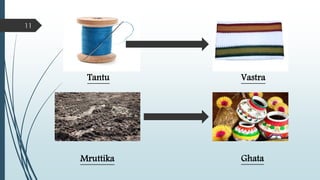
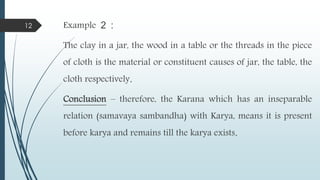
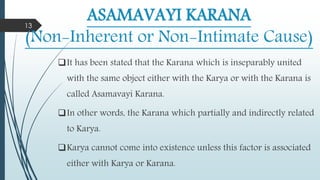
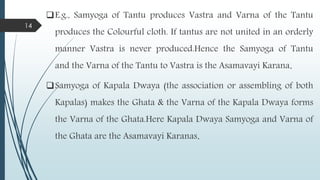
Example: Mruttika & Tantu are the Samavayi Karana for
Ghata & Vastra respectively.
10
11
Tantu Vastra
Mruttika Ghata
Example 2 :
The clay in a jar, the wood in a table or the threads in the piece
of cloth is the material or constituent causes of jar, the table, the
cloth respectively.
Conclusion – therefore, the Karana which has an inseparable
relation (samavaya sambandha) with Karya, means it is present
before karya and remains till the karya exists.
12
ASAMAVAYI KARANA
(Non-Inherent or Non-Intimate Cause)
It has been stated that the Karana which is inseparably united
with the same object either with the Karya or with the Karana is
called Asamavayi Karana.
In other words, the Karana which partially and indirectly related
to Karya.
Karya cannot come into existence unless this factor is associated
either with Karya or Karana.
13
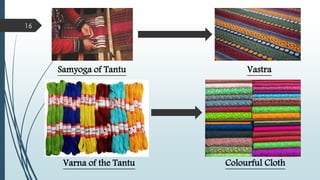
E.g., Samyoga of Tantu produces Vastra and Varna of the Tantu
produces the Colourful cloth. If tantus are not united in an orderly
manner Vastra is never produced.Hence the Samyoga of Tantu
and the Varna of the Tantu to Vastra is the Asamavayi Karana.
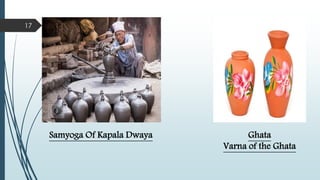
Samyoga of Kapala Dwaya (the association or assembling of both
Kapalas) makes the Ghata & the Varna of the Kapala Dwaya forms
the Varna of the Ghata.Here Kapala Dwaya Samyoga and Varna of
the Ghata are the Asamavayi Karanas.
14
In short, pot is made up of 2 earthern portions (kapalas). Each
earthern portion is the Samavayi Karana of the Pot (Karya). But the
portions by themselves do not form the pot. Both these portions
should be assembled or should get associated into a single unit so as
to form the full pot i.e., Kapala Dwaya Samyoga is called Asamavayi
Karana.
Conclusion – Though Asamavayi karana itself is not Samavayi
karana, it is closely connected with the karana.
15
16
Samyoga of Tantu Vastra
Varna of the Tantu Colourful Cloth
17
Samyoga Of Kapala Dwaya Ghata
Varna of the Ghata
NIMITTA KARANA
(Instrumental Cause)
It is different from Samavayi and Asamavayi Karanas and it
helps the Samavayi and Asamavayi Karana in the production
of Karya.
After production of Karya these karanas detach from Karya.
Such karana is called as Nimitta Karana.
18
Only Samavayi and Asamavayi karana are not sufficient, there
are also other karanas which are useful indirectly are known as
Nimitta Karana.
This can be said as supportive factor for Karyotpatti.
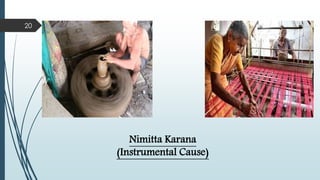
For instance, the viewer, the loom and the shuttle etc., are the
Nimitta karana of Vastra.
19
20
Nimitta Karana
(Instrumental Cause)
Theory of Karya – Karana Vada or Siddhanta ?
 The theory of Karya – Karana is to be considered as a SIDDHANTA because the
state of Karana as well Karya and their inter relationship is examined and
accepted by all Darshana and Sciences.
 But, the question arises then why it is called as Vada?
 The answer to this is that there are different views in regard with state of
Karya and Karana and it remains unanswered which came first Karya or
Karana?
 Just as there is a very famous puzzle which came first a hen or egg, and it
remains as a puzzle only.
21
SIGNIFICANCE OF KARYA & KARANA
 Karya Karana Vada has been given utmost importance & accepted in
Ayurveda.
 From Srusti utpatti to Rogotpatti, Chikitsa everywhere Karana & Karya
can be found and explained.
 Ayurveda explains Rogotpatti, which is also linked with past deeds
(Karmaphala).The karma done in poorvajanma is called as Daiva and in
present is called as Purusha.
 When these Daiva and Purusha becomes Vishama, then Rogotpatti occurs
and When it is sama then Dhatusamyata occurs.
22
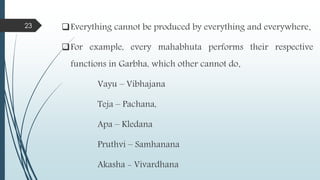
Everything cannot be produced by everything and everywhere.
For example, every mahabhuta performs their respective
functions in Garbha, which other cannot do.
Vayu – Vibhajana
Teja – Pachana,
Apa – Kledana
Pruthvi – Samhanana
Akasha - Vivardhana
23
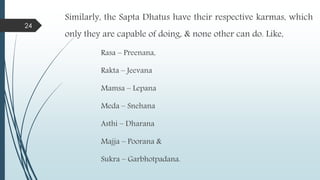
Similarly, the Sapta Dhatus have their respective karmas, which
only they are capable of doing, & none other can do. Like,
Rasa – Preenana,
Rakta – Jeevana
Mamsa – Lepana
Meda – Snehana
Asthi – Dharana
Majja – Poorana &
Sukra – Garbhotpadana.
24
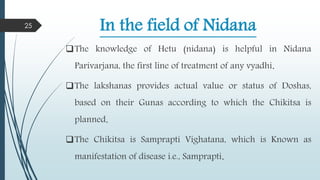
In the field of Nidana
The knowledge of Hetu (nidana) is helpful in Nidana
Parivarjana, the first line of treatment of any vyadhi.
The lakshanas provides actual value or status of Doshas,
based on their Gunas according to which the Chikitsa is
planned.
The Chikitsa is Samprapti Vighatana, which is Known as
manifestation of disease i.e., Samprapti.
25
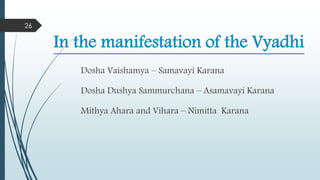
In the manifestation of the Vyadhi
Dosha Vaishamya – Samavayi Karana
Dosha Dushya Sammurchana – Asamavayi Karana
Mithya Ahara and Vihara – Nimitta Karana
26
In Chikitsa
As the main aim of tantra is;
à€§à€Ÿà€€à„à€žà€Ÿà€źà„à€Żà€•à„à€°à€żà€Żà€Ÿ à€šà„‹à€•à„à€€à€Ÿ à€€à€šà„à€€à„à€°à€žà„à€Żà€Ÿà€žà„à€Ż à€Șà„à€°à€Żà„‹à€œà€šà€żà„|| (Ca.Su-1/53)
 So as to attain the Dhatu Samyata (Karya) the Chikitsa Chatushpada (Karana)
is necessary.
 The Chikitsa Chatushpada are Bhishak, Dravya (oushadha), Upastha and
Rogi.
 Among which the Bhishak & Dravya are Samavayi Karana for the Karya and
Upastha is Nimitta Karana and the Rogi is the Karya Desha.
27
Cause for every Karya in Srushti
According to Acharya Charaka, Samanya, Visesha, Guna,
Dravya, Karma & Samavaya are the causative factors for the
whole universe or these are six such factors which are
responsible for everything in this universe and hence known as
Shat-Karanas.
28
Karanas for Vyadhi Utpatti
In Ayurveda, 4 types of karana for Vyadhi Utpatti are
described;
1. Sannikrushta Nidana (Instant Causes)
2. Viprakrushta Nidana (Distant Cause)
3. Vyabhichari Nidana (Unable Cause)
4. Pradhanika Nidana (Prominent Cause)
29
Other 3 karanas for Vyadhi Utpatti
1. Asatmyendriyartha Samyoga
2. Prajnaparadha &
3. Parinama
30
Other 3 Karanas are;
1. Dosha Hetu
2. Vyadhi Hetu &
3. Ubhaya Hetu
31
VADA
à€€à€° à€żà€Ÿà€Šà„‹ à€šà€Ÿà€ż à€ž à€Żà€€ à„ à€Șà€°à„‡à€Ł à€žà€č à€¶à€Ÿà€žà„à€°à€Șà„‚à€żà€źà€•
à€‚ à€”à€żà€—à„ƒà€čà„à€Ż à€•à€żà€Żà€€à€€|
à€ž à€š à€Šà„à€”à€żà€”à€żà€§à€Ÿà€ƒ à€žà€™à„à€°à€čà„‡à€Ł- à€œà€Čà„à€Șà€Ÿà€ƒ, à€”à€żà€€à€Łà„à€Ąà€Ÿ à€š|
à€€à€° à€Șà€•à„à€·à€Ÿà€§à€żà€€à€Żà„‹à€żà€źà€šà€šà€‚ à€œà€Čà„à€Șà€Ÿà€ƒ, à€œà€Čà„à€Șà€”à€żà€Șà€Żà€źà€Żà„‹ à€”à€żà€€à€Łà„à€Ąà€Ÿ|
à€”à€żà€€à€Łà„à€Ąà€Ÿ à€šà€Ÿà€ż à€Șà€°à€Șà€•à„à€·à„‡ à€Šà„‹à€·à€żà€šà€šà€żà€Ÿà€°à€żà„‡à€ż||à„šà„ź||
32
A hostile discussion with an opponent based on shastra is
called Vada.
It is of two types. Viz., Jalpa & Vitanda.
In Jalpa, establishment of one’s own view with logical
reasoning / argument is done.
In Vitanda, not only contradicting the opponent’s view but
also not establishing one’s own view.
33
Where one can get the conclusion of a
demonstrated truth / elements is called Vada.
(Nyaya.Sutra-2/1)
34
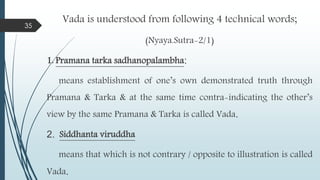
Vada is understood from following 4 technical words;
(Nyaya.Sutra-2/1)
1. Pramana tarka sadhanopalambha:
means establishment of one’s own demonstrated truth through
Pramana & Tarka & at the same time contra-indicating the other’s
view by the same Pramana & Tarka is called Vada.
2. Siddhanta viruddha
means that which is not contrary / opposite to illustration is called
Vada.
35
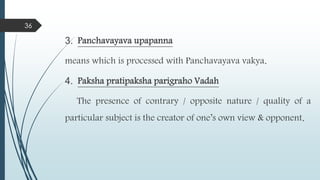
3. Panchavayava upapanna
means which is processed with Panchavayava vakya.
4. Paksha pratipaksha parigraho Vadah
The presence of contrary / opposite nature / quality of a
particular subject is the creator of one’s own view & opponent.
36
The presence of contrary quality of different subject matter
does not quote as Paksha & Pratipaksha.
As example – The presence of soul is one’s view & the absence
of soul is the opponent view. Here the word ‘presence’ &
’absence’ is described in a particular subject matter i.e., in
reference of the soul. Thus this is Paksha & Pratipaksha.
37
VADA’s
 Satkaryavada
 Asatkaryavada
 Parinamavada
 Arambhavada
 Paramanuvada
 Vivartavada
 Kshanabhanguravada
 Swabhavavada
 Pilupaka
 Pitharapaka
 Anekantavada
 Swabhavoparamavada
38
SATKARYAVADA
39
INTRODUCTION
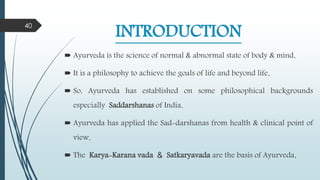
 Ayurveda is the science of normal & abnormal state of body & mind.
 It is a philosophy to achieve the goals of life and beyond life.
 So, Ayurveda has established on some philosophical backgrounds
especially Saddarshanas of India.
 Ayurveda has applied the Sad-darshanas from health & clinical point of
view.
 The Karya-Karana vada & Satkaryavada are the basis of Ayurveda.
40
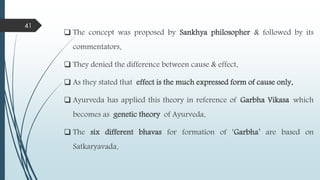
 The concept was proposed by Sankhya philosopher & followed by its
commentators.
 They denied the difference between cause & effect.
 As they stated that effect is the much expressed form of cause only.
 Ayurveda has applied this theory in reference of Garbha Vikasa which
becomes as genetic theory of Ayurveda.
 The six different bhavas for formation of ‘Garbha’ are based on
Satkaryavada.
41
The six darshana can be divided into set of three, means
each pair of two is complimentary to each other;
 the Nyaya-Vaisheshika darshana,
 the Sankhya-Yoga darshana, &
 the Meemamsa-Vedanta darshana.
42
The views of all these six darshanas on the Srushti utpatti can be
summarized into two;
1. Satkaryavada (pre-existence of the effect in the cause):
It maintains that Karya (effect) is sat or real. It is present in the Karana
(cause) in a potential form, even before its manifestation.
2. Asatkaryavada (non-existence of the effect in the cause):
It maintains that Karya (effect) is Asat or unreal until it comes into
being. Every effect, then is a new begining and is not born out of cause.
43
Concept of Satkaryavada as per
Sankhya Darshana
 Satkaryavada is laid down by Sankhya school of thought.
 This Siddhanta states “Karya is present in Karana in unmanifested form”.
 Karya remains present in subtle form in Karana before manifestation, and
after manifestation it becomes gross.
 Karana is gross before manifestation of Karya, and becomes subtle in
Karya after manifestation.
44
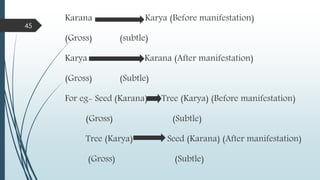
Karana Karya (Before manifestation)
(Gross) (subtle)
Karya Karana (After manifestation)
(Gross) (Subtle)
For eg- Seed (Karana) Tree (Karya) (Before manifestation)
(Gross) (Subtle)
Tree (Karya) Seed (Karana) (After manifestation)
(Gross) (Subtle)
45
Satkaryavada in Srushti Utpatti
 The Srushti Utpatti described by Acharya Sushruta is the same as
described in Sankhya Darshana, with a single difference.
 The Srushti involves 25 Tattva, which starts with the “Prakriti”.
 This Prakriti, which is Karana of Srushti Utpatti, is Trigunatmaka.
 The other 24 Tattva which are evolved from the Prakriti are also
Trigunatmaka.
 The whole world comprises of matter which are Panchabhoutika, which
are nothing but the modification of Triguna.
46
Satkaryavada states Karya remains present in Karana in
unmanifested state, so when it Karya gets manifested it has the
essence of Karana.
This is base of description of Satkaryavada in Srushti.
All the evolutes of Prakriti are Trigunatmaka.
47
Sankhya’s 25 Tattva of Srushti are;
 Prakriti
 Mahat
 Ahankara
 Panchatanmatra & Panchamahabhuta
 Ekadasha Indriya – 5 Jnanedriya + 5 Karmendriya + Manas
These are 24 Tattva, & the initiator of this process is the 25th
Tattva i.e., Purusha.
48
Sankhya divides these 25 Tattva into four categories on the basis of Karya and
Karana –
 The root product is called the Parkriti, they are Karana for manifestation of
Srushti.
 Prakriti & Vikriti – these are seven in number and are the nature of both
productive and produced, they are Karya as well as Karana.
 Vikriti – Ekadasha indriyas and Panchamahabhuta are non-productive but
produced, these are Karyas but cannot be Karana.
 Neither Prakriti nor Vikriti – Purusha is neither produced nor productive, this
is neither Karya nor Karana.
49
These 25 Tattvas can be divided into Avyakta and Vyakta
also.
Moola Prakriti is Avyakta , rest 23 are Vyakta while Purusha
is neither Avyakta nor Vyakta.
50
Etymology of word Satkaryavada
The word “Satkaryavada” is made up by three words Sat, Karya and Vada.
Sat – Streelinga Shabda, made up of ‘As’ dhatu shatru pratyaya.
Different meaning according to Amarakosha:
Satye, Sadhou, Pujithe, Dheere, Prashaste, Vidyamane etc.,
But here in the present context, ‘Vidyamane’ is considered.
Sat – Being, existing, existent
The term ‘Sat’ implies something whose positive existence is established for all
times i.e., past, present and future and which is a subject of examination.
à€žà€Šà€Šà€€à€€ à€”à€°à„à€§à€§à€”à€°à„à€·à€Żà€Șà„à€°à€żà€Ÿà€Łà€—à€źà„à€Żà€‚ à€­à€Ÿà€°à„à€°à„‚à€Șà€żà„(Ca.Su-11/17 Chakrapani)
51
Karya – what ought to be done, made, performed.
Vada – Pulinga shabda, made up of ‘Vad’ dhatu and ‘ghan’pratyaya.
Vada – Talking, speaking, speech words
Narration, account
Demonstrated conclusion, theory, doctrine.
But here in the present context, demonstrated conclusion, theory is
considered.
52
Definition of Satkaryavada
The theory states that “Karya is present in Karana in
unmanifested form”.
Before the operation of cause, the effect is existent in latent form
in cause. Only the manifestation of cause is mandatory for
appearance of effect.
Karya remains present in subtle form in Karana, prior to its
manifestation.
After manifestation the Karya becomes gross, and Karana subtle.
53
Example – Oil present in seeds, but without applying pressure
it do not appear, similarly, rice is present in paddy but requires
thumping to come into sight and same holds true with the
Milk. Milk is present in Cow, but unless milking is done they
cannot emerge.
These examples support the fact that Karya are present in
Karana, before existence, only the operation of cause is
required for their appearances.
54
Glimpse of Human life cycle
Fertilized egg (zygote) Foetus Baby (infant) Toddler Adolescent
Adult Old age Death
 These are the various stages of human life cycle. Each stage is the
mainfested state of preceding and unmanifested state of succeeding
stage.
 The Changes are occuring in one only, but as matter of time, state, and
condition they appear different.
 Like the baby is only changing to toddler and then to adolescent, or in
other words toddler is present in ‘Avyakta’ avastha in baby, as time
passes it becomes ‘Vykata’ in form of toddler.
55
Different avasthas of Amra phala
 The fruit of Mango has different tastes at different stages.
 Like it is Kashaya-Amla in Balavastha, it becomes Amla in Ardhapakwa
avastha and finally Madhura when it is totally Pakwa avastha.
 Madhura rasa which is the final rasa of Mango is present since Bala, but
appears in appropriate time, state and condition.
 Based on above examples it can be stated before manifestation “Karya” is
subtle in “Karana” and after manifestation the “Karana” becomes subtle
in “Karya”.
56
 Regarding the Karya-Karana Vada, Sankhya philosophy presents its
view in form of Satkaryavada.
 Satkaryavada is based on five syllogisms.
 This theory believes that only Sat karana (existent cause) can produce
Karya.
 In other words it could be said that Karya remains present in Karana in
Unmanifested form.
57
Hetu of Satkaryavada
In favour of the theory of ‘Satkaryavada’ some arguments were given
and it was explained with the help of 05 analogies, described in
Sankhyatattvakaumudi as follows:
1. Asat Akaranat
2. Upadana grahanat
3. Sarvasambhava abhavat
4. Shaktasya shakya karanat
5. Karana Bhavaccha
58
1. Asat Akaranat
 “Asat Akaranat” which depicts that Asat (non-existent) things by any
means cannot be brought into existence.
 A non entity can never be made an entity i.e., that which has never
existed can never be brought into existence.
 For example – Oil cannot be produced by Sands, as it is not present in it
any form.
 An existent thing be it in Avyakta or Vyakta form can only produce
another existent thing.
59
Acharya Charaka also supports the fact;
.........à€šà€Ÿà€™à„à€•
à„ à€°à„‹à€€à„à€Șà€žà„à€€à„à€€à€°à€Źà„€à€œà€Ÿà€€à„ (Ca.Su-11/32)
 There could not be germination of plant without seed.
 Without Karana, Karya cannot be produced.
.............. à€šà€Ÿà€šà„à€€à„à€Żà€žà„à€żà€Ÿà€Šà„à€Źà„€à€œà€Ÿà€Šà€šà„à€€à„à€Żà€žà„à€Żà„‹à€€à„à€Șà€žà„à€€à„à€€à€Ÿà€ƒ | (Ca.Su-11/32)
 Seed of a particular plant produces that specific plant and not another,
 Showing a specific interrelationship between Karana and Karya.
60
2. Upadana Grahanat
(selection of a causative material for the effect)
 For the manifestation of Karya from Karana assured specific materials are
required.
 “Upadana” stands for cause and “Grahana” means selecting the cause for
desired effect.
 For example – when one requires curd, he opt for milk and not hot
water, this shows cause and effect has certain relation.
61
3. Sarvasambhava abhavat
 Everything cannot be produced by everything or everywhere, because all
Karana cannot produce all Karya and Karya cannot be produced by all
Karana.
 Only specific Karana can produce specific Karya.
 For example – Just like, Gold cannot be produced by Silver, dust or Sand.
62
4. Shaktasya Shakya Karanat
 Potent thing can produces that for which it is capable of.
 For example – like a potter by means of mud, wheel, threads of rags,
water etc., can produce pot, because mud has the potency or capability
for the production of pot.
Acharya Charaka also supports the statement;
à€…à€ż à€žà€źà„à€­à€żà€Ÿà€ƒ- à€Żà„‹ à€Żà€€à€Ÿà€ƒ à€žà€źà„à€­à€żà€€à€€ à€ž à€€à€žà„à€Ż à€žà€źà„à€­à€żà€Ÿà€ƒ; à€Żà€żà€Ÿ- à€·à€Ąà„à€§à€Ÿà€€à€żà„‹ à€—à€­à€źà€žà„à€Ż,
à€”à„à€Żà€Ÿà€§à„‡à€°à€čà€čà€€à€‚, à€čà€čà€€à€żà€Ÿà€°à„‹à€—à„à€Żà€žà„à€Żà„‡à€€à€€|| (Ca.Su-8/49)
63
5. Karana Bhavaccha
 The production bears the nature from where it is produced; Whatever is
the nature of cause, the same is the nature of effect or production.
 For example – Barley produces Barley, and Rice produces Rice, if the
effect were not existent in the cause, then Barley would have been
produced by Kodrava, but that does not happen.
 So, effect is existent in cause before operation.
64
 These all five factors are the supporting factors which prove the theory
of Satkaryavada.
 Actually the means and the production do not differ, they are same.
 The unmanifested stage called means and the manifested stage of the
same is called production or creation.
 For example – the lump of clay and gold are means, pot and ornaments
are production.
65
Satkaryavada in Ayurveda
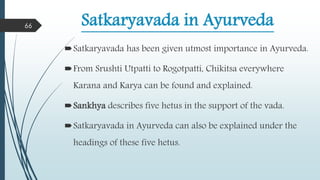
Satkaryavada has been given utmost importance in Ayurveda.
From Srushti Utpatti to Rogotpatti, Chikitsa everywhere
Karana and Karya can be found and explained.
Sankhya describes five hetus in the support of the vada.
Satkaryavada in Ayurveda can also be explained under the
headings of these five hetus.
66
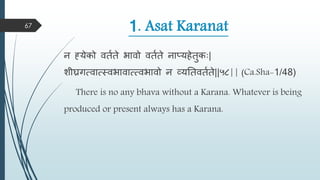
1. Asat Karanat
à€š à€čà„à€Żà„‡à€•à„‹ à€żà€€à€źà€€à„‡ à€­à€Ÿà€żà„‹ à€żà€€à€źà€€à„‡ à€šà€Ÿà€Șà„à€Żà€čà„‡à€€à„à€•à€Ÿà€ƒ|
à€¶à„€à€˜à„à€°à€—à€€à„à€żà€Ÿà€€à„à€žà„à€żà€­à€Ÿà€żà€Ÿà€€à„à€€à„à€żà€­à€Ÿà€żà„‹ à€š à€”à„à€Żà€€à€€à€żà€€à€źà€€à„‡||à„«à„ź|| (Ca.Sha-1/48)
There is no any bhava without a Karana. Whatever is being
produced or present always has a Karana.
67
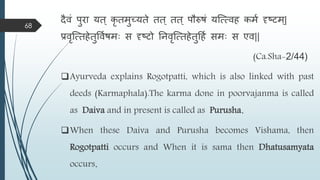
à€Šà„ˆà€żà€‚ à€Șà„à€°à€Ÿ à€Żà€€ à„ à€•à„ƒ à€€à€żà„à€šà„à€Żà€€à„‡ à€€à€€ à„ à€€à€€ à„ à€Șà„Œà€°à„à€·à€‚ à€Żà€žà„à€€à„à€€à„à€żà€č à€•à€żà€ź à€Šà„ƒà€·à„à€Ÿà€żà„|
à€Șà„à€°à€żà„ƒà€žà„à€€à„à€€à€čà„‡à€€à„à€”à€żà€źà€·à€żà€Ÿà€ƒ à€ž à€Šà„ƒà€·à„à€Ÿà„‹ à€€à€šà€żà„ƒà€žà„à€€à„à€€à€čà„‡à€€à„à€čà€čà€ź à€žà€żà€Ÿà€ƒ à€ž à€à€ż||
(Ca.Sha-2/44)
Ayurveda explains Rogotpatti, which is also linked with past
deeds (Karmaphala).The karma done in poorvajanma is called
as Daiva and in present is called as Purusha.
When these Daiva and Purusha becomes Vishama, then
Rogotpatti occurs and When it is sama then Dhatusamyata
occurs.
68
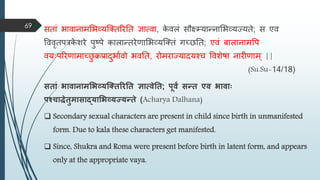
à€žà€€à€Ÿà€‚ à€­à€Ÿà€żà€Ÿà€šà€Ÿà€żà€źà€­à€”à„à€Żà€žà„à€•à„à€€à€°à€°à€€à€€ à€žà€Ÿà€€à„à€żà€Ÿ, à€•
à„‡ à€żà€żà€‚ à€žà„Œà€•à„à€·à„à€źà€źà„à€Żà€Ÿà€šà„à€€à„à€šà€Ÿà€źà€­à€”à„à€Żà€œà„à€œà„à€Żà€€à„‡; à€ž à€à€ż
à€”à€żà€żà„ƒà€€à€Șà€°à€•
à„‡ à€¶à€°à„‡ à€Șà„à€·à„à€Șà„‡ à€•à€Ÿà€żà€Ÿà€šà„à€€à„à€€à€°à„‡à€Łà€Ÿà€źà€­à€”à„à€Żà€žà„à€•à„à€€à€‚ à€—à€šà„à€›à€€à€€; à€à€żà€‚ à€Źà€Ÿà€żà€Ÿà€šà€Ÿà€żà€”à€Ș
à€żà€Żà€Ÿà€ƒà€Șà€°à€°à€Łà€Ÿà€żà€Ÿà€šà„à€›
à„ à€żà€Șà„à€°à€Ÿà€Šà„à€­à€Ÿà€źà€żà„‹ à€­à€żà€€à€€, à€°à„‹à€żà€°à€Ÿà€œà„à€œà„à€Żà€Ÿà€Šà€Żà€¶à„à€š à€”à€żà€¶à„‡à€·à€Ÿ à€šà€Ÿà€°à€Łà€Łà€Ÿà€żà„ ||
(Su.Su-14/18)
à€žà€€à€Ÿà€‚ à€­à€Ÿà€°à„à€Ÿà€šà€Ÿà€żà€źà€­à€”à„à€Żà€•à„à€€à€€à€°à€żà€€à€€ à€œà„à€žà€Ÿà€€à„à€°à„à„‡à€€à€€; à€Șà„‚à€°à„à€‚ à€žà€šà„à€€ à€à€°à„ à€­à€Ÿà€°à„à€Ÿà€ƒ
à€Șà€¶à„à€šà€Ÿà€Šà„à€§à„‡à€€à„à€żà€Ÿà€žà€Ÿà€Šà„à€Żà€Ÿà€źà€­à€”à„à€Żà€œà„à€Żà€šà„à€€à„‡ (Acharya Dalhana)
 Secondary sexual characters are present in child since birth in unmanifested
form. Due to kala these characters get manifested.
 Since, Shukra and Roma were present before birth in latent form, and appears
only at the appropriate vaya.
69
à€ž à€žà€żà€źà€—à„à€Łà€żà€Ÿà€šà„ à€—à€­à€źà€€à„à€żà€żà€Ÿà€Șà€šà„à€€à„à€šà€Ÿà€ƒ à€Șà„à€°à€żà€żà„‡ à€żà€Ÿà€źà€ž à€žà€źà„à€żà„‚à€žà„à€šà„à€›à€źà€€à€Ÿà€ƒ
à€žà€żà€źà€§à€Ÿà€€à„à€•à€żà„à€·à„€à€•à„ƒ à€€à€Ÿà€ƒ à€–à„‡à€Ÿà€­à„‚à€€à„‹ à€­à€żà€€à„à€Żà€”à„à€Żà€•à„à€€à€”à€żà€°à€čà€Ÿà€ƒ
à€žà€Šà€žà€Šà„à€­à„‚à€€à€Ÿà€™à„à€—à€Ÿà€żà€Żà€żà€Ÿà€ƒ|| (Ca.Sha-4/9)
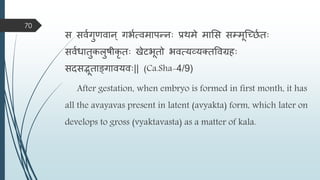
After gestation, when embryo is formed in first month, it has
all the avayavas present in latent (avyakta) form, which later on
develops to gross (vyaktavasta) as a matter of kala.
70
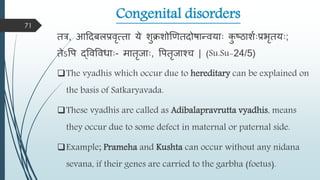
Congenital disorders
à€€à€°, à€†à€čà€Šà€Źà€żà€Șà„à€°à€żà„ƒà€€à„à€€à€Ÿ à€Żà„‡ à€¶à„à€żà€¶à„‹à€Łà€Łà€€à€Šà„‹à€·à€Ÿà€šà„à€€à„à€żà€Żà€Ÿà€Ÿà€ƒ à€•
à„ à€·à„à€ à€Ÿà€¶à€źà€Ÿà€ƒà€Șà„à€°à€­à„ƒà€€à€Żà€Ÿà€ƒ;
à€€à„‡à€œà€”à€Ș à€Šà„à€”à€żà€”à€żà€§à€Ÿà€Ÿà€ƒ- à€żà€Ÿà€€à„ƒà€œà€Ÿà€Ÿà€ƒ, à€”à€Șà€€à„ƒà€œà€Ÿà€¶à„à€š | (Su.Su-24/5)
The vyadhis which occur due to hereditary can be explained on
the basis of Satkaryavada.
These vyadhis are called as Adibalapravrutta vyadhis, means
they occur due to some defect in maternal or paternal side.
Example; Prameha and Kushta can occur without any nidana
sevana, if their genes are carried to the garbha (foetus).
71
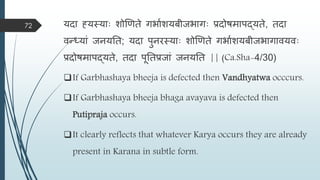
à€Żà€Šà€Ÿ à€čà„à€Żà€žà„à€Żà€Ÿà€Ÿà€ƒ à€¶à„‹à€Łà€Łà€€à„‡ à€—à€­à€Ÿà€źà€¶à€Żà€Źà„€à€œà€­à€Ÿà€—à€Ÿà€ƒ à€Șà„à€°à€Šà„‹à€·à€żà€Ÿà€Șà€Šà„à€Żà€€à„‡, à€€à€Šà€Ÿ
à€żà€šà„à€€à„à€§à€Żà€Ÿà€‚ à€œà€šà€Żà€€à€€; à€Żà€Šà€Ÿ à€Șà„à€šà€°à€žà„à€Żà€Ÿà€Ÿà€ƒ à€¶à„‹à€Łà€Łà€€à„‡ à€—à€­à€Ÿà€źà€¶à€Żà€Źà„€à€œà€­à€Ÿà€—à€Ÿà€żà€Żà€żà€Ÿà€ƒ
à€Șà„à€°à€Šà„‹à€·à€żà€Ÿà€Șà€Šà„à€Żà€€à„‡, à€€à€Šà€Ÿ à€Șà„‚à€€à€€à€Șà„à€°à€œà€Ÿà€‚ à€œà€šà€Żà€€à€€ || (Ca.Sha-4/30)
If Garbhashaya bheeja is defected then Vandhyatwa occcurs.
If Garbhashaya bheeja bhaga avayava is defected then
Putipraja occurs.
It clearly reflects that whatever Karya occurs they are already
present in Karana in subtle form.
72
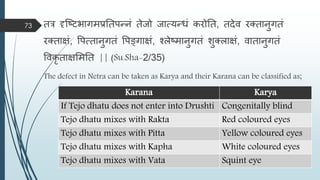
à€€à€° à€Šà„ƒà€žà„à€·à„à€Ÿà€­à€Ÿà€—à€żà€Șà„à€°à€€à€€à€Șà€šà„à€€à„à€šà€‚ à€€à„‡à€œà„‹ à€œà€Ÿà€€à„à€Żà€šà„à€€à„à€§à€‚ à€•à€°à„‹à€€à€€, à€€à€Šà„‡à€ż à€°à€•à„à€€à€Ÿà€šà„à€—à€€à€‚
à€°à€•à„à€€à€Ÿà€•à„à€·à€‚, à€”à€Șà€€à„à€€à€Ÿà€šà„à€—à€€à€‚ à€”à€Șà€™à„à€—à€Ÿà€•à„à€·à€‚, à€¶à„à€żà„‡à€·à„à€żà€Ÿà€šà„à€—à€€à€‚ à€¶à„à€•à„à€żà€Ÿà€•à„à€·à€‚, à€żà€Ÿà€€à€Ÿà€šà„à€—à€€à€‚
à€”à€żà€•à„ƒ à€€à€Ÿà€•à„à€·à€źà€żà€€à€€ || (Su.Sha-2/35)
The defect in Netra can be taken as Karya and their Karana can be classified as;
73
Karana Karya
If Tejo dhatu does not enter into Drushti Congenitally blind
Tejo dhatu mixes with Rakta Red coloured eyes
Tejo dhatu mixes with Pitta Yellow coloured eyes
Tejo dhatu mixes with Kapha White coloured eyes
Tejo dhatu mixes with Vata Squint eye
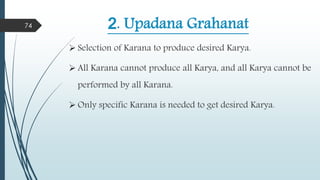
2. Upadana Grahanat
 Selection of Karana to produce desired Karya.
 All Karana cannot produce all Karya, and all Karya cannot be
performed by all Karana.
 Only specific Karana is needed to get desired Karya.
74
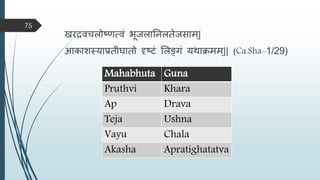
à€–à€°à€Šà„à€°à€żà€šà€żà„‹à€·à„à€Łà€€à„à€żà€‚ à€­à„‚à€œà€żà€Ÿà€€à€šà€żà€€à„‡à€œà€žà€Ÿà€żà„|
à€†à€•à€Ÿà€¶à€žà„à€Żà€Ÿà€Șà„à€°à€€à„€à€˜à€Ÿà€€à„‹ à€Šà„ƒà€·à„à€Ÿà€‚ à€źà€żà€™à„à€—à€‚ à€Żà€żà€Ÿà€żà€żà€żà„|| (Ca.Sha-1/29)
75
Mahabhuta Guna
Pruthvi Khara
Ap Drava
Teja Ushna
Vayu Chala
Akasha Apratighatatva
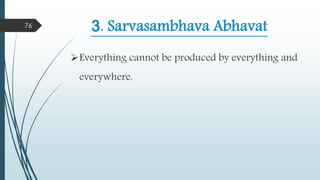
3. Sarvasambhava Abhavat
Everything cannot be produced by everything and
everywhere.
76
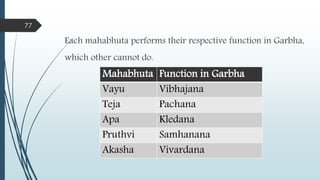
Each mahabhuta performs their respective function in Garbha,
which other cannot do.
77
Mahabhuta Function in Garbha
Vayu Vibhajana
Teja Pachana
Apa Kledana
Pruthvi Samhanana
Akasha Vivardana
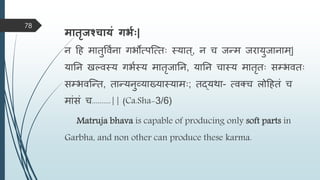
à€żà€Ÿà€€à„ƒà€œà€¶à„à€šà€Ÿà€Żà€‚ à€—à€­à€”à€ƒ|
à€š à€čà€č à€żà€Ÿà€€à„à€”à€żà€źà€šà€Ÿ à€—à€­à„‹à€€à„à€Șà€žà„à€€à„à€€à€Ÿà€ƒ à€žà„à€Żà€Ÿà€€à„, à€š à€š à€œà€šà„à€€à„à€ż à€œà€°à€Ÿà€Żà„à€œà€Ÿà€šà€Ÿà€żà„|
à€Żà€Ÿà€€à€š à€–à€Čà„à€żà€žà„à€Ż à€—à€­à€źà€žà„à€Ż à€żà€Ÿà€€à„ƒà€œà€Ÿà€€à€š, à€Żà€Ÿà€€à€š à€šà€Ÿà€žà„à€Ż à€żà€Ÿà€€à„ƒà€€à€Ÿà€ƒ à€žà€źà„à€­à€żà€€à€Ÿà€ƒ
à€žà€źà„à€­à€żà€žà„à€šà„à€€à„à€€, à€€à€Ÿà€šà„à€€à„à€Żà€šà„à€”à„à€Żà€Ÿà€–à„à€Żà€Ÿà€žà„à€Żà€Ÿà€żà€Ÿà€ƒ; à€€à€Šà„à€Żà€żà€Ÿ- à€€à„à€żà€•à„à€š à€żà„‹à€čà€čà€€à€‚ à€š
à€żà€Ÿà€‚à€žà€‚ à€š..........|| (Ca.Sha-3/6)
Matruja bhava is capable of producing only soft parts in
Garbha, and non other can produce these karma.
78
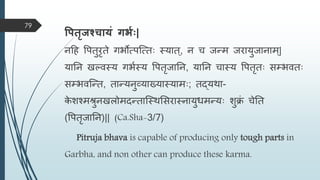
à€”à€Șà€€à„ƒà€œà€¶à„à€šà€Ÿà€Żà€‚ à€—à€­à€”à€ƒ|
à€šà€čà€č à€”à€Șà€€à„à€°à„ƒà€€à„‡ à€—à€­à„‹à€€à„à€Șà€žà„à€€à„à€€à€Ÿà€ƒ à€žà„à€Żà€Ÿà€€à„, à€š à€š à€œà€šà„à€€à„à€ż à€œà€°à€Ÿà€Żà„à€œà€Ÿà€šà€Ÿà€żà„|
à€Żà€Ÿà€€à€š à€–à€Čà„à€żà€žà„à€Ż à€—à€­à€źà€žà„à€Ż à€”à€Șà€€à„ƒà€œà€Ÿà€€à€š, à€Żà€Ÿà€€à€š à€šà€Ÿà€žà„à€Ż à€”à€Șà€€à„ƒà€€à€Ÿà€ƒ à€žà€źà„à€­à€żà€€à€Ÿà€ƒ
à€žà€źà„à€­à€żà€žà„à€šà„à€€à„à€€, à€€à€Ÿà€šà„à€€à„à€Żà€šà„à€”à„à€Żà€Ÿà€–à„à€Żà€Ÿà€žà„à€Żà€Ÿà€żà€Ÿà€ƒ; à€€à€Šà„à€Żà€żà€Ÿ-
à€•
à„‡ à€¶à€¶à„à€żà€żà„à€šà€–à€żà„‹à€żà€Šà€šà„à€€à„à€€à€Ÿà€žà„à€žà„à€żà€źà€žà€°à€Ÿà€žà„à€šà€Ÿà€Żà„à€§à€żà€šà„à€€à„à€Żà€Ÿà€ƒ à€¶à„à€ż
à€‚ à€šà„‡à€€à€€
(à€”à€Șà€€à„ƒà€œà€Ÿà€€à€š)|| (Ca.Sha-3/7)
Pitruja bhava is capable of producing only tough parts in
Garbha, and non other can produce these karma.
79
4. Shaktasya Shakya Karanat
Specific Karana can perform specific Karya.
Their Karya cannot be performed by another Karana.
80
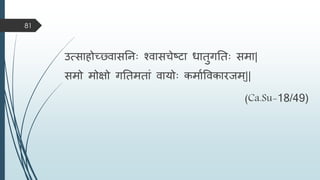
à€‰à€€à„à€žà€Ÿà€čà„‹à€šà„à„à€żà€Ÿà€žà€€à€šà€Ÿà€ƒ à€¶à„à€żà€Ÿà€žà€šà„‡à€·à„à€Ÿà€Ÿ à€§à€Ÿà€€à„à€—à€€à€€à€Ÿà€ƒ à€žà€żà€Ÿ|
à€žà€żà„‹ à€żà„‹à€•à„à€·à„‹ à€—à€€à€€à€żà€€à€Ÿà€‚ à€żà€Ÿà€Żà„‹à€Ÿà€ƒ à€•à€żà€Ÿà€źà€”à€żà€•à€Ÿà€°à€œà€ż à„||
(Ca.Su-18/49)
81
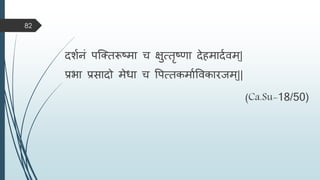
à€Šà€¶à€źà€šà€‚ à€Șà€žà„à€•à„à€€à€°à„‚à€·à„à€żà€Ÿ à€š à€•à„à€·à„à€€à„à€€à„ƒà€·à„à€Łà€Ÿ à€Šà„‡à€čà€żà€Ÿà€Šà€źà€żà€ż à„|
à€Șà„à€°à€­à€Ÿ à€Șà„à€°à€žà€Ÿà€Šà„‹ à€żà„‡à€§à€Ÿ à€š à€”à€Șà€€à„à€€à€•à€żà€Ÿà€źà€”à€żà€•à€Ÿà€°à€œà€ż à„||
(Ca.Su-18/50)
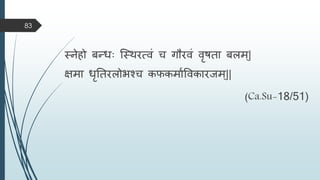
82
à€žà„à€šà„‡à€čà„‹ à€Źà€šà„à€€à„à€§à€Ÿà€ƒ à€žà„à€žà„à€żà€°à€€à„à€żà€‚ à€š à€—à„Œà€°à€żà€‚ à€żà„ƒà€·à€€à€Ÿ à€Źà€żà€ż à„|
à€•à„à€·à€żà€Ÿ à€§à„ƒà€€à€€à€°à€żà„‹à€­à€¶à„à€š à€•à€«à€•à€żà€Ÿà€źà€”à€żà€•à€Ÿà€°à€œà€ż à„||
(Ca.Su-18/51)
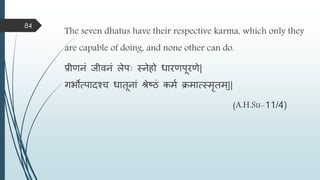
83
The seven dhatus have their respective karma, which only they
are capable of doing, and none other can do.
à€Șà„à€°à„€à€Łà€šà€‚ à€œà„€à€żà€šà€‚ à€żà„‡à€Șà€Ÿà€ƒ à€žà„à€šà„‡à€čà„‹ à€§à€Ÿà€°à€Łà€Șà„‚à€°à€Łà„‡|
à€—à€­à„‹à€€à„à€Șà€Ÿà€Šà€¶à„à€š à€§à€Ÿà€€à„‚à€šà€Ÿà€‚ à€żà„‡à€·à„à€ à€‚ à€•à€żà€ź à€żà€żà€Ÿà€€à„à€žà„à€żà„ƒà€€à€żà„||
(A.H.Su-11/4)
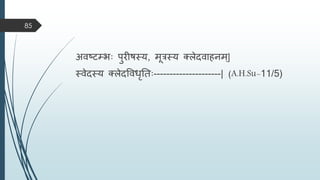
84
à€…à€żà€·à„à€Ÿà€źà„à€­à€Ÿà€ƒ à€Șà„à€°à€Łà€·à€žà„à€Ż, à€żà„‚à€°à€žà„à€Ż à€•à„à€żà„‡à€Šà€żà€Ÿà€čà€šà€żà„|
à€žà„à€żà„‡à€Šà€žà„à€Ż à€•à„à€żà„‡à€Šà€”à€żà€§à„ƒà€€à€€à€Ÿà€ƒ---------------------| (A.H.Su-11/5)
85
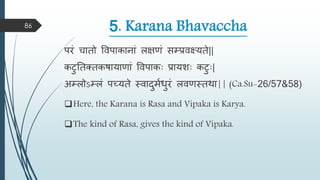
5. Karana Bhavaccha
à€Șà€°à€‚ à€šà€Ÿà€€à„‹ à€”à€żà€Șà€Ÿà€•à€Ÿà€šà€Ÿà€‚ à€żà€•à„à€·à€Łà€‚ à€žà€źà„à€Șà„à€°à€żà€•à„à€·à„à€źà€Żà€€à„‡||
à€•à€Ÿà„à€€à€€à€•à„à€€à€•à€·à€Ÿà€Żà€Ÿà€Łà€Ÿà€‚ à€”à€żà€Șà€Ÿà€•à€Ÿà€ƒ à€Șà„à€°à€Ÿà€Żà€¶à€Ÿà€ƒ à€•à€Ÿà„à€Ÿà€ƒ|
à€…à€źà„à€żà„‹à€œà€źà„à€żà€‚ à€Șà€šà„à€Żà€€à„‡ à€žà„à€żà€Ÿà€Šà„à€żà€źà€§à„à€°à€‚ à€żà€żà€Łà€žà„à€€à€żà€Ÿ|| (Ca.Su-26/57&58)
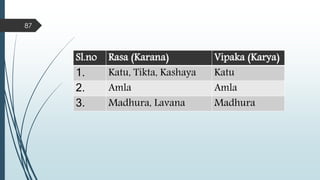
Here, the Karana is Rasa and Vipaka is Karya.
The kind of Rasa, gives the kind of Vipaka.
86
Sl.no Rasa (Karana) Vipaka (Karya)
1. Katu, Tikta, Kashaya Katu
2. Amla Amla
3. Madhura, Lavana Madhura
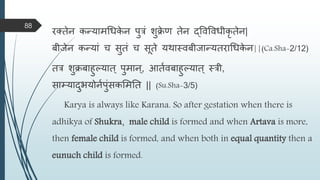
87
à€°à€•à„à€€à„‡à€š à€•à€šà„à€€à„à€Żà€Ÿà€żà€§à€§à€•
à„‡ à€š à€Șà„à€°à€‚ à€¶à„à€ż
à„‡ à€Ł à€€à„‡à€š à€Šà„à€”à€żà€”à€żà€§à„€à€•à„ƒ à€€à„‡à€š|
à€Źà„€à€œà„‡à€š à€•à€šà„à€€à„à€Żà€Ÿà€‚ à€š à€žà„à€€à€‚ à€š à€žà„‚à€€à„‡ à€Żà€żà€Ÿà€žà„à€żà€Źà„€à€œà€Ÿà€šà„à€€à„à€Żà€€à€°à€Ÿà€§à€§à€•
à„‡ à€š||(Ca.Sha-2/12)
à€€à€° à€¶à„à€żà€Źà€Ÿà€čà„à€Čà„à€Żà€Ÿà€€ à„ à€Șà„à€żà€Ÿà€š à„, à€†à€€à€źà€żà€Źà€Ÿà€čà„à€Čà„à€Żà€Ÿà€€ à„ à€žà„à€°à„€,
à€žà€Ÿà€źà„à€Żà€Ÿà€Šà„à€­à€Żà„‹à€šà€źà€Șà„à€‚à€žà€•à€źà€żà€€à€€ || (Su.Sha-3/5)
Karya is always like Karana. So after gestation when there is
adhikya of Shukra, male child is formed and when Artava is more,
then female child is formed, and when both in equal quantity then a
eunuch child is formed.
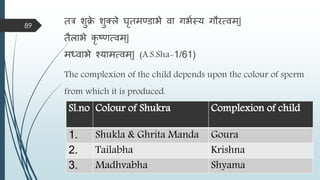
88
à€€à€° à€¶à„à€ż
à„‡ à€¶à„à€•à„à€żà„‡ à€˜à„ƒà€€à€żà€Łà„à€Ąà€Ÿà€­à„‡ à€żà€Ÿ à€—à€­à€źà€žà„à€Ż à€—à„Œà€°à€€à„à€żà€żà„|
à€€à„ˆà€żà€Ÿà€­à„‡ à€•à„ƒ à€·à„à€Łà€€à„à€żà€żà„|
à€żà€§à€żà€Ÿà€­à„‡ à€¶à„à€Żà€Ÿà€żà€€à„à€żà€żà„| (A.S.Sha-1/61)
The complexion of the child depends upon the colour of sperm
from which it is produced.
89
Sl.no Colour of Shukra Complexion of child
1. Shukla & Ghrita Manda Goura
2. Tailabha Krishna
3. Madhvabha Shyama
Applied Aspect of Satkaryavada in
Ayurveda
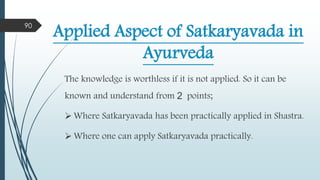
The knowledge is worthless if it is not applied. So it can be
known and understand from 2 points;
 Where Satkaryavada has been practically applied in Shastra.
 Where one can apply Satkaryavada practically.
90
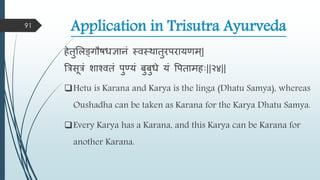
Application in Trisutra Ayurveda
à€čà„‡à€€à„à€źà€żà€™à„à€—à„Œà€·à€§à€žà€Ÿà€šà€‚ à€žà„à€żà€žà„à€żà€Ÿà€€à„à€°à€Șà€°à€Ÿà€Żà€Łà€żà„|
à€€à„à€°à€°à€žà„‚à€°à€‚ à€¶à€Ÿà€¶à„à€żà€€à€‚ à€Șà„à€Łà„à€Żà€‚ à€Źà„à€Źà„à€§à„‡ à€Żà€‚ à€”à€Șà€€à€Ÿà€żà€čà€Ÿà€ƒ||à„šà„Ș||
Hetu is Karana and Karya is the linga (Dhatu Samya), whereas
Oushadha can be taken as Karana for the Karya Dhatu Samya.
Every Karya has a Karana, and this Karya can be Karana for
another Karana.
91
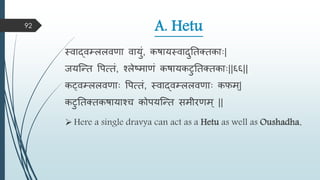
A. Hetu
à€žà„à€żà€Ÿà€Šà„à€żà€źà„à€żà€żà€żà€Łà€Ÿ à€żà€Ÿà€Żà„à€‚, à€•à€·à€Ÿà€Żà€žà„à€żà€Ÿà€Šà„à€€à€€à€•à„à€€à€•à€Ÿà€Ÿà€ƒ|
à€œà€Żà€žà„à€šà„à€€à„à€€ à€”à€Șà€€à„à€€à€‚, à€¶à„à€żà„‡à€·à„à€żà€Ÿà€Łà€‚ à€•à€·à€Ÿà€Żà€•à€Ÿà„à€€à€€à€•à„à€€à€•à€Ÿà€Ÿà€ƒ||à„Źà„Ź||
à€•à€Ÿà„à€żà€źà„à€żà€żà€żà€Łà€Ÿà€Ÿà€ƒ à€”à€Șà€€à„à€€à€‚, à€žà„à€żà€Ÿà€Šà„à€żà€źà„à€żà€żà€żà€Łà€Ÿà€Ÿà€ƒ à€•à€«à€żà„|
à€•à€Ÿà„à€€à€€à€•à„à€€à€•à€·à€Ÿà€Żà€Ÿà€¶à„à€š à€•à„‹à€Șà€Żà€žà„à€šà„à€€à„à€€ à€žà€żà„€à€°à€Łà€żà„ ||
 Here a single dravya can act as a Hetu as well as Oushadha.
92
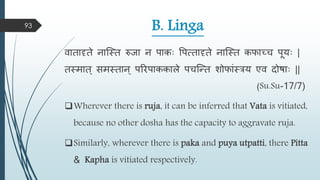
B. Linga
à€żà€Ÿà€€à€Ÿà€Šà„ƒà€€à„‡ à€šà€Ÿà€žà„à€žà„à€€ à€°à„à€œà€Ÿ à€š à€Șà€Ÿà€•à€Ÿà€ƒ à€”à€Șà€€à„à€€à€Ÿà€Šà„ƒà€€à„‡ à€šà€Ÿà€žà„à€žà„à€€ à€•à€«à€Ÿà€šà„à€š à€Șà„‚à€Żà€Ÿà€ƒ |
à€€à€žà„à€żà€Ÿà€€ à„ à€žà€żà€žà„à€€à€Ÿà€š à„ à€Șà€°à€°à€Șà€Ÿà€•à€•à€Ÿà€żà„‡ à€Șà€šà€žà„à€šà„à€€à„à€€ à€¶à„‹à€«à€Ÿà€‚à€žà„à€°à€Ż à€à€ż à€Šà„‹à€·à€Ÿà€Ÿà€ƒ ||
(Su.Su-17/7)
Wherever there is ruja, it can be inferred that Vata is vitiated,
because no other dosha has the capacity to aggravate ruja.
Similarly, wherever there is paka and puya utpatti, there Pitta
& Kapha is vitiated respectively.
93
C. Oushadha
à€žà€Ÿà€żà€Ÿà€šà„à€€à„à€Żà€‚ à€š à€”à€żà€¶à„‡à€·à€‚ à€š à€—à„à€Łà€Ÿà€š à„ à€Šà„à€°à€”à„à€Żà€Ÿà€Łà€Ł à€•à€żà€ź à€š||
à€žà€żà€żà€Ÿà€Żà€‚ à€š à€€à€œà„à€œà„à€žà€Ÿà€€à„à€żà€Ÿ à€€à€šà„à€€à„à€°à„‹à€•à„à€€à€‚ à€”à€żà€§à€§à€żà€Ÿà€žà„à€žà„à€żà€€à€Ÿà€Ÿà€ƒ|
(Ca.Su-1/28)
The main aim of Ayurveda is Dhatu samyata (Karya), and for
this Shatkaranas (Karana) are the necessary tools.
94
Utility of Satkaryavada in Ayurveda
In the previous section, the application of Satkaryavada in the
Shastra practically was dealt.
Now, Utility means how one can apply the content of subject
will be described.
The subject can be applied ;
 In Clinical practice
 In Pharmaceutics
 In Research
95
In Clinical Practice
à€Źà„à€”à€§à€Ÿà€ƒ à€Șà€¶à„à€Żà€€à€€ à€Żà€Ÿ à€­à€Ÿà€żà€Ÿà€š à„ à€Źà€čà„à€•à€Ÿà€°à€Łà€Żà„‹à€—à€œà€Ÿà€š à„|
à€Żà„à€žà„à€•à„à€€à€žà„à€žà„à€°à€•à€Ÿà€żà€Ÿ à€žà€Ÿ à€žà„‡à€Żà€Ÿ à€€à„à€°à€°à€żà€—à€źà€Ÿà€ƒ à€žà€Ÿà€§à€Żà€€à„‡ à€Żà€Żà€Ÿ|| (Ca.Su-11/25)
Yukti can be said as the intellect which is able to perceive the
consequences which occurs by the amalgamation of multiple
factors.
This intellect can be attained in past, future as well as present.
For the application of Yukti in Chikitsa, basically in selection
of drugs the principle of Satkaryavada is very useful.
96
à€€à€°, à€”à€żà€°à„‡à€šà€šà€Šà„à€°à€”à„à€Żà€Ÿà€Łà€Ł à€Șà„ƒà€§à€żà€”à„à€Żà€źà„à€Źà„à€—à„à€Łà€­à„‚à€€à€Żà€·à„à€ à€Ÿà€€à€š
à€żà€żà€šà€Šà„à€°à€”à„à€Żà€Ÿà€Łà„à€Żà€žà„à€—à„à€šà€żà€Ÿà€Żà„à€—à„à€Łà€­à„‚à€€à€Żà€·à„à€ à€Ÿà€€à€š || (Su.Su-41/6)
97
From one Karana, different Karya
(on the basis of Anupana)
A single drug can be used in different disease, along with different Anupana.
Narayana Churna (Sharangadhara Samhita, madhyama khanda 83-91)
In Adhmana – with Madya
In Gulma – with Badara Twak Kwatha
In Vitsanga – with Dadhi Mastu
In Ajeerna – with Ushna Jala
In Parikartika – with Vrikshamla
In Udararoga – with Takra
In Vatavyadhi – with Prasanna &
In Arshas – with Anardana
98
From one Karana, different Karya
(on the basis of Samyoga)
A single drug when used with different combn can produce different effects.
Like, Haritaki + Lavana = Kapha Nashaka
Haritaki + Sharkara = Pitta Nashaka
Haritaki + Ghrita = Vata Nashaka
Haritaki + Guda = Sarvaroga Nashaka
Similarly, Pippali + Madhu = Medakaphanashaka
Pippali + Guda = Jeernajwara, Agnimandya
99
From one Karana, different Karya
(on the basis of Samskara)
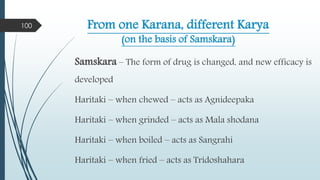
Samskara – The form of drug is changed, and new efficacy is
developed
Haritaki – when chewed – acts as Agnideepaka
Haritaki – when grinded – acts as Mala shodana
Haritaki – when boiled – acts as Sangrahi
Haritaki – when fried – acts as Tridoshahara
100
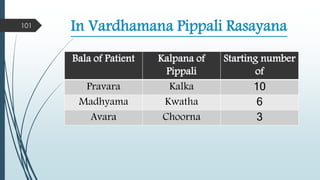
In Vardhamana Pippali Rasayana
Bala of Patient Kalpana of
Pippali
Starting number
of
Pravara Kalka 10
Madhyama Kwatha 6
Avara Choorna 3
101
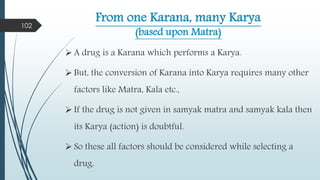
From one Karana, many Karya
(based upon Matra)
 A drug is a Karana which performs a Karya.
 But, the conversion of Karana into Karya requires many other
factors like Matra, Kala etc.,
 If the drug is not given in samyak matra and samyak kala then
its Karya (action) is doubtful.
 So these all factors should be considered while selecting a
drug.
102
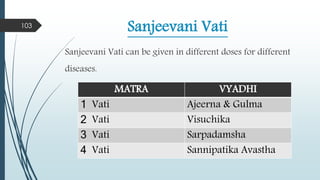
Sanjeevani Vati
Sanjeevani Vati can be given in different doses for different
diseases.
103
MATRA VYADHI
1 Vati Ajeerna & Gulma
2 Vati Visuchika
3 Vati Sarpadamsha
4 Vati Sannipatika Avastha
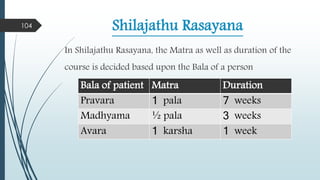
Shilajathu Rasayana
In Shilajathu Rasayana, the Matra as well as duration of the
course is decided based upon the Bala of a person
104
Bala of patient Matra Duration
Pravara 1 pala 7 weeks
Madhyama œ pala 3 weeks
Avara 1 karsha 1 week
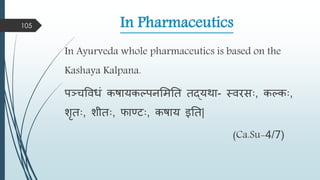
In Pharmaceutics
In Ayurveda whole pharmaceutics is based on the
Kashaya Kalpana.
à€Șà€žà„à€šà€”à€żà€§à€‚ à€•à€·à€Ÿà€Żà€•à€Čà„à€Șà€šà€źà€żà€€à€€ à€€à€Šà„à€Żà€żà€Ÿ- à€žà„à€żà€°à€žà€Ÿà€ƒ, à€•à€Čà„à€•à€Ÿà€ƒ,
à€¶à„ƒà€€à€Ÿà€ƒ, à€¶à„€à€€à€Ÿà€ƒ, à€«à€Ÿà€Łà„à€Ÿà€Ÿà€ƒ, à€•à€·à€Ÿà€Ż à€‡à€€à€€|
(Ca.Su-4/7)
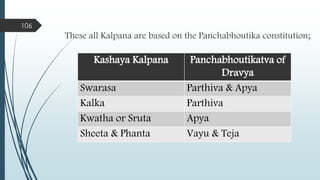
105
These all Kalpana are based on the Panchabhoutika constitution;
106
Kashaya Kalpana Panchabhoutikatva of
Dravya
Swarasa Parthiva & Apya
Kalka Parthiva
Kwatha or Sruta Apya
Sheeta & Phanta Vayu & Teja
In a nutshell, everything is not possible from
everything, only specific things can produce specific
materials.
107
In Research
The research is the establishment of the relation between the
Karana and Karya which can be established only after the
proper examination and evaluation.
For any kind of research a hypothesis is made.
108
All the clinical researches include a drug (Karana) and
disease. The effectiveness of the drug (Karana) in the resolving
or curing of disease (Karya) is observed.
For all these kind of research the drug chosen is on the basis
of Shat Karana.
A drug (Karana) is selected on the basis of its potency that it is
capable of producing an effect (Karya) & the research is
conducted to prove the hypothesis.
109
THANK YOU
110

KARYA-KARANA VADA

  • 1.
  • 2.
  • 3.
    INTRODUCTION à€Żà€€à€ƒ à€žà€°à„à€”à€Șà€Ÿà€°à€żà€·à€Šà€źà€żà€Šà€‚ à€¶à€Ÿà€žà„à€€à„à€°à€‚,à€€à„‡à€šà€Ÿà€Żà„à€°à„à„‡à€Šà€Ÿà€”à€°à„à€°à„à€Šà„à€§à€°à„à„ˆà€¶à„‡à€”à€·à€•à€žà€Ÿà€™à„à€–à„à€Żà€Ÿà€Šà€Šà€Šà€¶à€”à€šà€­à„‡à€Šà„‡à€š à€”à€°à„à€°à„à€Šà„à€§à€Ÿà€°à„à€„à„‹à€œà€źà€­à€§à„€à€Żà€żà€Ÿà€šà„‹ à€š à€Șà„‚à€°à„à€Ÿà€”à€Șà€żà€”à€°à„à€żà„‹à€§à€żà€Ÿà€°à„à€čà€€à„€à€€à„à€Żà€°à„à€„à€”à€ƒ| (Ca.Su-8/3 Chakrapani) Ayurveda Shastra is said to be “Sarvaparisada” which means Ayurveda being an independent Shastra has incorporated few concepts and fundamentals from different texts like Vedas, Upanishads, Darshana Shastra etc., Though the concepts are borrowed from texts as it is but, the purpose is being altered in Ayurveda as per the Prayojana (i.e., aim) 3
  • 4.
    Darshana thought beginsfrom the origin of this universe, and of Ayurveda also. Universe is nothing but modification of Guna. The modification is of Karana into Karya Anything in and off this world is produced by some Karana. Every karana (cause) has an Karya (effect), and this karya (effect) may be a karana (cause) for another karya (effect). Right from Srushti to evolvement of human being to Rogotpatti at each and every event Karya Karana Siddhanta can be found. 4
  • 5.
    The main Karyaof Ayurveda is attainment of Dhatu Samya and the Karanas used to produce this Karya are the Shat Padarthas. à€‡à€€à„à€Żà„à€•à„à€€à€‚ à€•à€Ÿà€°à€Łà€‚ à€•à€Ÿà€Żà€‚ à€§à€Ÿà€€à„à€žà€Ÿà€źà„à€Żà€źà€żà€čà„‹à€šà„à€Żà€€à„‡| à€§à€Ÿà€€à„à€žà€Ÿà€źà„à€Żà€•à„à€°à€żà€Żà€Ÿ à€šà„‹à€•à„à€€à€Ÿ à€€à€šà„à€€à„à€°à€žà„à€Żà€Ÿà€žà„à€Ż à€Șà„à€°à€Żà„‹à€œà€šà€żà„|| (Ca.Su-1/53) à€žà€Ÿà€żà€Ÿà€šà„à€€à„à€Żà€‚ à€š à€”à€żà€¶à„‡à€·à€‚ à€š à€—à„à€Łà€Ÿà€š à„ à€Šà„à€°à€”à„à€Żà€Ÿà€Łà€Ł à€•à€żà€ź à€š|| à€žà€żà€żà€Ÿà€Żà€‚ à€š à€€à€œà„à€œà„à€žà€Ÿà€€à„à€żà€Ÿ à€€à€šà„à€€à„à€°à„‹à€•à„à€€à€‚ à€”à€żà€§à€§à€żà€Ÿà€žà„à€žà„à€żà€€à€Ÿà€Ÿà€ƒ| (Ca.Su-1/28) 5
  • 6.
    The whole contextof Ayurveda i.e., the Triskandha / Trisutra siddhanta is based upon the Karya Karana Siddhanta. à€čà„‡à€€à„à€źà€żà€™à„à€—à„Œà€·à€§à€žà€Ÿà€šà€‚ à€žà„à€żà€žà„à€żà€Ÿà€€à„à€°à€Șà€°à€Ÿà€Żà€Łà€żà„| à€€à„à€°à€°à€žà„‚à€°à€‚ à€¶à€Ÿà€¶à„à€żà€€à€‚ à€Șà„à€Łà„à€Żà€‚ à€Źà„à€Źà„à€§à„‡ à€Żà€‚ à€”à€Șà€€à€Ÿà€żà€čà€Ÿà€ƒ||à„šà„Ș|| Here, Hetu is Karana to create the Karya, Linga. Where, Oushadha is again Karana to treat the Linga. 6
  • 7.
    The theory ofKarya Karana Siddhanta is accepted by all the sciences and philosophies, hence it is considered as Sarvatantra Siddhanta. But, regarding the mode of manifestation of Karya from Karana various postulations have been made. Some of the postulations are; Satkaryavada, Asatkaryavada, Parinamavada, Arambhavada, Paramanuvada, Vivartavada, Kshanabhanguravada, Swabhavavada, Pilupaka, Pitharapaka, Anekantavada, Swabhavoparamavada. 7
  • 8.
    KARANA BHEDA There arethree types of Karana as per Tarka Sangraha; 1. Samavayi Karana (Inherent or Intimate Cause) 2. Asamavayi Karana (Non inherent or Non intimate Cause) 3. Nimitta Karana (Instrumental Cause) 8
  • 9.
    SAMAVAYI KARANA (Inherent orIntimate Cause) The Karana which has an Samavaya Sambandha (inseparable relation) with Karya, means it is present before Karya and remains till the Karya exists i.e. the Karana and Karya are interrelated. This karana is very important in the production or manifestation of Karya & always exists with Karya. Samavayi Karana is also called as Upadana Karana. 9
  • 10.
    Destruction of Karyatakes place due to the destruction of its Upadana Karana. Dravya is the samavayi karana of Guna. Though the other causes like potter, weaver etc., will leave the Karya after its production but the Mruttika and Tantu exit in Ghata and Pata respectively until their destruction. Hence the cause which is not segregate until the destruction is called Samavayi Karana. Example: Mruttika & Tantu are the Samavayi Karana for Ghata & Vastra respectively. 10
  • 11.
  • 12.
    Example 2 : Theclay in a jar, the wood in a table or the threads in the piece of cloth is the material or constituent causes of jar, the table, the cloth respectively. Conclusion – therefore, the Karana which has an inseparable relation (samavaya sambandha) with Karya, means it is present before karya and remains till the karya exists. 12
  • 13.
    ASAMAVAYI KARANA (Non-Inherent orNon-Intimate Cause) It has been stated that the Karana which is inseparably united with the same object either with the Karya or with the Karana is called Asamavayi Karana. In other words, the Karana which partially and indirectly related to Karya. Karya cannot come into existence unless this factor is associated either with Karya or Karana. 13
  • 14.
    E.g., Samyoga ofTantu produces Vastra and Varna of the Tantu produces the Colourful cloth. If tantus are not united in an orderly manner Vastra is never produced.Hence the Samyoga of Tantu and the Varna of the Tantu to Vastra is the Asamavayi Karana. Samyoga of Kapala Dwaya (the association or assembling of both Kapalas) makes the Ghata & the Varna of the Kapala Dwaya forms the Varna of the Ghata.Here Kapala Dwaya Samyoga and Varna of the Ghata are the Asamavayi Karanas. 14
  • 15.
    In short, potis made up of 2 earthern portions (kapalas). Each earthern portion is the Samavayi Karana of the Pot (Karya). But the portions by themselves do not form the pot. Both these portions should be assembled or should get associated into a single unit so as to form the full pot i.e., Kapala Dwaya Samyoga is called Asamavayi Karana. Conclusion – Though Asamavayi karana itself is not Samavayi karana, it is closely connected with the karana. 15
  • 16.
    16 Samyoga of TantuVastra Varna of the Tantu Colourful Cloth
  • 17.
    17 Samyoga Of KapalaDwaya Ghata Varna of the Ghata
  • 18.
    NIMITTA KARANA (Instrumental Cause) Itis different from Samavayi and Asamavayi Karanas and it helps the Samavayi and Asamavayi Karana in the production of Karya. After production of Karya these karanas detach from Karya. Such karana is called as Nimitta Karana. 18
  • 19.
    Only Samavayi andAsamavayi karana are not sufficient, there are also other karanas which are useful indirectly are known as Nimitta Karana. This can be said as supportive factor for Karyotpatti. For instance, the viewer, the loom and the shuttle etc., are the Nimitta karana of Vastra. 19
  • 20.
  • 21.
    Theory of Karya– Karana Vada or Siddhanta ?  The theory of Karya – Karana is to be considered as a SIDDHANTA because the state of Karana as well Karya and their inter relationship is examined and accepted by all Darshana and Sciences.  But, the question arises then why it is called as Vada?  The answer to this is that there are different views in regard with state of Karya and Karana and it remains unanswered which came first Karya or Karana?  Just as there is a very famous puzzle which came first a hen or egg, and it remains as a puzzle only. 21
  • 22.
    SIGNIFICANCE OF KARYA& KARANA  Karya Karana Vada has been given utmost importance & accepted in Ayurveda.  From Srusti utpatti to Rogotpatti, Chikitsa everywhere Karana & Karya can be found and explained.  Ayurveda explains Rogotpatti, which is also linked with past deeds (Karmaphala).The karma done in poorvajanma is called as Daiva and in present is called as Purusha.  When these Daiva and Purusha becomes Vishama, then Rogotpatti occurs and When it is sama then Dhatusamyata occurs. 22
  • 23.
    Everything cannot beproduced by everything and everywhere. For example, every mahabhuta performs their respective functions in Garbha, which other cannot do. Vayu – Vibhajana Teja – Pachana, Apa – Kledana Pruthvi – Samhanana Akasha - Vivardhana 23
  • 24.
    Similarly, the SaptaDhatus have their respective karmas, which only they are capable of doing, & none other can do. Like, Rasa – Preenana, Rakta – Jeevana Mamsa – Lepana Meda – Snehana Asthi – Dharana Majja – Poorana & Sukra – Garbhotpadana. 24
  • 25.
    In the fieldof Nidana The knowledge of Hetu (nidana) is helpful in Nidana Parivarjana, the first line of treatment of any vyadhi. The lakshanas provides actual value or status of Doshas, based on their Gunas according to which the Chikitsa is planned. The Chikitsa is Samprapti Vighatana, which is Known as manifestation of disease i.e., Samprapti. 25
  • 26.
    In the manifestationof the Vyadhi Dosha Vaishamya – Samavayi Karana Dosha Dushya Sammurchana – Asamavayi Karana Mithya Ahara and Vihara – Nimitta Karana 26
  • 27.
    In Chikitsa As themain aim of tantra is; à€§à€Ÿà€€à„à€žà€Ÿà€źà„à€Żà€•à„à€°à€żà€Żà€Ÿ à€šà„‹à€•à„à€€à€Ÿ à€€à€šà„à€€à„à€°à€žà„à€Żà€Ÿà€žà„à€Ż à€Șà„à€°à€Żà„‹à€œà€šà€żà„|| (Ca.Su-1/53)  So as to attain the Dhatu Samyata (Karya) the Chikitsa Chatushpada (Karana) is necessary.  The Chikitsa Chatushpada are Bhishak, Dravya (oushadha), Upastha and Rogi.  Among which the Bhishak & Dravya are Samavayi Karana for the Karya and Upastha is Nimitta Karana and the Rogi is the Karya Desha. 27
  • 28.
    Cause for everyKarya in Srushti According to Acharya Charaka, Samanya, Visesha, Guna, Dravya, Karma & Samavaya are the causative factors for the whole universe or these are six such factors which are responsible for everything in this universe and hence known as Shat-Karanas. 28
  • 29.
    Karanas for VyadhiUtpatti In Ayurveda, 4 types of karana for Vyadhi Utpatti are described; 1. Sannikrushta Nidana (Instant Causes) 2. Viprakrushta Nidana (Distant Cause) 3. Vyabhichari Nidana (Unable Cause) 4. Pradhanika Nidana (Prominent Cause) 29
  • 30.
    Other 3 karanasfor Vyadhi Utpatti 1. Asatmyendriyartha Samyoga 2. Prajnaparadha & 3. Parinama 30
  • 31.
    Other 3 Karanasare; 1. Dosha Hetu 2. Vyadhi Hetu & 3. Ubhaya Hetu 31
  • 32.
    VADA à€€à€° à€żà€Ÿà€Šà„‹ à€šà€Ÿà€żà€ž à€Żà€€ à„ à€Șà€°à„‡à€Ł à€žà€č à€¶à€Ÿà€žà„à€°à€Șà„‚à€żà€źà€• à€‚ à€”à€żà€—à„ƒà€čà„à€Ż à€•à€żà€Żà€€à€€| à€ž à€š à€Šà„à€”à€żà€”à€żà€§à€Ÿà€ƒ à€žà€™à„à€°à€čà„‡à€Ł- à€œà€Čà„à€Șà€Ÿà€ƒ, à€”à€żà€€à€Łà„à€Ąà€Ÿ à€š| à€€à€° à€Șà€•à„à€·à€Ÿà€§à€żà€€à€Żà„‹à€żà€źà€šà€šà€‚ à€œà€Čà„à€Șà€Ÿà€ƒ, à€œà€Čà„à€Șà€”à€żà€Șà€Żà€źà€Żà„‹ à€”à€żà€€à€Łà„à€Ąà€Ÿ| à€”à€żà€€à€Łà„à€Ąà€Ÿ à€šà€Ÿà€ż à€Șà€°à€Șà€•à„à€·à„‡ à€Šà„‹à€·à€żà€šà€šà€żà€Ÿà€°à€żà„‡à€ż||à„šà„ź|| 32
  • 33.
    A hostile discussionwith an opponent based on shastra is called Vada. It is of two types. Viz., Jalpa & Vitanda. In Jalpa, establishment of one’s own view with logical reasoning / argument is done. In Vitanda, not only contradicting the opponent’s view but also not establishing one’s own view. 33
  • 34.
    Where one canget the conclusion of a demonstrated truth / elements is called Vada. (Nyaya.Sutra-2/1) 34
  • 35.
    Vada is understoodfrom following 4 technical words; (Nyaya.Sutra-2/1) 1. Pramana tarka sadhanopalambha: means establishment of one’s own demonstrated truth through Pramana & Tarka & at the same time contra-indicating the other’s view by the same Pramana & Tarka is called Vada. 2. Siddhanta viruddha means that which is not contrary / opposite to illustration is called Vada. 35
  • 36.
    3. Panchavayava upapanna meanswhich is processed with Panchavayava vakya. 4. Paksha pratipaksha parigraho Vadah The presence of contrary / opposite nature / quality of a particular subject is the creator of one’s own view & opponent. 36
  • 37.
    The presence ofcontrary quality of different subject matter does not quote as Paksha & Pratipaksha. As example – The presence of soul is one’s view & the absence of soul is the opponent view. Here the word ‘presence’ & ’absence’ is described in a particular subject matter i.e., in reference of the soul. Thus this is Paksha & Pratipaksha. 37
  • 38.
    VADA’s  Satkaryavada  Asatkaryavada Parinamavada  Arambhavada  Paramanuvada  Vivartavada  Kshanabhanguravada  Swabhavavada  Pilupaka  Pitharapaka  Anekantavada  Swabhavoparamavada 38
  • 39.
  • 40.
    INTRODUCTION  Ayurveda isthe science of normal & abnormal state of body & mind.  It is a philosophy to achieve the goals of life and beyond life.  So, Ayurveda has established on some philosophical backgrounds especially Saddarshanas of India.  Ayurveda has applied the Sad-darshanas from health & clinical point of view.  The Karya-Karana vada & Satkaryavada are the basis of Ayurveda. 40
  • 41.
     The conceptwas proposed by Sankhya philosopher & followed by its commentators.  They denied the difference between cause & effect.  As they stated that effect is the much expressed form of cause only.  Ayurveda has applied this theory in reference of Garbha Vikasa which becomes as genetic theory of Ayurveda.  The six different bhavas for formation of ‘Garbha’ are based on Satkaryavada. 41
  • 42.
    The six darshanacan be divided into set of three, means each pair of two is complimentary to each other;  the Nyaya-Vaisheshika darshana,  the Sankhya-Yoga darshana, &  the Meemamsa-Vedanta darshana. 42
  • 43.
    The views ofall these six darshanas on the Srushti utpatti can be summarized into two; 1. Satkaryavada (pre-existence of the effect in the cause): It maintains that Karya (effect) is sat or real. It is present in the Karana (cause) in a potential form, even before its manifestation. 2. Asatkaryavada (non-existence of the effect in the cause): It maintains that Karya (effect) is Asat or unreal until it comes into being. Every effect, then is a new begining and is not born out of cause. 43
  • 44.
    Concept of Satkaryavadaas per Sankhya Darshana  Satkaryavada is laid down by Sankhya school of thought.  This Siddhanta states “Karya is present in Karana in unmanifested form”.  Karya remains present in subtle form in Karana before manifestation, and after manifestation it becomes gross.  Karana is gross before manifestation of Karya, and becomes subtle in Karya after manifestation. 44
  • 45.
    Karana Karya (Beforemanifestation) (Gross) (subtle) Karya Karana (After manifestation) (Gross) (Subtle) For eg- Seed (Karana) Tree (Karya) (Before manifestation) (Gross) (Subtle) Tree (Karya) Seed (Karana) (After manifestation) (Gross) (Subtle) 45
  • 46.
    Satkaryavada in SrushtiUtpatti  The Srushti Utpatti described by Acharya Sushruta is the same as described in Sankhya Darshana, with a single difference.  The Srushti involves 25 Tattva, which starts with the “Prakriti”.  This Prakriti, which is Karana of Srushti Utpatti, is Trigunatmaka.  The other 24 Tattva which are evolved from the Prakriti are also Trigunatmaka.  The whole world comprises of matter which are Panchabhoutika, which are nothing but the modification of Triguna. 46
  • 47.
    Satkaryavada states Karyaremains present in Karana in unmanifested state, so when it Karya gets manifested it has the essence of Karana. This is base of description of Satkaryavada in Srushti. All the evolutes of Prakriti are Trigunatmaka. 47
  • 48.
    Sankhya’s 25 Tattvaof Srushti are;  Prakriti  Mahat  Ahankara  Panchatanmatra & Panchamahabhuta  Ekadasha Indriya – 5 Jnanedriya + 5 Karmendriya + Manas These are 24 Tattva, & the initiator of this process is the 25th Tattva i.e., Purusha. 48
  • 49.
    Sankhya divides these25 Tattva into four categories on the basis of Karya and Karana –  The root product is called the Parkriti, they are Karana for manifestation of Srushti.  Prakriti & Vikriti – these are seven in number and are the nature of both productive and produced, they are Karya as well as Karana.  Vikriti – Ekadasha indriyas and Panchamahabhuta are non-productive but produced, these are Karyas but cannot be Karana.  Neither Prakriti nor Vikriti – Purusha is neither produced nor productive, this is neither Karya nor Karana. 49
  • 50.
    These 25 Tattvascan be divided into Avyakta and Vyakta also. Moola Prakriti is Avyakta , rest 23 are Vyakta while Purusha is neither Avyakta nor Vyakta. 50
  • 51.
    Etymology of wordSatkaryavada The word “Satkaryavada” is made up by three words Sat, Karya and Vada. Sat – Streelinga Shabda, made up of ‘As’ dhatu shatru pratyaya. Different meaning according to Amarakosha: Satye, Sadhou, Pujithe, Dheere, Prashaste, Vidyamane etc., But here in the present context, ‘Vidyamane’ is considered. Sat – Being, existing, existent The term ‘Sat’ implies something whose positive existence is established for all times i.e., past, present and future and which is a subject of examination. à€žà€Šà€Šà€€à€€ à€”à€°à„à€§à€§à€”à€°à„à€·à€Żà€Șà„à€°à€żà€Ÿà€Łà€—à€źà„à€Żà€‚ à€­à€Ÿà€°à„à€°à„‚à€Șà€żà„(Ca.Su-11/17 Chakrapani) 51
  • 52.
    Karya – whatought to be done, made, performed. Vada – Pulinga shabda, made up of ‘Vad’ dhatu and ‘ghan’pratyaya. Vada – Talking, speaking, speech words Narration, account Demonstrated conclusion, theory, doctrine. But here in the present context, demonstrated conclusion, theory is considered. 52
  • 53.
    Definition of Satkaryavada Thetheory states that “Karya is present in Karana in unmanifested form”. Before the operation of cause, the effect is existent in latent form in cause. Only the manifestation of cause is mandatory for appearance of effect. Karya remains present in subtle form in Karana, prior to its manifestation. After manifestation the Karya becomes gross, and Karana subtle. 53
  • 54.
    Example – Oilpresent in seeds, but without applying pressure it do not appear, similarly, rice is present in paddy but requires thumping to come into sight and same holds true with the Milk. Milk is present in Cow, but unless milking is done they cannot emerge. These examples support the fact that Karya are present in Karana, before existence, only the operation of cause is required for their appearances. 54
  • 55.
    Glimpse of Humanlife cycle Fertilized egg (zygote) Foetus Baby (infant) Toddler Adolescent Adult Old age Death  These are the various stages of human life cycle. Each stage is the mainfested state of preceding and unmanifested state of succeeding stage.  The Changes are occuring in one only, but as matter of time, state, and condition they appear different.  Like the baby is only changing to toddler and then to adolescent, or in other words toddler is present in ‘Avyakta’ avastha in baby, as time passes it becomes ‘Vykata’ in form of toddler. 55
  • 56.
    Different avasthas ofAmra phala  The fruit of Mango has different tastes at different stages.  Like it is Kashaya-Amla in Balavastha, it becomes Amla in Ardhapakwa avastha and finally Madhura when it is totally Pakwa avastha.  Madhura rasa which is the final rasa of Mango is present since Bala, but appears in appropriate time, state and condition.  Based on above examples it can be stated before manifestation “Karya” is subtle in “Karana” and after manifestation the “Karana” becomes subtle in “Karya”. 56
  • 57.
     Regarding theKarya-Karana Vada, Sankhya philosophy presents its view in form of Satkaryavada.  Satkaryavada is based on five syllogisms.  This theory believes that only Sat karana (existent cause) can produce Karya.  In other words it could be said that Karya remains present in Karana in Unmanifested form. 57
  • 58.
    Hetu of Satkaryavada Infavour of the theory of ‘Satkaryavada’ some arguments were given and it was explained with the help of 05 analogies, described in Sankhyatattvakaumudi as follows: 1. Asat Akaranat 2. Upadana grahanat 3. Sarvasambhava abhavat 4. Shaktasya shakya karanat 5. Karana Bhavaccha 58
  • 59.
    1. Asat Akaranat “Asat Akaranat” which depicts that Asat (non-existent) things by any means cannot be brought into existence.  A non entity can never be made an entity i.e., that which has never existed can never be brought into existence.  For example – Oil cannot be produced by Sands, as it is not present in it any form.  An existent thing be it in Avyakta or Vyakta form can only produce another existent thing. 59
  • 60.
    Acharya Charaka alsosupports the fact; .........à€šà€Ÿà€™à„à€• à„ à€°à„‹à€€à„à€Șà€žà„à€€à„à€€à€°à€Źà„€à€œà€Ÿà€€à„ (Ca.Su-11/32)  There could not be germination of plant without seed.  Without Karana, Karya cannot be produced. .............. à€šà€Ÿà€šà„à€€à„à€Żà€žà„à€żà€Ÿà€Šà„à€Źà„€à€œà€Ÿà€Šà€šà„à€€à„à€Żà€žà„à€Żà„‹à€€à„à€Șà€žà„à€€à„à€€à€Ÿà€ƒ | (Ca.Su-11/32)  Seed of a particular plant produces that specific plant and not another,  Showing a specific interrelationship between Karana and Karya. 60
  • 61.
    2. Upadana Grahanat (selectionof a causative material for the effect)  For the manifestation of Karya from Karana assured specific materials are required.  “Upadana” stands for cause and “Grahana” means selecting the cause for desired effect.  For example – when one requires curd, he opt for milk and not hot water, this shows cause and effect has certain relation. 61
  • 62.
    3. Sarvasambhava abhavat Everything cannot be produced by everything or everywhere, because all Karana cannot produce all Karya and Karya cannot be produced by all Karana.  Only specific Karana can produce specific Karya.  For example – Just like, Gold cannot be produced by Silver, dust or Sand. 62
  • 63.
    4. Shaktasya ShakyaKaranat  Potent thing can produces that for which it is capable of.  For example – like a potter by means of mud, wheel, threads of rags, water etc., can produce pot, because mud has the potency or capability for the production of pot. Acharya Charaka also supports the statement; à€…à€ż à€žà€źà„à€­à€żà€Ÿà€ƒ- à€Żà„‹ à€Żà€€à€Ÿà€ƒ à€žà€źà„à€­à€żà€€à€€ à€ž à€€à€žà„à€Ż à€žà€źà„à€­à€żà€Ÿà€ƒ; à€Żà€żà€Ÿ- à€·à€Ąà„à€§à€Ÿà€€à€żà„‹ à€—à€­à€źà€žà„à€Ż, à€”à„à€Żà€Ÿà€§à„‡à€°à€čà€čà€€à€‚, à€čà€čà€€à€żà€Ÿà€°à„‹à€—à„à€Żà€žà„à€Żà„‡à€€à€€|| (Ca.Su-8/49) 63
  • 64.
    5. Karana Bhavaccha The production bears the nature from where it is produced; Whatever is the nature of cause, the same is the nature of effect or production.  For example – Barley produces Barley, and Rice produces Rice, if the effect were not existent in the cause, then Barley would have been produced by Kodrava, but that does not happen.  So, effect is existent in cause before operation. 64
  • 65.
     These allfive factors are the supporting factors which prove the theory of Satkaryavada.  Actually the means and the production do not differ, they are same.  The unmanifested stage called means and the manifested stage of the same is called production or creation.  For example – the lump of clay and gold are means, pot and ornaments are production. 65
  • 66.
    Satkaryavada in Ayurveda Satkaryavadahas been given utmost importance in Ayurveda. From Srushti Utpatti to Rogotpatti, Chikitsa everywhere Karana and Karya can be found and explained. Sankhya describes five hetus in the support of the vada. Satkaryavada in Ayurveda can also be explained under the headings of these five hetus. 66
  • 67.
    1. Asat Karanat à€šà€čà„à€Żà„‡à€•à„‹ à€żà€€à€źà€€à„‡ à€­à€Ÿà€żà„‹ à€żà€€à€źà€€à„‡ à€šà€Ÿà€Șà„à€Żà€čà„‡à€€à„à€•à€Ÿà€ƒ| à€¶à„€à€˜à„à€°à€—à€€à„à€żà€Ÿà€€à„à€žà„à€żà€­à€Ÿà€żà€Ÿà€€à„à€€à„à€żà€­à€Ÿà€żà„‹ à€š à€”à„à€Żà€€à€€à€żà€€à€źà€€à„‡||à„«à„ź|| (Ca.Sha-1/48) There is no any bhava without a Karana. Whatever is being produced or present always has a Karana. 67
  • 68.
    à€Šà„ˆà€żà€‚ à€Șà„à€°à€Ÿ à€Żà€€à„ à€•à„ƒ à€€à€żà„à€šà„à€Żà€€à„‡ à€€à€€ à„ à€€à€€ à„ à€Șà„Œà€°à„à€·à€‚ à€Żà€žà„à€€à„à€€à„à€żà€č à€•à€żà€ź à€Šà„ƒà€·à„à€Ÿà€żà„| à€Șà„à€°à€żà„ƒà€žà„à€€à„à€€à€čà„‡à€€à„à€”à€żà€źà€·à€żà€Ÿà€ƒ à€ž à€Šà„ƒà€·à„à€Ÿà„‹ à€€à€šà€żà„ƒà€žà„à€€à„à€€à€čà„‡à€€à„à€čà€čà€ź à€žà€żà€Ÿà€ƒ à€ž à€à€ż|| (Ca.Sha-2/44) Ayurveda explains Rogotpatti, which is also linked with past deeds (Karmaphala).The karma done in poorvajanma is called as Daiva and in present is called as Purusha. When these Daiva and Purusha becomes Vishama, then Rogotpatti occurs and When it is sama then Dhatusamyata occurs. 68
  • 69.
    à€žà€€à€Ÿà€‚ à€­à€Ÿà€żà€Ÿà€šà€Ÿà€żà€źà€­à€”à„à€Żà€žà„à€•à„à€€à€°à€°à€€à€€ à€žà€Ÿà€€à„à€żà€Ÿ,à€• à„‡ à€żà€żà€‚ à€žà„Œà€•à„à€·à„à€źà€źà„à€Żà€Ÿà€šà„à€€à„à€šà€Ÿà€źà€­à€”à„à€Żà€œà„à€œà„à€Żà€€à„‡; à€ž à€à€ż à€”à€żà€żà„ƒà€€à€Șà€°à€• à„‡ à€¶à€°à„‡ à€Șà„à€·à„à€Șà„‡ à€•à€Ÿà€żà€Ÿà€šà„à€€à„à€€à€°à„‡à€Łà€Ÿà€źà€­à€”à„à€Żà€žà„à€•à„à€€à€‚ à€—à€šà„à€›à€€à€€; à€à€żà€‚ à€Źà€Ÿà€żà€Ÿà€šà€Ÿà€żà€”à€Ș à€żà€Żà€Ÿà€ƒà€Șà€°à€°à€Łà€Ÿà€żà€Ÿà€šà„à€› à„ à€żà€Șà„à€°à€Ÿà€Šà„à€­à€Ÿà€źà€żà„‹ à€­à€żà€€à€€, à€°à„‹à€żà€°à€Ÿà€œà„à€œà„à€Żà€Ÿà€Šà€Żà€¶à„à€š à€”à€żà€¶à„‡à€·à€Ÿ à€šà€Ÿà€°à€Łà€Łà€Ÿà€żà„ || (Su.Su-14/18) à€žà€€à€Ÿà€‚ à€­à€Ÿà€°à„à€Ÿà€šà€Ÿà€żà€źà€­à€”à„à€Żà€•à„à€€à€€à€°à€żà€€à€€ à€œà„à€žà€Ÿà€€à„à€°à„à„‡à€€à€€; à€Șà„‚à€°à„à€‚ à€žà€šà„à€€ à€à€°à„ à€­à€Ÿà€°à„à€Ÿà€ƒ à€Șà€¶à„à€šà€Ÿà€Šà„à€§à„‡à€€à„à€żà€Ÿà€žà€Ÿà€Šà„à€Żà€Ÿà€źà€­à€”à„à€Żà€œà„à€Żà€šà„à€€à„‡ (Acharya Dalhana)  Secondary sexual characters are present in child since birth in unmanifested form. Due to kala these characters get manifested.  Since, Shukra and Roma were present before birth in latent form, and appears only at the appropriate vaya. 69
  • 70.
    à€ž à€žà€żà€źà€—à„à€Łà€żà€Ÿà€šà„ à€—à€­à€źà€€à„à€żà€żà€Ÿà€Șà€šà„à€€à„à€šà€Ÿà€ƒà€Șà„à€°à€żà€żà„‡ à€żà€Ÿà€źà€ž à€žà€źà„à€żà„‚à€žà„à€šà„à€›à€źà€€à€Ÿà€ƒ à€žà€żà€źà€§à€Ÿà€€à„à€•à€żà„à€·à„€à€•à„ƒ à€€à€Ÿà€ƒ à€–à„‡à€Ÿà€­à„‚à€€à„‹ à€­à€żà€€à„à€Żà€”à„à€Żà€•à„à€€à€”à€żà€°à€čà€Ÿà€ƒ à€žà€Šà€žà€Šà„à€­à„‚à€€à€Ÿà€™à„à€—à€Ÿà€żà€Żà€żà€Ÿà€ƒ|| (Ca.Sha-4/9) After gestation, when embryo is formed in first month, it has all the avayavas present in latent (avyakta) form, which later on develops to gross (vyaktavasta) as a matter of kala. 70
  • 71.
    Congenital disorders à€€à€°, à€†à€čà€Šà€Źà€żà€Șà„à€°à€żà„ƒà€€à„à€€à€Ÿà€Żà„‡ à€¶à„à€żà€¶à„‹à€Łà€Łà€€à€Šà„‹à€·à€Ÿà€šà„à€€à„à€żà€Żà€Ÿà€Ÿà€ƒ à€• à„ à€·à„à€ à€Ÿà€¶à€źà€Ÿà€ƒà€Șà„à€°à€­à„ƒà€€à€Żà€Ÿà€ƒ; à€€à„‡à€œà€”à€Ș à€Šà„à€”à€żà€”à€żà€§à€Ÿà€Ÿà€ƒ- à€żà€Ÿà€€à„ƒà€œà€Ÿà€Ÿà€ƒ, à€”à€Șà€€à„ƒà€œà€Ÿà€¶à„à€š | (Su.Su-24/5) The vyadhis which occur due to hereditary can be explained on the basis of Satkaryavada. These vyadhis are called as Adibalapravrutta vyadhis, means they occur due to some defect in maternal or paternal side. Example; Prameha and Kushta can occur without any nidana sevana, if their genes are carried to the garbha (foetus). 71
  • 72.
    à€Żà€Šà€Ÿ à€čà„à€Żà€žà„à€Żà€Ÿà€Ÿà€ƒ à€¶à„‹à€Łà€Łà€€à„‡à€—à€­à€Ÿà€źà€¶à€Żà€Źà„€à€œà€­à€Ÿà€—à€Ÿà€ƒ à€Șà„à€°à€Šà„‹à€·à€żà€Ÿà€Șà€Šà„à€Żà€€à„‡, à€€à€Šà€Ÿ à€żà€šà„à€€à„à€§à€Żà€Ÿà€‚ à€œà€šà€Żà€€à€€; à€Żà€Šà€Ÿ à€Șà„à€šà€°à€žà„à€Żà€Ÿà€Ÿà€ƒ à€¶à„‹à€Łà€Łà€€à„‡ à€—à€­à€Ÿà€źà€¶à€Żà€Źà„€à€œà€­à€Ÿà€—à€Ÿà€żà€Żà€żà€Ÿà€ƒ à€Șà„à€°à€Šà„‹à€·à€żà€Ÿà€Șà€Šà„à€Żà€€à„‡, à€€à€Šà€Ÿ à€Șà„‚à€€à€€à€Șà„à€°à€œà€Ÿà€‚ à€œà€šà€Żà€€à€€ || (Ca.Sha-4/30) If Garbhashaya bheeja is defected then Vandhyatwa occcurs. If Garbhashaya bheeja bhaga avayava is defected then Putipraja occurs. It clearly reflects that whatever Karya occurs they are already present in Karana in subtle form. 72
  • 73.
    à€€à€° à€Šà„ƒà€žà„à€·à„à€Ÿà€­à€Ÿà€—à€żà€Șà„à€°à€€à€€à€Șà€šà„à€€à„à€šà€‚ à€€à„‡à€œà„‹à€œà€Ÿà€€à„à€Żà€šà„à€€à„à€§à€‚ à€•à€°à„‹à€€à€€, à€€à€Šà„‡à€ż à€°à€•à„à€€à€Ÿà€šà„à€—à€€à€‚ à€°à€•à„à€€à€Ÿà€•à„à€·à€‚, à€”à€Șà€€à„à€€à€Ÿà€šà„à€—à€€à€‚ à€”à€Șà€™à„à€—à€Ÿà€•à„à€·à€‚, à€¶à„à€żà„‡à€·à„à€żà€Ÿà€šà„à€—à€€à€‚ à€¶à„à€•à„à€żà€Ÿà€•à„à€·à€‚, à€żà€Ÿà€€à€Ÿà€šà„à€—à€€à€‚ à€”à€żà€•à„ƒ à€€à€Ÿà€•à„à€·à€źà€żà€€à€€ || (Su.Sha-2/35) The defect in Netra can be taken as Karya and their Karana can be classified as; 73 Karana Karya If Tejo dhatu does not enter into Drushti Congenitally blind Tejo dhatu mixes with Rakta Red coloured eyes Tejo dhatu mixes with Pitta Yellow coloured eyes Tejo dhatu mixes with Kapha White coloured eyes Tejo dhatu mixes with Vata Squint eye
  • 74.
    2. Upadana Grahanat Selection of Karana to produce desired Karya.  All Karana cannot produce all Karya, and all Karya cannot be performed by all Karana.  Only specific Karana is needed to get desired Karya. 74
  • 75.
  • 76.
    3. Sarvasambhava Abhavat Everythingcannot be produced by everything and everywhere. 76
  • 77.
    Each mahabhuta performstheir respective function in Garbha, which other cannot do. 77 Mahabhuta Function in Garbha Vayu Vibhajana Teja Pachana Apa Kledana Pruthvi Samhanana Akasha Vivardana
  • 78.
    à€żà€Ÿà€€à„ƒà€œà€¶à„à€šà€Ÿà€Żà€‚ à€—à€­à€”à€ƒ| à€š à€čà€čà€żà€Ÿà€€à„à€”à€żà€źà€šà€Ÿ à€—à€­à„‹à€€à„à€Șà€žà„à€€à„à€€à€Ÿà€ƒ à€žà„à€Żà€Ÿà€€à„, à€š à€š à€œà€šà„à€€à„à€ż à€œà€°à€Ÿà€Żà„à€œà€Ÿà€šà€Ÿà€żà„| à€Żà€Ÿà€€à€š à€–à€Čà„à€żà€žà„à€Ż à€—à€­à€źà€žà„à€Ż à€żà€Ÿà€€à„ƒà€œà€Ÿà€€à€š, à€Żà€Ÿà€€à€š à€šà€Ÿà€žà„à€Ż à€żà€Ÿà€€à„ƒà€€à€Ÿà€ƒ à€žà€źà„à€­à€żà€€à€Ÿà€ƒ à€žà€źà„à€­à€żà€žà„à€šà„à€€à„à€€, à€€à€Ÿà€šà„à€€à„à€Żà€šà„à€”à„à€Żà€Ÿà€–à„à€Żà€Ÿà€žà„à€Żà€Ÿà€żà€Ÿà€ƒ; à€€à€Šà„à€Żà€żà€Ÿ- à€€à„à€żà€•à„à€š à€żà„‹à€čà€čà€€à€‚ à€š à€żà€Ÿà€‚à€žà€‚ à€š..........|| (Ca.Sha-3/6) Matruja bhava is capable of producing only soft parts in Garbha, and non other can produce these karma. 78
  • 79.
    à€”à€Șà€€à„ƒà€œà€¶à„à€šà€Ÿà€Żà€‚ à€—à€­à€”à€ƒ| à€šà€čà€č à€”à€Șà€€à„à€°à„ƒà€€à„‡à€—à€­à„‹à€€à„à€Șà€žà„à€€à„à€€à€Ÿà€ƒ à€žà„à€Żà€Ÿà€€à„, à€š à€š à€œà€šà„à€€à„à€ż à€œà€°à€Ÿà€Żà„à€œà€Ÿà€šà€Ÿà€żà„| à€Żà€Ÿà€€à€š à€–à€Čà„à€żà€žà„à€Ż à€—à€­à€źà€žà„à€Ż à€”à€Șà€€à„ƒà€œà€Ÿà€€à€š, à€Żà€Ÿà€€à€š à€šà€Ÿà€žà„à€Ż à€”à€Șà€€à„ƒà€€à€Ÿà€ƒ à€žà€źà„à€­à€żà€€à€Ÿà€ƒ à€žà€źà„à€­à€żà€žà„à€šà„à€€à„à€€, à€€à€Ÿà€šà„à€€à„à€Żà€šà„à€”à„à€Żà€Ÿà€–à„à€Żà€Ÿà€žà„à€Żà€Ÿà€żà€Ÿà€ƒ; à€€à€Šà„à€Żà€żà€Ÿ- à€• à„‡ à€¶à€¶à„à€żà€żà„à€šà€–à€żà„‹à€żà€Šà€šà„à€€à„à€€à€Ÿà€žà„à€žà„à€żà€źà€žà€°à€Ÿà€žà„à€šà€Ÿà€Żà„à€§à€żà€šà„à€€à„à€Żà€Ÿà€ƒ à€¶à„à€ż à€‚ à€šà„‡à€€à€€ (à€”à€Șà€€à„ƒà€œà€Ÿà€€à€š)|| (Ca.Sha-3/7) Pitruja bhava is capable of producing only tough parts in Garbha, and non other can produce these karma. 79
  • 80.
    4. Shaktasya ShakyaKaranat Specific Karana can perform specific Karya. Their Karya cannot be performed by another Karana. 80
  • 81.
    à€‰à€€à„à€žà€Ÿà€čà„‹à€šà„à„à€żà€Ÿà€žà€€à€šà€Ÿà€ƒ à€¶à„à€żà€Ÿà€žà€šà„‡à€·à„à€Ÿà€Ÿ à€§à€Ÿà€€à„à€—à€€à€€à€Ÿà€ƒà€žà€żà€Ÿ| à€žà€żà„‹ à€żà„‹à€•à„à€·à„‹ à€—à€€à€€à€żà€€à€Ÿà€‚ à€żà€Ÿà€Żà„‹à€Ÿà€ƒ à€•à€żà€Ÿà€źà€”à€żà€•à€Ÿà€°à€œà€ż à„|| (Ca.Su-18/49) 81
  • 82.
    à€Šà€¶à€źà€šà€‚ à€Șà€žà„à€•à„à€€à€°à„‚à€·à„à€żà€Ÿ à€šà€•à„à€·à„à€€à„à€€à„ƒà€·à„à€Łà€Ÿ à€Šà„‡à€čà€żà€Ÿà€Šà€źà€żà€ż à„| à€Șà„à€°à€­à€Ÿ à€Șà„à€°à€žà€Ÿà€Šà„‹ à€żà„‡à€§à€Ÿ à€š à€”à€Șà€€à„à€€à€•à€żà€Ÿà€źà€”à€żà€•à€Ÿà€°à€œà€ż à„|| (Ca.Su-18/50) 82
  • 83.
    à€žà„à€šà„‡à€čà„‹ à€Źà€šà„à€€à„à€§à€Ÿà€ƒ à€žà„à€žà„à€żà€°à€€à„à€żà€‚à€š à€—à„Œà€°à€żà€‚ à€żà„ƒà€·à€€à€Ÿ à€Źà€żà€ż à„| à€•à„à€·à€żà€Ÿ à€§à„ƒà€€à€€à€°à€żà„‹à€­à€¶à„à€š à€•à€«à€•à€żà€Ÿà€źà€”à€żà€•à€Ÿà€°à€œà€ż à„|| (Ca.Su-18/51) 83
  • 84.
    The seven dhatushave their respective karma, which only they are capable of doing, and none other can do. à€Șà„à€°à„€à€Łà€šà€‚ à€œà„€à€żà€šà€‚ à€żà„‡à€Șà€Ÿà€ƒ à€žà„à€šà„‡à€čà„‹ à€§à€Ÿà€°à€Łà€Șà„‚à€°à€Łà„‡| à€—à€­à„‹à€€à„à€Șà€Ÿà€Šà€¶à„à€š à€§à€Ÿà€€à„‚à€šà€Ÿà€‚ à€żà„‡à€·à„à€ à€‚ à€•à€żà€ź à€żà€żà€Ÿà€€à„à€žà„à€żà„ƒà€€à€żà„|| (A.H.Su-11/4) 84
  • 85.
    à€…à€żà€·à„à€Ÿà€źà„à€­à€Ÿà€ƒ à€Șà„à€°à€Łà€·à€žà„à€Ż, à€żà„‚à€°à€žà„à€Żà€•à„à€żà„‡à€Šà€żà€Ÿà€čà€šà€żà„| à€žà„à€żà„‡à€Šà€žà„à€Ż à€•à„à€żà„‡à€Šà€”à€żà€§à„ƒà€€à€€à€Ÿà€ƒ---------------------| (A.H.Su-11/5) 85
  • 86.
    5. Karana Bhavaccha à€Șà€°à€‚à€šà€Ÿà€€à„‹ à€”à€żà€Șà€Ÿà€•à€Ÿà€šà€Ÿà€‚ à€żà€•à„à€·à€Łà€‚ à€žà€źà„à€Șà„à€°à€żà€•à„à€·à„à€źà€Żà€€à„‡|| à€•à€Ÿà„à€€à€€à€•à„à€€à€•à€·à€Ÿà€Żà€Ÿà€Łà€Ÿà€‚ à€”à€żà€Șà€Ÿà€•à€Ÿà€ƒ à€Șà„à€°à€Ÿà€Żà€¶à€Ÿà€ƒ à€•à€Ÿà„à€Ÿà€ƒ| à€…à€źà„à€żà„‹à€œà€źà„à€żà€‚ à€Șà€šà„à€Żà€€à„‡ à€žà„à€żà€Ÿà€Šà„à€żà€źà€§à„à€°à€‚ à€żà€żà€Łà€žà„à€€à€żà€Ÿ|| (Ca.Su-26/57&58) Here, the Karana is Rasa and Vipaka is Karya. The kind of Rasa, gives the kind of Vipaka. 86
  • 87.
    Sl.no Rasa (Karana)Vipaka (Karya) 1. Katu, Tikta, Kashaya Katu 2. Amla Amla 3. Madhura, Lavana Madhura 87
  • 88.
    à€°à€•à„à€€à„‡à€š à€•à€šà„à€€à„à€Żà€Ÿà€żà€§à€§à€• à„‡ à€šà€Șà„à€°à€‚ à€¶à„à€ż à„‡ à€Ł à€€à„‡à€š à€Šà„à€”à€żà€”à€żà€§à„€à€•à„ƒ à€€à„‡à€š| à€Źà„€à€œà„‡à€š à€•à€šà„à€€à„à€Żà€Ÿà€‚ à€š à€žà„à€€à€‚ à€š à€žà„‚à€€à„‡ à€Żà€żà€Ÿà€žà„à€żà€Źà„€à€œà€Ÿà€šà„à€€à„à€Żà€€à€°à€Ÿà€§à€§à€• à„‡ à€š||(Ca.Sha-2/12) à€€à€° à€¶à„à€żà€Źà€Ÿà€čà„à€Čà„à€Żà€Ÿà€€ à„ à€Șà„à€żà€Ÿà€š à„, à€†à€€à€źà€żà€Źà€Ÿà€čà„à€Čà„à€Żà€Ÿà€€ à„ à€žà„à€°à„€, à€žà€Ÿà€źà„à€Żà€Ÿà€Šà„à€­à€Żà„‹à€šà€źà€Șà„à€‚à€žà€•à€źà€żà€€à€€ || (Su.Sha-3/5) Karya is always like Karana. So after gestation when there is adhikya of Shukra, male child is formed and when Artava is more, then female child is formed, and when both in equal quantity then a eunuch child is formed. 88
  • 89.
    à€€à€° à€¶à„à€ż à„‡ à€¶à„à€•à„à€żà„‡à€˜à„ƒà€€à€żà€Łà„à€Ąà€Ÿà€­à„‡ à€żà€Ÿ à€—à€­à€źà€žà„à€Ż à€—à„Œà€°à€€à„à€żà€żà„| à€€à„ˆà€żà€Ÿà€­à„‡ à€•à„ƒ à€·à„à€Łà€€à„à€żà€żà„| à€żà€§à€żà€Ÿà€­à„‡ à€¶à„à€Żà€Ÿà€żà€€à„à€żà€żà„| (A.S.Sha-1/61) The complexion of the child depends upon the colour of sperm from which it is produced. 89 Sl.no Colour of Shukra Complexion of child 1. Shukla & Ghrita Manda Goura 2. Tailabha Krishna 3. Madhvabha Shyama
  • 90.
    Applied Aspect ofSatkaryavada in Ayurveda The knowledge is worthless if it is not applied. So it can be known and understand from 2 points;  Where Satkaryavada has been practically applied in Shastra.  Where one can apply Satkaryavada practically. 90
  • 91.
    Application in TrisutraAyurveda à€čà„‡à€€à„à€źà€żà€™à„à€—à„Œà€·à€§à€žà€Ÿà€šà€‚ à€žà„à€żà€žà„à€żà€Ÿà€€à„à€°à€Șà€°à€Ÿà€Żà€Łà€żà„| à€€à„à€°à€°à€žà„‚à€°à€‚ à€¶à€Ÿà€¶à„à€żà€€à€‚ à€Șà„à€Łà„à€Żà€‚ à€Źà„à€Źà„à€§à„‡ à€Żà€‚ à€”à€Șà€€à€Ÿà€żà€čà€Ÿà€ƒ||à„šà„Ș|| Hetu is Karana and Karya is the linga (Dhatu Samya), whereas Oushadha can be taken as Karana for the Karya Dhatu Samya. Every Karya has a Karana, and this Karya can be Karana for another Karana. 91
  • 92.
    A. Hetu à€žà„à€żà€Ÿà€Šà„à€żà€źà„à€żà€żà€żà€Łà€Ÿ à€żà€Ÿà€Żà„à€‚,à€•à€·à€Ÿà€Żà€žà„à€żà€Ÿà€Šà„à€€à€€à€•à„à€€à€•à€Ÿà€Ÿà€ƒ| à€œà€Żà€žà„à€šà„à€€à„à€€ à€”à€Șà€€à„à€€à€‚, à€¶à„à€żà„‡à€·à„à€żà€Ÿà€Łà€‚ à€•à€·à€Ÿà€Żà€•à€Ÿà„à€€à€€à€•à„à€€à€•à€Ÿà€Ÿà€ƒ||à„Źà„Ź|| à€•à€Ÿà„à€żà€źà„à€żà€żà€żà€Łà€Ÿà€Ÿà€ƒ à€”à€Șà€€à„à€€à€‚, à€žà„à€żà€Ÿà€Šà„à€żà€źà„à€żà€żà€żà€Łà€Ÿà€Ÿà€ƒ à€•à€«à€żà„| à€•à€Ÿà„à€€à€€à€•à„à€€à€•à€·à€Ÿà€Żà€Ÿà€¶à„à€š à€•à„‹à€Șà€Żà€žà„à€šà„à€€à„à€€ à€žà€żà„€à€°à€Łà€żà„ ||  Here a single dravya can act as a Hetu as well as Oushadha. 92
  • 93.
    B. Linga à€żà€Ÿà€€à€Ÿà€Šà„ƒà€€à„‡ à€šà€Ÿà€žà„à€žà„à€€à€°à„à€œà€Ÿ à€š à€Șà€Ÿà€•à€Ÿà€ƒ à€”à€Șà€€à„à€€à€Ÿà€Šà„ƒà€€à„‡ à€šà€Ÿà€žà„à€žà„à€€ à€•à€«à€Ÿà€šà„à€š à€Șà„‚à€Żà€Ÿà€ƒ | à€€à€žà„à€żà€Ÿà€€ à„ à€žà€żà€žà„à€€à€Ÿà€š à„ à€Șà€°à€°à€Șà€Ÿà€•à€•à€Ÿà€żà„‡ à€Șà€šà€žà„à€šà„à€€à„à€€ à€¶à„‹à€«à€Ÿà€‚à€žà„à€°à€Ż à€à€ż à€Šà„‹à€·à€Ÿà€Ÿà€ƒ || (Su.Su-17/7) Wherever there is ruja, it can be inferred that Vata is vitiated, because no other dosha has the capacity to aggravate ruja. Similarly, wherever there is paka and puya utpatti, there Pitta & Kapha is vitiated respectively. 93
  • 94.
    C. Oushadha à€žà€Ÿà€żà€Ÿà€šà„à€€à„à€Żà€‚ à€šà€”à€żà€¶à„‡à€·à€‚ à€š à€—à„à€Łà€Ÿà€š à„ à€Šà„à€°à€”à„à€Żà€Ÿà€Łà€Ł à€•à€żà€ź à€š|| à€žà€żà€żà€Ÿà€Żà€‚ à€š à€€à€œà„à€œà„à€žà€Ÿà€€à„à€żà€Ÿ à€€à€šà„à€€à„à€°à„‹à€•à„à€€à€‚ à€”à€żà€§à€§à€żà€Ÿà€žà„à€žà„à€żà€€à€Ÿà€Ÿà€ƒ| (Ca.Su-1/28) The main aim of Ayurveda is Dhatu samyata (Karya), and for this Shatkaranas (Karana) are the necessary tools. 94
  • 95.
    Utility of Satkaryavadain Ayurveda In the previous section, the application of Satkaryavada in the Shastra practically was dealt. Now, Utility means how one can apply the content of subject will be described. The subject can be applied ;  In Clinical practice  In Pharmaceutics  In Research 95
  • 96.
    In Clinical Practice à€Źà„à€”à€§à€Ÿà€ƒà€Șà€¶à„à€Żà€€à€€ à€Żà€Ÿ à€­à€Ÿà€żà€Ÿà€š à„ à€Źà€čà„à€•à€Ÿà€°à€Łà€Żà„‹à€—à€œà€Ÿà€š à„| à€Żà„à€žà„à€•à„à€€à€žà„à€žà„à€°à€•à€Ÿà€żà€Ÿ à€žà€Ÿ à€žà„‡à€Żà€Ÿ à€€à„à€°à€°à€żà€—à€źà€Ÿà€ƒ à€žà€Ÿà€§à€Żà€€à„‡ à€Żà€Żà€Ÿ|| (Ca.Su-11/25) Yukti can be said as the intellect which is able to perceive the consequences which occurs by the amalgamation of multiple factors. This intellect can be attained in past, future as well as present. For the application of Yukti in Chikitsa, basically in selection of drugs the principle of Satkaryavada is very useful. 96
  • 97.
  • 98.
    From one Karana,different Karya (on the basis of Anupana) A single drug can be used in different disease, along with different Anupana. Narayana Churna (Sharangadhara Samhita, madhyama khanda 83-91) In Adhmana – with Madya In Gulma – with Badara Twak Kwatha In Vitsanga – with Dadhi Mastu In Ajeerna – with Ushna Jala In Parikartika – with Vrikshamla In Udararoga – with Takra In Vatavyadhi – with Prasanna & In Arshas – with Anardana 98
  • 99.
    From one Karana,different Karya (on the basis of Samyoga) A single drug when used with different combn can produce different effects. Like, Haritaki + Lavana = Kapha Nashaka Haritaki + Sharkara = Pitta Nashaka Haritaki + Ghrita = Vata Nashaka Haritaki + Guda = Sarvaroga Nashaka Similarly, Pippali + Madhu = Medakaphanashaka Pippali + Guda = Jeernajwara, Agnimandya 99
  • 100.
    From one Karana,different Karya (on the basis of Samskara) Samskara – The form of drug is changed, and new efficacy is developed Haritaki – when chewed – acts as Agnideepaka Haritaki – when grinded – acts as Mala shodana Haritaki – when boiled – acts as Sangrahi Haritaki – when fried – acts as Tridoshahara 100
  • 101.
    In Vardhamana PippaliRasayana Bala of Patient Kalpana of Pippali Starting number of Pravara Kalka 10 Madhyama Kwatha 6 Avara Choorna 3 101
  • 102.
    From one Karana,many Karya (based upon Matra)  A drug is a Karana which performs a Karya.  But, the conversion of Karana into Karya requires many other factors like Matra, Kala etc.,  If the drug is not given in samyak matra and samyak kala then its Karya (action) is doubtful.  So these all factors should be considered while selecting a drug. 102
  • 103.
    Sanjeevani Vati Sanjeevani Vatican be given in different doses for different diseases. 103 MATRA VYADHI 1 Vati Ajeerna & Gulma 2 Vati Visuchika 3 Vati Sarpadamsha 4 Vati Sannipatika Avastha
  • 104.
    Shilajathu Rasayana In ShilajathuRasayana, the Matra as well as duration of the course is decided based upon the Bala of a person 104 Bala of patient Matra Duration Pravara 1 pala 7 weeks Madhyama œ pala 3 weeks Avara 1 karsha 1 week
  • 105.
    In Pharmaceutics In Ayurvedawhole pharmaceutics is based on the Kashaya Kalpana. à€Șà€žà„à€šà€”à€żà€§à€‚ à€•à€·à€Ÿà€Żà€•à€Čà„à€Șà€šà€źà€żà€€à€€ à€€à€Šà„à€Żà€żà€Ÿ- à€žà„à€żà€°à€žà€Ÿà€ƒ, à€•à€Čà„à€•à€Ÿà€ƒ, à€¶à„ƒà€€à€Ÿà€ƒ, à€¶à„€à€€à€Ÿà€ƒ, à€«à€Ÿà€Łà„à€Ÿà€Ÿà€ƒ, à€•à€·à€Ÿà€Ż à€‡à€€à€€| (Ca.Su-4/7) 105
  • 106.
    These all Kalpanaare based on the Panchabhoutika constitution; 106 Kashaya Kalpana Panchabhoutikatva of Dravya Swarasa Parthiva & Apya Kalka Parthiva Kwatha or Sruta Apya Sheeta & Phanta Vayu & Teja
  • 107.
    In a nutshell,everything is not possible from everything, only specific things can produce specific materials. 107
  • 108.
    In Research The researchis the establishment of the relation between the Karana and Karya which can be established only after the proper examination and evaluation. For any kind of research a hypothesis is made. 108
  • 109.
    All the clinicalresearches include a drug (Karana) and disease. The effectiveness of the drug (Karana) in the resolving or curing of disease (Karya) is observed. For all these kind of research the drug chosen is on the basis of Shat Karana. A drug (Karana) is selected on the basis of its potency that it is capable of producing an effect (Karya) & the research is conducted to prove the hypothesis. 109
  • 110.