Concept of Shatkriyakala
Prof. Sangeeta Gehlot
& Dr. Sonam Agarwal
Department of Kriya Sharir, Faculty of Ayurveda, IMS, BHU
Introduction
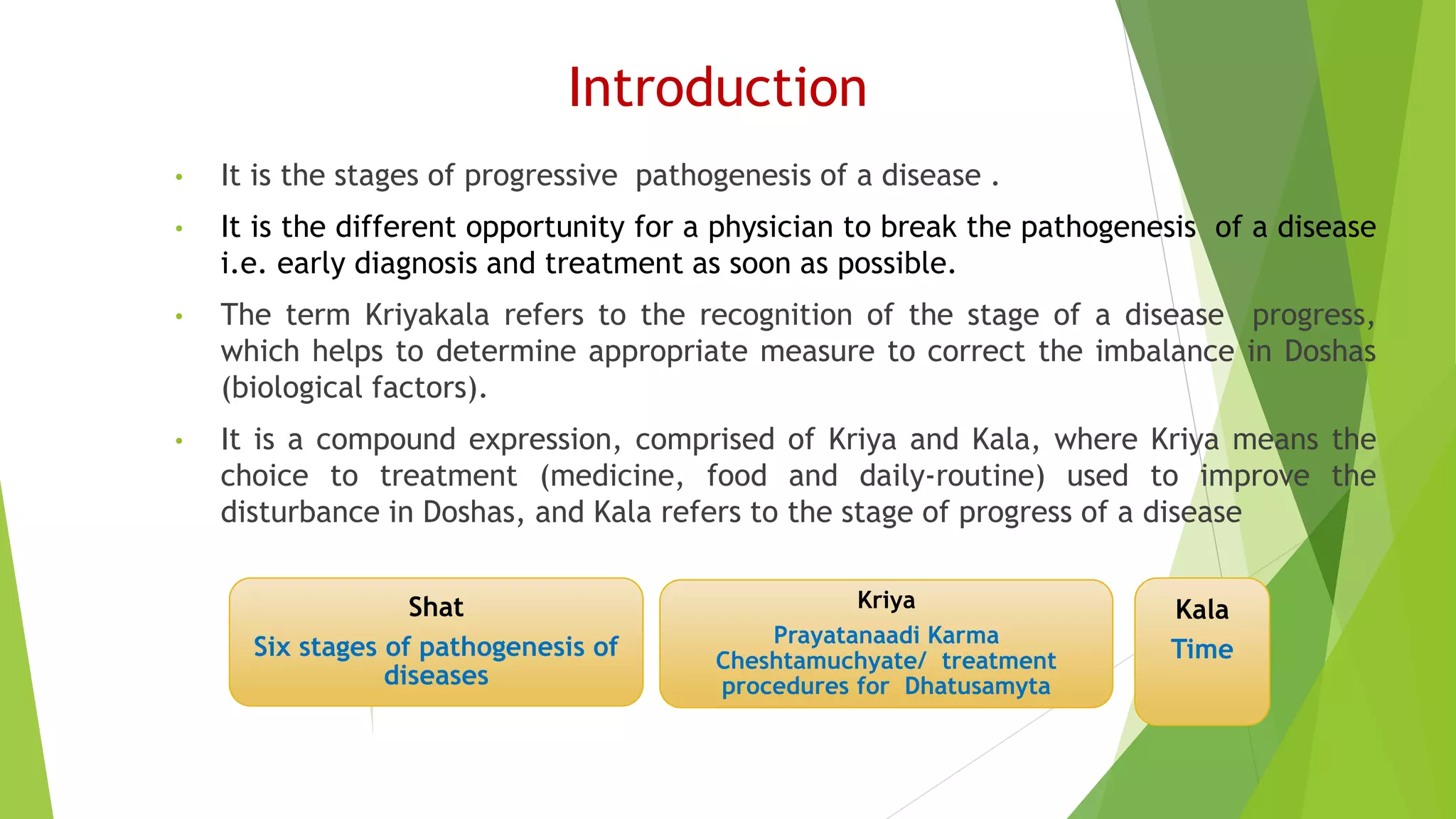
• It is the stages of progressive pathogenesis of a disease .
• It is the different opportunity for a physician to break the pathogenesis of a disease
i.e. early diagnosis and treatment as soon as possible.
• The term Kriyakala refers to the recognition of the stage of a disease progress,
which helps to determine appropriate measure to correct the imbalance in Doshas
(biological factors).
• It is a compound expression, comprised of Kriya and Kala, where Kriya means the
choice to treatment (medicine, food and daily-routine) used to improve the
disturbance in Doshas, and Kala refers to the stage of progress of a disease
Shat
Six stages of pathogenesis of
diseases
Kriya
Prayatanaadi Karma
Cheshtamuchyate/ treatment
procedures for Dhatusamyta
Kala
Time
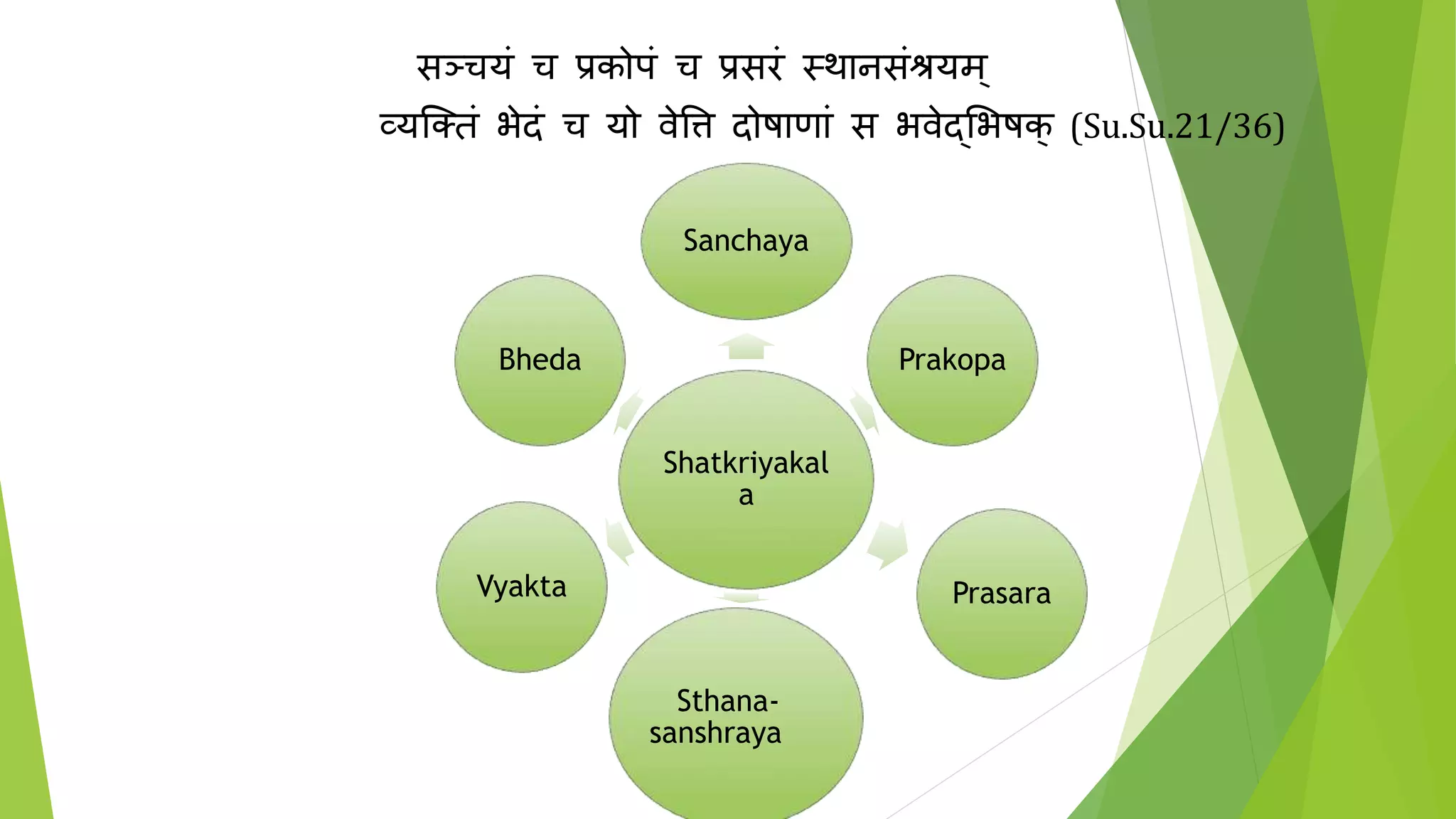
सञ्चयं च प्रकोपं च प्रसरं स्थानसंश्रयम्
व्यक्तं भेदं च यो वेत्ति दोषाणां स भवेद्भभषक् (Su.Su.21/36)
Shatkriyakal
a
Sanchaya
Prakopa
Prasara
Sthana-
sanshraya
Vyakta
Bheda
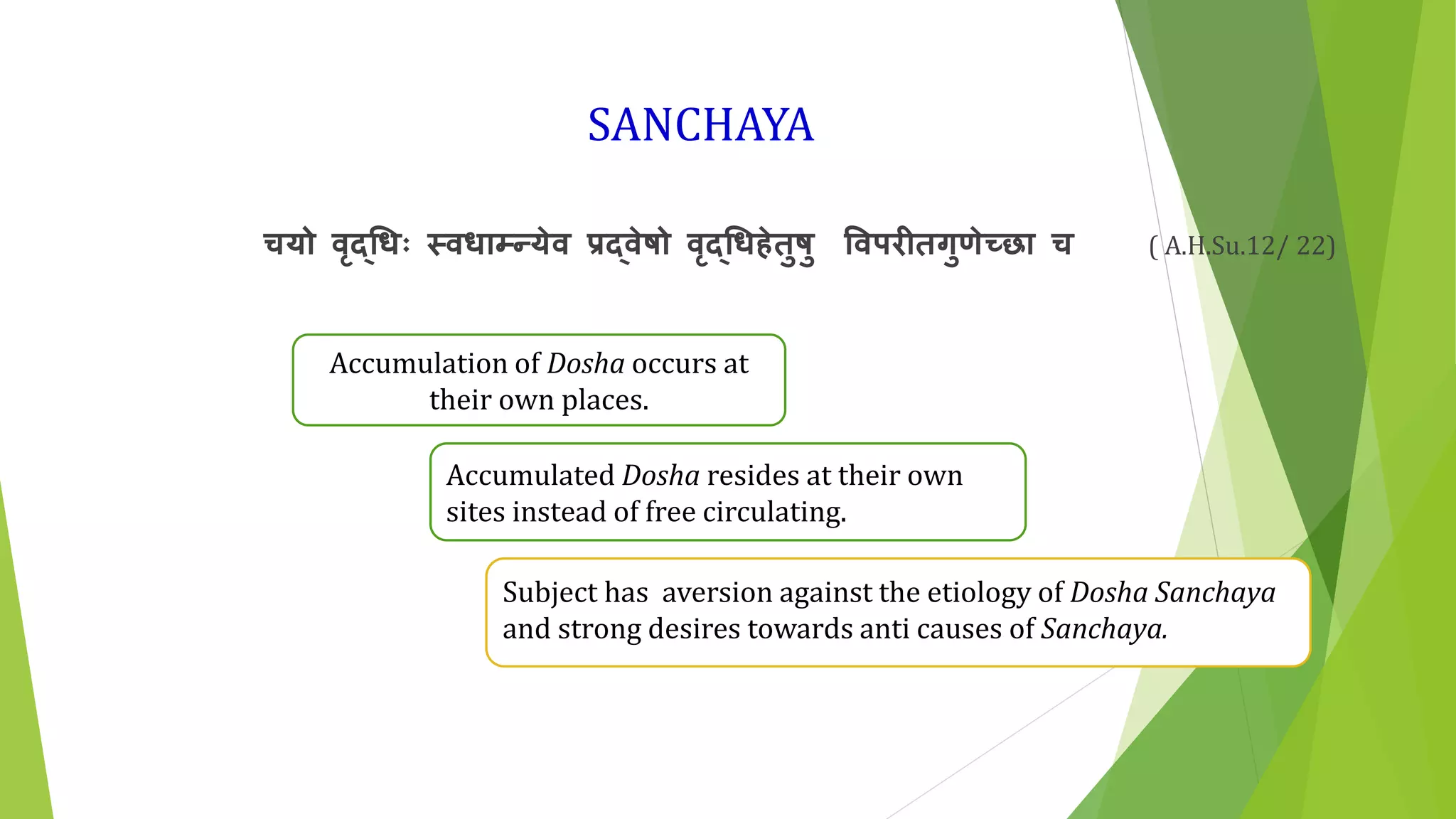
SANCHAYA
चयो वृद्धिः स्वधाम्न्येव प्रदवेषो वृद्धहेतुषु ववपरीतगुणेच्छा च ( A.H.Su.12/ 22)
Accumulation of Dosha occurs at
their own places.
Accumulated Dosha resides at their own
sites instead of free circulating.
Subject has aversion against the etiology of Dosha Sanchaya
and strong desires towards anti causes of Sanchaya.
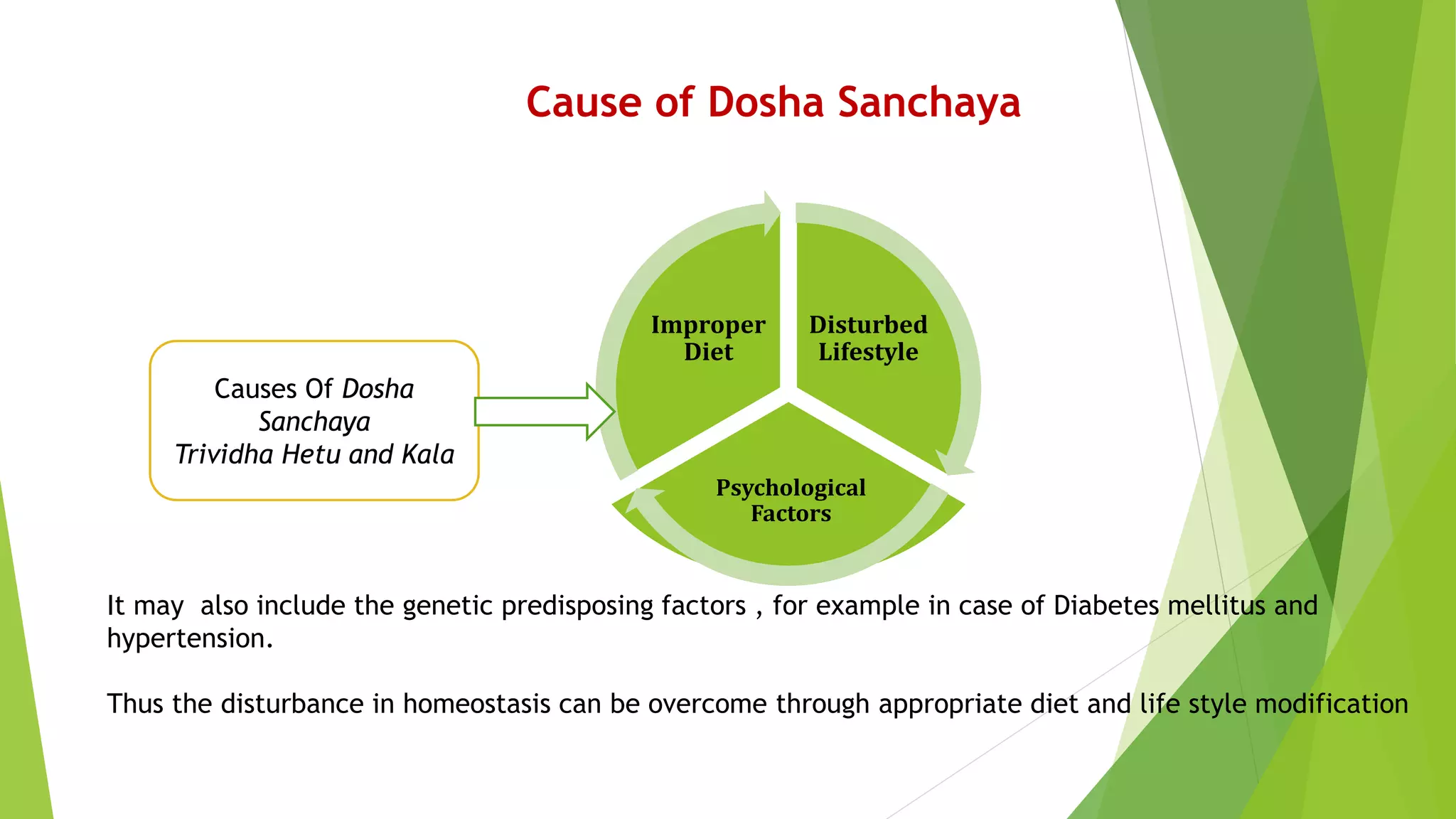
Cause of Dosha Sanchaya
Disturbed
Lifestyle
Psychological
Factors
Improper
Diet
Causes Of Dosha
Sanchaya
Trividha Hetu and Kala
It may also include the genetic predisposing factors , for example in case of Diabetes mellitus and
hypertension.
Thus the disturbance in homeostasis can be overcome through appropriate diet and life style modification
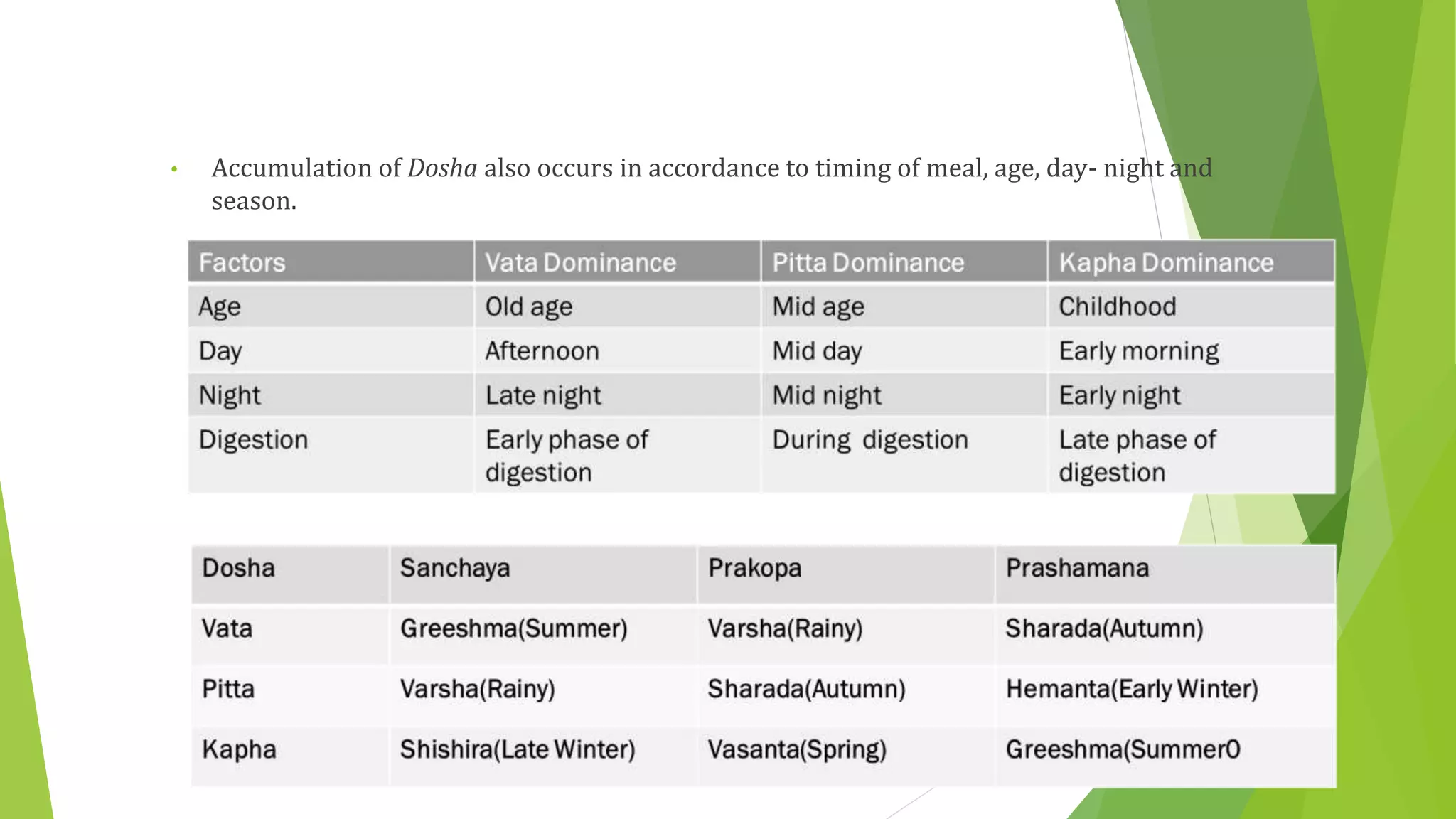
• Accumulation of Dosha also occurs in accordance to timing of meal, age, day- night and
season.
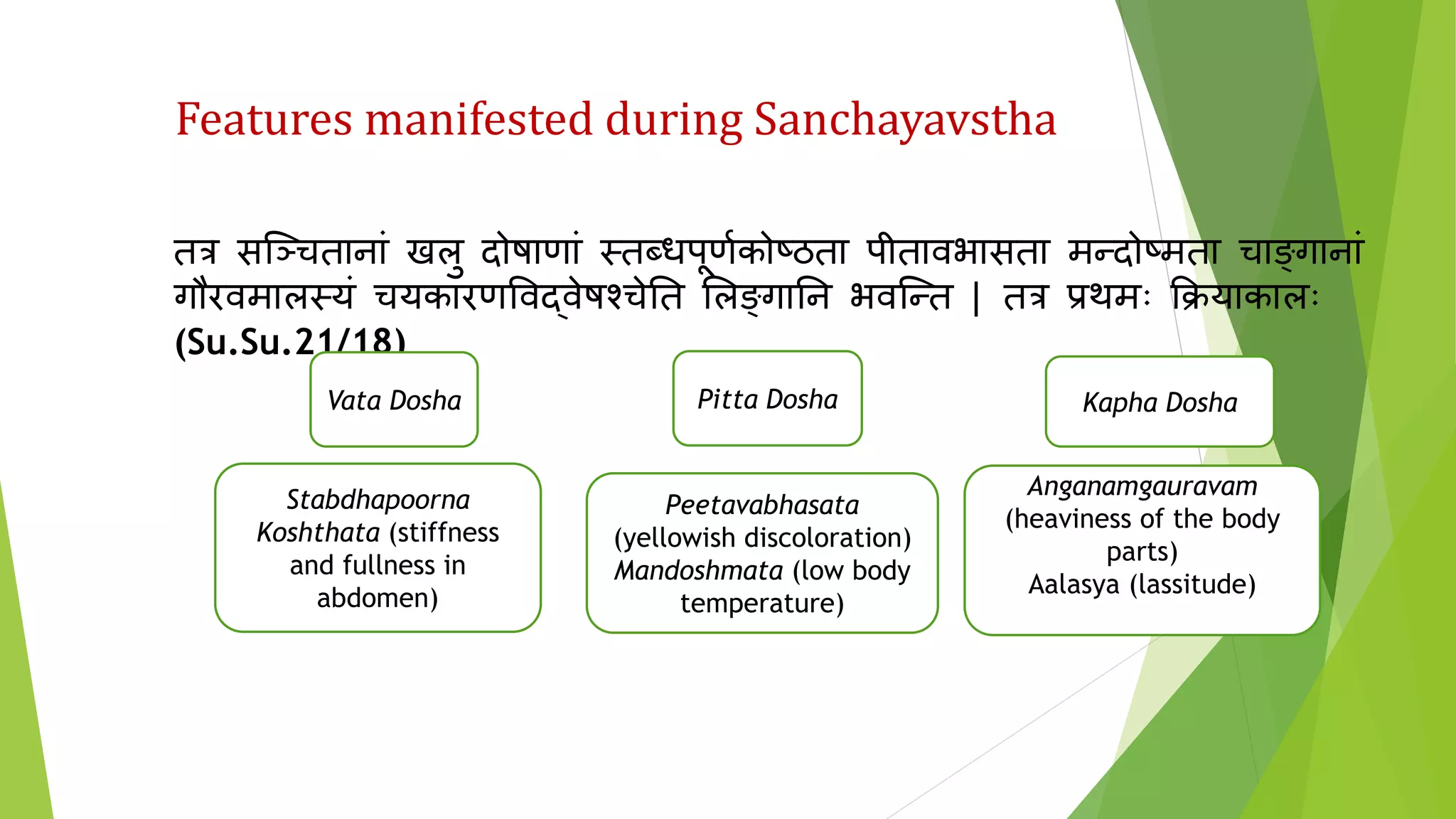
Features manifested during Sanchayavstha
तत्र सकञ्चतानां खलु दोषाणां स्तब्धपूणणकोष्ठता पीतावभासता मन्दोष्मता चाङ्गानां
गौरवमालस्यं चयकारणत्तवद्वेषश्चेतत भलङ्गातन भवकन्त | तत्र प्रथमः क्रियाकालः
(Su.Su.21/18)
Vata Dosha Pitta Dosha Kapha Dosha
Stabdhapoorna
Koshthata (stiffness
and fullness in
abdomen)
Peetavabhasata
(yellowish discoloration)
Mandoshmata (low body
temperature)
Anganamgauravam
(heaviness of the body
parts)
Aalasya (lassitude)
PRAKOPA
(The stage of vitiation)
कोपस्तून्मागणगाभमता|
भलङ्गानां दर्णनं स्वेषामस्वास््यं रोगसम्भवः (A.H.Su.12/23)
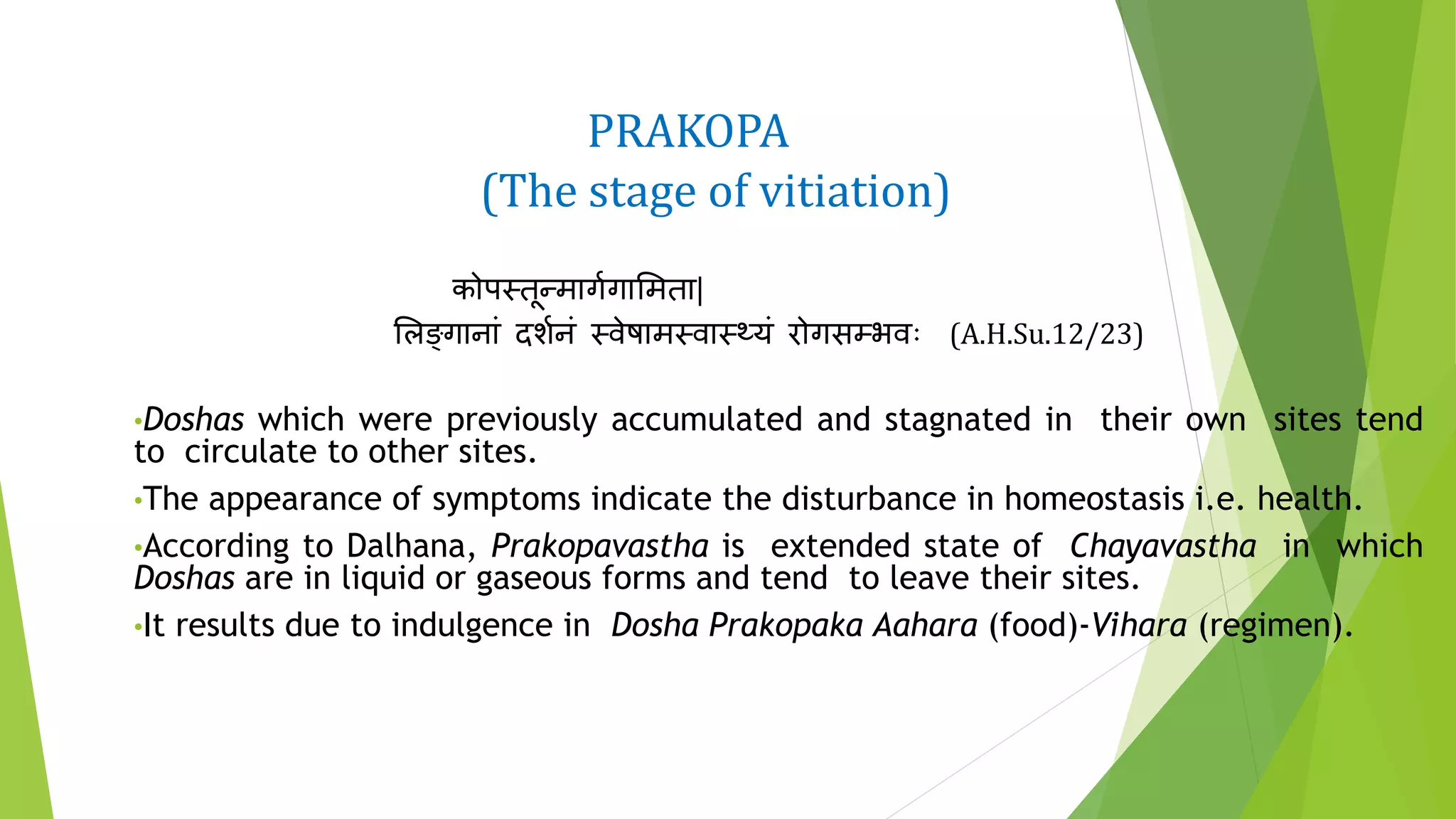
•Doshas which were previously accumulated and stagnated in their own sites tend
to circulate to other sites.
•The appearance of symptoms indicate the disturbance in homeostasis i.e. health.
•According to Dalhana, Prakopavastha is extended state of Chayavastha in which
Doshas are in liquid or gaseous forms and tend to leave their sites.
•It results due to indulgence in Dosha Prakopaka Aahara (food)-Vihara (regimen).
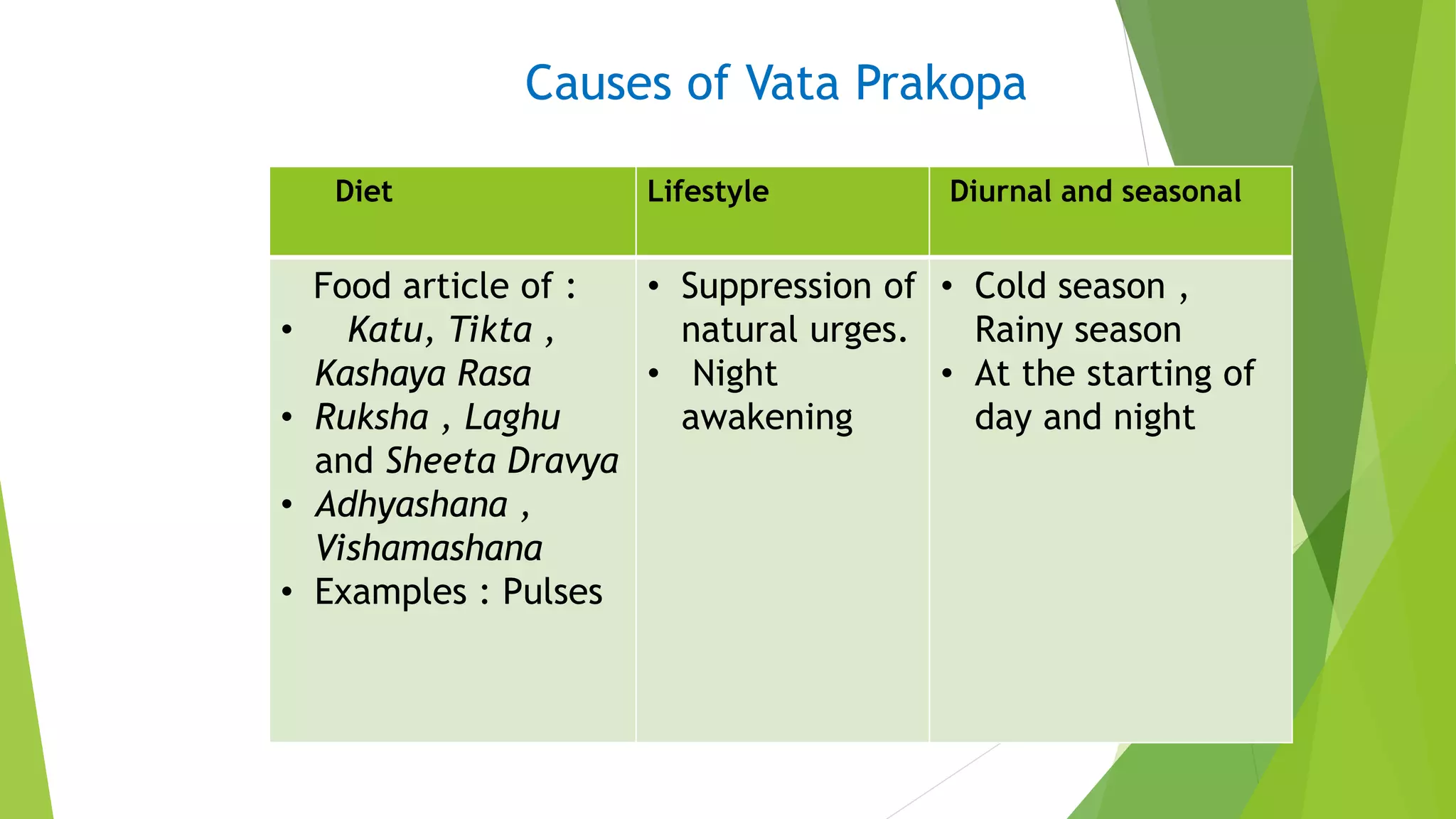
Causes of Vata Prakopa
Diet Lifestyle Diurnal and seasonal
Food article of :
• Katu, Tikta ,
Kashaya Rasa
• Ruksha , Laghu
and Sheeta Dravya
• Adhyashana ,
Vishamashana
• Examples : Pulses
• Suppression of
natural urges.
• Night
awakening
• Cold season ,
Rainy season
• At the starting of
day and night
Causes of Pitta Prakopa
Diet Life Style Psychological Diurnal and
seasonal
Food articles of :
• Katu, Amla and
Lavana Rasa
• Teekshna , Ushna,
Laghu and Vidahi
substances
• Taking food in
small quantity
• Example : Tila
taila, Pinyaka
Over exertion Anger, Grief ,
Anxiety
• At the mid of the
day and night
• During the
digestion of meal
• Hot season and
autumn
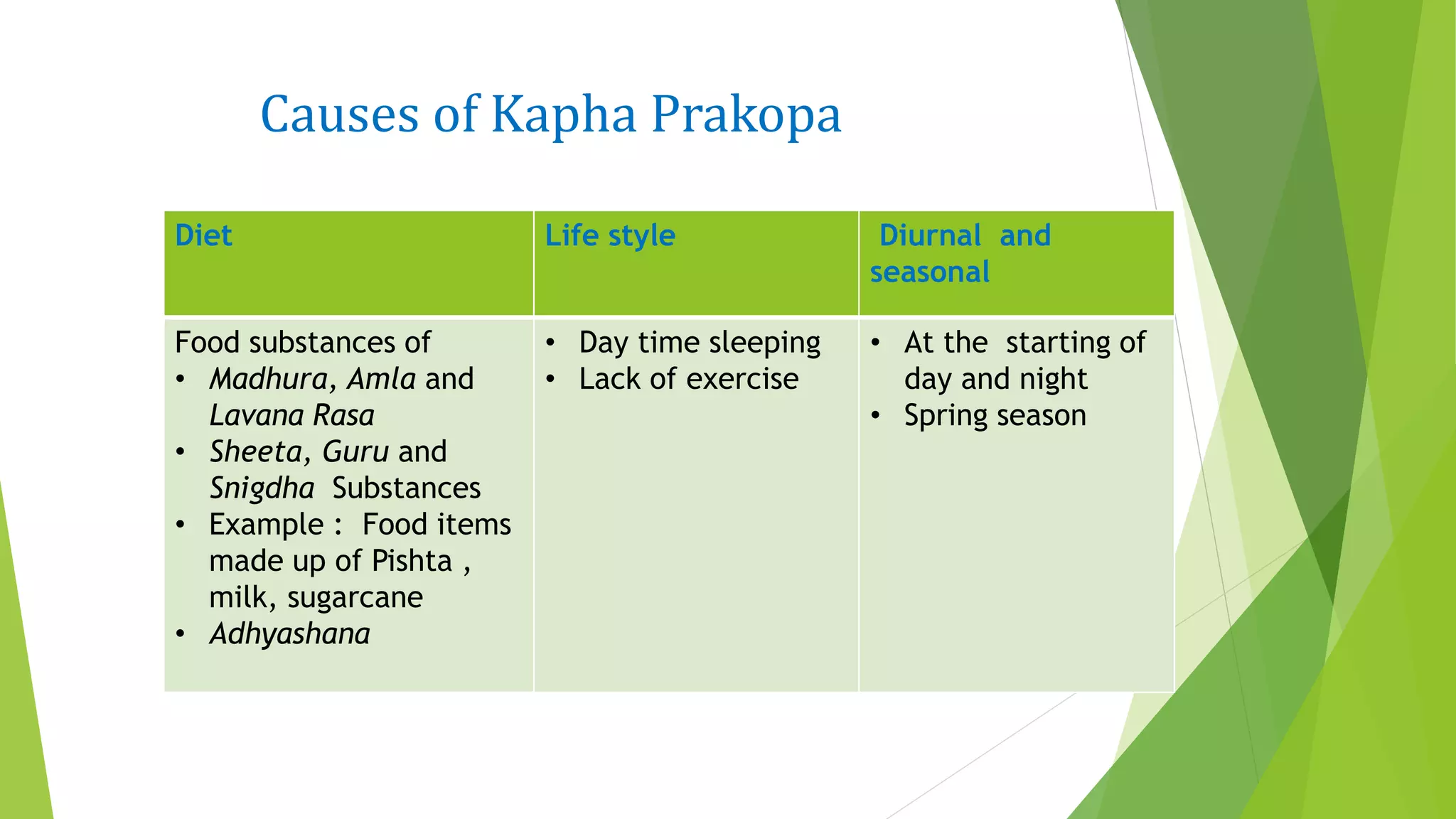
Causes of Kapha Prakopa
Diet Life style Diurnal and
seasonal
Food substances of
• Madhura, Amla and
Lavana Rasa
• Sheeta, Guru and
Snigdha Substances
• Example : Food items
made up of Pishta ,
milk, sugarcane
• Adhyashana
• Day time sleeping
• Lack of exercise
• At the starting of
day and night
• Spring season
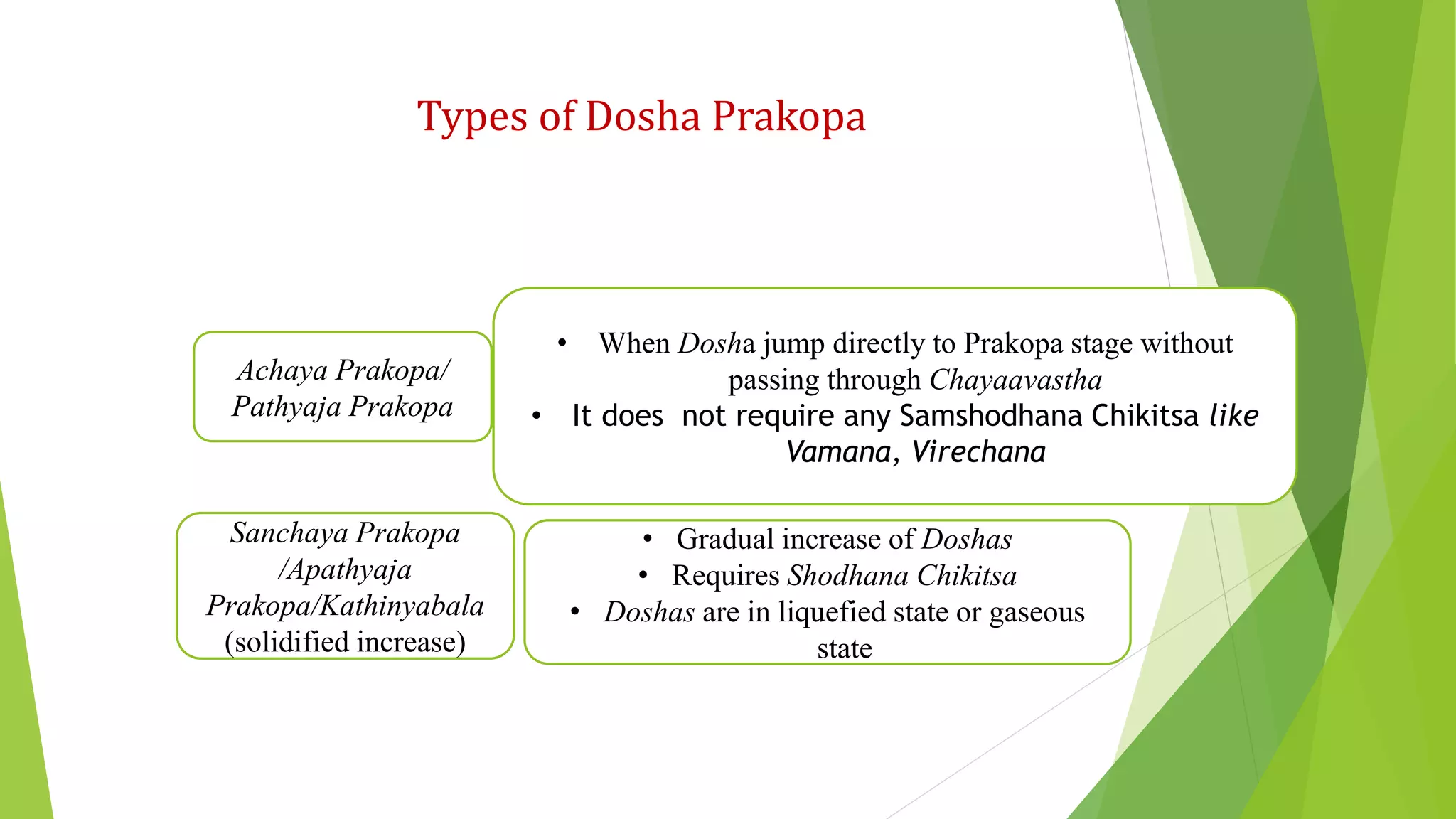
Types of Dosha Prakopa
Achaya Prakopa/
Pathyaja Prakopa
• When Dosha jump directly to Prakopa stage without
passing through Chayaavastha
• It does not require any Samshodhana Chikitsa like
Vamana, Virechana
Sanchaya Prakopa
/Apathyaja
Prakopa/Kathinyabala
(solidified increase)
• Gradual increase of Doshas
• Requires Shodhana Chikitsa
• Doshas are in liquefied state or gaseous
state
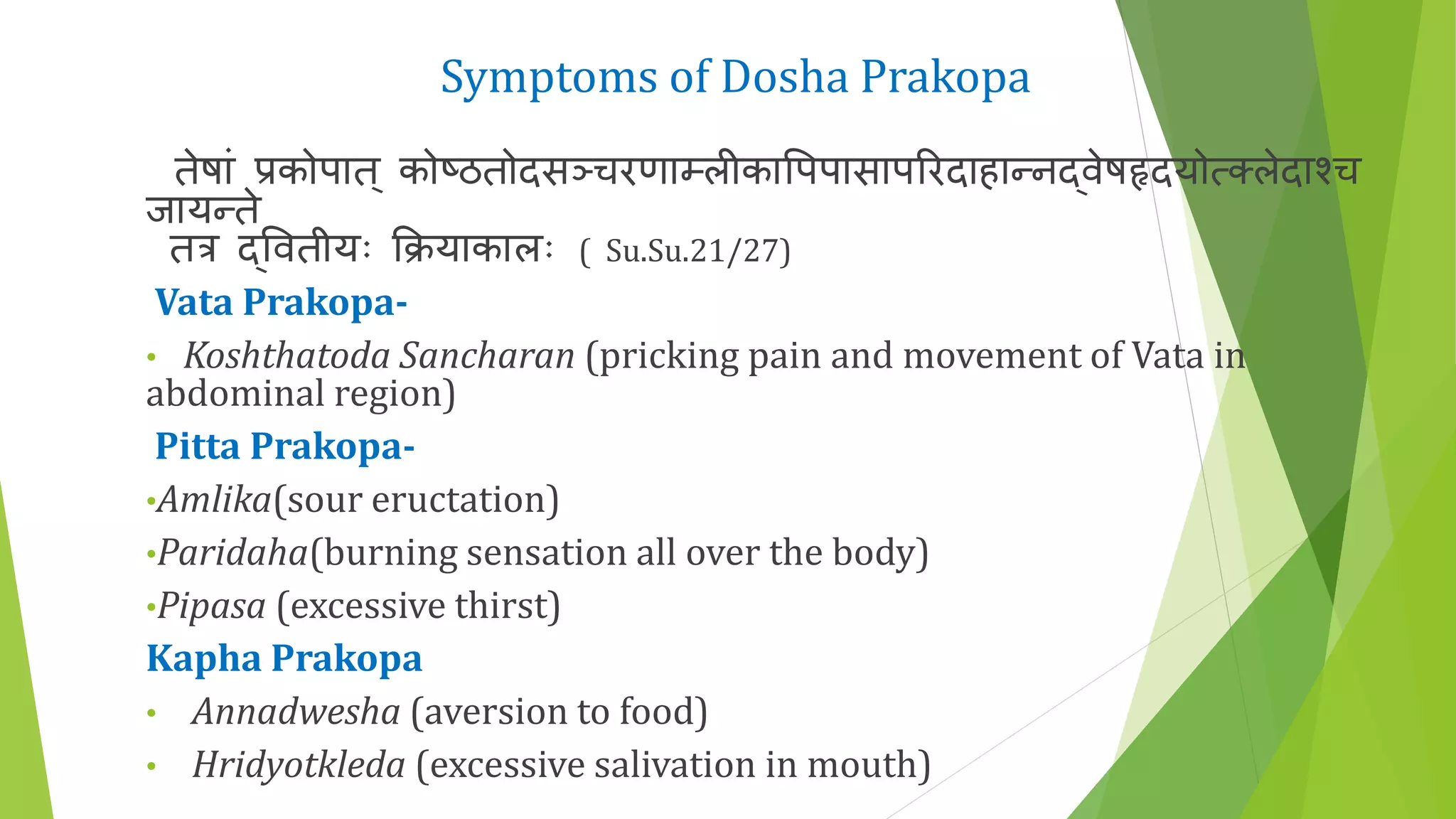
Symptoms of Dosha Prakopa
तेषां प्रकोपात ् कोष्ठतोदसञ्चरणाम्लीकात्तपपासापररदाहान्नद्वेषृददयो््लेदाश्च
जायन्ते
तत्र द्त्तवतीयः क्रियाकालः ( Su.Su.21/27)
Vata Prakopa-
• Koshthatoda Sancharan (pricking pain and movement of Vata in
abdominal region)
Pitta Prakopa-
•Amlika(sour eructation)
•Paridaha(burning sensation all over the body)
•Pipasa (excessive thirst)
Kapha Prakopa
• Annadwesha (aversion to food)
• Hridyotkleda (excessive salivation in mouth)
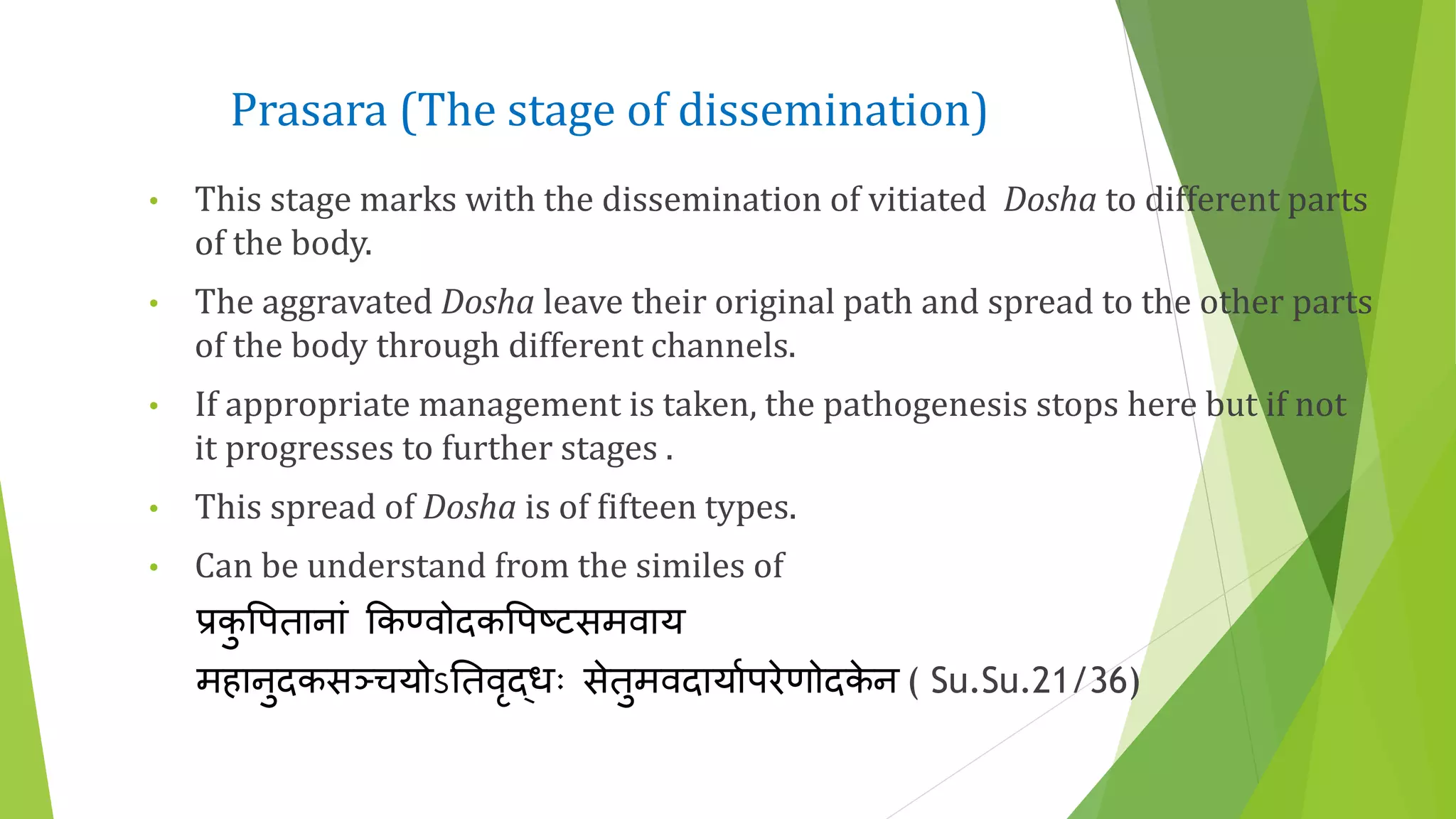
Prasara (The stage of dissemination)
• This stage marks with the dissemination of vitiated Dosha to different parts
of the body.
• The aggravated Dosha leave their original path and spread to the other parts
of the body through different channels.
• If appropriate management is taken, the pathogenesis stops here but if not
it progresses to further stages .
• This spread of Dosha is of fifteen types.
• Can be understand from the similes of
प्रकु त्तपतानां क्रकण्वोदकत्तपष्टसमवाय
महानुदकसञ्चयोऽततवृद्धः सेतुमवदायाणपरेणोदके न ( Su.Su.21/36)
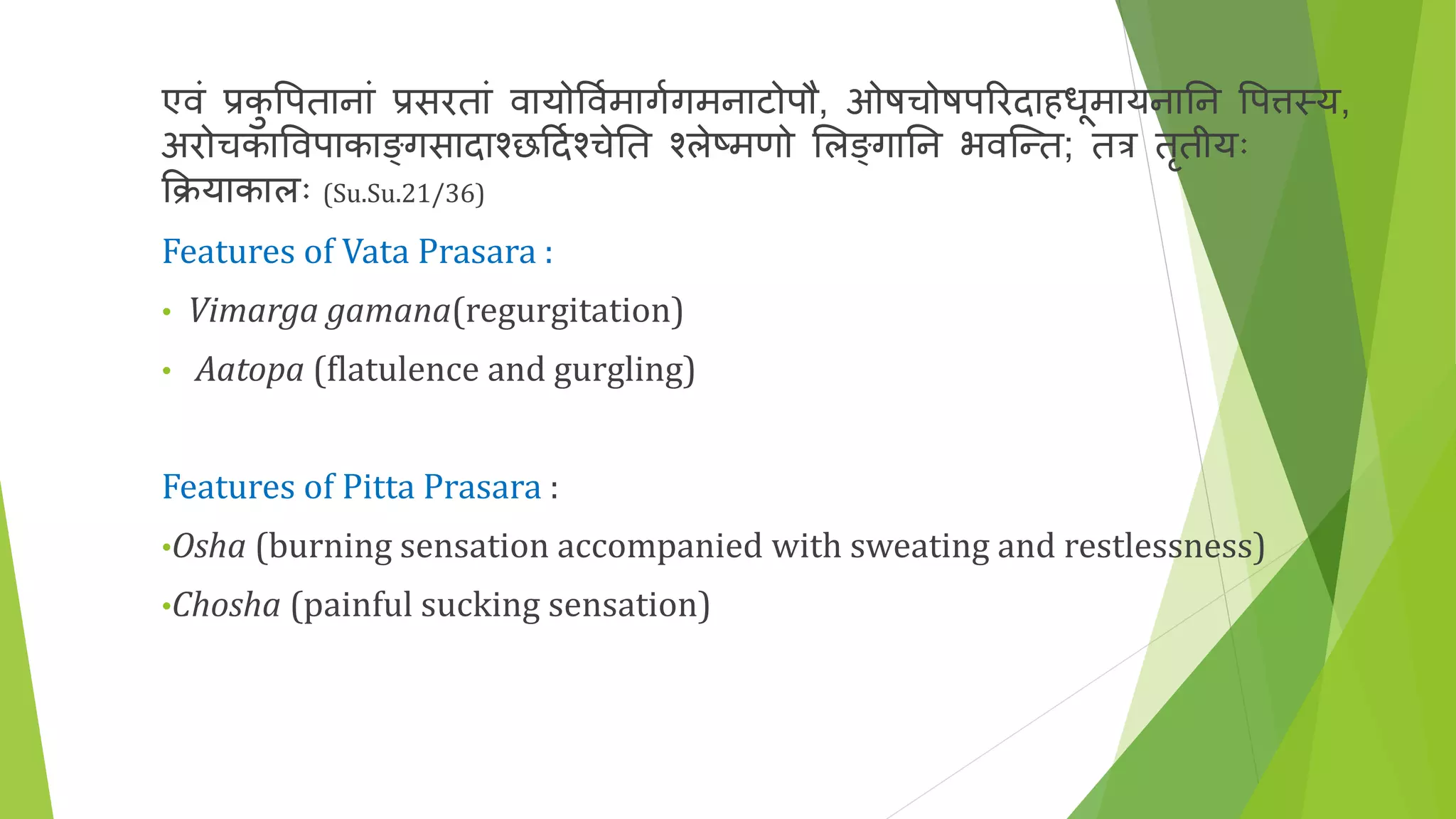
एवं प्रकु त्तपतानां प्रसरतां वायोत्तवणमागणगमनाटोपौ, ओषचोषपररदाहधूमायनातन त्तपिस्य,
अरोचकात्तवपाकाङ्गसादाश्छर्दणश्चेतत श्लेष्मणो भलङ्गातन भवकन्त; तत्र तृतीयः
क्रियाकालः (Su.Su.21/36)
Features of Vata Prasara :
• Vimarga gamana(regurgitation)
• Aatopa (flatulence and gurgling)
Features of Pitta Prasara :
•Osha (burning sensation accompanied with sweating and restlessness)
•Chosha (painful sucking sensation)
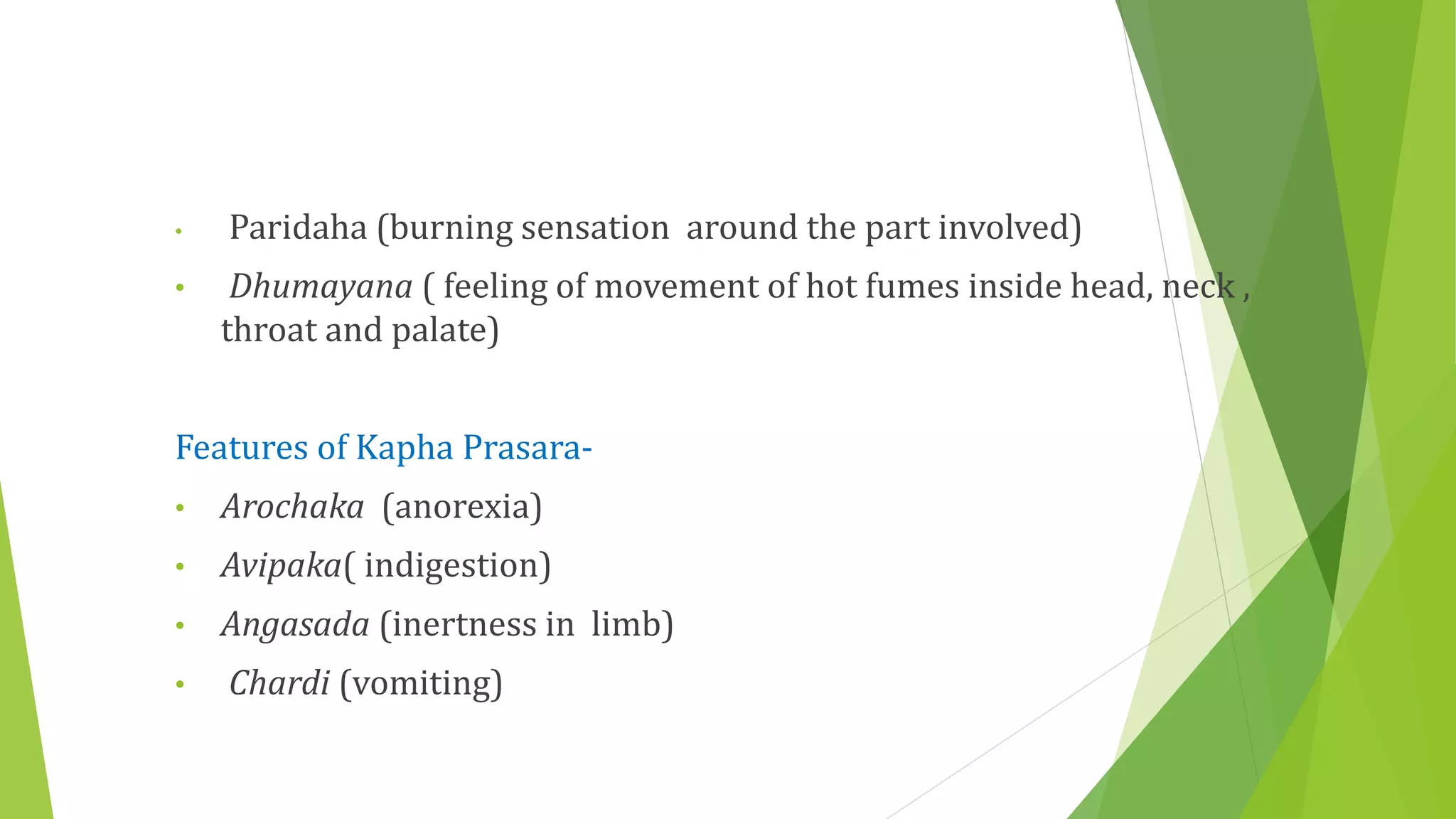
• Paridaha (burning sensation around the part involved)
• Dhumayana ( feeling of movement of hot fumes inside head, neck ,
throat and palate)
Features of Kapha Prasara-
• Arochaka (anorexia)
• Avipaka( indigestion)
• Angasada (inertness in limb)
• Chardi (vomiting)
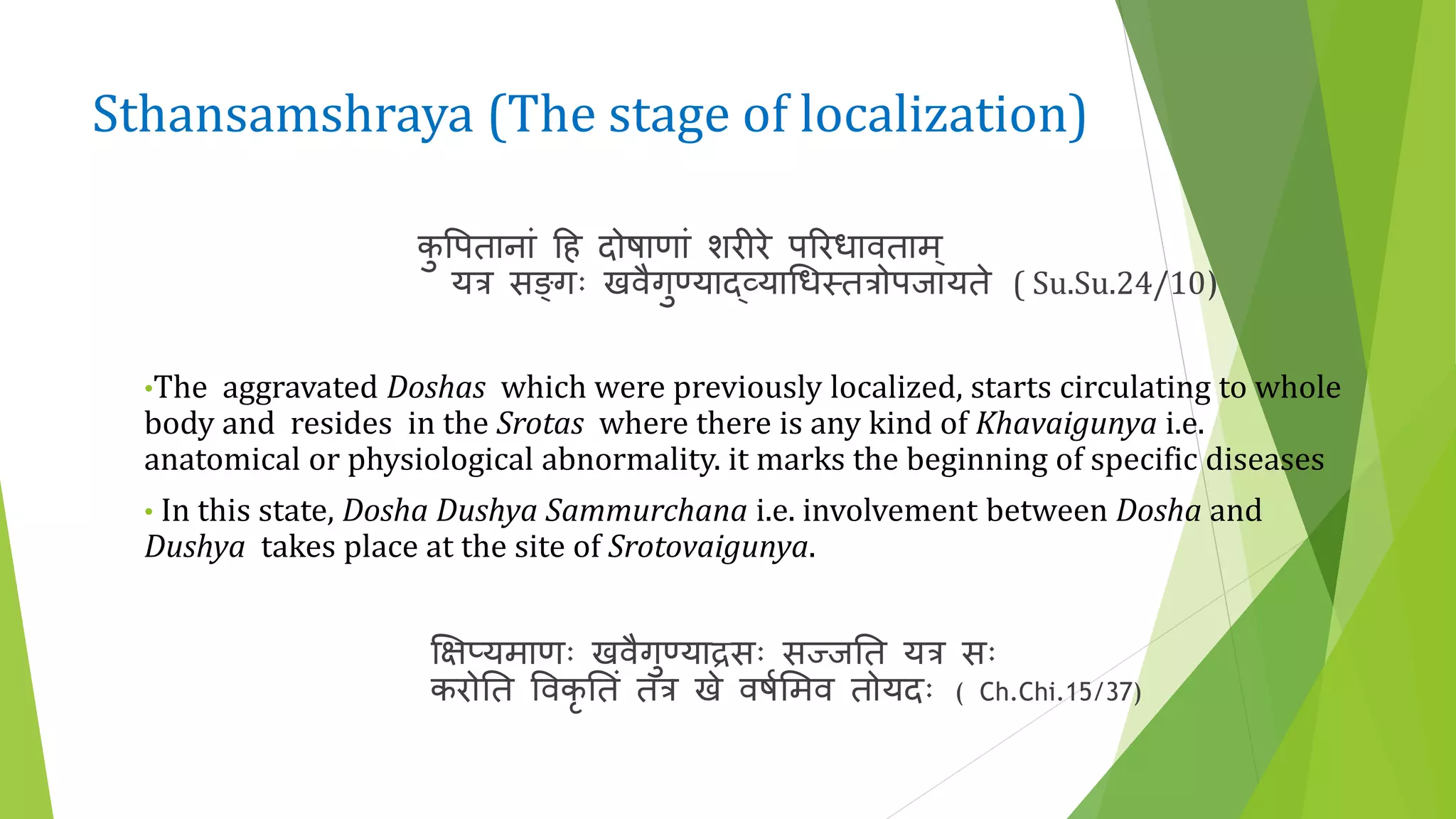
Sthansamshraya (The stage of localization)
कु त्तपतानां र्ह दोषाणां र्रीरे पररधावताम्
यत्र सङ्गः खवैगुण्याद्व्याधधस्तत्रोपजायते ( Su.Su.24/10)
•The aggravated Doshas which were previously localized, starts circulating to whole
body and resides in the Srotas where there is any kind of Khavaigunya i.e.
anatomical or physiological abnormality. it marks the beginning of specific diseases
• In this state, Dosha Dushya Sammurchana i.e. involvement between Dosha and
Dushya takes place at the site of Srotovaigunya.
क्षिप्यमाणः खवैगुण्याद्रसः सज्जतत यत्र सः
करोतत त्तवकृ ततं तत्र खे वषणभमव तोयदः ( Ch.Chi.15/37)
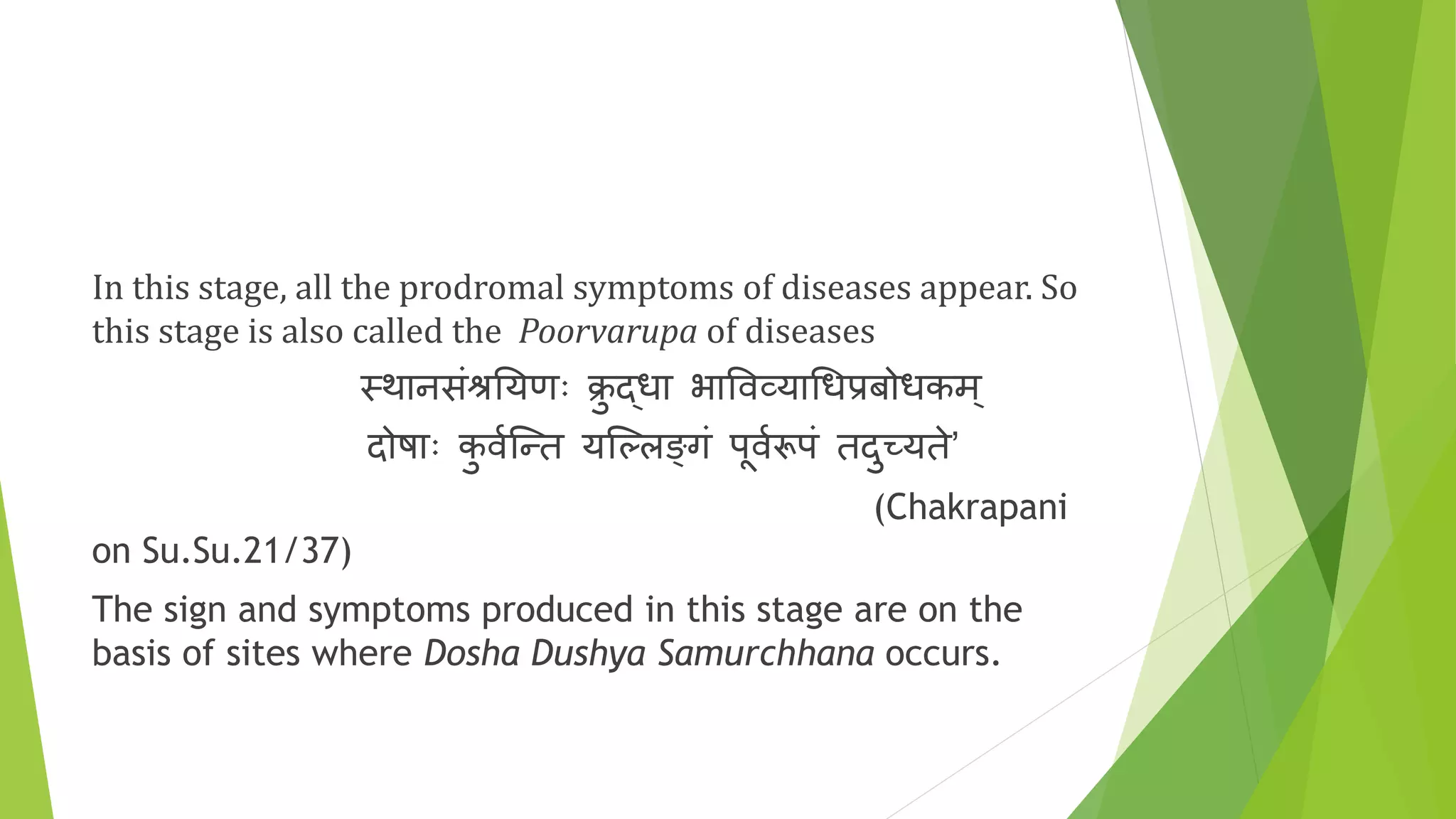
In this stage, all the prodromal symptoms of diseases appear. So
this stage is also called the Poorvarupa of diseases
स्थानसंश्रतयणः िु द्धा भात्तवव्याधधप्रबोधकम्
दोषाः कु वणकन्त यकललङ्गं पूवणरूपं तदुच्यते’
(Chakrapani
on Su.Su.21/37)
The sign and symptoms produced in this stage are on the
basis of sites where Dosha Dushya Samurchhana occurs.
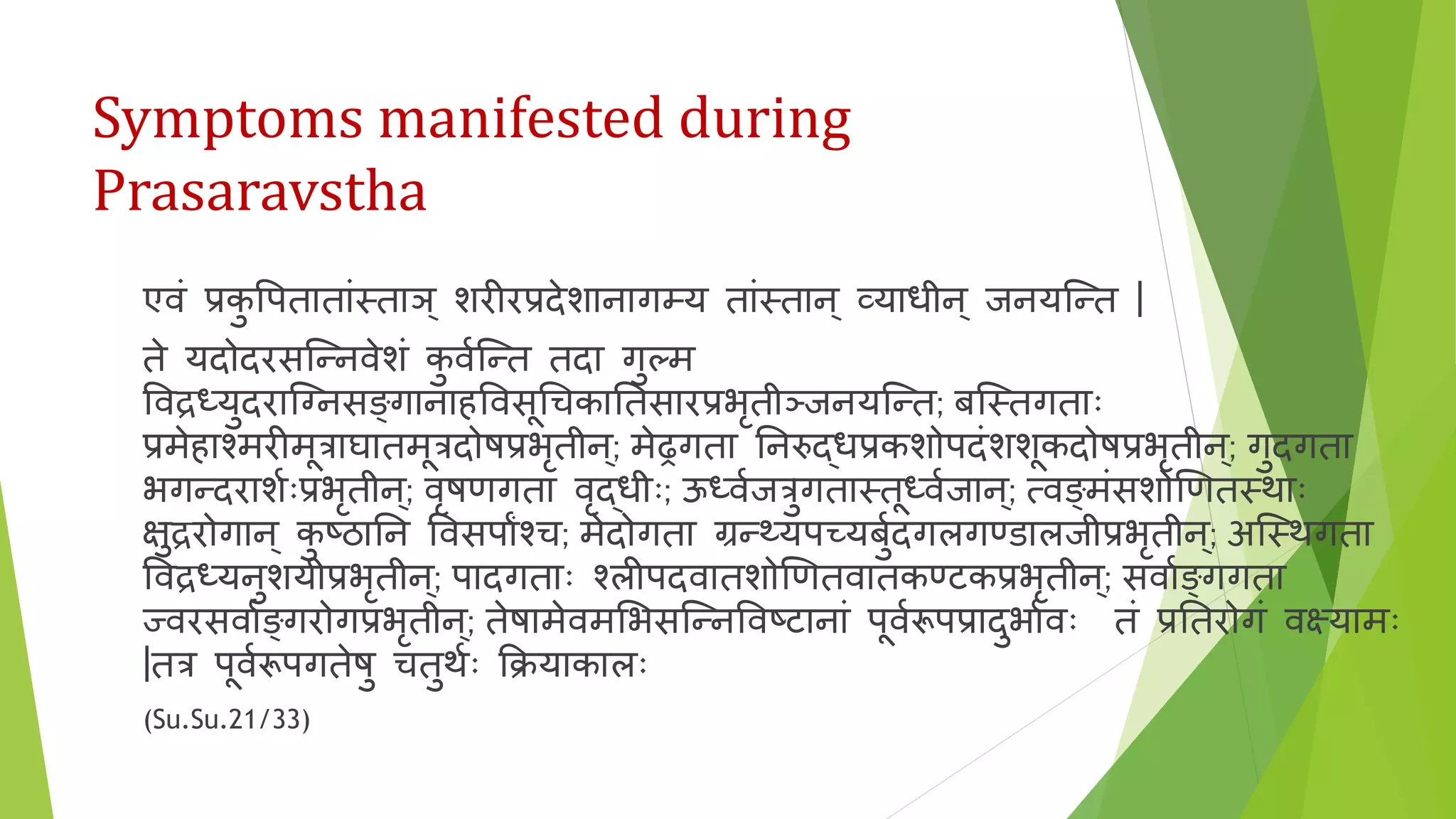
Symptoms manifested during
Prasaravstha
एवं प्रकु त्तपतातांस्ताञ् र्रीरप्रदेर्ानागम्य तांस्तान् व्याधीन् जनयकन्त |
ते यदोदरसकन्नवेर्ं कु वणकन्त तदा गुलम
त्तवद्रध्युदराकननसङ्गानाहत्तवसूधचकाततसारप्रभृतीञ्जनयकन्त; बकस्तगताः
प्रमेहाश्मरीमूत्राघातमूत्रदोषप्रभृतीन्; मेढ्रगता तनरुद्धप्रकर्ोपदंर्र्ूकदोषप्रभृतीन्; गुदगता
भगन्दरार्णःप्रभृतीन्; वृषणगता वृद्धीः; ऊध्वणजत्रुगतास्तूध्वणजान्; ्वङ्मंसर्ोणणतस्थाः
िुद्ररोगान् कु ष्ठातन त्तवसपाांश्च; मेदोगता ग्रन््यपच्यबुणदगलगण्डालजीप्रभृतीन्; अकस्थगता
त्तवद्रध्यनुर्यीप्रभृतीन्; पादगताः श्लीपदवातर्ोणणतवातकण्टकप्रभृतीन्; सवाणङ्गगता
ज्वरसवाणङ्गरोगप्रभृतीन्; तेषामेवमभभसकन्नत्तवष्टानां पूवणरूपप्रादुभाणवः तं प्रततरोगं वक्ष्यामः
|तत्र पूवणरूपगतेषु चतुथणः क्रियाकालः
(Su.Su.21/33)
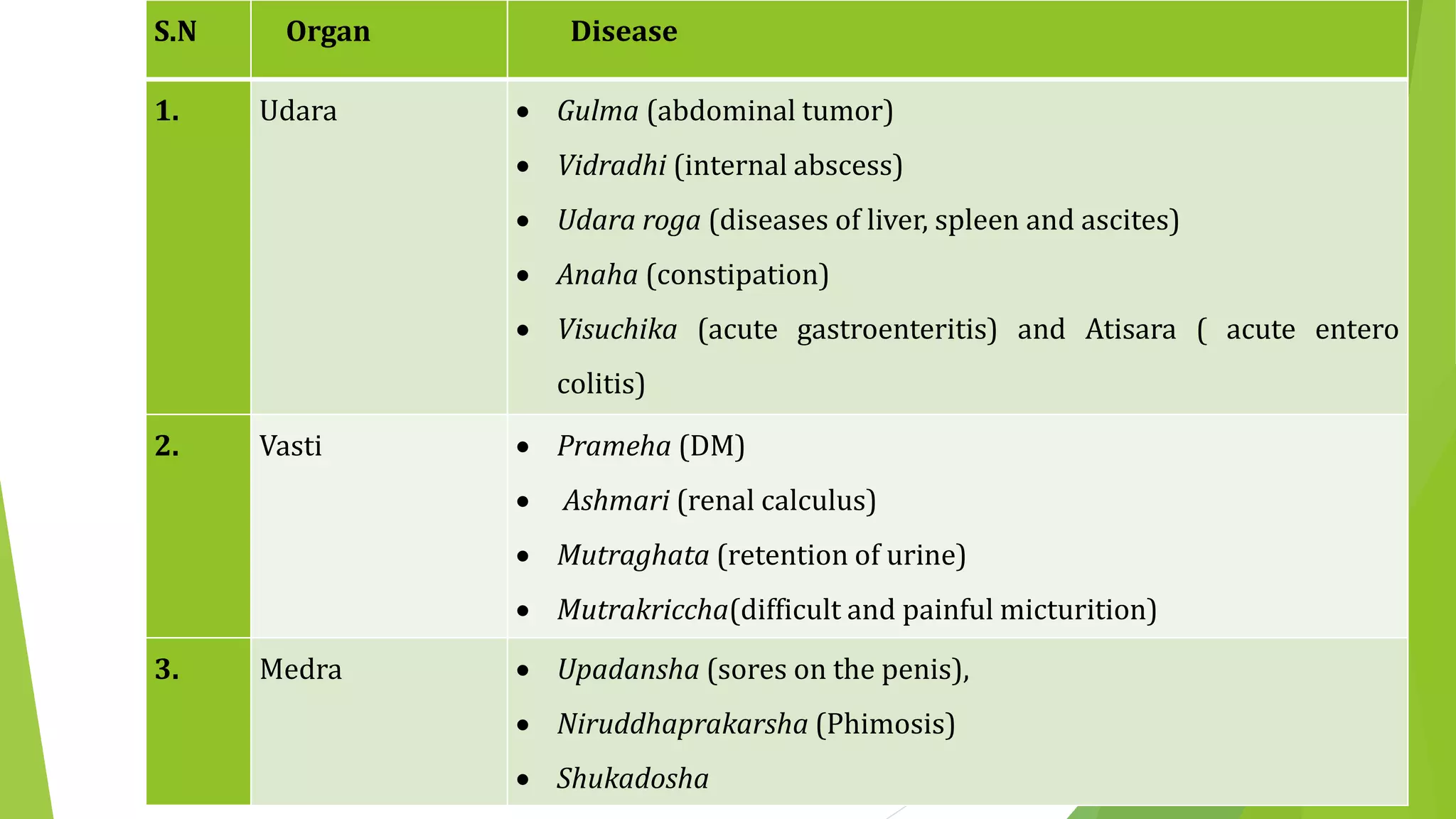
S.N Organ Disease
1. Udara  Gulma (abdominal tumor)
 Vidradhi (internal abscess)
 Udara roga (diseases of liver, spleen and ascites)
 Anaha (constipation)
 Visuchika (acute gastroenteritis) and Atisara ( acute entero
colitis)
2. Vasti  Prameha (DM)
 Ashmari (renal calculus)
 Mutraghata (retention of urine)
 Mutrakriccha(difficult and painful micturition)
3. Medra  Upadansha (sores on the penis),
 Niruddhaprakarsha (Phimosis)
 Shukadosha
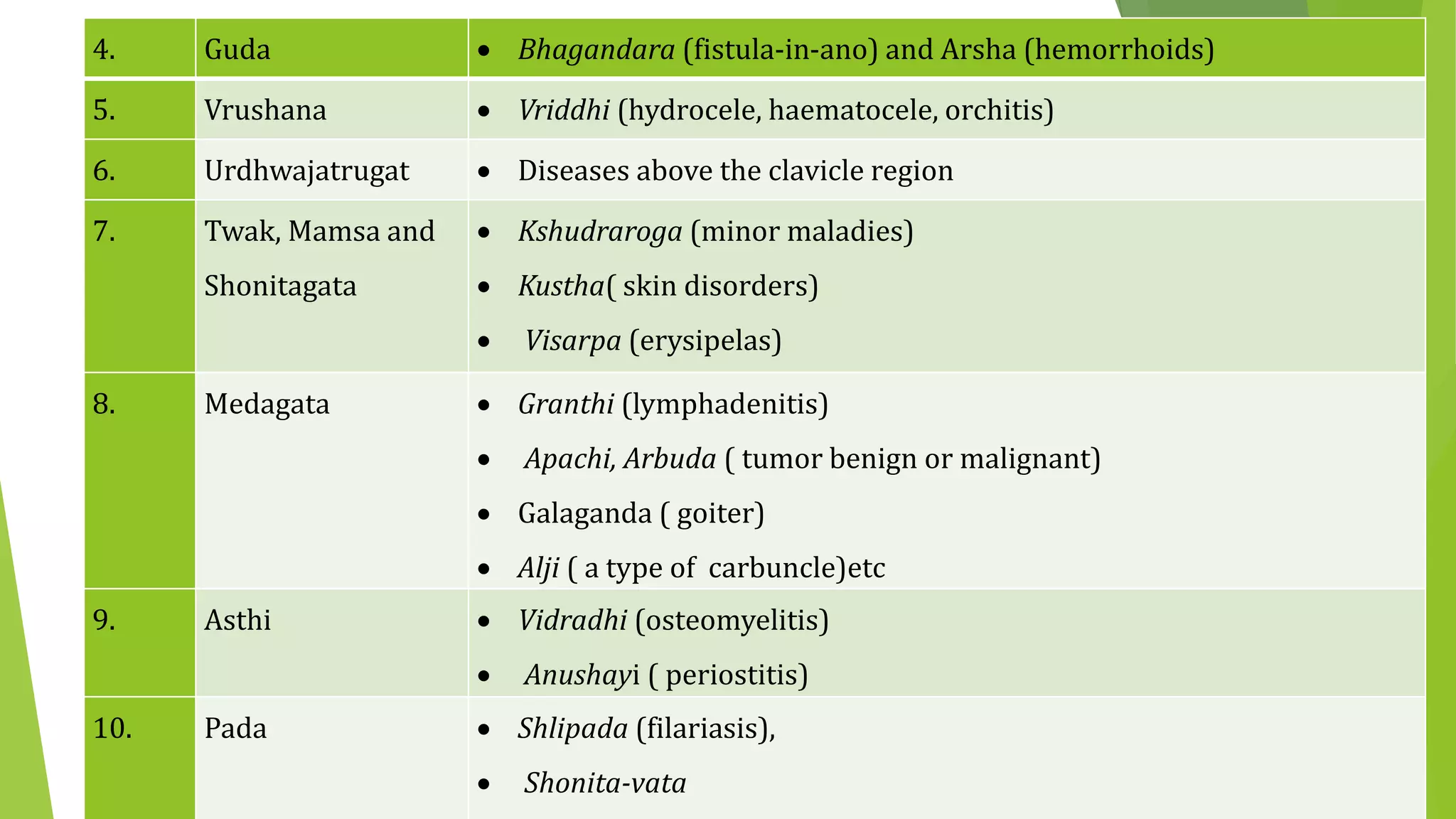
4. Guda  Bhagandara (fistula-in-ano) and Arsha (hemorrhoids)
5. Vrushana  Vriddhi (hydrocele, haematocele, orchitis)
6. Urdhwajatrugat  Diseases above the clavicle region
7. Twak, Mamsa and
Shonitagata
 Kshudraroga (minor maladies)
 Kustha( skin disorders)
 Visarpa (erysipelas)
8. Medagata  Granthi (lymphadenitis)
 Apachi, Arbuda ( tumor benign or malignant)
 Galaganda ( goiter)
 Alji ( a type of carbuncle)etc
9. Asthi  Vidradhi (osteomyelitis)
 Anushayi ( periostitis)
10. Pada  Shlipada (filariasis),
 Shonita-vata
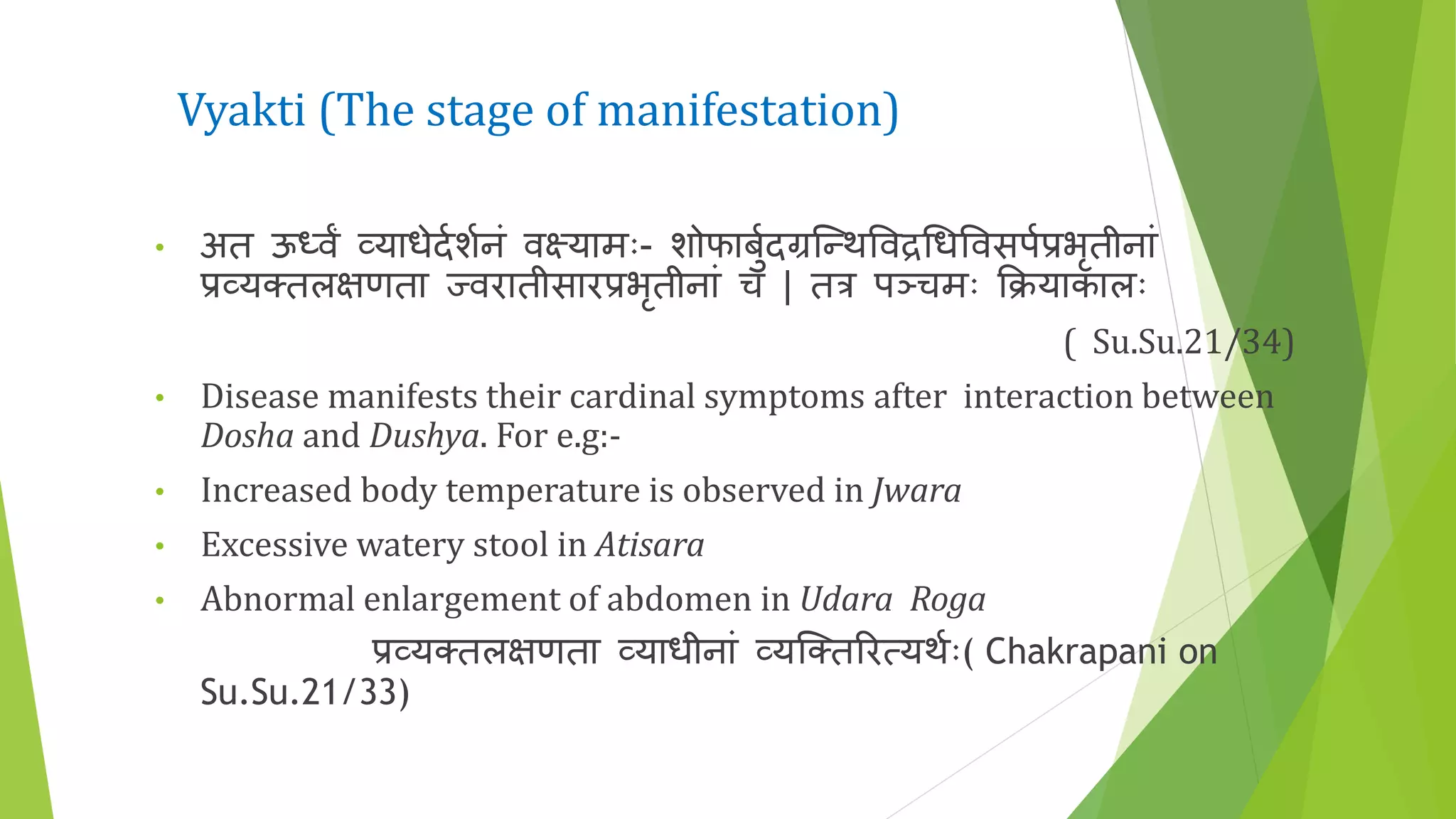
Vyakti (The stage of manifestation)
• अत ऊध्वां व्याधेदणर्णनं वक्ष्यामः- र्ोफाबुणदग्रकन्थत्तवद्रधधत्तवसपणप्रभृतीनां
प्रव्य्तलिणता ज्वरातीसारप्रभृतीनां च | तत्र पञ्चमः क्रियाकालः
( Su.Su.21/34)
• Disease manifests their cardinal symptoms after interaction between
Dosha and Dushya. For e.g:-
• Increased body temperature is observed in Jwara
• Excessive watery stool in Atisara
• Abnormal enlargement of abdomen in Udara Roga
प्रव्य्तलिणता व्याधीनां व्यक्तरर्यथणः( Chakrapani on
Su.Su.21/33)
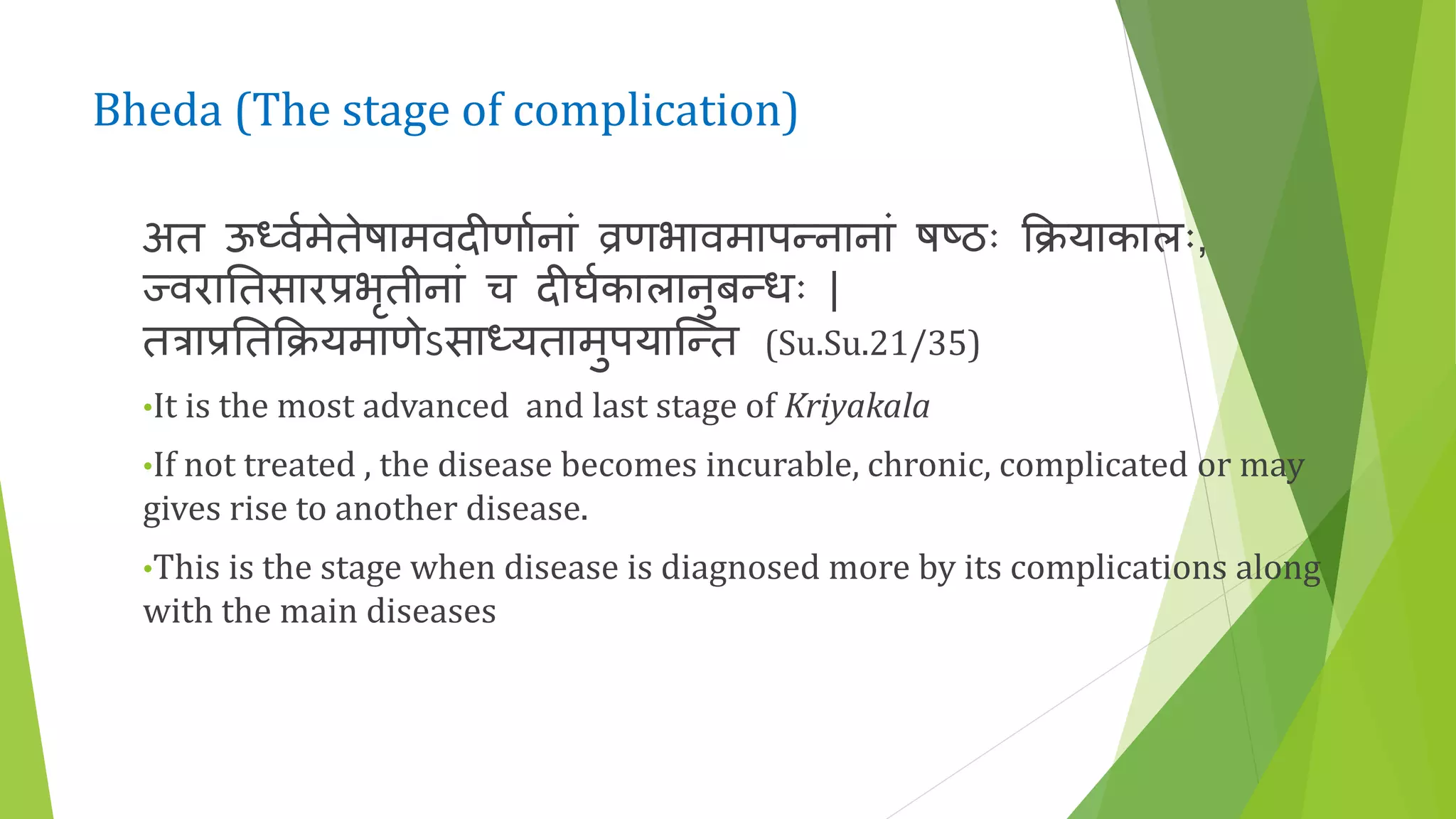
Bheda (The stage of complication)
अत ऊध्वणमेतेषामवदीणाणनां व्रणभावमापन्नानां षष्ठः क्रियाकालः,
ज्वराततसारप्रभृतीनां च दीघणकालानुबन्धः |
तत्राप्रततक्रियमाणेऽसाध्यतामुपयाकन्त (Su.Su.21/35)
•It is the most advanced and last stage of Kriyakala
•If not treated , the disease becomes incurable, chronic, complicated or may
gives rise to another disease.
•This is the stage when disease is diagnosed more by its complications along
with the main diseases
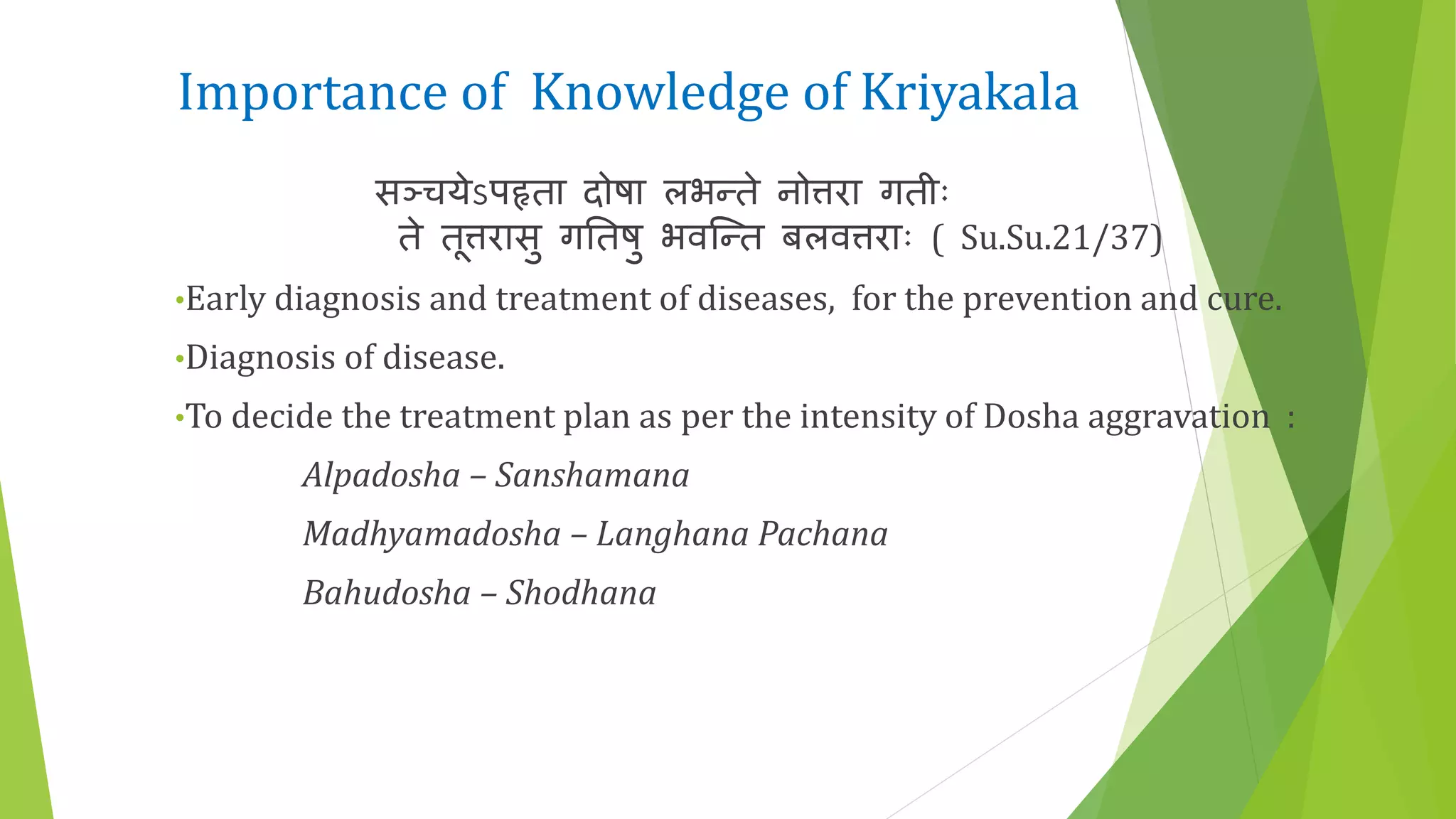
Importance of Knowledge of Kriyakala
सञ्चयेऽपृदता दोषा लभन्ते नोिरा गतीः
ते तूिरासु गततषु भवकन्त बलविराः ( Su.Su.21/37)
•Early diagnosis and treatment of diseases, for the prevention and cure.
•Diagnosis of disease.
•To decide the treatment plan as per the intensity of Dosha aggravation :
Alpadosha – Sanshamana
Madhyamadosha – Langhana Pachana
Bahudosha – Shodhana
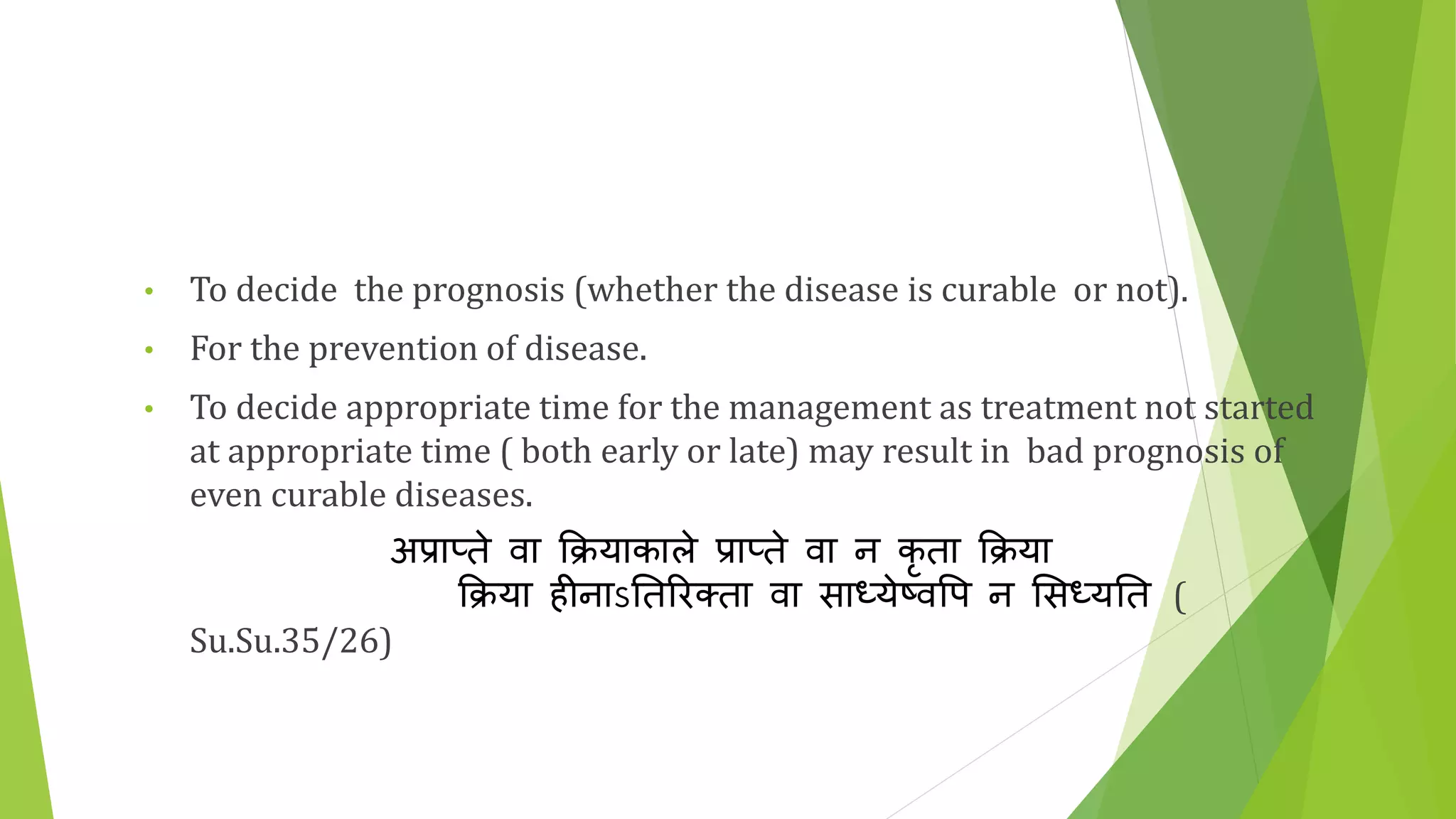
• To decide the prognosis (whether the disease is curable or not).
• For the prevention of disease.
• To decide appropriate time for the management as treatment not started
at appropriate time ( both early or late) may result in bad prognosis of
even curable diseases.
अप्राप्ते वा क्रियाकाले प्राप्ते वा न कृ ता क्रिया
क्रिया हीनाऽततरर्ता वा साध्येष्वत्तप न भसध्यतत (
Su.Su.35/26)
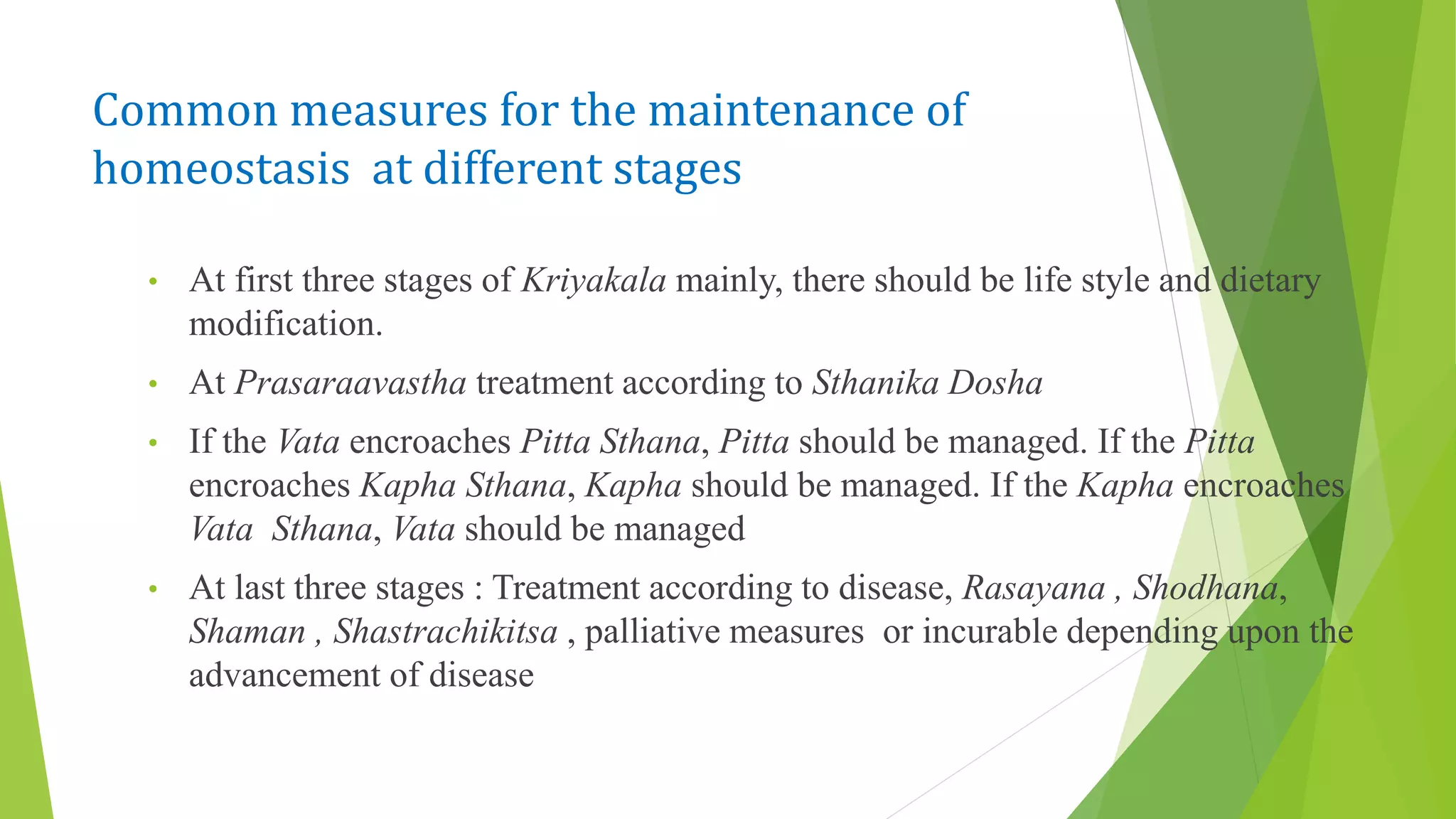
Common measures for the maintenance of
homeostasis at different stages
• At first three stages of Kriyakala mainly, there should be life style and dietary
modification.
• At Prasaraavastha treatment according to Sthanika Dosha
• If the Vata encroaches Pitta Sthana, Pitta should be managed. If the Pitta
encroaches Kapha Sthana, Kapha should be managed. If the Kapha encroaches
Vata Sthana, Vata should be managed
• At last three stages : Treatment according to disease, Rasayana , Shodhana,
Shaman , Shastrachikitsa , palliative measures or incurable depending upon the
advancement of disease
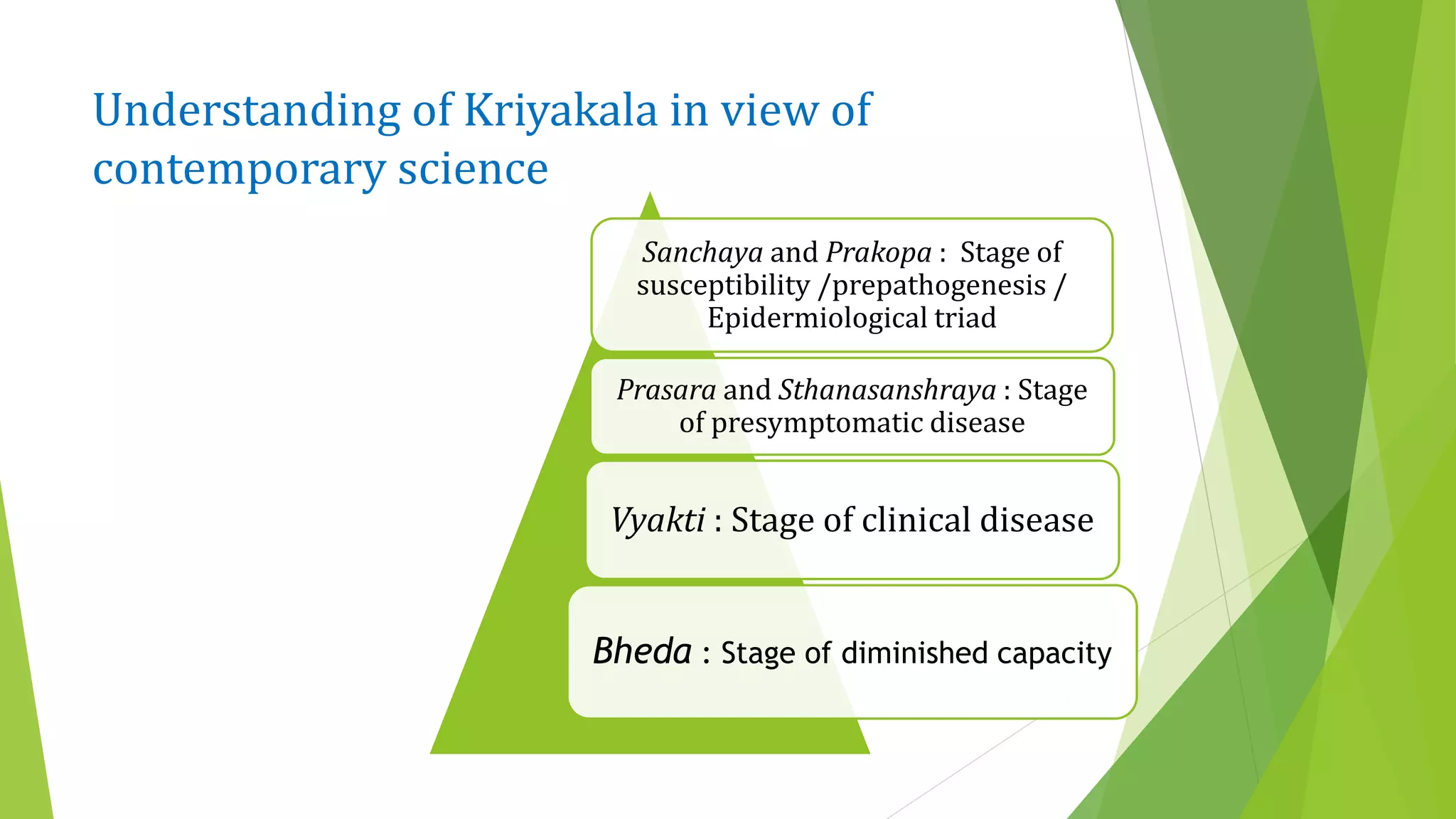
Understanding of Kriyakala in view of
contemporary science
Sanchaya and Prakopa : Stage of
susceptibility /prepathogenesis /
Epidermiological triad
Prasara and Sthanasanshraya : Stage
of presymptomatic disease
Vyakti : Stage of clinical disease
Bheda : Stage of diminished capacity
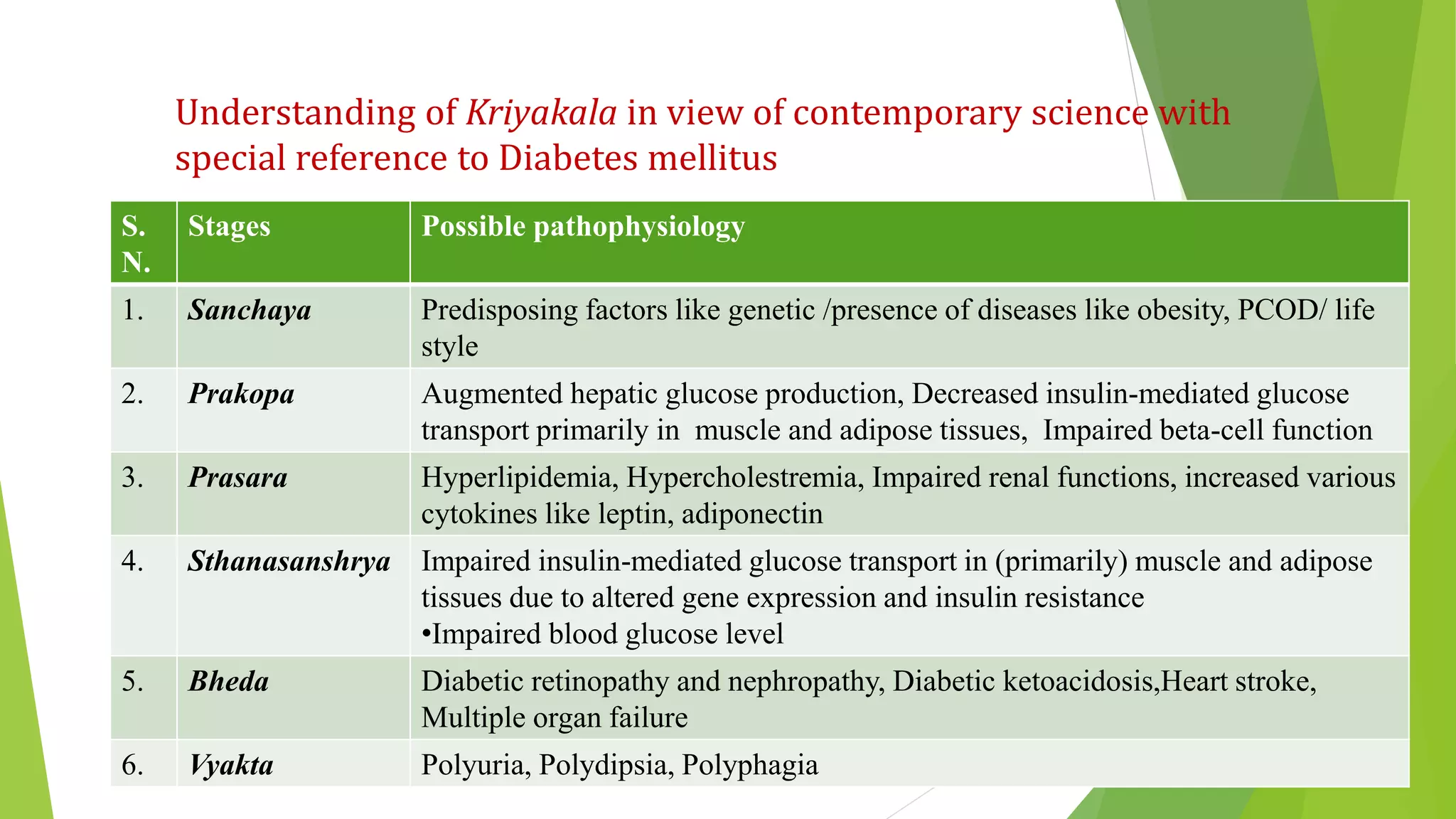
Understanding of Kriyakala in view of contemporary science with
special reference to Diabetes mellitus
S.
N.
Stages Possible pathophysiology
1. Sanchaya Predisposing factors like genetic /presence of diseases like obesity, PCOD/ life
style
2. Prakopa Augmented hepatic glucose production, Decreased insulin-mediated glucose
transport primarily in muscle and adipose tissues, Impaired beta-cell function
3. Prasara Hyperlipidemia, Hypercholestremia, Impaired renal functions, increased various
cytokines like leptin, adiponectin
4. Sthanasanshrya Impaired insulin-mediated glucose transport in (primarily) muscle and adipose
tissues due to altered gene expression and insulin resistance
•Impaired blood glucose level
5. Bheda Diabetic retinopathy and nephropathy, Diabetic ketoacidosis,Heart stroke,
Multiple organ failure
6. Vyakta Polyuria, Polydipsia, Polyphagia
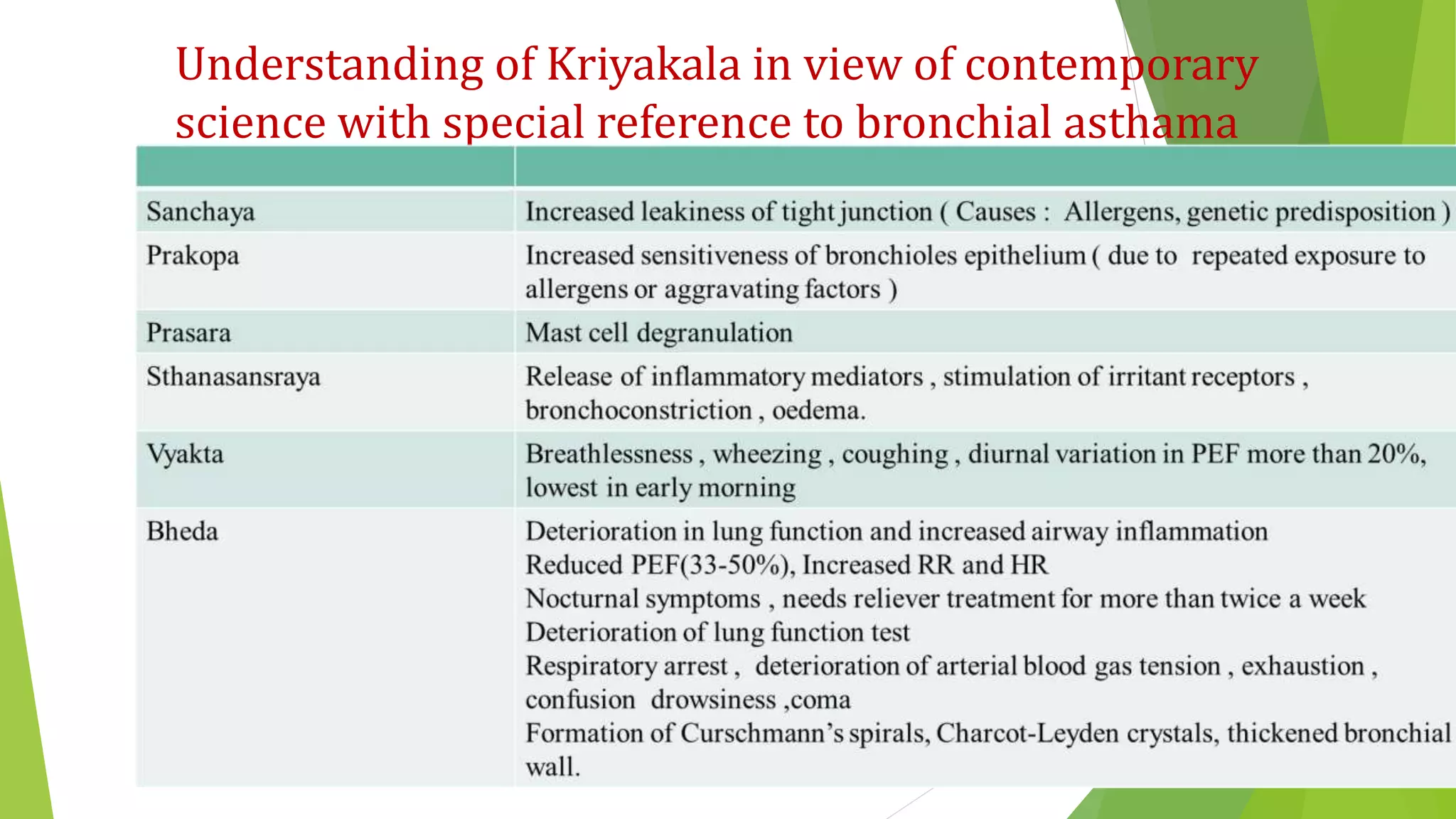
Understanding of Kriyakala in view of contemporary
science with special reference to bronchial asthama
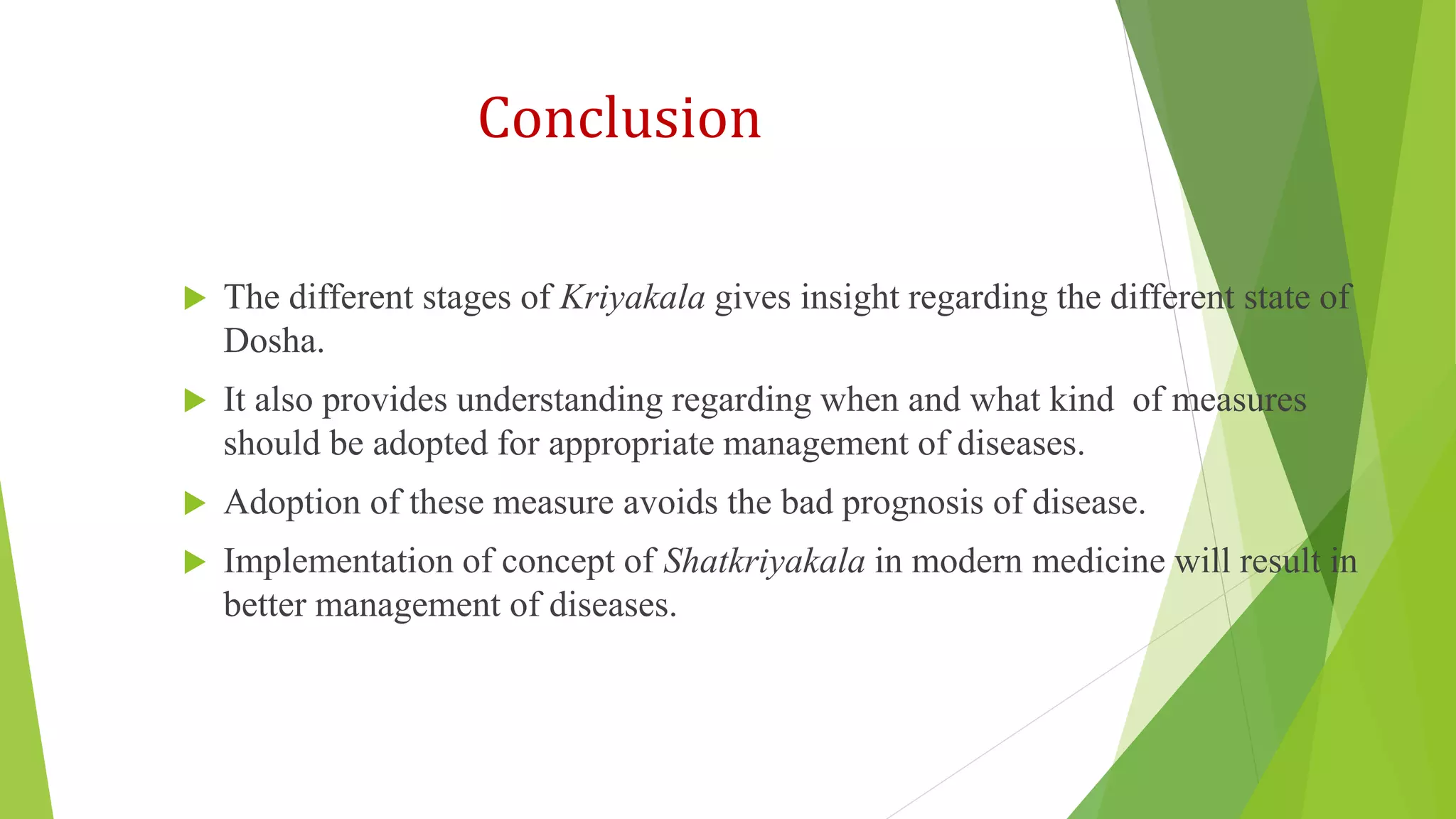
Conclusion
 The different stages of Kriyakala gives insight regarding the different state of
Dosha.
 It also provides understanding regarding when and what kind of measures
should be adopted for appropriate management of diseases.
 Adoption of these measure avoids the bad prognosis of disease.
 Implementation of concept of Shatkriyakala in modern medicine will result in
better management of diseases.
Understanding the Concept of Kriyakala

Understanding the Concept of Kriyakala

  • 1.
    Concept of Shatkriyakala Prof.Sangeeta Gehlot & Dr. Sonam Agarwal Department of Kriya Sharir, Faculty of Ayurveda, IMS, BHU
  • 2.
    Introduction • It isthe stages of progressive pathogenesis of a disease . • It is the different opportunity for a physician to break the pathogenesis of a disease i.e. early diagnosis and treatment as soon as possible. • The term Kriyakala refers to the recognition of the stage of a disease progress, which helps to determine appropriate measure to correct the imbalance in Doshas (biological factors). • It is a compound expression, comprised of Kriya and Kala, where Kriya means the choice to treatment (medicine, food and daily-routine) used to improve the disturbance in Doshas, and Kala refers to the stage of progress of a disease Shat Six stages of pathogenesis of diseases Kriya Prayatanaadi Karma Cheshtamuchyate/ treatment procedures for Dhatusamyta Kala Time
  • 3.
    सञ्चयं च प्रकोपंच प्रसरं स्थानसंश्रयम् व्यक्तं भेदं च यो वेत्ति दोषाणां स भवेद्भभषक् (Su.Su.21/36) Shatkriyakal a Sanchaya Prakopa Prasara Sthana- sanshraya Vyakta Bheda
  • 4.
    SANCHAYA चयो वृद्धिः स्वधाम्न्येवप्रदवेषो वृद्धहेतुषु ववपरीतगुणेच्छा च ( A.H.Su.12/ 22) Accumulation of Dosha occurs at their own places. Accumulated Dosha resides at their own sites instead of free circulating. Subject has aversion against the etiology of Dosha Sanchaya and strong desires towards anti causes of Sanchaya.
  • 5.
    Cause of DoshaSanchaya Disturbed Lifestyle Psychological Factors Improper Diet Causes Of Dosha Sanchaya Trividha Hetu and Kala It may also include the genetic predisposing factors , for example in case of Diabetes mellitus and hypertension. Thus the disturbance in homeostasis can be overcome through appropriate diet and life style modification
  • 6.
    • Accumulation ofDosha also occurs in accordance to timing of meal, age, day- night and season.
  • 7.
    Features manifested duringSanchayavstha तत्र सकञ्चतानां खलु दोषाणां स्तब्धपूणणकोष्ठता पीतावभासता मन्दोष्मता चाङ्गानां गौरवमालस्यं चयकारणत्तवद्वेषश्चेतत भलङ्गातन भवकन्त | तत्र प्रथमः क्रियाकालः (Su.Su.21/18) Vata Dosha Pitta Dosha Kapha Dosha Stabdhapoorna Koshthata (stiffness and fullness in abdomen) Peetavabhasata (yellowish discoloration) Mandoshmata (low body temperature) Anganamgauravam (heaviness of the body parts) Aalasya (lassitude)
  • 8.
    PRAKOPA (The stage ofvitiation) कोपस्तून्मागणगाभमता| भलङ्गानां दर्णनं स्वेषामस्वास््यं रोगसम्भवः (A.H.Su.12/23) •Doshas which were previously accumulated and stagnated in their own sites tend to circulate to other sites. •The appearance of symptoms indicate the disturbance in homeostasis i.e. health. •According to Dalhana, Prakopavastha is extended state of Chayavastha in which Doshas are in liquid or gaseous forms and tend to leave their sites. •It results due to indulgence in Dosha Prakopaka Aahara (food)-Vihara (regimen).
  • 9.
    Causes of VataPrakopa Diet Lifestyle Diurnal and seasonal Food article of : • Katu, Tikta , Kashaya Rasa • Ruksha , Laghu and Sheeta Dravya • Adhyashana , Vishamashana • Examples : Pulses • Suppression of natural urges. • Night awakening • Cold season , Rainy season • At the starting of day and night
  • 10.
    Causes of PittaPrakopa Diet Life Style Psychological Diurnal and seasonal Food articles of : • Katu, Amla and Lavana Rasa • Teekshna , Ushna, Laghu and Vidahi substances • Taking food in small quantity • Example : Tila taila, Pinyaka Over exertion Anger, Grief , Anxiety • At the mid of the day and night • During the digestion of meal • Hot season and autumn
  • 11.
    Causes of KaphaPrakopa Diet Life style Diurnal and seasonal Food substances of • Madhura, Amla and Lavana Rasa • Sheeta, Guru and Snigdha Substances • Example : Food items made up of Pishta , milk, sugarcane • Adhyashana • Day time sleeping • Lack of exercise • At the starting of day and night • Spring season
  • 12.
    Types of DoshaPrakopa Achaya Prakopa/ Pathyaja Prakopa • When Dosha jump directly to Prakopa stage without passing through Chayaavastha • It does not require any Samshodhana Chikitsa like Vamana, Virechana Sanchaya Prakopa /Apathyaja Prakopa/Kathinyabala (solidified increase) • Gradual increase of Doshas • Requires Shodhana Chikitsa • Doshas are in liquefied state or gaseous state
  • 13.
    Symptoms of DoshaPrakopa तेषां प्रकोपात ् कोष्ठतोदसञ्चरणाम्लीकात्तपपासापररदाहान्नद्वेषृददयो््लेदाश्च जायन्ते तत्र द्त्तवतीयः क्रियाकालः ( Su.Su.21/27) Vata Prakopa- • Koshthatoda Sancharan (pricking pain and movement of Vata in abdominal region) Pitta Prakopa- •Amlika(sour eructation) •Paridaha(burning sensation all over the body) •Pipasa (excessive thirst) Kapha Prakopa • Annadwesha (aversion to food) • Hridyotkleda (excessive salivation in mouth)
  • 14.
    Prasara (The stageof dissemination) • This stage marks with the dissemination of vitiated Dosha to different parts of the body. • The aggravated Dosha leave their original path and spread to the other parts of the body through different channels. • If appropriate management is taken, the pathogenesis stops here but if not it progresses to further stages . • This spread of Dosha is of fifteen types. • Can be understand from the similes of प्रकु त्तपतानां क्रकण्वोदकत्तपष्टसमवाय महानुदकसञ्चयोऽततवृद्धः सेतुमवदायाणपरेणोदके न ( Su.Su.21/36)
  • 15.
    एवं प्रकु त्तपतानांप्रसरतां वायोत्तवणमागणगमनाटोपौ, ओषचोषपररदाहधूमायनातन त्तपिस्य, अरोचकात्तवपाकाङ्गसादाश्छर्दणश्चेतत श्लेष्मणो भलङ्गातन भवकन्त; तत्र तृतीयः क्रियाकालः (Su.Su.21/36) Features of Vata Prasara : • Vimarga gamana(regurgitation) • Aatopa (flatulence and gurgling) Features of Pitta Prasara : •Osha (burning sensation accompanied with sweating and restlessness) •Chosha (painful sucking sensation)
  • 16.
    • Paridaha (burningsensation around the part involved) • Dhumayana ( feeling of movement of hot fumes inside head, neck , throat and palate) Features of Kapha Prasara- • Arochaka (anorexia) • Avipaka( indigestion) • Angasada (inertness in limb) • Chardi (vomiting)
  • 17.
    Sthansamshraya (The stageof localization) कु त्तपतानां र्ह दोषाणां र्रीरे पररधावताम् यत्र सङ्गः खवैगुण्याद्व्याधधस्तत्रोपजायते ( Su.Su.24/10) •The aggravated Doshas which were previously localized, starts circulating to whole body and resides in the Srotas where there is any kind of Khavaigunya i.e. anatomical or physiological abnormality. it marks the beginning of specific diseases • In this state, Dosha Dushya Sammurchana i.e. involvement between Dosha and Dushya takes place at the site of Srotovaigunya. क्षिप्यमाणः खवैगुण्याद्रसः सज्जतत यत्र सः करोतत त्तवकृ ततं तत्र खे वषणभमव तोयदः ( Ch.Chi.15/37)
  • 18.
    In this stage,all the prodromal symptoms of diseases appear. So this stage is also called the Poorvarupa of diseases स्थानसंश्रतयणः िु द्धा भात्तवव्याधधप्रबोधकम् दोषाः कु वणकन्त यकललङ्गं पूवणरूपं तदुच्यते’ (Chakrapani on Su.Su.21/37) The sign and symptoms produced in this stage are on the basis of sites where Dosha Dushya Samurchhana occurs.
  • 19.
    Symptoms manifested during Prasaravstha एवंप्रकु त्तपतातांस्ताञ् र्रीरप्रदेर्ानागम्य तांस्तान् व्याधीन् जनयकन्त | ते यदोदरसकन्नवेर्ं कु वणकन्त तदा गुलम त्तवद्रध्युदराकननसङ्गानाहत्तवसूधचकाततसारप्रभृतीञ्जनयकन्त; बकस्तगताः प्रमेहाश्मरीमूत्राघातमूत्रदोषप्रभृतीन्; मेढ्रगता तनरुद्धप्रकर्ोपदंर्र्ूकदोषप्रभृतीन्; गुदगता भगन्दरार्णःप्रभृतीन्; वृषणगता वृद्धीः; ऊध्वणजत्रुगतास्तूध्वणजान्; ्वङ्मंसर्ोणणतस्थाः िुद्ररोगान् कु ष्ठातन त्तवसपाांश्च; मेदोगता ग्रन््यपच्यबुणदगलगण्डालजीप्रभृतीन्; अकस्थगता त्तवद्रध्यनुर्यीप्रभृतीन्; पादगताः श्लीपदवातर्ोणणतवातकण्टकप्रभृतीन्; सवाणङ्गगता ज्वरसवाणङ्गरोगप्रभृतीन्; तेषामेवमभभसकन्नत्तवष्टानां पूवणरूपप्रादुभाणवः तं प्रततरोगं वक्ष्यामः |तत्र पूवणरूपगतेषु चतुथणः क्रियाकालः (Su.Su.21/33)
  • 20.
    S.N Organ Disease 1.Udara  Gulma (abdominal tumor)  Vidradhi (internal abscess)  Udara roga (diseases of liver, spleen and ascites)  Anaha (constipation)  Visuchika (acute gastroenteritis) and Atisara ( acute entero colitis) 2. Vasti  Prameha (DM)  Ashmari (renal calculus)  Mutraghata (retention of urine)  Mutrakriccha(difficult and painful micturition) 3. Medra  Upadansha (sores on the penis),  Niruddhaprakarsha (Phimosis)  Shukadosha
  • 21.
    4. Guda Bhagandara (fistula-in-ano) and Arsha (hemorrhoids) 5. Vrushana  Vriddhi (hydrocele, haematocele, orchitis) 6. Urdhwajatrugat  Diseases above the clavicle region 7. Twak, Mamsa and Shonitagata  Kshudraroga (minor maladies)  Kustha( skin disorders)  Visarpa (erysipelas) 8. Medagata  Granthi (lymphadenitis)  Apachi, Arbuda ( tumor benign or malignant)  Galaganda ( goiter)  Alji ( a type of carbuncle)etc 9. Asthi  Vidradhi (osteomyelitis)  Anushayi ( periostitis) 10. Pada  Shlipada (filariasis),  Shonita-vata
  • 22.
    Vyakti (The stageof manifestation) • अत ऊध्वां व्याधेदणर्णनं वक्ष्यामः- र्ोफाबुणदग्रकन्थत्तवद्रधधत्तवसपणप्रभृतीनां प्रव्य्तलिणता ज्वरातीसारप्रभृतीनां च | तत्र पञ्चमः क्रियाकालः ( Su.Su.21/34) • Disease manifests their cardinal symptoms after interaction between Dosha and Dushya. For e.g:- • Increased body temperature is observed in Jwara • Excessive watery stool in Atisara • Abnormal enlargement of abdomen in Udara Roga प्रव्य्तलिणता व्याधीनां व्यक्तरर्यथणः( Chakrapani on Su.Su.21/33)
  • 23.
    Bheda (The stageof complication) अत ऊध्वणमेतेषामवदीणाणनां व्रणभावमापन्नानां षष्ठः क्रियाकालः, ज्वराततसारप्रभृतीनां च दीघणकालानुबन्धः | तत्राप्रततक्रियमाणेऽसाध्यतामुपयाकन्त (Su.Su.21/35) •It is the most advanced and last stage of Kriyakala •If not treated , the disease becomes incurable, chronic, complicated or may gives rise to another disease. •This is the stage when disease is diagnosed more by its complications along with the main diseases
  • 24.
    Importance of Knowledgeof Kriyakala सञ्चयेऽपृदता दोषा लभन्ते नोिरा गतीः ते तूिरासु गततषु भवकन्त बलविराः ( Su.Su.21/37) •Early diagnosis and treatment of diseases, for the prevention and cure. •Diagnosis of disease. •To decide the treatment plan as per the intensity of Dosha aggravation : Alpadosha – Sanshamana Madhyamadosha – Langhana Pachana Bahudosha – Shodhana
  • 25.
    • To decidethe prognosis (whether the disease is curable or not). • For the prevention of disease. • To decide appropriate time for the management as treatment not started at appropriate time ( both early or late) may result in bad prognosis of even curable diseases. अप्राप्ते वा क्रियाकाले प्राप्ते वा न कृ ता क्रिया क्रिया हीनाऽततरर्ता वा साध्येष्वत्तप न भसध्यतत ( Su.Su.35/26)
  • 26.
    Common measures forthe maintenance of homeostasis at different stages • At first three stages of Kriyakala mainly, there should be life style and dietary modification. • At Prasaraavastha treatment according to Sthanika Dosha • If the Vata encroaches Pitta Sthana, Pitta should be managed. If the Pitta encroaches Kapha Sthana, Kapha should be managed. If the Kapha encroaches Vata Sthana, Vata should be managed • At last three stages : Treatment according to disease, Rasayana , Shodhana, Shaman , Shastrachikitsa , palliative measures or incurable depending upon the advancement of disease
  • 27.
    Understanding of Kriyakalain view of contemporary science Sanchaya and Prakopa : Stage of susceptibility /prepathogenesis / Epidermiological triad Prasara and Sthanasanshraya : Stage of presymptomatic disease Vyakti : Stage of clinical disease Bheda : Stage of diminished capacity
  • 28.
    Understanding of Kriyakalain view of contemporary science with special reference to Diabetes mellitus S. N. Stages Possible pathophysiology 1. Sanchaya Predisposing factors like genetic /presence of diseases like obesity, PCOD/ life style 2. Prakopa Augmented hepatic glucose production, Decreased insulin-mediated glucose transport primarily in muscle and adipose tissues, Impaired beta-cell function 3. Prasara Hyperlipidemia, Hypercholestremia, Impaired renal functions, increased various cytokines like leptin, adiponectin 4. Sthanasanshrya Impaired insulin-mediated glucose transport in (primarily) muscle and adipose tissues due to altered gene expression and insulin resistance •Impaired blood glucose level 5. Bheda Diabetic retinopathy and nephropathy, Diabetic ketoacidosis,Heart stroke, Multiple organ failure 6. Vyakta Polyuria, Polydipsia, Polyphagia
  • 29.
    Understanding of Kriyakalain view of contemporary science with special reference to bronchial asthama
  • 30.
    Conclusion  The differentstages of Kriyakala gives insight regarding the different state of Dosha.  It also provides understanding regarding when and what kind of measures should be adopted for appropriate management of diseases.  Adoption of these measure avoids the bad prognosis of disease.  Implementation of concept of Shatkriyakala in modern medicine will result in better management of diseases.