

“Marketing Management”
Sales Force and
Promotion
Prepared by:
Jonah C. Pardillo
SALES PROMOTION:
- Consists of a diverse collection of incentive tools, mostly short
term, designed to stimulate quicker or greater purchase of
particular products or services by consumers or the trade.
FACTORS CONTRIBUTE TO THE RAPID GROWTH OF SALES
PROMOTION
INTERNAL FACTORS:
 Promotion is now more accepted by top management as an
effective sales tool;
 More product managers are qualified to use sales-promotion tools;
 Product managers are under greater pressure to increase current
sales.
EXTERNAL FACTORS:
 The number of brands has increased;
 Competitors use promotion frequently;
 Many brands are seen as similar;
 Consumers are more price-oriented
 The trade has demanded more deals from manufacturers;
 Advertising efficiency has declined because of rising costs, media
clutter, and legal restraints.
PURPOSE OF SALES PROMOTION
1. to attract new triers
 Users of other brand in the same category
 Users in other categories
 Frequent brand switchers
2. To reward loyal customers
3. To increase the repurchase rates of occasional users.
MAJOR DECISION IN
SALES PROMOTION
Select the tools
Established its
objectives
Implement and
control
Develop the
program
Pre-test the
program
Evaluate the
result
ESTABLISHING THE OBJECTIVES
 Basic marketing – developed for the product
 Sales promotion – target market
 Consumers – encouraging purchase of large-size units,
building trial among nonusers, and attracting switchers away
from competitors’ brand.
 Retailers – persuading retailers
to new items and higher levels of
inventory, encouraging off
seasons buying, encouraging
stocking of related items,
offsetting competitive
promotions, building loyalty, and
gaining entry into new retail
outlets.
 Sales force – encouraging
support of a new product or
model, encouraging more
prospecting, and stimulating off-
season sales.
SELECTING CONSUMER-
PROMOTION TOOLS
 Samples
 Coupons
 Cash refunds offers(rebates)
 Price packs (cents-off deals)
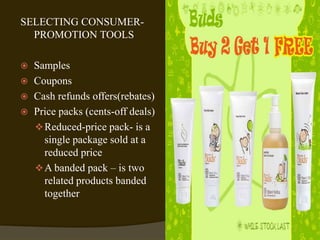
Reduced-price pack- is a
single package sold at a
reduced price
A banded pack – is two
related products banded
together
 Premiums
 with pack-premium
Free in mail premium
Self liquidating premium
 Prizes
 contest
Sweepstakes
Game
 Patronage awards
 Free trials
 Product warranties
 Tie-in promotions
 Cross promotions
 Point-of-purchase (POP)
Displays and
Demonstrations
SELECTING TRADE-
PROMOTION TOOLS:
1. To persuade the retailer or
wholesaler to carry the
brand.
2. To persuade the retailer or
wholesaler to carry more
units than the normal
amount.
3. To induce retailers to
promote the brand by
featuring, display, and price
reductions.
4. To stimulate retailers and
their sales clerks to push
the product.
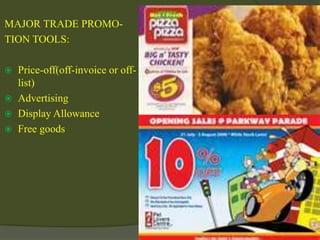
MAJOR TRADE PROMO-
TION TOOLS:
 Price-off(off-invoice or off-
list)
 Advertising
 Display Allowance
 Free goods
SELECTING BUSINESS &
SALES FORCE PROMOTION
TOOLS:
 Trade shows and
conventions
 Sales contests
 Specialty advertising
DEVELOPING THE
PROGRAM:
 Size of the incentive
 Conditions for participation
 Duration of promotion
 Distribution vehicles
 Timing of promotion
 Sales-promotion budget
PRETESTING THE PROGRAM:
- To determine if the tools are appropriate, the incentive size
optimal, and the presentation method efficient. Consumers can
be asked to rate or rank different possible deals, or trial tests can
be run in limited geographic area.
IMPLEMENTING AND CONTROLLING THE PROGRAM
 Lead time – is the time necessary to prepare the program prior
to launching it: initial planning, design, and approval of package
modifications or material to be mailed or distributed;
preparation of advertising of and point-of-sale materials;
notification of field sales personnel; established of allocations
for individual distributors
purchasing and printing of special premiums or packaging materials;
production of advance inventories in preparation for release at a
specific date; and finally, the distribution to retailer
 Sell-in-time – begins with the promotional launch and ends when
approximately 95% of the deal is in the hands of consumers.
EVALUATING RESULTS
1. Sales data – marketers can analyze the
types of people who took advantage of
the promotion, what they bought before
the promotion, and how consumer
behaved later toward the brands and
other brands.
2. Consumers survey – can be conducted
to learn how many recall the promotion,
what they thought of it, how many took
advantage of it, and how the promotion
affected subsequent brand choice
behaviour.
3. Experiments – vary such attributes as
incentive value, duration, and
distribution media.
Thank you......
And GOD BLESS ......!!!

Sales Force and Promotion

  • 1.
    “Marketing Management” Sales Forceand Promotion Prepared by: Jonah C. Pardillo
  • 2.
    SALES PROMOTION: - Consistsof a diverse collection of incentive tools, mostly short term, designed to stimulate quicker or greater purchase of particular products or services by consumers or the trade.
  • 3.
    FACTORS CONTRIBUTE TOTHE RAPID GROWTH OF SALES PROMOTION INTERNAL FACTORS:  Promotion is now more accepted by top management as an effective sales tool;  More product managers are qualified to use sales-promotion tools;  Product managers are under greater pressure to increase current sales. EXTERNAL FACTORS:  The number of brands has increased;  Competitors use promotion frequently;  Many brands are seen as similar;  Consumers are more price-oriented  The trade has demanded more deals from manufacturers;  Advertising efficiency has declined because of rising costs, media clutter, and legal restraints.
  • 4.
    PURPOSE OF SALESPROMOTION 1. to attract new triers  Users of other brand in the same category  Users in other categories  Frequent brand switchers 2. To reward loyal customers 3. To increase the repurchase rates of occasional users.
  • 5.
    MAJOR DECISION IN SALESPROMOTION Select the tools Established its objectives Implement and control Develop the program Pre-test the program Evaluate the result
  • 6.
    ESTABLISHING THE OBJECTIVES Basic marketing – developed for the product  Sales promotion – target market  Consumers – encouraging purchase of large-size units, building trial among nonusers, and attracting switchers away from competitors’ brand.
  • 7.
     Retailers –persuading retailers to new items and higher levels of inventory, encouraging off seasons buying, encouraging stocking of related items, offsetting competitive promotions, building loyalty, and gaining entry into new retail outlets.  Sales force – encouraging support of a new product or model, encouraging more prospecting, and stimulating off- season sales.
  • 8.
    SELECTING CONSUMER- PROMOTION TOOLS Samples  Coupons  Cash refunds offers(rebates)  Price packs (cents-off deals) Reduced-price pack- is a single package sold at a reduced price A banded pack – is two related products banded together
  • 9.
     Premiums  withpack-premium Free in mail premium Self liquidating premium  Prizes  contest Sweepstakes Game  Patronage awards  Free trials  Product warranties  Tie-in promotions  Cross promotions  Point-of-purchase (POP) Displays and Demonstrations
  • 10.
    SELECTING TRADE- PROMOTION TOOLS: 1.To persuade the retailer or wholesaler to carry the brand. 2. To persuade the retailer or wholesaler to carry more units than the normal amount. 3. To induce retailers to promote the brand by featuring, display, and price reductions. 4. To stimulate retailers and their sales clerks to push the product.
  • 11.
    MAJOR TRADE PROMO- TIONTOOLS:  Price-off(off-invoice or off- list)  Advertising  Display Allowance  Free goods
  • 12.
    SELECTING BUSINESS & SALESFORCE PROMOTION TOOLS:  Trade shows and conventions  Sales contests  Specialty advertising DEVELOPING THE PROGRAM:  Size of the incentive  Conditions for participation  Duration of promotion  Distribution vehicles  Timing of promotion  Sales-promotion budget
  • 13.
    PRETESTING THE PROGRAM: -To determine if the tools are appropriate, the incentive size optimal, and the presentation method efficient. Consumers can be asked to rate or rank different possible deals, or trial tests can be run in limited geographic area. IMPLEMENTING AND CONTROLLING THE PROGRAM  Lead time – is the time necessary to prepare the program prior to launching it: initial planning, design, and approval of package modifications or material to be mailed or distributed; preparation of advertising of and point-of-sale materials; notification of field sales personnel; established of allocations for individual distributors
  • 14.
    purchasing and printingof special premiums or packaging materials; production of advance inventories in preparation for release at a specific date; and finally, the distribution to retailer  Sell-in-time – begins with the promotional launch and ends when approximately 95% of the deal is in the hands of consumers.
  • 15.
    EVALUATING RESULTS 1. Salesdata – marketers can analyze the types of people who took advantage of the promotion, what they bought before the promotion, and how consumer behaved later toward the brands and other brands. 2. Consumers survey – can be conducted to learn how many recall the promotion, what they thought of it, how many took advantage of it, and how the promotion affected subsequent brand choice behaviour. 3. Experiments – vary such attributes as incentive value, duration, and distribution media.
  • 16.
    Thank you...... And GODBLESS ......!!!