SALES PROMOTION
PREPARED BY
AVNEET CHAUDHARY
ROLL NO -09
PROMOTION
• “The short term incentive to encourage consumers to buy the products or it is a short term tool used to
persuade the prospective buyers towards the product at point of sales.”
• Promotion is a form of communication with an additional element of pursuasion to accept ideas, products, and
services. It is third element of marketing mix.
. Promotion is the spark plug of our marketing mix and an important marketing strategy.
Avneet chaudhary
PROMOTION
• Promotion is the process of marketing communication to inform, persuade, remind and influence
consumers or users in favor of your product or service.
• People must know that the right product at the right price is available at the right place.
• In marketing, effective communication is absolutely necessary even though you have a superb product,
best package and also you offer a fair price, People will not buy your product, if they have never heard of it
and they are simply unaware of its existence.
Avneet chaudhary
PROMOTION
• Promotion persuades and convinces the buyer and influences his/her behaviour to take the desired action.
Promotional efforts act as powerful tools of competition providing the cutting edge of its entire marketing
program.
• Promotion has been also defined as “ the coordinated self-initiated efforts to establish channels of information
and persuasion to facilitate or faster the sale of goods or services, of the acceptance of ideas or point of view.”
Avneet chaudhary
SALES PROMOTION
• Sales promotions are the set of marketing activities undertaken to boost sales of the product or service.
• The American Marketing Association (AMA) defines sales promotion as "media and non-media marketing pressure
applied for a predetermined, limited period of time in order to stimulate trial, increase consumer demand, or
improve product quality.”
Avneet chaudhary
SALES PROMOTION
• Businesses can target sales promotions at three different audiences: consumers, resellers, and the company's own
sales force.
• Sales promotion acts as a competitive weapon by providing an extra incentive for the target audience to purchase
or support one brand over another.
• It is particularly effective in product trial and unplanned purchases. Most marketers believe that a given product or
service has an established perceived price or value, and they use sales promotion to change this price-value
relationship by increasing the value and/or lowering the price.
Avneet chaudhary
SALES PROMOTION
• Compared to the other components of the marketing mix (advertising, publicity, and personal selling), sales
promotion usually operates on a shorter time line, uses a more rational appeal, returns a tangible or real value,
fosters an immediate sale, and contributes highly to profitability.
• Sales promotion consists of a diverse collection of incentive tools, mostly short-term, designed to stimulate quicker
and/or greater purchase of a particular product by consumers to the trade.
Avneet chaudhary
GROWTH OF SALES PROMTION
Sales promotion has grown substantially in recent years . There are several reasons for this dramatic growth in sales
promotion.
• First, consumers have accepted sales promotion as part of their buying decision criteria.
• Second, the increasing tendency of businesses to focus on short-term results has helped super growth in sales
promotion, which can provide an immediate boost in sales.
• Third, the emergence of computer technology has enabled manufacturers to get rapid feedback on the results of
promotions.
• Finally, an increase in the size and power of retailers has also boosted the use of sales promotion.
Avneet chaudhary
SALES PROMOTION OBJECTIVES
The main objective of sales promotion is to bring about a change in the demand pattern of products and services.
Basically, sales promotion has specific objectives are as follows.
• It is meant to provide important marketing information to the potential buyers.
• Objective is to convince and influence the potential buyers through persuasive measures.
• Sales promotion is meant to act as a powerful tool of competition
Avneet chaudhary
SALES PROMOTION OBJECTIVES :
• To introduce new products or services.
• To attract new customers.
• To induce existing customers to buy more.
• Helps the firm to remain competitive.
• To increase sales in off-seasons.
• To add to the stock of the dealers.
• To introduce new products or services.
• To attract new customers.
• To induce existing customers to buy more
Avneet chaudhary
SALES PROMOTION OBJECTIVES
• Helps the firm to remain competitive.
• To increase sales in off-seasons.
• To add to the stock of the dealers.
Avneet chaudhary
SALES PROMOTION OBJECTIVES
• There can be number of sales promotion objectives, depending upon the firm’s policies, marketing objectives,
nature of the product and its stage in product life-cycle, level of existing and anticipated competitive activity,
consumer response pattern, economic conditions, and the target group (consumers, traders or sales force), etc.
Avneet chaudhary
STRENGTHS OF SALES PROMOTION
• It stimulates positive attitudes towards the product.
• It gives extra incentive to the customer to make a purchase.
• It gives direct inducement to take immediate action now rather than later.
• It has flexibility and it can be used at any stage of a new product introduction DINESH NIKAM SALES PRO
Avneet chaudhary
STRENGTHS OF SALES PROMOTION
Sales promotion are very effective:
• When a new brand is introduce.
• When we have to communicate a major improvement in our product.
• When we want to amplify the results of the advertising.
• When we want to increase the number of retail stores to sell our products.
Avneet chaudhary
SALES PROMOTION TOOL
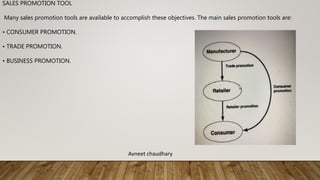
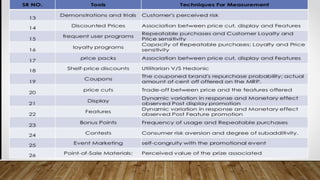
Many sales promotion tools are available to accomplish these objectives. The main sales promotion tools are:
• CONSUMER PROMOTION.
• TRADE PROMOTION.
• BUSINESS PROMOTION.
Avneet chaudhary
CONSUMER PROMOTION :
The promotion planner should take into account the type of market, sales promotion objectives, competitive
conditions, and each tool’s costeffectiveness. The main consumer promotion tools are:
Samples : offer of a free amount of a product or service delivered door-to-door, sent in the mall, picked up in a
store, attached to another product, or featured in an advertising offer.
Coupons : Certificates entitling the bearer to stated saving on the purchase of a specific product: mailed, enclosed
in other products or attached to them, or inserted in magazine and newspaper ads.
Cash Refund offers (rebates) : Provide a price reduction after purchase rather than at the retail shop: Consumer
sends a specified “proof of purchase” to the manufacturer who “refunds” part of the purchase price by mail.
Price Packs ( cents-off deals): Offers to consumers of savings off the regular price of a product, flagged on the
label or package. A reduced-price pack is a single package sold at a reduced price (such as two for the price of one.)
A banded pack is two related products banded together (such as a toothbrush and toothpaste).
Avneet chaudhary
CONSUMER PROMOTION
Premiums (gifts) : Merchandise offered at a relatively low cost or free as an incentive to purchase a particular
product. A with-pack premium accompanies the product inside or on the package. A free in-the-mail premium is
mailed to consumers who send in a proof of purchase, such as a box top or UPC code. A self-liquidating premium is
sold below its normal retail price to consumers who request it.
Frequency Programs: Programs providing rewards related to the consumer's frequency and intensity in
purchasing the company's products or services.
Product Warranties: Explicit or implicit promises by sellers that the product will perform as specified or that the
seller will fix it or refund the customer's money during a specified period.
Tie-in Promotions: Two or more brands or companies team up on coupons, refunds, and contests to increase
pulling power.
Cross-Promotions: Using one brand to advertise another noncompeting brand.
Point-of-Purchase (P-O-P) Displays and Demonstrations: P-O-P displays and demonstrations take place at the
point of purchase or sale.
Avneet chaudhary
TRADE PROMOTION:
Manufacturers award money to the trades
to persuade the retailer or wholesaler to carry the brand.
to persuade the retailer or wholesaler to carry more units than the normal amount.
to induce retailers to promote the brand by featuring, display, and price reductions.
to stimulate retailers and their sales clerks to push the product.
Avneet chaudhary
TRADE PROMOTION
Manufacturers use a number of trade promotion tools.
Price-Off (off-invoice or off-list): A straight discount off the list price on each case purchased during a stated
time period.
Allowance: An amount offered in return for the retailer's agreeing to feature the manufacturer's products in
some way. An advertising allowance compensates retailers for advertising the manufacturer's product. A display
allowance compensates them for carrying a special product display.
Free Goods: Offers of extra cases of merchandise to intermediaries who buy a certain quantity or who feature a
certain flavor or size.
Sales Contests: A sales contest aims at inducing the sales force or dealers to increase their sales results over a
stated period, with prizes (money, trips, gifts, or points) going to those who succeed.
Specialty Advertising: Specialty advertising consists of useful, low-cost items bearing the company's name and
address, and sometimes an advertising message that salespeople give to prospects and customers, Common items
are ballpoint pens, calendars, key chains, flashlights, tote bags, and memo pads.
Avneet chaudhary
LIMITATIONS OF SALES PROMOTION
• Sales promotion have temporary and short life not exceeding three months, Sales promotion alone cannot build
up brand loyalty.
• Sales promotions are only supplementary devices to supplement selling efforts of other promotion tools.
• They are non-recurring in their use. They have seldom reuse values.
• Too many sales promotion may affect adversely the brand image, suggesting its lack of popularity or
overstocking by a company.
Avneet chaudhary
LIMITATIONS OF SALES PROMOTION
• Advertising agencies accord low status to sales promotion and usually employ junior staff for sales promotion so
that they may be trained for more creative jobs. Sales promotion are ineffective:
When established brand have a declining market.
There are no product improvements.
When there is intensive competition on consumer sales promotion
Avneet chaudhary
DEVELOPING THE SALES PROMOTION PROGRAM
In deciding to use a particular incentive, marketers have to consider:
• the size of the incentive (a certain minimum is necessary if the promotion is to succeed; a higher level will produce
more sales response but at a diminishing rate)
• the conditions for participation (whether to offer the incentive to everyone or to select groups)
• the duration (if the period is too short, many prospects will not be able to take advantage of it—but if it runs too
long, it loses some of its “act now” force)
• The distribution vehicle (each distribution method involves a different level of reach, cost, and impact).
• The timing (annually, one-time, or some other dates which must be communicated and coordinated with other
departments).
• The total sales promotion budget (including administrative costs and incentive costs).
Avneet chaudhary
PRETESTING THE PROGRAM
• Although most sales-promotion programs are designed on the basis of experience, savvy marketers use
pretests to determine if the tools are appropriate, the incentive size is optimal, and the presentation method is
efficient.
• Promotions usually can be tested quickly and inexpensively and that large companies should test alternative
strategies in selected market areas with each national promotion.
Avneet chaudhary
IMPLEMENTING AND EVALUATING THE PROGRAM
• Implementation planning must cover lead time (the time needed to prepare the program before the launch)
and sell-in time (which begins with the launch and ends when approximately 95 percent of the deal merchandise
is in the hands of consumers).
• After implementation, manufacturers can measure sales-promotion effectiveness using sales data, consumer
surveys, and experiments.
Avneet chaudhary
THANKS YOU
Avneet chaudhary

Sales promotion

  • 1.
  • 2.
    PROMOTION • “The shortterm incentive to encourage consumers to buy the products or it is a short term tool used to persuade the prospective buyers towards the product at point of sales.” • Promotion is a form of communication with an additional element of pursuasion to accept ideas, products, and services. It is third element of marketing mix. . Promotion is the spark plug of our marketing mix and an important marketing strategy. Avneet chaudhary
  • 3.
    PROMOTION • Promotion isthe process of marketing communication to inform, persuade, remind and influence consumers or users in favor of your product or service. • People must know that the right product at the right price is available at the right place. • In marketing, effective communication is absolutely necessary even though you have a superb product, best package and also you offer a fair price, People will not buy your product, if they have never heard of it and they are simply unaware of its existence. Avneet chaudhary
  • 4.
    PROMOTION • Promotion persuadesand convinces the buyer and influences his/her behaviour to take the desired action. Promotional efforts act as powerful tools of competition providing the cutting edge of its entire marketing program. • Promotion has been also defined as “ the coordinated self-initiated efforts to establish channels of information and persuasion to facilitate or faster the sale of goods or services, of the acceptance of ideas or point of view.” Avneet chaudhary
  • 5.
    SALES PROMOTION • Salespromotions are the set of marketing activities undertaken to boost sales of the product or service. • The American Marketing Association (AMA) defines sales promotion as "media and non-media marketing pressure applied for a predetermined, limited period of time in order to stimulate trial, increase consumer demand, or improve product quality.” Avneet chaudhary
  • 6.
    SALES PROMOTION • Businessescan target sales promotions at three different audiences: consumers, resellers, and the company's own sales force. • Sales promotion acts as a competitive weapon by providing an extra incentive for the target audience to purchase or support one brand over another. • It is particularly effective in product trial and unplanned purchases. Most marketers believe that a given product or service has an established perceived price or value, and they use sales promotion to change this price-value relationship by increasing the value and/or lowering the price. Avneet chaudhary
  • 7.
    SALES PROMOTION • Comparedto the other components of the marketing mix (advertising, publicity, and personal selling), sales promotion usually operates on a shorter time line, uses a more rational appeal, returns a tangible or real value, fosters an immediate sale, and contributes highly to profitability. • Sales promotion consists of a diverse collection of incentive tools, mostly short-term, designed to stimulate quicker and/or greater purchase of a particular product by consumers to the trade. Avneet chaudhary
  • 8.
    GROWTH OF SALESPROMTION Sales promotion has grown substantially in recent years . There are several reasons for this dramatic growth in sales promotion. • First, consumers have accepted sales promotion as part of their buying decision criteria. • Second, the increasing tendency of businesses to focus on short-term results has helped super growth in sales promotion, which can provide an immediate boost in sales. • Third, the emergence of computer technology has enabled manufacturers to get rapid feedback on the results of promotions. • Finally, an increase in the size and power of retailers has also boosted the use of sales promotion. Avneet chaudhary
  • 9.
    SALES PROMOTION OBJECTIVES Themain objective of sales promotion is to bring about a change in the demand pattern of products and services. Basically, sales promotion has specific objectives are as follows. • It is meant to provide important marketing information to the potential buyers. • Objective is to convince and influence the potential buyers through persuasive measures. • Sales promotion is meant to act as a powerful tool of competition Avneet chaudhary
  • 10.
    SALES PROMOTION OBJECTIVES: • To introduce new products or services. • To attract new customers. • To induce existing customers to buy more. • Helps the firm to remain competitive. • To increase sales in off-seasons. • To add to the stock of the dealers. • To introduce new products or services. • To attract new customers. • To induce existing customers to buy more Avneet chaudhary
  • 11.
    SALES PROMOTION OBJECTIVES •Helps the firm to remain competitive. • To increase sales in off-seasons. • To add to the stock of the dealers. Avneet chaudhary
  • 12.
    SALES PROMOTION OBJECTIVES •There can be number of sales promotion objectives, depending upon the firm’s policies, marketing objectives, nature of the product and its stage in product life-cycle, level of existing and anticipated competitive activity, consumer response pattern, economic conditions, and the target group (consumers, traders or sales force), etc. Avneet chaudhary
  • 13.
    STRENGTHS OF SALESPROMOTION • It stimulates positive attitudes towards the product. • It gives extra incentive to the customer to make a purchase. • It gives direct inducement to take immediate action now rather than later. • It has flexibility and it can be used at any stage of a new product introduction DINESH NIKAM SALES PRO Avneet chaudhary
  • 14.
    STRENGTHS OF SALESPROMOTION Sales promotion are very effective: • When a new brand is introduce. • When we have to communicate a major improvement in our product. • When we want to amplify the results of the advertising. • When we want to increase the number of retail stores to sell our products. Avneet chaudhary
  • 15.
    SALES PROMOTION TOOL Manysales promotion tools are available to accomplish these objectives. The main sales promotion tools are: • CONSUMER PROMOTION. • TRADE PROMOTION. • BUSINESS PROMOTION. Avneet chaudhary
  • 16.
    CONSUMER PROMOTION : Thepromotion planner should take into account the type of market, sales promotion objectives, competitive conditions, and each tool’s costeffectiveness. The main consumer promotion tools are: Samples : offer of a free amount of a product or service delivered door-to-door, sent in the mall, picked up in a store, attached to another product, or featured in an advertising offer. Coupons : Certificates entitling the bearer to stated saving on the purchase of a specific product: mailed, enclosed in other products or attached to them, or inserted in magazine and newspaper ads. Cash Refund offers (rebates) : Provide a price reduction after purchase rather than at the retail shop: Consumer sends a specified “proof of purchase” to the manufacturer who “refunds” part of the purchase price by mail. Price Packs ( cents-off deals): Offers to consumers of savings off the regular price of a product, flagged on the label or package. A reduced-price pack is a single package sold at a reduced price (such as two for the price of one.) A banded pack is two related products banded together (such as a toothbrush and toothpaste). Avneet chaudhary
  • 17.
    CONSUMER PROMOTION Premiums (gifts): Merchandise offered at a relatively low cost or free as an incentive to purchase a particular product. A with-pack premium accompanies the product inside or on the package. A free in-the-mail premium is mailed to consumers who send in a proof of purchase, such as a box top or UPC code. A self-liquidating premium is sold below its normal retail price to consumers who request it. Frequency Programs: Programs providing rewards related to the consumer's frequency and intensity in purchasing the company's products or services. Product Warranties: Explicit or implicit promises by sellers that the product will perform as specified or that the seller will fix it or refund the customer's money during a specified period. Tie-in Promotions: Two or more brands or companies team up on coupons, refunds, and contests to increase pulling power. Cross-Promotions: Using one brand to advertise another noncompeting brand. Point-of-Purchase (P-O-P) Displays and Demonstrations: P-O-P displays and demonstrations take place at the point of purchase or sale. Avneet chaudhary
  • 18.
    TRADE PROMOTION: Manufacturers awardmoney to the trades to persuade the retailer or wholesaler to carry the brand. to persuade the retailer or wholesaler to carry more units than the normal amount. to induce retailers to promote the brand by featuring, display, and price reductions. to stimulate retailers and their sales clerks to push the product. Avneet chaudhary
  • 19.
    TRADE PROMOTION Manufacturers usea number of trade promotion tools. Price-Off (off-invoice or off-list): A straight discount off the list price on each case purchased during a stated time period. Allowance: An amount offered in return for the retailer's agreeing to feature the manufacturer's products in some way. An advertising allowance compensates retailers for advertising the manufacturer's product. A display allowance compensates them for carrying a special product display. Free Goods: Offers of extra cases of merchandise to intermediaries who buy a certain quantity or who feature a certain flavor or size. Sales Contests: A sales contest aims at inducing the sales force or dealers to increase their sales results over a stated period, with prizes (money, trips, gifts, or points) going to those who succeed. Specialty Advertising: Specialty advertising consists of useful, low-cost items bearing the company's name and address, and sometimes an advertising message that salespeople give to prospects and customers, Common items are ballpoint pens, calendars, key chains, flashlights, tote bags, and memo pads. Avneet chaudhary
  • 22.
    LIMITATIONS OF SALESPROMOTION • Sales promotion have temporary and short life not exceeding three months, Sales promotion alone cannot build up brand loyalty. • Sales promotions are only supplementary devices to supplement selling efforts of other promotion tools. • They are non-recurring in their use. They have seldom reuse values. • Too many sales promotion may affect adversely the brand image, suggesting its lack of popularity or overstocking by a company. Avneet chaudhary
  • 23.
    LIMITATIONS OF SALESPROMOTION • Advertising agencies accord low status to sales promotion and usually employ junior staff for sales promotion so that they may be trained for more creative jobs. Sales promotion are ineffective: When established brand have a declining market. There are no product improvements. When there is intensive competition on consumer sales promotion Avneet chaudhary
  • 24.
    DEVELOPING THE SALESPROMOTION PROGRAM In deciding to use a particular incentive, marketers have to consider: • the size of the incentive (a certain minimum is necessary if the promotion is to succeed; a higher level will produce more sales response but at a diminishing rate) • the conditions for participation (whether to offer the incentive to everyone or to select groups) • the duration (if the period is too short, many prospects will not be able to take advantage of it—but if it runs too long, it loses some of its “act now” force) • The distribution vehicle (each distribution method involves a different level of reach, cost, and impact). • The timing (annually, one-time, or some other dates which must be communicated and coordinated with other departments). • The total sales promotion budget (including administrative costs and incentive costs). Avneet chaudhary
  • 25.
    PRETESTING THE PROGRAM •Although most sales-promotion programs are designed on the basis of experience, savvy marketers use pretests to determine if the tools are appropriate, the incentive size is optimal, and the presentation method is efficient. • Promotions usually can be tested quickly and inexpensively and that large companies should test alternative strategies in selected market areas with each national promotion. Avneet chaudhary
  • 26.
    IMPLEMENTING AND EVALUATINGTHE PROGRAM • Implementation planning must cover lead time (the time needed to prepare the program before the launch) and sell-in time (which begins with the launch and ends when approximately 95 percent of the deal merchandise is in the hands of consumers). • After implementation, manufacturers can measure sales-promotion effectiveness using sales data, consumer surveys, and experiments. Avneet chaudhary
  • 27.