May 9, 2016
1
Programming and Controlling Uniformity
in Multi-Level-Cell ReRAM
May 9, 2016
Misbah Ramadan
Shahar Kvatinsky
Ran Ginosar
Andrew & Erna Viterbi Faculty
of Electrical Engineering,
Technion
May 9, 2016
2
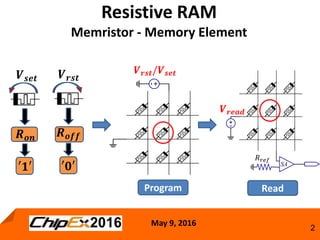
Resistive RAM
Memristor - Memory Element
𝑽 𝒓𝒔𝒕𝑽 𝒔𝒆𝒕
𝑹 𝒐𝒏
′𝟏′
-+
𝑽 𝒓𝒔𝒕/𝑽 𝒔𝒆𝒕
-+
SA
𝑽 𝒓𝒆𝒂𝒅
𝑅 𝑟𝑒𝑓
𝑹 𝒐𝒇𝒇
′𝟎′
Program Read
May 9, 2016
3
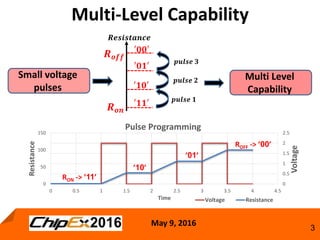
Multi-Level Capability
0
50
100
150
0
0.5
1
1.5
2
2.5
0 0.5 1 1.5 2 2.5 3 3.5 4 4.5
Voltage
Resistance
Time
Pulse Programming
Voltage Resistance
ROFF -> ’00’
RON -> ’11’
’10’
’01’
Small voltage
pulses
𝒑𝒖𝒍𝒔𝒆 𝟏
𝒑𝒖𝒍𝒔𝒆 𝟐
𝒑𝒖𝒍𝒔𝒆 𝟑
𝑹𝒆𝒔𝒊𝒔𝒕𝒂𝒏𝒄𝒆
𝑹 𝒐𝒏
𝑹 𝒐𝒇𝒇
′𝟎𝟎′
′𝟏𝟎′
′𝟎𝟏′
′𝟏𝟏′
Multi Level
Capability
May 9, 2016
4
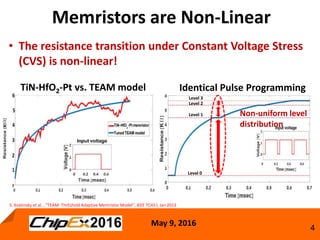
Memristors are Non-Linear
• The resistance transition under Constant Voltage Stress
(CVS) is non-linear!
S. Kvatinsky et al. , “TEAM: ThrEshold Adaptive Memristor Model”, IEEE TCAS I, Jan 2013
Level 0
Level 1
Level 2
Level 3
Non-uniform level
distribution
Identical Pulse ProgrammingTiN-HfO2-Pt vs. TEAM model
May 9, 2016
5
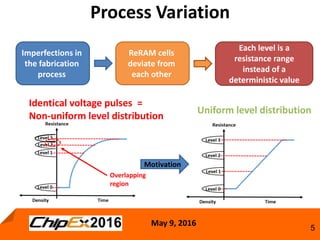
Process Variation
Imperfections in
the fabrication
process
ReRAM cells
deviate from
each other
Each level is a
resistance range
instead of a
deterministic value
Identical voltage pulses =
Non-uniform level distribution
Overlapping
region
Motivation
Uniform level distribution
May 9, 2016
6
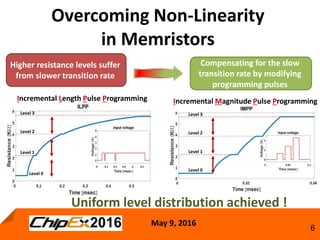
Overcoming Non-Linearity
in Memristors
Higher resistance levels suffer
from slower transition rate
Compensating for the slow
transition rate by modifying
programming pulses
Incremental Length Pulse Programming Incremental Magnitude Pulse Programming
Uniform level distribution achieved !
Level 0
Level 1
Level 2
Level 3
Level 0
Level 1
Level 2
Level 3
May 9, 2016
7
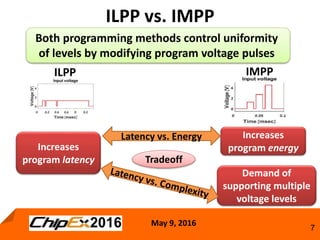
ILPP vs. IMPP
Both programming methods control uniformity
of levels by modifying program voltage pulses
ILPP IMPP
Increases
program latency
Increases
program energy
Demand of
supporting multiple
voltage levels
Latency vs. Energy
Tradeoff
May 9, 2016
8
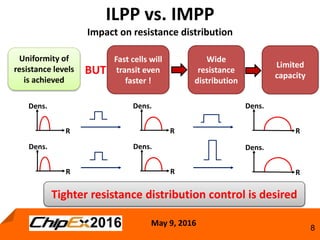
ILPP vs. IMPP
Impact on resistance distribution
Uniformity of
resistance levels
is achieved
BUT
Fast cells will
transit even
faster !
R
Dens.
R
Dens.
R
Dens.
R
Dens.
R
Dens.
R
Dens.
Tighter resistance distribution control is desired
Wide
resistance
distribution
Limited
capacity
May 9, 2016
9
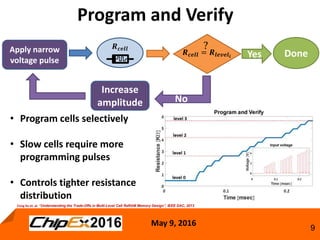
Program and Verify
Apply narrow
voltage pulse
Done
𝑹 𝒄𝒆𝒍𝒍
𝑹 𝒄𝒆𝒍𝒍 = 𝑹𝒍𝒆𝒗𝒆𝒍 𝒊
?
Increase
amplitude
Yes
No
• Program cells selectively
• Slow cells require more
programming pulses
• Controls tighter resistance
distribution
Cong Xu et. al. “Understanding the Trade-Offs in Multi-Level Cell ReRAM Memory Design”, IEEE DAC, 2013
May 9, 2016
10
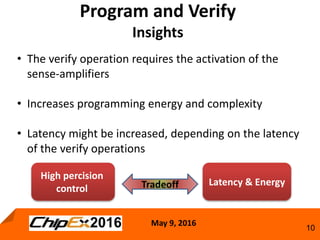
Program and Verify
Insights
• The verify operation requires the activation of the
sense-amplifiers
• Increases programming energy and complexity
• Latency might be increased, depending on the latency
of the verify operations
High percision
control
Latency & EnergyTradeoff
May 9, 2016
11
-
+
readV
SASASA
-
+
programV
1BL En 2BL En 3BL En
Controller
WrEn
-+
rEn
VerifyV
SASASA
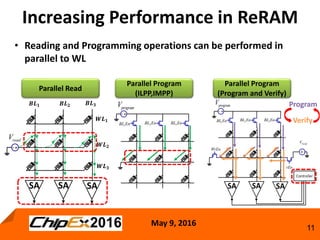
Increasing Performance in ReRAM
• Reading and Programming operations can be performed in
parallel to WL
Parallel Read
𝑾𝑳 𝟏
𝑾𝑳 𝟐
𝑾𝑳 𝟑
𝑩𝑳 𝟏 𝑩𝑳 𝟐 𝑩𝑳 𝟑
-
+
programV
1BL En 2BL En 3BL En
Parallel Program
(ILPP,IMPP)
Parallel Program
(Program and Verify)
Program
Verify
May 9, 2016
12
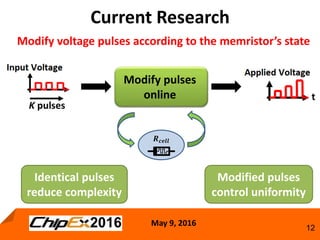
Current Research
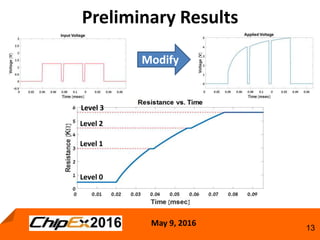
Modify voltage pulses according to the memristor’s state
Modify pulses
online
𝑹 𝒄𝒆𝒍𝒍
Identical pulses
reduce complexity
Modified pulses
control uniformity
May 9, 2016
13
Preliminary Results
Modify
Level 0
Level 1
Level 2
Level 3
May 9, 2016
14
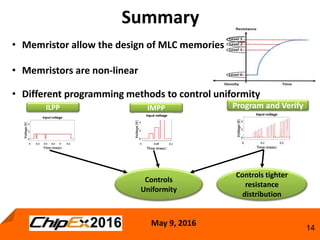
Summary
• Different programming methods to control uniformity
ILPP IMPP Program and Verify
Controls
Uniformity
Controls tighter
resistance
distribution
• Memristor allow the design of MLC memories
• Memristors are non-linear
May 9, 2016
15
Thank You

Any Questions?

Misbah Ramadan, Graduate Student,Technion

  • 1.
    May 9, 2016 1 Programmingand Controlling Uniformity in Multi-Level-Cell ReRAM May 9, 2016 Misbah Ramadan Shahar Kvatinsky Ran Ginosar Andrew & Erna Viterbi Faculty of Electrical Engineering, Technion
  • 2.
    May 9, 2016 2 ResistiveRAM Memristor - Memory Element 𝑽 𝒓𝒔𝒕𝑽 𝒔𝒆𝒕 𝑹 𝒐𝒏 ′𝟏′ -+ 𝑽 𝒓𝒔𝒕/𝑽 𝒔𝒆𝒕 -+ SA 𝑽 𝒓𝒆𝒂𝒅 𝑅 𝑟𝑒𝑓 𝑹 𝒐𝒇𝒇 ′𝟎′ Program Read
  • 3.
    May 9, 2016 3 Multi-LevelCapability 0 50 100 150 0 0.5 1 1.5 2 2.5 0 0.5 1 1.5 2 2.5 3 3.5 4 4.5 Voltage Resistance Time Pulse Programming Voltage Resistance ROFF -> ’00’ RON -> ’11’ ’10’ ’01’ Small voltage pulses 𝒑𝒖𝒍𝒔𝒆 𝟏 𝒑𝒖𝒍𝒔𝒆 𝟐 𝒑𝒖𝒍𝒔𝒆 𝟑 𝑹𝒆𝒔𝒊𝒔𝒕𝒂𝒏𝒄𝒆 𝑹 𝒐𝒏 𝑹 𝒐𝒇𝒇 ′𝟎𝟎′ ′𝟏𝟎′ ′𝟎𝟏′ ′𝟏𝟏′ Multi Level Capability
  • 4.
    May 9, 2016 4 Memristorsare Non-Linear • The resistance transition under Constant Voltage Stress (CVS) is non-linear! S. Kvatinsky et al. , “TEAM: ThrEshold Adaptive Memristor Model”, IEEE TCAS I, Jan 2013 Level 0 Level 1 Level 2 Level 3 Non-uniform level distribution Identical Pulse ProgrammingTiN-HfO2-Pt vs. TEAM model
  • 5.
    May 9, 2016 5 ProcessVariation Imperfections in the fabrication process ReRAM cells deviate from each other Each level is a resistance range instead of a deterministic value Identical voltage pulses = Non-uniform level distribution Overlapping region Motivation Uniform level distribution
  • 6.
    May 9, 2016 6 OvercomingNon-Linearity in Memristors Higher resistance levels suffer from slower transition rate Compensating for the slow transition rate by modifying programming pulses Incremental Length Pulse Programming Incremental Magnitude Pulse Programming Uniform level distribution achieved ! Level 0 Level 1 Level 2 Level 3 Level 0 Level 1 Level 2 Level 3
  • 7.
    May 9, 2016 7 ILPPvs. IMPP Both programming methods control uniformity of levels by modifying program voltage pulses ILPP IMPP Increases program latency Increases program energy Demand of supporting multiple voltage levels Latency vs. Energy Tradeoff
  • 8.
    May 9, 2016 8 ILPPvs. IMPP Impact on resistance distribution Uniformity of resistance levels is achieved BUT Fast cells will transit even faster ! R Dens. R Dens. R Dens. R Dens. R Dens. R Dens. Tighter resistance distribution control is desired Wide resistance distribution Limited capacity
  • 9.
    May 9, 2016 9 Programand Verify Apply narrow voltage pulse Done 𝑹 𝒄𝒆𝒍𝒍 𝑹 𝒄𝒆𝒍𝒍 = 𝑹𝒍𝒆𝒗𝒆𝒍 𝒊 ? Increase amplitude Yes No • Program cells selectively • Slow cells require more programming pulses • Controls tighter resistance distribution Cong Xu et. al. “Understanding the Trade-Offs in Multi-Level Cell ReRAM Memory Design”, IEEE DAC, 2013
  • 10.
    May 9, 2016 10 Programand Verify Insights • The verify operation requires the activation of the sense-amplifiers • Increases programming energy and complexity • Latency might be increased, depending on the latency of the verify operations High percision control Latency & EnergyTradeoff
  • 11.
    May 9, 2016 11 - + readV SASASA - + programV 1BLEn 2BL En 3BL En Controller WrEn -+ rEn VerifyV SASASA Increasing Performance in ReRAM • Reading and Programming operations can be performed in parallel to WL Parallel Read 𝑾𝑳 𝟏 𝑾𝑳 𝟐 𝑾𝑳 𝟑 𝑩𝑳 𝟏 𝑩𝑳 𝟐 𝑩𝑳 𝟑 - + programV 1BL En 2BL En 3BL En Parallel Program (ILPP,IMPP) Parallel Program (Program and Verify) Program Verify
  • 12.
    May 9, 2016 12 CurrentResearch Modify voltage pulses according to the memristor’s state Modify pulses online 𝑹 𝒄𝒆𝒍𝒍 Identical pulses reduce complexity Modified pulses control uniformity
  • 13.
    May 9, 2016 13 PreliminaryResults Modify Level 0 Level 1 Level 2 Level 3
  • 14.
    May 9, 2016 14 Summary •Different programming methods to control uniformity ILPP IMPP Program and Verify Controls Uniformity Controls tighter resistance distribution • Memristor allow the design of MLC memories • Memristors are non-linear
  • 15.
    May 9, 2016 15 ThankYou  Any Questions?

Editor's Notes

  • #7 Increase Fonts
  • #8 Voltage regulators, not voltage generators
  • #15 Change fonts fix indents…