

IoT Security & Privacy Considerations
2016 Taiwan IGF
Kenny Huang, Ph.D. 黃勝雄博⼠
Executive Council Member, APNIC
huangksh@gmail.com
2016.06.17
2
source : The Economist source : BBC
“Every step you take will be the threat to privacy”The Economist
3
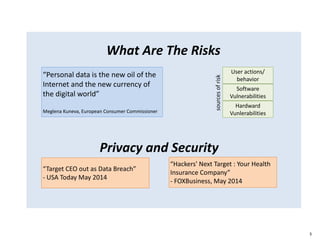
“Personal data is the new oil of the
Internet and the new currency of
the digital world”
Meglena Kuneva, European Consumer Commissioner
User actions/
behavior
Software
Vulnerabilities
Hardward
Vunlerabilities
sourcesofrisk
“Target CEO out as Data Breach”
- USA Today May 2014
“Hackers' Next Target : Your Health
Insurance Company”
- FOXBusiness, May 2014
Privacy and Security
What Are The Risks
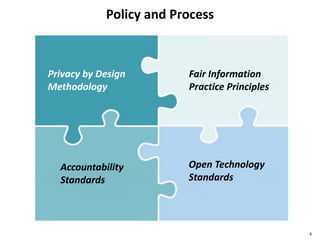
Policy and Process
4
Privacy by Design
Methodology
Fair Information
Practice Principles
Accountability
Standards
Open Technology
Standards
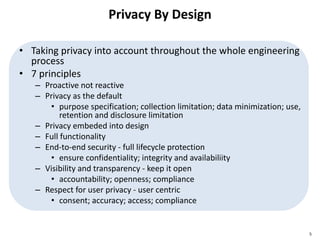
Privacy By Design
• Taking privacy into account throughout the whole engineering
process
• 7 principles
– Proactive not reactive
– Privacy as the default
• purpose specification; collection limitation; data minimization; use,
retention and disclosure limitation
– Privacy embeded into design
– Full functionality
– End-to-end security - full lifecycle protection
• ensure confidentiality; integrity and availabiliity
– Visibility and transparency - keep it open
• accountability; openness; compliance
– Respect for user privacy - user centric
• consent; accuracy; access; compliance
5
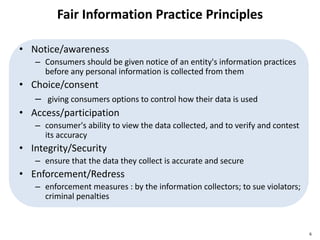
Fair Information Practice Principles
• Notice/awareness
– Consumers should be given notice of an entity's information practices
before any personal information is collected from them
• Choice/consent
– giving consumers options to control how their data is used
• Access/participation
– consumer's ability to view the data collected, and to verify and contest
its accuracy
• Integrity/Security
– ensure that the data they collect is accurate and secure
• Enforcement/Redress
– enforcement measures : by the information collectors; to sue violators;
criminal penalties
6
7
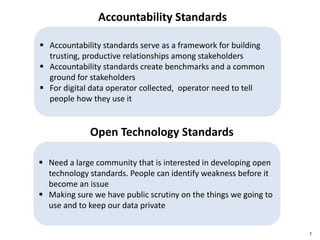
 Accountability standards serve as a framework for building
trusting, productive relationships among stakeholders
 Accountability standards create benchmarks and a common
ground for stakeholders
 For digital data operator collected, operator need to tell
people how they use it
Accountability Standards
 Need a large community that is interested in developing open
technology standards. People can identify weakness before it
become an issue
 Making sure we have public scrutiny on the things we going to
use and to keep our data private
Open Technology Standards
IoT Security is Critical
• Security is the top issue for IoT
– Deployments will not scale without trust
• With large deployments
– must limit attack surface of each device
• Applies to even simple sensors
– Even if there is no secure data issues
• Security must be architected from the beginning and
must not be made an option
8
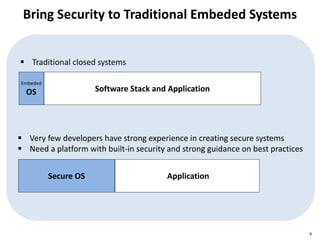
Bring Security to Traditional Embeded Systems
9
Embeded
OS Software Stack and Application
 Traditional closed systems
Secure OS Application
 Very few developers have strong experience in creating secure systems
 Need a platform with built-in security and strong guidance on best practices
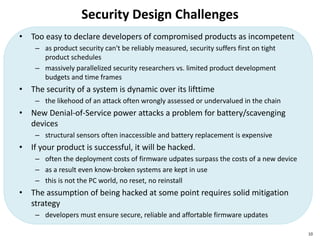
Security Design Challenges
• Too easy to declare developers of compromised products as incompetent
– as product security can't be reliably measured, security suffers first on tight
product schedules
– massively parallelized security researchers vs. limited product development
budgets and time frames
• The security of a system is dynamic over its lifttime
– the likehood of an attack often wrongly assessed or undervalued in the chain
• New Denial-of-Service power attacks a problem for battery/scavenging
devices
– structural sensors often inaccessible and battery replacement is expensive
• If your product is successful, it will be hacked.
– often the deployment costs of firmware udpates surpass the costs of a new device
– as a result even know-broken systems are kept in use
– this is not the PC world, no reset, no reinstall
• The assumption of being hacked at some point requires solid mitigation
strategy
– developers must ensure secure, reliable and affortable firmware updates
10
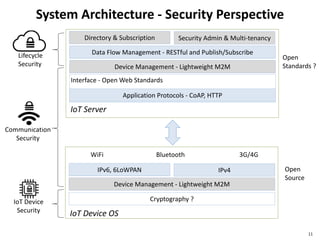
System Architecture - Security Perspective
11
Directory & Subscription Security Admin & Multi-tenancy
Data Flow Management - RESTful and Publish/Subscribe
Device Management - Lightweight M2M
Interface - Open Web Standards
Application Protocols - CoAP, HTTP
IoT Server
Device Management - Lightweight M2M
Cryptography ?
IoT Device OS
WiFi Bluetooth 3G/4G
IPv6, 6LoWPAN IPv4
Lifecycle
Security
Communication
Security
IoT Device
Security
Open
Standards ?
Open
Source
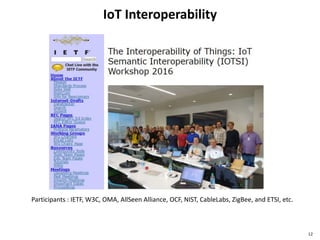
IoT Interoperability
12
Participants : IETF, W3C, OMA, AllSeen Alliance, OCF, NIST, CableLabs, ZigBee, and ETSI, etc.
WiFi Stack
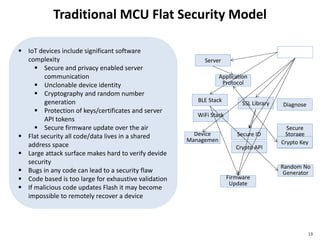
Traditional MCU Flat Security Model
13
Server
Application
Protocol
SSL Library
Secure
Storage
Crypto Key
Device
Managemen
Secure ID
Crypto API
Firmware
Update
Diagnose
BLE Stack
Random No
Generator
 IoT devices include significant software
complexity
 Secure and privacy enabled server
communication
 Unclonable device identity
 Cryptography and random number
generation
 Protection of keys/certificates and server
API tokens
 Secure firmware update over the air
 Flat security all code/data lives in a shared
address space
 Large attack surface makes hard to verify devide
security
 Bugs in any code can lead to a security flaw
 Code based is too large for exhaustive validation
 If malicious code updates Flash it may become
impossible to remotely recover a device
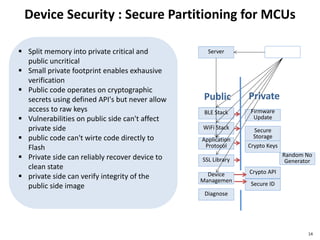
Device Security : Secure Partitioning for MCUs
14
BLE Stack
WiFi Stack
Application
Protocol
SSL Library
Device
Managemen
Diagnose
Server
Firmware
Update
Secure
Storage
Crypto Keys
Crypto API
Secure ID
Random No
Generator
Public Private
 Split memory into private critical and
public uncritical
 Small private footprint enables exhausive
verification
 Public code operates on cryptographic
secrets using defined API's but never allow
access to raw keys
 Vulnerabilities on public side can't affect
private side
 public code can't wirte code directly to
Flash
 Private side can reliably recover device to
clean state
 private side can verify integrity of the
public side image
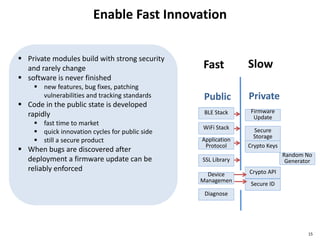
Enable Fast Innovation
15
BLE Stack
WiFi Stack
Application
Protocol
SSL Library
Device
Managemen
Diagnose
Firmware
Update
Secure
Storage
Crypto Keys
Crypto API
Secure ID
Random No
Generator
Public Private
Fast Slow
 Private modules build with strong security
and rarely change
 software is never finished
 new features, bug fixes, patching
vulnerabilities and tracking standards
 Code in the public state is developed
rapidly
 fast time to market
 quick innovation cycles for public side
 still a secure product
 When bugs are discovered after
deployment a firmware update can be
reliably enforced
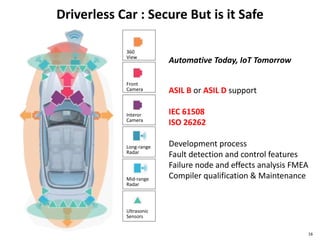
Driverless Car : Secure But is it Safe
16
360
View
Front
Camera
Interor
Camera
Long-range
Radar
Mid-range
Radar
Ultrasonic
Sensors
Automative Today, IoT Tomorrow
ASIL B or ASIL D support
IEC 61508
ISO 26262
Development process
Fault detection and control features
Failure node and effects analysis FMEA
Compiler qualification & Maintenance
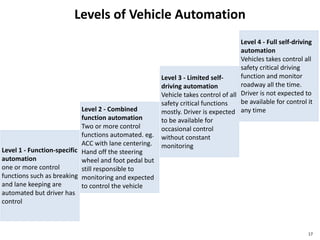
Levels of Vehicle Automation
17
Level 1 - Function-specific
automation
one or more control
functions such as breaking
and lane keeping are
automated but driver has
control
Level 2 - Combined
function automation
Two or more control
functions automated. eg.
ACC with lane centering.
Hand off the steering
wheel and foot pedal but
still responsible to
monitoring and expected
to control the vehicle
Level 3 - Limited self-
driving automation
Vehicle takes control of all
safety critical functions
mostly. Driver is expected
to be available for
occasional control
without constant
monitoring
Level 4 - Full self-driving
automation
Vehicles takes control all
safety critical driving
function and monitor
roadway all the time.
Driver is not expected to
be available for control it
any time
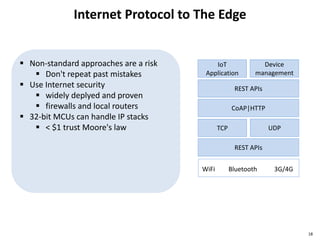
Internet Protocol to The Edge
18
REST APIs
CoAP|HTTP
TCP
REST APIs
UDP
IoT
Application
Device
management
WiFi Bluetooth 3G/4G
 Non-standard approaches are a risk
 Don't repeat past mistakes
 Use Internet security
 widely deplyed and proven
 firewalls and local routers
 32-bit MCUs can handle IP stacks
 < $1 trust Moore's law
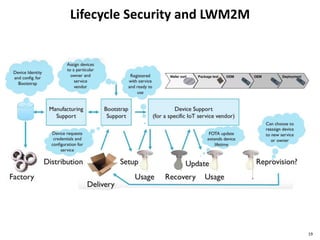
Lifecycle Security and LWM2M
19
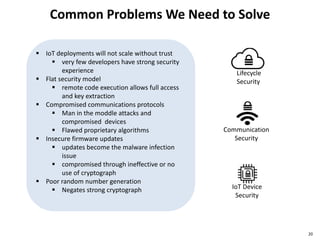
Common Problems We Need to Solve
20
 IoT deployments will not scale without trust
 very few developers have strong security
experience
 Flat security model
 remote code execution allows full access
and key extraction
 Compromised communications protocols
 Man in the moddle attacks and
compromised devices
 Flawed proprietary algorithms
 Insecure firmware updates
 updates become the malware infection
issue
 compromised through ineffective or no
use of cryptograph
 Poor random number generation
 Negates strong cryptograph
Lifecycle
Security
Communication
Security
IoT Device
Security
21

IoT Security and Privacy Considerations

  • 1.
    IoT Security &Privacy Considerations 2016 Taiwan IGF Kenny Huang, Ph.D. 黃勝雄博⼠ Executive Council Member, APNIC huangksh@gmail.com 2016.06.17
  • 2.
    2 source : TheEconomist source : BBC “Every step you take will be the threat to privacy”The Economist
  • 3.
    3 “Personal data isthe new oil of the Internet and the new currency of the digital world” Meglena Kuneva, European Consumer Commissioner User actions/ behavior Software Vulnerabilities Hardward Vunlerabilities sourcesofrisk “Target CEO out as Data Breach” - USA Today May 2014 “Hackers' Next Target : Your Health Insurance Company” - FOXBusiness, May 2014 Privacy and Security What Are The Risks
  • 4.
    Policy and Process 4 Privacyby Design Methodology Fair Information Practice Principles Accountability Standards Open Technology Standards
  • 5.
    Privacy By Design •Taking privacy into account throughout the whole engineering process • 7 principles – Proactive not reactive – Privacy as the default • purpose specification; collection limitation; data minimization; use, retention and disclosure limitation – Privacy embeded into design – Full functionality – End-to-end security - full lifecycle protection • ensure confidentiality; integrity and availabiliity – Visibility and transparency - keep it open • accountability; openness; compliance – Respect for user privacy - user centric • consent; accuracy; access; compliance 5
  • 6.
    Fair Information PracticePrinciples • Notice/awareness – Consumers should be given notice of an entity's information practices before any personal information is collected from them • Choice/consent – giving consumers options to control how their data is used • Access/participation – consumer's ability to view the data collected, and to verify and contest its accuracy • Integrity/Security – ensure that the data they collect is accurate and secure • Enforcement/Redress – enforcement measures : by the information collectors; to sue violators; criminal penalties 6
  • 7.
    7  Accountability standardsserve as a framework for building trusting, productive relationships among stakeholders  Accountability standards create benchmarks and a common ground for stakeholders  For digital data operator collected, operator need to tell people how they use it Accountability Standards  Need a large community that is interested in developing open technology standards. People can identify weakness before it become an issue  Making sure we have public scrutiny on the things we going to use and to keep our data private Open Technology Standards
  • 8.
    IoT Security isCritical • Security is the top issue for IoT – Deployments will not scale without trust • With large deployments – must limit attack surface of each device • Applies to even simple sensors – Even if there is no secure data issues • Security must be architected from the beginning and must not be made an option 8
  • 9.
    Bring Security toTraditional Embeded Systems 9 Embeded OS Software Stack and Application  Traditional closed systems Secure OS Application  Very few developers have strong experience in creating secure systems  Need a platform with built-in security and strong guidance on best practices
  • 10.
    Security Design Challenges •Too easy to declare developers of compromised products as incompetent – as product security can't be reliably measured, security suffers first on tight product schedules – massively parallelized security researchers vs. limited product development budgets and time frames • The security of a system is dynamic over its lifttime – the likehood of an attack often wrongly assessed or undervalued in the chain • New Denial-of-Service power attacks a problem for battery/scavenging devices – structural sensors often inaccessible and battery replacement is expensive • If your product is successful, it will be hacked. – often the deployment costs of firmware udpates surpass the costs of a new device – as a result even know-broken systems are kept in use – this is not the PC world, no reset, no reinstall • The assumption of being hacked at some point requires solid mitigation strategy – developers must ensure secure, reliable and affortable firmware updates 10
  • 11.
    System Architecture -Security Perspective 11 Directory & Subscription Security Admin & Multi-tenancy Data Flow Management - RESTful and Publish/Subscribe Device Management - Lightweight M2M Interface - Open Web Standards Application Protocols - CoAP, HTTP IoT Server Device Management - Lightweight M2M Cryptography ? IoT Device OS WiFi Bluetooth 3G/4G IPv6, 6LoWPAN IPv4 Lifecycle Security Communication Security IoT Device Security Open Standards ? Open Source
  • 12.
    IoT Interoperability 12 Participants :IETF, W3C, OMA, AllSeen Alliance, OCF, NIST, CableLabs, ZigBee, and ETSI, etc.
  • 13.
    WiFi Stack Traditional MCUFlat Security Model 13 Server Application Protocol SSL Library Secure Storage Crypto Key Device Managemen Secure ID Crypto API Firmware Update Diagnose BLE Stack Random No Generator  IoT devices include significant software complexity  Secure and privacy enabled server communication  Unclonable device identity  Cryptography and random number generation  Protection of keys/certificates and server API tokens  Secure firmware update over the air  Flat security all code/data lives in a shared address space  Large attack surface makes hard to verify devide security  Bugs in any code can lead to a security flaw  Code based is too large for exhaustive validation  If malicious code updates Flash it may become impossible to remotely recover a device
  • 14.
    Device Security :Secure Partitioning for MCUs 14 BLE Stack WiFi Stack Application Protocol SSL Library Device Managemen Diagnose Server Firmware Update Secure Storage Crypto Keys Crypto API Secure ID Random No Generator Public Private  Split memory into private critical and public uncritical  Small private footprint enables exhausive verification  Public code operates on cryptographic secrets using defined API's but never allow access to raw keys  Vulnerabilities on public side can't affect private side  public code can't wirte code directly to Flash  Private side can reliably recover device to clean state  private side can verify integrity of the public side image
  • 15.
    Enable Fast Innovation 15 BLEStack WiFi Stack Application Protocol SSL Library Device Managemen Diagnose Firmware Update Secure Storage Crypto Keys Crypto API Secure ID Random No Generator Public Private Fast Slow  Private modules build with strong security and rarely change  software is never finished  new features, bug fixes, patching vulnerabilities and tracking standards  Code in the public state is developed rapidly  fast time to market  quick innovation cycles for public side  still a secure product  When bugs are discovered after deployment a firmware update can be reliably enforced
  • 16.
    Driverless Car :Secure But is it Safe 16 360 View Front Camera Interor Camera Long-range Radar Mid-range Radar Ultrasonic Sensors Automative Today, IoT Tomorrow ASIL B or ASIL D support IEC 61508 ISO 26262 Development process Fault detection and control features Failure node and effects analysis FMEA Compiler qualification & Maintenance
  • 17.
    Levels of VehicleAutomation 17 Level 1 - Function-specific automation one or more control functions such as breaking and lane keeping are automated but driver has control Level 2 - Combined function automation Two or more control functions automated. eg. ACC with lane centering. Hand off the steering wheel and foot pedal but still responsible to monitoring and expected to control the vehicle Level 3 - Limited self- driving automation Vehicle takes control of all safety critical functions mostly. Driver is expected to be available for occasional control without constant monitoring Level 4 - Full self-driving automation Vehicles takes control all safety critical driving function and monitor roadway all the time. Driver is not expected to be available for control it any time
  • 18.
    Internet Protocol toThe Edge 18 REST APIs CoAP|HTTP TCP REST APIs UDP IoT Application Device management WiFi Bluetooth 3G/4G  Non-standard approaches are a risk  Don't repeat past mistakes  Use Internet security  widely deplyed and proven  firewalls and local routers  32-bit MCUs can handle IP stacks  < $1 trust Moore's law
  • 19.
  • 20.
    Common Problems WeNeed to Solve 20  IoT deployments will not scale without trust  very few developers have strong security experience  Flat security model  remote code execution allows full access and key extraction  Compromised communications protocols  Man in the moddle attacks and compromised devices  Flawed proprietary algorithms  Insecure firmware updates  updates become the malware infection issue  compromised through ineffective or no use of cryptograph  Poor random number generation  Negates strong cryptograph Lifecycle Security Communication Security IoT Device Security
  • 21.