LinuxCon
Tokyo, Japan 2016
Secure IoT Gateway
Jim Gallagher
Senior Technical Marketing Lead, MontaVista Software
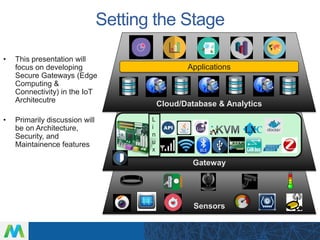
Setting the Stage
• This presentation will
focus on developing
Secure Gateways (Edge
Computing &
Connectivity) in the IoT
Architecutre
• Primarily discussion will
be on Architecture,
Security, and
Maintainence features
Sensors
Gateway
Cloud/Database & Analytics
Applications
L
i
n
u
x
Agenda
Architecture
Connectivity
Security
Maintainability
Summary and Q&A
Architecture:
Modern vs Wild West
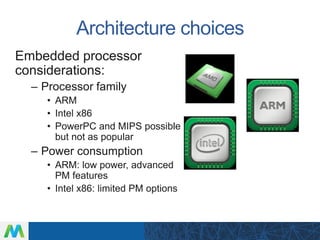
Architecture choices
Embedded processor
considerations:
– Processor family
• ARM
• Intel x86
• PowerPC and MIPS possible
but not as popular
– Power consumption
• ARM: low power, advanced
PM features
• Intel x86: limited PM options
Architecture choices (ctd)
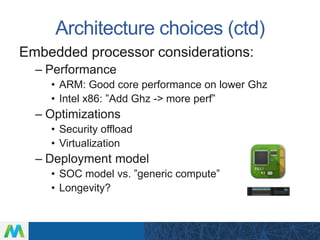
Embedded processor considerations:
– Performance
• ARM: Good core performance on lower Ghz
• Intel x86: ”Add Ghz -> more perf”
– Optimizations
• Security offload
• Virtualization
– Deployment model
• SOC model vs. ”generic compute”
• Longevity?
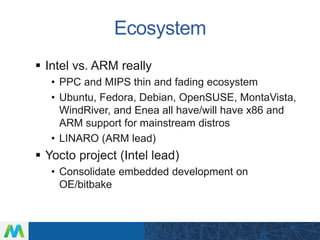
Ecosystem
 Intel vs. ARM really
• PPC and MIPS thin and fading ecosystem
• Ubuntu, Fedora, Debian, OpenSUSE, MontaVista,
WindRiver, and Enea all have/will have x86 and
ARM support for mainstream distros
• LINARO (ARM lead)
 Yocto project (Intel lead)
• Consolidate embedded development on
OE/bitbake
Connectivity
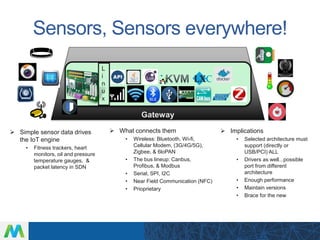
Sensors, Sensors everywhere!
 Simple sensor data drives
the IoT engine
• Fitness trackers, heart
monitors, oil and pressure
temperature gauges, &
packet latency in SDN
Gateway
L
i
n
u
x
 What connects them
• Wireless: Bluetooth, Wi-fi,
Cellular Modem, (3G/4G/5G),
Zigbee, & 6loPAN
• The bus lineup: Canbus,
Profibus, & Modbus
• Serial, SPI, I2C
• Near Field Communication (NFC)
• Prioprietary
 Implications
• Selected architecture must
support (directly or
USB/PCI) ALL
• Drivers as well...possible
port from different
architecture
• Enough performance
• Maintain versions
• Brace for the new
To the Cloud
 Data from sensors is the lifeblood of IoT
• Connects to cloud or database
• Gateways can filter/preprocess data
• Push must be secure (encrypted and
authenticated)
• Connectivity is bi-redirectional so IoT Gateway
must be secure from the cloud
 IoTivity
 Community framework to connect end devices
 Alljoyn Open Source Framework
 Connect and communicate across transports/OSes
Security
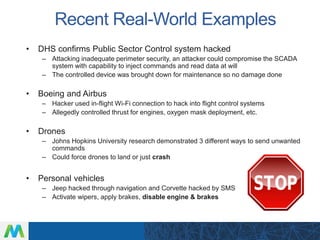
Recent Real-World Examples
• DHS confirms Public Sector Control system hacked
– Attacking inadequate perimeter security, an attacker could compromise the SCADA
system with capability to inject commands and read data at will
– The controlled device was brought down for maintenance so no damage done
• Boeing and Airbus
– Hacker used in-flight Wi-Fi connection to hack into flight control systems
– Allegedly controlled thrust for engines, oxygen mask deployment, etc.
• Drones
– Johns Hopkins University research demonstrated 3 different ways to send unwanted
commands
– Could force drones to land or just crash
• Personal vehicles
– Jeep hacked through navigation and Corvette hacked by SMS
– Activate wipers, apply brakes, disable engine & brakes
Design Considerations
• Building security primarily in
the Gateway?
– Edge devices are
constrained on hardened
channel
– Requires encryption for the
channel and two-way
authentication for setup
• Trusted edge vs. Edge
Computing - two polars?
– Moving computing to the
edge can help build end-to-
end efficiency, but requires
edge and gateway devices
to handle the security
– Can also be seen as a way
to fence out security threats
for some layers of the
processing so they cannot
be exploited from the Cloud
• Lifecycle: secure
firmware updates and
CVEs
– The Edge is relying on
the IT-supported backend
to handle the updates,
requires careful
consideration for the
technology and process
• Provide monitoring for
end-to-end data on the
Gateway
– Using DPI for heuristics-
based detection of
exploits
• Combining types of
security: physical,
networking, system
integrity and isolation of
domains
Architectural Functional
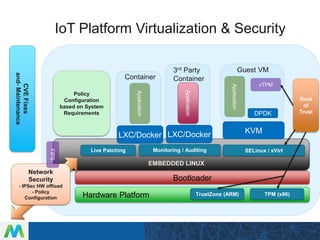
IoT Platform Virtualization & Security
vTPM
Guest VM
Container
Openflow DPDK
LXC/Docker
KVM
EMBEDDED LINUX
SELinux / sVirt
Application
Application
Hardware Platform
LXC/Docker
Application
3rd Party
Container
Monitoring / Auditing
Bootloader
TPM (x86)
Root
of
Trust
CVEFixes
and-Maintenance
Network
Security
- IPSec HW offload
- Policy
Configuration
Live Patching
Policy
Configuration
based on System
Requirements
TrustZone (ARM)
DPDK
FIPS
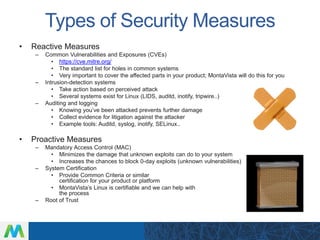
Types of Security Measures
• Reactive Measures
– Common Vulnerabilities and Exposures (CVEs)
• https://cve.mitre.org/
• The standard list for holes in common systems
• Very important to cover the affected parts in your product; MontaVista will do this for you
– Intrusion-detection systems
• Take action based on perceived attack
• Several systems exist for Linux (LIDS, auditd, inotify, tripwire..)
– Auditing and logging
• Knowing you’ve been attacked prevents further damage
• Collect evidence for litigation against the attacker
• Example tools: Auditd, syslog, inotify, SELinux..
• Proactive Measures
– Mandatory Access Control (MAC)
• Minimizes the damage that unknown exploits can do to your system
• Increases the chances to block 0-day exploits (unknown vulnerabilities)
– System Certification
• Provide Common Criteria or similar
certification for your product or platform
• MontaVista’s Linux is certifiable and we can help with
the process
– Root of Trust
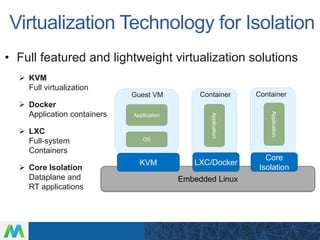
• Full featured and lightweight virtualization solutions
Embedded Linux
Container
Core
Isolation
Application
LXC/Docker
Container
Application
KVM
Application
OS
Guest VM
 KVM
Full virtualization
 Docker
Application containers
 LXC
Full-system
Containers
 Core Isolation
Dataplane and
RT applications
Virtualization Technology for Isolation
• Make Security a Priority
• Implement Mixture
– Reactive
– Proactive
• Stay Current
Maintenance
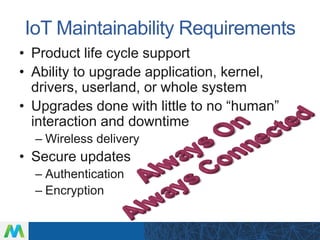
IoT Maintainability Requirements
• Product life cycle support
• Ability to upgrade application, kernel,
drivers, userland, or whole system
• Upgrades done with little to no “human”
interaction and downtime
– Wireless delivery
• Secure updates
– Authentication
– Encryption
Addressing IoT Maintenance with Linux
• Long Term Support (LTS) Kernel
– Can be extended beyond 10+ years in
commercial Linux distributions
• SMART package manager
– Allows for source or binary distribution
– Flexible to update userland, application, etc.
• Live kernel patching
• Crypto API support
• Trusted Platform Module (TPM) and
TrustZone for secure OTA updates
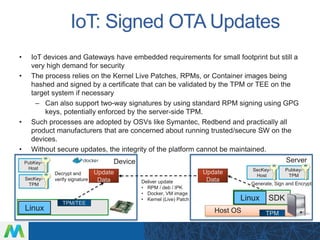
IoT: Signed OTA Updates
• IoT devices and Gateways have embedded requirements for small footprint but still a
very high demand for security
• The process relies on the Kernel Live Patches, RPMs, or Container images being
hashed and signed by a certificate that can be validated by the TPM or TEE on the
target system if necessary
– Can also support two-way signatures by using standard RPM signing using GPG
keys, potentially enforced by the server-side TPM.
• Such processes are adopted by OSVs like Symantec, Redbend and practically all
product manufacturers that are concerned about running trusted/secure SW on the
devices.
• Without secure updates, the integrity of the platform cannot be maintained.
ServerDevice
Decrypt and
verify signature
Update
Data
Generate, Sign and Encrypt
Host OS
Update
Data
Pubkey-
TPM
SecKey-
Host
PubKey-
Host
SecKey-
TPM
Deliver update
• RPM / deb / IPK
• Docker, VM image
• Kernel (Live) Patch
TPM
TPM/TEE
SDK
Linux
Linux
Summary
• Embedded Linux
offers solid software
platform to IoT
Gateway developers
– Architecture
– Connectivity
• Security is
IMPORTANT to
implement
• High uptime
maintainability
Thank You
Questions/Discussion
jgallagher@mvista.com

Secure IOT Gateway

  • 1.
    LinuxCon Tokyo, Japan 2016 SecureIoT Gateway Jim Gallagher Senior Technical Marketing Lead, MontaVista Software
  • 2.
    Setting the Stage •This presentation will focus on developing Secure Gateways (Edge Computing & Connectivity) in the IoT Architecutre • Primarily discussion will be on Architecture, Security, and Maintainence features Sensors Gateway Cloud/Database & Analytics Applications L i n u x
  • 3.
  • 4.
  • 5.
    Architecture choices Embedded processor considerations: –Processor family • ARM • Intel x86 • PowerPC and MIPS possible but not as popular – Power consumption • ARM: low power, advanced PM features • Intel x86: limited PM options
  • 6.
    Architecture choices (ctd) Embeddedprocessor considerations: – Performance • ARM: Good core performance on lower Ghz • Intel x86: ”Add Ghz -> more perf” – Optimizations • Security offload • Virtualization – Deployment model • SOC model vs. ”generic compute” • Longevity?
  • 7.
    Ecosystem  Intel vs.ARM really • PPC and MIPS thin and fading ecosystem • Ubuntu, Fedora, Debian, OpenSUSE, MontaVista, WindRiver, and Enea all have/will have x86 and ARM support for mainstream distros • LINARO (ARM lead)  Yocto project (Intel lead) • Consolidate embedded development on OE/bitbake
  • 8.
  • 9.
    Sensors, Sensors everywhere! Simple sensor data drives the IoT engine • Fitness trackers, heart monitors, oil and pressure temperature gauges, & packet latency in SDN Gateway L i n u x  What connects them • Wireless: Bluetooth, Wi-fi, Cellular Modem, (3G/4G/5G), Zigbee, & 6loPAN • The bus lineup: Canbus, Profibus, & Modbus • Serial, SPI, I2C • Near Field Communication (NFC) • Prioprietary  Implications • Selected architecture must support (directly or USB/PCI) ALL • Drivers as well...possible port from different architecture • Enough performance • Maintain versions • Brace for the new
  • 10.
    To the Cloud Data from sensors is the lifeblood of IoT • Connects to cloud or database • Gateways can filter/preprocess data • Push must be secure (encrypted and authenticated) • Connectivity is bi-redirectional so IoT Gateway must be secure from the cloud  IoTivity  Community framework to connect end devices  Alljoyn Open Source Framework  Connect and communicate across transports/OSes
  • 11.
  • 12.
    Recent Real-World Examples •DHS confirms Public Sector Control system hacked – Attacking inadequate perimeter security, an attacker could compromise the SCADA system with capability to inject commands and read data at will – The controlled device was brought down for maintenance so no damage done • Boeing and Airbus – Hacker used in-flight Wi-Fi connection to hack into flight control systems – Allegedly controlled thrust for engines, oxygen mask deployment, etc. • Drones – Johns Hopkins University research demonstrated 3 different ways to send unwanted commands – Could force drones to land or just crash • Personal vehicles – Jeep hacked through navigation and Corvette hacked by SMS – Activate wipers, apply brakes, disable engine & brakes
  • 13.
    Design Considerations • Buildingsecurity primarily in the Gateway? – Edge devices are constrained on hardened channel – Requires encryption for the channel and two-way authentication for setup • Trusted edge vs. Edge Computing - two polars? – Moving computing to the edge can help build end-to- end efficiency, but requires edge and gateway devices to handle the security – Can also be seen as a way to fence out security threats for some layers of the processing so they cannot be exploited from the Cloud • Lifecycle: secure firmware updates and CVEs – The Edge is relying on the IT-supported backend to handle the updates, requires careful consideration for the technology and process • Provide monitoring for end-to-end data on the Gateway – Using DPI for heuristics- based detection of exploits • Combining types of security: physical, networking, system integrity and isolation of domains Architectural Functional
  • 14.
    IoT Platform Virtualization& Security vTPM Guest VM Container Openflow DPDK LXC/Docker KVM EMBEDDED LINUX SELinux / sVirt Application Application Hardware Platform LXC/Docker Application 3rd Party Container Monitoring / Auditing Bootloader TPM (x86) Root of Trust CVEFixes and-Maintenance Network Security - IPSec HW offload - Policy Configuration Live Patching Policy Configuration based on System Requirements TrustZone (ARM) DPDK FIPS
  • 15.
    Types of SecurityMeasures • Reactive Measures – Common Vulnerabilities and Exposures (CVEs) • https://cve.mitre.org/ • The standard list for holes in common systems • Very important to cover the affected parts in your product; MontaVista will do this for you – Intrusion-detection systems • Take action based on perceived attack • Several systems exist for Linux (LIDS, auditd, inotify, tripwire..) – Auditing and logging • Knowing you’ve been attacked prevents further damage • Collect evidence for litigation against the attacker • Example tools: Auditd, syslog, inotify, SELinux.. • Proactive Measures – Mandatory Access Control (MAC) • Minimizes the damage that unknown exploits can do to your system • Increases the chances to block 0-day exploits (unknown vulnerabilities) – System Certification • Provide Common Criteria or similar certification for your product or platform • MontaVista’s Linux is certifiable and we can help with the process – Root of Trust
  • 16.
    • Full featuredand lightweight virtualization solutions Embedded Linux Container Core Isolation Application LXC/Docker Container Application KVM Application OS Guest VM  KVM Full virtualization  Docker Application containers  LXC Full-system Containers  Core Isolation Dataplane and RT applications Virtualization Technology for Isolation
  • 17.
    • Make Securitya Priority • Implement Mixture – Reactive – Proactive • Stay Current
  • 18.
  • 19.
    IoT Maintainability Requirements •Product life cycle support • Ability to upgrade application, kernel, drivers, userland, or whole system • Upgrades done with little to no “human” interaction and downtime – Wireless delivery • Secure updates – Authentication – Encryption
  • 20.
    Addressing IoT Maintenancewith Linux • Long Term Support (LTS) Kernel – Can be extended beyond 10+ years in commercial Linux distributions • SMART package manager – Allows for source or binary distribution – Flexible to update userland, application, etc. • Live kernel patching • Crypto API support • Trusted Platform Module (TPM) and TrustZone for secure OTA updates
  • 21.
    IoT: Signed OTAUpdates • IoT devices and Gateways have embedded requirements for small footprint but still a very high demand for security • The process relies on the Kernel Live Patches, RPMs, or Container images being hashed and signed by a certificate that can be validated by the TPM or TEE on the target system if necessary – Can also support two-way signatures by using standard RPM signing using GPG keys, potentially enforced by the server-side TPM. • Such processes are adopted by OSVs like Symantec, Redbend and practically all product manufacturers that are concerned about running trusted/secure SW on the devices. • Without secure updates, the integrity of the platform cannot be maintained. ServerDevice Decrypt and verify signature Update Data Generate, Sign and Encrypt Host OS Update Data Pubkey- TPM SecKey- Host PubKey- Host SecKey- TPM Deliver update • RPM / deb / IPK • Docker, VM image • Kernel (Live) Patch TPM TPM/TEE SDK Linux Linux
  • 22.
    Summary • Embedded Linux offerssolid software platform to IoT Gateway developers – Architecture – Connectivity • Security is IMPORTANT to implement • High uptime maintainability
  • 23.