By
Raghav S
Technical Seminar on Security in
Embedded Systems
 What is an Embedded System?
 Introduction to Network Security
 Survey
 Problem Definition
 Proposed Solution
 Comparison
 Future Scope
Overview
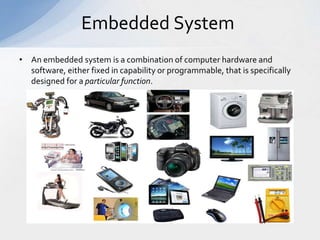
• An embedded system is a combination of computer hardware and
software, either fixed in capability or programmable, that is specifically
designed for a particular function.
Embedded System
• Network security is a term that describes the policies and procedures
implemented by a network administrator to avoid and keep track of
unauthorized access, exploitation, modification and denial of the access.
Network Security
• Hacking is gaining of unauthorized access to a computer and viewing,
copying, or creating data with/without the intention of destroying data or
maliciously harming the computer.
Hacking
Reasons for Hacking:
Cost of Insecurity:
Survey
• Advancement in Technology
• Security is an afterthought
Problem Definition
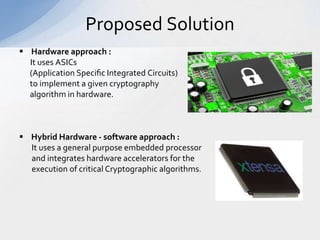
 Hardware approach :
It uses ASICs
(Application Specific Integrated Circuits)
to implement a given cryptography
algorithm in hardware.
 Hybrid Hardware - software approach :
It uses a general purpose embedded processor
and integrates hardware accelerators for the
execution of critical Cryptographic algorithms.
Proposed Solution
Comparison
Existing Solution
(Software Solution)
Proposed Solution
(Hardware Solution)
• Protects the system against software
attacks only.
• Protects the system against software
as well as hardware attacks.
• Has to be administered by the user. • Self – administered.
• It proves to be expensive. • It is cost effective.
• Updating on a regular basis needs to
be carried out.
• Eliminates the need for updating.
• High level user interaction required. • User interaction is close to nil.
 Design challenges:
 Battery Gap
 Flexibility
 Tamper resistance
 Interaction between Network Security engineer
and Architecture engineer is required.
 Presently it is difficult to implement in the
existing devices.
Disadvantages of the Proposed solution
• Development in the semiconductor industry might aid the manufacturing
of the chip.
• Diversity in the hardware component used(Cryptographic Chip).
• Develop methodology to provide the features of Cryptographic chips in
the existing devices.
Future Scope
1. Paul Kocher, Ruby Lee, Gary McGraw, Anand Raghunathan and Srivaths
Ravi, “Security as a New Dimension in Embedded System Design”.
2. Srivaths Ravi, Anand Raghunathan, Paul Kocher, Sunil Hattangady,
“Security in Embedded Systems: Design Challenges”.
3. Jesús Lizarraga, Roberto Uribeetxeberria, Urko Zurutuza, Miguel
Fernández, “Security in embedded systems”.
4. Embedded systems,
http://searchenterpriselinux.techtarget.com/definition/embedded-
system.
5. Network Security,
http://www.techopedia.com/definition/24783/network-security.
References
Thank You!

Security in embedded systems

  • 1.
    By Raghav S Technical Seminaron Security in Embedded Systems
  • 2.
     What isan Embedded System?  Introduction to Network Security  Survey  Problem Definition  Proposed Solution  Comparison  Future Scope Overview
  • 3.
    • An embeddedsystem is a combination of computer hardware and software, either fixed in capability or programmable, that is specifically designed for a particular function. Embedded System
  • 4.
    • Network securityis a term that describes the policies and procedures implemented by a network administrator to avoid and keep track of unauthorized access, exploitation, modification and denial of the access. Network Security
  • 5.
    • Hacking isgaining of unauthorized access to a computer and viewing, copying, or creating data with/without the intention of destroying data or maliciously harming the computer. Hacking
  • 6.
    Reasons for Hacking: Costof Insecurity: Survey
  • 7.
    • Advancement inTechnology • Security is an afterthought Problem Definition
  • 8.
     Hardware approach: It uses ASICs (Application Specific Integrated Circuits) to implement a given cryptography algorithm in hardware.  Hybrid Hardware - software approach : It uses a general purpose embedded processor and integrates hardware accelerators for the execution of critical Cryptographic algorithms. Proposed Solution
  • 9.
    Comparison Existing Solution (Software Solution) ProposedSolution (Hardware Solution) • Protects the system against software attacks only. • Protects the system against software as well as hardware attacks. • Has to be administered by the user. • Self – administered. • It proves to be expensive. • It is cost effective. • Updating on a regular basis needs to be carried out. • Eliminates the need for updating. • High level user interaction required. • User interaction is close to nil.
  • 10.
     Design challenges: Battery Gap  Flexibility  Tamper resistance  Interaction between Network Security engineer and Architecture engineer is required.  Presently it is difficult to implement in the existing devices. Disadvantages of the Proposed solution
  • 11.
    • Development inthe semiconductor industry might aid the manufacturing of the chip. • Diversity in the hardware component used(Cryptographic Chip). • Develop methodology to provide the features of Cryptographic chips in the existing devices. Future Scope
  • 12.
    1. Paul Kocher,Ruby Lee, Gary McGraw, Anand Raghunathan and Srivaths Ravi, “Security as a New Dimension in Embedded System Design”. 2. Srivaths Ravi, Anand Raghunathan, Paul Kocher, Sunil Hattangady, “Security in Embedded Systems: Design Challenges”. 3. Jesús Lizarraga, Roberto Uribeetxeberria, Urko Zurutuza, Miguel Fernández, “Security in embedded systems”. 4. Embedded systems, http://searchenterpriselinux.techtarget.com/definition/embedded- system. 5. Network Security, http://www.techopedia.com/definition/24783/network-security. References
  • 13.