Safety Guard for the Blind using AVR ATmega8
Abstract
The present electronic travel aid device consist usually available ultrasonic sensor to detect
obstacles on the way within a distance of two to three meters. It transmits ultrasound beams at
a regular time interval. If any object is present on the way, the emitted ultrasound will be
reflected back to the sensor. The discrete distance of the object is then measured according to
discrete levels of 1, 2 and 3 meter and sensed by tactile vibrators. In addition to this, device is
to give information about water pits in the traveling path which is sensed by audio signal.
I. Introduction
Mobility for the blind can be defined as the ability to move with ease, speed and safety through
his environment independently. It is estimated that there are 180 million people in the world
currently who are affected by problems with their vision. Within this number, approximately
40 – 45 million are blind, by definition not able to walk unaided. With an estimated 7 million
people going blind each year, the number of people visually impaired is expectedly to double
by the year 2020. A person who cannot see at 6 meter nor has a field vision of 10° or less is
considered legally blind. 95% of people classed as legally blind have some vision. To be classed
as blind, there is a total loss of vision. Low vision cannot be corrected by visual aids such as
glasses and contacts. With the general population living longer due to advances in medical
technology, more people are being affected by age-related macular degeneration (AMD). This
is a leading cause of blindness on the developed countries with an estimated 25 – 30 million
people affected worldwide. This number is expected to triple in the coming 25 years. AMD
causes the degeneration of central vision, leaving only peripheral view. This is caused by
damage to the damage to the retina and hence cannot be corrected. While it rarely causes
blindness, it can deteriorate into severe cases causing large disruption to normal life.
Mobility aids like walking stick and guide dogs are commonly used by the blind even today.
With the advances of modern technologies many different types of devices are available to
support the mobility of blind. These mobility aids are generally known as electronic travel aid.
This devices aim at conveying information (typically via the haptic and auditory channels)
about the environment to visually impaired individuals, so that they can exploit part of the
information that sighted people normally use to experience the world and navigate it. In this
technical report we focus on the objective and architecture of discrete distance indication in
electronic travel aid. The electronic travel aid like laser cane uses laser beam. But most of the
commonly used electronic travel aids use ultrasound . These devices, along with many others,
are all based on producing beams of ultrasonic sound or laser light. The device receives any
reflected waves, and produces either an audio or tactile stimulus in response to any nearby
object. The intensity of the sound or tactile vibration is proportional to the proximity of the
detected object.
II. Disadvantages of the Present Devices
Sonic pathfinder a head mounted device, on the other hand produces audio signal of different
frequencies but not designed to detect any hanging object. Moreover a blind person having
hearing acuity may be unable to use it properly due to the absence of any tactile sensor. Distance
information between blind person and object is missing in these devices because intensity of
audio signal or tactile vibration is uniform as blind person is approaching towards object.
III. Suggested Device
The suggested device uses ultrasonic sensor SRF04 and can detect any object that lies on the
ground or hanging from top, situated a distance of 3 meters from the user. The minimum size
of the object that can be detected should not be less than 3 cm width (or diameter). In operation
a beam of ultrasound of 40 KHz frequency is transmitted at a regular interval in the forward
direction. The ultrasound will be reflected from a nearby object, if any. The sensor will then
detect the presence of any object that lies within 3 meters by detecting the reflected sound beam.
The time intervals at which the transmitter will transmit ultrasound depend on the walking
speed of the user. For water pit indication electrodes are fitted at the bottom of the stick these
electrodes are sensing water and conveying information to blind people.
IV. Block Diagram
Figure 1, shows the complete block diagram of the suggested device. Once triggered the sensor
will generate and transmit ultrasound in the forward direction. This ultrasound will be reflected
back to the sensor if any object is present within 3 meter range. The time taken by the ultrasound
to travel to and back from the obstacle is measured by a counter using specific clock frequency.
Again for continuous distance measurement the ultrasonic sensor should be triggered at a
regular time Interval and the counter inside microcontroller should also be reset accordingly.
The counter output of microcontroller is then decoded and interfaced appropriately with output
devices. This produces one of the two audio signal either for water pit or for low battery
indication and to activate tactile vibrator to indicate discrete distance of 1 or 2 or 3 meter. The
detail description of each block is given below:
Figure 1. Block Diagram
IV.1 Ultrasonic Sensors
It is the heart of the suggested device. We have used ultrasonic sensor type SRF04, known as
ultrasonic range finder. The SRF04 is a light weight ( of 0.4 Oz), small size ( 4 cm wide, 2 cm
height and 1.5 cm depth) sensor and produces ultrasound of 40 KHz frequency and has built-
in transmitter and receiver. It operates from 5 V DC and consumes 30 mA to 50 mA current.
The maximum range of this sensor is 3 meters. This sensor can detect a stick having diameter
of 3 cm from a distance of 2 meters or more.
This SRF04 uses a microcontroller and requires an input trigger pulse of minimum 10 micro
second widths. In operation the processor of SRF04 waits for a trigger pulse. After receiving a
proper trigger pulse the processor will generate eight cycles of sonic burst of 40 kHz. This sonic
burst will be reflected back to the sensor by any obstacle that is situated within the range 3
meters. Accordingly an echo pulse whose width is proportional to obstacle distance will be
generated by the microcontroller. The width of the echo pulse can be anywhere between 100
microsecond to 18 m sec, if there is any obstacle present within the specified range. The
minimum pulse width is 100 microseconds corresponds to a distance of 1.67 meter and the
maximum pulse width of 18 m sec corresponds to a distance of 3 meters. However if there is
no obstacle within the range of 3 meters then width of the echo pulse will be 36 m sec.
IV.2. Input Trigger
The ultrasonic sensor SRF04 should be triggered regularly at a specified time interval for
continuous distance measurement. Considering the walking speed of a blind person in an
unknown place as 1.5 km/hour, the time taken to travel 1 meter is 2.4 second. The sensor needs
to be triggered at the time interval of 2.4 second which corresponds to a clock frequency of
0.417Hz. The timer IC 555 in a stable configuration is used to generate trigger pulses of
0.417Hz frequency [11].
IV.3. Reset Circuit
This circuit will generate pulse automatically to reset all the counters so that a new set of data
may enter into the counter. The reset pulse should be synchronized with the input trigger pulse
that is used to trigger the ultrasonic sensor. Every time a trigger pulse appears there should be
a corresponding reset pulse. Once again 555 timer has been used as a monostable multivibrator
that is triggered by the input trigger pulse to generate the required reset pulse.
V. Design Parameters
The proposed ETA is designed according to the following parameters:
Detectable range in meter 0.2 to 2.5
Weight in gram 300 to 350
Operating Voltage 9V
Allowable input frequency 40 kHz
Sensitivity in db -63±3
Operating temp. Range (o
C) -30 to +85
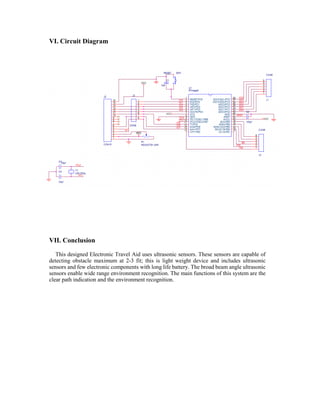
VI. Circuit Diagram
VII. Conclusion
This designed Electronic Travel Aid uses ultrasonic sensors. These sensors are capable of
detecting obstacle maximum at 2-3 fit; this is light weight device and includes ultrasonic
sensors and few electronic components with long life battery. The broad beam angle ultrasonic
sensors enable wide range environment recognition. The main functions of this system are the
clear path indication and the environment recognition.
Safety guard for blind

Safety guard for blind

  • 1.
    Safety Guard forthe Blind using AVR ATmega8 Abstract The present electronic travel aid device consist usually available ultrasonic sensor to detect obstacles on the way within a distance of two to three meters. It transmits ultrasound beams at a regular time interval. If any object is present on the way, the emitted ultrasound will be reflected back to the sensor. The discrete distance of the object is then measured according to discrete levels of 1, 2 and 3 meter and sensed by tactile vibrators. In addition to this, device is to give information about water pits in the traveling path which is sensed by audio signal. I. Introduction Mobility for the blind can be defined as the ability to move with ease, speed and safety through his environment independently. It is estimated that there are 180 million people in the world currently who are affected by problems with their vision. Within this number, approximately 40 – 45 million are blind, by definition not able to walk unaided. With an estimated 7 million people going blind each year, the number of people visually impaired is expectedly to double by the year 2020. A person who cannot see at 6 meter nor has a field vision of 10° or less is considered legally blind. 95% of people classed as legally blind have some vision. To be classed as blind, there is a total loss of vision. Low vision cannot be corrected by visual aids such as glasses and contacts. With the general population living longer due to advances in medical technology, more people are being affected by age-related macular degeneration (AMD). This is a leading cause of blindness on the developed countries with an estimated 25 – 30 million people affected worldwide. This number is expected to triple in the coming 25 years. AMD causes the degeneration of central vision, leaving only peripheral view. This is caused by damage to the damage to the retina and hence cannot be corrected. While it rarely causes blindness, it can deteriorate into severe cases causing large disruption to normal life. Mobility aids like walking stick and guide dogs are commonly used by the blind even today. With the advances of modern technologies many different types of devices are available to support the mobility of blind. These mobility aids are generally known as electronic travel aid. This devices aim at conveying information (typically via the haptic and auditory channels) about the environment to visually impaired individuals, so that they can exploit part of the information that sighted people normally use to experience the world and navigate it. In this technical report we focus on the objective and architecture of discrete distance indication in electronic travel aid. The electronic travel aid like laser cane uses laser beam. But most of the commonly used electronic travel aids use ultrasound . These devices, along with many others, are all based on producing beams of ultrasonic sound or laser light. The device receives any reflected waves, and produces either an audio or tactile stimulus in response to any nearby object. The intensity of the sound or tactile vibration is proportional to the proximity of the detected object. II. Disadvantages of the Present Devices Sonic pathfinder a head mounted device, on the other hand produces audio signal of different frequencies but not designed to detect any hanging object. Moreover a blind person having hearing acuity may be unable to use it properly due to the absence of any tactile sensor. Distance information between blind person and object is missing in these devices because intensity of audio signal or tactile vibration is uniform as blind person is approaching towards object.
  • 2.
    III. Suggested Device Thesuggested device uses ultrasonic sensor SRF04 and can detect any object that lies on the ground or hanging from top, situated a distance of 3 meters from the user. The minimum size of the object that can be detected should not be less than 3 cm width (or diameter). In operation a beam of ultrasound of 40 KHz frequency is transmitted at a regular interval in the forward direction. The ultrasound will be reflected from a nearby object, if any. The sensor will then detect the presence of any object that lies within 3 meters by detecting the reflected sound beam. The time intervals at which the transmitter will transmit ultrasound depend on the walking speed of the user. For water pit indication electrodes are fitted at the bottom of the stick these electrodes are sensing water and conveying information to blind people. IV. Block Diagram Figure 1, shows the complete block diagram of the suggested device. Once triggered the sensor will generate and transmit ultrasound in the forward direction. This ultrasound will be reflected back to the sensor if any object is present within 3 meter range. The time taken by the ultrasound to travel to and back from the obstacle is measured by a counter using specific clock frequency. Again for continuous distance measurement the ultrasonic sensor should be triggered at a regular time Interval and the counter inside microcontroller should also be reset accordingly. The counter output of microcontroller is then decoded and interfaced appropriately with output devices. This produces one of the two audio signal either for water pit or for low battery indication and to activate tactile vibrator to indicate discrete distance of 1 or 2 or 3 meter. The detail description of each block is given below: Figure 1. Block Diagram
  • 3.
    IV.1 Ultrasonic Sensors Itis the heart of the suggested device. We have used ultrasonic sensor type SRF04, known as ultrasonic range finder. The SRF04 is a light weight ( of 0.4 Oz), small size ( 4 cm wide, 2 cm height and 1.5 cm depth) sensor and produces ultrasound of 40 KHz frequency and has built- in transmitter and receiver. It operates from 5 V DC and consumes 30 mA to 50 mA current. The maximum range of this sensor is 3 meters. This sensor can detect a stick having diameter of 3 cm from a distance of 2 meters or more. This SRF04 uses a microcontroller and requires an input trigger pulse of minimum 10 micro second widths. In operation the processor of SRF04 waits for a trigger pulse. After receiving a proper trigger pulse the processor will generate eight cycles of sonic burst of 40 kHz. This sonic burst will be reflected back to the sensor by any obstacle that is situated within the range 3 meters. Accordingly an echo pulse whose width is proportional to obstacle distance will be generated by the microcontroller. The width of the echo pulse can be anywhere between 100 microsecond to 18 m sec, if there is any obstacle present within the specified range. The minimum pulse width is 100 microseconds corresponds to a distance of 1.67 meter and the maximum pulse width of 18 m sec corresponds to a distance of 3 meters. However if there is no obstacle within the range of 3 meters then width of the echo pulse will be 36 m sec. IV.2. Input Trigger The ultrasonic sensor SRF04 should be triggered regularly at a specified time interval for continuous distance measurement. Considering the walking speed of a blind person in an unknown place as 1.5 km/hour, the time taken to travel 1 meter is 2.4 second. The sensor needs to be triggered at the time interval of 2.4 second which corresponds to a clock frequency of 0.417Hz. The timer IC 555 in a stable configuration is used to generate trigger pulses of 0.417Hz frequency [11]. IV.3. Reset Circuit This circuit will generate pulse automatically to reset all the counters so that a new set of data may enter into the counter. The reset pulse should be synchronized with the input trigger pulse that is used to trigger the ultrasonic sensor. Every time a trigger pulse appears there should be a corresponding reset pulse. Once again 555 timer has been used as a monostable multivibrator that is triggered by the input trigger pulse to generate the required reset pulse. V. Design Parameters The proposed ETA is designed according to the following parameters: Detectable range in meter 0.2 to 2.5 Weight in gram 300 to 350 Operating Voltage 9V Allowable input frequency 40 kHz Sensitivity in db -63±3 Operating temp. Range (o C) -30 to +85
  • 4.
    VI. Circuit Diagram VII.Conclusion This designed Electronic Travel Aid uses ultrasonic sensors. These sensors are capable of detecting obstacle maximum at 2-3 fit; this is light weight device and includes ultrasonic sensors and few electronic components with long life battery. The broad beam angle ultrasonic sensors enable wide range environment recognition. The main functions of this system are the clear path indication and the environment recognition.