LIFE DETECTION
SYSTEM
Using Microwaves
INTRODUCTION
 Microwave life-detection system is a system which can be used to locate
human subjects buried under earthquake rubble or hidden behind
various barriers has been constructed.
 By advent of this system the world death rate may decrease to greater
extent as large percentage of death occur due to earthquake.
 This system operating at 1150 MHz or 450 MHz can detect the breathing
and heartbeat signals of human subjects through earthquake rubble or a
construction barrier of about 10-ft thickness.
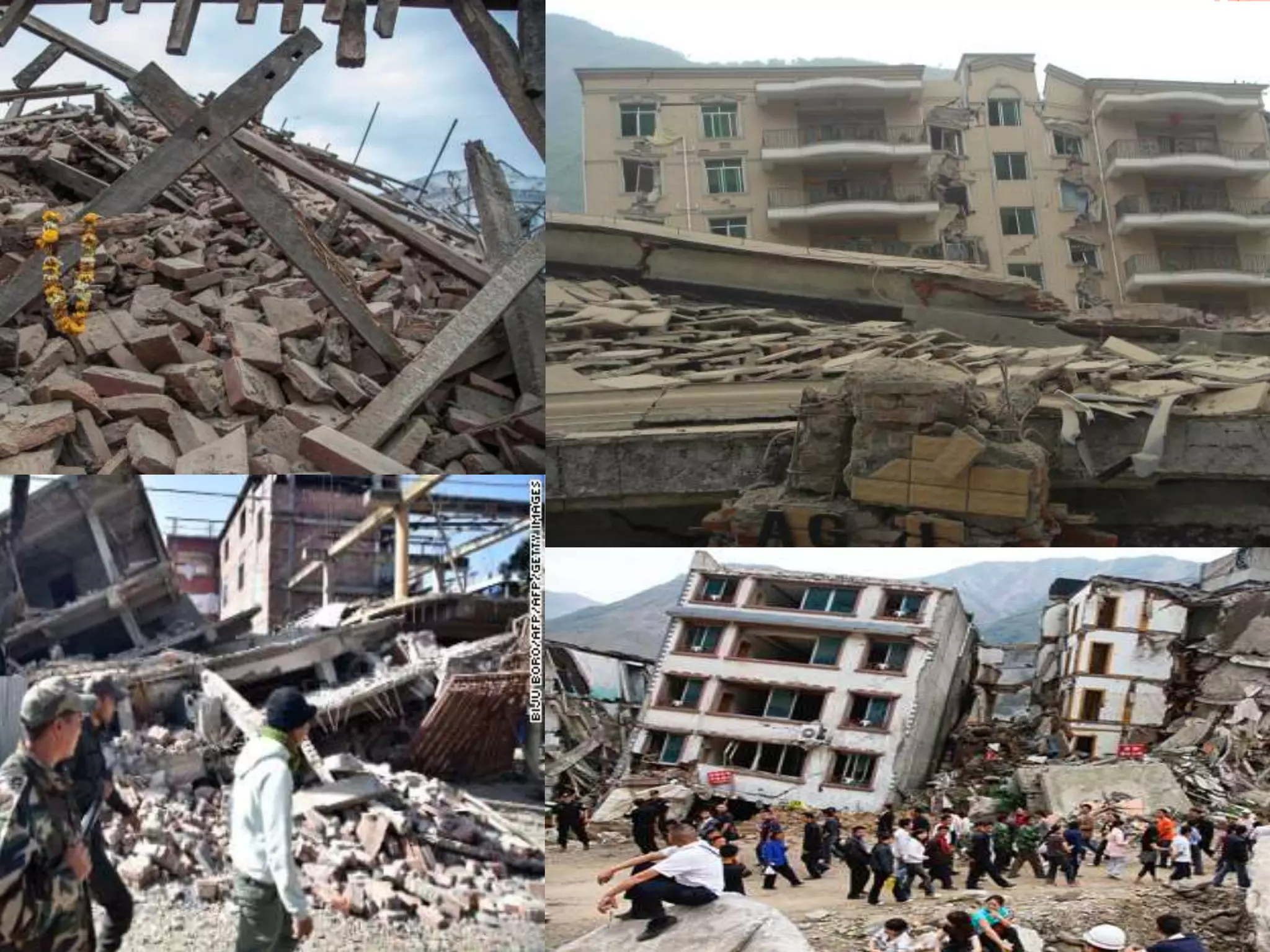
 The natural and manmade disaster such an earthquakes, landslide,
avalanches, have become common in the last decades due to these
buildings tends to collapse on people. After most of these incidents, the
common problem is that more number of lives could have been saved
had the survivors been found and rescued earlier.
 This incident cause’s people to death to safeguard it our technology is
helpful. Hence there is need to develop a comprehensive disaster
management solution to tackle this problem.
7
CONVENTIONAL METHODS
METHODS LIMITATIONS
1. Utilization of the dogs But the dogs can detect the dead persons and
this occupies the precious time which can be
utilize to detect alive victims.
2. Optical devices the optical devices require expert operators and
cannot be used in inaccessible area.
3. Acoustic life detectors Acoustical detectors such as geophones are
simple to use but they require quiet working
environments, a condition difficult to reach
especially in critical situations
4. Rescue robot The Rescue Robot can navigate deep into the
rubble to search for victim by the use of
temperature sensor but they are unable to trap
once they go out of range
MICROWAVES
 Microwaves are electromagnetic waves with wavelengths
ranging from as long as one meter to as short as one
millimeter, or equivalently, with frequencies between 300
MHz (0.3 GHz) and 300 GHz.
 This broad definition includes both UHF and EHF
(millimeter waves). In all cases, microwave includes the
entire SHF band (3 to 30 GHz, or 10 to 1 cm) at
minimum.
PROPERTIES OF MICROWAVES
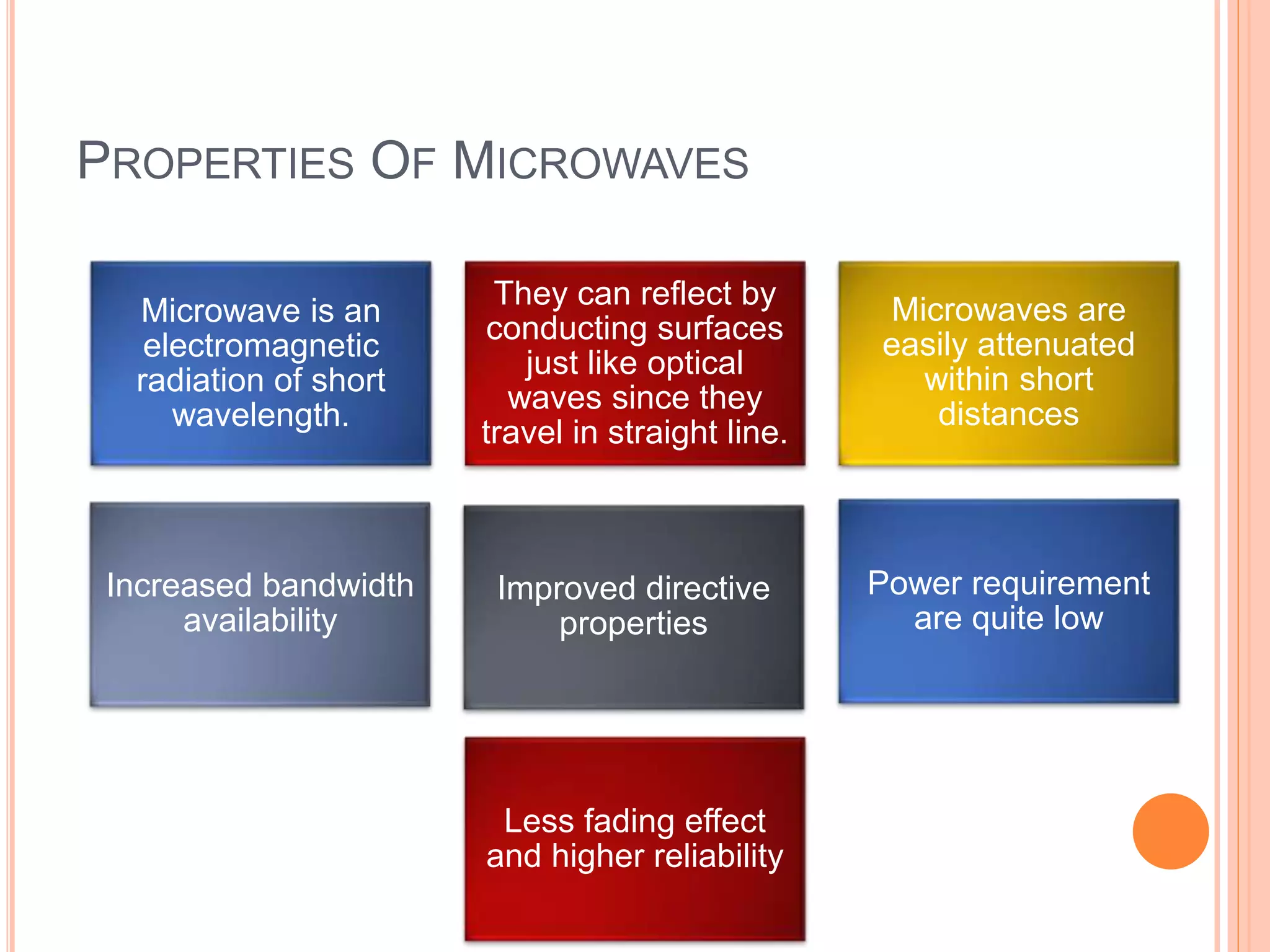
Microwave is an
electromagnetic
radiation of short
wavelength.
They can reflect by
conducting surfaces
just like optical
waves since they
travel in straight line.
Microwaves are
easily attenuated
within short
distances
Increased bandwidth
availability
Improved directive
properties
Power requirement
are quite low
Less fading effect
and higher reliability
PRINCIPLE OF OPERATION
The reception of
modulated signals
shows the
presence of alive
human inside the
rubble.
When the beam
hits the body, the
signal reflected
with an additional
modulation
created by
movement of heart
and lungs.
Microwave would
reflect back from
some objects.
Microwave is sent
through rubble to
detect vital signs
of life.
This REFLECTIVE
and PENETRATIVE
property of
microwaves is the
underlying principle,
which makes
DETECTION OF LIFE
possible…
Make any sense?
Yes? No? Maybe?
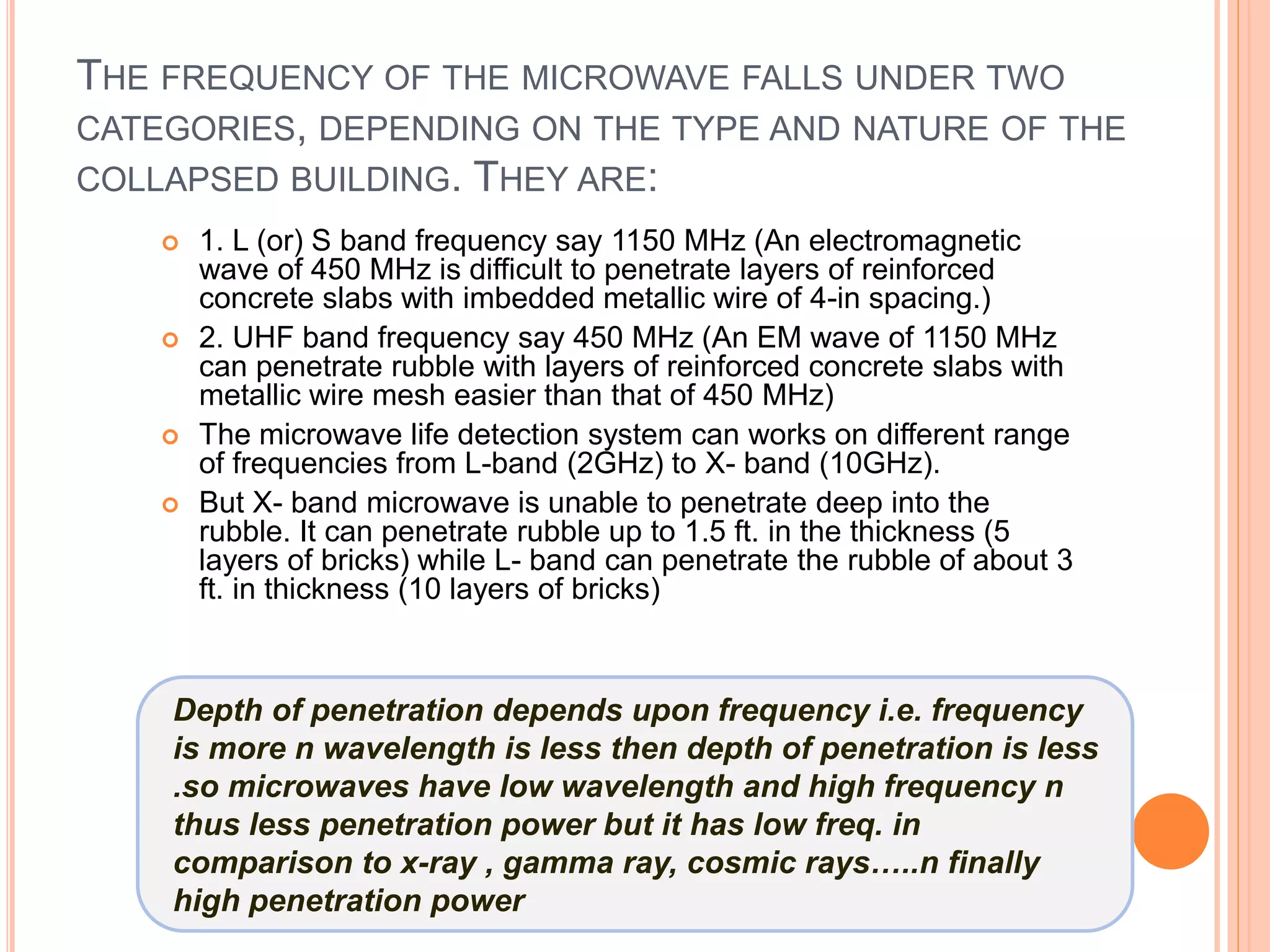
THE FREQUENCY OF THE MICROWAVE FALLS UNDER TWO
CATEGORIES, DEPENDING ON THE TYPE AND NATURE OF THE
COLLAPSED BUILDING. THEY ARE:
 1. L (or) S band frequency say 1150 MHz (An electromagnetic
wave of 450 MHz is difficult to penetrate layers of reinforced
concrete slabs with imbedded metallic wire of 4-in spacing.)
 2. UHF band frequency say 450 MHz (An EM wave of 1150 MHz
can penetrate rubble with layers of reinforced concrete slabs with
metallic wire mesh easier than that of 450 MHz)
 The microwave life detection system can works on different range
of frequencies from L-band (2GHz) to X- band (10GHz).
 But X- band microwave is unable to penetrate deep into the
rubble. It can penetrate rubble up to 1.5 ft. in the thickness (5
layers of bricks) while L- band can penetrate the rubble of about 3
ft. in thickness (10 layers of bricks)
Depth of penetration depends upon frequency i.e. frequency
is more n wavelength is less then depth of penetration is less
.so microwaves have low wavelength and high frequency n
thus less penetration power but it has low freq. in
comparison to x-ray , gamma ray, cosmic rays…..n finally
high penetration power
MAJOR COMPONENT
Microwave Circuit
Dual Antenna System
Microwave Controlled
Clutter Cancellation
System
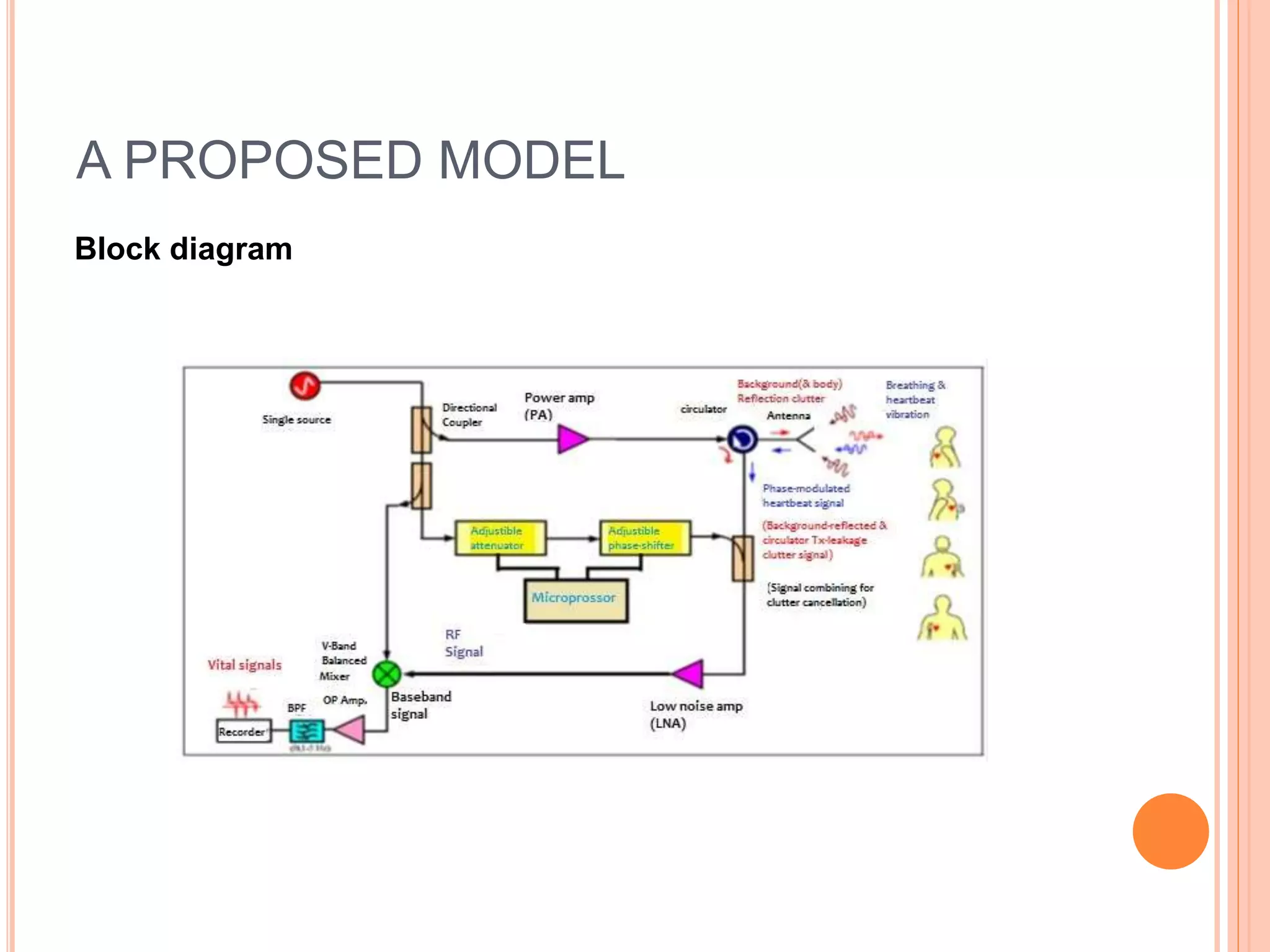
A PROPOSED MODEL
Block diagram
COMPONENTS OF BLOCK DIAGRAM
1. PHASE LOCKED OSCILLATOR:
 A phase-shift oscillator is a simple electronic oscillator. It contains an inverting
amplifier elements such as a transistor or op amp, and a feedback filter . Here
the phase locked oscillator generates a very stable electromagnetic wave say
1150 MHz with output power say 400mW.
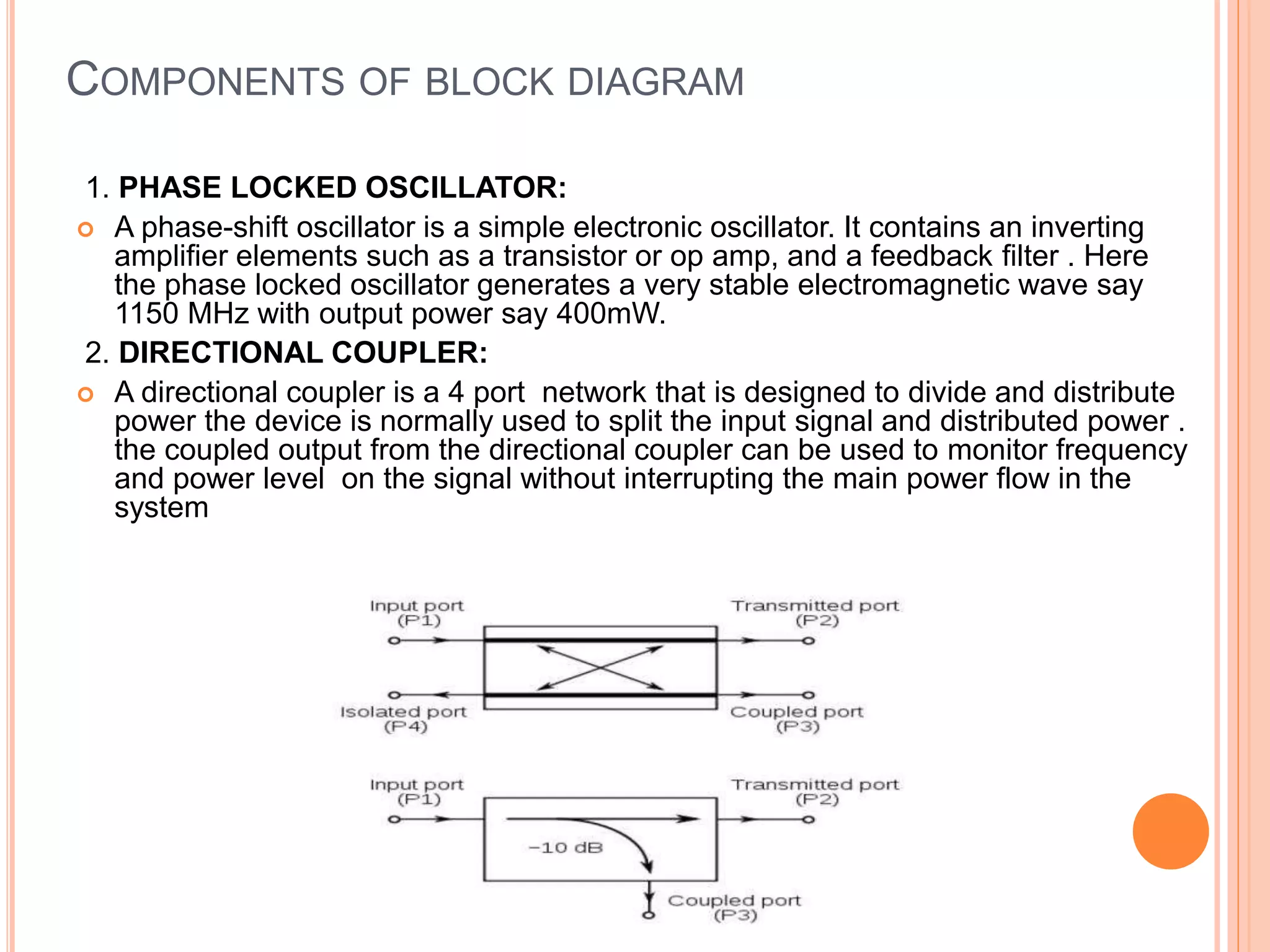
2. DIRECTIONAL COUPLER:
 A directional coupler is a 4 port network that is designed to divide and distribute
power the device is normally used to split the input signal and distributed power .
the coupled output from the directional coupler can be used to monitor frequency
and power level on the signal without interrupting the main power flow in the
system
3. CIRCULATOR:
 A circulator is a ferrite device (ferrite is a class of materials with strange
magnetic properties) with usually three ports. That is, energy into port 1
predominantly exits port 2, energy into port 2 exits port 3, and energy
into port 3 exits port 1
4. ANTENNA SYSTEM:
 The dual antenna system has two antennas, which are energized
sequentially by an electronically controlled microwave single-pole
double-throw (SPDT) switch. The SPDT switch turns on and off at a
certain frequency. Each antenna acts separately. Each antenna
simultaneously acts as the radiating element and the receiving element.
It radiates EM wave through the earthquake rubble to reach the trapped
human subjects and at the same time it receives the reflected EM wave
from the rubble and the human subjects.
CCW and CW circulators
5. CLUTTER CANCELLATION SYSTEM:
In any remote sensing instrument the clutter caused by undesirable
objects surrounding the detectable subject must be cancel to the optimum
level. The clutter canceller forms the heart of life detection system. The
clutter cancellation unit consists of
 1. A digitally controlled phase shifter
 2. A fixed attenuator
 3. A RF amplifier
 4. A digitally controlled attenuator.
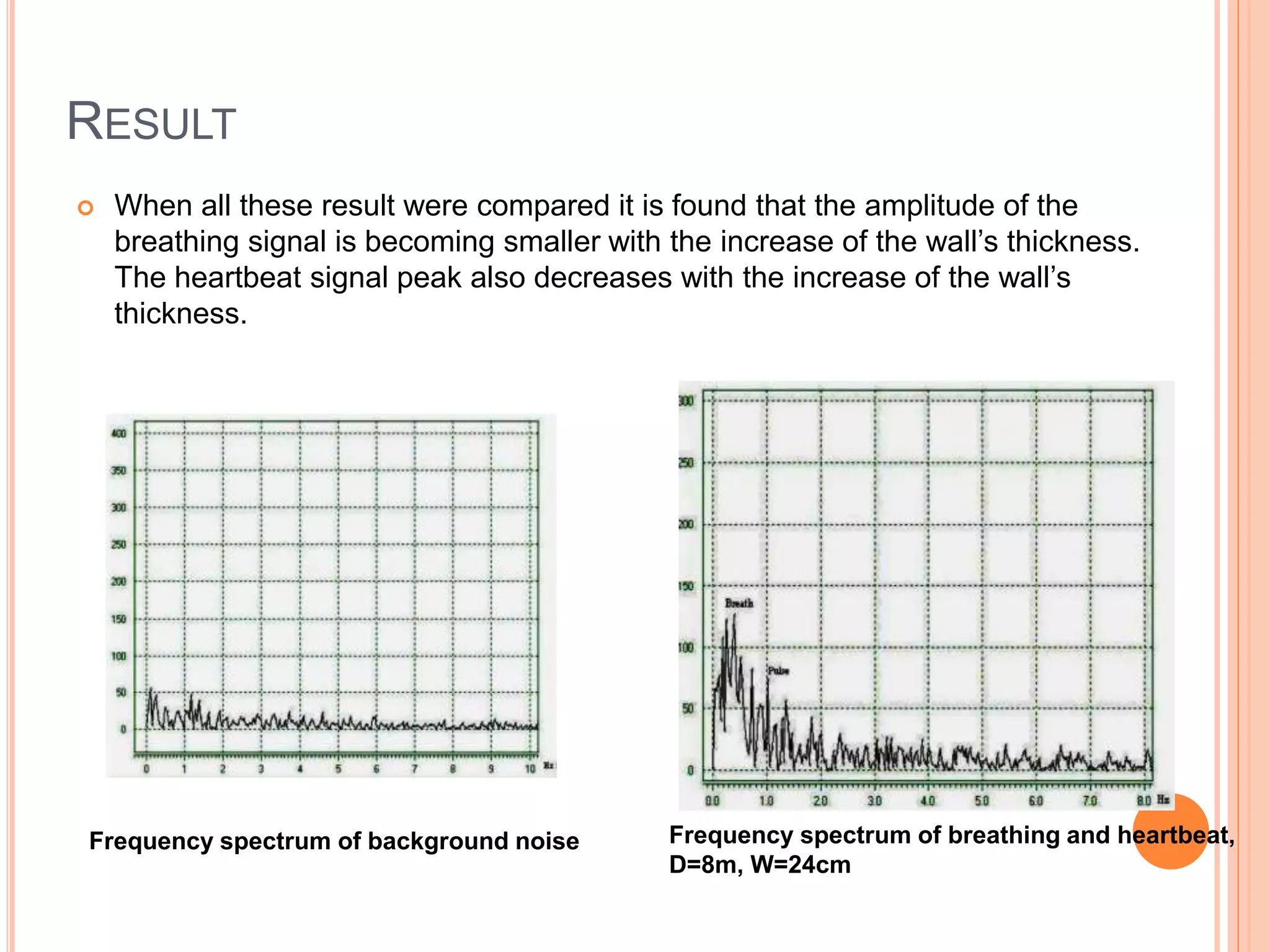
RESULT
 When all these result were compared it is found that the amplitude of the
breathing signal is becoming smaller with the increase of the wall’s thickness.
The heartbeat signal peak also decreases with the increase of the wall’s
thickness.
Frequency spectrum of background noise Frequency spectrum of breathing and heartbeat,
D=8m, W=24cm
ANALYSIS
ADVANTAGES
 Remote life sensing could be a
powerful tool in applications where
access to the subject is limited.
 The frequency 2.45 GHz i.e. L-
band frequency and this is free for
use by commercial applications, so
we expect a minimum interference
with other devices during our tests.
 If a minute movement of the victim
is observed then detection can be
done.
DISADVANTAGES
 Project is expensive but once it is
implemented the expenses can be
reduce lower extend.
 The L- band frequency is unable to
penetrate more metal like structure
but it can penetrate over 10 layers
of bricks.
 The involvement of clutter signal
may destroy the vital information of
life signs. But if the proper
demodulation is used one can
receive the vital signs efficiently.
Future Scope:
In future, depending upon the developing such technology, if we can enhance the
system so that it will able to detect number of victims buried under the respective
rubble. Then rescuer will prefer area with more number of victims. Eventually, our
system can save more lives.
THANK YOU

Life detection system

  • 1.
  • 2.
    INTRODUCTION  Microwave life-detectionsystem is a system which can be used to locate human subjects buried under earthquake rubble or hidden behind various barriers has been constructed.  By advent of this system the world death rate may decrease to greater extent as large percentage of death occur due to earthquake.  This system operating at 1150 MHz or 450 MHz can detect the breathing and heartbeat signals of human subjects through earthquake rubble or a construction barrier of about 10-ft thickness.  The natural and manmade disaster such an earthquakes, landslide, avalanches, have become common in the last decades due to these buildings tends to collapse on people. After most of these incidents, the common problem is that more number of lives could have been saved had the survivors been found and rescued earlier.  This incident cause’s people to death to safeguard it our technology is helpful. Hence there is need to develop a comprehensive disaster management solution to tackle this problem.
  • 3.
  • 4.
    CONVENTIONAL METHODS METHODS LIMITATIONS 1.Utilization of the dogs But the dogs can detect the dead persons and this occupies the precious time which can be utilize to detect alive victims. 2. Optical devices the optical devices require expert operators and cannot be used in inaccessible area. 3. Acoustic life detectors Acoustical detectors such as geophones are simple to use but they require quiet working environments, a condition difficult to reach especially in critical situations 4. Rescue robot The Rescue Robot can navigate deep into the rubble to search for victim by the use of temperature sensor but they are unable to trap once they go out of range
  • 5.
    MICROWAVES  Microwaves areelectromagnetic waves with wavelengths ranging from as long as one meter to as short as one millimeter, or equivalently, with frequencies between 300 MHz (0.3 GHz) and 300 GHz.  This broad definition includes both UHF and EHF (millimeter waves). In all cases, microwave includes the entire SHF band (3 to 30 GHz, or 10 to 1 cm) at minimum.
  • 7.
    PROPERTIES OF MICROWAVES Microwaveis an electromagnetic radiation of short wavelength. They can reflect by conducting surfaces just like optical waves since they travel in straight line. Microwaves are easily attenuated within short distances Increased bandwidth availability Improved directive properties Power requirement are quite low Less fading effect and higher reliability
  • 8.
    PRINCIPLE OF OPERATION Thereception of modulated signals shows the presence of alive human inside the rubble. When the beam hits the body, the signal reflected with an additional modulation created by movement of heart and lungs. Microwave would reflect back from some objects. Microwave is sent through rubble to detect vital signs of life.
  • 9.
    This REFLECTIVE and PENETRATIVE propertyof microwaves is the underlying principle, which makes DETECTION OF LIFE possible… Make any sense? Yes? No? Maybe?
  • 10.
    THE FREQUENCY OFTHE MICROWAVE FALLS UNDER TWO CATEGORIES, DEPENDING ON THE TYPE AND NATURE OF THE COLLAPSED BUILDING. THEY ARE:  1. L (or) S band frequency say 1150 MHz (An electromagnetic wave of 450 MHz is difficult to penetrate layers of reinforced concrete slabs with imbedded metallic wire of 4-in spacing.)  2. UHF band frequency say 450 MHz (An EM wave of 1150 MHz can penetrate rubble with layers of reinforced concrete slabs with metallic wire mesh easier than that of 450 MHz)  The microwave life detection system can works on different range of frequencies from L-band (2GHz) to X- band (10GHz).  But X- band microwave is unable to penetrate deep into the rubble. It can penetrate rubble up to 1.5 ft. in the thickness (5 layers of bricks) while L- band can penetrate the rubble of about 3 ft. in thickness (10 layers of bricks) Depth of penetration depends upon frequency i.e. frequency is more n wavelength is less then depth of penetration is less .so microwaves have low wavelength and high frequency n thus less penetration power but it has low freq. in comparison to x-ray , gamma ray, cosmic rays…..n finally high penetration power
  • 11.
    MAJOR COMPONENT Microwave Circuit DualAntenna System Microwave Controlled Clutter Cancellation System
  • 12.
  • 13.
    COMPONENTS OF BLOCKDIAGRAM 1. PHASE LOCKED OSCILLATOR:  A phase-shift oscillator is a simple electronic oscillator. It contains an inverting amplifier elements such as a transistor or op amp, and a feedback filter . Here the phase locked oscillator generates a very stable electromagnetic wave say 1150 MHz with output power say 400mW. 2. DIRECTIONAL COUPLER:  A directional coupler is a 4 port network that is designed to divide and distribute power the device is normally used to split the input signal and distributed power . the coupled output from the directional coupler can be used to monitor frequency and power level on the signal without interrupting the main power flow in the system
  • 14.
    3. CIRCULATOR:  Acirculator is a ferrite device (ferrite is a class of materials with strange magnetic properties) with usually three ports. That is, energy into port 1 predominantly exits port 2, energy into port 2 exits port 3, and energy into port 3 exits port 1 4. ANTENNA SYSTEM:  The dual antenna system has two antennas, which are energized sequentially by an electronically controlled microwave single-pole double-throw (SPDT) switch. The SPDT switch turns on and off at a certain frequency. Each antenna acts separately. Each antenna simultaneously acts as the radiating element and the receiving element. It radiates EM wave through the earthquake rubble to reach the trapped human subjects and at the same time it receives the reflected EM wave from the rubble and the human subjects. CCW and CW circulators
  • 15.
    5. CLUTTER CANCELLATIONSYSTEM: In any remote sensing instrument the clutter caused by undesirable objects surrounding the detectable subject must be cancel to the optimum level. The clutter canceller forms the heart of life detection system. The clutter cancellation unit consists of  1. A digitally controlled phase shifter  2. A fixed attenuator  3. A RF amplifier  4. A digitally controlled attenuator.
  • 16.
    RESULT  When allthese result were compared it is found that the amplitude of the breathing signal is becoming smaller with the increase of the wall’s thickness. The heartbeat signal peak also decreases with the increase of the wall’s thickness. Frequency spectrum of background noise Frequency spectrum of breathing and heartbeat, D=8m, W=24cm
  • 17.
    ANALYSIS ADVANTAGES  Remote lifesensing could be a powerful tool in applications where access to the subject is limited.  The frequency 2.45 GHz i.e. L- band frequency and this is free for use by commercial applications, so we expect a minimum interference with other devices during our tests.  If a minute movement of the victim is observed then detection can be done. DISADVANTAGES  Project is expensive but once it is implemented the expenses can be reduce lower extend.  The L- band frequency is unable to penetrate more metal like structure but it can penetrate over 10 layers of bricks.  The involvement of clutter signal may destroy the vital information of life signs. But if the proper demodulation is used one can receive the vital signs efficiently. Future Scope: In future, depending upon the developing such technology, if we can enhance the system so that it will able to detect number of victims buried under the respective rubble. Then rescuer will prefer area with more number of victims. Eventually, our system can save more lives.
  • 18.