PROTEIN
PHOSPHORYLATION
By:
Sachin kumar
M.Pharm. (Pharmacology)
Deptt. of Pharma. Sciences
M.D.U. Rohtak, 124001
CONTENTS
 Introduction
 Protein phosphorylation sites.
 Mechanism of phosphorylation.
 Function of phosphorylation.
 Role of phosphorylation in human health &
disease.
 Disease caused by abnormal phosphorylation.
 Methods of detection of protein
phophorylation.
 Recent studies
 References
PROTEIN
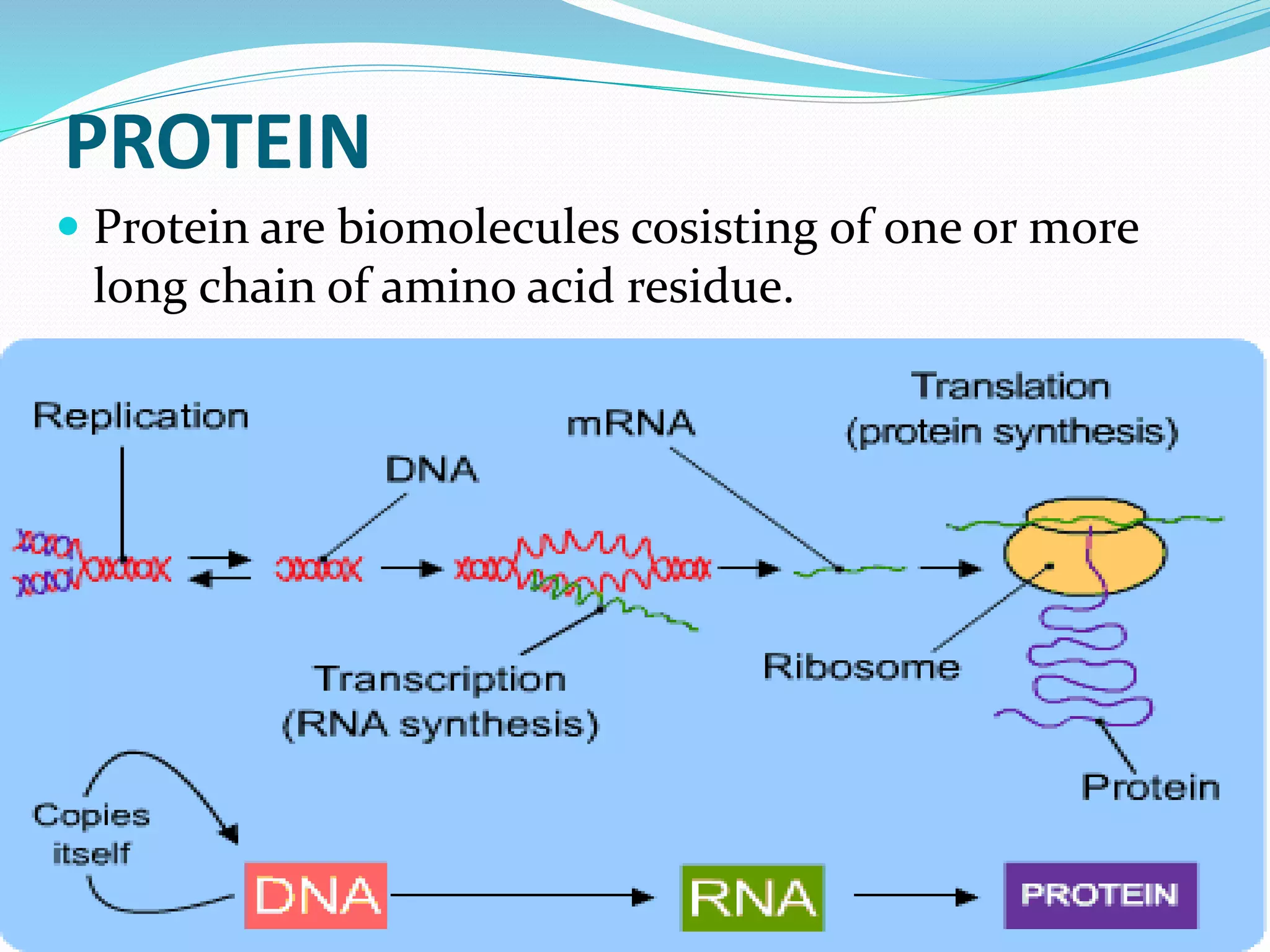
 Protein are biomolecules cosisting of one or more
long chain of amino acid residue.
PROTEIN PHOSPHORYLATION
 Protein phosphorylation was first reported in 1906
by Phoebus Levene. He identified phosphate in
protein vitellin.
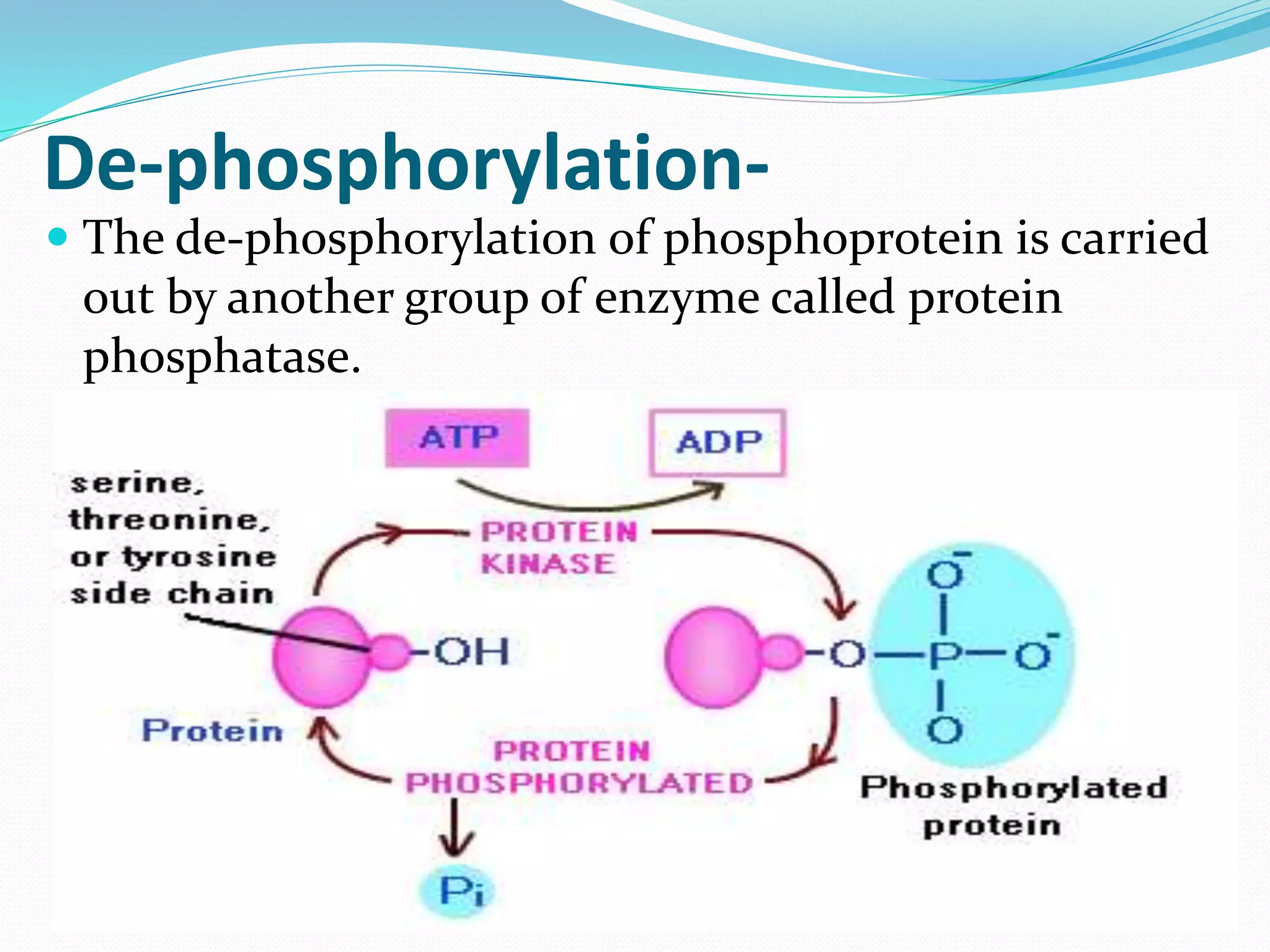
 It is a post-translational modification of protein in
which an amino acid residue is phosphorylated by
a protein kinase by the addition of covalently
bound phosphate group.
 It alters the structural conformation of a protein ,
causing it to become activated, deactivated or
modifying its function.
De-phosphorylation-
 The de-phosphorylation of phosphoprotein is carried
out by another group of enzyme called protein
phosphatase.
Protein phosphorylation sites
 Most commonly phosphorylated amino acids are
serine, threonine and tyrosine.
 There are thousand of different kind of protein in a
cell, hence there are thousand of distinct
phosphorylation sites in a given cell.
 One study indicates that 30% of proteins in the
human genome can be phosphorylated, and
abnormal
phosphorylation is now recognized as a cause of
human disease.
Mechanism of p.phophorylation
 Amino acids serine, threonine & tyrosine have a
neuclophilic (-OH) group that attacks the terminal
phosphate group on the universal phophoryl donor
ATP, resulting in the transfer of phosphate group to
the amino acid side chain.
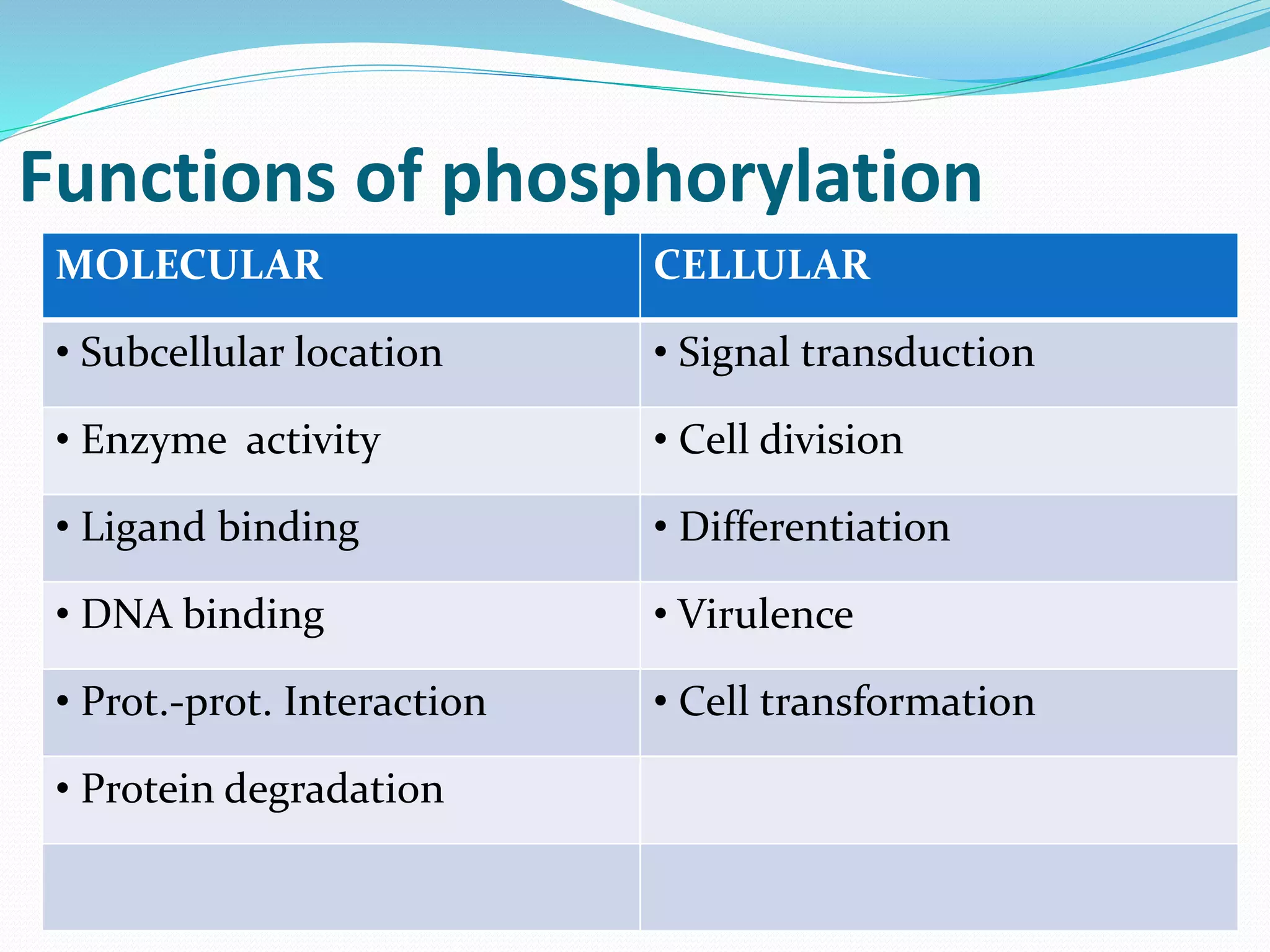
Functions of phosphorylation
MOLECULAR CELLULAR
• Subcellular location • Signal transduction
• Enzyme activity • Cell division
• Ligand binding • Differentiation
• DNA binding • Virulence
• Prot.-prot. Interaction • Cell transformation
• Protein degradation
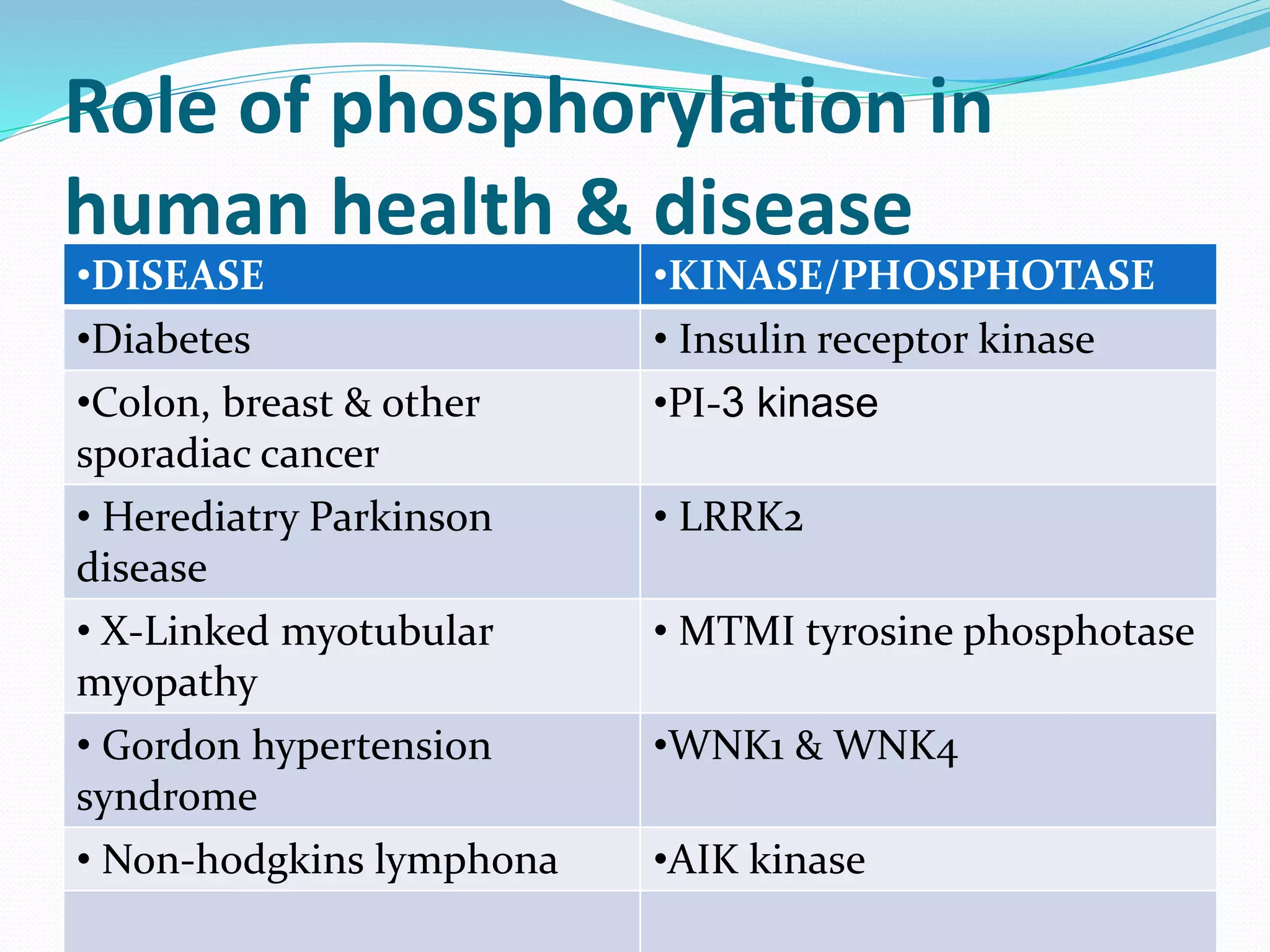
Role of phosphorylation in
human health & disease
•DISEASE •KINASE/PHOSPHOTASE
•Diabetes • Insulin receptor kinase
•Colon, breast & other
sporadiac cancer
•PI-3 kinase
• Herediatry Parkinson
disease
• LRRK2
• X-Linked myotubular
myopathy
• MTMI tyrosine phosphotase
• Gordon hypertension
syndrome
•WNK1 & WNK4
• Non-hodgkins lymphona •AIK kinase
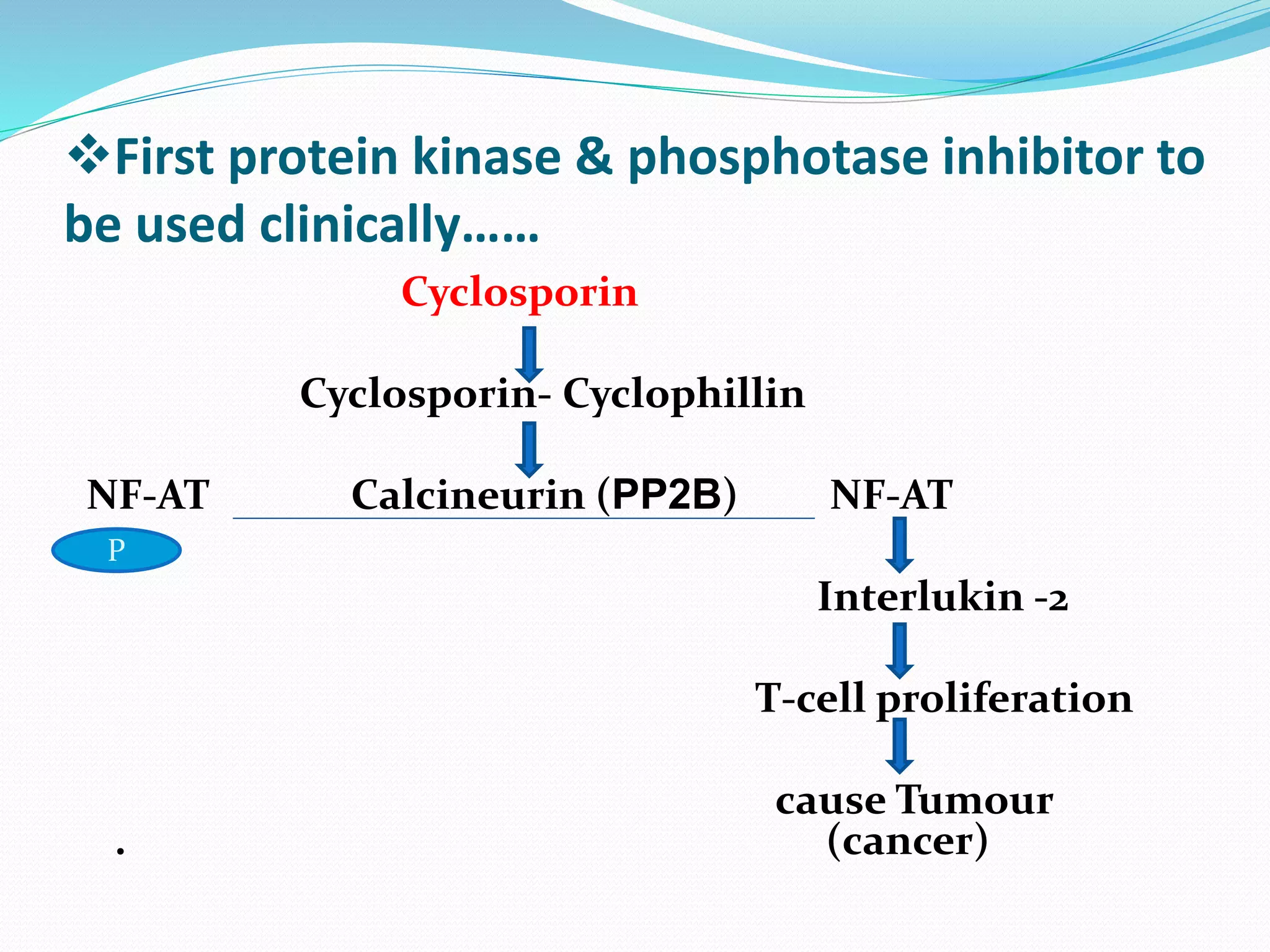
First protein kinase & phosphotase inhibitor to
be used clinically……
Cyclosporin
Cyclosporin- Cyclophillin
NF-AT Calcineurin (PP2B) NF-AT
Interlukin -2
T-cell proliferation
cause Tumour
. (cancer)
P
Protein kinase inhibitor as drug to treat cancer…
Interaction of growth factor (EGF & PDGF) with their
receptor.
Activate tyrosin kinase STI571
GTP-Ras Abelson STI571
tyrosine kinase
Raf
PD98059,UO126
MKK1 (MAPK kinase1)
MAPKs
--
--
--
CDKs
Cell proliferation
• Over expression and mutation of receptor and other
protein tyrosin kinase such as Abelson tyrosine kinase
cause cell transformation and cancer.
• The EGF receptor kinase is over expressed in many
cancer such as lungs and breast cancer.
ROSCOVITINE
FLAVOPIRIDOL
INDIRUBIN
--
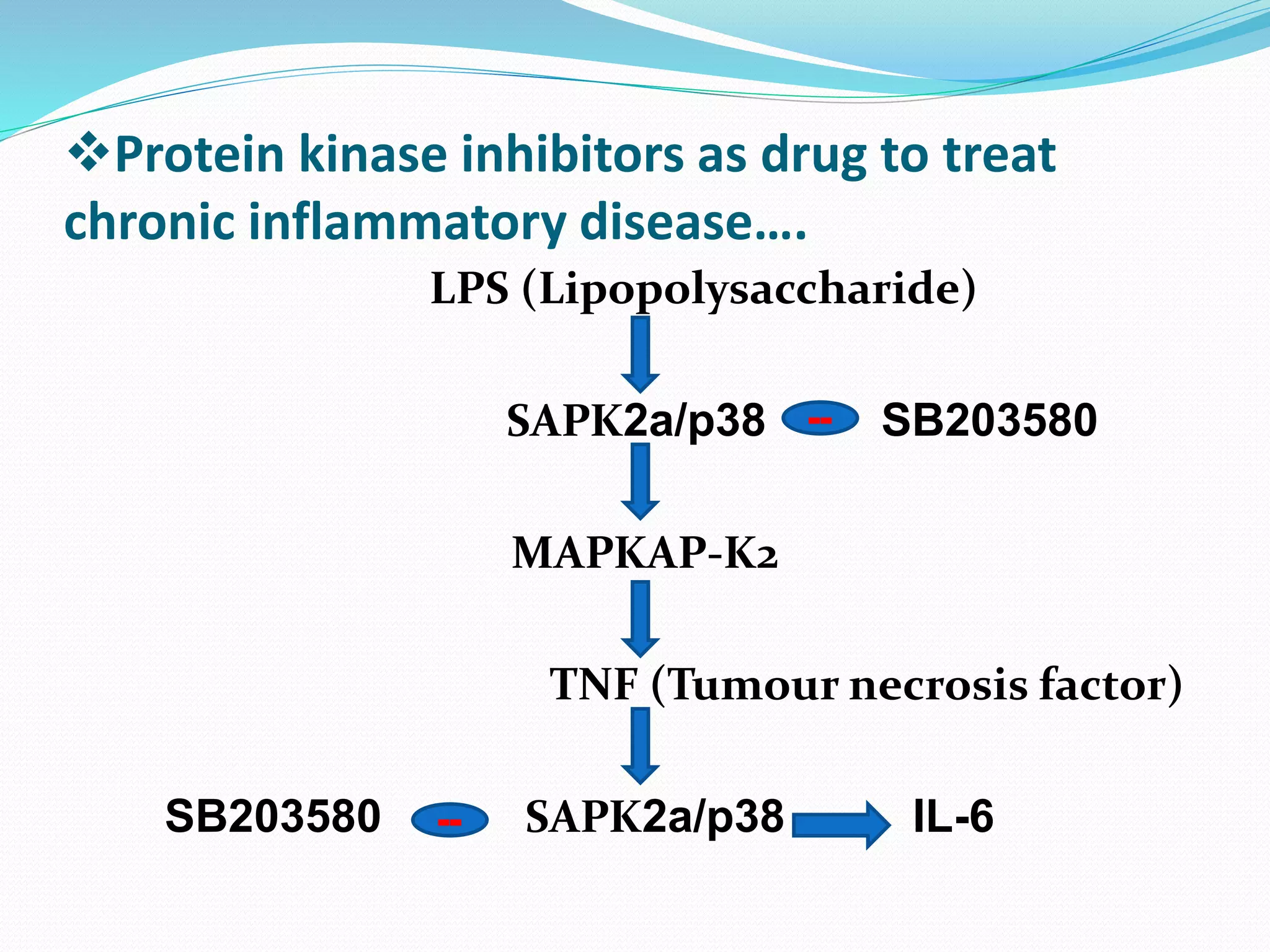
Protein kinase inhibitors as drug to treat
chronic inflammatory disease….
LPS (Lipopolysaccharide)
SAPK2a/p38 SB203580
MAPKAP-K2
TNF (Tumour necrosis factor)
SB203580 SAPK2a/p38 IL-6--
--
GSK3 inhibitors as drug to treat diabetes….
Insulin
Insulin receptor
Tyrosine kinase
IRS PI3 PIP2 PIP3 PDK1
It phosphorylate GSK3 & Protein kinase B
Inhibit its dephophorylation
GSK3 (Inhibited)
GS elF2B
Glycogen Protein
Synthesis Synthesis
• Type –II or NIDDM, which accounts for 90% of all
cases of this disease is characterized by insulin
resistance .
• Insulin induced inhibition of GSK3 and treat diabetes.
Disease caused by abnormal phosphorylation
 Abnormal phosphorylation cause no. of disease such
as Alzheimer‘s Disease, Parkison Disease & other
degenerative disorders.
 In Alzheimer‘s Disease hyperphosphorylation of Tau
protein leads to abnormal aggregation into fibrillary
tangles inside the neuron & cause cell death.
 In Parkinson Disease phosphorylation of Ser¹²⁹ is
associated with the aggregation of protein & further
damage to the nervous system.
Methods of detection of protein
phophorylation…..
 Western blotting
 ELISA (enzyme linked immunosorbent assay)
 Quantitative mass spectrometry
 Intracellular flow cytometry
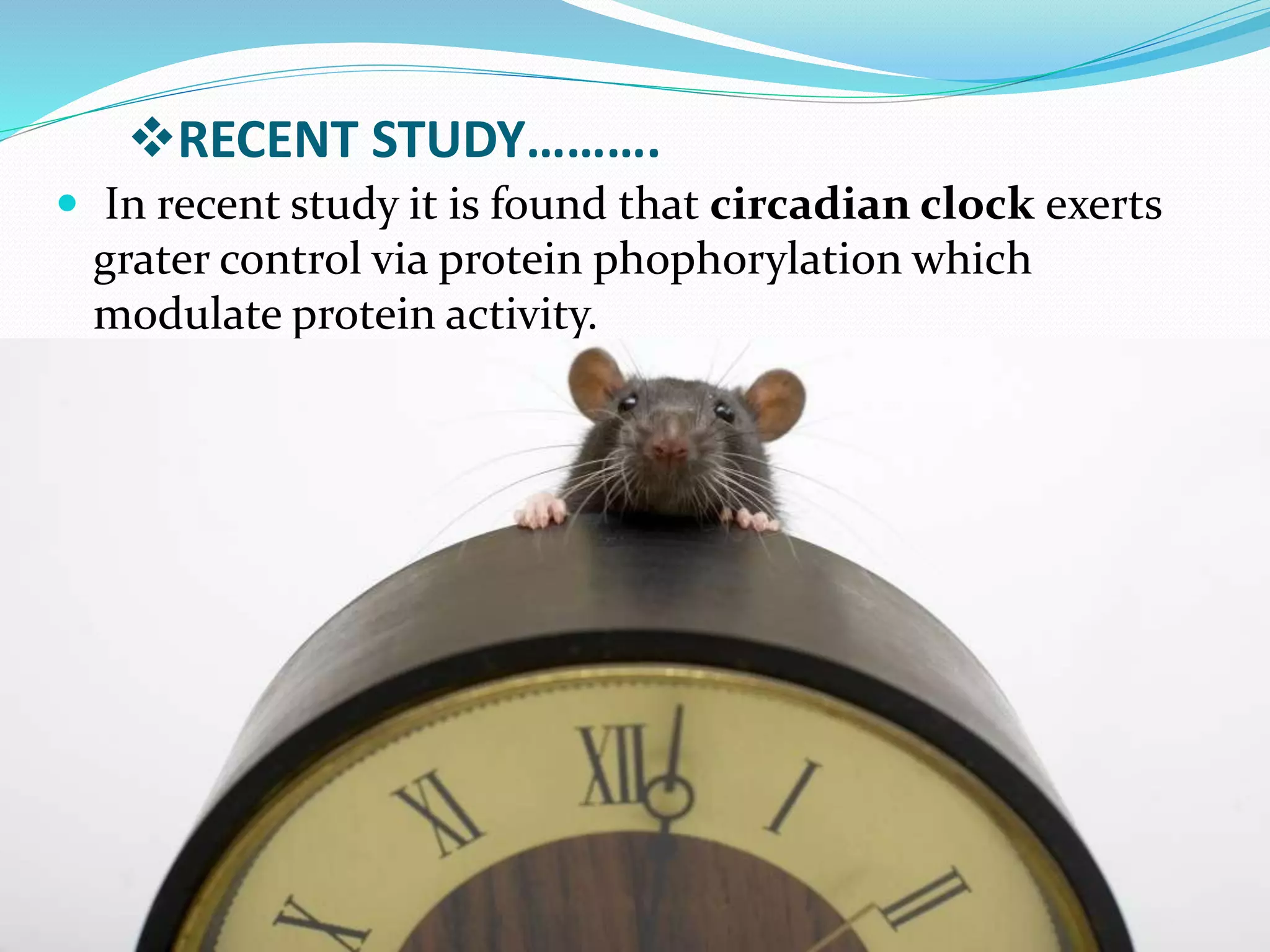
RECENT STUDY……….
 In recent study it is found that circadian clock exerts
grater control via protein phophorylation which
modulate protein activity.
 Previous study indicated that protein phosphorylation
play a important role in controlling the the circadian
clock molecular mechanism.
 Scientists did not know how big?
 Maria Robels, a choronobiologist at the Max planck
institutes of biochemistry in Planegg Germany, used
high resolution mass spectrometry to detect
flcutuation in the amount of phosphorylated protein
in mouse liver cell over a 24hr period.
 About 40% of phophorylated protein in mouse liver
displayed distinct circadian oscillation.
References
 HRV A. Synthesis of amino acids and proteins vol.7.In
MTP International Review of Sciences. Biochemistry
Section. University Park Press, Baltimore, Md., 1975.
 Ptacek J, Synder M, Global analysis of protein
phophorylation.2006, PMID: 16908088.
 https://www.rndsystems.com/resources/articles/metho
ds detectingproteinphosphorylation.
 P.Cohen, The role of protein phosphorylation in human
health and disease, the FEBS journal, 2001, vvol.268.
http://onlinelibrary.wiley.com/doi/10.1046/j.0014-
2956.2001.02473.
 http://journal.frontiersin.org/article/10.3389/fmicb.2016
.00184.
http://blog.pnas.org/2017/02/journalclub-
phosphorylationhassurprisinglybigroleincontrolof-
circadianclocks.
Thomas B,M. Flint, Human molecular genetics (2007)
16 (R2): R183-R194.
DOI: https://doi.org/10.1093/hmg/ddm159 Published:
15 October 2007
http://neurosciencenews.com/alzheimerskinasep38y-
5549.
Kolarova M,Bartos J,Ricny J,Ripova D, Structure and
Pathology of Tau Protein in Alzheimer Disease ,
International Journal of Alzheimer's Disease, volume
2012, Article ID:731526.
protein phosphorylation

protein phosphorylation

  • 1.
  • 2.
    CONTENTS  Introduction  Proteinphosphorylation sites.  Mechanism of phosphorylation.  Function of phosphorylation.  Role of phosphorylation in human health & disease.  Disease caused by abnormal phosphorylation.  Methods of detection of protein phophorylation.  Recent studies  References
  • 3.
    PROTEIN  Protein arebiomolecules cosisting of one or more long chain of amino acid residue.
  • 4.
    PROTEIN PHOSPHORYLATION  Proteinphosphorylation was first reported in 1906 by Phoebus Levene. He identified phosphate in protein vitellin.  It is a post-translational modification of protein in which an amino acid residue is phosphorylated by a protein kinase by the addition of covalently bound phosphate group.  It alters the structural conformation of a protein , causing it to become activated, deactivated or modifying its function.
  • 5.
    De-phosphorylation-  The de-phosphorylationof phosphoprotein is carried out by another group of enzyme called protein phosphatase.
  • 6.
    Protein phosphorylation sites Most commonly phosphorylated amino acids are serine, threonine and tyrosine.  There are thousand of different kind of protein in a cell, hence there are thousand of distinct phosphorylation sites in a given cell.  One study indicates that 30% of proteins in the human genome can be phosphorylated, and abnormal phosphorylation is now recognized as a cause of human disease.
  • 7.
    Mechanism of p.phophorylation Amino acids serine, threonine & tyrosine have a neuclophilic (-OH) group that attacks the terminal phosphate group on the universal phophoryl donor ATP, resulting in the transfer of phosphate group to the amino acid side chain.
  • 8.
    Functions of phosphorylation MOLECULARCELLULAR • Subcellular location • Signal transduction • Enzyme activity • Cell division • Ligand binding • Differentiation • DNA binding • Virulence • Prot.-prot. Interaction • Cell transformation • Protein degradation
  • 9.
    Role of phosphorylationin human health & disease •DISEASE •KINASE/PHOSPHOTASE •Diabetes • Insulin receptor kinase •Colon, breast & other sporadiac cancer •PI-3 kinase • Herediatry Parkinson disease • LRRK2 • X-Linked myotubular myopathy • MTMI tyrosine phosphotase • Gordon hypertension syndrome •WNK1 & WNK4 • Non-hodgkins lymphona •AIK kinase
  • 10.
    First protein kinase& phosphotase inhibitor to be used clinically…… Cyclosporin Cyclosporin- Cyclophillin NF-AT Calcineurin (PP2B) NF-AT Interlukin -2 T-cell proliferation cause Tumour . (cancer) P
  • 11.
    Protein kinase inhibitoras drug to treat cancer… Interaction of growth factor (EGF & PDGF) with their receptor. Activate tyrosin kinase STI571 GTP-Ras Abelson STI571 tyrosine kinase Raf PD98059,UO126 MKK1 (MAPK kinase1) MAPKs -- -- --
  • 12.
    CDKs Cell proliferation • Overexpression and mutation of receptor and other protein tyrosin kinase such as Abelson tyrosine kinase cause cell transformation and cancer. • The EGF receptor kinase is over expressed in many cancer such as lungs and breast cancer. ROSCOVITINE FLAVOPIRIDOL INDIRUBIN --
  • 13.
    Protein kinase inhibitorsas drug to treat chronic inflammatory disease…. LPS (Lipopolysaccharide) SAPK2a/p38 SB203580 MAPKAP-K2 TNF (Tumour necrosis factor) SB203580 SAPK2a/p38 IL-6-- --
  • 14.
    GSK3 inhibitors asdrug to treat diabetes…. Insulin Insulin receptor Tyrosine kinase IRS PI3 PIP2 PIP3 PDK1 It phosphorylate GSK3 & Protein kinase B Inhibit its dephophorylation
  • 15.
    GSK3 (Inhibited) GS elF2B GlycogenProtein Synthesis Synthesis • Type –II or NIDDM, which accounts for 90% of all cases of this disease is characterized by insulin resistance . • Insulin induced inhibition of GSK3 and treat diabetes.
  • 16.
    Disease caused byabnormal phosphorylation  Abnormal phosphorylation cause no. of disease such as Alzheimer‘s Disease, Parkison Disease & other degenerative disorders.  In Alzheimer‘s Disease hyperphosphorylation of Tau protein leads to abnormal aggregation into fibrillary tangles inside the neuron & cause cell death.  In Parkinson Disease phosphorylation of Ser¹²⁹ is associated with the aggregation of protein & further damage to the nervous system.
  • 17.
    Methods of detectionof protein phophorylation…..  Western blotting  ELISA (enzyme linked immunosorbent assay)  Quantitative mass spectrometry  Intracellular flow cytometry
  • 18.
    RECENT STUDY……….  Inrecent study it is found that circadian clock exerts grater control via protein phophorylation which modulate protein activity.
  • 19.
     Previous studyindicated that protein phosphorylation play a important role in controlling the the circadian clock molecular mechanism.  Scientists did not know how big?  Maria Robels, a choronobiologist at the Max planck institutes of biochemistry in Planegg Germany, used high resolution mass spectrometry to detect flcutuation in the amount of phosphorylated protein in mouse liver cell over a 24hr period.  About 40% of phophorylated protein in mouse liver displayed distinct circadian oscillation.
  • 20.
    References  HRV A.Synthesis of amino acids and proteins vol.7.In MTP International Review of Sciences. Biochemistry Section. University Park Press, Baltimore, Md., 1975.  Ptacek J, Synder M, Global analysis of protein phophorylation.2006, PMID: 16908088.  https://www.rndsystems.com/resources/articles/metho ds detectingproteinphosphorylation.  P.Cohen, The role of protein phosphorylation in human health and disease, the FEBS journal, 2001, vvol.268. http://onlinelibrary.wiley.com/doi/10.1046/j.0014- 2956.2001.02473.  http://journal.frontiersin.org/article/10.3389/fmicb.2016 .00184.
  • 21.
    http://blog.pnas.org/2017/02/journalclub- phosphorylationhassurprisinglybigroleincontrolof- circadianclocks. Thomas B,M. Flint,Human molecular genetics (2007) 16 (R2): R183-R194. DOI: https://doi.org/10.1093/hmg/ddm159 Published: 15 October 2007 http://neurosciencenews.com/alzheimerskinasep38y- 5549. Kolarova M,Bartos J,Ricny J,Ripova D, Structure and Pathology of Tau Protein in Alzheimer Disease , International Journal of Alzheimer's Disease, volume 2012, Article ID:731526.