191
Student Investigation
Investigating Vectors
in 2D and 3D
S7
S t u d e n t W o r k s h e e t Name:	
Activity 1: Position VectorsActivity 1: Position Vectors
Open up the Autograph file called “Vectors - Activity 1”.
Make sure you are not in Whiteboard Mode (there should not be a blue square
around the button).
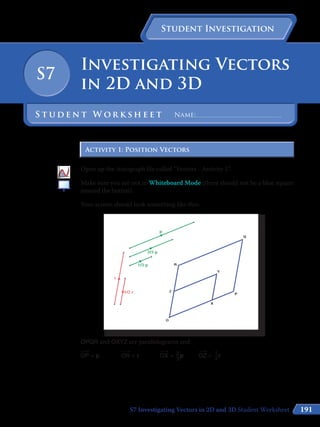
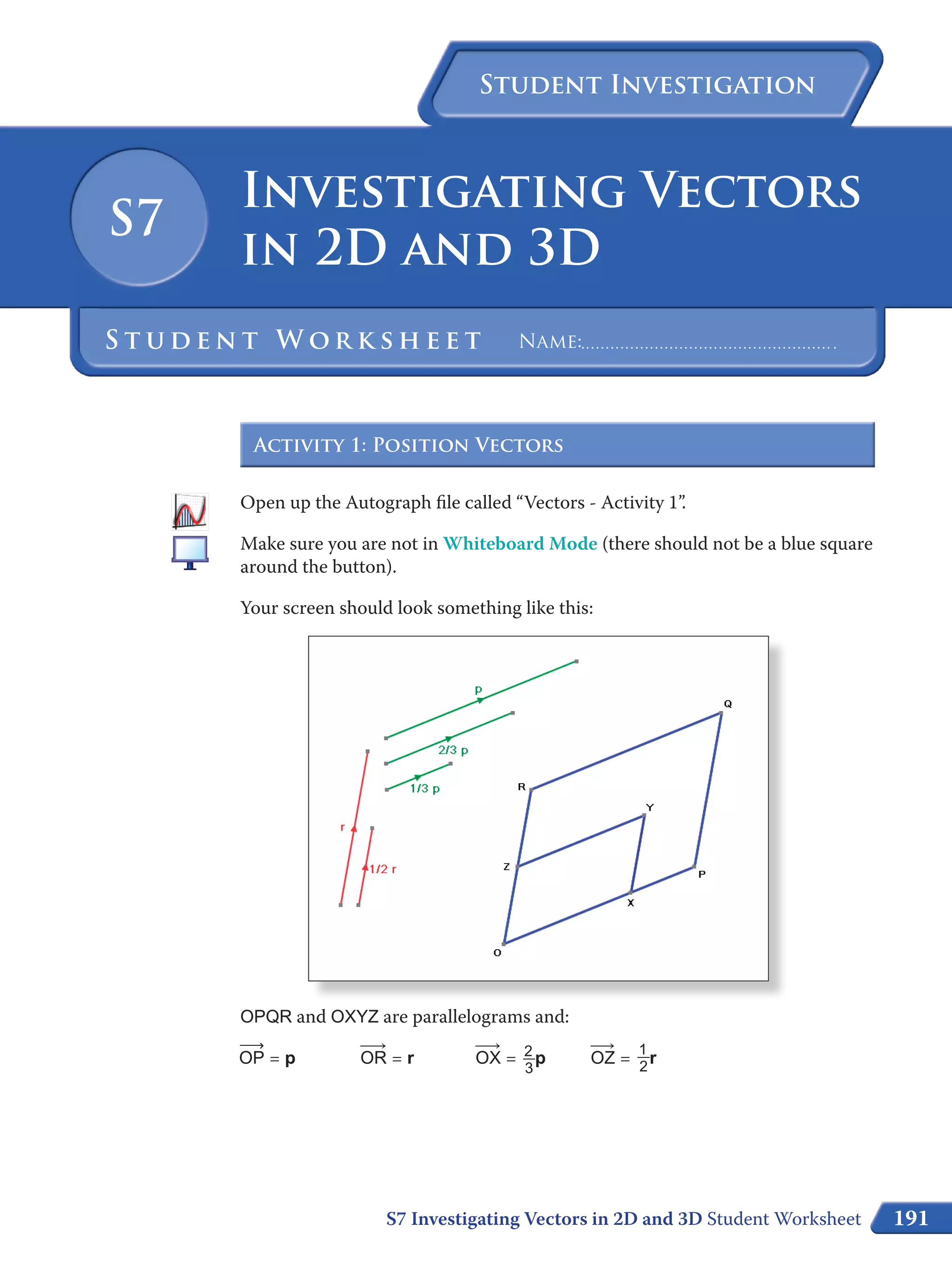
Your screen should look something like this:
OPQR and OXYZ are parallelograms and:
​
​___
 
›
 OP​= p		​
​___
 
›
 OR​= r		​
​___
 
›
 OX​= ​ 2
 __ 
3
 ​p	​
​___
 
›
 OZ​= ​ 
1
 
__
 
2
 ​r
S7 Investigating Vectors in 2D and 3D Student Worksheet
192
Task 1: Express the following vectors in terms of p and r (see below how
Autograph can help you):
1. ​
​___
 
›
 OQ​		 		 6. ​
​___
 
›
 PY​	
2. ​
​___
 
›
 PR​		 		 7. ​
​___
 
›
 YR​	
3. ​
​___
 
›
 OY​		 		 8. ​
​___
 
›
 XQ​	
4. ​
​___
 
›
 XZ​	 		 9. ​
​___
 
›
 XR​	
5. ​
​___
 
›
 RP​		 		 10. ​
​___
 
›
 RX​	
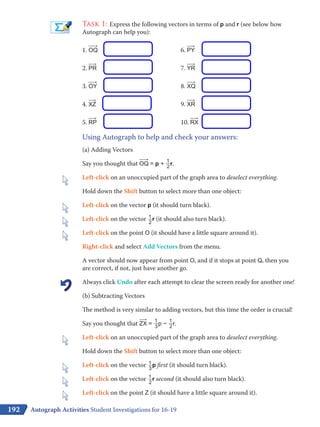
Using Autograph to help and check your answers:
(a) Adding Vectors
Say you thought that ​
​___
 
›
 OQ​= p + ​ 
1
 
__
 
2
 ​r.
Left-click on an unoccupied part of the graph area to deselect everything.
Hold down the Shift button to select more than one object:
Left-click on the vector p (it should turn black).
Left-click on the vector ​ 1
 __ 
2
 ​r (it should also turn black).
Left-click on the point O (it should have a little square around it).
Right-click and select Add Vectors from the menu.
A vector should now appear from point O, and if it stops at point Q, then you
are correct, if not, just have another go.
Always click Undo after each attempt to clear the screen ready for another one!
(b) Subtracting Vectors
The method is very similar to adding vectors, but this time the order is crucial!
Say you thought that ​
​___
 
›
 ZX​= ​ 
1
 
__
 
3
 ​p − ​ 
1
 
__
 
2
 ​r.
Left-click on an unoccupied part of the graph area to deselect everything.
Hold down the Shift button to select more than one object:
Left-click on the vector ​ 1
 __ 
3
 ​p first (it should turn black).
Left-click on the vector ​ 1
 __ 
2
 ​r second (it should also turn black).
Left-click on the point Z (it should have a little square around it).
Autograph Activities Student Investigations for 16-19
193
Right-click and select Subtract Vectors from the menu.
A vector should now appear from point Z, and if it stops at point X, then you
are correct, if not, just have another go.
Task 2: What fraction of the area of parallelogram OPQR is not taken up by
parallelogram OXYZ?
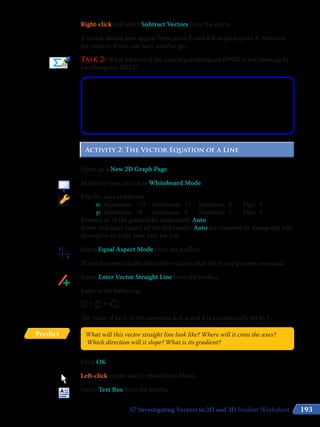
Activity 2: The Vector Equation of a LineActivity 2: The Vector Equation of a Line
Open up a New 2D Graph Page.
Make sure you are not in Whiteboard Mode.
Edit the axes as follows:
x:	 Minimum:	 −17	 Maximum:	 17	 Numbers:	 2	 Pips:	 1
y:	 Minimum:	 −9	 Maximum:	 9	 Numbers:	 1	 Pips:	 1
Remove all of the green ticks underneath Auto.
Note: You must ensure all the ticks under Auto are removed or Autograph will
attempt to re-scale your axes for you.
Select Equal Aspect Mode from the toolbar.
This will automatically adjust the x-axis so that the x- and y-scales are equal.
Select Enter Vector Straight Line from the toolbar.
Enter in the following:
​( x
   y )​= ​( a
   
b )​+ λ​( p
   q )​
The value of each of the constants a, b, p and q is automatically set to 1.
What will this vector straight line look like? Where will it cross the axes?
Which direction will it slope? What is its gradient?
Predict
Click OK.
Left-click on the line (it should turn black).
Select Text Box from the toolbar.
S7 Investigating Vectors in 2D and 3D Student Worksheet
194
Tick the box next to Show Detailed Object Text and click OK.
The Text Box should now display the equation of the vector straight line,
together with the current values of the constants a, b, p and q.
Try to think what effect adjusting the values of each of the four constants
will have on the vector straight line.
Predict
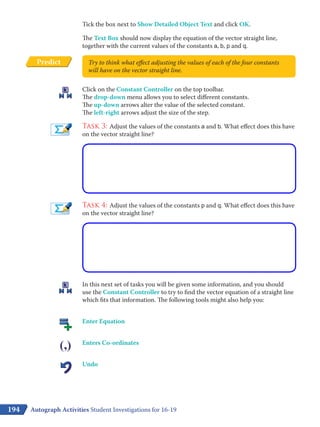
Click on the Constant Controller on the top toolbar.
The drop-down menu allows you to select different constants.
The up-down arrows alter the value of the selected constant.
The left-right arrows adjust the size of the step.
Task 3: Adjust the values of the constants a and b. What effect does this have
on the vector straight line?
Task 4: Adjust the values of the constants p and q. What effect does this have
on the vector straight line?
In this next set of tasks you will be given some information, and you should
use the Constant Controller to try to find the vector equation of a straight line
which fits that information. The following tools might also help you:
Enter Equation
Enters Co-ordinates
Undo
Autograph Activities Student Investigations for 16-19
195
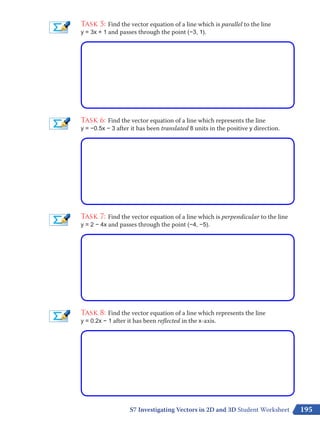
Task 5: Find the vector equation of a line which is parallel to the line
y = 3x + 1 and passes through the point (−3, 1).
Task 6: Find the vector equation of a line which represents the line
y = −0.5x − 3 after it has been translated 8 units in the positive y direction.
Task 7: Find the vector equation of a line which is perpendicular to the line
y = 2 – 4x and passes through the point (−4, −5).
Task 8: Find the vector equation of a line which represents the line
y = 0.2x – 1 after it has been reflected in the x-axis.
S7 Investigating Vectors in 2D and 3D Student Worksheet
196
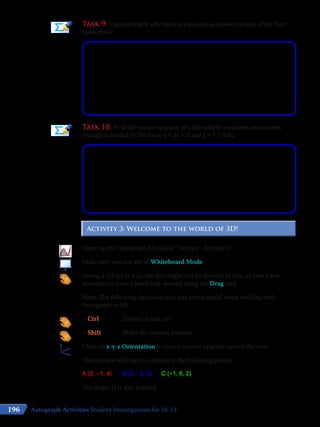
Task 9: Explain briefly why there are no unique answers to any of the four
tasks above.
Task 10: Find the vector equation of a line which completes an isosceles
triangle bounded by the lines: y = 2x + 2 and y = 7 – 0.5x.
Activity 3: Welcome to the world of 3D!Activity 3: Welcome to the world of 3D!
Open up the Autograph file called “Vectors - Activity 3”.
Make sure you not are in Whiteboard Mode.
Seeing a 3D set of axes like this might not be familiar to you, so take a few
moments to have a good look around using the Drag tool.
Note: The following functions may also prove useful when working with
Autograph in 3D:
+ Ctrl			 Zooms in and out
+ Shift			 Shifts the camera position
Click on x-y-z Orientation to return to your original view of the axes.
The triangle ABC has its vertices at the following points:
A (2, −1, 4)	 B (3, −2, 5)	 C (−1, 6, 2)
The origin O is also marked.
Autograph Activities Student Investigations for 16-19
197
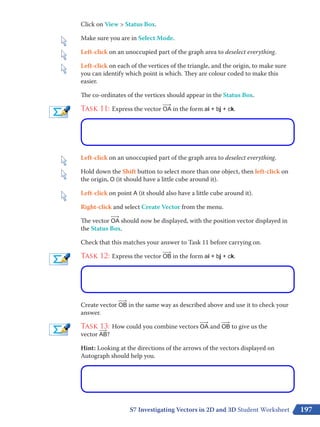
Click on View > Status Box.
Make sure you are in Select Mode.
Left-click on an unoccupied part of the graph area to deselect everything.
Left-click on each of the vertices of the triangle, and the origin, to make sure
you can identify which point is which. They are colour coded to make this
easier.
The co-ordinates of the vertices should appear in the Status Box.
Task 11: Express the vector ​
​___
 
›
 OA​in the form ai + bj + ck.
Left-click on an unoccupied part of the graph area to deselect everything.
Hold down the Shift button to select more than one object, then left-click on
the origin, O (it should have a little cube around it).
Left-click on point A (it should also have a little cube around it).
Right-click and select Create Vector from the menu.
The vector ​
​___
 
›
 OA​should now be displayed, with the position vector displayed in
the Status Box.
Check that this matches your answer to Task 11 before carrying on.
Task 12: Express the vector ​
​___
 
›
 OB​in the form ai + bj + ck.
Create vector ​
​___
 
›
 OB​in the same way as described above and use it to check your
answer.
Task 13: How could you combine vectors ​
​___
 
›
 OA​and ​
​___
 
›
 OB​to give us the
vector ​
​___
 
›
 AB​?
Hint: Looking at the directions of the arrows of the vectors displayed on
Autograph should help you.
S7 Investigating Vectors in 2D and 3D Student Worksheet
198
Task 14: Use your answer to Task 13 to express the vector ​
​___
 
›
 AB​in the form
ai + bj + ck. (Be very careful with your minus signs!)
Checking your answer:
Left-click on an unoccupied part of the graph area to deselect everything.
Hold down the Shift button to select more than one object, then left-click on
point A (it should have a little cube around it).
Right-click and select Vector from the menu.
Write your answer to Task 14 and click OK.
If your answer was correct, the vector ​
​___
 
›
 AB​should now be displayed.
If not, just hit Undo and try again!
Task 15: Use a similar technique (including drawing the relevant vectors in
Autograph) to express the vector ​
​___
 
›
 AC​in the form ai + bj + ck.
Make sure you check and create your answer using the method described
above, as we will need this vector later!
Task 16: Calling vector ​
​___
 
›
 AB​a, and vector ​
​___
 
›
 AC​c, use your answers to Task 14
and Task 15 to find the scalar (or dot) product a.c.
Autograph Activities Student Investigations for 16-19
199
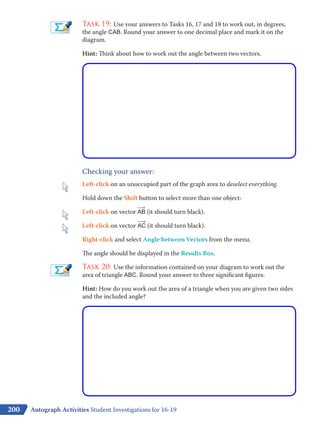
Below is a two-dimensional sketch of triangle ABC which you may find helpful
for the next few tasks:
Task 17: Use your answer to Task 14 to work out the length of the side AB.
Leave your answer as a surd and mark it on the diagram.
Task 18: Use your answer to Task 15 to work out the length of the side AC.
Leave your answer as a surd and mark it on the diagram.
S7 Investigating Vectors in 2D and 3D Student Worksheet
200
Task 19: Use your answers to Tasks 16, 17 and 18 to work out, in degrees,
the angle CAB. Round your answer to one decimal place and mark it on the
diagram.
Hint: Think about how to work out the angle between two vectors.
Checking your answer:
Left-click on an unoccupied part of the graph area to deselect everything.
Hold down the Shift button to select more than one object:
Left-click on vector ​
​___
 
›
 AB​(it should turn black).
Left-click on vector ​
​___
 
›
 AC​(it should turn black).
Right-click and select Angle between Vectors from the menu.
The angle should be displayed in the Results Box.
Task 20: Use the information contained on your diagram to work out the
area of triangle ABC. Round your answer to three significant figures.
Hint: How do you work out the area of a triangle when you are given two sides
and the included angle?
Autograph Activities Student Investigations for 16-19
201
Task 21: Work out the co-ordinates of the mid-point of the line AC.
Task 22: Write the vector equation of a straight line which is parallel to AB,
and which passes through the mid-point of AC.
Checking your answer:
Left-click on an unoccupied part of the graph area to deselect everything.
Hold down the Shift button to select more than one object:
Left-click on point A and then point C (they should have cubes around them).
Right-click and select Mid-Point from the menu.
The mid-point of the line AC should now be displayed.
Select Enter Vector Straight Line from the toolbar.
Enter your answer to Task 22.
A vector straight line should now appear which is parallel to AB and which
passes through the mid-point of AC.
Task 23: What is the vector equation of the x-axis?
Select Enter Vector Straight Line and check your answer.
S7 Investigating Vectors in 2D and 3D Student Worksheet
202
Task 24: Will the line from Task 22 ever cross the x-axis? If so, find the co-
ordinates of intersection. If not, explain how you know algebraically.
SummarySummary
Use the space below to summarise what you have learnt during this
investigation:
Autograph Activities Student Investigations for 16-19

S7 investigating vectors student worksheet (colour)

  • 1.
    191 Student Investigation Investigating Vectors in2D and 3D S7 S t u d e n t W o r k s h e e t Name: Activity 1: Position VectorsActivity 1: Position Vectors Open up the Autograph file called “Vectors - Activity 1”. Make sure you are not in Whiteboard Mode (there should not be a blue square around the button). Your screen should look something like this: OPQR and OXYZ are parallelograms and: ​ ​___   ›  OP​= p ​ ​___   ›  OR​= r ​ ​___   ›  OX​= ​ 2  __  3  ​p ​ ​___   ›  OZ​= ​  1   __   2  ​r S7 Investigating Vectors in 2D and 3D Student Worksheet
  • 2.
    192 Task 1: Expressthe following vectors in terms of p and r (see below how Autograph can help you): 1. ​ ​___   ›  OQ​ 6. ​ ​___   ›  PY​ 2. ​ ​___   ›  PR​ 7. ​ ​___   ›  YR​ 3. ​ ​___   ›  OY​ 8. ​ ​___   ›  XQ​ 4. ​ ​___   ›  XZ​ 9. ​ ​___   ›  XR​ 5. ​ ​___   ›  RP​ 10. ​ ​___   ›  RX​ Using Autograph to help and check your answers: (a) Adding Vectors Say you thought that ​ ​___   ›  OQ​= p + ​  1   __   2  ​r. Left-click on an unoccupied part of the graph area to deselect everything. Hold down the Shift button to select more than one object: Left-click on the vector p (it should turn black). Left-click on the vector ​ 1  __  2  ​r (it should also turn black). Left-click on the point O (it should have a little square around it). Right-click and select Add Vectors from the menu. A vector should now appear from point O, and if it stops at point Q, then you are correct, if not, just have another go. Always click Undo after each attempt to clear the screen ready for another one! (b) Subtracting Vectors The method is very similar to adding vectors, but this time the order is crucial! Say you thought that ​ ​___   ›  ZX​= ​  1   __   3  ​p − ​  1   __   2  ​r. Left-click on an unoccupied part of the graph area to deselect everything. Hold down the Shift button to select more than one object: Left-click on the vector ​ 1  __  3  ​p first (it should turn black). Left-click on the vector ​ 1  __  2  ​r second (it should also turn black). Left-click on the point Z (it should have a little square around it). Autograph Activities Student Investigations for 16-19
  • 3.
    193 Right-click and selectSubtract Vectors from the menu. A vector should now appear from point Z, and if it stops at point X, then you are correct, if not, just have another go. Task 2: What fraction of the area of parallelogram OPQR is not taken up by parallelogram OXYZ? Activity 2: The Vector Equation of a LineActivity 2: The Vector Equation of a Line Open up a New 2D Graph Page. Make sure you are not in Whiteboard Mode. Edit the axes as follows: x: Minimum: −17 Maximum: 17 Numbers: 2 Pips: 1 y: Minimum: −9 Maximum: 9 Numbers: 1 Pips: 1 Remove all of the green ticks underneath Auto. Note: You must ensure all the ticks under Auto are removed or Autograph will attempt to re-scale your axes for you. Select Equal Aspect Mode from the toolbar. This will automatically adjust the x-axis so that the x- and y-scales are equal. Select Enter Vector Straight Line from the toolbar. Enter in the following: ​( x    y )​= ​( a     b )​+ λ​( p    q )​ The value of each of the constants a, b, p and q is automatically set to 1. What will this vector straight line look like? Where will it cross the axes? Which direction will it slope? What is its gradient? Predict Click OK. Left-click on the line (it should turn black). Select Text Box from the toolbar. S7 Investigating Vectors in 2D and 3D Student Worksheet
  • 4.
    194 Tick the boxnext to Show Detailed Object Text and click OK. The Text Box should now display the equation of the vector straight line, together with the current values of the constants a, b, p and q. Try to think what effect adjusting the values of each of the four constants will have on the vector straight line. Predict Click on the Constant Controller on the top toolbar. The drop-down menu allows you to select different constants. The up-down arrows alter the value of the selected constant. The left-right arrows adjust the size of the step. Task 3: Adjust the values of the constants a and b. What effect does this have on the vector straight line? Task 4: Adjust the values of the constants p and q. What effect does this have on the vector straight line? In this next set of tasks you will be given some information, and you should use the Constant Controller to try to find the vector equation of a straight line which fits that information. The following tools might also help you: Enter Equation Enters Co-ordinates Undo Autograph Activities Student Investigations for 16-19
  • 5.
    195 Task 5: Findthe vector equation of a line which is parallel to the line y = 3x + 1 and passes through the point (−3, 1). Task 6: Find the vector equation of a line which represents the line y = −0.5x − 3 after it has been translated 8 units in the positive y direction. Task 7: Find the vector equation of a line which is perpendicular to the line y = 2 – 4x and passes through the point (−4, −5). Task 8: Find the vector equation of a line which represents the line y = 0.2x – 1 after it has been reflected in the x-axis. S7 Investigating Vectors in 2D and 3D Student Worksheet
  • 6.
    196 Task 9: Explainbriefly why there are no unique answers to any of the four tasks above. Task 10: Find the vector equation of a line which completes an isosceles triangle bounded by the lines: y = 2x + 2 and y = 7 – 0.5x. Activity 3: Welcome to the world of 3D!Activity 3: Welcome to the world of 3D! Open up the Autograph file called “Vectors - Activity 3”. Make sure you not are in Whiteboard Mode. Seeing a 3D set of axes like this might not be familiar to you, so take a few moments to have a good look around using the Drag tool. Note: The following functions may also prove useful when working with Autograph in 3D: + Ctrl Zooms in and out + Shift Shifts the camera position Click on x-y-z Orientation to return to your original view of the axes. The triangle ABC has its vertices at the following points: A (2, −1, 4) B (3, −2, 5) C (−1, 6, 2) The origin O is also marked. Autograph Activities Student Investigations for 16-19
  • 7.
    197 Click on View> Status Box. Make sure you are in Select Mode. Left-click on an unoccupied part of the graph area to deselect everything. Left-click on each of the vertices of the triangle, and the origin, to make sure you can identify which point is which. They are colour coded to make this easier. The co-ordinates of the vertices should appear in the Status Box. Task 11: Express the vector ​ ​___   ›  OA​in the form ai + bj + ck. Left-click on an unoccupied part of the graph area to deselect everything. Hold down the Shift button to select more than one object, then left-click on the origin, O (it should have a little cube around it). Left-click on point A (it should also have a little cube around it). Right-click and select Create Vector from the menu. The vector ​ ​___   ›  OA​should now be displayed, with the position vector displayed in the Status Box. Check that this matches your answer to Task 11 before carrying on. Task 12: Express the vector ​ ​___   ›  OB​in the form ai + bj + ck. Create vector ​ ​___   ›  OB​in the same way as described above and use it to check your answer. Task 13: How could you combine vectors ​ ​___   ›  OA​and ​ ​___   ›  OB​to give us the vector ​ ​___   ›  AB​? Hint: Looking at the directions of the arrows of the vectors displayed on Autograph should help you. S7 Investigating Vectors in 2D and 3D Student Worksheet
  • 8.
    198 Task 14: Useyour answer to Task 13 to express the vector ​ ​___   ›  AB​in the form ai + bj + ck. (Be very careful with your minus signs!) Checking your answer: Left-click on an unoccupied part of the graph area to deselect everything. Hold down the Shift button to select more than one object, then left-click on point A (it should have a little cube around it). Right-click and select Vector from the menu. Write your answer to Task 14 and click OK. If your answer was correct, the vector ​ ​___   ›  AB​should now be displayed. If not, just hit Undo and try again! Task 15: Use a similar technique (including drawing the relevant vectors in Autograph) to express the vector ​ ​___   ›  AC​in the form ai + bj + ck. Make sure you check and create your answer using the method described above, as we will need this vector later! Task 16: Calling vector ​ ​___   ›  AB​a, and vector ​ ​___   ›  AC​c, use your answers to Task 14 and Task 15 to find the scalar (or dot) product a.c. Autograph Activities Student Investigations for 16-19
  • 9.
    199 Below is atwo-dimensional sketch of triangle ABC which you may find helpful for the next few tasks: Task 17: Use your answer to Task 14 to work out the length of the side AB. Leave your answer as a surd and mark it on the diagram. Task 18: Use your answer to Task 15 to work out the length of the side AC. Leave your answer as a surd and mark it on the diagram. S7 Investigating Vectors in 2D and 3D Student Worksheet
  • 10.
    200 Task 19: Useyour answers to Tasks 16, 17 and 18 to work out, in degrees, the angle CAB. Round your answer to one decimal place and mark it on the diagram. Hint: Think about how to work out the angle between two vectors. Checking your answer: Left-click on an unoccupied part of the graph area to deselect everything. Hold down the Shift button to select more than one object: Left-click on vector ​ ​___   ›  AB​(it should turn black). Left-click on vector ​ ​___   ›  AC​(it should turn black). Right-click and select Angle between Vectors from the menu. The angle should be displayed in the Results Box. Task 20: Use the information contained on your diagram to work out the area of triangle ABC. Round your answer to three significant figures. Hint: How do you work out the area of a triangle when you are given two sides and the included angle? Autograph Activities Student Investigations for 16-19
  • 11.
    201 Task 21: Workout the co-ordinates of the mid-point of the line AC. Task 22: Write the vector equation of a straight line which is parallel to AB, and which passes through the mid-point of AC. Checking your answer: Left-click on an unoccupied part of the graph area to deselect everything. Hold down the Shift button to select more than one object: Left-click on point A and then point C (they should have cubes around them). Right-click and select Mid-Point from the menu. The mid-point of the line AC should now be displayed. Select Enter Vector Straight Line from the toolbar. Enter your answer to Task 22. A vector straight line should now appear which is parallel to AB and which passes through the mid-point of AC. Task 23: What is the vector equation of the x-axis? Select Enter Vector Straight Line and check your answer. S7 Investigating Vectors in 2D and 3D Student Worksheet
  • 12.
    202 Task 24: Willthe line from Task 22 ever cross the x-axis? If so, find the co- ordinates of intersection. If not, explain how you know algebraically. SummarySummary Use the space below to summarise what you have learnt during this investigation: Autograph Activities Student Investigations for 16-19