Contents
Functions and Coordinates
Parameters of linear equations
Quadratic polynomials
Functions and Coordinates
Creating new objects
You can create new objects
(e.g. points, lines, functions)
by either using the Graphics
Tools provided in the Toolbar,
or by entering their equations
and coordinates into the Input
Bar.
Task
• Enter the following
equations and
coordinates into the Input
Bar to graph functions
and points.
Creating new objects
1. Enter the equation
y = 3x + 1 into the
Input Bar and press
the Enter key.
2. Enter the function
g(x) = x² + 2 into the
Input Bar and press
the Enter key.
Creating new objects
3. Enter B = (2, 1) into
the Input Bar and
press Enter to create a
new point. Create
another new point C =
(-1, 3).
Creating new objects
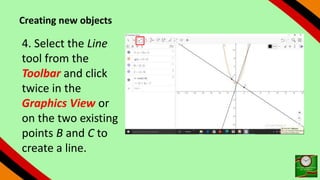
4. Select the Line
tool from the
Toolbar and click
twice in the
Graphics View or
on the two existing
points B and C to
create a line.
Virtual Keyboard
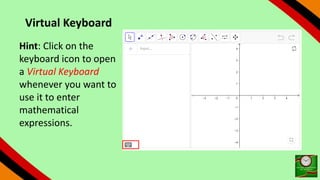
Hint: Click on the
keyboard icon to open
a Virtual Keyboard
whenever you want to
use it to enter
mathematical
expressions.
Modifying existing objects
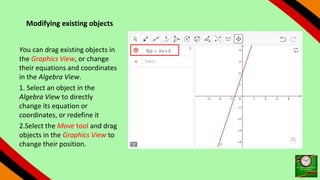
You can drag existing objects in
the Graphics View, or change
their equations and coordinates
in the Algebra View.
1. Select an object in the
Algebra View to directly
change its equation or
coordinates, or redefine it
2.Select the Move tool and drag
objects in the Graphics View to
change their position.
Deleting objects
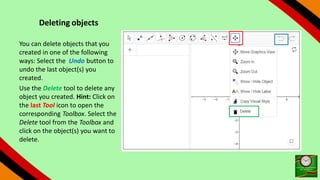
You can delete objects that you
created in one of the following
ways: Select the Undo button to
undo the last object(s) you
created.
Use the Delete tool to delete any
object you created. Hint: Click on
the last Tool icon to open the
corresponding Toolbox. Select the
Delete tool from the Toolbox and
click on the object(s) you want to
delete.
Parameters of linear equations
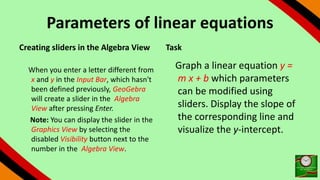
Creating sliders in the Algebra View
When you enter a letter different from
x and y in the Input Bar, which hasn't
been defined previously, GeoGebra
will create a slider in the Algebra
View after pressing Enter.
Note: You can display the slider in the
Graphics View by selecting the
disabled Visibility button next to the
number in the Algebra View.
Task
Graph a linear equation y =
m x + b which parameters
can be modified using
sliders. Display the slope of
the corresponding line and
visualize the y-intercept.
Creating sliders in the Algebra
View
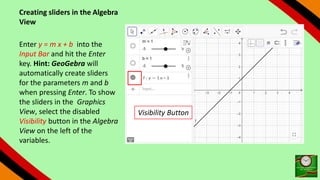
Enter y = m x + b into the
Input Bar and hit the Enter
key. Hint: GeoGebra will
automatically create sliders
for the parameters m and b
when pressing Enter. To show
the sliders in the Graphics
View, select the disabled
Visibility button in the Algebra
View on the left of the
variables.
Visibility Button
Creating sliders in the
Algebra View
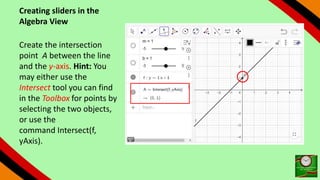
Create the intersection
point A between the line
and the y-axis. Hint: You
may either use the
Intersect tool you can find
in the Toolbox for points by
selecting the two objects,
or use the
command Intersect(f,
yAxis).
Creating sliders in the Algebra
View
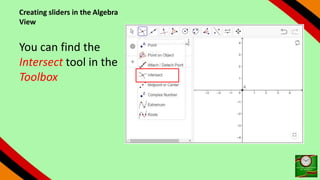
You can find the
Intersect tool in the
Toolbox
Creating sliders in the Algebra
View
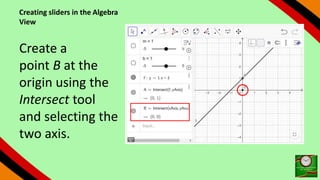
Create a
point B at the
origin using the
Intersect tool
and selecting the
two axis.
Creating sliders in the Algebra
View
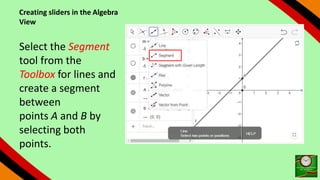
Select the Segment
tool from the
Toolbox for lines and
create a segment
between
points A and B by
selecting both
points.
Creating sliders in the Algebra
View
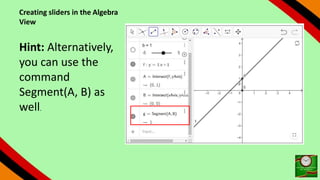
Hint: Alternatively,
you can use the
command
Segment(A, B) as
well.
Creating sliders in the Algebra
View
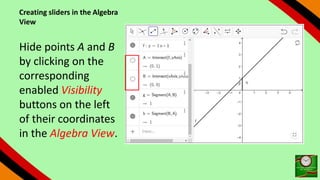
Hide points A and B
by clicking on the
corresponding
enabled Visibility
buttons on the left
of their coordinates
in the Algebra View.
Creating sliders in the
Algebra View
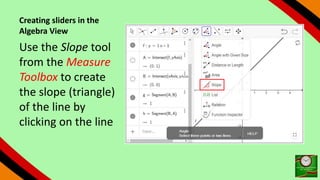
Use the Slope tool
from the Measure
Toolbox to create
the slope (triangle)
of the line by
clicking on the line
Creating sliders in the
Algebra View
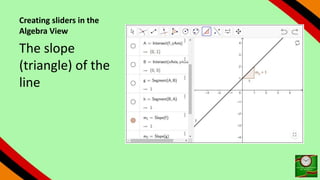
The slope
(triangle) of the
line
Creating sliders in the
Algebra View
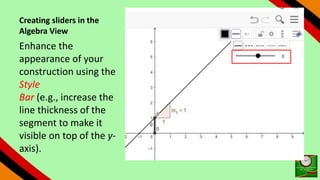
Enhance the
appearance of your
construction using the
Style
Bar (e.g., increase the
line thickness of the
segment to make it
visible on top of the y-
axis).
Change a slider's position in the Graphics View
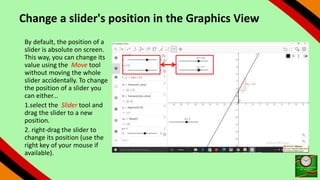
By default, the position of a
slider is absolute on screen.
This way, you can change its
value using the Move tool
without moving the whole
slider accidentally. To change
the position of a slider you
can either...
1.select the Slider tool and
drag the slider to a new
position.
2. right-drag the slider to
change its position (use the
right key of your mouse if
available).
Quadratic polynomials
Task
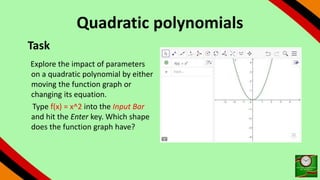
Explore the impact of parameters
on a quadratic polynomial by either
moving the function graph or
changing its equation.
Type f(x) = x^2 into the Input Bar
and hit the Enter key. Which shape
does the function graph have?
Quadratic polynomials
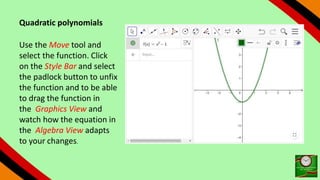
Use the Move tool and
select the function. Click
on the Style Bar and select
the padlock button to unfix
the function and to be able
to drag the function in
the Graphics View and
watch how the equation in
the Algebra View adapts
to your changes.
Quadratic polynomials
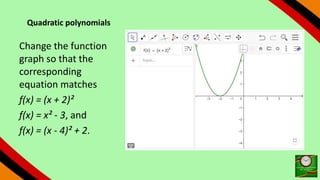
Change the function
graph so that the
corresponding
equation matches
f(x) = (x + 2)²
f(x) = x² - 3, and
f(x) = (x - 4)² + 2.
Quadratic polynomials
Task
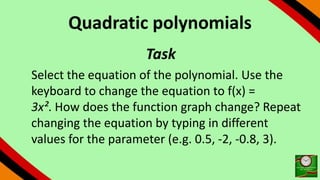
Select the equation of the polynomial. Use the
keyboard to change the equation to f(x) =
3x². How does the function graph change? Repeat
changing the equation by typing in different
values for the parameter (e.g. 0.5, -2, -0.8, 3).
Parameters of a polynomial
Task
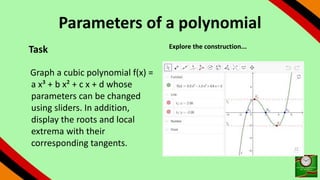
Graph a cubic polynomial f(x) =
a x³ + b x² + c x + d whose
parameters can be changed
using sliders. In addition,
display the roots and local
extrema with their
corresponding tangents.
Explore the construction...
Do It Yourself
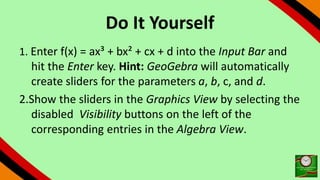
1. Enter f(x) = ax³ + bx² + cx + d into the Input Bar and
hit the Enter key. Hint: GeoGebra will automatically
create sliders for the parameters a, b, c, and d.
2.Show the sliders in the Graphics View by selecting the
disabled Visibility buttons on the left of the
corresponding entries in the Algebra View.
Do It Yourself
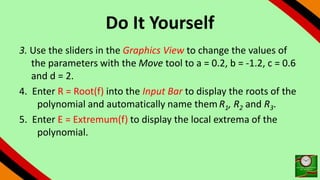
3. Use the sliders in the Graphics View to change the values of
the parameters with the Move tool to a = 0.2, b = -1.2, c = 0.6
and d = 2.
4. Enter R = Root(f) into the Input Bar to display the roots of the
polynomial and automatically name themR1, R2 and R3.
5. Enter E = Extremum(f) to display the local extrema of the
polynomial.
Do It Yourself
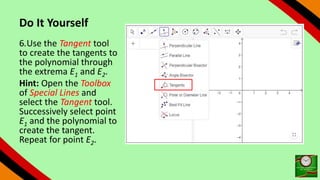
6.Use the Tangent tool
to create the tangents to
the polynomial through
the extrema E1 and E2.
Hint: Open the Toolbox
of Special Lines and
select the Tangent tool.
Successively select point
E1 and the polynomial to
create the tangent.
Repeat for point E2.
Do It Yourself
7.Systematically change the values of the sliders using
the Move tool to explore how the parameters affect
the polynomial.
END
NEXT TOPIC:
continue…

GeoGebra 3

  • 2.
    Contents Functions and Coordinates Parametersof linear equations Quadratic polynomials
  • 3.
    Functions and Coordinates Creatingnew objects You can create new objects (e.g. points, lines, functions) by either using the Graphics Tools provided in the Toolbar, or by entering their equations and coordinates into the Input Bar. Task • Enter the following equations and coordinates into the Input Bar to graph functions and points.
  • 4.
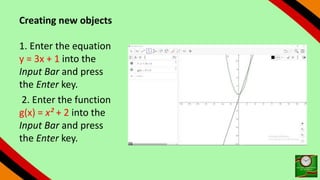
    Creating new objects 1.Enter the equation y = 3x + 1 into the Input Bar and press the Enter key. 2. Enter the function g(x) = x² + 2 into the Input Bar and press the Enter key.
  • 5.
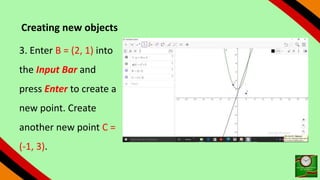
    Creating new objects 3.Enter B = (2, 1) into the Input Bar and press Enter to create a new point. Create another new point C = (-1, 3).
  • 6.
    Creating new objects 4.Select the Line tool from the Toolbar and click twice in the Graphics View or on the two existing points B and C to create a line.
  • 7.
    Virtual Keyboard Hint: Clickon the keyboard icon to open a Virtual Keyboard whenever you want to use it to enter mathematical expressions.
  • 8.
    Modifying existing objects Youcan drag existing objects in the Graphics View, or change their equations and coordinates in the Algebra View. 1. Select an object in the Algebra View to directly change its equation or coordinates, or redefine it 2.Select the Move tool and drag objects in the Graphics View to change their position.
  • 9.
    Deleting objects You candelete objects that you created in one of the following ways: Select the Undo button to undo the last object(s) you created. Use the Delete tool to delete any object you created. Hint: Click on the last Tool icon to open the corresponding Toolbox. Select the Delete tool from the Toolbox and click on the object(s) you want to delete.
  • 10.
    Parameters of linearequations Creating sliders in the Algebra View When you enter a letter different from x and y in the Input Bar, which hasn't been defined previously, GeoGebra will create a slider in the Algebra View after pressing Enter. Note: You can display the slider in the Graphics View by selecting the disabled Visibility button next to the number in the Algebra View. Task Graph a linear equation y = m x + b which parameters can be modified using sliders. Display the slope of the corresponding line and visualize the y-intercept.
  • 11.
    Creating sliders inthe Algebra View Enter y = m x + b into the Input Bar and hit the Enter key. Hint: GeoGebra will automatically create sliders for the parameters m and b when pressing Enter. To show the sliders in the Graphics View, select the disabled Visibility button in the Algebra View on the left of the variables. Visibility Button
  • 12.
    Creating sliders inthe Algebra View Create the intersection point A between the line and the y-axis. Hint: You may either use the Intersect tool you can find in the Toolbox for points by selecting the two objects, or use the command Intersect(f, yAxis).
  • 13.
    Creating sliders inthe Algebra View You can find the Intersect tool in the Toolbox
  • 14.
    Creating sliders inthe Algebra View Create a point B at the origin using the Intersect tool and selecting the two axis.
  • 15.
    Creating sliders inthe Algebra View Select the Segment tool from the Toolbox for lines and create a segment between points A and B by selecting both points.
  • 16.
    Creating sliders inthe Algebra View Hint: Alternatively, you can use the command Segment(A, B) as well.
  • 17.
    Creating sliders inthe Algebra View Hide points A and B by clicking on the corresponding enabled Visibility buttons on the left of their coordinates in the Algebra View.
  • 18.
    Creating sliders inthe Algebra View Use the Slope tool from the Measure Toolbox to create the slope (triangle) of the line by clicking on the line
  • 19.
    Creating sliders inthe Algebra View The slope (triangle) of the line
  • 20.
    Creating sliders inthe Algebra View Enhance the appearance of your construction using the Style Bar (e.g., increase the line thickness of the segment to make it visible on top of the y- axis).
  • 21.
    Change a slider'sposition in the Graphics View By default, the position of a slider is absolute on screen. This way, you can change its value using the Move tool without moving the whole slider accidentally. To change the position of a slider you can either... 1.select the Slider tool and drag the slider to a new position. 2. right-drag the slider to change its position (use the right key of your mouse if available).
  • 22.
    Quadratic polynomials Task Explore theimpact of parameters on a quadratic polynomial by either moving the function graph or changing its equation. Type f(x) = x^2 into the Input Bar and hit the Enter key. Which shape does the function graph have?
  • 23.
    Quadratic polynomials Use theMove tool and select the function. Click on the Style Bar and select the padlock button to unfix the function and to be able to drag the function in the Graphics View and watch how the equation in the Algebra View adapts to your changes.
  • 24.
    Quadratic polynomials Change thefunction graph so that the corresponding equation matches f(x) = (x + 2)² f(x) = x² - 3, and f(x) = (x - 4)² + 2.
  • 25.
    Quadratic polynomials Task Select theequation of the polynomial. Use the keyboard to change the equation to f(x) = 3x². How does the function graph change? Repeat changing the equation by typing in different values for the parameter (e.g. 0.5, -2, -0.8, 3).
  • 26.
    Parameters of apolynomial Task Graph a cubic polynomial f(x) = a x³ + b x² + c x + d whose parameters can be changed using sliders. In addition, display the roots and local extrema with their corresponding tangents. Explore the construction...
  • 27.
    Do It Yourself 1.Enter f(x) = ax³ + bx² + cx + d into the Input Bar and hit the Enter key. Hint: GeoGebra will automatically create sliders for the parameters a, b, c, and d. 2.Show the sliders in the Graphics View by selecting the disabled Visibility buttons on the left of the corresponding entries in the Algebra View.
  • 28.
    Do It Yourself 3.Use the sliders in the Graphics View to change the values of the parameters with the Move tool to a = 0.2, b = -1.2, c = 0.6 and d = 2. 4. Enter R = Root(f) into the Input Bar to display the roots of the polynomial and automatically name themR1, R2 and R3. 5. Enter E = Extremum(f) to display the local extrema of the polynomial.
  • 29.
    Do It Yourself 6.Usethe Tangent tool to create the tangents to the polynomial through the extrema E1 and E2. Hint: Open the Toolbox of Special Lines and select the Tangent tool. Successively select point E1 and the polynomial to create the tangent. Repeat for point E2.
  • 30.
    Do It Yourself 7.Systematicallychange the values of the sliders using the Move tool to explore how the parameters affect the polynomial.
  • 31.