Contents
Derivation of Sine
Tracing the Graphs of Trigonometric
Functions
Derivation of Sine
Task
Create an applet with the sine function and graph its
derivative through the slope of the tangent in each point.
Applet with the
sine function
Enter the function
f(x) = sin(x)
Applet with the
sine function
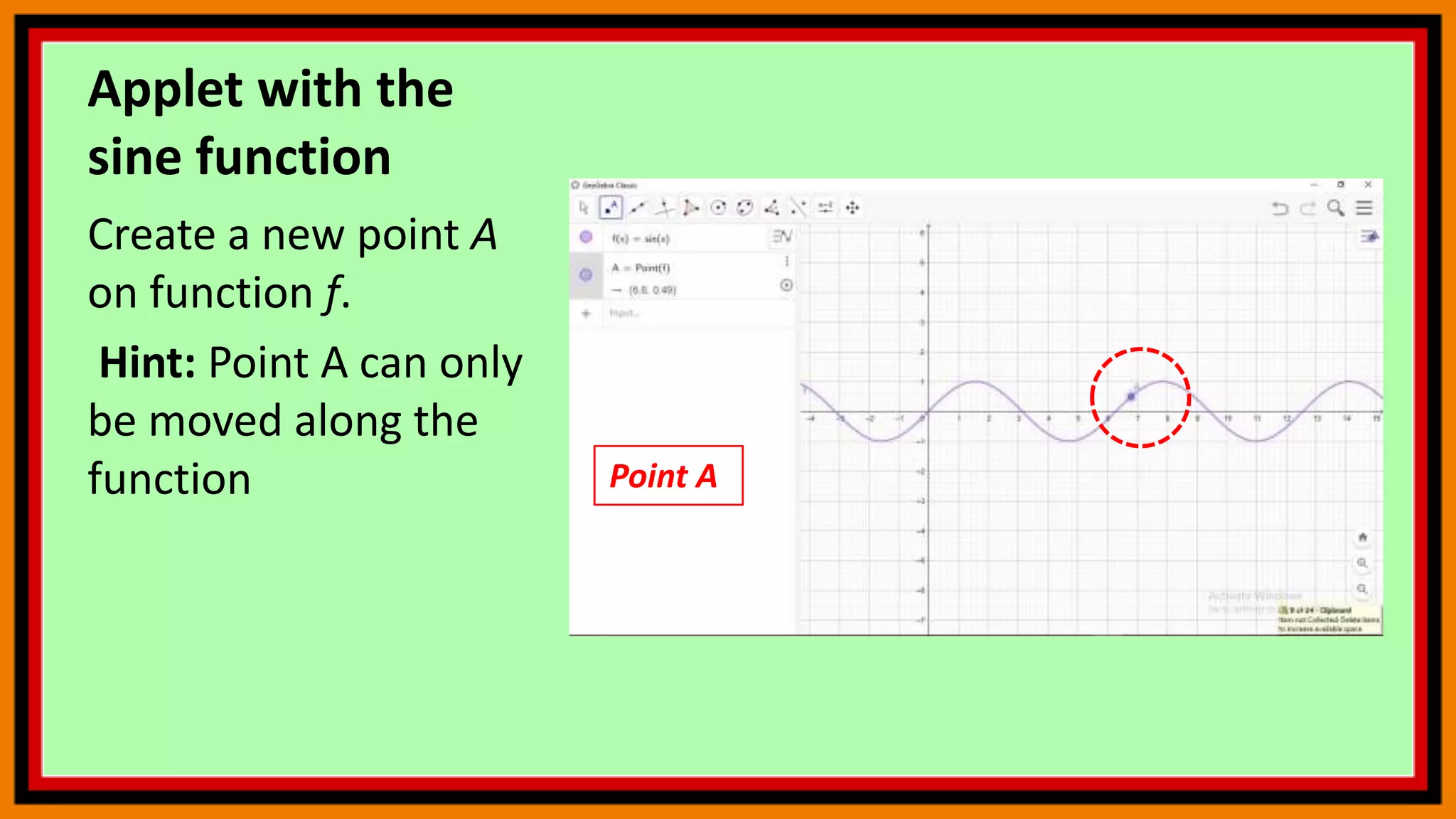
Create a new point A
on function f.
Hint: Point A can only
be moved along the
function Point A
Applet with the
sine function
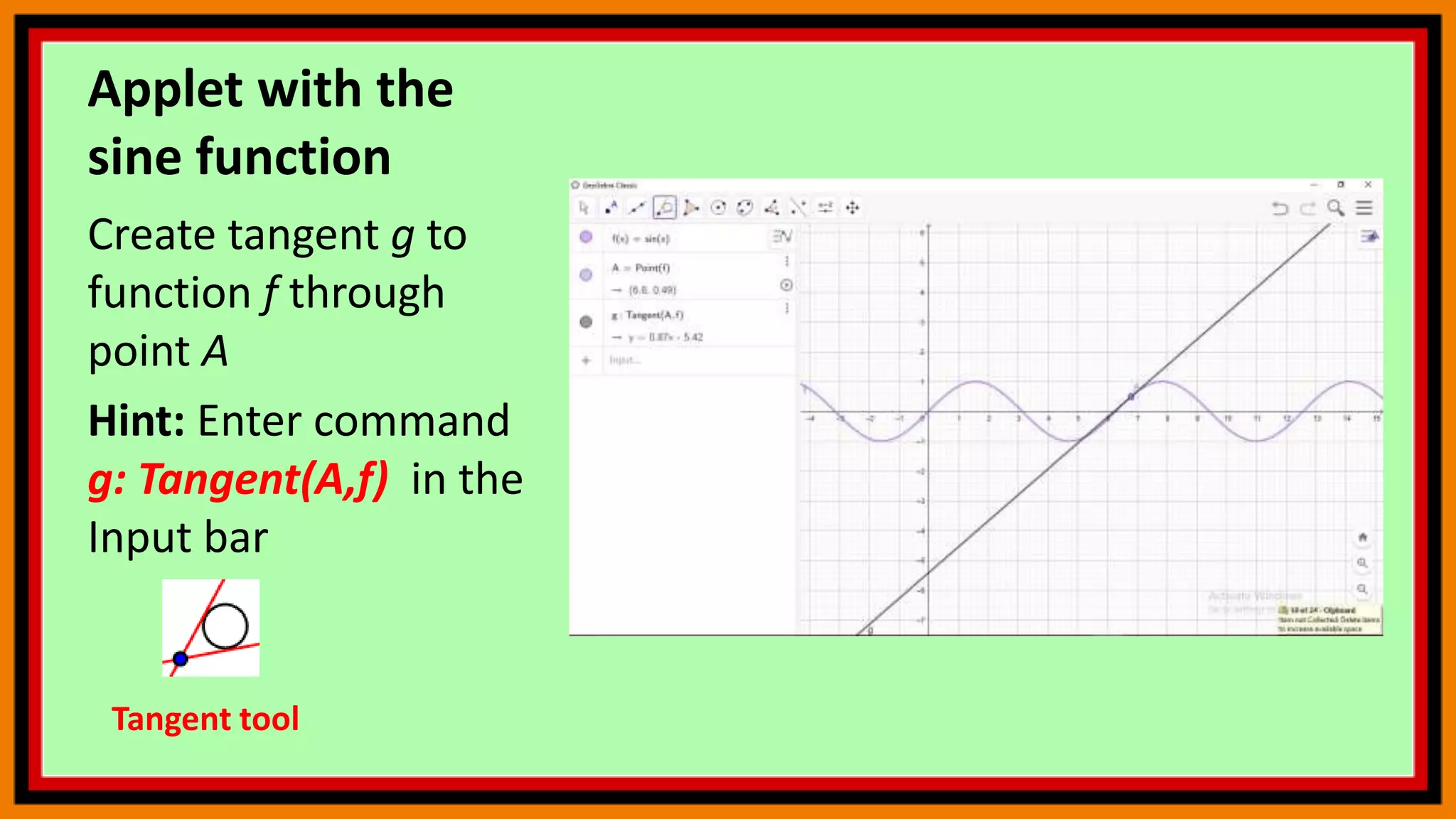
Create tangent g to
function f through
point A
Hint: Enter command
g: Tangent(A,f) in the
Input bar
Tangent tool
Applet with the
sine function
Create the slope of
tangent g using the
Slope tool
Slope tool
Applet with the
sine function
Define point
S = (x(A), m).
Hint: x(A) gives you
the x-coordinate of
point A
Applet with the
sine function
Connect points A and
S using a segment
Segment tool
Applet with the
sine function
Turn on the trace of
point S.
Hint: Right-click point
S (MacOS: Ctrl-click,
tablet: long click) and
select Show Trace
Applet with the
sine function
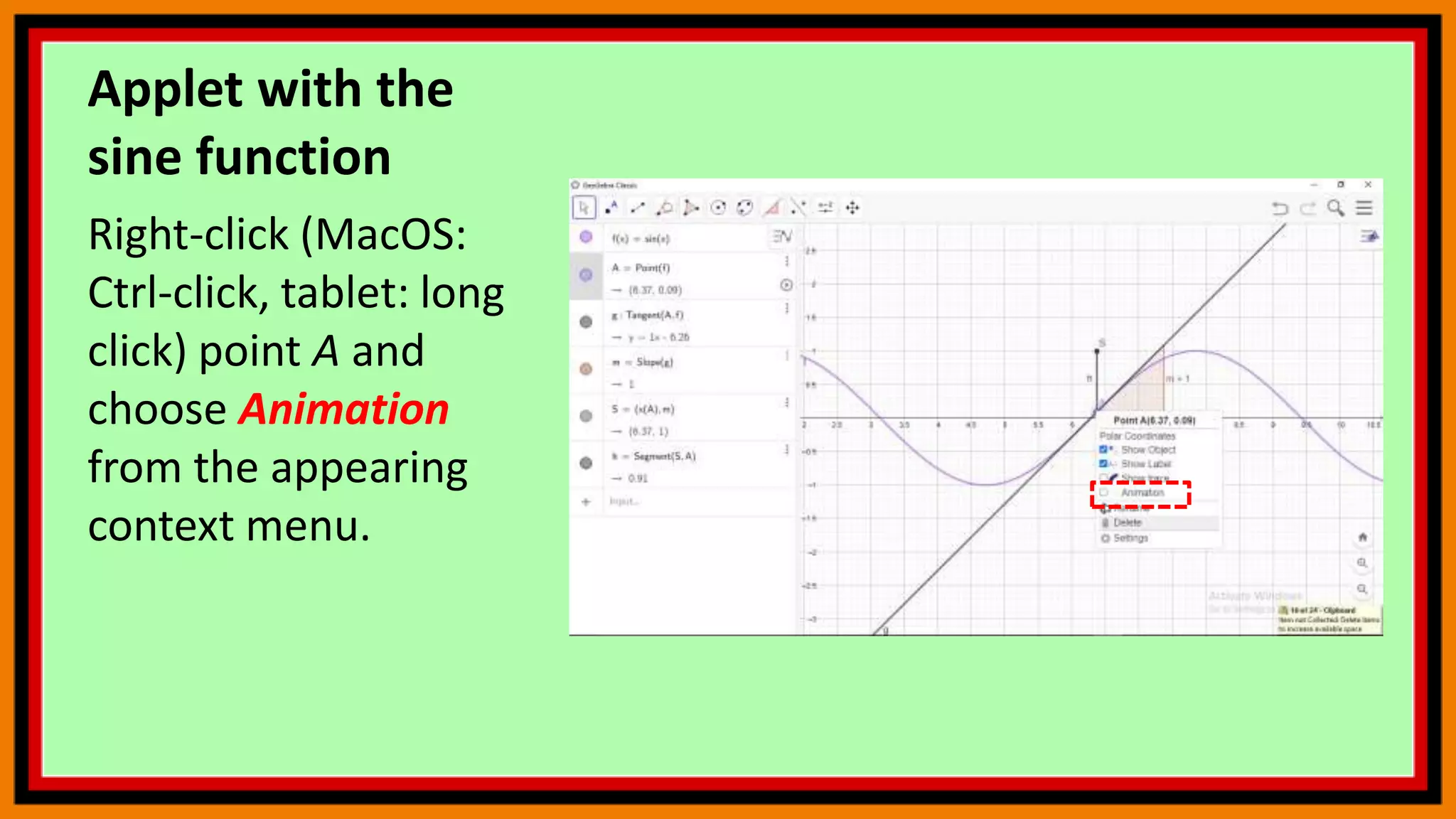
Right-click (MacOS:
Ctrl-click, tablet: long
click) point A and
choose Animation
from the appearing
context menu.
Applet with the
sine function
Hint: An Animation
button appears in the
lower left corner of
the Graphics View. It
allows you to either
pause or continue an
animation
Applet with the
sine function
Right-Click on the
Graphics View and
Select Graphics... .
Applet with the
sine function
Select tab xAxis and
change the unit to 
Tracing the Graphs of Trigonometric Functions
Just like in the previous tutorial, in this tutorial, we use
the Input bar to create mathematical objects particularly a
circle, an arc, and a point that traces the sine and cosine
function. In doing the tutorial, we learn the following:
 use the GeoGebra keyboard commands to construct various
geometric objects
 use the GeoGebra trace function
 change the interval of the x-axis
Open GeoGebra and
be sure the Algebra &
Graphics view is
displayed
(Perspectives menu).
To create point A at
the origin, type A =
(0,0) in the Input
bar and press the
ENTER key on your
keyboard
Next, to construct a
circle with
center A and radius 1,
type circle[A,1] in
the Input Bar and
press the ENTER key
on your keyboard
We fix point A to
prevent it from being
accidentally moved. To
fix the position of
point A, right click on
point A, and then
click Object Properties
from the context
menu.
This will display
the Preferences dialog
box.
In Basic tab of
the Preferences dialog
box, click the Fix
Object check box to
check it, then close
the window
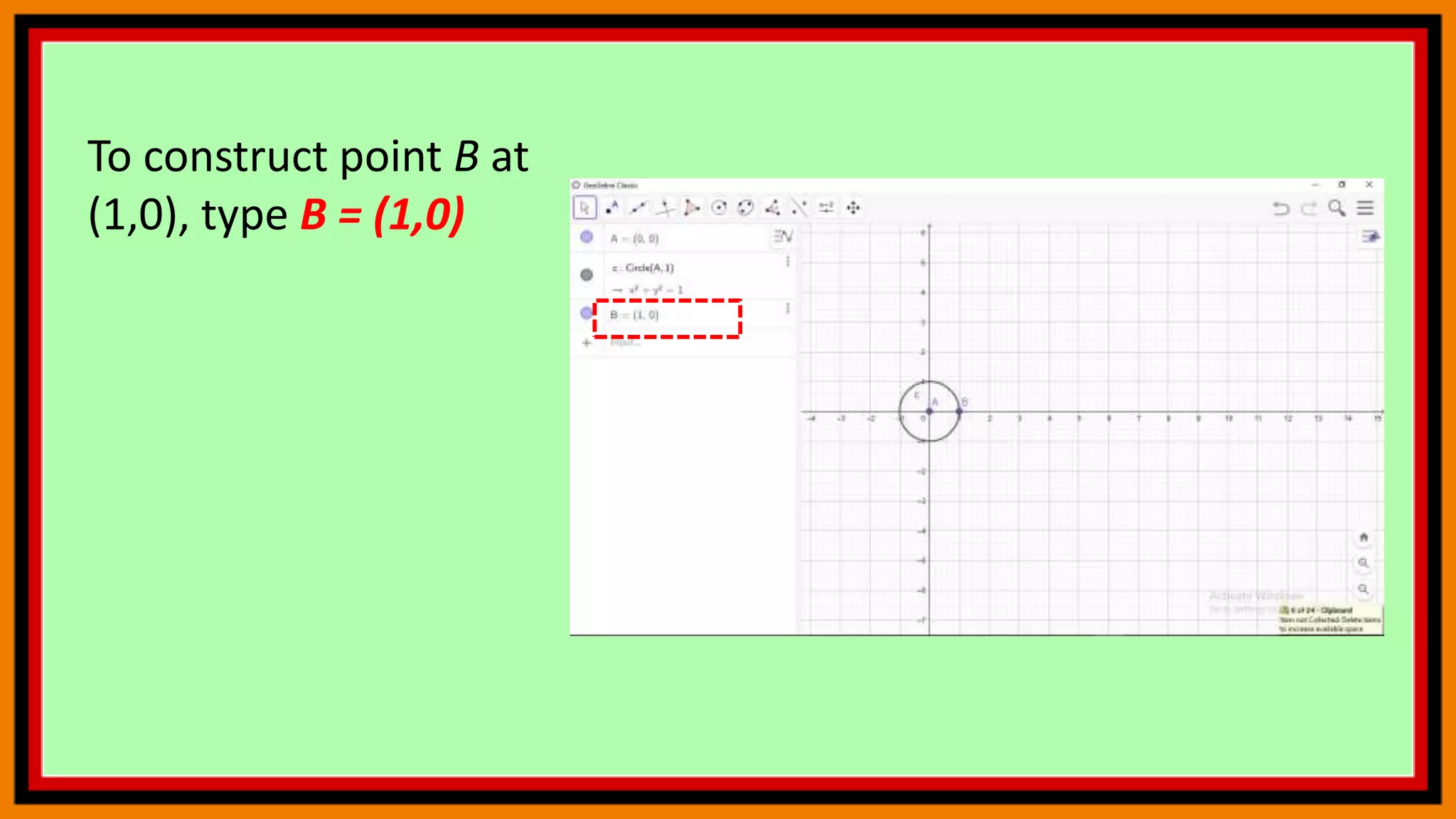
To construct point B at
(1,0), type B = (1,0)
Fix the location of
point B
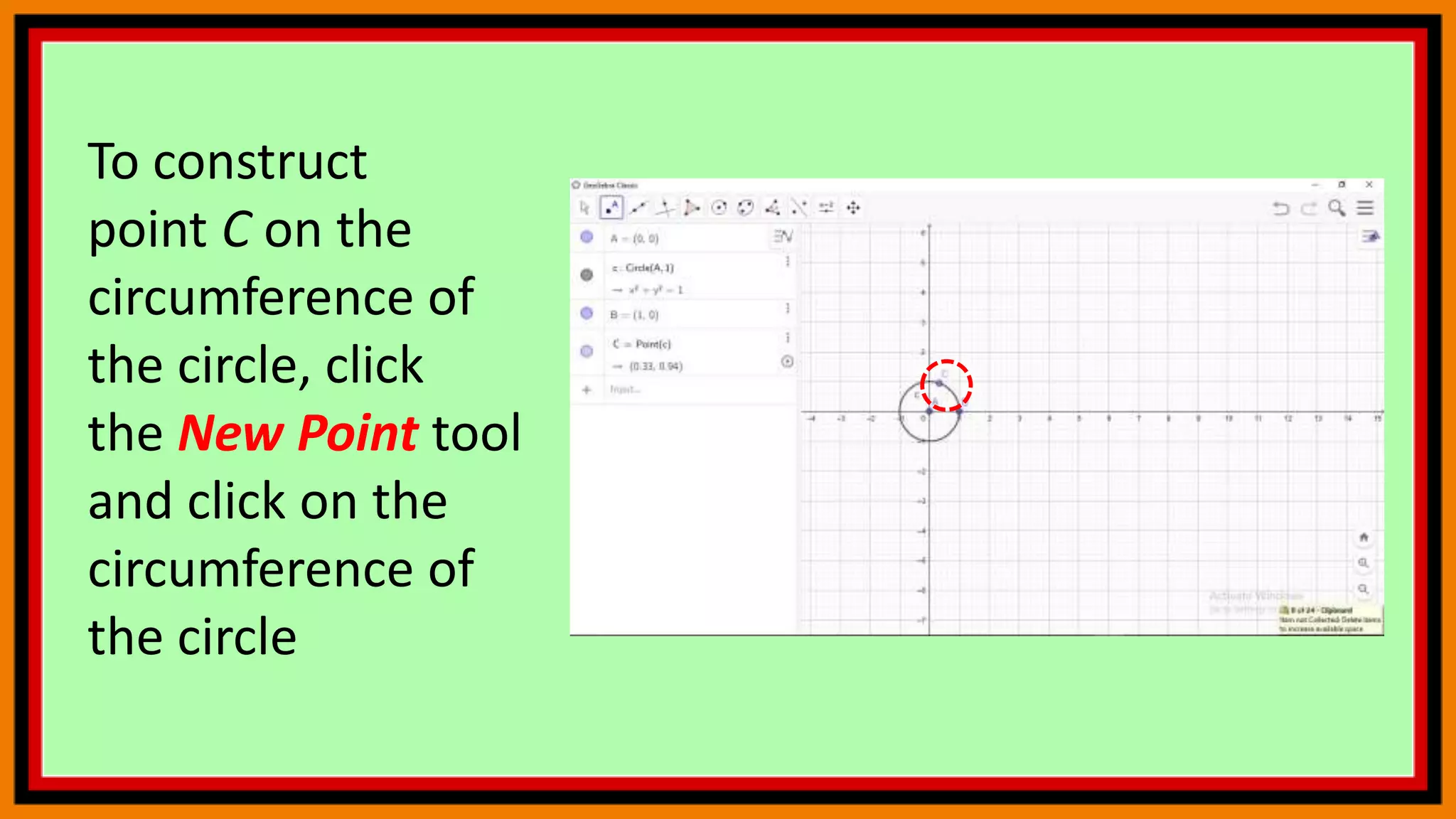
To construct
point C on the
circumference of
the circle, click
the New Point tool
and click on the
circumference of
the circle
We now change the
interval of the x-axis
from 1 to π/2. To do
this, right
click Graphics from
the context menu
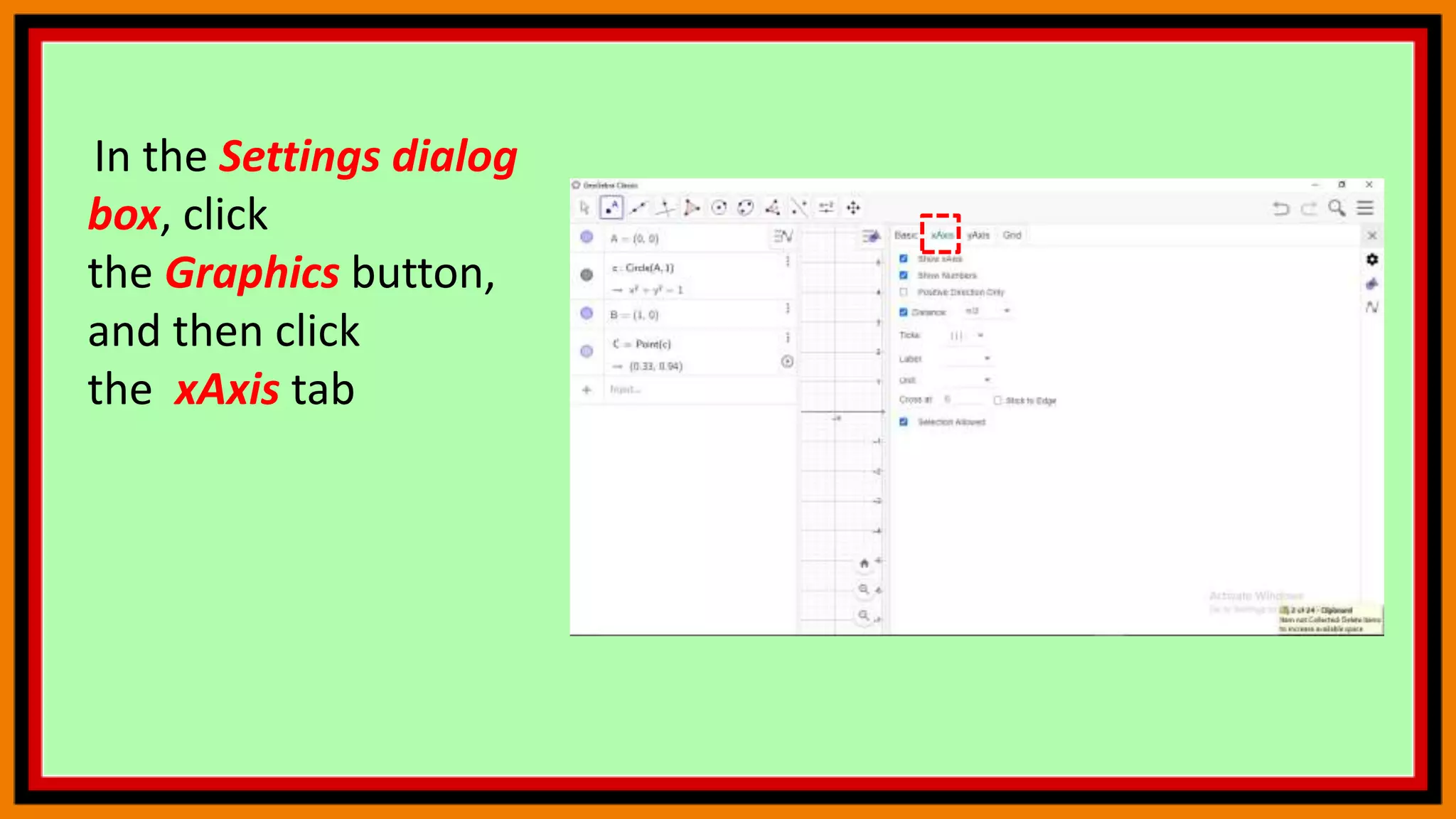
In the Settings dialog
box, click
the Graphics button,
and then click
the xAxis tab
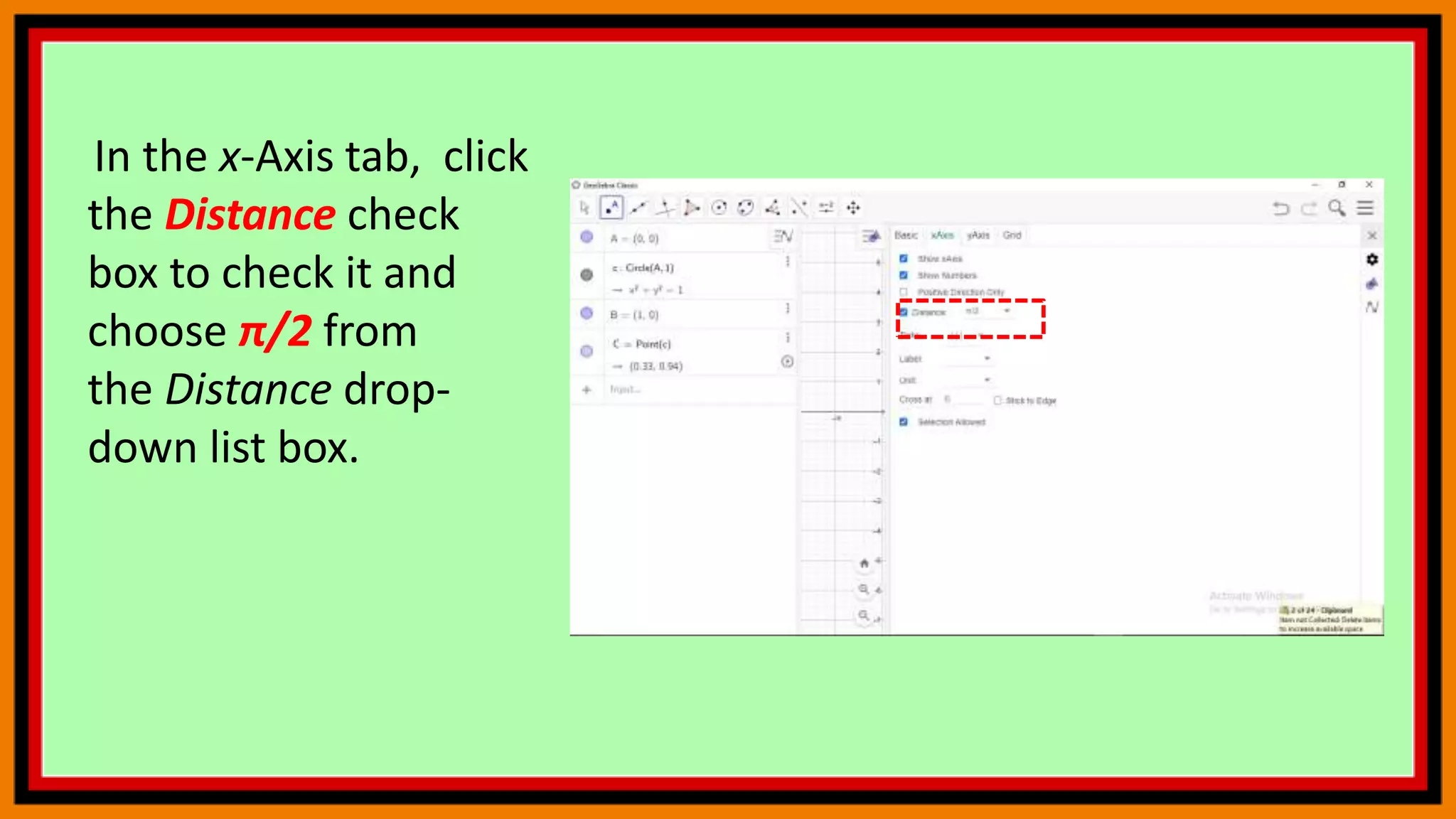
In the x-Axis tab, click
the Distance check
box to check it and
choose π/2 from
the Distance drop-
down list box.
Now we create
arc BC of circle with
center A starting
from B and going
counterclockwise
to C. To do this, type
circularArc[A, B, C]
Right click the
arc BC, then
click Object Properties
to display
the Preferences
window.
In the Preferences
window, choose
the Basic tab.
Be sure that the Show
label check box is
checked and
choose Value from the
drop-down list box.
This will display the
length of arc BC
Next, we change the
color of the arc to
make it visible. Click
the Color tab and
choose red (or any
color you want except
black) from the color
palette
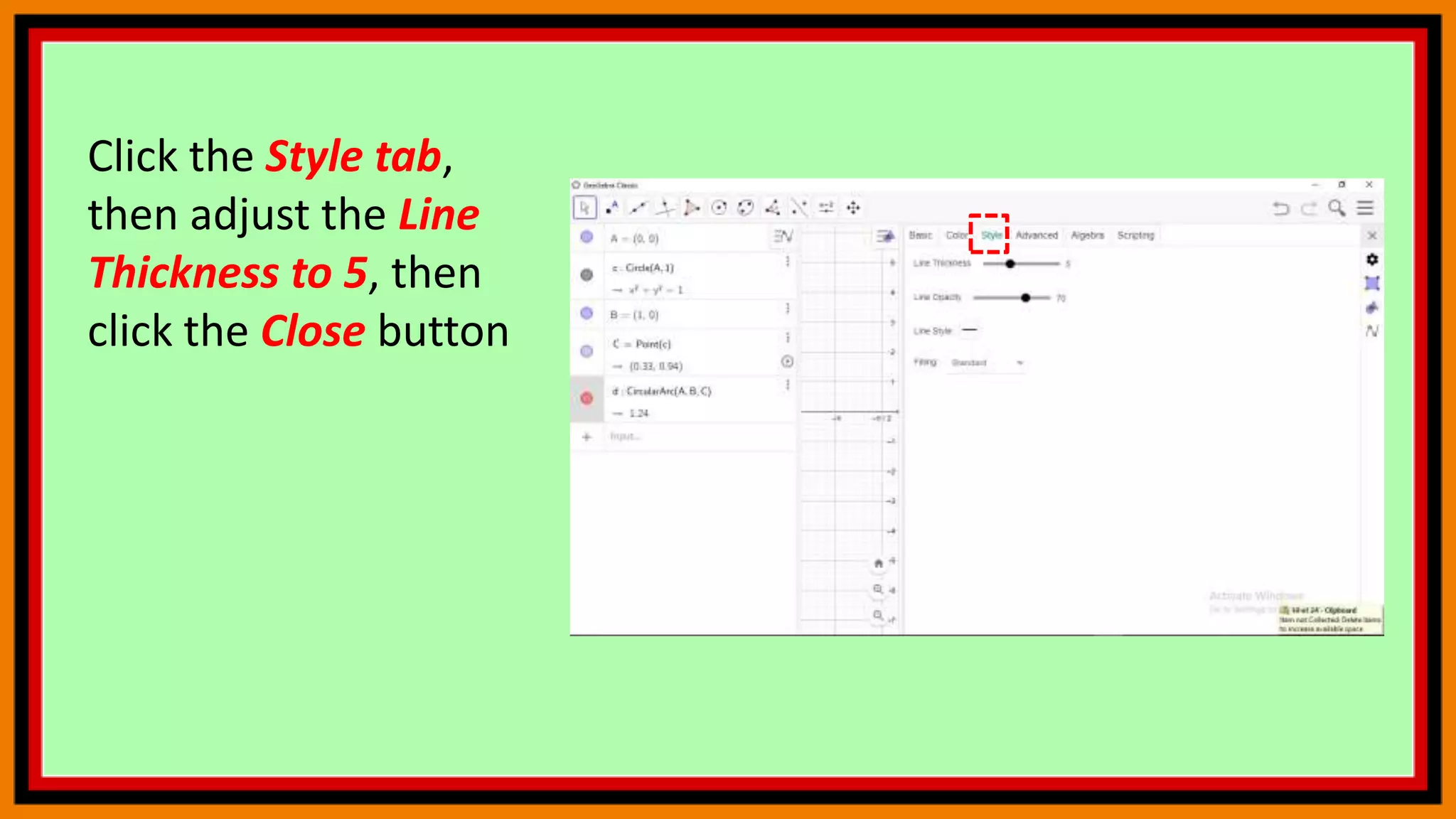
Click the Style tab,
then adjust the Line
Thickness to 5, then
click the Close button
Next, to construct the
point that will trace
the sine wave, we
construct an ordered
pair (d,y(C)) where d is
the arc length
of BC and the y(C) y-
coordinate (or the
sine) of point C. To do
this, type P = (d,y(C)).
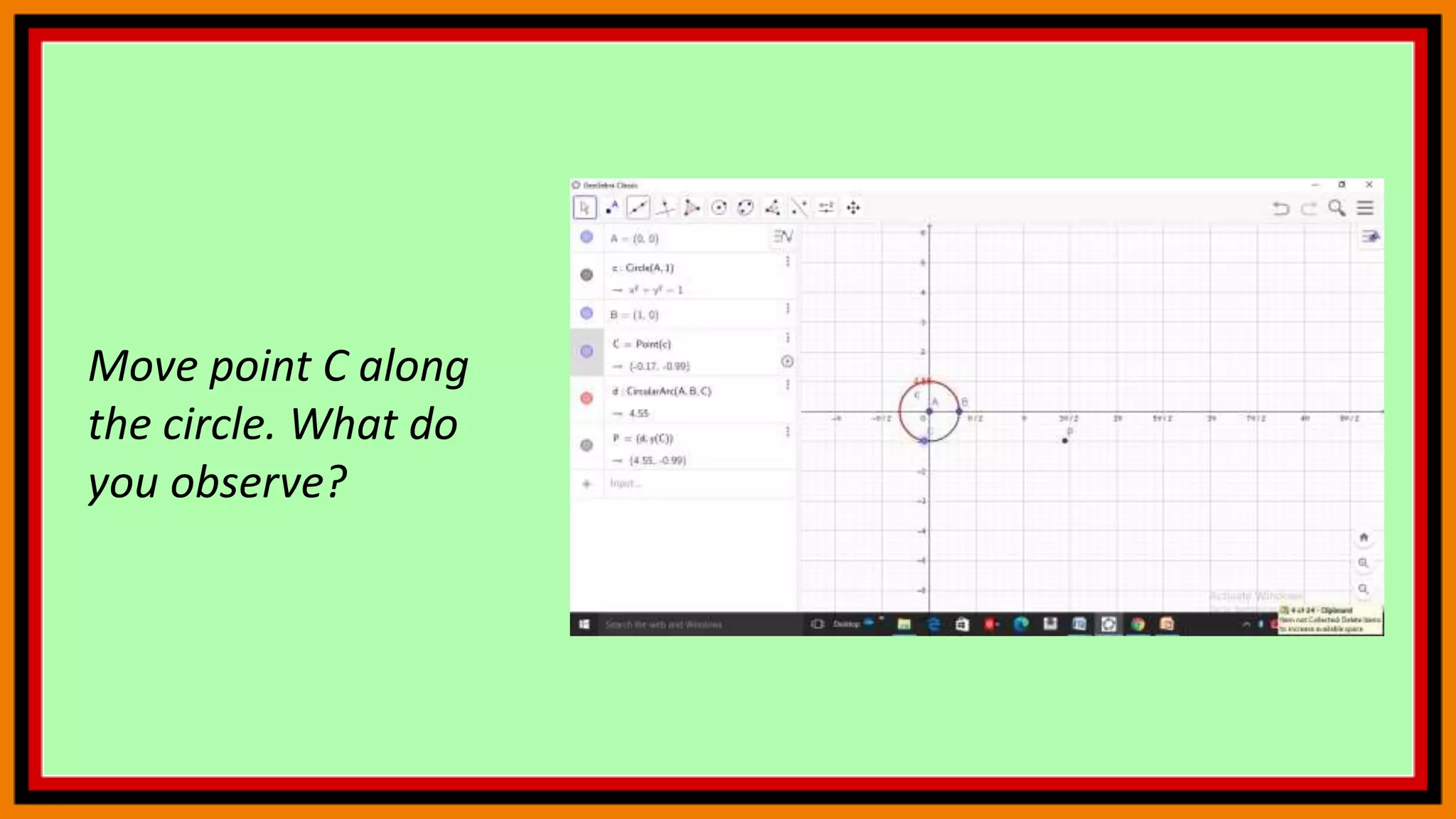
Move point C along
the circle. What do
you observe?
To trace the path
point P, right click
on P and click Trace
on from the context
menu
Now, move point C
along the
circumference of the
circle and see the path
of P
To create point Q that
will trace the cosine
wave, type Q = (d,x(C))
Activate the trace
function of point Q
Now, move point C
along the
circumference of the
circle and observe the
path of point Q. What
do you observe?
Do It Yourself
Graph the other four functions namely
tangent, contangent, secant and
cosecant functions
END
NEXT TOPIC:
continue…

Geogebra 5

  • 2.
    Contents Derivation of Sine Tracingthe Graphs of Trigonometric Functions
  • 3.
    Derivation of Sine Task Createan applet with the sine function and graph its derivative through the slope of the tangent in each point.
  • 4.
    Applet with the sinefunction Enter the function f(x) = sin(x)
  • 5.
    Applet with the sinefunction Create a new point A on function f. Hint: Point A can only be moved along the function Point A
  • 6.
    Applet with the sinefunction Create tangent g to function f through point A Hint: Enter command g: Tangent(A,f) in the Input bar Tangent tool
  • 7.
    Applet with the sinefunction Create the slope of tangent g using the Slope tool Slope tool
  • 8.
    Applet with the sinefunction Define point S = (x(A), m). Hint: x(A) gives you the x-coordinate of point A
  • 9.
    Applet with the sinefunction Connect points A and S using a segment Segment tool
  • 10.
    Applet with the sinefunction Turn on the trace of point S. Hint: Right-click point S (MacOS: Ctrl-click, tablet: long click) and select Show Trace
  • 11.
    Applet with the sinefunction Right-click (MacOS: Ctrl-click, tablet: long click) point A and choose Animation from the appearing context menu.
  • 12.
    Applet with the sinefunction Hint: An Animation button appears in the lower left corner of the Graphics View. It allows you to either pause or continue an animation
  • 13.
    Applet with the sinefunction Right-Click on the Graphics View and Select Graphics... .
  • 14.
    Applet with the sinefunction Select tab xAxis and change the unit to 
  • 15.
    Tracing the Graphsof Trigonometric Functions Just like in the previous tutorial, in this tutorial, we use the Input bar to create mathematical objects particularly a circle, an arc, and a point that traces the sine and cosine function. In doing the tutorial, we learn the following:  use the GeoGebra keyboard commands to construct various geometric objects  use the GeoGebra trace function  change the interval of the x-axis
  • 16.
    Open GeoGebra and besure the Algebra & Graphics view is displayed (Perspectives menu). To create point A at the origin, type A = (0,0) in the Input bar and press the ENTER key on your keyboard
  • 17.
    Next, to constructa circle with center A and radius 1, type circle[A,1] in the Input Bar and press the ENTER key on your keyboard
  • 18.
    We fix pointA to prevent it from being accidentally moved. To fix the position of point A, right click on point A, and then click Object Properties from the context menu.
  • 19.
    This will display thePreferences dialog box. In Basic tab of the Preferences dialog box, click the Fix Object check box to check it, then close the window
  • 20.
    To construct pointB at (1,0), type B = (1,0)
  • 21.
    Fix the locationof point B
  • 22.
    To construct point Con the circumference of the circle, click the New Point tool and click on the circumference of the circle
  • 23.
    We now changethe interval of the x-axis from 1 to π/2. To do this, right click Graphics from the context menu
  • 24.
    In the Settingsdialog box, click the Graphics button, and then click the xAxis tab
  • 25.
    In the x-Axistab, click the Distance check box to check it and choose π/2 from the Distance drop- down list box.
  • 26.
    Now we create arcBC of circle with center A starting from B and going counterclockwise to C. To do this, type circularArc[A, B, C]
  • 27.
    Right click the arcBC, then click Object Properties to display the Preferences window.
  • 28.
    In the Preferences window,choose the Basic tab.
  • 29.
    Be sure thatthe Show label check box is checked and choose Value from the drop-down list box. This will display the length of arc BC
  • 30.
    Next, we changethe color of the arc to make it visible. Click the Color tab and choose red (or any color you want except black) from the color palette
  • 31.
    Click the Styletab, then adjust the Line Thickness to 5, then click the Close button
  • 32.
    Next, to constructthe point that will trace the sine wave, we construct an ordered pair (d,y(C)) where d is the arc length of BC and the y(C) y- coordinate (or the sine) of point C. To do this, type P = (d,y(C)).
  • 33.
    Move point Calong the circle. What do you observe?
  • 34.
    To trace thepath point P, right click on P and click Trace on from the context menu
  • 35.
    Now, move pointC along the circumference of the circle and see the path of P
  • 36.
    To create pointQ that will trace the cosine wave, type Q = (d,x(C))
  • 37.
  • 38.
    Now, move pointC along the circumference of the circle and observe the path of point Q. What do you observe?
  • 39.
    Do It Yourself Graphthe other four functions namely tangent, contangent, secant and cosecant functions
  • 40.