Session – 6 
Measures of Central Tendency 
1 
Mode 
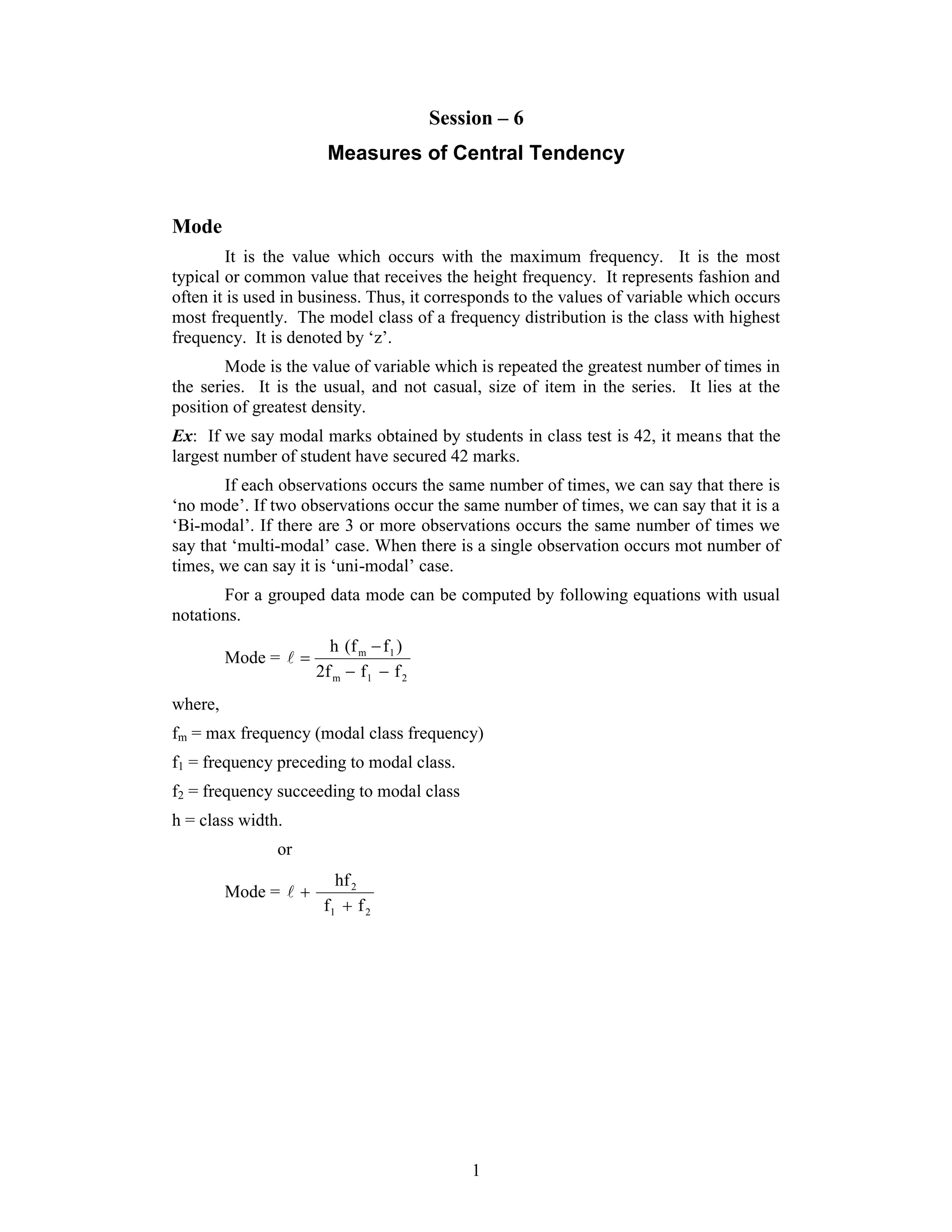
It is the value which occurs with the maximum frequency. It is the most 
typical or common value that receives the height frequency. It represents fashion and 
often it is used in business. Thus, it corresponds to the values of variable which occurs 
most frequently. The model class of a frequency distribution is the class with highest 
frequency. It is denoted by ‘z’. 
Mode is the value of variable which is repeated the greatest number of times in 
the series. It is the usual, and not casual, size of item in the series. It lies at the 
position of greatest density. 
Ex: If we say modal marks obtained by students in class test is 42, it means that the 
largest number of student have secured 42 marks. 
If each observations occurs the same number of times, we can say that there is 
‘no mode’. If two observations occur the same number of times, we can say that it is a 
‘Bi-modal’. If there are 3 or more observations occurs the same number of times we 
say that ‘multi-modal’ case. When there is a single observation occurs mot number of 
times, we can say it is ‘uni-modal’ case. 
For a grouped data mode can be computed by following equations with usual 
notations. 
Mode = 
 
h (f f ) 
m 1 
  
2f f f 
m 1 2 
  
where, 
fm = max frequency (modal class frequency) 
f1 = frequency preceding to modal class. 
f2 = frequency succeeding to modal class 
h = class width. 
or 
Mode = 
hf 
 
2 
f f 
1 2 
 
2 
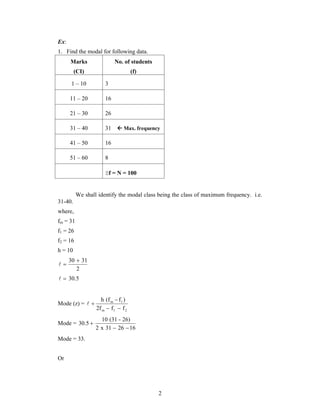
Ex: 
1. Find the modal for following data. 
Marks 
(CI) 
No. of students 
(f) 
1 – 10 3 
11 – 20 16 
21 – 30 26 
31 – 40 31  Max. frequency 
41 – 50 16 
51 – 60 8 
f = N = 100 
We shall identify the modal class being the class of maximum frequency. i.e. 
31-40. 
where, 
fm = 31 
f1 = 26 
f2 = 16 
h = 10 
30  31 
2 
  
  30.5 
Mode (z) = 
 
h (f f ) 
m 1 
  
2f f f 
m 1 2 
  
Mode = 
10 (31 - 26) 
2 x 31 26 16 
30.5 
  
 
Mode = 33. 
Or
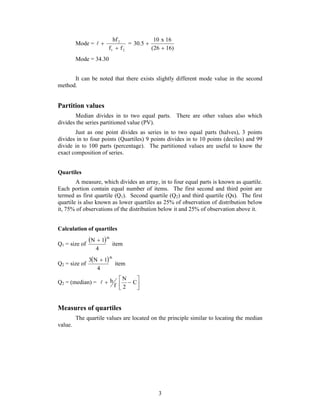
10 x 16 
3 
Mode = 
hf 
 
  2 
= 
f f 
1 2 
(26 16) 
30.5 
 
 
Mode = 34.30 
It can be noted that there exists slightly different mode value in the second 
method. 
Partition values 
Median divides in to two equal parts. There are other values also which 
divides the series partitioned value (PV). 
Just as one point divides as series in to two equal parts (halves), 3 points 
divides in to four points (Quartiles) 9 points divides in to 10 points (deciles) and 99 
divide in to 100 parts (percentage). The partitioned values are useful to know the 
exact composition of series. 
Quartiles 
A measure, which divides an array, in to four equal parts is known as quartile. 
Each portion contain equal number of items. The first second and third point are 
termed as first quartile (Q1). Second quartile (Q2) and third quartile (Qs). The first 
quartile is also known as lower quartiles as 25% of observation of distribution below 
it, 75% of observations of the distribution below it and 25% of observation above it. 
Calculation of quartiles 
Q1 = size of 
  
item 
N 1 th  
4 
Q2 = size of 
  
item 
3 N 1 th  
4 
 Q2 = (median) =    
C 
 
N 
2 
f 
 h 
Measures of quartiles 
The quartile values are located on the principle similar to locating the median 
value.
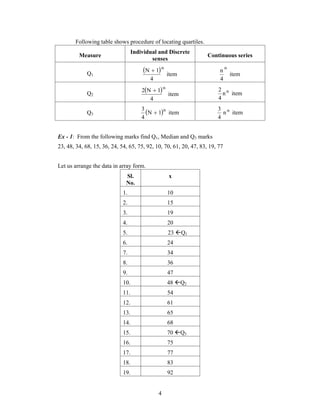
Following table shows procedure of locating quartiles. 
Individual and Discrete 
Measure 
senses Continuous series 
N 1 th  
2 N 1 th  n item 
3 th  n item 
4 
Q1 
  
item 
4 
item 
n th 
4 
Q2 
  
item 
4 
2 th 
4 
Q3 N 1 item 
4 
3 th 
4 
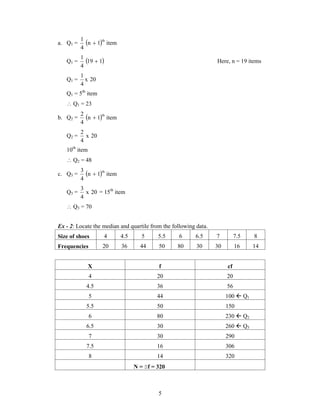
Ex - 1: From the following marks find Q1, Median and Q3 marks 
23, 48, 34, 68, 15, 36, 24, 54, 65, 75, 92, 10, 70, 61, 20, 47, 83, 19, 77 
Let us arrange the data in array form. 
Sl. 
No. 
x 
1. 10 
2. 15 
3. 19 
4. 20 
5. 23 Q1 
6. 24 
7. 34 
8. 36 
9. 47 
10. 48 Q2 
11. 54 
12. 61 
13. 65 
14. 68 
15. 70 Q3 
16. 75 
17. 77 
18. 83 
19. 92
1  Here, n = 19 items 
5 
1 th  
a. Q1 = n 1 item 
4 
Q1 = 19 1 
4 
1 
Q1 = x 20 
4 
Q1 = 5th item 
 Q1 = 23 
2 th  
b. Q2 = n 1 item 
4 
2 
Q2 = x 20 
4 
10th item 
 Q2 = 48 
3 th  
c. Q3 = n 1 item 
4 
3 
Q3 = x 20 
4 
= 15th item 
 Q3 = 70 
Ex - 2: Locate the median and quartile from the following data. 
Size of shoes 4 4.5 5 5.5 6 6.5 7 7.5 8 
Frequencies 20 36 44 50 80 30 30 16 14 
X f cf 
4 20 20 
4.5 36 56 
5 44 100  Q1 
5.5 50 150 
6 80 230  Q2 
6.5 30 260  Q3 
7 30 290 
7.5 16 306 
8 14 320 
N = f = 320
  N  C 
 h 
 3 
N  C 
 and Q3 =  
6 
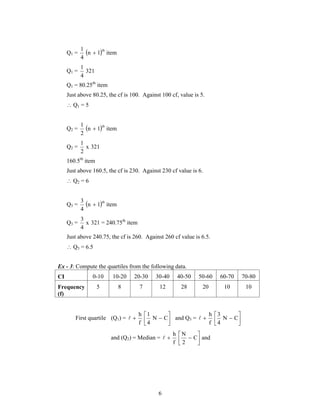
1 th  
Q1 = n 1 item 
4 
1 
Q1 = 321 
4 
Q1 = 80.25th item 
Just above 80.25, the cf is 100. Against 100 cf, value is 5. 
 Q1 = 5 
1 th  
Q2 = n 1 item 
2 
1 
Q2 = x 321 
2 
160.5th item 
Just above 160.5, the cf is 230. Against 230 cf value is 6. 
 Q2 = 6 
3 th  
Q3 = n 1 item 
4 
3 
Q3 = x 
4 
321 = 240.75th item 
Just above 240.75, the cf is 260. Against 260 cf value is 6.5. 
 Q3 = 6.5 
Ex - 3: Compute the quartiles from the following data. 
CI 0-10 10-20 20-30 30-40 40-50 50-60 60-70 70-80 
Frequency 
5 8 7 12 28 20 10 10 
(f) 
 
1 
h 
First quartile (Q1) =  
 
4 
f 
 
 
4 
f 
 
 
 h 
 N 
  
and (Q2) = Median = C and 
2 
f 
 

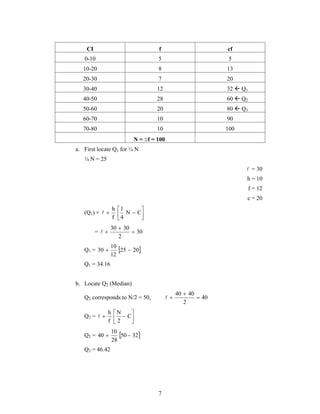
CI f cf 
0-10 5 5 
10-20 8 13 
20-30 7 20 
30-40 12 32  Q1 
40-50 28 60  Q2 
50-60 20 80  Q3 
60-70 10 90 
70-80 10 100 
N = f = 100 
7 
a. First locate Q1 for ¼ N 
¼ N = 25 
 = 30 
h = 10 
f = 12 
c = 20 
 
 h 
 1 
N  C 
(Q1) =  
 
4 
f 
 
 
30 30  
= 30 
2 
  
10 
Q1 = 30  25  
20 
12 
Q1 = 34.16 
b. Locate Q2 (Median) 
 
40 40  
Q2 corresponds to N/2 = 50, 40 
2 
  
 
 h 
 N 
 C 
Q2 =  
 
2 
f 
 
10 
Q2 = 40  50  
32 
28 
Q2 = 46.42
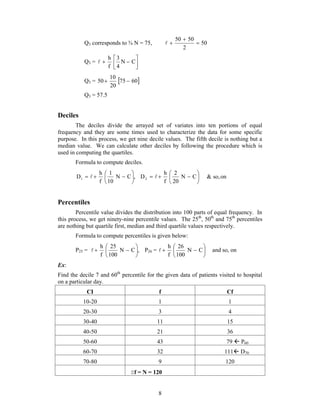
 
50 50  
Q3 corresponds to ¾ N = 75, 50 
        N  C 
 
D2  & so,on 
    P26 =  
 and so, on 
8 
2 
  
 
 h 
 3 
N  C 
Q3 =  
 
4 
f 
 
10 
Q3 = 50 75  
60 
20 
Q3 = 57.5 
Deciles 
The deciles divide the arrayed set of variates into ten portions of equal 
frequency and they are some times used to characterize the data for some specific 
purpose. In this process, we get nine decile values. The fifth decile is nothing but a 
median value. We can calculate other deciles by following the procedure which is 
used in computing the quartiles. 
Formula to compute deciles. 
D1  
N C , 
1 
10 
h 
f 
 
 
 
 
2 
20 
h 
f 
Percentiles 
Percentile value divides the distribution into 100 parts of equal frequency. In 
this process, we get ninety-nine percentile values. The 25th, 50th and 75th percentiles 
are nothing but quartile first, median and third quartile values respectively. 
Formula to compute percentiles is given below: 
25 
h 
 
P25 = N C , 
100 
f 
 
 
 
  N  C 
 
26 
100 
h 
f 
Ex: 
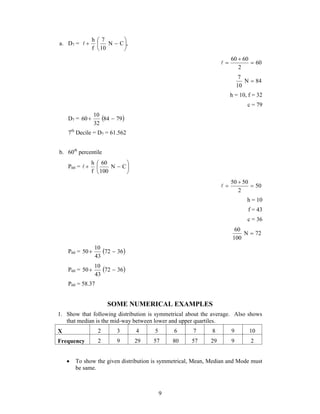
Find the decile 7 and 60th percentile for the given data of patients visited to hospital 
on a particular day. 
CI f Cf 
10-20 1 1 
20-30 3 4 
30-40 11 15 
40-50 21 36 
50-60 43 79  P60 
60-70 32 111 D70 
70-80 9 120 
f = N = 120
9 
 
 h 
 7 
  
a. D7 = N C , 
10 
f 
 
 
60 
 
60 60  
2 
  
7  
N 84 
10 
h = 10, f = 32 
c = 79 
10 
D7 = 60 84  
79 
32 
7th Decile = D7 = 61.562 
b. 60th percentile 
 
 h 
 60 
N  C 
P60 =  
 
100 
f 
 
50 
 
50 50  
2 
  
h = 10 
f = 43 
c = 36 
60  
N 72 
100 
10 
P60 = 50 72  
36 
43 
10 
P60 = 50 72  
36 
43 
P60 = 58.37 
SOME NUMERICAL EXAMPLES 
1. Show that following distribution is symmetrical about the average. Also shows 
that median is the mid-way between lower and upper quartiles. 
X 2 3 4 5 6 7 8 9 10 
Frequency 2 9 29 57 80 57 29 9 2 
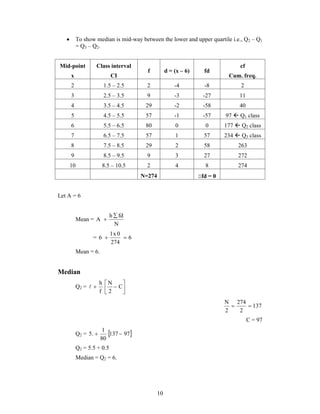
 To show the given distribution is symmetrical, Mean, Median and Mode must 
be same.
 To show median is mid-way between the lower and upper quartile i.e., Q2 – Q1 
10 
= Q3 – Q2. 
Mid-point 
x 
Class interval 
CI 
f d = (x – 6) fd 
cf 
Cum. freq. 
2 1.5 – 2.5 2 -4 -8 2 
3 2.5 – 3.5 9 -3 -27 11 
4 3.5 – 4.5 29 -2 -58 40 
5 4.5 – 5.5 57 -1 -57 97  Q1 class 
6 5.5 – 6.5 80 0 0 177  Q2 class 
7 6.5 – 7.5 57 1 57 234  Q3 class 
8 7.5 – 8.5 29 2 58 263 
9 8.5 – 9.5 9 3 27 272 
10 8.5 – 10.5 2 4 8 274 
N=274 fd = 0 
Let A = 6 
Mean = 
h fd 
N 
A 
 
 
1x 0 
6   
= 6 
274 
Mean = 6. 
Median 
 
 h 
 N 
 C 
Q2 =  
 
2 
f 
 
137 
N  274 
 
2 
2 
C = 97 
1 
Q2 = 5.  137  
97 
80 
Q2 = 5.5 + 0.5 
Median = Q2 = 6.
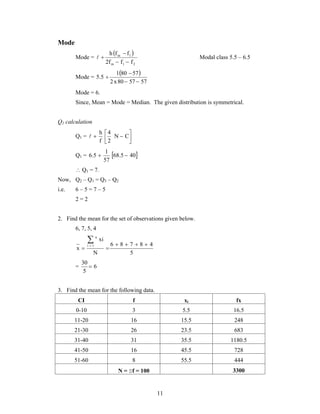
  Modal class 5.5 – 6.5 
11 
Mode 
Mode = 
  
 
h f f 
  
m 1 
2f f f 
m 1 2 
Mode = 
  
 
1 80 57 
2 x 80 57 57 
5.5 
  
 
Mode = 6. 
Since, Mean = Mode = Median. The given distribution is symmetrical. 
Q1 calculation 
 
 h 
 4 
N  C 
Q1 =  
 
2 
f 
 
1 
Q1 = 6.5  68.5  
40 
57 
 Q1 = 7. 
Now, Q2 – Q1 = Q3 – Q2 
i.e. 6 – 5 = 7 – 5 
2 = 2 
2. Find the mean for the set of observations given below. 
6, 7, 5, 4 
6 8 7 8 4 
5 
 
N 
xi 
x i 1 
n 
    
  
30  
= 6 
5 
3. Find the mean for the following data. 
CI f xi fx 
0-10 3 5.5 16.5 
11-20 16 15.5 248 
21-30 26 23.5 683 
31-40 31 35.5 1180.5 
41-50 16 45.5 728 
51-60 8 55.5 444 
N = f = 100 3300
12 
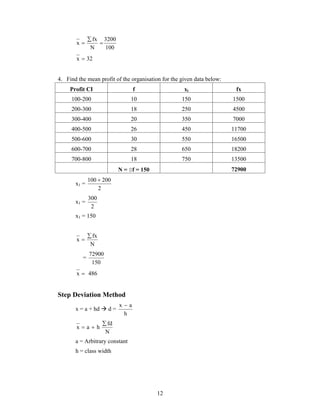
3200 
100 
fx 
 
 
x  
N 
x  32 
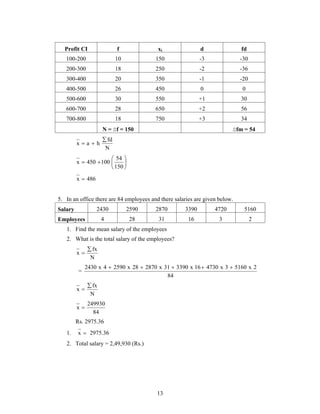
4. Find the mean profit of the organisation for the given data below: 
Profit CI f xi fx 
100-200 10 150 1500 
200-300 18 250 4500 
300-400 20 350 7000 
400-500 26 450 11700 
500-600 30 550 16500 
600-700 28 650 18200 
700-800 18 750 13500 
N = f = 150 72900 
x1 = 
100  200 
2 
x1 = 
300 
2 
x1 = 150 
fx 
N 
x 
 
 
= 
72900 
150 
x  486 
Step Deviation Method 
x = a + hd  d = 
x  a 
h 
fd 
N 
x a h 
 
  
a = Arbitrary constant 
h = class width
Profit CI f xi d fd 
100-200 10 150 -3 -30 
200-300 18 250 -2 -36 
300-400 20 350 -1 -20 
400-500 26 450 0 0 
500-600 30 550 +1 30 
600-700 28 650 +2 56 
700-800 18 750 +3 34 
N = f = 150 fm = 54 
2430 x 4  2590 x 28  2870 x 31  3390 x 16 4730 x 3  5160 x 2 
13 
fd 
N 
x a h 
 
  
 
 
   
 
54 
150 
x 450 100 
x  486 
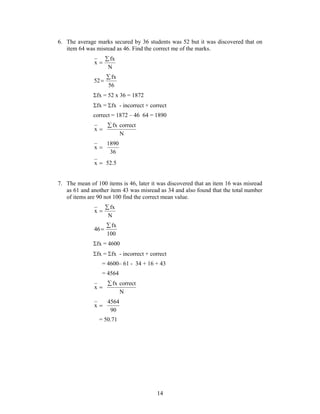
5. In an office there are 84 employees and there salaries are given below. 
Salary 2430 2590 2870 3390 4720 5160 
Employees 4 28 31 16 3 2 
1. Find the mean salary of the employees 
2. What is the total salary of the employees? 
fx 
N 
x 
 
 
= 
84 
fx 
N 
x 
 
 
249930 
84 
x  
Rs. 2975.36 
1. x  2975.36 
2. Total salary = 2,49,930 (Rs.)
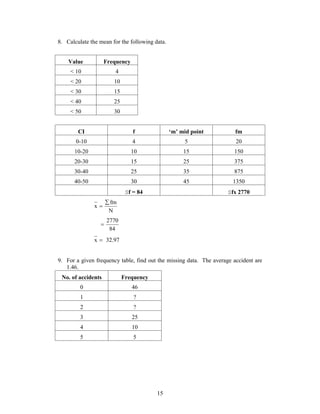
6. The average marks secured by 36 students was 52 but it was discovered that on 
item 64 was misread as 46. Find the correct me of the marks. 
14 
fx 
N 
x 
 
 
fx 
56 
52 
 
 
fx = 52 x 36 = 1872 
fx = fx - incorrect + correct 
correct = 1872 – 46 64 = 1890 
x  
fx correct 
N 
x  
1890 
36 
x  52.5 
7. The mean of 100 items is 46, later it was discovered that an item 16 was misread 
as 61 and another item 43 was misread as 34 and also found that the total number 
of items are 90 not 100 find the correct mean value. 
fx 
N 
x 
 
 
fx 
100 
46 
 
 
fx = 4600 
fx = fx - incorrect + correct 
= 4600– 61 - 34 + 16 + 43 
= 4564 
x  
fx correct 
N 
x  
4564 
90 
= 50.71
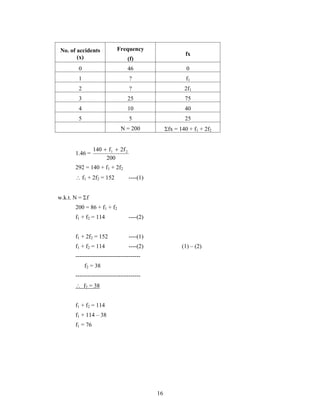
8. Calculate the mean for the following data. 
15 
Value Frequency 
< 10 4 
< 20 10 
< 30 15 
< 40 25 
< 50 30 
CI f ‘m’ mid point fm 
0-10 4 5 20 
10-20 10 15 150 
20-30 15 25 375 
30-40 25 35 875 
40-50 30 45 1350 
f = 84 fx 2770 
fm 
N 
x 
 
 
2770  
84 
x  32.97 
9. For a given frequency table, find out the missing data. The average accident are 
1.46. 
No. of accidents Frequency 
0 46 
1 ? 
2 ? 
3 25 
4 10 
5 5
16 
No. of accidents 
(x) 
Frequency 
(f) 
fx 
0 46 0 
1 ? f1 
2 ? 2f1 
3 25 75 
4 10 40 
5 5 25 
N = 200 fx = 140 + f1 + 2f2 
1.46 = 
140 f 2f 1 2   
200 
292 = 140 + f1 + 2f2 
 f1 + 2f2 = 152 ----(1) 
w.k.t. N = f 
200 = 86 + f1 + f2 
f1 + f2 = 114 ----(2) 
f1 + 2f2 = 152 ----(1) 
f1 + f2 = 114 ----(2) (1) – (2) 
--------------------------------- 
f2 = 38 
--------------------------------- 
 f2 = 38 
f1 + f2 = 114 
f1 + 114 – 38 
f1 = 76
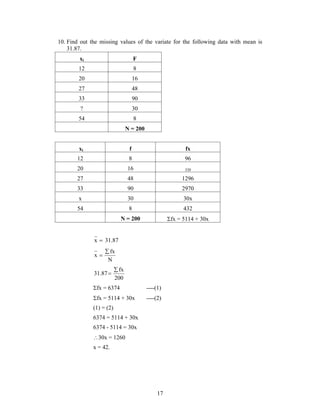
10. Find out the missing values of the variate for the following data with mean is 
17 
31.87. 
xi F 
12 8 
20 16 
27 48 
33 90 
? 30 
54 8 
N = 200 
xi f fx 
12 8 96 
20 16 320 
27 48 1296 
33 90 2970 
x 30 30x 
54 8 432 
N = 200 fx = 5114 + 30x 
x  31.87 
fx 
N 
x 
 
 
fx 
200 
31.87 
 
 
fx = 6374 ----(1) 
fx = 5114 + 30x ----(2) 
(1) = (2) 
6374 = 5114 + 30x 
6374 - 5114 = 30x 
30x = 1260 
x = 42.
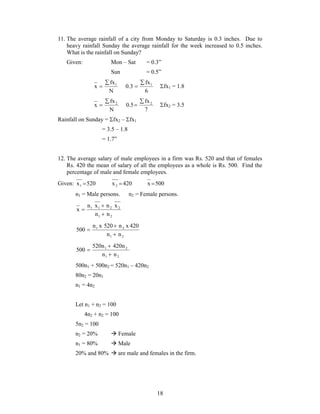
11. The average rainfall of a city from Monday to Saturday is 0.3 inches. Due to 
heavy rainfall Sunday the average rainfall for the week increased to 0.5 inches. 
What is the rainfall on Sunday? 
Given: Mon – Sat = 0.3” 
Sun = 0.5” 
 fx1 = 1.8 
 fx2 = 3.5 
18 
 
 
fx 
x 1 N 
 
fx 
0.3 1 6 
 
 
fx 
x 2 N 
 
fx 
0.5 2 7 
Rainfall on Sunday = fx2 – fx1 
= 3.5 – 1.8 
= 1.7” 
12. The average salary of male employees in a firm was Rs. 520 and that of females 
Rs. 420 the mean of salary of all the employees as a whole is Rs. 500. Find the 
percentage of male and female employees. 
Given: x 520 1  x 420 2  x 500 
n1 = Male persons. n2 = Female persons. 
 
n x n x 
1 1 2 2 
n n 
1 2 
x 
 
 
 
n x 520 n x 420 
1 2 
n n 
1 2 
500 
 
 
 
520n 420n 
1 2 
n n 
1 2 
500 
 
 
500n1 + 500n2 = 520n1 – 420n2 
80n2 = 20n1 
n1 = 4n2 
Let n1 + n2 = 100 
4n2 + n2 = 100 
5n2 = 100 
n2 = 20%  Female 
n1 = 80%  Male 
20% and 80%  are male and females in the firm.
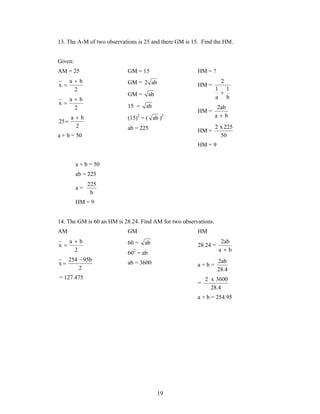
13. The A-M of two observations is 25 and there GM is 15. Find the HM. 
19 
Given: 
AM = 25 
a b 
2 
x 
 
 
a b 
2 
x 
 
 
a b 
2 
25 
 
 
a + b = 50 
GM = 15 
GM = 2 ab 
GM = ab 
15 = ab 
(15)2 = ( ab )2 
ab = 225 
HM = ? 
HM = 
1 
b 
1 
a 
2 
 
HM = 
2ab 
 
a b 
HM = 
2 x 225 
50 
HM = 9 
a + b = 50 
ab = 225 
a = 
225 
b 
HM = 9 
14. The GM is 60 an HM is 28.24. Find AM for two observations. 
AM GM HM 
a b 
2 
x 
 
 
254 95b 
2 
x 
 
 
= 127.475 
60 = ab 
602 = ab 
ab = 3600 
28.24 = 
2ab 
 
a b 
a + b = 
2ab 
28.4 
= 
2 x 3600 
28.4 
a + b = 254.95
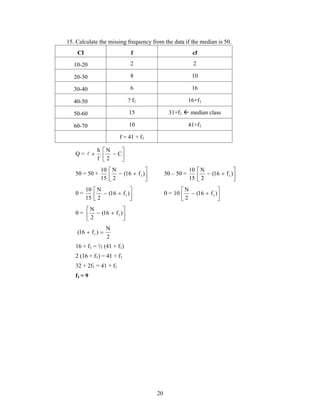
15. Calculate the missing frequency from the data if the median is 50. 
CI f cf 
10-20 2 2 
20-30 8 10 
30-40 6 16 
40-50 ? f1 16+f1 
50-60 15 31+f1  median class 
60-70 10 41+f1 
20 
f = 41 + f1 
 
 h 
 N 
 C 
Q =  
 
2 
f 
 
 
  (16  f ) 
2 
10 
50 = 50 +  
 
N 
15 
 
  (16  f ) 
2 
10 
1 50 – 50 =  
 
N 
15 
1 
 
  (16  f ) 
2 
10 
0 =  
 
N 
15 
 
  (16  f ) 
2 
1 0 =  
 
N 
10 1 
 
  (16  f ) 
2 
0 =  
 
N 
1 
N 
(16  f )  
1 2 
16 + f1 = ½ (41 + f1) 
2 (16 + f1) = 41 + f1 
32 + 2f1 = 41 + f1 
f1 = 9
SOURCES AND REFERENCES 
1. Statistics for Management, Richard I Levin, PHI / 2000. 
2. Statistics, RSN Pillai and Bagavathi, S. Chands, Delhi. 
3. An Introduction to Statistical Method, C.B. Gupta, & Vijaya Gupta, Vikasa 
21 
Publications, 23e/2006. 
4. Business Statistics, C.M. Chikkodi and Salya Prasad, Himalaya Publications, 
2000. 
5. Statistics, D.C. Sancheti and Kappor, Sultan Chand and Sons, New Delhi, 2004. 
6. Fundamentals of Statistics, D.N. Elhance and Veena and Aggarwal, KITAB 
Publications, Kolkata, 2003. 
7. Business Statistics, Dr. J.S. Chandan, Prof. Jagit Singh and Kanna, Vikas 
Publications, 2006.

S3 pn

  • 1.
    Session – 6 Measures of Central Tendency 1 Mode It is the value which occurs with the maximum frequency. It is the most typical or common value that receives the height frequency. It represents fashion and often it is used in business. Thus, it corresponds to the values of variable which occurs most frequently. The model class of a frequency distribution is the class with highest frequency. It is denoted by ‘z’. Mode is the value of variable which is repeated the greatest number of times in the series. It is the usual, and not casual, size of item in the series. It lies at the position of greatest density. Ex: If we say modal marks obtained by students in class test is 42, it means that the largest number of student have secured 42 marks. If each observations occurs the same number of times, we can say that there is ‘no mode’. If two observations occur the same number of times, we can say that it is a ‘Bi-modal’. If there are 3 or more observations occurs the same number of times we say that ‘multi-modal’ case. When there is a single observation occurs mot number of times, we can say it is ‘uni-modal’ case. For a grouped data mode can be computed by following equations with usual notations. Mode =  h (f f ) m 1   2f f f m 1 2   where, fm = max frequency (modal class frequency) f1 = frequency preceding to modal class. f2 = frequency succeeding to modal class h = class width. or Mode = hf  2 f f 1 2  
  • 2.
    2 Ex: 1.Find the modal for following data. Marks (CI) No. of students (f) 1 – 10 3 11 – 20 16 21 – 30 26 31 – 40 31  Max. frequency 41 – 50 16 51 – 60 8 f = N = 100 We shall identify the modal class being the class of maximum frequency. i.e. 31-40. where, fm = 31 f1 = 26 f2 = 16 h = 10 30  31 2     30.5 Mode (z) =  h (f f ) m 1   2f f f m 1 2   Mode = 10 (31 - 26) 2 x 31 26 16 30.5    Mode = 33. Or
  • 3.
    10 x 16 3 Mode = hf    2 = f f 1 2 (26 16) 30.5   Mode = 34.30 It can be noted that there exists slightly different mode value in the second method. Partition values Median divides in to two equal parts. There are other values also which divides the series partitioned value (PV). Just as one point divides as series in to two equal parts (halves), 3 points divides in to four points (Quartiles) 9 points divides in to 10 points (deciles) and 99 divide in to 100 parts (percentage). The partitioned values are useful to know the exact composition of series. Quartiles A measure, which divides an array, in to four equal parts is known as quartile. Each portion contain equal number of items. The first second and third point are termed as first quartile (Q1). Second quartile (Q2) and third quartile (Qs). The first quartile is also known as lower quartiles as 25% of observation of distribution below it, 75% of observations of the distribution below it and 25% of observation above it. Calculation of quartiles Q1 = size of   item N 1 th  4 Q2 = size of   item 3 N 1 th  4  Q2 = (median) =    C  N 2 f  h Measures of quartiles The quartile values are located on the principle similar to locating the median value.
  • 4.
    Following table showsprocedure of locating quartiles. Individual and Discrete Measure senses Continuous series N 1 th  2 N 1 th  n item 3 th  n item 4 Q1   item 4 item n th 4 Q2   item 4 2 th 4 Q3 N 1 item 4 3 th 4 Ex - 1: From the following marks find Q1, Median and Q3 marks 23, 48, 34, 68, 15, 36, 24, 54, 65, 75, 92, 10, 70, 61, 20, 47, 83, 19, 77 Let us arrange the data in array form. Sl. No. x 1. 10 2. 15 3. 19 4. 20 5. 23 Q1 6. 24 7. 34 8. 36 9. 47 10. 48 Q2 11. 54 12. 61 13. 65 14. 68 15. 70 Q3 16. 75 17. 77 18. 83 19. 92
  • 5.
    1  Here,n = 19 items 5 1 th  a. Q1 = n 1 item 4 Q1 = 19 1 4 1 Q1 = x 20 4 Q1 = 5th item  Q1 = 23 2 th  b. Q2 = n 1 item 4 2 Q2 = x 20 4 10th item  Q2 = 48 3 th  c. Q3 = n 1 item 4 3 Q3 = x 20 4 = 15th item  Q3 = 70 Ex - 2: Locate the median and quartile from the following data. Size of shoes 4 4.5 5 5.5 6 6.5 7 7.5 8 Frequencies 20 36 44 50 80 30 30 16 14 X f cf 4 20 20 4.5 36 56 5 44 100  Q1 5.5 50 150 6 80 230  Q2 6.5 30 260  Q3 7 30 290 7.5 16 306 8 14 320 N = f = 320
  • 6.
      N C  h  3 N  C  and Q3 =  6 1 th  Q1 = n 1 item 4 1 Q1 = 321 4 Q1 = 80.25th item Just above 80.25, the cf is 100. Against 100 cf, value is 5.  Q1 = 5 1 th  Q2 = n 1 item 2 1 Q2 = x 321 2 160.5th item Just above 160.5, the cf is 230. Against 230 cf value is 6.  Q2 = 6 3 th  Q3 = n 1 item 4 3 Q3 = x 4 321 = 240.75th item Just above 240.75, the cf is 260. Against 260 cf value is 6.5.  Q3 = 6.5 Ex - 3: Compute the quartiles from the following data. CI 0-10 10-20 20-30 30-40 40-50 50-60 60-70 70-80 Frequency 5 8 7 12 28 20 10 10 (f)  1 h First quartile (Q1) =   4 f   4 f    h  N   and (Q2) = Median = C and 2 f  
  • 7.
    CI f cf 0-10 5 5 10-20 8 13 20-30 7 20 30-40 12 32  Q1 40-50 28 60  Q2 50-60 20 80  Q3 60-70 10 90 70-80 10 100 N = f = 100 7 a. First locate Q1 for ¼ N ¼ N = 25  = 30 h = 10 f = 12 c = 20   h  1 N  C (Q1) =   4 f   30 30  = 30 2   10 Q1 = 30  25  20 12 Q1 = 34.16 b. Locate Q2 (Median)  40 40  Q2 corresponds to N/2 = 50, 40 2     h  N  C Q2 =   2 f  10 Q2 = 40  50  32 28 Q2 = 46.42
  • 8.
     50 50 Q3 corresponds to ¾ N = 75, 50         N  C  D2  & so,on     P26 =   and so, on 8 2     h  3 N  C Q3 =   4 f  10 Q3 = 50 75  60 20 Q3 = 57.5 Deciles The deciles divide the arrayed set of variates into ten portions of equal frequency and they are some times used to characterize the data for some specific purpose. In this process, we get nine decile values. The fifth decile is nothing but a median value. We can calculate other deciles by following the procedure which is used in computing the quartiles. Formula to compute deciles. D1  N C , 1 10 h f     2 20 h f Percentiles Percentile value divides the distribution into 100 parts of equal frequency. In this process, we get ninety-nine percentile values. The 25th, 50th and 75th percentiles are nothing but quartile first, median and third quartile values respectively. Formula to compute percentiles is given below: 25 h  P25 = N C , 100 f      N  C  26 100 h f Ex: Find the decile 7 and 60th percentile for the given data of patients visited to hospital on a particular day. CI f Cf 10-20 1 1 20-30 3 4 30-40 11 15 40-50 21 36 50-60 43 79  P60 60-70 32 111 D70 70-80 9 120 f = N = 120
  • 9.
    9  h  7   a. D7 = N C , 10 f   60  60 60  2   7  N 84 10 h = 10, f = 32 c = 79 10 D7 = 60 84  79 32 7th Decile = D7 = 61.562 b. 60th percentile   h  60 N  C P60 =   100 f  50  50 50  2   h = 10 f = 43 c = 36 60  N 72 100 10 P60 = 50 72  36 43 10 P60 = 50 72  36 43 P60 = 58.37 SOME NUMERICAL EXAMPLES 1. Show that following distribution is symmetrical about the average. Also shows that median is the mid-way between lower and upper quartiles. X 2 3 4 5 6 7 8 9 10 Frequency 2 9 29 57 80 57 29 9 2  To show the given distribution is symmetrical, Mean, Median and Mode must be same.
  • 10.
     To showmedian is mid-way between the lower and upper quartile i.e., Q2 – Q1 10 = Q3 – Q2. Mid-point x Class interval CI f d = (x – 6) fd cf Cum. freq. 2 1.5 – 2.5 2 -4 -8 2 3 2.5 – 3.5 9 -3 -27 11 4 3.5 – 4.5 29 -2 -58 40 5 4.5 – 5.5 57 -1 -57 97  Q1 class 6 5.5 – 6.5 80 0 0 177  Q2 class 7 6.5 – 7.5 57 1 57 234  Q3 class 8 7.5 – 8.5 29 2 58 263 9 8.5 – 9.5 9 3 27 272 10 8.5 – 10.5 2 4 8 274 N=274 fd = 0 Let A = 6 Mean = h fd N A   1x 0 6   = 6 274 Mean = 6. Median   h  N  C Q2 =   2 f  137 N  274  2 2 C = 97 1 Q2 = 5.  137  97 80 Q2 = 5.5 + 0.5 Median = Q2 = 6.
  • 11.
      Modalclass 5.5 – 6.5 11 Mode Mode =    h f f   m 1 2f f f m 1 2 Mode =    1 80 57 2 x 80 57 57 5.5    Mode = 6. Since, Mean = Mode = Median. The given distribution is symmetrical. Q1 calculation   h  4 N  C Q1 =   2 f  1 Q1 = 6.5  68.5  40 57  Q1 = 7. Now, Q2 – Q1 = Q3 – Q2 i.e. 6 – 5 = 7 – 5 2 = 2 2. Find the mean for the set of observations given below. 6, 7, 5, 4 6 8 7 8 4 5  N xi x i 1 n       30  = 6 5 3. Find the mean for the following data. CI f xi fx 0-10 3 5.5 16.5 11-20 16 15.5 248 21-30 26 23.5 683 31-40 31 35.5 1180.5 41-50 16 45.5 728 51-60 8 55.5 444 N = f = 100 3300
  • 12.
    12 3200 100 fx   x  N x  32 4. Find the mean profit of the organisation for the given data below: Profit CI f xi fx 100-200 10 150 1500 200-300 18 250 4500 300-400 20 350 7000 400-500 26 450 11700 500-600 30 550 16500 600-700 28 650 18200 700-800 18 750 13500 N = f = 150 72900 x1 = 100  200 2 x1 = 300 2 x1 = 150 fx N x   = 72900 150 x  486 Step Deviation Method x = a + hd  d = x  a h fd N x a h    a = Arbitrary constant h = class width
  • 13.
    Profit CI fxi d fd 100-200 10 150 -3 -30 200-300 18 250 -2 -36 300-400 20 350 -1 -20 400-500 26 450 0 0 500-600 30 550 +1 30 600-700 28 650 +2 56 700-800 18 750 +3 34 N = f = 150 fm = 54 2430 x 4  2590 x 28  2870 x 31  3390 x 16 4730 x 3  5160 x 2 13 fd N x a h          54 150 x 450 100 x  486 5. In an office there are 84 employees and there salaries are given below. Salary 2430 2590 2870 3390 4720 5160 Employees 4 28 31 16 3 2 1. Find the mean salary of the employees 2. What is the total salary of the employees? fx N x   = 84 fx N x   249930 84 x  Rs. 2975.36 1. x  2975.36 2. Total salary = 2,49,930 (Rs.)
  • 14.
    6. The averagemarks secured by 36 students was 52 but it was discovered that on item 64 was misread as 46. Find the correct me of the marks. 14 fx N x   fx 56 52   fx = 52 x 36 = 1872 fx = fx - incorrect + correct correct = 1872 – 46 64 = 1890 x  fx correct N x  1890 36 x  52.5 7. The mean of 100 items is 46, later it was discovered that an item 16 was misread as 61 and another item 43 was misread as 34 and also found that the total number of items are 90 not 100 find the correct mean value. fx N x   fx 100 46   fx = 4600 fx = fx - incorrect + correct = 4600– 61 - 34 + 16 + 43 = 4564 x  fx correct N x  4564 90 = 50.71
  • 15.
    8. Calculate themean for the following data. 15 Value Frequency < 10 4 < 20 10 < 30 15 < 40 25 < 50 30 CI f ‘m’ mid point fm 0-10 4 5 20 10-20 10 15 150 20-30 15 25 375 30-40 25 35 875 40-50 30 45 1350 f = 84 fx 2770 fm N x   2770  84 x  32.97 9. For a given frequency table, find out the missing data. The average accident are 1.46. No. of accidents Frequency 0 46 1 ? 2 ? 3 25 4 10 5 5
  • 16.
    16 No. ofaccidents (x) Frequency (f) fx 0 46 0 1 ? f1 2 ? 2f1 3 25 75 4 10 40 5 5 25 N = 200 fx = 140 + f1 + 2f2 1.46 = 140 f 2f 1 2   200 292 = 140 + f1 + 2f2  f1 + 2f2 = 152 ----(1) w.k.t. N = f 200 = 86 + f1 + f2 f1 + f2 = 114 ----(2) f1 + 2f2 = 152 ----(1) f1 + f2 = 114 ----(2) (1) – (2) --------------------------------- f2 = 38 ---------------------------------  f2 = 38 f1 + f2 = 114 f1 + 114 – 38 f1 = 76
  • 17.
    10. Find outthe missing values of the variate for the following data with mean is 17 31.87. xi F 12 8 20 16 27 48 33 90 ? 30 54 8 N = 200 xi f fx 12 8 96 20 16 320 27 48 1296 33 90 2970 x 30 30x 54 8 432 N = 200 fx = 5114 + 30x x  31.87 fx N x   fx 200 31.87   fx = 6374 ----(1) fx = 5114 + 30x ----(2) (1) = (2) 6374 = 5114 + 30x 6374 - 5114 = 30x 30x = 1260 x = 42.
  • 18.
    11. The averagerainfall of a city from Monday to Saturday is 0.3 inches. Due to heavy rainfall Sunday the average rainfall for the week increased to 0.5 inches. What is the rainfall on Sunday? Given: Mon – Sat = 0.3” Sun = 0.5”  fx1 = 1.8  fx2 = 3.5 18   fx x 1 N  fx 0.3 1 6   fx x 2 N  fx 0.5 2 7 Rainfall on Sunday = fx2 – fx1 = 3.5 – 1.8 = 1.7” 12. The average salary of male employees in a firm was Rs. 520 and that of females Rs. 420 the mean of salary of all the employees as a whole is Rs. 500. Find the percentage of male and female employees. Given: x 520 1  x 420 2  x 500 n1 = Male persons. n2 = Female persons.  n x n x 1 1 2 2 n n 1 2 x    n x 520 n x 420 1 2 n n 1 2 500    520n 420n 1 2 n n 1 2 500   500n1 + 500n2 = 520n1 – 420n2 80n2 = 20n1 n1 = 4n2 Let n1 + n2 = 100 4n2 + n2 = 100 5n2 = 100 n2 = 20%  Female n1 = 80%  Male 20% and 80%  are male and females in the firm.
  • 19.
    13. The A-Mof two observations is 25 and there GM is 15. Find the HM. 19 Given: AM = 25 a b 2 x   a b 2 x   a b 2 25   a + b = 50 GM = 15 GM = 2 ab GM = ab 15 = ab (15)2 = ( ab )2 ab = 225 HM = ? HM = 1 b 1 a 2  HM = 2ab  a b HM = 2 x 225 50 HM = 9 a + b = 50 ab = 225 a = 225 b HM = 9 14. The GM is 60 an HM is 28.24. Find AM for two observations. AM GM HM a b 2 x   254 95b 2 x   = 127.475 60 = ab 602 = ab ab = 3600 28.24 = 2ab  a b a + b = 2ab 28.4 = 2 x 3600 28.4 a + b = 254.95
  • 20.
    15. Calculate themissing frequency from the data if the median is 50. CI f cf 10-20 2 2 20-30 8 10 30-40 6 16 40-50 ? f1 16+f1 50-60 15 31+f1  median class 60-70 10 41+f1 20 f = 41 + f1   h  N  C Q =   2 f     (16  f ) 2 10 50 = 50 +   N 15    (16  f ) 2 10 1 50 – 50 =   N 15 1    (16  f ) 2 10 0 =   N 15    (16  f ) 2 1 0 =   N 10 1    (16  f ) 2 0 =   N 1 N (16  f )  1 2 16 + f1 = ½ (41 + f1) 2 (16 + f1) = 41 + f1 32 + 2f1 = 41 + f1 f1 = 9
  • 21.
    SOURCES AND REFERENCES 1. Statistics for Management, Richard I Levin, PHI / 2000. 2. Statistics, RSN Pillai and Bagavathi, S. Chands, Delhi. 3. An Introduction to Statistical Method, C.B. Gupta, & Vijaya Gupta, Vikasa 21 Publications, 23e/2006. 4. Business Statistics, C.M. Chikkodi and Salya Prasad, Himalaya Publications, 2000. 5. Statistics, D.C. Sancheti and Kappor, Sultan Chand and Sons, New Delhi, 2004. 6. Fundamentals of Statistics, D.N. Elhance and Veena and Aggarwal, KITAB Publications, Kolkata, 2003. 7. Business Statistics, Dr. J.S. Chandan, Prof. Jagit Singh and Kanna, Vikas Publications, 2006.