Solving LPP by Simplex
Method
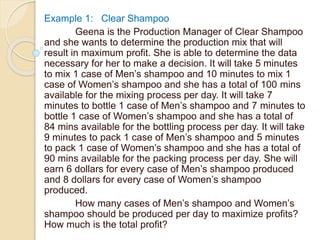
Example 1: Clear Shampoo
Geena is the Production Manager of Clear Shampoo
and she wants to determine the production mix that will
result in maximum profit. She is able to determine the data
necessary for her to make a decision. It will take 5 minutes
to mix 1 case of Men’s shampoo and 10 minutes to mix 1
case of Women’s shampoo and she has a total of 100 mins
available for the mixing process per day. It will take 7
minutes to bottle 1 case of Men’s shampoo and 7 minutes to
bottle 1 case of Women’s shampoo and she has a total of
84 mins available for the bottling process per day. It will take
9 minutes to pack 1 case of Men’s shampoo and 5 minutes
to pack 1 case of Women’s shampoo and she has a total of
90 mins available for the packing process per day. She will
earn 6 dollars for every case of Men’s shampoo produced
and 8 dollars for every case of Women’s shampoo
produced.
How many cases of Men’s shampoo and Women’s
shampoo should be produced per day to maximize profits?
How much is the total profit?
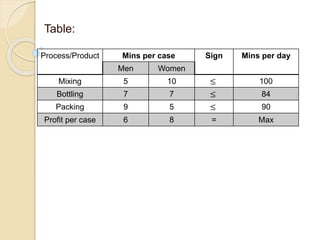
Table:
Process/Product Mins per case Sign Mins per day
Men Women
Mixing 5 10 ≤ 100
Bottling 7 7 ≤ 84
Packing 9 5 ≤ 90
Profit per case 6 8 = Max
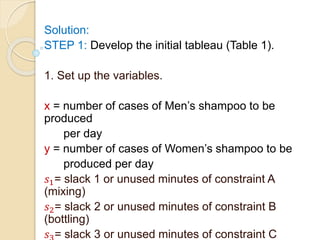
Solution:
STEP 1: Develop the initial tableau (Table 1).
1. Set up the variables.
x = number of cases of Men’s shampoo to be
produced
per day
y = number of cases of Women’s shampoo to be
produced per day
𝑠1= slack 1 or unused minutes of constraint A
(mixing)
𝑠2= slack 2 or unused minutes of constraint B
(bottling)
𝑠 = slack 3 or unused minutes of constraint C
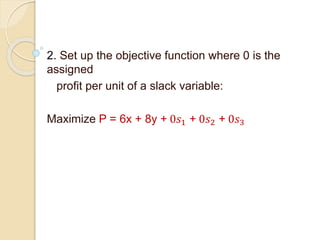
2. Set up the objective function where 0 is the
assigned
profit per unit of a slack variable:
Maximize P = 6x + 8y + 0𝑠1 + 0𝑠2 + 0𝑠3
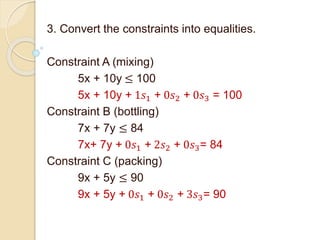
3. Convert the constraints into equalities.
Constraint A (mixing)
5x + 10y ≤ 100
5x + 10y + 1𝑠1 + 0𝑠2 + 0𝑠3 = 100
Constraint B (bottling)
7x + 7y ≤ 84
7x+ 7y + 0𝑠1 + 2𝑠2 + 0𝑠3= 84
Constraint C (packing)
9x + 5y ≤ 90
9x + 5y + 0𝑠1 + 0𝑠2 + 3𝑠3= 90
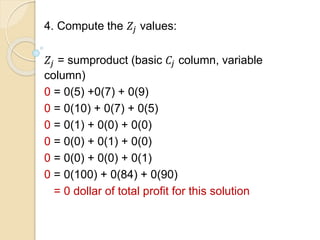
4. Compute the 𝑍𝑗 values:
𝑍𝑗 = sumproduct (basic 𝐶𝑗 column, variable
column)
0 = 0(5) +0(7) + 0(9)
0 = 0(10) + 0(7) + 0(5)
0 = 0(1) + 0(0) + 0(0)
0 = 0(0) + 0(1) + 0(0)
0 = 0(0) + 0(0) + 0(1)
0 = 0(100) + 0(84) + 0(90)
= 0 dollar of total profit for this solution
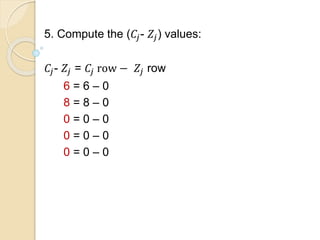
5. Compute the (𝐶𝑗- 𝑍𝑗) values:
𝐶𝑗- 𝑍𝑗 = 𝐶𝑗 row − 𝑍𝑗 row
6 = 6 – 0
8 = 8 – 0
0 = 0 – 0
0 = 0 – 0
0 = 0 – 0
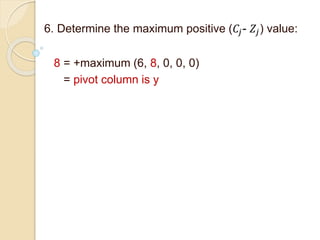
6. Determine the maximum positive (𝐶𝑗- 𝑍𝑗) value:
8 = +maximum (6, 8, 0, 0, 0)
= pivot column is y
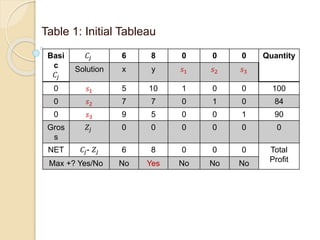
Table 1: Initial Tableau
Basi
c
𝐶𝑗
𝐶𝑗 6 8 0 0 0 Quantity
Solution x y 𝑠1 𝑠2 𝑠3
0 𝑠1 5 10 1 0 0 100
0 𝑠2 7 7 0 1 0 84
0 𝑠3 9 5 0 0 1 90
Gros
s
𝑍𝑗 0 0 0 0 0 0
NET 𝐶𝑗- 𝑍𝑗 6 8 0 0 0 Total
ProfitMax +? Yes/No No Yes No No No
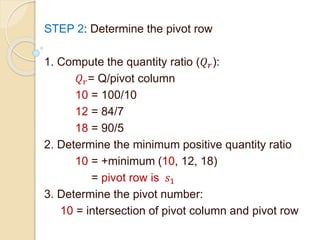
STEP 2: Determine the pivot row
1. Compute the quantity ratio (𝑄 𝑟):
𝑄 𝑟= Q/pivot column
10 = 100/10
12 = 84/7
18 = 90/5
2. Determine the minimum positive quantity ratio
10 = +minimum (10, 12, 18)
= pivot row is 𝑠1
3. Determine the pivot number:
10 = intersection of pivot column and pivot row
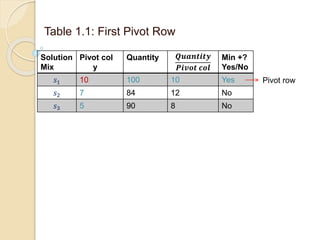
Table 1.1: First Pivot Row
Solution
Mix
Pivot col
y
Quantity 𝑸𝒖𝒂𝒏𝒕𝒊𝒕𝒚
𝑷𝒊𝒗𝒐𝒕 𝒄𝒐𝒍
Min +?
Yes/No
𝑠1 10 100 10 Yes
𝑠2 7 84 12 No
𝑠3 5 90 8 No
Pivot row
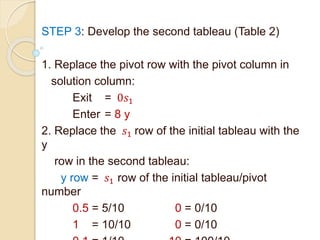
STEP 3: Develop the second tableau (Table 2)
1. Replace the pivot row with the pivot column in
solution column:
Exit = 0𝑠1
Enter = 8 y
2. Replace the 𝑠1 row of the initial tableau with the
y
row in the second tableau:
y row = 𝑠1 row of the initial tableau/pivot
number
0.5 = 5/10 0 = 0/10
1 = 10/10 0 = 0/10
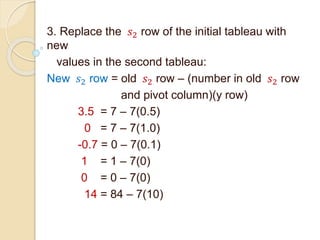
3. Replace the 𝑠2 row of the initial tableau with
new
values in the second tableau:
New 𝑠2 row = old 𝑠2 row – (number in old 𝑠2 row
and pivot column)(y row)
3.5 = 7 – 7(0.5)
0 = 7 – 7(1.0)
-0.7 = 0 – 7(0.1)
1 = 1 – 7(0)
0 = 0 – 7(0)
14 = 84 – 7(10)
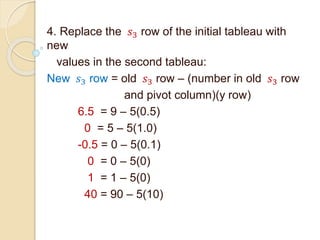
4. Replace the 𝑠3 row of the initial tableau with
new
values in the second tableau:
New 𝑠3 row = old 𝑠3 row – (number in old 𝑠3 row
and pivot column)(y row)
6.5 = 9 – 5(0.5)
0 = 5 – 5(1.0)
-0.5 = 0 – 5(0.1)
0 = 0 – 5(0)
1 = 1 – 5(0)
40 = 90 – 5(10)
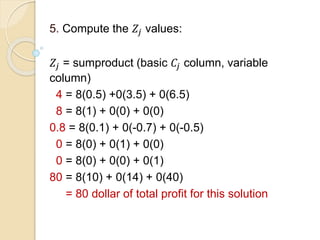
5. Compute the 𝑍𝑗 values:
𝑍𝑗 = sumproduct (basic 𝐶𝑗 column, variable
column)
4 = 8(0.5) +0(3.5) + 0(6.5)
8 = 8(1) + 0(0) + 0(0)
0.8 = 8(0.1) + 0(-0.7) + 0(-0.5)
0 = 8(0) + 0(1) + 0(0)
0 = 8(0) + 0(0) + 0(1)
80 = 8(10) + 0(14) + 0(40)
= 80 dollar of total profit for this solution
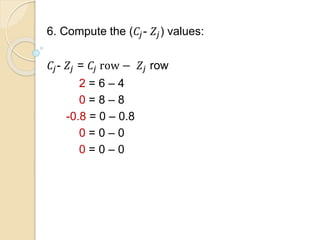
6. Compute the (𝐶𝑗- 𝑍𝑗) values:
𝐶𝑗- 𝑍𝑗 = 𝐶𝑗 row − 𝑍𝑗 row
2 = 6 – 4
0 = 8 – 8
-0.8 = 0 – 0.8
0 = 0 – 0
0 = 0 – 0
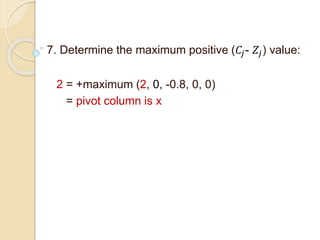
7. Determine the maximum positive (𝐶𝑗- 𝑍𝑗) value:
2 = +maximum (2, 0, -0.8, 0, 0)
= pivot column is x
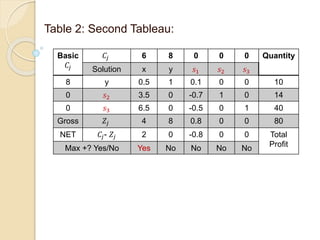
Table 2: Second Tableau:
Basic
𝐶𝑗
𝐶𝑗 6 8 0 0 0 Quantity
Solution x y 𝑠1 𝑠2 𝑠3
8 y 0.5 1 0.1 0 0 10
0 𝑠2 3.5 0 -0.7 1 0 14
0 𝑠3 6.5 0 -0.5 0 1 40
Gross 𝑍𝑗 4 8 0.8 0 0 80
NET 𝐶𝑗- 𝑍𝑗 2 0 -0.8 0 0 Total
ProfitMax +? Yes/No Yes No No No No
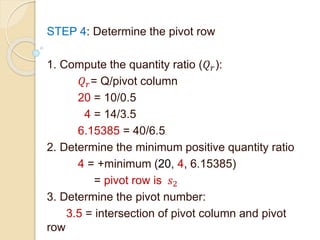
STEP 4: Determine the pivot row
1. Compute the quantity ratio (𝑄 𝑟):
𝑄 𝑟= Q/pivot column
20 = 10/0.5
4 = 14/3.5
6.15385 = 40/6.5
2. Determine the minimum positive quantity ratio
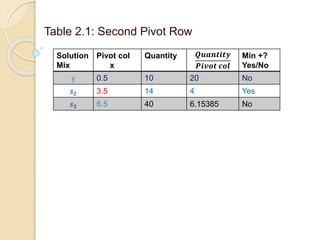
4 = +minimum (20, 4, 6.15385)
= pivot row is 𝑠2
3. Determine the pivot number:
3.5 = intersection of pivot column and pivot
row
Table 2.1: Second Pivot Row
Solution
Mix
Pivot col
x
Quantity 𝑸𝒖𝒂𝒏𝒕𝒊𝒕𝒚
𝑷𝒊𝒗𝒐𝒕 𝒄𝒐𝒍
Min +?
Yes/No
y 0.5 10 20 No
𝑠2 3.5 14 4 Yes
𝑠3 6.5 40 6.15385 No
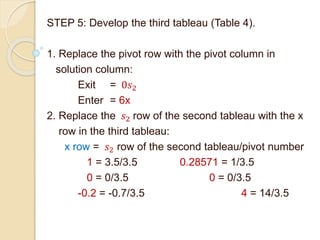
STEP 5: Develop the third tableau (Table 4).
1. Replace the pivot row with the pivot column in
solution column:
Exit = 0𝑠2
Enter = 6x
2. Replace the 𝑠2 row of the second tableau with the x
row in the third tableau:
x row = 𝑠2 row of the second tableau/pivot number
1 = 3.5/3.5 0.28571 = 1/3.5
0 = 0/3.5 0 = 0/3.5
-0.2 = -0.7/3.5 4 = 14/3.5
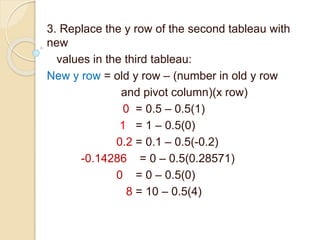
3. Replace the y row of the second tableau with
new
values in the third tableau:
New y row = old y row – (number in old y row
and pivot column)(x row)
0 = 0.5 – 0.5(1)
1 = 1 – 0.5(0)
0.2 = 0.1 – 0.5(-0.2)
-0.14286 = 0 – 0.5(0.28571)
0 = 0 – 0.5(0)
8 = 10 – 0.5(4)
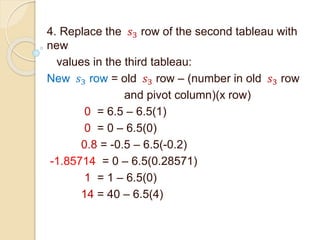
4. Replace the 𝑠3 row of the second tableau with
new
values in the third tableau:
New 𝑠3 row = old 𝑠3 row – (number in old 𝑠3 row
and pivot column)(x row)
0 = 6.5 – 6.5(1)
0 = 0 – 6.5(0)
0.8 = -0.5 – 6.5(-0.2)
-1.85714 = 0 – 6.5(0.28571)
1 = 1 – 6.5(0)
14 = 40 – 6.5(4)
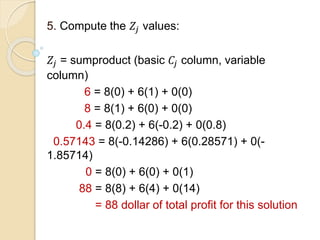
5. Compute the 𝑍𝑗 values:
𝑍𝑗 = sumproduct (basic 𝐶𝑗 column, variable
column)
6 = 8(0) + 6(1) + 0(0)
8 = 8(1) + 6(0) + 0(0)
0.4 = 8(0.2) + 6(-0.2) + 0(0.8)
0.57143 = 8(-0.14286) + 6(0.28571) + 0(-
1.85714)
0 = 8(0) + 6(0) + 0(1)
88 = 8(8) + 6(4) + 0(14)
= 88 dollar of total profit for this solution
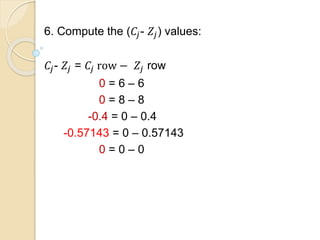
6. Compute the (𝐶𝑗- 𝑍𝑗) values:
𝐶𝑗- 𝑍𝑗 = 𝐶𝑗 row − 𝑍𝑗 row
0 = 6 – 6
0 = 8 – 8
-0.4 = 0 – 0.4
-0.57143 = 0 – 0.57143
0 = 0 – 0
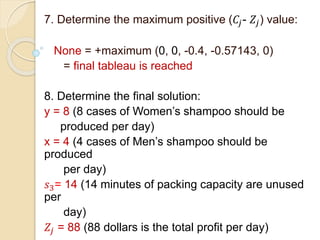
7. Determine the maximum positive (𝐶𝑗- 𝑍𝑗) value:
None = +maximum (0, 0, -0.4, -0.57143, 0)
= final tableau is reached
8. Determine the final solution:
y = 8 (8 cases of Women’s shampoo should be
produced per day)
x = 4 (4 cases of Men’s shampoo should be
produced
per day)
𝑠3= 14 (14 minutes of packing capacity are unused
per
day)
𝑍𝑗 = 88 (88 dollars is the total profit per day)
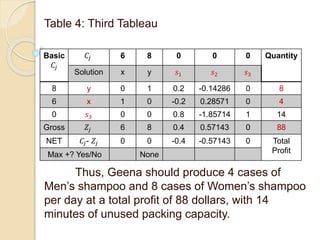
Table 4: Third Tableau
Thus, Geena should produce 4 cases of
Men’s shampoo and 8 cases of Women’s shampoo
per day at a total profit of 88 dollars, with 14
minutes of unused packing capacity.
Basic
𝐶𝑗
𝐶𝑗 6 8 0 0 0 Quantity
Solution x y 𝑠1 𝑠2 𝑠3
8 y 0 1 0.2 -0.14286 0 8
6 x 1 0 -0.2 0.28571 0 4
0 𝑠3 0 0 0.8 -1.85714 1 14
Gross 𝑍𝑗 6 8 0.4 0.57143 0 88
NET 𝐶𝑗- 𝑍𝑗 0 0 -0.4 -0.57143 0 Total
ProfitMax +? Yes/No None
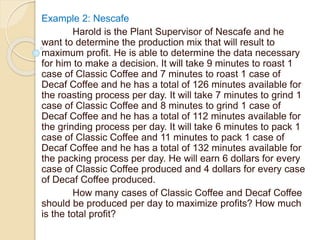
Example 2: Nescafe
Harold is the Plant Supervisor of Nescafe and he
want to determine the production mix that will result to
maximum profit. He is able to determine the data necessary
for him to make a decision. It will take 9 minutes to roast 1
case of Classic Coffee and 7 minutes to roast 1 case of
Decaf Coffee and he has a total of 126 minutes available for
the roasting process per day. It will take 7 minutes to grind 1
case of Classic Coffee and 8 minutes to grind 1 case of
Decaf Coffee and he has a total of 112 minutes available for
the grinding process per day. It will take 6 minutes to pack 1
case of Classic Coffee and 11 minutes to pack 1 case of
Decaf Coffee and he has a total of 132 minutes available for
the packing process per day. He will earn 6 dollars for every
case of Classic Coffee produced and 4 dollars for every case
of Decaf Coffee produced.
How many cases of Classic Coffee and Decaf Coffee
should be produced per day to maximize profits? How much
is the total profit?
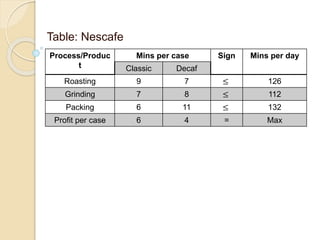
Table: Nescafe
Process/Produc
t
Mins per case Sign Mins per day
Classic Decaf
Roasting 9 7 ≤ 126
Grinding 7 8 ≤ 112
Packing 6 11 ≤ 132
Profit per case 6 4 = Max
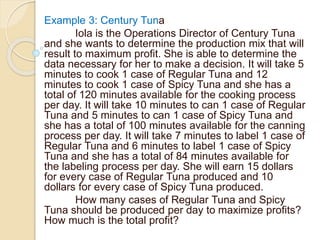
Example 3: Century Tuna
Iola is the Operations Director of Century Tuna
and she wants to determine the production mix that will
result to maximum profit. She is able to determine the
data necessary for her to make a decision. It will take 5
minutes to cook 1 case of Regular Tuna and 12
minutes to cook 1 case of Spicy Tuna and she has a
total of 120 minutes available for the cooking process
per day. It will take 10 minutes to can 1 case of Regular
Tuna and 5 minutes to can 1 case of Spicy Tuna and
she has a total of 100 minutes available for the canning
process per day. It will take 7 minutes to label 1 case of
Regular Tuna and 6 minutes to label 1 case of Spicy
Tuna and she has a total of 84 minutes available for
the labeling process per day. She will earn 15 dollars
for every case of Regular Tuna produced and 10
dollars for every case of Spicy Tuna produced.
How many cases of Regular Tuna and Spicy
Tuna should be produced per day to maximize profits?
How much is the total profit?
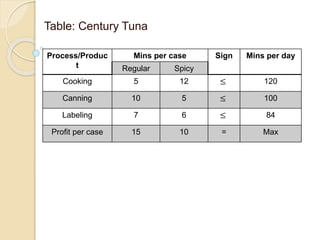
Table: Century Tuna
Process/Produc
t
Mins per case Sign Mins per day
Regular Spicy
Cooking 5 12 ≤ 120
Canning 10 5 ≤ 100
Labeling 7 6 ≤ 84
Profit per case 15 10 = Max
References:
1) Quantitative Techniques for Business
by Priscilla S. Altares, et.,al.
2) Quantitative Techniques in
Management
by Jonathan B. Cabero, et., al.
3) Quantitative Decision Models
by Edwin J. Loma
4) Quantitative Business Method
by David Anderson

Maximization simplex method

  • 1.
    Solving LPP bySimplex Method
  • 2.
    Example 1: ClearShampoo Geena is the Production Manager of Clear Shampoo and she wants to determine the production mix that will result in maximum profit. She is able to determine the data necessary for her to make a decision. It will take 5 minutes to mix 1 case of Men’s shampoo and 10 minutes to mix 1 case of Women’s shampoo and she has a total of 100 mins available for the mixing process per day. It will take 7 minutes to bottle 1 case of Men’s shampoo and 7 minutes to bottle 1 case of Women’s shampoo and she has a total of 84 mins available for the bottling process per day. It will take 9 minutes to pack 1 case of Men’s shampoo and 5 minutes to pack 1 case of Women’s shampoo and she has a total of 90 mins available for the packing process per day. She will earn 6 dollars for every case of Men’s shampoo produced and 8 dollars for every case of Women’s shampoo produced. How many cases of Men’s shampoo and Women’s shampoo should be produced per day to maximize profits? How much is the total profit?
  • 3.
    Table: Process/Product Mins percase Sign Mins per day Men Women Mixing 5 10 ≤ 100 Bottling 7 7 ≤ 84 Packing 9 5 ≤ 90 Profit per case 6 8 = Max
  • 4.
    Solution: STEP 1: Developthe initial tableau (Table 1). 1. Set up the variables. x = number of cases of Men’s shampoo to be produced per day y = number of cases of Women’s shampoo to be produced per day 𝑠1= slack 1 or unused minutes of constraint A (mixing) 𝑠2= slack 2 or unused minutes of constraint B (bottling) 𝑠 = slack 3 or unused minutes of constraint C
  • 5.
    2. Set upthe objective function where 0 is the assigned profit per unit of a slack variable: Maximize P = 6x + 8y + 0𝑠1 + 0𝑠2 + 0𝑠3
  • 6.
    3. Convert theconstraints into equalities. Constraint A (mixing) 5x + 10y ≤ 100 5x + 10y + 1𝑠1 + 0𝑠2 + 0𝑠3 = 100 Constraint B (bottling) 7x + 7y ≤ 84 7x+ 7y + 0𝑠1 + 2𝑠2 + 0𝑠3= 84 Constraint C (packing) 9x + 5y ≤ 90 9x + 5y + 0𝑠1 + 0𝑠2 + 3𝑠3= 90
  • 7.
    4. Compute the𝑍𝑗 values: 𝑍𝑗 = sumproduct (basic 𝐶𝑗 column, variable column) 0 = 0(5) +0(7) + 0(9) 0 = 0(10) + 0(7) + 0(5) 0 = 0(1) + 0(0) + 0(0) 0 = 0(0) + 0(1) + 0(0) 0 = 0(0) + 0(0) + 0(1) 0 = 0(100) + 0(84) + 0(90) = 0 dollar of total profit for this solution
  • 8.
    5. Compute the(𝐶𝑗- 𝑍𝑗) values: 𝐶𝑗- 𝑍𝑗 = 𝐶𝑗 row − 𝑍𝑗 row 6 = 6 – 0 8 = 8 – 0 0 = 0 – 0 0 = 0 – 0 0 = 0 – 0
  • 9.
    6. Determine themaximum positive (𝐶𝑗- 𝑍𝑗) value: 8 = +maximum (6, 8, 0, 0, 0) = pivot column is y
  • 10.
    Table 1: InitialTableau Basi c 𝐶𝑗 𝐶𝑗 6 8 0 0 0 Quantity Solution x y 𝑠1 𝑠2 𝑠3 0 𝑠1 5 10 1 0 0 100 0 𝑠2 7 7 0 1 0 84 0 𝑠3 9 5 0 0 1 90 Gros s 𝑍𝑗 0 0 0 0 0 0 NET 𝐶𝑗- 𝑍𝑗 6 8 0 0 0 Total ProfitMax +? Yes/No No Yes No No No
  • 11.
    STEP 2: Determinethe pivot row 1. Compute the quantity ratio (𝑄 𝑟): 𝑄 𝑟= Q/pivot column 10 = 100/10 12 = 84/7 18 = 90/5 2. Determine the minimum positive quantity ratio 10 = +minimum (10, 12, 18) = pivot row is 𝑠1 3. Determine the pivot number: 10 = intersection of pivot column and pivot row
  • 12.
    Table 1.1: FirstPivot Row Solution Mix Pivot col y Quantity 𝑸𝒖𝒂𝒏𝒕𝒊𝒕𝒚 𝑷𝒊𝒗𝒐𝒕 𝒄𝒐𝒍 Min +? Yes/No 𝑠1 10 100 10 Yes 𝑠2 7 84 12 No 𝑠3 5 90 8 No Pivot row
  • 13.
    STEP 3: Developthe second tableau (Table 2) 1. Replace the pivot row with the pivot column in solution column: Exit = 0𝑠1 Enter = 8 y 2. Replace the 𝑠1 row of the initial tableau with the y row in the second tableau: y row = 𝑠1 row of the initial tableau/pivot number 0.5 = 5/10 0 = 0/10 1 = 10/10 0 = 0/10
  • 14.
    3. Replace the𝑠2 row of the initial tableau with new values in the second tableau: New 𝑠2 row = old 𝑠2 row – (number in old 𝑠2 row and pivot column)(y row) 3.5 = 7 – 7(0.5) 0 = 7 – 7(1.0) -0.7 = 0 – 7(0.1) 1 = 1 – 7(0) 0 = 0 – 7(0) 14 = 84 – 7(10)
  • 15.
    4. Replace the𝑠3 row of the initial tableau with new values in the second tableau: New 𝑠3 row = old 𝑠3 row – (number in old 𝑠3 row and pivot column)(y row) 6.5 = 9 – 5(0.5) 0 = 5 – 5(1.0) -0.5 = 0 – 5(0.1) 0 = 0 – 5(0) 1 = 1 – 5(0) 40 = 90 – 5(10)
  • 16.
    5. Compute the𝑍𝑗 values: 𝑍𝑗 = sumproduct (basic 𝐶𝑗 column, variable column) 4 = 8(0.5) +0(3.5) + 0(6.5) 8 = 8(1) + 0(0) + 0(0) 0.8 = 8(0.1) + 0(-0.7) + 0(-0.5) 0 = 8(0) + 0(1) + 0(0) 0 = 8(0) + 0(0) + 0(1) 80 = 8(10) + 0(14) + 0(40) = 80 dollar of total profit for this solution
  • 17.
    6. Compute the(𝐶𝑗- 𝑍𝑗) values: 𝐶𝑗- 𝑍𝑗 = 𝐶𝑗 row − 𝑍𝑗 row 2 = 6 – 4 0 = 8 – 8 -0.8 = 0 – 0.8 0 = 0 – 0 0 = 0 – 0
  • 18.
    7. Determine themaximum positive (𝐶𝑗- 𝑍𝑗) value: 2 = +maximum (2, 0, -0.8, 0, 0) = pivot column is x
  • 19.
    Table 2: SecondTableau: Basic 𝐶𝑗 𝐶𝑗 6 8 0 0 0 Quantity Solution x y 𝑠1 𝑠2 𝑠3 8 y 0.5 1 0.1 0 0 10 0 𝑠2 3.5 0 -0.7 1 0 14 0 𝑠3 6.5 0 -0.5 0 1 40 Gross 𝑍𝑗 4 8 0.8 0 0 80 NET 𝐶𝑗- 𝑍𝑗 2 0 -0.8 0 0 Total ProfitMax +? Yes/No Yes No No No No
  • 20.
    STEP 4: Determinethe pivot row 1. Compute the quantity ratio (𝑄 𝑟): 𝑄 𝑟= Q/pivot column 20 = 10/0.5 4 = 14/3.5 6.15385 = 40/6.5 2. Determine the minimum positive quantity ratio 4 = +minimum (20, 4, 6.15385) = pivot row is 𝑠2 3. Determine the pivot number: 3.5 = intersection of pivot column and pivot row
  • 21.
    Table 2.1: SecondPivot Row Solution Mix Pivot col x Quantity 𝑸𝒖𝒂𝒏𝒕𝒊𝒕𝒚 𝑷𝒊𝒗𝒐𝒕 𝒄𝒐𝒍 Min +? Yes/No y 0.5 10 20 No 𝑠2 3.5 14 4 Yes 𝑠3 6.5 40 6.15385 No
  • 22.
    STEP 5: Developthe third tableau (Table 4). 1. Replace the pivot row with the pivot column in solution column: Exit = 0𝑠2 Enter = 6x 2. Replace the 𝑠2 row of the second tableau with the x row in the third tableau: x row = 𝑠2 row of the second tableau/pivot number 1 = 3.5/3.5 0.28571 = 1/3.5 0 = 0/3.5 0 = 0/3.5 -0.2 = -0.7/3.5 4 = 14/3.5
  • 23.
    3. Replace they row of the second tableau with new values in the third tableau: New y row = old y row – (number in old y row and pivot column)(x row) 0 = 0.5 – 0.5(1) 1 = 1 – 0.5(0) 0.2 = 0.1 – 0.5(-0.2) -0.14286 = 0 – 0.5(0.28571) 0 = 0 – 0.5(0) 8 = 10 – 0.5(4)
  • 24.
    4. Replace the𝑠3 row of the second tableau with new values in the third tableau: New 𝑠3 row = old 𝑠3 row – (number in old 𝑠3 row and pivot column)(x row) 0 = 6.5 – 6.5(1) 0 = 0 – 6.5(0) 0.8 = -0.5 – 6.5(-0.2) -1.85714 = 0 – 6.5(0.28571) 1 = 1 – 6.5(0) 14 = 40 – 6.5(4)
  • 25.
    5. Compute the𝑍𝑗 values: 𝑍𝑗 = sumproduct (basic 𝐶𝑗 column, variable column) 6 = 8(0) + 6(1) + 0(0) 8 = 8(1) + 6(0) + 0(0) 0.4 = 8(0.2) + 6(-0.2) + 0(0.8) 0.57143 = 8(-0.14286) + 6(0.28571) + 0(- 1.85714) 0 = 8(0) + 6(0) + 0(1) 88 = 8(8) + 6(4) + 0(14) = 88 dollar of total profit for this solution
  • 26.
    6. Compute the(𝐶𝑗- 𝑍𝑗) values: 𝐶𝑗- 𝑍𝑗 = 𝐶𝑗 row − 𝑍𝑗 row 0 = 6 – 6 0 = 8 – 8 -0.4 = 0 – 0.4 -0.57143 = 0 – 0.57143 0 = 0 – 0
  • 27.
    7. Determine themaximum positive (𝐶𝑗- 𝑍𝑗) value: None = +maximum (0, 0, -0.4, -0.57143, 0) = final tableau is reached 8. Determine the final solution: y = 8 (8 cases of Women’s shampoo should be produced per day) x = 4 (4 cases of Men’s shampoo should be produced per day) 𝑠3= 14 (14 minutes of packing capacity are unused per day) 𝑍𝑗 = 88 (88 dollars is the total profit per day)
  • 28.
    Table 4: ThirdTableau Thus, Geena should produce 4 cases of Men’s shampoo and 8 cases of Women’s shampoo per day at a total profit of 88 dollars, with 14 minutes of unused packing capacity. Basic 𝐶𝑗 𝐶𝑗 6 8 0 0 0 Quantity Solution x y 𝑠1 𝑠2 𝑠3 8 y 0 1 0.2 -0.14286 0 8 6 x 1 0 -0.2 0.28571 0 4 0 𝑠3 0 0 0.8 -1.85714 1 14 Gross 𝑍𝑗 6 8 0.4 0.57143 0 88 NET 𝐶𝑗- 𝑍𝑗 0 0 -0.4 -0.57143 0 Total ProfitMax +? Yes/No None
  • 29.
    Example 2: Nescafe Haroldis the Plant Supervisor of Nescafe and he want to determine the production mix that will result to maximum profit. He is able to determine the data necessary for him to make a decision. It will take 9 minutes to roast 1 case of Classic Coffee and 7 minutes to roast 1 case of Decaf Coffee and he has a total of 126 minutes available for the roasting process per day. It will take 7 minutes to grind 1 case of Classic Coffee and 8 minutes to grind 1 case of Decaf Coffee and he has a total of 112 minutes available for the grinding process per day. It will take 6 minutes to pack 1 case of Classic Coffee and 11 minutes to pack 1 case of Decaf Coffee and he has a total of 132 minutes available for the packing process per day. He will earn 6 dollars for every case of Classic Coffee produced and 4 dollars for every case of Decaf Coffee produced. How many cases of Classic Coffee and Decaf Coffee should be produced per day to maximize profits? How much is the total profit?
  • 30.
    Table: Nescafe Process/Produc t Mins percase Sign Mins per day Classic Decaf Roasting 9 7 ≤ 126 Grinding 7 8 ≤ 112 Packing 6 11 ≤ 132 Profit per case 6 4 = Max
  • 31.
    Example 3: CenturyTuna Iola is the Operations Director of Century Tuna and she wants to determine the production mix that will result to maximum profit. She is able to determine the data necessary for her to make a decision. It will take 5 minutes to cook 1 case of Regular Tuna and 12 minutes to cook 1 case of Spicy Tuna and she has a total of 120 minutes available for the cooking process per day. It will take 10 minutes to can 1 case of Regular Tuna and 5 minutes to can 1 case of Spicy Tuna and she has a total of 100 minutes available for the canning process per day. It will take 7 minutes to label 1 case of Regular Tuna and 6 minutes to label 1 case of Spicy Tuna and she has a total of 84 minutes available for the labeling process per day. She will earn 15 dollars for every case of Regular Tuna produced and 10 dollars for every case of Spicy Tuna produced. How many cases of Regular Tuna and Spicy Tuna should be produced per day to maximize profits? How much is the total profit?
  • 32.
    Table: Century Tuna Process/Produc t Minsper case Sign Mins per day Regular Spicy Cooking 5 12 ≤ 120 Canning 10 5 ≤ 100 Labeling 7 6 ≤ 84 Profit per case 15 10 = Max
  • 33.
    References: 1) Quantitative Techniquesfor Business by Priscilla S. Altares, et.,al. 2) Quantitative Techniques in Management by Jonathan B. Cabero, et., al. 3) Quantitative Decision Models by Edwin J. Loma 4) Quantitative Business Method by David Anderson