-- B. Kedhar Guhan --
        -- X D --
         -- 34 --
In this PPT, we would first recap what we had learnt
in 9th.-

•   Histograms : SLIDE 3

•   Frequency polygons: SLIDE 4

•   Numerical representatives of ungrouped data:
    SLIDE 5
Then we sneak-a-peek on-

   Central Tendencies of a Grouped Data:   SLIDE 7
   Grouped Data :                          SLIDE 8
   Mean of a grouped data:                 SLIDE 9
   Direct Method:                          SLIDE 11
   Assumed mean method:                    SLIDE 13
   Step deviation Method:                  SLIDE 15
   Mode:                                   SLIDE 16
   Concept of Cumulative Frequency:        SLIDE 17
•   Median:                                 SLIDE 18
•   Ogives :                                SLIDE 20
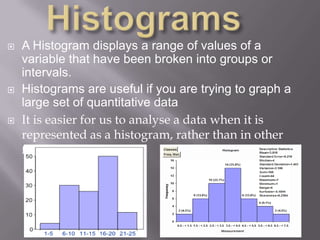
   A Histogram displays a range of values of a
    variable that have been broken into groups or
    intervals.
   Histograms are useful if you are trying to graph a
    large set of quantitative data
   It is easier for us to analyse a data when it is
    represented as a histogram, rather than in other
    forms.
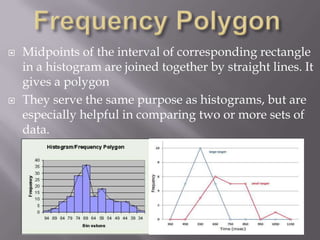
   Midpoints of the interval of corresponding rectangle
    in a histogram are joined together by straight lines. It
    gives a polygon
   They serve the same purpose as histograms, but are
    especially helpful in comparing two or more sets of
    data.
1.  Arithmetic Mean: (or Average)
• Sum of all observation divided by
  the Number of observation.
• Let x1,x2,x3,x4 ….xn be obs.( thus
  there are „n‟ number of scores)
   Then Average =
(x1+x2+x3+x4 ….+xn)/n
2   Median: When the data is arranged
    in ascending or descending order,
    the middle observation is the
    MEDIAN of the data. If n is even,
    the median is the average of the
    n/2nd and (n/2+1/2 )nd observation.

3   Mode: It is the observation that has
    the highest frequency.
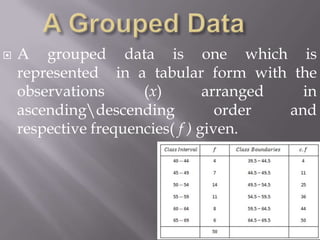
   A grouped data is one which is
    represented in a tabular form with the
    observations      (x)        arranged   in
    ascendingdescending           order  and
    respective frequencies( f ) given.
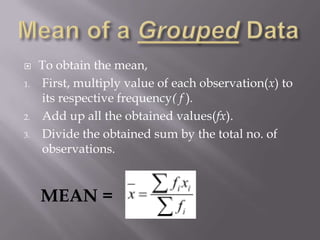
    To obtain the mean,
1.   First, multiply value of each observation(x) to
     its respective frequency( f ).
2.   Add up all the obtained values(fx).
3.   Divide the obtained sum by the total no. of
     observations.


     MEAN =
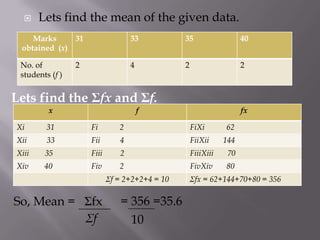
    Lets find the mean of the given data.
    Marks     31                   33           35                   40
 obtained (x)

 No. of          2                 4            2                    2
 students (f )


Lets find the Σfx and Σf.
         x                             f                             fx

Xi       31          Fi        2                    FiXi       62
Xii      33          Fii       4                    FiiXii     144
Xiii    35           Fiii      2                    FiiiXiii    70
Xiv     40           Fiv       2                    FivXiv     80
                            Σf = 2+2+2+4 = 10       Σfx = 62+144+70+80 = 356

So, Mean = Σfx                 = 356 =35.6
           Σf                    10
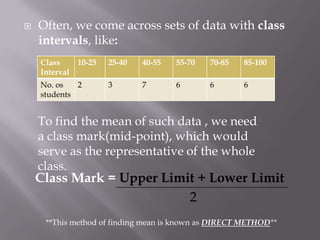
   Often, we come across sets of data with class
    intervals, like:
    Class      10-25   25-40   40-55   55-70   70-85   85-100
    Interval
    No. os   2         3       7       6       6       6
    students


    To find the mean of such data , we need
    a class mark(mid-point), which would
    serve as the representative of the whole
    class.
    Class Mark = Upper Limit + Lower Limit
                           2
     **This method of finding mean is known as DIRECT METHOD**
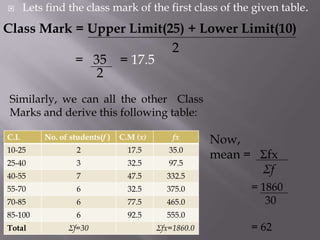
      Lets find the class mark of the first class of the given table.
Class Mark = Upper Limit(25) + Lower Limit(10)
                          2
           = 35 = 17.5
              2
 Similarly, we can all the other Class
 Marks and derive this following table:

C.I.       No. of students(f )   C.M (x)       fx       Now,
10-25               2              17.5       35.0
                                                        mean = Σfx
25-40               3              32.5       97.5
40-55               7              47.5      332.5
                                                               Σf
55-70               6              32.5      375.0            = 1860
70-85               6              77.5      465.0               30
85-100              6              92.5      555.0
Total            Σf=30                     Σfx=1860.0         = 62
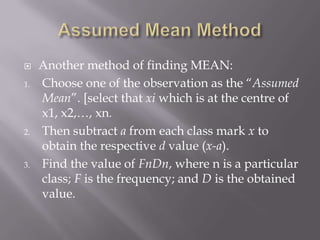
    Another method of finding MEAN:
1.   Choose one of the observation as the “Assumed
     Mean”. [select that xi which is at the centre of
     x1, x2,…, xn.
2.   Then subtract a from each class mark x to
     obtain the respective d value (x-a).
3.   Find the value of FnDn, where n is a particular
     class; F is the frequency; and D is the obtained
     value.
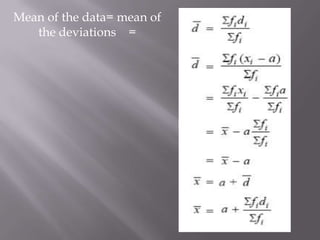
Mean of the data= mean of
   the deviations =
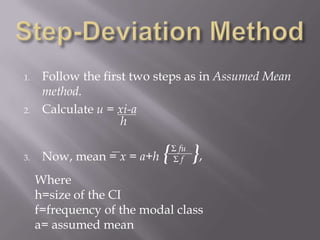
1.    Follow the first two steps as in Assumed Mean
      method.
2.    Calculate u = xi-a
                     h

3.    Now, mean = x = a+h   { },
                             Σ fu
                             Σf

     Where
     h=size of the CI
     f=frequency of the modal class
     a= assumed mean
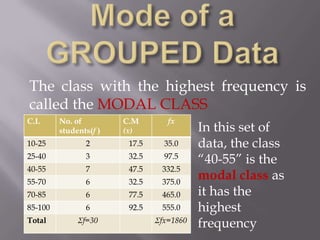
The class with the highest frequency is
called the MODAL CLASS
C.I.     No. of         C.M        fx
         students(f )   (x)                In this set of
10-25           2        17.5     35.0     data, the class
25-40           3        32.5     97.5
                                           “40-55” is the
40-55           7        47.5    332.5
55-70           6        32.5    375.0
                                           modal class as
70-85           6        77.5    465.0     it has the
85-100          6        92.5    555.0     highest
Total         Σf=30             Σfx=1860
                                           frequency
   It‟s the „running total‟ of frequencies.
   It‟s the frequency obtained by adding the of all
    the preceding classes.
   When the class is taken as less than [the Upper
    limit of the CI], the cumulative frequencies is
    said to be the less than type.
   When the class is taken as more than [the lower
    limit of the CI], the cumulative frequencies is
    said to be the more than type.
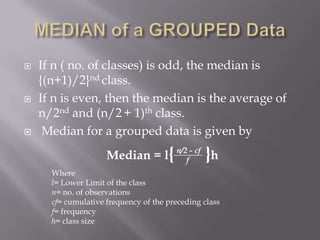
   If n ( no. of classes) is odd, the median is
    {(n+1)/2}nd class.
   If n is even, then the median is the average of
    n/2nd and (n/2 + 1)th class.
    Median for a grouped data is given by
                     Median = l{ n/2f- cf }h
      Where
      l= Lower Limit of the class
      n= no. of observations
      cf= cumulative frequency of the preceding class
      f= frequency
      h= class size
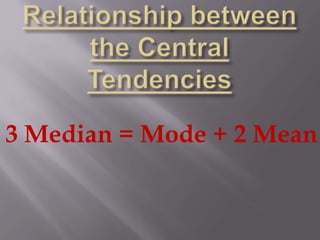
3 Median = Mode + 2 Mean
   Cumulative frequency distribution can be
    graphically represented as a cumulative
    frequency curve( Ogive )
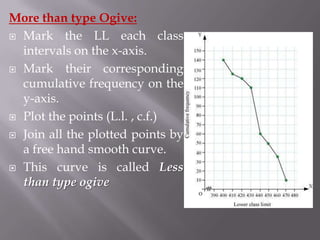
More than type Ogive:
 Mark the LL each class
  intervals on the x-axis.
 Mark     their corresponding
  cumulative frequency on the
  y-axis.
 Plot the points (L.l. , c.f.)

 Join all the plotted points by
  a free hand smooth curve.
 This curve is called Less
  than type ogive
Less than type Ogive :

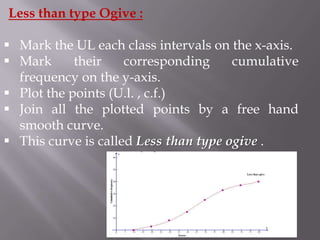
 Mark the UL each class intervals on the x-axis.
 Mark      their    corresponding     cumulative
  frequency on the y-axis.
 Plot the points (U.l. , c.f.)
 Join all the plotted points by a free hand
  smooth curve.
 This curve is called Less than type ogive .
METHOD 1
   Locate n/2 on the y-axis.
   From here, draw a line parallel to x-axis, cutting
    an ogive ( less/more than type) at a point.
   From this point, drop a perpendicular to x-axis.
   The point of intersection of this perpendicular
    and the x-axis determines the median of the
    data.
METHOD 2:

   Draw Both the Ogives of the data.
   From the point of intersection of these
    Ogives, draw a perpendicular on the x-axis.
   The point of intersection of the
    perpendicular and the x-axis determines.
-- B. Kedhar Guhan --
        -- X D --
         -- 34 --

Statistics

  • 1.
    -- B. KedharGuhan -- -- X D -- -- 34 --
  • 2.
    In this PPT,we would first recap what we had learnt in 9th.- • Histograms : SLIDE 3 • Frequency polygons: SLIDE 4 • Numerical representatives of ungrouped data: SLIDE 5
  • 3.
    Then we sneak-a-peekon-  Central Tendencies of a Grouped Data: SLIDE 7  Grouped Data : SLIDE 8  Mean of a grouped data: SLIDE 9  Direct Method: SLIDE 11  Assumed mean method: SLIDE 13  Step deviation Method: SLIDE 15  Mode: SLIDE 16  Concept of Cumulative Frequency: SLIDE 17 • Median: SLIDE 18 • Ogives : SLIDE 20
  • 4.
    A Histogram displays a range of values of a variable that have been broken into groups or intervals.  Histograms are useful if you are trying to graph a large set of quantitative data  It is easier for us to analyse a data when it is represented as a histogram, rather than in other forms.
  • 5.
    Midpoints of the interval of corresponding rectangle in a histogram are joined together by straight lines. It gives a polygon  They serve the same purpose as histograms, but are especially helpful in comparing two or more sets of data.
  • 6.
    1. ArithmeticMean: (or Average) • Sum of all observation divided by the Number of observation. • Let x1,x2,x3,x4 ….xn be obs.( thus there are „n‟ number of scores) Then Average = (x1+x2+x3+x4 ….+xn)/n
  • 7.
    2 Median: When the data is arranged in ascending or descending order, the middle observation is the MEDIAN of the data. If n is even, the median is the average of the n/2nd and (n/2+1/2 )nd observation. 3 Mode: It is the observation that has the highest frequency.
  • 8.
    A grouped data is one which is represented in a tabular form with the observations (x) arranged in ascendingdescending order and respective frequencies( f ) given.
  • 9.
    To obtain the mean, 1. First, multiply value of each observation(x) to its respective frequency( f ). 2. Add up all the obtained values(fx). 3. Divide the obtained sum by the total no. of observations. MEAN =
  • 10.
    Lets find the mean of the given data. Marks 31 33 35 40 obtained (x) No. of 2 4 2 2 students (f ) Lets find the Σfx and Σf. x f fx Xi 31 Fi 2 FiXi 62 Xii 33 Fii 4 FiiXii 144 Xiii 35 Fiii 2 FiiiXiii 70 Xiv 40 Fiv 2 FivXiv 80 Σf = 2+2+2+4 = 10 Σfx = 62+144+70+80 = 356 So, Mean = Σfx = 356 =35.6 Σf 10
  • 11.
    Often, we come across sets of data with class intervals, like: Class 10-25 25-40 40-55 55-70 70-85 85-100 Interval No. os 2 3 7 6 6 6 students To find the mean of such data , we need a class mark(mid-point), which would serve as the representative of the whole class. Class Mark = Upper Limit + Lower Limit 2 **This method of finding mean is known as DIRECT METHOD**
  • 12.
    Lets find the class mark of the first class of the given table. Class Mark = Upper Limit(25) + Lower Limit(10) 2 = 35 = 17.5 2 Similarly, we can all the other Class Marks and derive this following table: C.I. No. of students(f ) C.M (x) fx Now, 10-25 2 17.5 35.0 mean = Σfx 25-40 3 32.5 97.5 40-55 7 47.5 332.5 Σf 55-70 6 32.5 375.0 = 1860 70-85 6 77.5 465.0 30 85-100 6 92.5 555.0 Total Σf=30 Σfx=1860.0 = 62
  • 13.
    Another method of finding MEAN: 1. Choose one of the observation as the “Assumed Mean”. [select that xi which is at the centre of x1, x2,…, xn. 2. Then subtract a from each class mark x to obtain the respective d value (x-a). 3. Find the value of FnDn, where n is a particular class; F is the frequency; and D is the obtained value.
  • 14.
    Mean of thedata= mean of the deviations =
  • 15.
    1. Follow the first two steps as in Assumed Mean method. 2. Calculate u = xi-a h 3. Now, mean = x = a+h { }, Σ fu Σf Where h=size of the CI f=frequency of the modal class a= assumed mean
  • 16.
    The class withthe highest frequency is called the MODAL CLASS C.I. No. of C.M fx students(f ) (x) In this set of 10-25 2 17.5 35.0 data, the class 25-40 3 32.5 97.5 “40-55” is the 40-55 7 47.5 332.5 55-70 6 32.5 375.0 modal class as 70-85 6 77.5 465.0 it has the 85-100 6 92.5 555.0 highest Total Σf=30 Σfx=1860 frequency
  • 17.
    It‟s the „running total‟ of frequencies.  It‟s the frequency obtained by adding the of all the preceding classes.  When the class is taken as less than [the Upper limit of the CI], the cumulative frequencies is said to be the less than type.  When the class is taken as more than [the lower limit of the CI], the cumulative frequencies is said to be the more than type.
  • 18.
    If n ( no. of classes) is odd, the median is {(n+1)/2}nd class.  If n is even, then the median is the average of n/2nd and (n/2 + 1)th class.  Median for a grouped data is given by Median = l{ n/2f- cf }h Where l= Lower Limit of the class n= no. of observations cf= cumulative frequency of the preceding class f= frequency h= class size
  • 19.
    3 Median =Mode + 2 Mean
  • 20.
    Cumulative frequency distribution can be graphically represented as a cumulative frequency curve( Ogive )
  • 21.
    More than typeOgive:  Mark the LL each class intervals on the x-axis.  Mark their corresponding cumulative frequency on the y-axis.  Plot the points (L.l. , c.f.)  Join all the plotted points by a free hand smooth curve.  This curve is called Less than type ogive
  • 22.
    Less than typeOgive :  Mark the UL each class intervals on the x-axis.  Mark their corresponding cumulative frequency on the y-axis.  Plot the points (U.l. , c.f.)  Join all the plotted points by a free hand smooth curve.  This curve is called Less than type ogive .
  • 23.
    METHOD 1  Locate n/2 on the y-axis.  From here, draw a line parallel to x-axis, cutting an ogive ( less/more than type) at a point.  From this point, drop a perpendicular to x-axis.  The point of intersection of this perpendicular and the x-axis determines the median of the data.
  • 24.
    METHOD 2:  Draw Both the Ogives of the data.  From the point of intersection of these Ogives, draw a perpendicular on the x-axis.  The point of intersection of the perpendicular and the x-axis determines.
  • 25.
    -- B. KedharGuhan -- -- X D -- -- 34 --