PATTERNS OF DEVELOPMENT
I. NARRATION
I. NARRATION
• the most basic pattern of written text
• describes how, when, and where an event
or occurrence actually happened
• used to tell a story or focus on a set of
related events
Components of Narrative Texts
A. LOGICAL ACTIONS
• are considered the very movements within
the plot or the narrative that drive the
characters forward, be it during the
dialogue, or within a scene
EXAMPLE:
It was late spring the last time we saw Ross. He
was standing at the edge of the hill, and he never so much
as looked up even though we were sure he knew we were
there. There was a bunch of flowers clutched to his fist,
but there really was no reason for him to be standing
there. We knew that Carrie wasn't coming to see him. But
he stood there anyway, waiting, even as the afternoon
sunlight deepened towards the evening. He must have
been standing there for hours.
B. WAY OF NARRATION
• refers to how the writer presents the story
• includes the pace by which scenes are
given out
*Having natural progression of time to the
events of the story makes a good writing.
B. WAYS OF NARRATION
• CLIPPED NARRATION
• PACED NARRATION
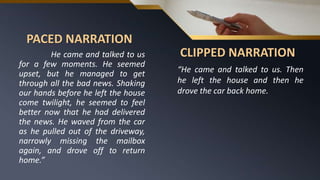
PACED NARRATION
He came and talked to us for a few
moments. He seemed upset, but he managed to
get through all the bad news. Shaking our hands
before he left the house come twilight, he seemed
to feel better now that he had delivered the news.
He waved from the car as he pulled out of the
driveway, narrowly missing the mailbox again,
and drove off to return home.”
CLIPPED NARRATION
“He came and talked to us. Then he left the
house and then he drove the car back
home.”
PACED NARRATION
He came and talked to us
for a few moments. He seemed
upset, but he managed to get
through all the bad news. Shaking
our hands before he left the house
come twilight, he seemed to feel
better now that he had delivered
the news. He waved from the car
as he pulled out of the driveway,
narrowly missing the mailbox
again, and drove off to return
home.”
CLIPPED NARRATION
“He came and talked to us. Then
he left the house and then he
drove the car back home.
C. TERMINOLOGY
• places emphasis on the fact that concepts
are critical to the narration
*Writers must choose how to address terms
and which ones they want to use in order to
create an appropriate setting.
C. TERMINOLOGY
• CONCRETE TERMS
• ABSTRACT TERMS
• GENERAL TERMS
• SPECIFIC TERMS
CONCRETE TERMS
• words that identify things, places, and
events that can be measured and
observed
• terms that have physical manifestation in
our world
EXAMPLES
• Classrooms
• School materials
• Books
• Buildings
• Flash drive
ABSTRACT TERMS
• refer to ideas or concepts that are
intangible
EXAMPLES:
love, freedom, hope, feminism, maturity,
justice, peace, integrity, etc.
GENERAL TERMS
• commonly used to denote groups
• these are broad in nature
SPECIFIC TERMS
• refer to an individual component of the
group
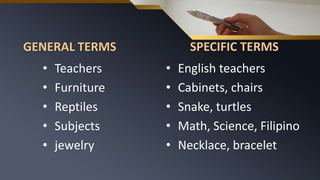
GENERAL TERMS
• Teachers
• Furniture
• Reptiles
• Subjects
• jewelry
SPECIFIC TERMS
• English teachers
• Cabinets, chairs
• Snake, turtles
• Math, Science, Filipino
• Necklace, bracelet
LET’S TRY!
“He was shivering violently from the cold.”
“The joy in the air was palpable.”
“Learning English will help us improve our
grammar.”
“He was given a failed grade in all his
subjects.”
II. DESCRIPTION
II. DESCRIPTION
• the pattern of development which goes
into details about a specific object, person,
or location, in order to firmly set its
appearance
What does it look like?
What are its characteristics?
Characteristics of Description
II. DESCRIPTION
• has a clear focus and sense of purpose
• uses sensory details and precise words
• presents details in a logical order
Varieties of Description
A. OBJECTIVE DESCRIPTION
• looks into factual and scientific
characteristics of what is being described
as objectively as possible
• The writer stays away from emotional
impressions or responses and instead,
describes the scene as it is.
EXAMPLE:
The Acer barbatum is a small to medium-sized,
deciduous tree usually ranging from 15 to 25 m. (50 to 80
ft.) tall when mature. Its bark is light gray and smooth on
younger trees, and it becomes ridged and furrowed with
age. Leaves are opposite and shallowly to deeply
palmately lobed, with a few blunt teeth but no serrations.
The leaf sinuses are rounded, unlike those of red maple
(Acer rubrum) which are sharply V-shaped.
B. SUBJECTIVE DESCRIPTION
• a sort of description that the author would
normally use to “paint a picture” of how he
sees a character, or how he wants the reader
to see a character
• also used in a literary discourse when there is
stereotyped image that can be attributed to
a person, place, or an event.
EXAMPLE:
My mother had hair so dark that it looked like a
waterfall of ink. She always kept it in a braid that fell to
her slim waist, and always tied with a plain black band.
The braid of black slung over her shoulder, the plaits
shining like scales.
III. DEFINITION
III. DEFINITION
• explains not just what something means
or is, but also what something does, what
something is used for, what something
looks like, etc.
Varieties of Definition
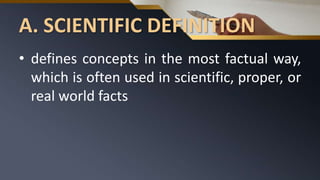
A. SCIENTIFIC DEFINITION
• defines concepts in the most factual way,
which is often used in scientific, proper, or
real world facts
A. SCIENTIFIC DEFINITION
• defines concepts in the most factual way,
which is often used in scientific, proper, or
real world facts
A. SUBJECTIVE DEFINITION
• defines the objects in a more personal way
• usually derived from the author's own
experiences and opinion
• often used by a writer to state something
from the point of view of the characters or in
relation to the setting
The term could be emphasized by the
following:
1. Characteristics or features
2. Function
3. Effect
4. Origin
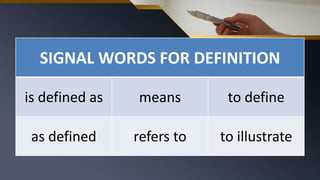
SIGNAL WORDS FOR DEFINITION
is defined as means to define
as defined refers to to illustrate
IV. CLASSIFICATION &
EXEMPLIFICATION
IV. CLASSIFICATION
• divides things into groups, classes, or
categories
• organizes ideas into divisions based on
criteria or standards
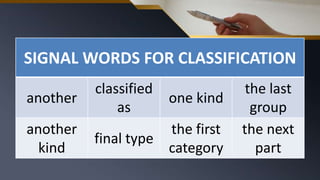
SIGNAL WORDS FOR CLASSIFICATION
another
classified
as
one kind
the last
group
another
kind
final type
the first
category
the next
part
IV. EXEMPLIFICATION
• provides examples and illustrations in
order to further clarify or explain the
concept or subject matter
• presents the general statement and then
provides specific and concrete examples
to expound on the main idea
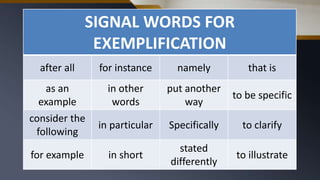
SIGNAL WORDS FOR
EXEMPLIFICATION
after all for instance namely that is
as an
example
in other
words
put another
way
to be specific
consider the
following
in particular Specifically to clarify
for example in short
stated
differently
to illustrate
LET’S TRY!
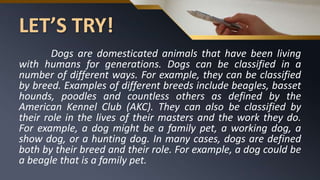
Dogs are domesticated animals that have been living
with humans for generations. Dogs can be classified in a
number of different ways. For example, they can be classified
by breed. Examples of different breeds include beagles, basset
hounds, poodles and countless others as defined by the
American Kennel Club (AKC). They can also be classified by
their role in the lives of their masters and the work they do.
For example, a dog might be a family pet, a working dog, a
show dog, or a hunting dog. In many cases, dogs are defined
both by their breed and their role. For example, a dog could be
a beagle that is a family pet.
V. COMPARISON AND
CONTRAST
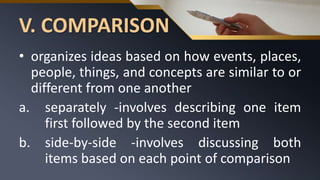
V. COMPARISON
• organizes ideas based on how events, places,
people, things, and concepts are similar to or
different from one another
a. separately -involves describing one item
first followed by the second item
b. side-by-side -involves discussing both
items based on each point of comparison
EXAMPLE:
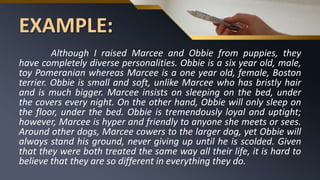
Although I raised Marcee and Obbie from puppies, they
have completely diverse personalities. Obbie is a six year old, male,
toy Pomeranian whereas Marcee is a one year old, female, Boston
terrier. Obbie is small and soft, unlike Marcee who has bristly hair
and is much bigger. Marcee insists on sleeping on the bed, under
the covers every night. On the other hand, Obbie will only sleep on
the floor, under the bed. Obbie is tremendously loyal and uptight;
however, Marcee is hyper and friendly to anyone she meets or sees.
Around other dogs, Marcee cowers to the larger dog, yet Obbie will
always stand his ground, never giving up until he is scolded. Given
that they were both treated the same way all their life, it is hard to
believe that they are so different in everything they do.
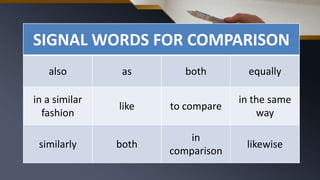
SIGNAL WORDS FOR COMPARISON
also as both equally
in a similar
fashion
like to compare
in the same
way
similarly both
in
comparison
likewise
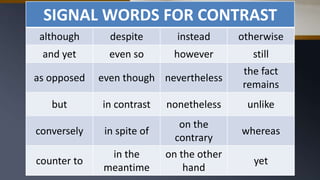
SIGNAL WORDS FOR CONTRAST
although despite instead otherwise
and yet even so however still
as opposed even though nevertheless
the fact
remains
but in contrast nonetheless unlike
conversely in spite of
on the
contrary
whereas
counter to
in the
meantime
on the other
hand
yet
VI. CAUSE AND EFFECT
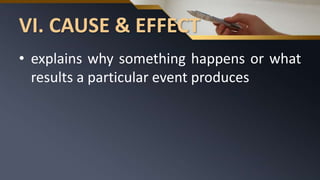
VI. CAUSE & EFFECT
• explains why something happens or what
results a particular event produces
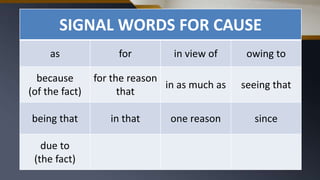
SIGNAL WORDS FOR CAUSE
as for in view of owing to
because
(of the fact)
for the reason
that
in as much as seeing that
being that in that one reason since
due to
(the fact)
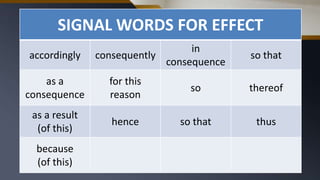
SIGNAL WORDS FOR EFFECT
accordingly consequently
in
consequence
so that
as a
consequence
for this
reason
so thereof
as a result
(of this)
hence so that thus
because
(of this)
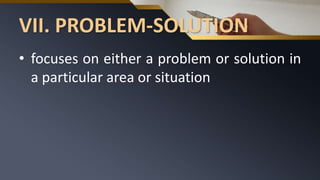
VII. PROBLEM-SOLUTION
• focuses on either a problem or solution in
a particular area or situation
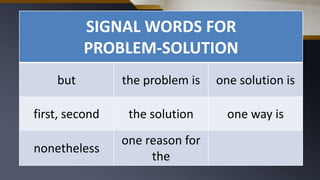
SIGNAL WORDS FOR
PROBLEM-SOLUTION
but the problem is one solution is
first, second the solution one way is
nonetheless
one reason for
the
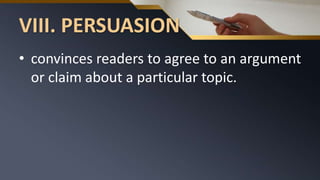
VIII. PERSUASION
• convinces readers to agree to an argument
or claim about a particular topic.
SIGNAL WORDS FOR
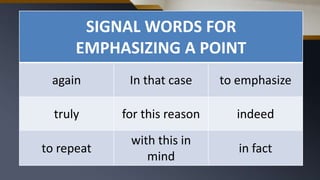
EMPHASIZING A POINT
again In that case to emphasize
truly for this reason indeed
to repeat
with this in
mind
in fact
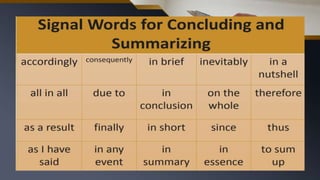
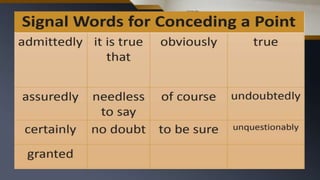
OTHER SIGNALING WORDS
No part of this material may be reproduced or transmitted in any form or by any means-
electronic or mechanical including photocopying- without written permission from the teacher.
Copyright © 2021 Polytechnic College of La Union Basic Education Department.
All rights reserved.
END 
Thank you for listening!

R&W-LESSON 5 (PATTERNS OF DEVELOPMENT).pptx

  • 1.
  • 2.
  • 3.
    I. NARRATION • themost basic pattern of written text • describes how, when, and where an event or occurrence actually happened • used to tell a story or focus on a set of related events
  • 4.
  • 5.
    A. LOGICAL ACTIONS •are considered the very movements within the plot or the narrative that drive the characters forward, be it during the dialogue, or within a scene
  • 6.
    EXAMPLE: It was latespring the last time we saw Ross. He was standing at the edge of the hill, and he never so much as looked up even though we were sure he knew we were there. There was a bunch of flowers clutched to his fist, but there really was no reason for him to be standing there. We knew that Carrie wasn't coming to see him. But he stood there anyway, waiting, even as the afternoon sunlight deepened towards the evening. He must have been standing there for hours.
  • 7.
    B. WAY OFNARRATION • refers to how the writer presents the story • includes the pace by which scenes are given out *Having natural progression of time to the events of the story makes a good writing.
  • 8.
    B. WAYS OFNARRATION • CLIPPED NARRATION • PACED NARRATION
  • 9.
    PACED NARRATION He cameand talked to us for a few moments. He seemed upset, but he managed to get through all the bad news. Shaking our hands before he left the house come twilight, he seemed to feel better now that he had delivered the news. He waved from the car as he pulled out of the driveway, narrowly missing the mailbox again, and drove off to return home.”
  • 10.
    CLIPPED NARRATION “He cameand talked to us. Then he left the house and then he drove the car back home.”
  • 11.
    PACED NARRATION He cameand talked to us for a few moments. He seemed upset, but he managed to get through all the bad news. Shaking our hands before he left the house come twilight, he seemed to feel better now that he had delivered the news. He waved from the car as he pulled out of the driveway, narrowly missing the mailbox again, and drove off to return home.” CLIPPED NARRATION “He came and talked to us. Then he left the house and then he drove the car back home.
  • 12.
    C. TERMINOLOGY • placesemphasis on the fact that concepts are critical to the narration *Writers must choose how to address terms and which ones they want to use in order to create an appropriate setting.
  • 13.
    C. TERMINOLOGY • CONCRETETERMS • ABSTRACT TERMS • GENERAL TERMS • SPECIFIC TERMS
  • 14.
    CONCRETE TERMS • wordsthat identify things, places, and events that can be measured and observed • terms that have physical manifestation in our world
  • 15.
    EXAMPLES • Classrooms • Schoolmaterials • Books • Buildings • Flash drive
  • 16.
    ABSTRACT TERMS • referto ideas or concepts that are intangible EXAMPLES: love, freedom, hope, feminism, maturity, justice, peace, integrity, etc.
  • 17.
    GENERAL TERMS • commonlyused to denote groups • these are broad in nature
  • 18.
    SPECIFIC TERMS • referto an individual component of the group
  • 19.
    GENERAL TERMS • Teachers •Furniture • Reptiles • Subjects • jewelry SPECIFIC TERMS • English teachers • Cabinets, chairs • Snake, turtles • Math, Science, Filipino • Necklace, bracelet
  • 20.
    LET’S TRY! “He wasshivering violently from the cold.” “The joy in the air was palpable.” “Learning English will help us improve our grammar.” “He was given a failed grade in all his subjects.”
  • 21.
  • 22.
    II. DESCRIPTION • thepattern of development which goes into details about a specific object, person, or location, in order to firmly set its appearance What does it look like? What are its characteristics?
  • 23.
  • 24.
    II. DESCRIPTION • hasa clear focus and sense of purpose • uses sensory details and precise words • presents details in a logical order
  • 25.
  • 26.
    A. OBJECTIVE DESCRIPTION •looks into factual and scientific characteristics of what is being described as objectively as possible • The writer stays away from emotional impressions or responses and instead, describes the scene as it is.
  • 27.
    EXAMPLE: The Acer barbatumis a small to medium-sized, deciduous tree usually ranging from 15 to 25 m. (50 to 80 ft.) tall when mature. Its bark is light gray and smooth on younger trees, and it becomes ridged and furrowed with age. Leaves are opposite and shallowly to deeply palmately lobed, with a few blunt teeth but no serrations. The leaf sinuses are rounded, unlike those of red maple (Acer rubrum) which are sharply V-shaped.
  • 28.
    B. SUBJECTIVE DESCRIPTION •a sort of description that the author would normally use to “paint a picture” of how he sees a character, or how he wants the reader to see a character • also used in a literary discourse when there is stereotyped image that can be attributed to a person, place, or an event.
  • 29.
    EXAMPLE: My mother hadhair so dark that it looked like a waterfall of ink. She always kept it in a braid that fell to her slim waist, and always tied with a plain black band. The braid of black slung over her shoulder, the plaits shining like scales.
  • 30.
  • 31.
    III. DEFINITION • explainsnot just what something means or is, but also what something does, what something is used for, what something looks like, etc.
  • 32.
  • 33.
    A. SCIENTIFIC DEFINITION •defines concepts in the most factual way, which is often used in scientific, proper, or real world facts
  • 34.
    A. SCIENTIFIC DEFINITION •defines concepts in the most factual way, which is often used in scientific, proper, or real world facts
  • 35.
    A. SUBJECTIVE DEFINITION •defines the objects in a more personal way • usually derived from the author's own experiences and opinion • often used by a writer to state something from the point of view of the characters or in relation to the setting
  • 36.
    The term couldbe emphasized by the following: 1. Characteristics or features 2. Function 3. Effect 4. Origin
  • 37.
    SIGNAL WORDS FORDEFINITION is defined as means to define as defined refers to to illustrate
  • 38.
  • 39.
    IV. CLASSIFICATION • dividesthings into groups, classes, or categories • organizes ideas into divisions based on criteria or standards
  • 40.
    SIGNAL WORDS FORCLASSIFICATION another classified as one kind the last group another kind final type the first category the next part
  • 41.
    IV. EXEMPLIFICATION • providesexamples and illustrations in order to further clarify or explain the concept or subject matter • presents the general statement and then provides specific and concrete examples to expound on the main idea
  • 42.
    SIGNAL WORDS FOR EXEMPLIFICATION afterall for instance namely that is as an example in other words put another way to be specific consider the following in particular Specifically to clarify for example in short stated differently to illustrate
  • 43.
    LET’S TRY! Dogs aredomesticated animals that have been living with humans for generations. Dogs can be classified in a number of different ways. For example, they can be classified by breed. Examples of different breeds include beagles, basset hounds, poodles and countless others as defined by the American Kennel Club (AKC). They can also be classified by their role in the lives of their masters and the work they do. For example, a dog might be a family pet, a working dog, a show dog, or a hunting dog. In many cases, dogs are defined both by their breed and their role. For example, a dog could be a beagle that is a family pet.

  • 44.
  • 45.
    V. COMPARISON • organizesideas based on how events, places, people, things, and concepts are similar to or different from one another a. separately -involves describing one item first followed by the second item b. side-by-side -involves discussing both items based on each point of comparison
  • 46.
    EXAMPLE: Although I raisedMarcee and Obbie from puppies, they have completely diverse personalities. Obbie is a six year old, male, toy Pomeranian whereas Marcee is a one year old, female, Boston terrier. Obbie is small and soft, unlike Marcee who has bristly hair and is much bigger. Marcee insists on sleeping on the bed, under the covers every night. On the other hand, Obbie will only sleep on the floor, under the bed. Obbie is tremendously loyal and uptight; however, Marcee is hyper and friendly to anyone she meets or sees. Around other dogs, Marcee cowers to the larger dog, yet Obbie will always stand his ground, never giving up until he is scolded. Given that they were both treated the same way all their life, it is hard to believe that they are so different in everything they do.
  • 47.
    SIGNAL WORDS FORCOMPARISON also as both equally in a similar fashion like to compare in the same way similarly both in comparison likewise
  • 48.
    SIGNAL WORDS FORCONTRAST although despite instead otherwise and yet even so however still as opposed even though nevertheless the fact remains but in contrast nonetheless unlike conversely in spite of on the contrary whereas counter to in the meantime on the other hand yet
  • 49.
  • 50.
    VI. CAUSE &EFFECT • explains why something happens or what results a particular event produces
  • 51.
    SIGNAL WORDS FORCAUSE as for in view of owing to because (of the fact) for the reason that in as much as seeing that being that in that one reason since due to (the fact)
  • 52.
    SIGNAL WORDS FOREFFECT accordingly consequently in consequence so that as a consequence for this reason so thereof as a result (of this) hence so that thus because (of this)
  • 53.
  • 54.
    VII. PROBLEM-SOLUTION • focuseson either a problem or solution in a particular area or situation
  • 55.
    SIGNAL WORDS FOR PROBLEM-SOLUTION butthe problem is one solution is first, second the solution one way is nonetheless one reason for the
  • 56.
    VIII. PERSUASION • convincesreaders to agree to an argument or claim about a particular topic.
  • 57.
    SIGNAL WORDS FOR EMPHASIZINGA POINT again In that case to emphasize truly for this reason indeed to repeat with this in mind in fact
  • 58.
  • 61.
    No part ofthis material may be reproduced or transmitted in any form or by any means- electronic or mechanical including photocopying- without written permission from the teacher. Copyright © 2021 Polytechnic College of La Union Basic Education Department. All rights reserved.
  • 62.