READING &
WRITING SKILLS
PREPARED BY:
ELLA MAE M. AGUILAR, T-I
OBJECTIVES:
The learner distinguishes between and among
techniques in selecting and organizing information
(EN11/12RWS-IIIa-2)
a.Brainstorming list
b.Graphic organizer
c.Topic outline
d.Sentence outline
BRIEF INTRODUCTION
DISCUSSION
Use of strategies in selecting and organizing
information like brainstorming, using graphic
organizers, and outlining facilitates cognitive processes
and improves comprehension. As vital tools for active
learning and deeper understanding of content, it is
important to be able to break down bigger ideas into
smaller, simpler representations that are easily
comprehensible. The following are some techniques that
aid in selection, organization, and retention of concepts
and their relations.
STRATEGIES IN SELECTING AND
ORGANIZING INFORMATION
1. BRAINSTORMING
2. OUTLINING
3. USING GRAPHIC ORGANIZERS
1. BRAINSTORMING – Brainstorming is
a technique to generate ideas within a
group or individual setting. It provides a
quick means for tapping the ideas and
concepts of an individual or of a group
then helps establish patterns and
develop relationship among these
concepts. Tools in brainstorming:
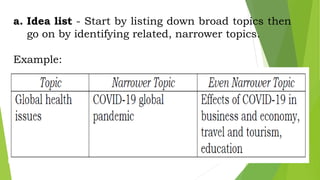
a. Idea list - Start by listing down broad topics then
go on by identifying related, narrower topics.
Example:
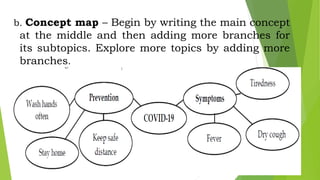
b. Concept map – Begin by writing the main concept
at the middle and then adding more branches for
its subtopics. Explore more topics by adding more
branches.
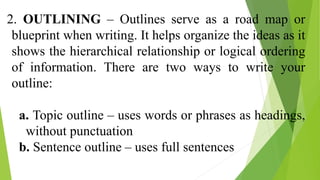
2. OUTLINING – Outlines serve as a road map or
blueprint when writing. It helps organize the ideas as it
shows the hierarchical relationship or logical ordering
of information. There are two ways to write your
outline:
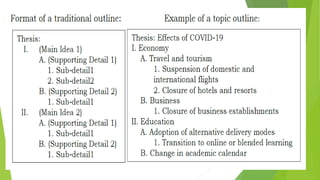
a. Topic outline – uses words or phrases as headings,
without punctuation
b. Sentence outline – uses full sentences
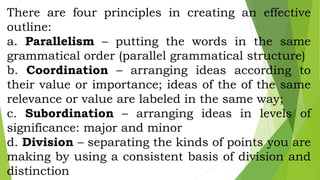
There are four principles in creating an effective
outline:
a. Parallelism – putting the words in the same
grammatical order (parallel grammatical structure)
b. Coordination – arranging ideas according to
their value or importance; ideas of the of the same
relevance or value are labeled in the same way;
c. Subordination – arranging ideas in levels of
significance: major and minor
d. Division – separating the kinds of points you are
making by using a consistent basis of division and
distinction
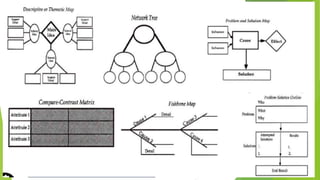
3. USING GRAPHIC ORGANIZERS –
Graphic organizers are visual and
graphic displays that show the
relationships among concepts or ideas.
There are many different kinds of graphic
organizers depending on the type of
information being organized. Some are
given below:
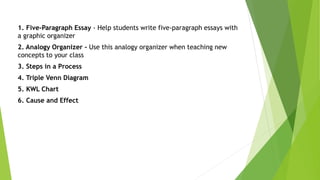
1. Five-Paragraph Essay - Help students write five-paragraph essays with
a graphic organizer
2. Analogy Organizer - Use this analogy organizer when teaching new
concepts to your class
3. Steps in a Process
4. Triple Venn Diagram
5. KWL Chart
6. Cause and Effect
READING & WRITING SKILLS week 1.pptx

READING & WRITING SKILLS week 1.pptx

  • 1.
    READING & WRITING SKILLS PREPAREDBY: ELLA MAE M. AGUILAR, T-I
  • 3.
    OBJECTIVES: The learner distinguishesbetween and among techniques in selecting and organizing information (EN11/12RWS-IIIa-2) a.Brainstorming list b.Graphic organizer c.Topic outline d.Sentence outline
  • 4.
    BRIEF INTRODUCTION DISCUSSION Use ofstrategies in selecting and organizing information like brainstorming, using graphic organizers, and outlining facilitates cognitive processes and improves comprehension. As vital tools for active learning and deeper understanding of content, it is important to be able to break down bigger ideas into smaller, simpler representations that are easily comprehensible. The following are some techniques that aid in selection, organization, and retention of concepts and their relations.
  • 5.
    STRATEGIES IN SELECTINGAND ORGANIZING INFORMATION 1. BRAINSTORMING 2. OUTLINING 3. USING GRAPHIC ORGANIZERS
  • 6.
    1. BRAINSTORMING –Brainstorming is a technique to generate ideas within a group or individual setting. It provides a quick means for tapping the ideas and concepts of an individual or of a group then helps establish patterns and develop relationship among these concepts. Tools in brainstorming:
  • 7.
    a. Idea list- Start by listing down broad topics then go on by identifying related, narrower topics. Example:
  • 8.
    b. Concept map– Begin by writing the main concept at the middle and then adding more branches for its subtopics. Explore more topics by adding more branches.
  • 9.
    2. OUTLINING –Outlines serve as a road map or blueprint when writing. It helps organize the ideas as it shows the hierarchical relationship or logical ordering of information. There are two ways to write your outline: a. Topic outline – uses words or phrases as headings, without punctuation b. Sentence outline – uses full sentences
  • 10.
    There are fourprinciples in creating an effective outline: a. Parallelism – putting the words in the same grammatical order (parallel grammatical structure) b. Coordination – arranging ideas according to their value or importance; ideas of the of the same relevance or value are labeled in the same way; c. Subordination – arranging ideas in levels of significance: major and minor d. Division – separating the kinds of points you are making by using a consistent basis of division and distinction
  • 12.
    3. USING GRAPHICORGANIZERS – Graphic organizers are visual and graphic displays that show the relationships among concepts or ideas. There are many different kinds of graphic organizers depending on the type of information being organized. Some are given below:
  • 14.
    1. Five-Paragraph Essay- Help students write five-paragraph essays with a graphic organizer 2. Analogy Organizer - Use this analogy organizer when teaching new concepts to your class 3. Steps in a Process 4. Triple Venn Diagram 5. KWL Chart 6. Cause and Effect