






READING AND WRITING
SKILLS
WEEK 1
3RD QUARTER
Learning Competency:
 Compare and contrast patterns of written texts
across disciplines:
a) Narration
b) Description & Definition
c) Classification
d) Comparison & Contrast
e) Cause and Effect
f) Problem-Solution
g) Persuasion
Can you define what a paragraph is?
What is paragraph?
The word paragraph is associated with
two Greek words: para which means
“beyond” or “beside” and graphein
which means “to write”.
A paragraph is a collection of related
sentences with one central idea. Each
sentence shows connection to other
sentences in the paragraph.
 A paragraph is an independent unit or a
related unit. As an independent unit, it is
complete in itself. As a related unit, it is a
part of a composition that is combined with
other paragraphs to make a larger
composition.
Whether a paragraph is an
independent unit or a related unit,
it has its beginning, middle and
end.
DEVELOPING EFFECTIVE
PARAGRAPHS
A paragraph is made up of the
topic sentence which contains the
main idea, the supporting details
and the conclusion or the
clinching sentence at the end.
Topic sentence
 reveals the main or central idea of the
paragraph. It does not necessarily have to
be placed at the beginning of the
paragraph. It may be found in the middle of
the first and the last sentence or at the
end. If it is found at the end of the
paragraph, it may be used as a clinching or
concluding sentence.
Supporting details
give the paragraph life as it
elaborates on the scope given by
the topic sentence
Clinching sentence
 closes your paragraph. According to
Dagdag (2010), this “may be a restatement
of the topic sentence, a summary, or a
conclusion based on the supporting
details.”
Can you identify where the topic sentence,
supporting sentences and clinching sentence are?
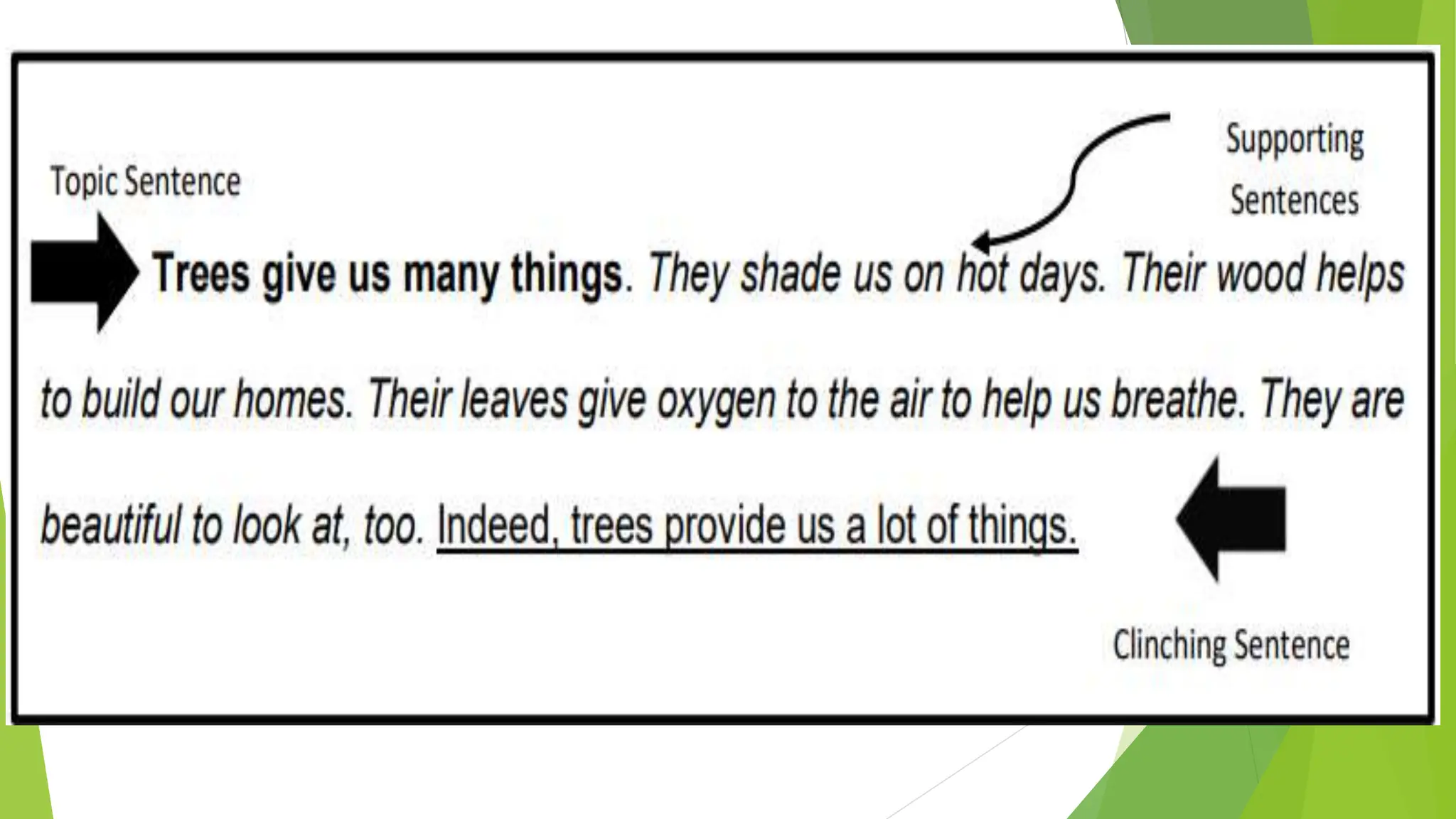
Trees give us many things. They shade
us on hot days. Their wood helps to
build our homes. Their leaves give
oxygen to the air to help us breathe.
They are beautiful to look at, too.
Indeed, trees provide us a lot of
things.
The topic sentence is: Trees give
us many things.
(This sentence tells the reader
what the paragraph is going to be
about).
The supporting sentences are:
They shade us on hot days.
Their wood helps to build our
homes. Their leaves give
oxygen to the air to help us
breathe. They are beautiful to
look at, too. (These sentences
elaborates on the scope given
by the topic sentence)
clinching sentence is: Indeed, trees
provide us a lot of things. (This
sentence serves to close the paragraph
as it restates the idea of the topic
sentence
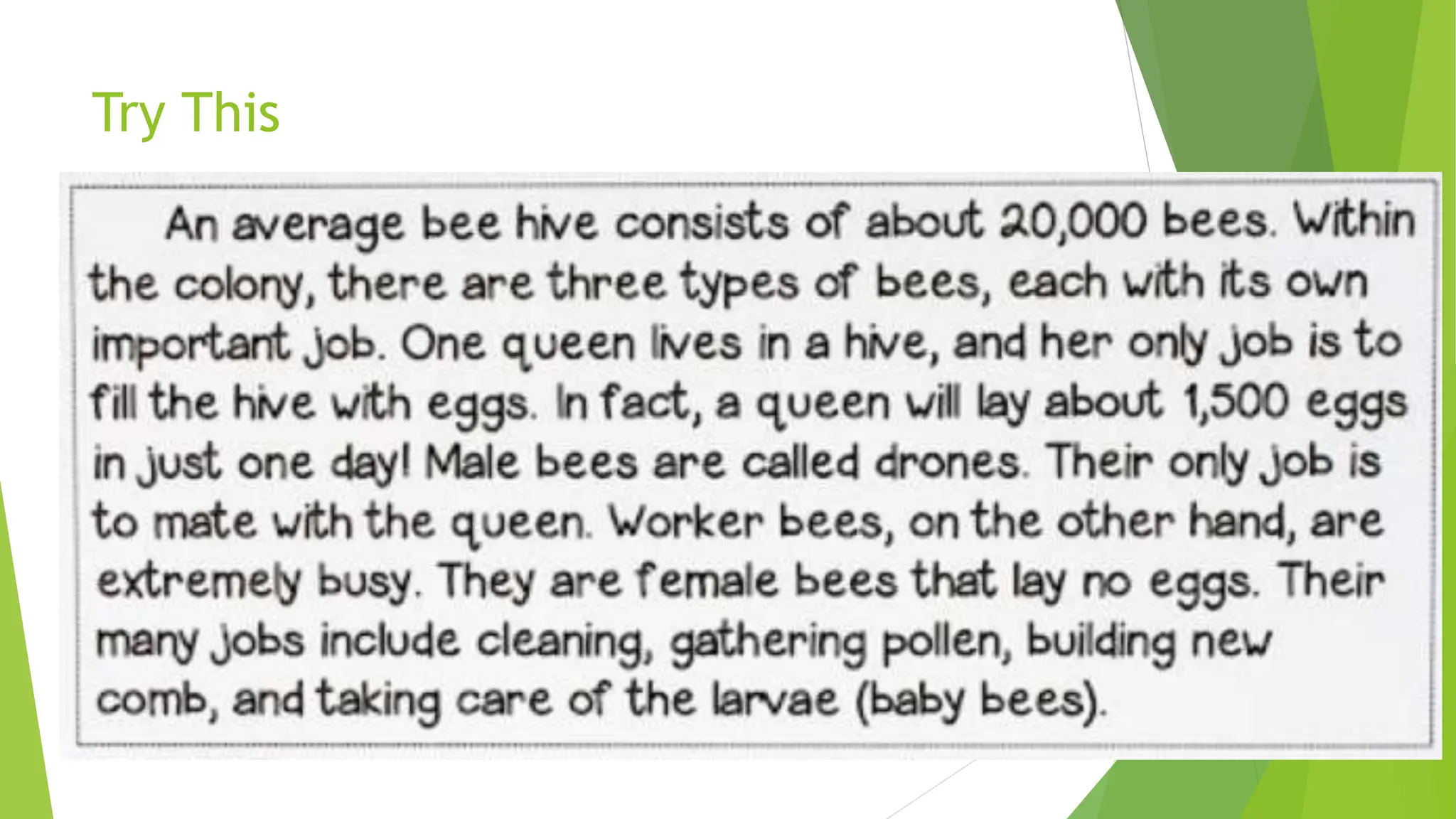
Try This
Group 1-Identify the
topic sentence and
write it in your paper
Group 2-Identify the
supporting details and
write it in your paper
Group 3-Identify the
clinching sentence and
write it in your paper
1.) Oceans and lakes have much in common, but
they are also quite different. Both are bodies of
water, but oceans are very large bodies of salt
water, while lakes are much smaller bodies of
fresh water. Lakes are usually surrounded by
land, while oceans are what surround
continents. Both have plants and animals living
in them. The ocean is home to the largest
animals on the planet, whereas lakes support
much smaller forms of life. When it is time for a
vacation, both will make a great place to visit
and enjoy. I want to swim in the lake.
2.) Sunset is the time of day when our sky
meets the outer space solar winds. There are
blue, pink, and purple swirls, spinning and
twisting, like clouds of balloons caught in a
blender. Sunset is the opposite of sunrise.
The sun moves slowly to hide behind the line
of horizon, while the moon races to take its
place in prominence atop the night sky.
People slow to a crawl, entranced, fully
forgetting the deeds that still must be done.
There is a coolness, a calmness when the sun
does set.
3) Here is the perfect system for cleaning your
room. First, move all of the items that do not
have a proper place to the center of the room.
Get rid of at least five things that you have not
used within the last year. Take out all the trash,
and place all of the dirty dishes in the kitchen
sink. Now find a location for each of the items
you had placed in the center of the room. 5s is a
Japanese cleaning system. For any remaining
items, see if you can squeeze them in under
your bed or stuff them into the back of your
closet. See, that was easy!
Part 2
Make a paragraph about any
daily routine. Make sure that
you involved the parts of
making a paragraph.
Narration
NARRATIVE PARAGRAPH
Narration, from the root word
narrates, originated from the Latin
word narrare— which means
related or told.
It gives a written account of an
event or story, or simply,
storytelling. The sequence of
events is told in chronological
order.
It usually contains the
following: the who, what
and when.
A narrative must have a “vivid
description of details, a
consistent point of view and verb
tense, and a well-defined point or
significance.” (Tiongson, 2016).
At the end of writing it, it must
send a clear message to its
readers through the story.
A narrative paragraph simply tells
what happened and establishes
facts. It is sharing of personal
experiences that offer lessons and
insights. It is more than just a
chronological sequence of events
that happen to the different
characters. It also contains
elements of drama and tension.
Narration is the most common type of paragraph
development. It has the following elements:
Setting. It is the time and location in
which a story takes place.
2. Characters. The life-giving element
of the story.
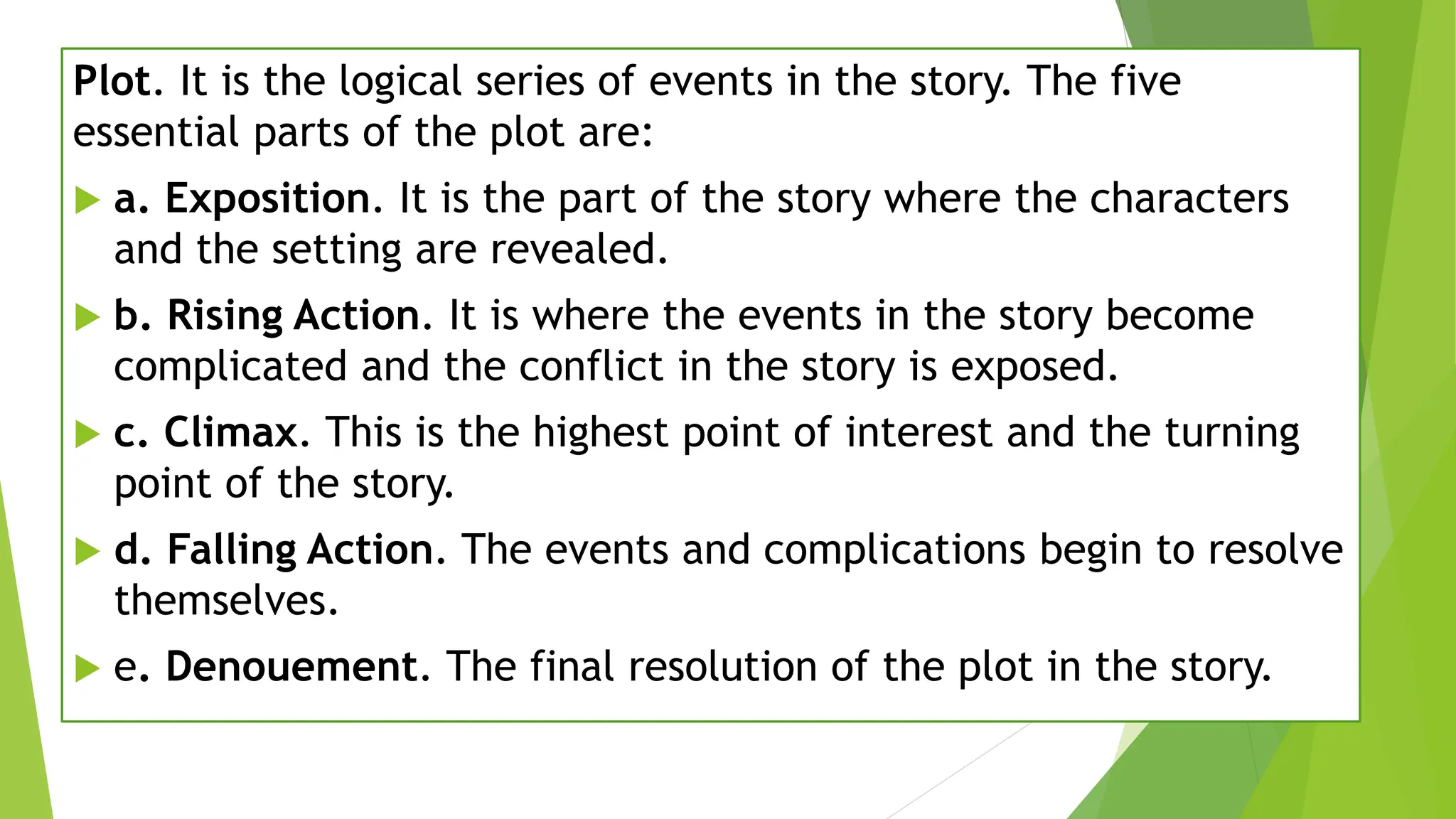
Plot. It is the logical series of events in the story. The five
essential parts of the plot are:
 a. Exposition. It is the part of the story where the characters
and the setting are revealed.
 b. Rising Action. It is where the events in the story become
complicated and the conflict in the story is exposed.
 c. Climax. This is the highest point of interest and the turning
point of the story.
 d. Falling Action. The events and complications begin to resolve
themselves.
 e. Denouement. The final resolution of the plot in the story.
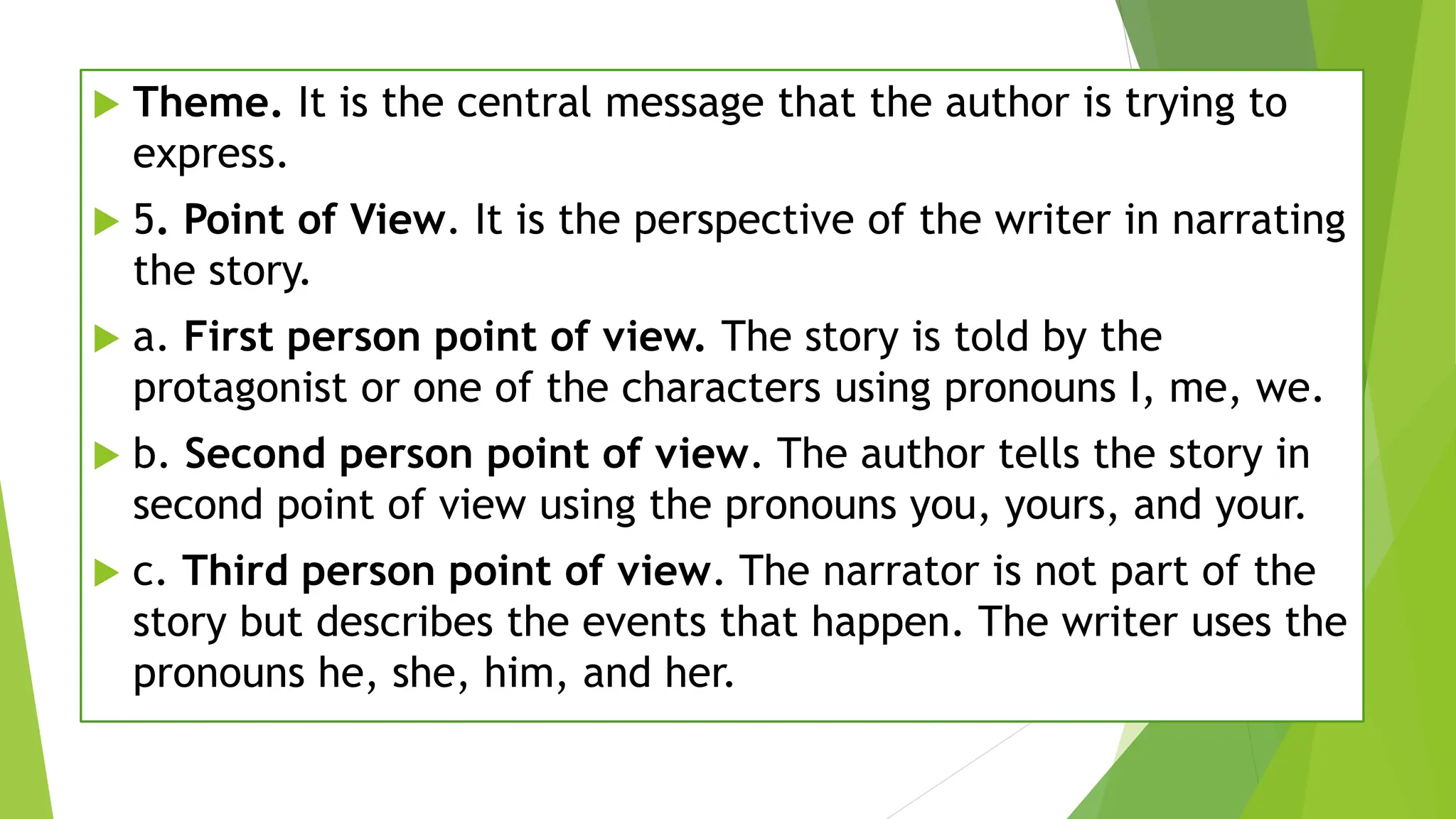
 Theme. It is the central message that the author is trying to
express.
 5. Point of View. It is the perspective of the writer in narrating
the story.
 a. First person point of view. The story is told by the
protagonist or one of the characters using pronouns I, me, we.
 b. Second person point of view. The author tells the story in
second point of view using the pronouns you, yours, and your.
 c. Third person point of view. The narrator is not part of the
story but describes the events that happen. The writer uses the
pronouns he, she, him, and her.
Directions: Narrate your single
experience that you never forget.
Be sure that you include the
elements in telling a story.
(setting, character, plot, theme,
and POV)
Description or
Descriptive Paragraph
 Description gives information of
what a person, an object, a place
or a situation is like.
 It appeals to the reader’s
senses.
A descriptive paragraph has
concrete and specific details,
which are carefully chosen by a
writer to paint a picture in the
mind of the reader.
Descriptive writing emphasizes a
reader’s ability to paint vivid
pictures using words on a
reader’s mind. This relies on the
writer’s ability to appeal to
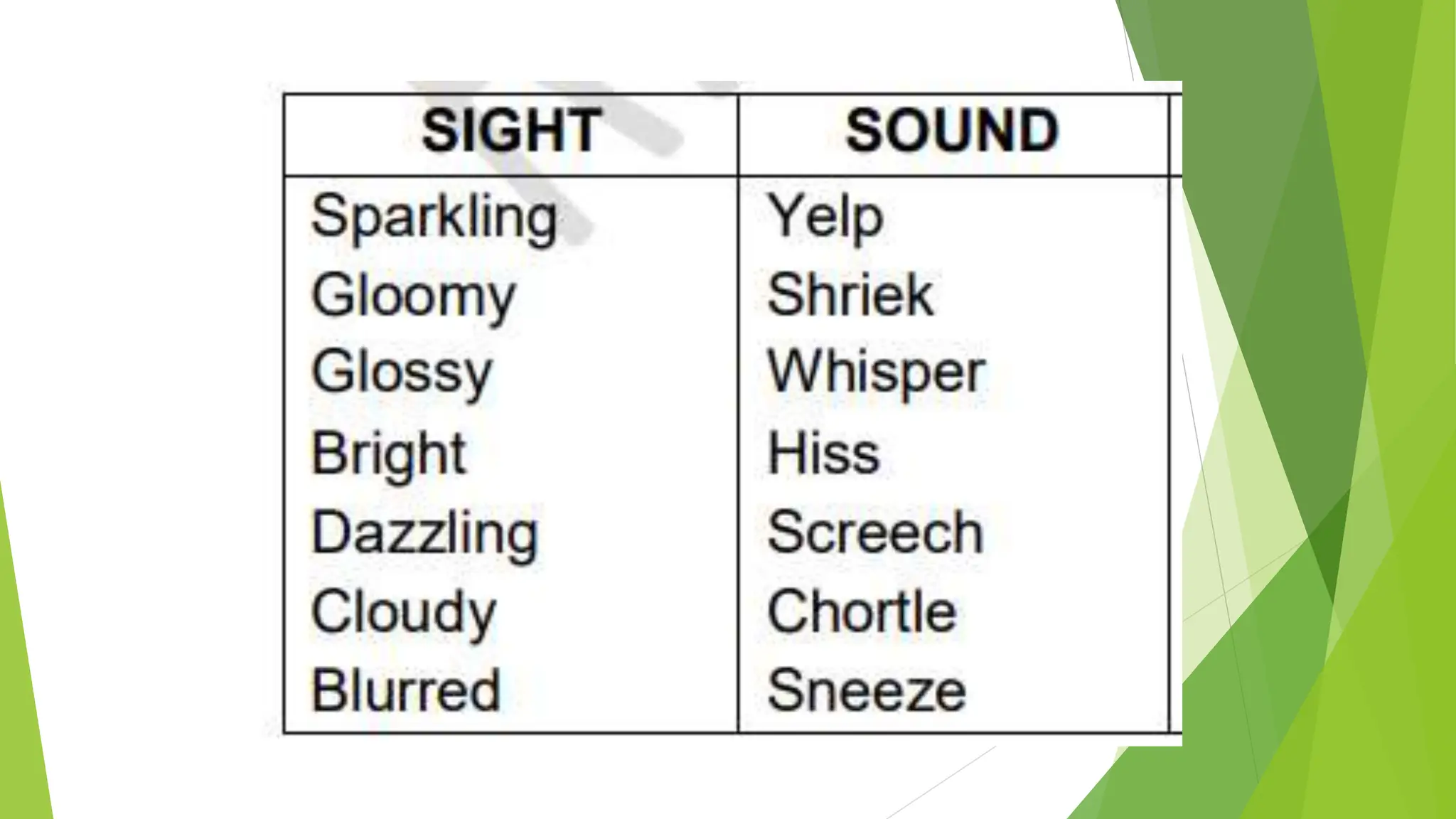
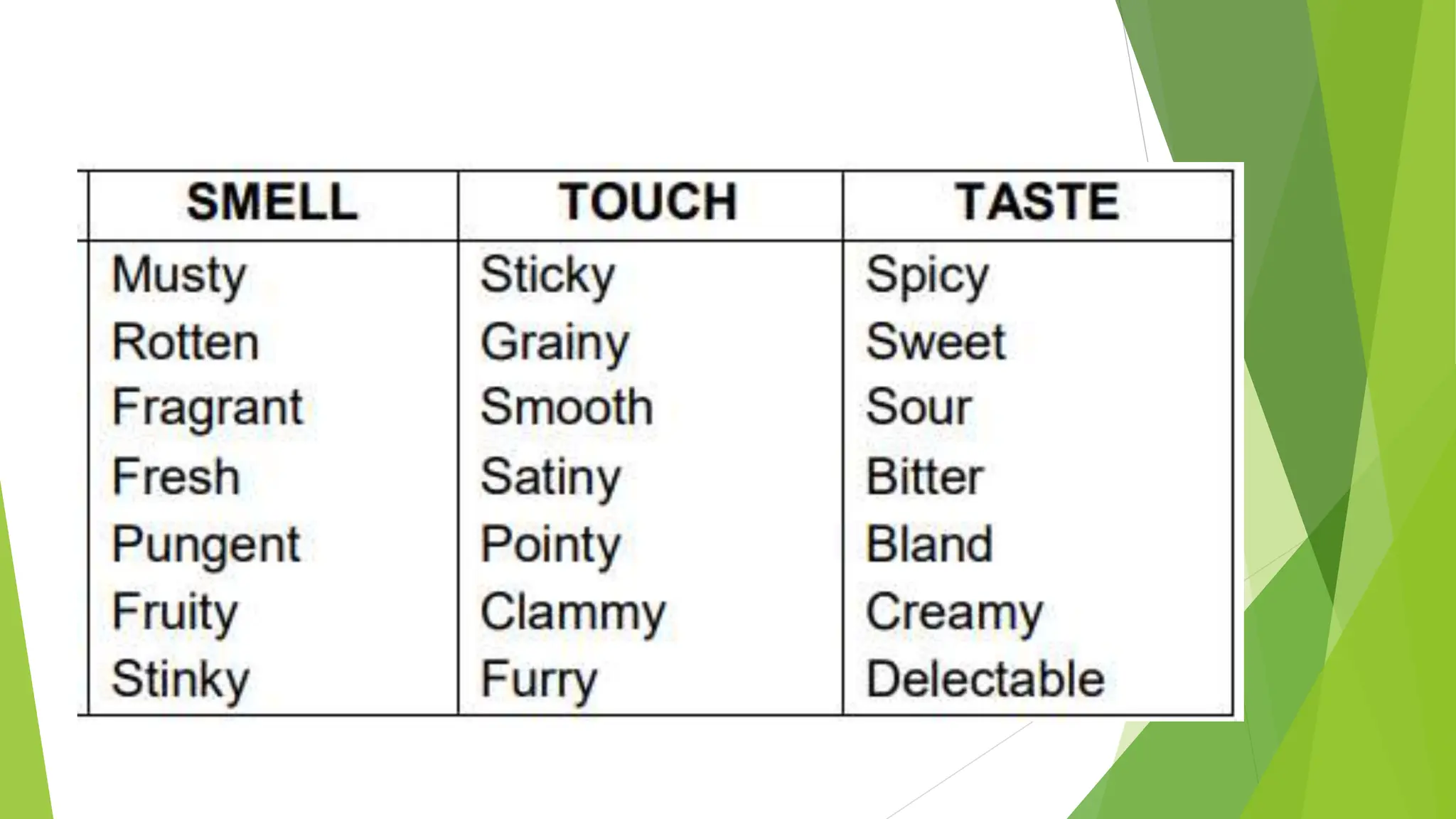
his/her five senses: sight, smell,
touch, taste, and hearing.
To rouse readers' feelings,
emotions and reactions is what
descriptive paragraphs aim for.
Simple adjectives will not cut it
for readers desiring an
appropriate description of an
event, thing, place, or person.
According to Dagdag (2010),
there are two types of
description: objective and
subjective.
Objective description is a factual
description of the topic at hand.
This relies on its information on
physical aspects and appeals to
those who crave facts.
Meanwhile, subjective
description allows the writer to
explore ways to describe an
emotion, an event, a thing, a
place, or a person, appealing to
emotions. Often, this is an
artistic way of describing
things, mostly from the eye
and perspective of the writer
The kitchen table is rectangular, seventy-
two inches long and thirty inches wide.
Made of a two-inch-thick piece of oak. Its
top is covered with a waxy oil cloth
patterned in dark red and blue squares
against a white background. In the right
corner, close to the wall, a square blue
ceramic tile serves as the protective base
for a brown earthenware teapot.
A single white placemat has been set
to the left of the tile, with a knife
and fork on either side of a white
dinner plate, around nine inches in
diameter. On the plate are two thick
pieces of meat.
The descriptive paragraph on the previous
page is an example of an objective
description. It is primarily factual, omitting
any attention to the writer, especially with
regards to the writer’s feelings. Imagine that a
robotic camera is observing the subject; such
a camera has absolutely no attachment or
reaction to what is being observed. That is
objective description.
Our lives at home converged around the pleasantly-
shaped kitchen table. It was the magnet that drew
our family together quite warmly. Cut from the
sturdiest oak, the table was tough, smooth, and long
enough for my mother, my sisters, and me to work or
play on at the same time. Our favorite light blue
ceramic tile, stationed in the right corner, was the
table’s sole defense against the ravages of everything
from a steaming teapot to the latest red-hot gadget
from the magazine.
More often than not, however, the heat would spread
quickly beyond the small tile and onto the checkered
oilcloth, which just as quickly exuded a rank and sour
odor. Yet no matter how intensely the four of us
competed for elbow room at the table, none dared
venture near the lone dinner place arranged securely
to the left of the tile. There was no telling when
Father would get home from work, but, when he did,
he expected the food to be ready— steaming hot. He
liked to eat right away—steak mostly—two bloody but
thick pieces.
The descriptive paragraph
above is an example of
subjective description.
Subjective description includes
attention to both the subject
described and the writer’s
reactions to that subject.
WRITTEN WORK 2.1
Directions: Make a flash story
about your embarrassing
moment. Identify the elements
that involve your story.
PERFORMANCE TASK-1
A. Imagine yourself that you are in the
big old haunted house of your
grandparents. At night, when you
wanted to turn on the lights you
cannot find the switch on the lamp.
Your cellphone is low battery. Write a
short paragraph describing your
sensations.
imagine yourself in the forest. You
continue walking and you get lost
along the way and you don’t know
where to go. You get tired, so you
sit under a tree. Suddenly, a lady
appears in front of you! How would
you describe the lady so that
others could imagine her?
Definition Paragraph
What is Definition?
Anyone can define, what is
family.
Definition explains a concept,
term, or subject. Its main
purpose is to tell what
something is
It consists of three parts: (1)
the term, concept or subject to
be defined; (2) the general
class to which it belongs; and
(3) the characteristics that
differentiate it from the other
members of its class.
A definition explains what a
term means. When you want
your readers to know exactly
how you are using a certain
term or an unfamiliar concept,
you use definition.
In developing a paragraph by definition,
you should take account of these things:
a) the term to be defined
b) the class to which the term
belongs
c) the characteristics that
distinguish the term from the
other members of its class.
An owl is a bird with a large
head, strong talons, and a
nocturnal habit.
Owl – is the term to define
Bird – is the class where the owl
belongs
with a large head, strong talons,
and has a nocturnal habit – are
the characteristics that distinguish
the owl from the other birds
Water (term) is a liquid (class)
made up of molecules of
hydrogen and oxygen in the
ratio of 2 to 1 (differentiating
characteristics).
Astronomy (term) is a branch of
scientific study (class) primarily
concerned with celestial objects
inside and outside the earth’s
atmosphere (differentiating
characteristics).
The following are the different types of
definitions:
Formal Definition
Informal Definition
Definition Paragraph
1. Formal Definition. The
definitions provided in
dictionaries
Informal Definitions. The four
common informal definitions are
operational, synonyms,
denotations, and connotations
a. Operational Definitions give the
meaning of an abstract word for one
particular time and place.
b. Synonyms or words that mean the
same as another word.
c. Denotation is the exact meaning of
the word
d. Connotation is an idea or meaning
suggested by or associated with a word
or thing.
3. Definition Paragraph
It is a definition sentence that is
extended into a paragraph by adding
meanings, descriptions, narrations,
and other kinds of paragraph
development to make clear the term
being defined.
definition paragraph:
A racist is not someone who accepts another person for who
they are but rather judges them based on their appearance or
their skin color. The vast diversity of society makes it nearly
impossible to eliminate all racial tension. A racist usually has
no other reason to hate somebody except for the fact that the
other person may look different or have a different skin color
than them. In the long run, racists are only hurting themselves
because they are limiting their knowledge of different
cultures and people and they are not broadening their
horizons. Racists are extremely close-minded individuals and
they strictly adhere to their own set of morals without any
regard for other people’s belief systems. (Mike Sullivan, 2005).
Written Work-3
Directions: Make a definition
paragraph about love.
CLASSIFICATION
PARAGRAPH
Classification paragraphs
group items into categories,
to establish a clear
distinction.
If the topic encompasses a large body
of information, one effective way of
elaborating it is through classifying
things of distinct features into
groups/classes.
Classification groups items into
categories to establish a clear
distinction between related or similar
ideas. Similar items are grouped into
categories for the readers to better
understand and analyze the material
at hand
In a classification paragraph you tell
readers how a collection of items can
be sorted into categories. It is an
activity of sorting items (people,
things , ideas ) into categories.
1. Terms that signal classification:
aspects areas
Kinds levels
qualities systems
traits types
2. Transitional Expressions
can be divided
can be categorized
can be classified the first type
Types of Friends
Friends can be classified according to their
honesty, loyalty, the type that fits you into their
schedule, or the type that finds time for you
when they need something. An honest friend tells
you the truth even if it’s not always what you
want to hear. In the long run, that honest friend
may have saved you from embarrassment or
possibly rejection.
They give you constructive criticisms overall. The loyal
friend is the type of friend that will be there for you
through the thick and thin. They don’t care how good
or bad you may look one day; they are sensitive to your
feelings, they respect you and the other people in your
life, and most of all they will never let you down when
times are hard. They may be what you call a best
friend. The third group, the person that fits you into
their schedule, is the type of person that is always on
the go.
They barely have time for themselves let alone
another person. More than likely they will not be
there for you when you need them the most,
because they are so wrapped up in their busy,
hectic life. Then you have the self-absorbent
type of friend that finds time for you only when
they need something. This type of person isn’t
what you would call a friend.
This person may always be extremely nice to you
because they know that if they are nice to you then they
will more than likely get what they want. They will call
you every once in a while when it is almost time for
them to use that person again. It may be for a ride to
work, home or they just want somebody to hangout with
because they have no other friends. If the person that is
being used is smart they will eventually realize that they
are getting used and will stop being there for that
person. (Amy Neil, 2005)
Comprehension Questions
1. What are the types of friends?
2. What is the basis used by the author
to classify friends?
3. How does the author develop the
classification essay?
week 1- patterns of written text across discipline.pptx

week 1- patterns of written text across discipline.pptx

  • 1.
  • 2.
    Learning Competency:  Compareand contrast patterns of written texts across disciplines: a) Narration b) Description & Definition c) Classification d) Comparison & Contrast e) Cause and Effect f) Problem-Solution g) Persuasion
  • 3.
    Can you definewhat a paragraph is?
  • 4.
  • 5.
    The word paragraphis associated with two Greek words: para which means “beyond” or “beside” and graphein which means “to write”.
  • 6.
    A paragraph isa collection of related sentences with one central idea. Each sentence shows connection to other sentences in the paragraph.
  • 7.
     A paragraphis an independent unit or a related unit. As an independent unit, it is complete in itself. As a related unit, it is a part of a composition that is combined with other paragraphs to make a larger composition.
  • 8.
    Whether a paragraphis an independent unit or a related unit, it has its beginning, middle and end.
  • 9.
  • 10.
    A paragraph ismade up of the topic sentence which contains the main idea, the supporting details and the conclusion or the clinching sentence at the end.
  • 11.
    Topic sentence  revealsthe main or central idea of the paragraph. It does not necessarily have to be placed at the beginning of the paragraph. It may be found in the middle of the first and the last sentence or at the end. If it is found at the end of the paragraph, it may be used as a clinching or concluding sentence.
  • 12.
    Supporting details give theparagraph life as it elaborates on the scope given by the topic sentence
  • 13.
    Clinching sentence  closesyour paragraph. According to Dagdag (2010), this “may be a restatement of the topic sentence, a summary, or a conclusion based on the supporting details.”
  • 14.
    Can you identifywhere the topic sentence, supporting sentences and clinching sentence are? Trees give us many things. They shade us on hot days. Their wood helps to build our homes. Their leaves give oxygen to the air to help us breathe. They are beautiful to look at, too. Indeed, trees provide us a lot of things.
  • 15.
    The topic sentenceis: Trees give us many things. (This sentence tells the reader what the paragraph is going to be about).
  • 16.
    The supporting sentencesare: They shade us on hot days. Their wood helps to build our homes. Their leaves give oxygen to the air to help us breathe. They are beautiful to look at, too. (These sentences elaborates on the scope given by the topic sentence)
  • 17.
    clinching sentence is:Indeed, trees provide us a lot of things. (This sentence serves to close the paragraph as it restates the idea of the topic sentence
  • 19.
  • 20.
    Group 1-Identify the topicsentence and write it in your paper
  • 21.
    Group 2-Identify the supportingdetails and write it in your paper
  • 22.
    Group 3-Identify the clinchingsentence and write it in your paper
  • 23.
    1.) Oceans andlakes have much in common, but they are also quite different. Both are bodies of water, but oceans are very large bodies of salt water, while lakes are much smaller bodies of fresh water. Lakes are usually surrounded by land, while oceans are what surround continents. Both have plants and animals living in them. The ocean is home to the largest animals on the planet, whereas lakes support much smaller forms of life. When it is time for a vacation, both will make a great place to visit and enjoy. I want to swim in the lake.
  • 24.
    2.) Sunset isthe time of day when our sky meets the outer space solar winds. There are blue, pink, and purple swirls, spinning and twisting, like clouds of balloons caught in a blender. Sunset is the opposite of sunrise. The sun moves slowly to hide behind the line of horizon, while the moon races to take its place in prominence atop the night sky. People slow to a crawl, entranced, fully forgetting the deeds that still must be done. There is a coolness, a calmness when the sun does set.
  • 25.
    3) Here isthe perfect system for cleaning your room. First, move all of the items that do not have a proper place to the center of the room. Get rid of at least five things that you have not used within the last year. Take out all the trash, and place all of the dirty dishes in the kitchen sink. Now find a location for each of the items you had placed in the center of the room. 5s is a Japanese cleaning system. For any remaining items, see if you can squeeze them in under your bed or stuff them into the back of your closet. See, that was easy!
  • 26.
    Part 2 Make aparagraph about any daily routine. Make sure that you involved the parts of making a paragraph.
  • 27.
  • 28.
    Narration, from theroot word narrates, originated from the Latin word narrare— which means related or told.
  • 29.
    It gives awritten account of an event or story, or simply, storytelling. The sequence of events is told in chronological order.
  • 30.
    It usually containsthe following: the who, what and when.
  • 31.
    A narrative musthave a “vivid description of details, a consistent point of view and verb tense, and a well-defined point or significance.” (Tiongson, 2016).
  • 32.
    At the endof writing it, it must send a clear message to its readers through the story.
  • 33.
    A narrative paragraphsimply tells what happened and establishes facts. It is sharing of personal experiences that offer lessons and insights. It is more than just a chronological sequence of events that happen to the different characters. It also contains elements of drama and tension.
  • 34.
    Narration is themost common type of paragraph development. It has the following elements: Setting. It is the time and location in which a story takes place. 2. Characters. The life-giving element of the story.
  • 35.
    Plot. It isthe logical series of events in the story. The five essential parts of the plot are:  a. Exposition. It is the part of the story where the characters and the setting are revealed.  b. Rising Action. It is where the events in the story become complicated and the conflict in the story is exposed.  c. Climax. This is the highest point of interest and the turning point of the story.  d. Falling Action. The events and complications begin to resolve themselves.  e. Denouement. The final resolution of the plot in the story.
  • 36.
     Theme. Itis the central message that the author is trying to express.  5. Point of View. It is the perspective of the writer in narrating the story.  a. First person point of view. The story is told by the protagonist or one of the characters using pronouns I, me, we.  b. Second person point of view. The author tells the story in second point of view using the pronouns you, yours, and your.  c. Third person point of view. The narrator is not part of the story but describes the events that happen. The writer uses the pronouns he, she, him, and her.
  • 37.
    Directions: Narrate yoursingle experience that you never forget. Be sure that you include the elements in telling a story. (setting, character, plot, theme, and POV)
  • 38.
  • 39.
     Description givesinformation of what a person, an object, a place or a situation is like.
  • 40.
     It appealsto the reader’s senses.
  • 41.
    A descriptive paragraphhas concrete and specific details, which are carefully chosen by a writer to paint a picture in the mind of the reader.
  • 42.
    Descriptive writing emphasizesa reader’s ability to paint vivid pictures using words on a reader’s mind. This relies on the writer’s ability to appeal to his/her five senses: sight, smell, touch, taste, and hearing.
  • 43.
    To rouse readers'feelings, emotions and reactions is what descriptive paragraphs aim for. Simple adjectives will not cut it for readers desiring an appropriate description of an event, thing, place, or person.
  • 44.
    According to Dagdag(2010), there are two types of description: objective and subjective.
  • 45.
    Objective description isa factual description of the topic at hand. This relies on its information on physical aspects and appeals to those who crave facts.
  • 46.
    Meanwhile, subjective description allowsthe writer to explore ways to describe an emotion, an event, a thing, a place, or a person, appealing to emotions. Often, this is an artistic way of describing things, mostly from the eye and perspective of the writer
  • 47.
    The kitchen tableis rectangular, seventy- two inches long and thirty inches wide. Made of a two-inch-thick piece of oak. Its top is covered with a waxy oil cloth patterned in dark red and blue squares against a white background. In the right corner, close to the wall, a square blue ceramic tile serves as the protective base for a brown earthenware teapot.
  • 48.
    A single whiteplacemat has been set to the left of the tile, with a knife and fork on either side of a white dinner plate, around nine inches in diameter. On the plate are two thick pieces of meat.
  • 49.
    The descriptive paragraphon the previous page is an example of an objective description. It is primarily factual, omitting any attention to the writer, especially with regards to the writer’s feelings. Imagine that a robotic camera is observing the subject; such a camera has absolutely no attachment or reaction to what is being observed. That is objective description.
  • 50.
    Our lives athome converged around the pleasantly- shaped kitchen table. It was the magnet that drew our family together quite warmly. Cut from the sturdiest oak, the table was tough, smooth, and long enough for my mother, my sisters, and me to work or play on at the same time. Our favorite light blue ceramic tile, stationed in the right corner, was the table’s sole defense against the ravages of everything from a steaming teapot to the latest red-hot gadget from the magazine.
  • 51.
    More often thannot, however, the heat would spread quickly beyond the small tile and onto the checkered oilcloth, which just as quickly exuded a rank and sour odor. Yet no matter how intensely the four of us competed for elbow room at the table, none dared venture near the lone dinner place arranged securely to the left of the tile. There was no telling when Father would get home from work, but, when he did, he expected the food to be ready— steaming hot. He liked to eat right away—steak mostly—two bloody but thick pieces.
  • 52.
    The descriptive paragraph aboveis an example of subjective description. Subjective description includes attention to both the subject described and the writer’s reactions to that subject.
  • 55.
  • 56.
    Directions: Make aflash story about your embarrassing moment. Identify the elements that involve your story.
  • 57.
  • 58.
    A. Imagine yourselfthat you are in the big old haunted house of your grandparents. At night, when you wanted to turn on the lights you cannot find the switch on the lamp. Your cellphone is low battery. Write a short paragraph describing your sensations.
  • 59.
    imagine yourself inthe forest. You continue walking and you get lost along the way and you don’t know where to go. You get tired, so you sit under a tree. Suddenly, a lady appears in front of you! How would you describe the lady so that others could imagine her?
  • 60.
  • 61.
    What is Definition? Anyonecan define, what is family.
  • 62.
    Definition explains aconcept, term, or subject. Its main purpose is to tell what something is
  • 63.
    It consists ofthree parts: (1) the term, concept or subject to be defined; (2) the general class to which it belongs; and (3) the characteristics that differentiate it from the other members of its class.
  • 64.
    A definition explainswhat a term means. When you want your readers to know exactly how you are using a certain term or an unfamiliar concept, you use definition.
  • 65.
    In developing aparagraph by definition, you should take account of these things: a) the term to be defined b) the class to which the term belongs c) the characteristics that distinguish the term from the other members of its class.
  • 66.
    An owl isa bird with a large head, strong talons, and a nocturnal habit.
  • 67.
    Owl – isthe term to define Bird – is the class where the owl belongs with a large head, strong talons, and has a nocturnal habit – are the characteristics that distinguish the owl from the other birds
  • 68.
    Water (term) isa liquid (class) made up of molecules of hydrogen and oxygen in the ratio of 2 to 1 (differentiating characteristics).
  • 69.
    Astronomy (term) isa branch of scientific study (class) primarily concerned with celestial objects inside and outside the earth’s atmosphere (differentiating characteristics).
  • 70.
    The following arethe different types of definitions: Formal Definition Informal Definition Definition Paragraph
  • 71.
    1. Formal Definition.The definitions provided in dictionaries
  • 72.
    Informal Definitions. Thefour common informal definitions are operational, synonyms, denotations, and connotations
  • 73.
    a. Operational Definitionsgive the meaning of an abstract word for one particular time and place. b. Synonyms or words that mean the same as another word. c. Denotation is the exact meaning of the word d. Connotation is an idea or meaning suggested by or associated with a word or thing.
  • 74.
    3. Definition Paragraph Itis a definition sentence that is extended into a paragraph by adding meanings, descriptions, narrations, and other kinds of paragraph development to make clear the term being defined.
  • 75.
    definition paragraph: A racistis not someone who accepts another person for who they are but rather judges them based on their appearance or their skin color. The vast diversity of society makes it nearly impossible to eliminate all racial tension. A racist usually has no other reason to hate somebody except for the fact that the other person may look different or have a different skin color than them. In the long run, racists are only hurting themselves because they are limiting their knowledge of different cultures and people and they are not broadening their horizons. Racists are extremely close-minded individuals and they strictly adhere to their own set of morals without any regard for other people’s belief systems. (Mike Sullivan, 2005).
  • 76.
    Written Work-3 Directions: Makea definition paragraph about love.
  • 77.
  • 78.
    Classification paragraphs group itemsinto categories, to establish a clear distinction.
  • 79.
    If the topicencompasses a large body of information, one effective way of elaborating it is through classifying things of distinct features into groups/classes.
  • 80.
    Classification groups itemsinto categories to establish a clear distinction between related or similar ideas. Similar items are grouped into categories for the readers to better understand and analyze the material at hand
  • 81.
    In a classificationparagraph you tell readers how a collection of items can be sorted into categories. It is an activity of sorting items (people, things , ideas ) into categories.
  • 82.
    1. Terms thatsignal classification: aspects areas Kinds levels qualities systems traits types
  • 83.
    2. Transitional Expressions canbe divided can be categorized can be classified the first type
  • 84.
    Types of Friends Friendscan be classified according to their honesty, loyalty, the type that fits you into their schedule, or the type that finds time for you when they need something. An honest friend tells you the truth even if it’s not always what you want to hear. In the long run, that honest friend may have saved you from embarrassment or possibly rejection.
  • 85.
    They give youconstructive criticisms overall. The loyal friend is the type of friend that will be there for you through the thick and thin. They don’t care how good or bad you may look one day; they are sensitive to your feelings, they respect you and the other people in your life, and most of all they will never let you down when times are hard. They may be what you call a best friend. The third group, the person that fits you into their schedule, is the type of person that is always on the go.
  • 86.
    They barely havetime for themselves let alone another person. More than likely they will not be there for you when you need them the most, because they are so wrapped up in their busy, hectic life. Then you have the self-absorbent type of friend that finds time for you only when they need something. This type of person isn’t what you would call a friend.
  • 87.
    This person mayalways be extremely nice to you because they know that if they are nice to you then they will more than likely get what they want. They will call you every once in a while when it is almost time for them to use that person again. It may be for a ride to work, home or they just want somebody to hangout with because they have no other friends. If the person that is being used is smart they will eventually realize that they are getting used and will stop being there for that person. (Amy Neil, 2005)
  • 88.
    Comprehension Questions 1. Whatare the types of friends? 2. What is the basis used by the author to classify friends? 3. How does the author develop the classification essay?