READING AND WRITING
LESSON 1: DESCRIPTION
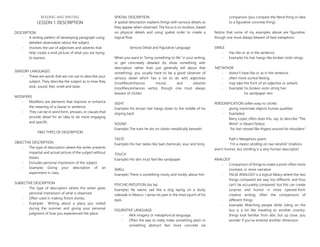
DESCRIPTION
- A writing pattern of developing paragraph using
detailed observation about the subject.
- Involves the use of adjectives and adverbs that
help create a vivid picture of what you are trying
to express.
SENSORY LANGUAGES
- These are words that we can use to describe your
subject. They describe the subject as to how they
look, sound, feel, smell and taste.
MODIFIERS
- Modifiers are elements that improve or enhance
the meaning of a clause or sentence.
- They can be in word form, phrases, or clauses that
provide detail for an idea to be more engaging
and specific.
TWO TYPES OF DESCRIPTION
OBJECTIVE DESCRIPTION
- The type of description where the writer presents
impartial and actual picture of the subject without
biases.
- Excludes personal impression of the subject.
- Example) Giving your description of an
experiment in class.
SUBJECTIVE DESCRIPTION
- The type of description where the writer gives
personal impression of what is observed.
- Often used in making fiction stories.
- Example) Writing about a place you visited
during the summer and giving your personal
judgment of how you experienced the place.
SPATIAL DESCRIPTION
A spatial description explains things with sensory details as
they appear when observed. The focus is on location, based
on physical details and using spatial order to create a
logical flow.
Sensory Detail and Figurative Language
When you want to "bring something to life" in your writing,
or get concretely detailed (to show something with
description rather than just generally tell about that
something), you usually have to be a good observer of
sensory detail which has a lot to do with adjectives
(modifies/enhances nouns) and adverbs
(modifies/enhances verbs), though one must always
beware of clichés:
SIGHT
Example) His brown hair hangs down to the middle of his
sloping back
SOUND
Example) The train he sits on clanks metallically beneath.
TASTE
Example) His hair tastes like bad chemicals, sour and tinny
TOUCH
Example) His skin must feel like sandpaper
SMELL
Example) There is something musty and moldy about him
PSYCHIC/INTUITION (ha ha)
Example) He seems sad like a dog laying on a dusty
sidewalk in Mexico. I sense his pain in the tired squint of his
eyes
FIGURATIVE LANGUAGE
- AKA imagery or metaphorical language,
- Often the way to really make something plain or
something abstract feel more concrete via
comparison (you compare the literal thing or idea
to a figurative concrete thing).
Notice that some of my examples above are figurative,
though one must always beware of bad metaphors:
SIMILE
- Has like or as in the sentence
- Example) his hair hangs like broken violin stings
‘METAPHOR
- doesn't have like or as in the sentence
- often more surreal feeling
- may take the form of an adjective or adverb
- Example) his broken violin string hair
his sandpaper skin
PERSONIFICATION (often easy to cliché)
- giving inanimate objects human qualities
- Examples)
Barry Lopez often does this, say, to describe “The
Wind" in Desert Notes)
“his hair moved like fingers around his shoulders”
Path's Metaphors poem
“I’m a melon strolling on two tendrils" (mellons
aren't human, but strolling is a very human descriptor)
ANALOGY
- Comparison of things to make a point-often more
involved, or more narrative
- FALSE ANALOGY is a logical fallacy where the two
things compared are way too different, and thus
can't be accurately compared: but this can create
surprise and humor in more opened-form
creative writing; often the comparisons of
different things
- Example) Watching people while riding on the
bus is a lot like traveling to another country:
things look familiar from afar, but up close, you
wonder if you've entered another dimension.
READING AND WRITING
LESSON 2: DEFINITION
DEFINITION
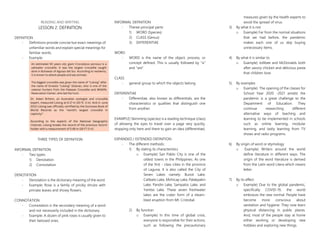
- Definitions provide concise but exact meanings of
unfamiliar words and explain special meanings for
familiar words.
- Example:
THREE TYPES OF DEFINITION
INFORMAL DEFINITION
- Two types:
1) Denotation
2) Connotation
DENOTATION
- Denotation is the dictionary meaning of the word.
- Example: Rose is a family of prickly shrubs with
pinnate leaves and showy flowers.
CONNOTATION
- Connotation is the secondary meaning of a word
and not necessarily included in the dictionary.
- Example: A dozen of pink roses is usually given to
their beloved ones.
INFORMAL DEFINITION
- Theree principal parts:
1) WORD (Species)
2) CLASS (Genus)
3) DIFFERENTIAE
WORD
- WORD is the name of the object, process, or
concept defined. This is usually followed by “is”
and “are”
CLASS
- general group to which the objects belong
DIFFERENTIAE
- Differentiae, also known as differentials, are the
characteristics or qualities that distinguish one
from another.
EXAMPLE) Skimming (species) is a reading technique (class)
of allowing the eyes to travel over a page very quickly,
stopping only here and there to gain an idea (differentiae).
EXPANDED / EXTENDED DEFINITION
- The different methods:
1) By stating its characteristics
o Example) San Pablo City is one of the
oldest towns in the Philippines. As one
of the first - class cities in the province
of Laguna. It is also called the City of
Seven Lakes namely: Bunot Lake,
Calibato Lake, Mohicap Lake, Palakpakin
Lake, Pandin Lake, Sampaloc Lake, and
Yambo Lake. These seven freshwater
lakes are the crater form of a steam-
blast eruption from Mt. Cristobal.
2) By function
o Example) In this time of global crisis,
everyone is responsible for their actions,
such as following the precautionary
measures given by the health experts to
avoid the spread of virus.
3) By what it is not
o Example) Far from the normal situations
that we had before, the pandemic
makes each one of us skip buying
unnecessary items.
4) By what it is similar to
o Example) Jollibee and McDonalds both
after savory chicken and delicious pasta
that children love.
5) By examples
o Example) The opening of the classes for
School Year 2020 -2021 amidst the
pandemic is a great challenge to the
Department of Education. They
continue researching different
alternative ways of teaching and
learning to be implemented in schools
such as online learning, modular
learning, and lastly learning from TV
shows and radio programs.
6) By origin of word or etymology
o Example) Writers around the world
define literature in different ways. The
origin of the word literature is derived
from the Latin word Litera which means
letter.
7) By its effect
o Example) Due to the global pandemic,
specifically COVID-19, the world
embraces the new normal. People have
become more conscious about
sanitation and hygiene. They now learn
physical distancing in public places.
And, most of the people stay at home
either working or developing new
hobbies and exploring new things.
READING AND WRITING
LESSON 3: CLASSIFICATION &
EXEMPLIFICATION
TRANSITIONAL EXPRESSIONS
- Connect one idea to another between or within
sentences and alert readers to the connections
between paragraphs or blocks of the text.
- Three types:
1) Transitions between sections
2) Transitions between paragraphs
3) Transitions within paragraphs
CLASSIFICATION
- Division or category in a system which divides
things into groups or types.
- Used when a writer needs to sort out or arrange
subjects to groups or categories based on their
common and shared characteristics.
- Some transitional expressions in writing effective
classification paragraphs: classified as, one kind,
the last group, another kind, another, final type,
the first category, are categorized as, the next
part.
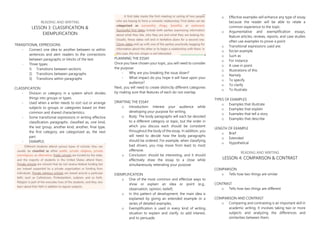
- EXAMPLE:
PLANNING THE ESSAY
Once you have chosen your topic, you will need to consider
the purpose:
- Why are you breaking the issue down?
- What impact do you hope it will have upon your
audience?
Next, you will need to create distinctly different categories
by making sure that features of each do not overlap.
DRAFTING THE ESSAY
o Introduction: Interest your audience while
developing your purpose for writing.
o Body: The body paragraphs will each be devoted
to a different category or topic, but the order in
which you discuss each should be consistent
throughout the body of the essay. In addition, you
will need to decide how the body paragraphs
should be ordered. For example, when classifying
bad drivers, you may move from least to most
offensive.
o Conclusion: should be interesting, and it should
effectively draw the essay to a close while
simultaneously reiterating your purpose
EXEMPLIFICATION
o One of the most common and effective ways to
show or explain an idea or point (e.g.,
observation, opinion, belief).
o In this pattern of development, the main idea is
explained by giving an extended example or a
series of detailed examples.
o Exemplification is used in every kind of writing
situation to explain and clarify, to add interest,
and to persuade.
o Effective examples will enhance any type of essay
because the reader will be able to relate a
common experience to the topic.
o Argumentative and exemplification essays,
feature articles, reviews, reports, and case studies
often use examples to prove a point
o Transitional expressions used are:
o for/an example
o Such as
o For instance
o A case in point
o Illustrations of this
o Namely
o To specify
o To clarify
o To illustrate
TYPES OF EXAMPLES
o Examples that illustrate
o Examples that explain
o Examples that tell a story
o Examples that describe
LENGTH OF EXAMPLE
o Brief
o Extended
o Hypothetical
READING AND WRITING
LESSON 4: COMPARISON & CONTRAST
COMPARISON
o Tells how two things are similar
CONTRAST
o Tells how two things are different
COMPARISON AND CONTRAST
o Comparing and contrasting is an important skill in
academic writing. It involves taking two or more
subjects and analyzing the differences and
similarities between them.
o It points out the similarities and differences
between two or more subjects. It’s ideal for
showing what separates and unites related things
or concepts.
o By seeing the differences and similarities, the
reader better understands each of the subjects by
using the other subject as a frame of reference.
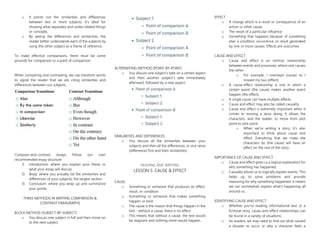
To make effective comparisons, there must be some
grounds for comparison or a point of comparison.
When comparing and contrasting, we use transition words
to signal the reader that we are citing similarities and
differences between our subjects.
Compare-and-contrast essays follow our own
recommended essay structure:
1) Introduction: where you explain your thesis or
what your essay will discuss
2) Body: where you actually list the similarities and
differences of your subjects; the largest section
3) Conclusion: where you wrap up and summarize
your points
THREE METHODS IN WRITING COMPARISON &
CONTRAST PARAGRAPHS
BLOCK METHOD (SUBJECT-BY-SUBJECT)
o You discuss one subject in full and then move on
to the next subject.
ALTERNATING METHOD (POINT-BY-POINT)
o You discuss one subject’s take on a certain aspect
and then another subject’s take immediately
afterward, followed by a new aspect.
SIMILARITIES AND DIFFERENCES
o You discuss all the similarities between your
subjects and then all the differences, or vice versa
(differences first and then similarities).
READING AND WRITING
LESSON 5: CAUSE & EFFECT
CAUSE
o Something or someone that produces an effect,
result, or condition
o Something or someone that makes something
happen or exist
o The cause is the reason that things happen in the
text - without a cause, there is no effect.
o This means that without a cause, the text would
be stagnant and nothing more would happen.
EFFECT
o A change which is a result or consequence of an
action or other cause.
o The result of a particular influence
o Something that happens because of something
else: a condition, occurrence, or result generated
by one or more causes. Effects are outcomes.
CAUSE AND EFFECT
o Cause and effect is an intrinsic relationship
between events and processes, where one causes
the other.
o For example, I overslept (cause) so I
missed my bus (effect).
o A cause-effect relationship is one in which a
certain event (the cause) makes another event
happen (the effect).
o A single cause can have multiple effects.
o Cause and effect may also be called causality.
o Cause and effect is extremely important when it
comes to moving a story along. It allows the
characters, and the reader, to move from plot
point to plot point.
o When we're writing a story, it's also
important to think about cause and
effect. Everything that we make the
characters do (the cause) will have an
effect on the rest of the story.
IMPORTANCE OF CAUSE AND EFFECT
o Cause and effect gives us a logical explanation for
why something has happened.
o Causality allows us to logically explain events. This
helps up to solve problems and provide
reasoning for why something happened. It means
we can (somewhat) explain what's happening all
around us.
IDENTIFYING CAUSE AND EFFECT
o Whether you're reading informational text or a
fictional story, cause-and-effect relationships can
be found in a variety of situations.
o As readers, we may need to find out what caused
a disaster to occur or why a character feels a
certain way; identifying the cause and the effect
help us to do that.
o It is important to recognize these relationships
because they can help readers draw conclusions
and make inferences.
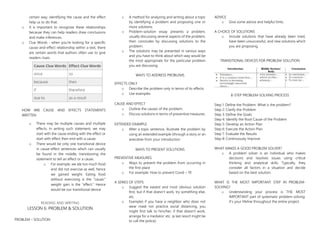
o Clue Words - when you're looking for a specific
cause-and-effect relationship within a text, there
are certain words that authors often use to give
readers clues.
HOW ARE CAUSE AND EFFECTS STATEMENTS
WRITTEN
o There may be multiple causes and multiple
effects. In writing such statement, we may
start with the cause ending with the effect or
start with effect then end with a cause.
o There would be only one transitional device
in cause-effect sentences which can usually
be found in the middle, transitioning the
statement to tell an effect or a cause.
o For example, we ate too much food
and did not exercise as well, hence
we gained weight. Eating food
without exercising is the “cause;”
weight gain is the “effect.” Hence
would be our transitional device.
READING AND WRITING
LESSON 6: PROBLEM & SOLUTION
PROBLEM – SOLUTION
o A method for analyzing and writing about a topic
by identifying a problem and proposing one or
more solutions.
o Problem-solution essay presents a problem,
usually discussing several aspects of the problem,
then concludes by discussing solutions to the
problem.
o The solutions may be presented in various ways
and you have to think about which way would be
the most appropriate for the particular problem
you are discussing.
WAYS TO ADDRESS PROBLEMS
EFFECTS ONLY
o Describe the problem only in terms of its effects.
o Use examples
CAUSE AND EFFECT
o Outline the causes of the problem.
o Discuss solutions in terms of preventive measures.
EXTENDED EXAMPLE
o After a topic sentence, illustrate the problem by
using an extended example (through a story or an
anecdote from your introduction
WAYS TO PRESENT SOLUTIONS
PREVENTIVE MEASURES
o Ways to prevent the problem from occurring in
the first place
o For example: How to prevent Covid – 19
A SERIES OF STEPS
o Suggest the easiest and most obvious solution
first, but if that doesn’t work, try something else,
etc.
o Example) if you have a neighbor who does not
wear mask nor practice social distancing, you
might first talk to him/her; if that doesn’t work,
arrange for a mediator; etc. (a last resort might be
to call the police).
ADVICE
o Give some advice and helpful hints.
A CHOICE OF SOLUTIONS
o Include solutions that have already been tried,
have been unsuccessful, and new solutions which
you are proposing.
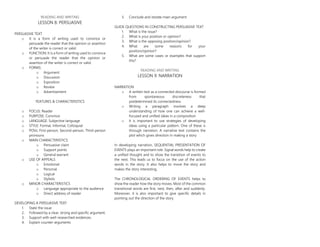
TRANSITIONAL DEVICES FOR PROBLEM-SOLUTION
8-STEP PROBLEM-SOLVING PROCESS
Step 1: Define the Problem. What is the problem?
Step 2: Clarify the Problem
Step 3: Define the Goals
Step 4: Identify the Root Cause of the Problem
Step 5: Develop an Action Plan
Step 6: Execute the Action Plan
Step 7: Evaluate the Results
Step 8: Continuously Improve
WHAT MAKES A GOOD PROBLEM SOLVER?
o A problem solver is an individual who makes
decisions and resolves issues using critical
thinking and analytical skills. Typically, they
consider all factors in a situation and decide
based on the best solution.
WHAT IS THE MOST IMPORTANT STEP IN PROBLEM-
SOLVING?
o Understanding your process is THE MOST
IMPORTANT part of systematic problem-solving.
It's your lifeline throughout the entire project.
READING AND WRITING
LESSON 8: PERSUASIVE
PERSUASIVE TEXT
o It is a form of writing used to convince or
persuade the reader that the opinion or assertion
of the writer is correct or valid.
o FUNCTION: It is a form of writing used to convince
or persuade the reader that the opinion or
assertion of the writer is correct or valid.
o FORMS:
o Argument
o Discussion
o Exposition
o Review
o Advertisement
FEATURES & CHARACTERISTICS
o FOCUS: Reader
o PURPOSE: Convince
o LANGUAGE: Subjective language
o STYLE: Formal, Informal, Colloquial
o POVs: First-person, Second-person, Third-person
pronouns
o MAIN CHARACTERISTICS:
o Persuasive claim
o Support points
o General warrant
o USE OF APPEALS
o Emotional
o Personal
o Logical
o Stylistic
o MINOR CHARACTERISTICS
o Language appropriate to the audience
o Direct address of reader
DEVELOPING A PERSUASIVE TEXT
1. State the issue
2. Followed by a clear, strong and specific argument.
3. Support with well-researched evidences.
4. Explain counter-arguments
5. Conclude and restate main argument
GUIDE QUESTIONS IN CONSTRUCTING PERSUASIVE TEXT
1. What is the issue?
2. What is your position or opinion?
3. What is the opposing position/opinion?
4. What are some reasons for your
position/opinion?
5. What are some cases or examples that support
this?
READING AND WRITING
LESSON 9: NARRATION
NARRATION
o A written text as a connected discourse is formed
from spontaneous discreteness that
predetermined its connectedness
o Writing a paragraph involves a deep
understanding of how one can achieve a well-
focused and unified ideas in a composition
o It is important to use strategies of developing
ideas using a particular pattern. One of these is
through narration. A narrative text contains the
plot which gives direction in making a story
In developing narration, SEQUENTIAL PRESENTATION OF
EVENTS plays an important role. Signal words help to create
a unified thought and to show the transition of events to
the next. This leads us to focus on the use of the action
words in the story. It also helps to move the story and
makes the story interesting.
The CHRONOLOGICAL ORDERING OF EVENTS helps to
show the reader how the story moves. Most of the common
transitional words are first, next, then, after and suddenly.
Moreover, it is also important to give specific details in
pointing out the direction of the story.

READING AND WRITING LESSON 1.docx

  • 1.
    READING AND WRITING LESSON1: DESCRIPTION DESCRIPTION - A writing pattern of developing paragraph using detailed observation about the subject. - Involves the use of adjectives and adverbs that help create a vivid picture of what you are trying to express. SENSORY LANGUAGES - These are words that we can use to describe your subject. They describe the subject as to how they look, sound, feel, smell and taste. MODIFIERS - Modifiers are elements that improve or enhance the meaning of a clause or sentence. - They can be in word form, phrases, or clauses that provide detail for an idea to be more engaging and specific. TWO TYPES OF DESCRIPTION OBJECTIVE DESCRIPTION - The type of description where the writer presents impartial and actual picture of the subject without biases. - Excludes personal impression of the subject. - Example) Giving your description of an experiment in class. SUBJECTIVE DESCRIPTION - The type of description where the writer gives personal impression of what is observed. - Often used in making fiction stories. - Example) Writing about a place you visited during the summer and giving your personal judgment of how you experienced the place. SPATIAL DESCRIPTION A spatial description explains things with sensory details as they appear when observed. The focus is on location, based on physical details and using spatial order to create a logical flow. Sensory Detail and Figurative Language When you want to "bring something to life" in your writing, or get concretely detailed (to show something with description rather than just generally tell about that something), you usually have to be a good observer of sensory detail which has a lot to do with adjectives (modifies/enhances nouns) and adverbs (modifies/enhances verbs), though one must always beware of clichés: SIGHT Example) His brown hair hangs down to the middle of his sloping back SOUND Example) The train he sits on clanks metallically beneath. TASTE Example) His hair tastes like bad chemicals, sour and tinny TOUCH Example) His skin must feel like sandpaper SMELL Example) There is something musty and moldy about him PSYCHIC/INTUITION (ha ha) Example) He seems sad like a dog laying on a dusty sidewalk in Mexico. I sense his pain in the tired squint of his eyes FIGURATIVE LANGUAGE - AKA imagery or metaphorical language, - Often the way to really make something plain or something abstract feel more concrete via comparison (you compare the literal thing or idea to a figurative concrete thing). Notice that some of my examples above are figurative, though one must always beware of bad metaphors: SIMILE - Has like or as in the sentence - Example) his hair hangs like broken violin stings ‘METAPHOR - doesn't have like or as in the sentence - often more surreal feeling - may take the form of an adjective or adverb - Example) his broken violin string hair his sandpaper skin PERSONIFICATION (often easy to cliché) - giving inanimate objects human qualities - Examples) Barry Lopez often does this, say, to describe “The Wind" in Desert Notes) “his hair moved like fingers around his shoulders” Path's Metaphors poem “I’m a melon strolling on two tendrils" (mellons aren't human, but strolling is a very human descriptor) ANALOGY - Comparison of things to make a point-often more involved, or more narrative - FALSE ANALOGY is a logical fallacy where the two things compared are way too different, and thus can't be accurately compared: but this can create surprise and humor in more opened-form creative writing; often the comparisons of different things - Example) Watching people while riding on the bus is a lot like traveling to another country: things look familiar from afar, but up close, you wonder if you've entered another dimension.
  • 2.
    READING AND WRITING LESSON2: DEFINITION DEFINITION - Definitions provide concise but exact meanings of unfamiliar words and explain special meanings for familiar words. - Example: THREE TYPES OF DEFINITION INFORMAL DEFINITION - Two types: 1) Denotation 2) Connotation DENOTATION - Denotation is the dictionary meaning of the word. - Example: Rose is a family of prickly shrubs with pinnate leaves and showy flowers. CONNOTATION - Connotation is the secondary meaning of a word and not necessarily included in the dictionary. - Example: A dozen of pink roses is usually given to their beloved ones. INFORMAL DEFINITION - Theree principal parts: 1) WORD (Species) 2) CLASS (Genus) 3) DIFFERENTIAE WORD - WORD is the name of the object, process, or concept defined. This is usually followed by “is” and “are” CLASS - general group to which the objects belong DIFFERENTIAE - Differentiae, also known as differentials, are the characteristics or qualities that distinguish one from another. EXAMPLE) Skimming (species) is a reading technique (class) of allowing the eyes to travel over a page very quickly, stopping only here and there to gain an idea (differentiae). EXPANDED / EXTENDED DEFINITION - The different methods: 1) By stating its characteristics o Example) San Pablo City is one of the oldest towns in the Philippines. As one of the first - class cities in the province of Laguna. It is also called the City of Seven Lakes namely: Bunot Lake, Calibato Lake, Mohicap Lake, Palakpakin Lake, Pandin Lake, Sampaloc Lake, and Yambo Lake. These seven freshwater lakes are the crater form of a steam- blast eruption from Mt. Cristobal. 2) By function o Example) In this time of global crisis, everyone is responsible for their actions, such as following the precautionary measures given by the health experts to avoid the spread of virus. 3) By what it is not o Example) Far from the normal situations that we had before, the pandemic makes each one of us skip buying unnecessary items. 4) By what it is similar to o Example) Jollibee and McDonalds both after savory chicken and delicious pasta that children love. 5) By examples o Example) The opening of the classes for School Year 2020 -2021 amidst the pandemic is a great challenge to the Department of Education. They continue researching different alternative ways of teaching and learning to be implemented in schools such as online learning, modular learning, and lastly learning from TV shows and radio programs. 6) By origin of word or etymology o Example) Writers around the world define literature in different ways. The origin of the word literature is derived from the Latin word Litera which means letter. 7) By its effect o Example) Due to the global pandemic, specifically COVID-19, the world embraces the new normal. People have become more conscious about sanitation and hygiene. They now learn physical distancing in public places. And, most of the people stay at home either working or developing new hobbies and exploring new things.
  • 3.
    READING AND WRITING LESSON3: CLASSIFICATION & EXEMPLIFICATION TRANSITIONAL EXPRESSIONS - Connect one idea to another between or within sentences and alert readers to the connections between paragraphs or blocks of the text. - Three types: 1) Transitions between sections 2) Transitions between paragraphs 3) Transitions within paragraphs CLASSIFICATION - Division or category in a system which divides things into groups or types. - Used when a writer needs to sort out or arrange subjects to groups or categories based on their common and shared characteristics. - Some transitional expressions in writing effective classification paragraphs: classified as, one kind, the last group, another kind, another, final type, the first category, are categorized as, the next part. - EXAMPLE: PLANNING THE ESSAY Once you have chosen your topic, you will need to consider the purpose: - Why are you breaking the issue down? - What impact do you hope it will have upon your audience? Next, you will need to create distinctly different categories by making sure that features of each do not overlap. DRAFTING THE ESSAY o Introduction: Interest your audience while developing your purpose for writing. o Body: The body paragraphs will each be devoted to a different category or topic, but the order in which you discuss each should be consistent throughout the body of the essay. In addition, you will need to decide how the body paragraphs should be ordered. For example, when classifying bad drivers, you may move from least to most offensive. o Conclusion: should be interesting, and it should effectively draw the essay to a close while simultaneously reiterating your purpose EXEMPLIFICATION o One of the most common and effective ways to show or explain an idea or point (e.g., observation, opinion, belief). o In this pattern of development, the main idea is explained by giving an extended example or a series of detailed examples. o Exemplification is used in every kind of writing situation to explain and clarify, to add interest, and to persuade. o Effective examples will enhance any type of essay because the reader will be able to relate a common experience to the topic. o Argumentative and exemplification essays, feature articles, reviews, reports, and case studies often use examples to prove a point o Transitional expressions used are: o for/an example o Such as o For instance o A case in point o Illustrations of this o Namely o To specify o To clarify o To illustrate TYPES OF EXAMPLES o Examples that illustrate o Examples that explain o Examples that tell a story o Examples that describe LENGTH OF EXAMPLE o Brief o Extended o Hypothetical READING AND WRITING LESSON 4: COMPARISON & CONTRAST COMPARISON o Tells how two things are similar CONTRAST o Tells how two things are different COMPARISON AND CONTRAST o Comparing and contrasting is an important skill in academic writing. It involves taking two or more subjects and analyzing the differences and similarities between them.
  • 4.
    o It pointsout the similarities and differences between two or more subjects. It’s ideal for showing what separates and unites related things or concepts. o By seeing the differences and similarities, the reader better understands each of the subjects by using the other subject as a frame of reference. To make effective comparisons, there must be some grounds for comparison or a point of comparison. When comparing and contrasting, we use transition words to signal the reader that we are citing similarities and differences between our subjects. Compare-and-contrast essays follow our own recommended essay structure: 1) Introduction: where you explain your thesis or what your essay will discuss 2) Body: where you actually list the similarities and differences of your subjects; the largest section 3) Conclusion: where you wrap up and summarize your points THREE METHODS IN WRITING COMPARISON & CONTRAST PARAGRAPHS BLOCK METHOD (SUBJECT-BY-SUBJECT) o You discuss one subject in full and then move on to the next subject. ALTERNATING METHOD (POINT-BY-POINT) o You discuss one subject’s take on a certain aspect and then another subject’s take immediately afterward, followed by a new aspect. SIMILARITIES AND DIFFERENCES o You discuss all the similarities between your subjects and then all the differences, or vice versa (differences first and then similarities). READING AND WRITING LESSON 5: CAUSE & EFFECT CAUSE o Something or someone that produces an effect, result, or condition o Something or someone that makes something happen or exist o The cause is the reason that things happen in the text - without a cause, there is no effect. o This means that without a cause, the text would be stagnant and nothing more would happen. EFFECT o A change which is a result or consequence of an action or other cause. o The result of a particular influence o Something that happens because of something else: a condition, occurrence, or result generated by one or more causes. Effects are outcomes. CAUSE AND EFFECT o Cause and effect is an intrinsic relationship between events and processes, where one causes the other. o For example, I overslept (cause) so I missed my bus (effect). o A cause-effect relationship is one in which a certain event (the cause) makes another event happen (the effect). o A single cause can have multiple effects. o Cause and effect may also be called causality. o Cause and effect is extremely important when it comes to moving a story along. It allows the characters, and the reader, to move from plot point to plot point. o When we're writing a story, it's also important to think about cause and effect. Everything that we make the characters do (the cause) will have an effect on the rest of the story. IMPORTANCE OF CAUSE AND EFFECT o Cause and effect gives us a logical explanation for why something has happened. o Causality allows us to logically explain events. This helps up to solve problems and provide reasoning for why something happened. It means we can (somewhat) explain what's happening all around us. IDENTIFYING CAUSE AND EFFECT o Whether you're reading informational text or a fictional story, cause-and-effect relationships can be found in a variety of situations. o As readers, we may need to find out what caused a disaster to occur or why a character feels a
  • 5.
    certain way; identifyingthe cause and the effect help us to do that. o It is important to recognize these relationships because they can help readers draw conclusions and make inferences. o Clue Words - when you're looking for a specific cause-and-effect relationship within a text, there are certain words that authors often use to give readers clues. HOW ARE CAUSE AND EFFECTS STATEMENTS WRITTEN o There may be multiple causes and multiple effects. In writing such statement, we may start with the cause ending with the effect or start with effect then end with a cause. o There would be only one transitional device in cause-effect sentences which can usually be found in the middle, transitioning the statement to tell an effect or a cause. o For example, we ate too much food and did not exercise as well, hence we gained weight. Eating food without exercising is the “cause;” weight gain is the “effect.” Hence would be our transitional device. READING AND WRITING LESSON 6: PROBLEM & SOLUTION PROBLEM – SOLUTION o A method for analyzing and writing about a topic by identifying a problem and proposing one or more solutions. o Problem-solution essay presents a problem, usually discussing several aspects of the problem, then concludes by discussing solutions to the problem. o The solutions may be presented in various ways and you have to think about which way would be the most appropriate for the particular problem you are discussing. WAYS TO ADDRESS PROBLEMS EFFECTS ONLY o Describe the problem only in terms of its effects. o Use examples CAUSE AND EFFECT o Outline the causes of the problem. o Discuss solutions in terms of preventive measures. EXTENDED EXAMPLE o After a topic sentence, illustrate the problem by using an extended example (through a story or an anecdote from your introduction WAYS TO PRESENT SOLUTIONS PREVENTIVE MEASURES o Ways to prevent the problem from occurring in the first place o For example: How to prevent Covid – 19 A SERIES OF STEPS o Suggest the easiest and most obvious solution first, but if that doesn’t work, try something else, etc. o Example) if you have a neighbor who does not wear mask nor practice social distancing, you might first talk to him/her; if that doesn’t work, arrange for a mediator; etc. (a last resort might be to call the police). ADVICE o Give some advice and helpful hints. A CHOICE OF SOLUTIONS o Include solutions that have already been tried, have been unsuccessful, and new solutions which you are proposing. TRANSITIONAL DEVICES FOR PROBLEM-SOLUTION 8-STEP PROBLEM-SOLVING PROCESS Step 1: Define the Problem. What is the problem? Step 2: Clarify the Problem Step 3: Define the Goals Step 4: Identify the Root Cause of the Problem Step 5: Develop an Action Plan Step 6: Execute the Action Plan Step 7: Evaluate the Results Step 8: Continuously Improve WHAT MAKES A GOOD PROBLEM SOLVER? o A problem solver is an individual who makes decisions and resolves issues using critical thinking and analytical skills. Typically, they consider all factors in a situation and decide based on the best solution. WHAT IS THE MOST IMPORTANT STEP IN PROBLEM- SOLVING? o Understanding your process is THE MOST IMPORTANT part of systematic problem-solving. It's your lifeline throughout the entire project.
  • 6.
    READING AND WRITING LESSON8: PERSUASIVE PERSUASIVE TEXT o It is a form of writing used to convince or persuade the reader that the opinion or assertion of the writer is correct or valid. o FUNCTION: It is a form of writing used to convince or persuade the reader that the opinion or assertion of the writer is correct or valid. o FORMS: o Argument o Discussion o Exposition o Review o Advertisement FEATURES & CHARACTERISTICS o FOCUS: Reader o PURPOSE: Convince o LANGUAGE: Subjective language o STYLE: Formal, Informal, Colloquial o POVs: First-person, Second-person, Third-person pronouns o MAIN CHARACTERISTICS: o Persuasive claim o Support points o General warrant o USE OF APPEALS o Emotional o Personal o Logical o Stylistic o MINOR CHARACTERISTICS o Language appropriate to the audience o Direct address of reader DEVELOPING A PERSUASIVE TEXT 1. State the issue 2. Followed by a clear, strong and specific argument. 3. Support with well-researched evidences. 4. Explain counter-arguments 5. Conclude and restate main argument GUIDE QUESTIONS IN CONSTRUCTING PERSUASIVE TEXT 1. What is the issue? 2. What is your position or opinion? 3. What is the opposing position/opinion? 4. What are some reasons for your position/opinion? 5. What are some cases or examples that support this? READING AND WRITING LESSON 9: NARRATION NARRATION o A written text as a connected discourse is formed from spontaneous discreteness that predetermined its connectedness o Writing a paragraph involves a deep understanding of how one can achieve a well- focused and unified ideas in a composition o It is important to use strategies of developing ideas using a particular pattern. One of these is through narration. A narrative text contains the plot which gives direction in making a story In developing narration, SEQUENTIAL PRESENTATION OF EVENTS plays an important role. Signal words help to create a unified thought and to show the transition of events to the next. This leads us to focus on the use of the action words in the story. It also helps to move the story and makes the story interesting. The CHRONOLOGICAL ORDERING OF EVENTS helps to show the reader how the story moves. Most of the common transitional words are first, next, then, after and suddenly. Moreover, it is also important to give specific details in pointing out the direction of the story.