Congratulations!
Sort Cards
Group B
Group A
Primary Source vs. Secondary Source
Primary sources are original materials
that were created at the time of the
event or period being studied.
Examples:
letters, diaries, photographs,
government documents, and artifacts
Secondary sources are materials that
are created after the event or period
being studied and interpret or analyze
the primary sources.
Examples:
textbooks, journal articles,
biographies, and history books
In summary, primary sources
provide firsthand accounts or
evidence of an event or period,
while secondary sources analyze or
interpret the primary sources.
Check point! Reflect on the following questions:
1. What is a primary source? a secondary source?
2. What is the difference between primary and secondary
sources?
3. What are your sources in making your persuasive speech?
4. Among the sources you have mentioned, which of them are
considered as primary sources? secondary sources?
5. What is the importance of using primary and secondary
sources?
Outline
Purpose of an Outline and its Importance in Organizing Ideas
Outlining
a method of organizing written or verbal communication in a
hierarchical structure
Outlining…
involves creating a plan or framework for your
ideas or arguments before you start writing or
presenting.
is commonly used in academic writing, business
writing, and public speaking.
2 main types of outlines:
Topic outlines use
keywords and phrases
to organize the main
ideas and supporting
points of your
communication.
Sentence outlines use
complete sentences to
outline your ideas and
arguments.
Basic Structure:
Introduction, Body, & Conclusion
Within the body, you will include your main ideas and
supporting details or evidence.
You can also use subheadings and bullet points to further
organize your ideas and make the outline more visually
appealing and easy to understand.
Outlining can be a useful tool for several reasons.
● It helps you to organize your thoughts and ideas in a logical
way, making it easier to write or present your communication.
● It also helps you to identify gaps in your argument or areas
where you need to do further research or provide more
evidence.
● It can save you time by helping you to stay focused and avoid
unnecessary tangents or repetitions.
Outlining is a valuable technique for
anyone who wants to communicate
their ideas or arguments effectively,
whether in writing or speaking.
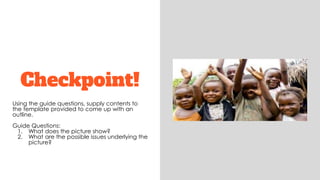
Checkpoint!
Using the guide questions, supply contents to
the template provided to come up with an
outline.
Guide Questions:
1. What does the picture show?
2. What are the possible issues underlying the
picture?
Check point! Reflect on the following questions:
1. What is an outline?
2. What is the purpose of an outline? Why is it important to have
one before writing?
3. Do you find it challenging to expand the content of your
outline using primary and secondary sources? Why or why
not?
Share Your Insights
Application Cards
Why is it important to use primary and secondary sources to support
your outline?
Authentic Questions
Activity # 4._
Expanding the content of an outline
Look for primary and secondary sources about Indian
Literature, take note of the sources and details and use it to
expand the content of the outline.
Definition, Importance, Historical Overview, Forms &
Genres, & Famous Writers & their Works
Activity # 4._: Expanding the content of an outline
From the outline you have created, create a powerpoint presentation and be ready
for the sharing or reporting on the next day.
You are free to choose the medium of your presentation whether through
PowerPoint presentation, video, and the like.
Tasks to be delegated:
● 2-3 Researchers
● PowerPoint Presentation Creator
● 1-2 Presenter/s

Outlining.pptx

  • 1.
  • 2.
  • 3.
    Primary Source vs.Secondary Source Primary sources are original materials that were created at the time of the event or period being studied. Examples: letters, diaries, photographs, government documents, and artifacts Secondary sources are materials that are created after the event or period being studied and interpret or analyze the primary sources. Examples: textbooks, journal articles, biographies, and history books
  • 4.
    In summary, primarysources provide firsthand accounts or evidence of an event or period, while secondary sources analyze or interpret the primary sources.
  • 5.
    Check point! Reflecton the following questions: 1. What is a primary source? a secondary source? 2. What is the difference between primary and secondary sources? 3. What are your sources in making your persuasive speech? 4. Among the sources you have mentioned, which of them are considered as primary sources? secondary sources? 5. What is the importance of using primary and secondary sources?
  • 6.
    Outline Purpose of anOutline and its Importance in Organizing Ideas
  • 7.
    Outlining a method oforganizing written or verbal communication in a hierarchical structure
  • 8.
    Outlining… involves creating aplan or framework for your ideas or arguments before you start writing or presenting. is commonly used in academic writing, business writing, and public speaking.
  • 9.
    2 main typesof outlines: Topic outlines use keywords and phrases to organize the main ideas and supporting points of your communication. Sentence outlines use complete sentences to outline your ideas and arguments.
  • 10.
    Basic Structure: Introduction, Body,& Conclusion Within the body, you will include your main ideas and supporting details or evidence. You can also use subheadings and bullet points to further organize your ideas and make the outline more visually appealing and easy to understand.
  • 11.
    Outlining can bea useful tool for several reasons. ● It helps you to organize your thoughts and ideas in a logical way, making it easier to write or present your communication. ● It also helps you to identify gaps in your argument or areas where you need to do further research or provide more evidence. ● It can save you time by helping you to stay focused and avoid unnecessary tangents or repetitions.
  • 12.
    Outlining is avaluable technique for anyone who wants to communicate their ideas or arguments effectively, whether in writing or speaking.
  • 13.
    Checkpoint! Using the guidequestions, supply contents to the template provided to come up with an outline. Guide Questions: 1. What does the picture show? 2. What are the possible issues underlying the picture?
  • 14.
    Check point! Reflecton the following questions: 1. What is an outline? 2. What is the purpose of an outline? Why is it important to have one before writing? 3. Do you find it challenging to expand the content of your outline using primary and secondary sources? Why or why not?
  • 15.
  • 16.
    Application Cards Why isit important to use primary and secondary sources to support your outline?
  • 17.
  • 18.
    Activity # 4._ Expandingthe content of an outline Look for primary and secondary sources about Indian Literature, take note of the sources and details and use it to expand the content of the outline. Definition, Importance, Historical Overview, Forms & Genres, & Famous Writers & their Works
  • 19.
    Activity # 4._:Expanding the content of an outline From the outline you have created, create a powerpoint presentation and be ready for the sharing or reporting on the next day. You are free to choose the medium of your presentation whether through PowerPoint presentation, video, and the like. Tasks to be delegated: ● 2-3 Researchers ● PowerPoint Presentation Creator ● 1-2 Presenter/s