READING AND WRITING SKILLS
PATTERN OF DEVELOPMENT IN
WRITING ACROSS DISCIPLINE
• NARRATION
• DESCRIPTION
• DEFINITION
• EXEMPLIFICATION/
CLASSIFICATION
• COMPARISON AND
CONTRAST
• CAUSE AND EFFECT
• PROBLEM-SOLUTION ESSAY
• PERSUASION
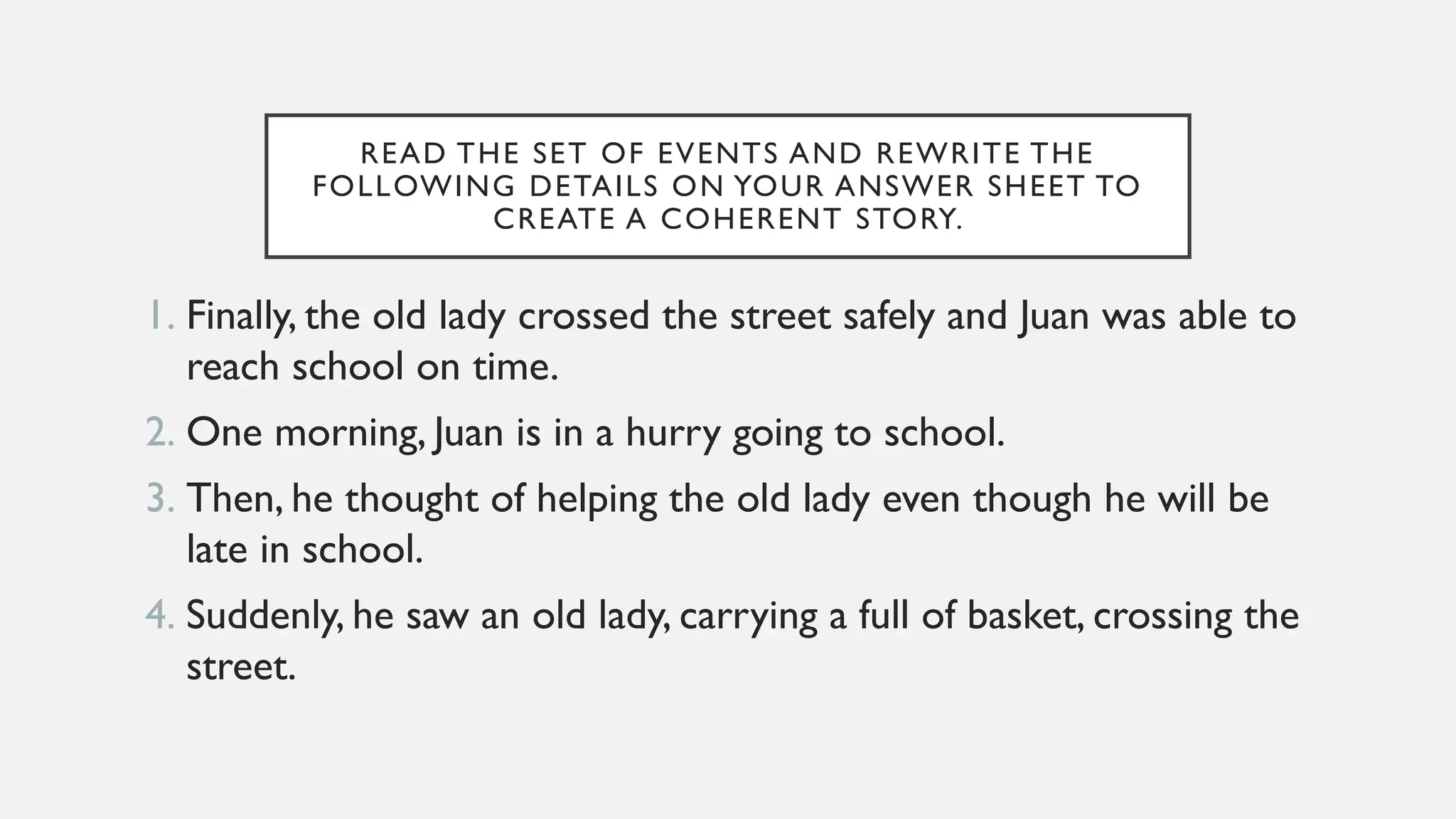
READ THE SET OF EVENTS AND REWRITE THE
FOLLOWING DETAILS ON YOUR ANSWER SHEET TO
CREATE A COHERENT STORY.
1. Finally, the old lady crossed the street safely and Juan was able to
reach school on time.
2. One morning, Juan is in a hurry going to school.
3. Then, he thought of helping the old lady even though he will be
late in school.
4. Suddenly, he saw an old lady, carrying a full of basket, crossing the
street.
NARRATION
refers to the way that a story is told, and so
belongs to the level of discourse (although in first-
person narration it may be that the narrator also
plays a role in the development of the story itself).
• In developing narration, sequential presentation of events plays
an important role. Signal words help to create unified thought
and to show the transition of events to the next.This leads us
to focus on the use of the action words in the story.
• The chronological ordering of events helps to show the
reader how the story moves.
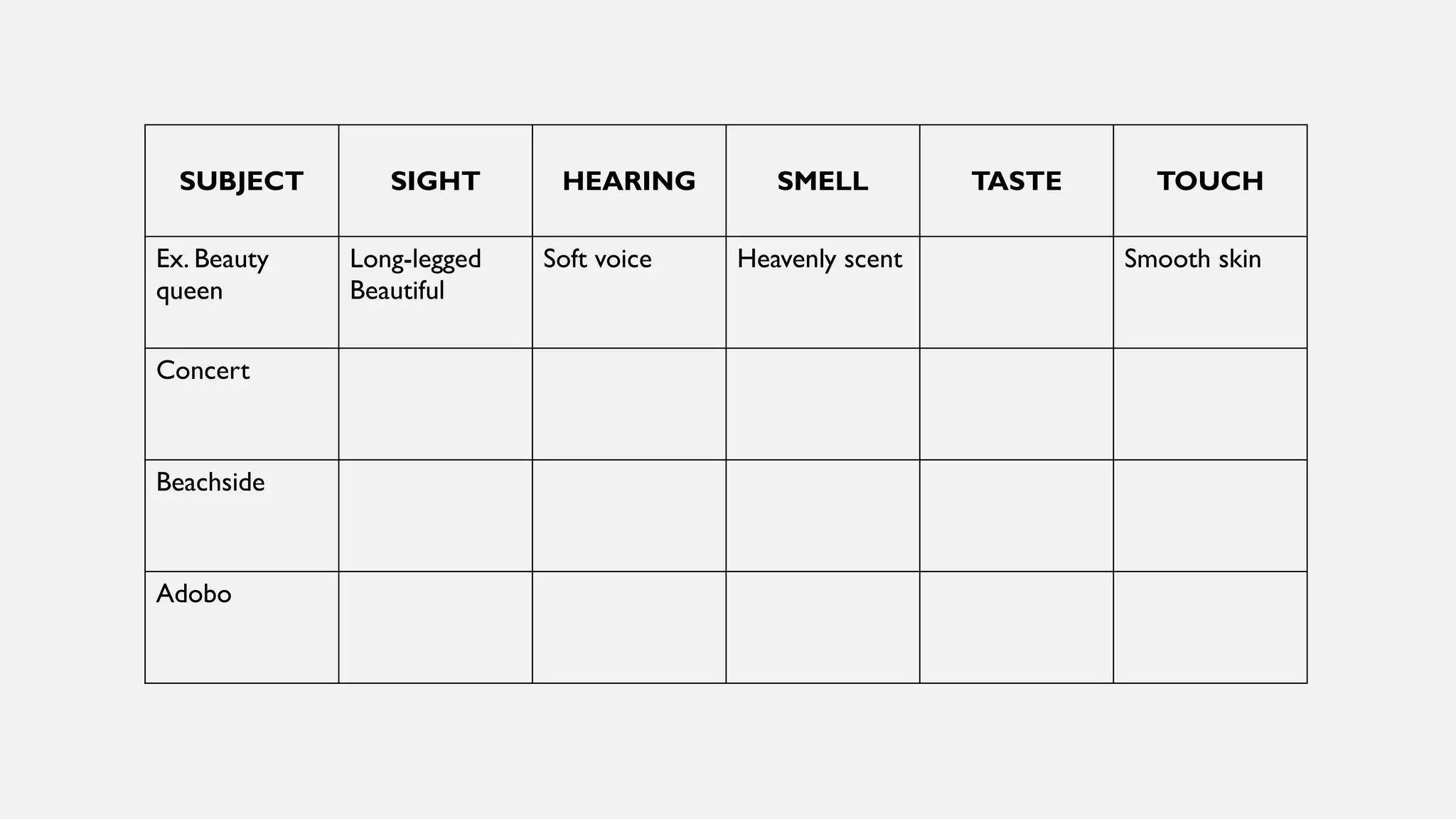
SUBJECT SIGHT HEARING SMELL TASTE TOUCH
Ex. Beauty
queen
Long-legged
Beautiful
Soft voice Heavenly scent Smooth skin
Concert
Beachside
Adobo
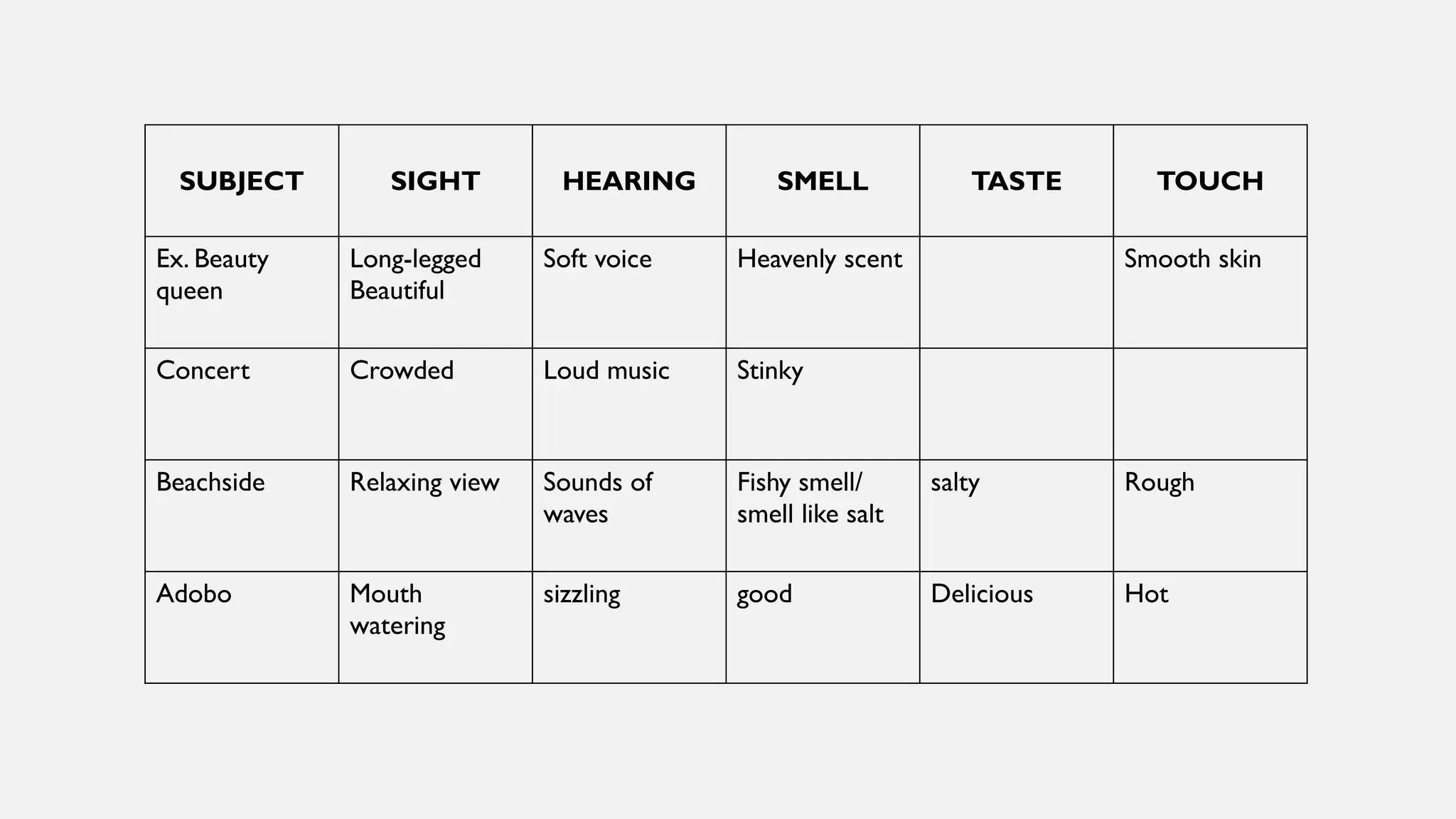
SUBJECT SIGHT HEARING SMELL TASTE TOUCH
Ex. Beauty
queen
Long-legged
Beautiful
Soft voice Heavenly scent Smooth skin
Concert Crowded Loud music Stinky
Beachside Relaxing view Sounds of
waves
Fishy smell/
smell like salt
salty Rough
Adobo Mouth
watering
sizzling good Delicious Hot
DESCRIPTION
• The use of description plays an important role to
elucidate the nature of people, places and things.A
series of detailed observation about the subject
can help you create a good descriptive paragraph.
This involves the use of adjectives and adverbs in
the paragraph.
SENSORY LANGUAGE
• Kind of words we used to describe how
your subject looks, sounds, feels, smells or
even tastes.
TWO TYPES OF DESCRIPTION
• Objective description
-The writer presents
impartial and actual picture
of the subject without
biases and excluding
personal impression of the
subject.
• Subjective description
-The writer gives
personal impression of
what is observed.This is
often used in making
fiction stories.
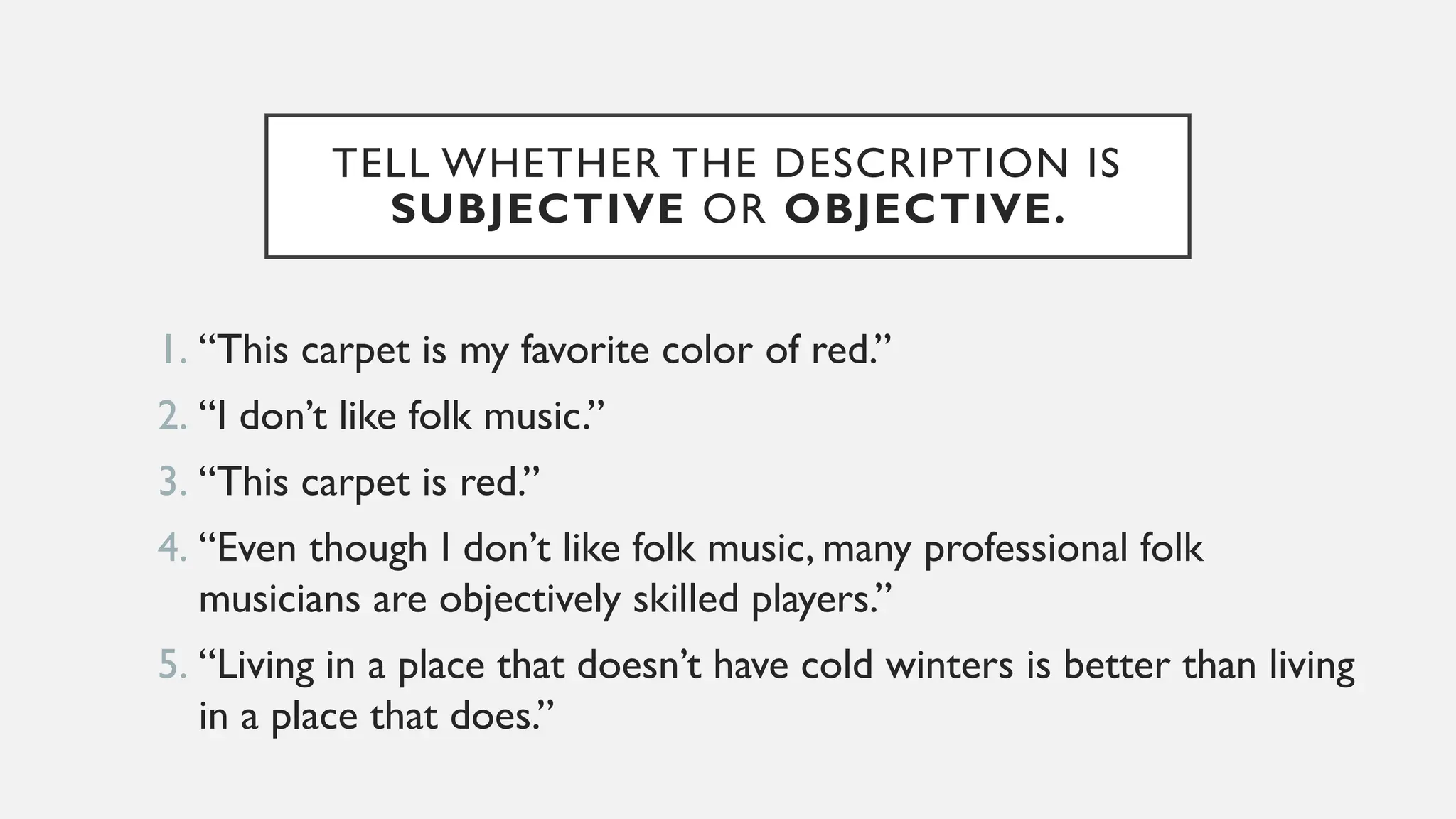
TELL WHETHER THE DESCRIPTION IS
SUBJECTIVE OR OBJECTIVE.
1. “This carpet is my favorite color of red.”
2. “I don’t like folk music.”
3. “This carpet is red.”
4. “Even though I don’t like folk music, many professional folk
musicians are objectively skilled players.”
5. “Living in a place that doesn’t have cold winters is better than living
in a place that does.”
DEFINITION
• It provides concise but exact meanings of
unfamiliar words and explain special
meanings for familiar words.They are often
used to explain technical words and
concepts.
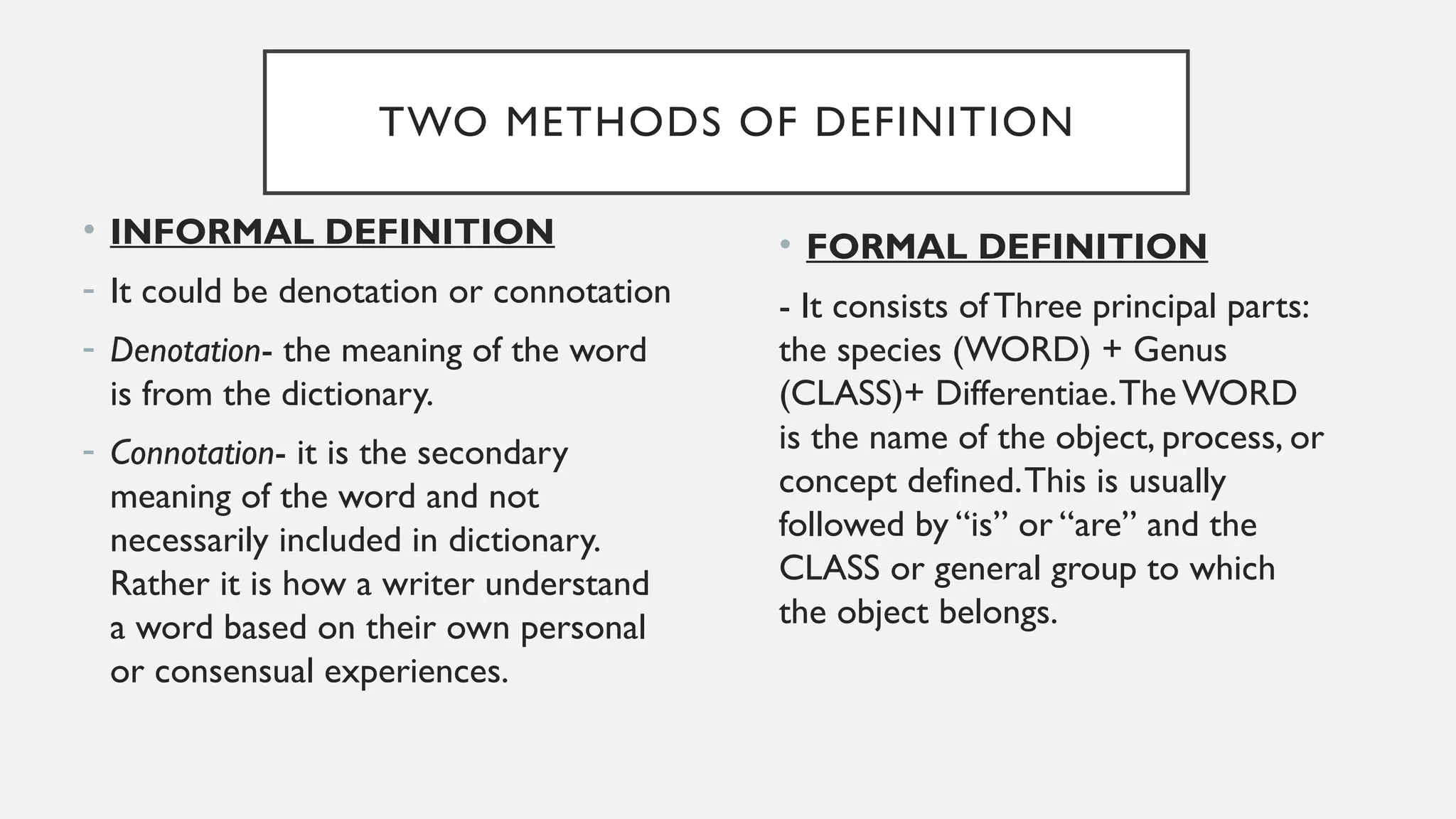
TWO METHODS OF DEFINITION
• INFORMAL DEFINITION
- It could be denotation or connotation
- Denotation- the meaning of the word
is from the dictionary.
- Connotation- it is the secondary
meaning of the word and not
necessarily included in dictionary.
Rather it is how a writer understand
a word based on their own personal
or consensual experiences.
• FORMAL DEFINITION
- It consists ofThree principal parts:
the species (WORD) + Genus
(CLASS)+ Differentiae.The WORD
is the name of the object, process, or
concept defined.This is usually
followed by “is” or “are” and the
CLASS or general group to which
the object belongs.
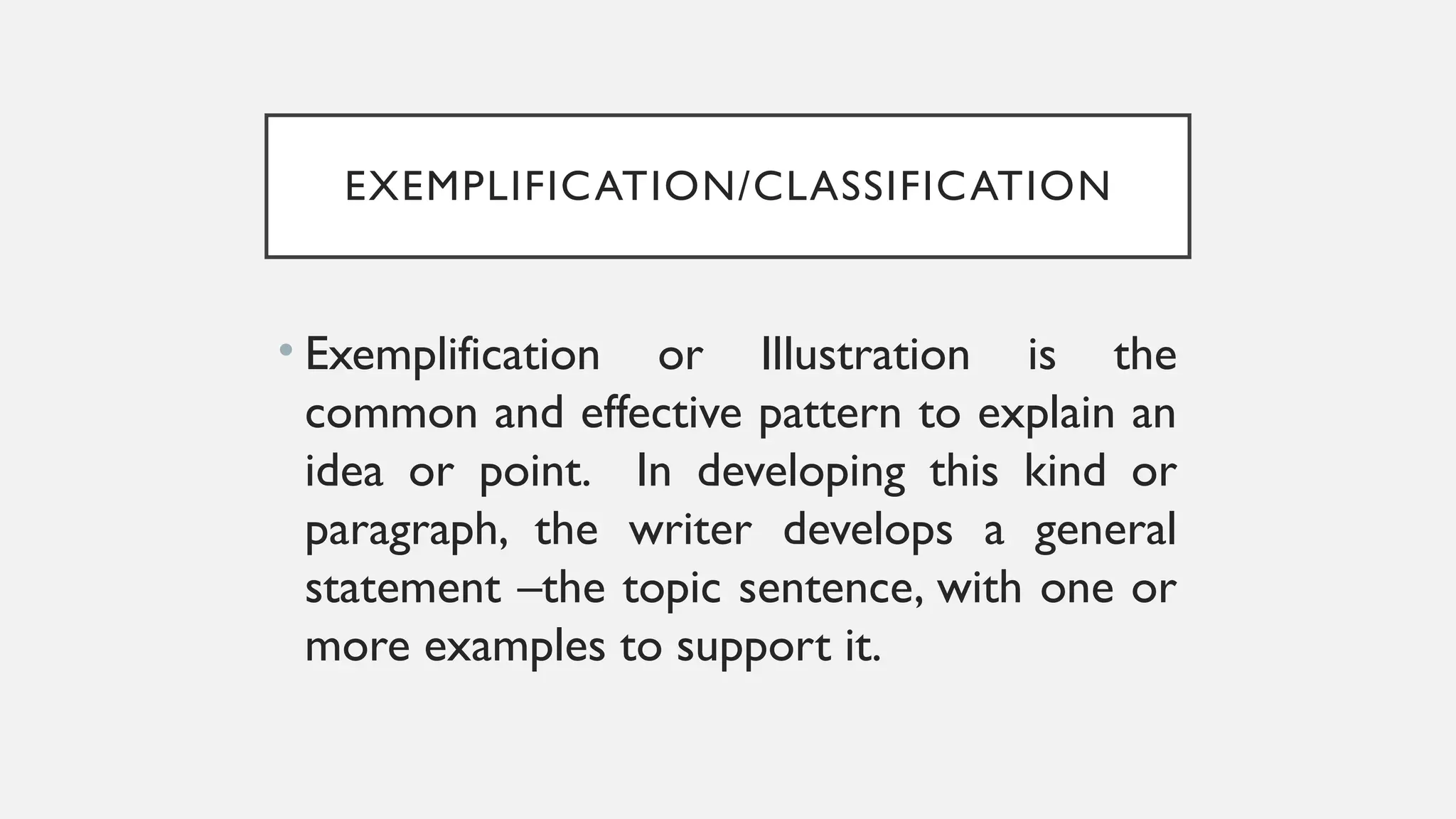
EXEMPLIFICATION/CLASSIFICATION
• Exemplification or Illustration is the
common and effective pattern to explain an
idea or point. In developing this kind or
paragraph, the writer develops a general
statement –the topic sentence, with one or
more examples to support it.
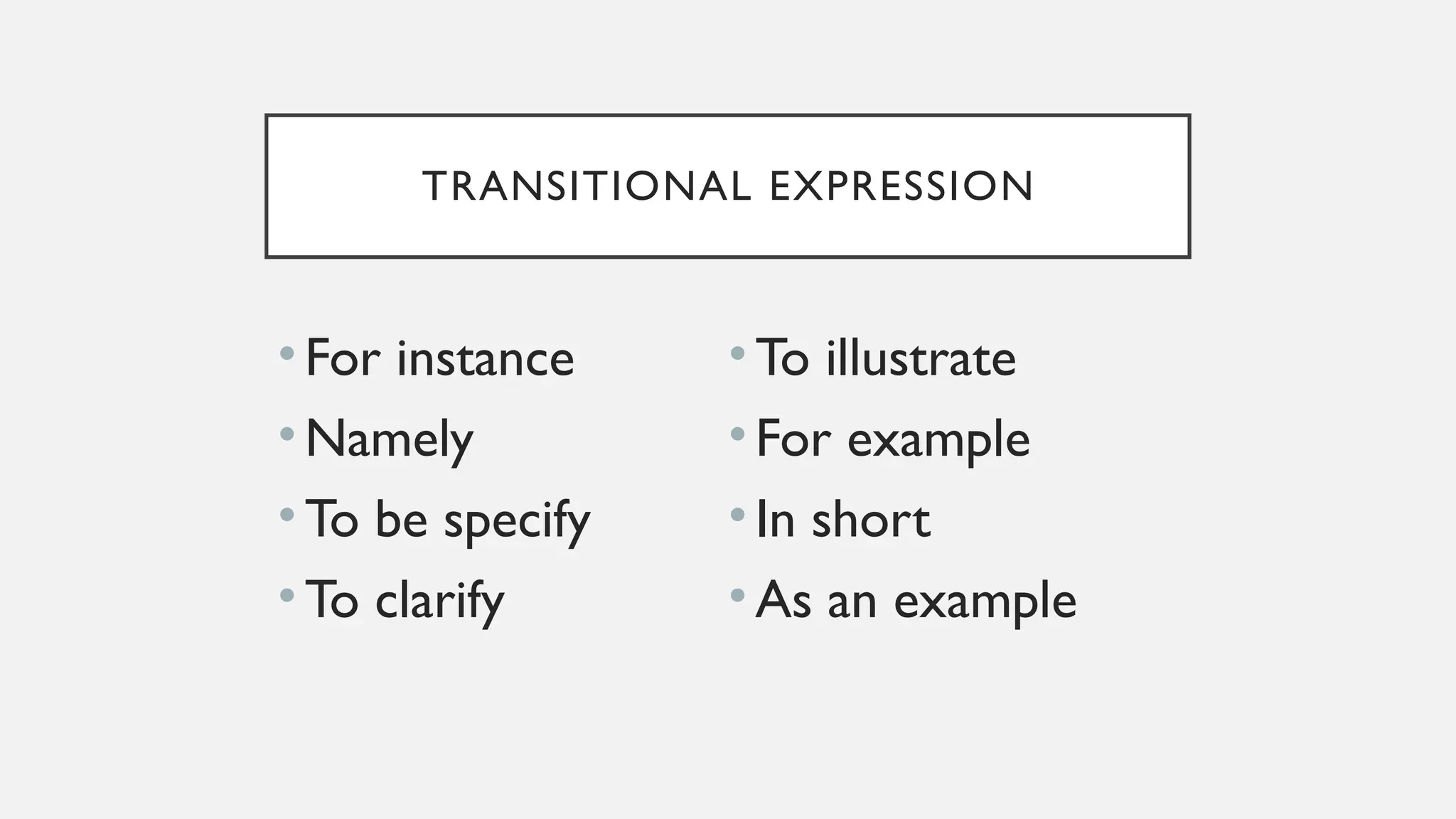
TRANSITIONAL EXPRESSION
•For instance
•Namely
•To be specify
•To clarify
•To illustrate
•For example
•In short
•As an example
CLASSIFICATION
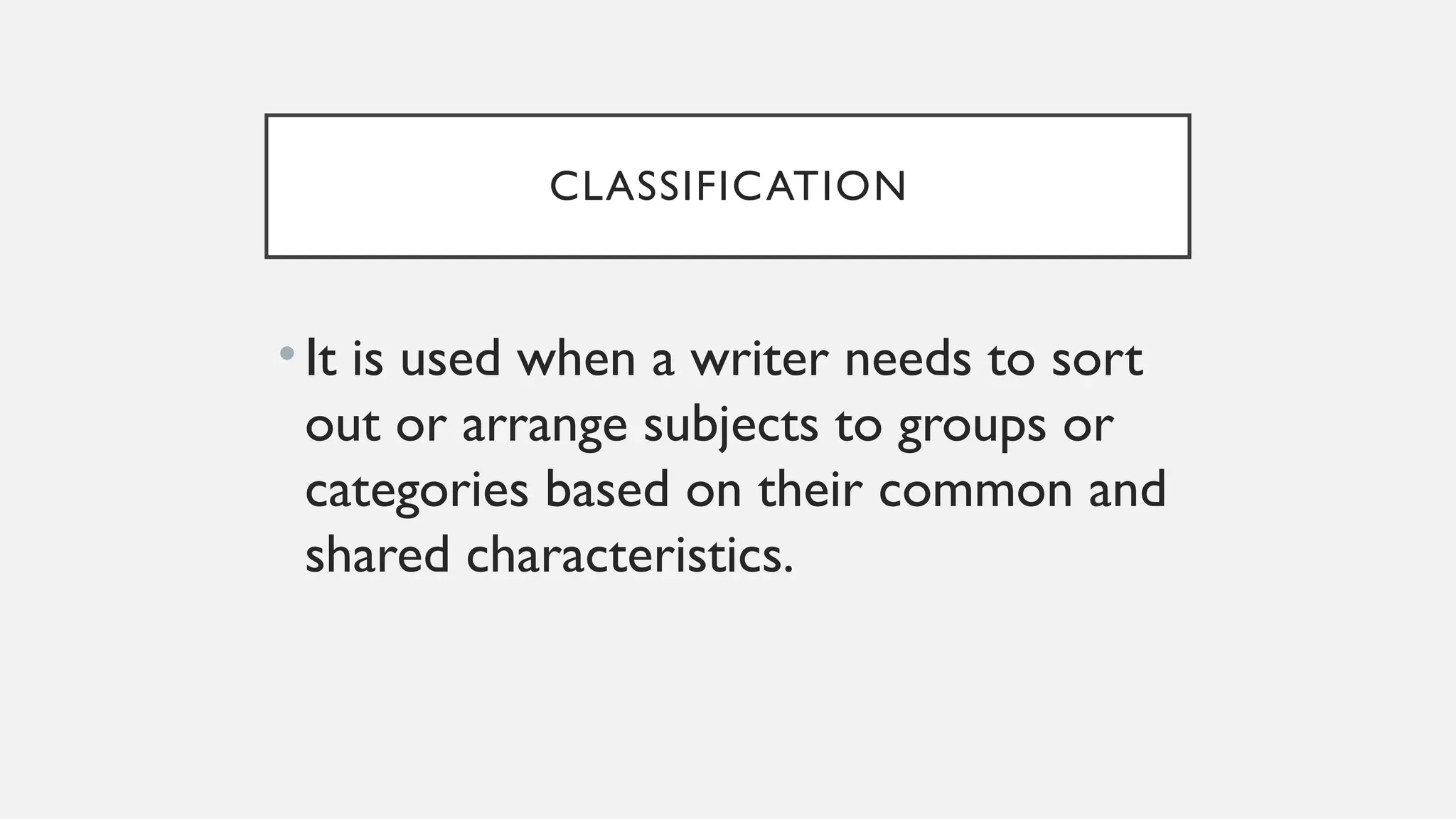
•It is used when a writer needs to sort
out or arrange subjects to groups or
categories based on their common and
shared characteristics.
TRANSITIONAL EXPRESSION
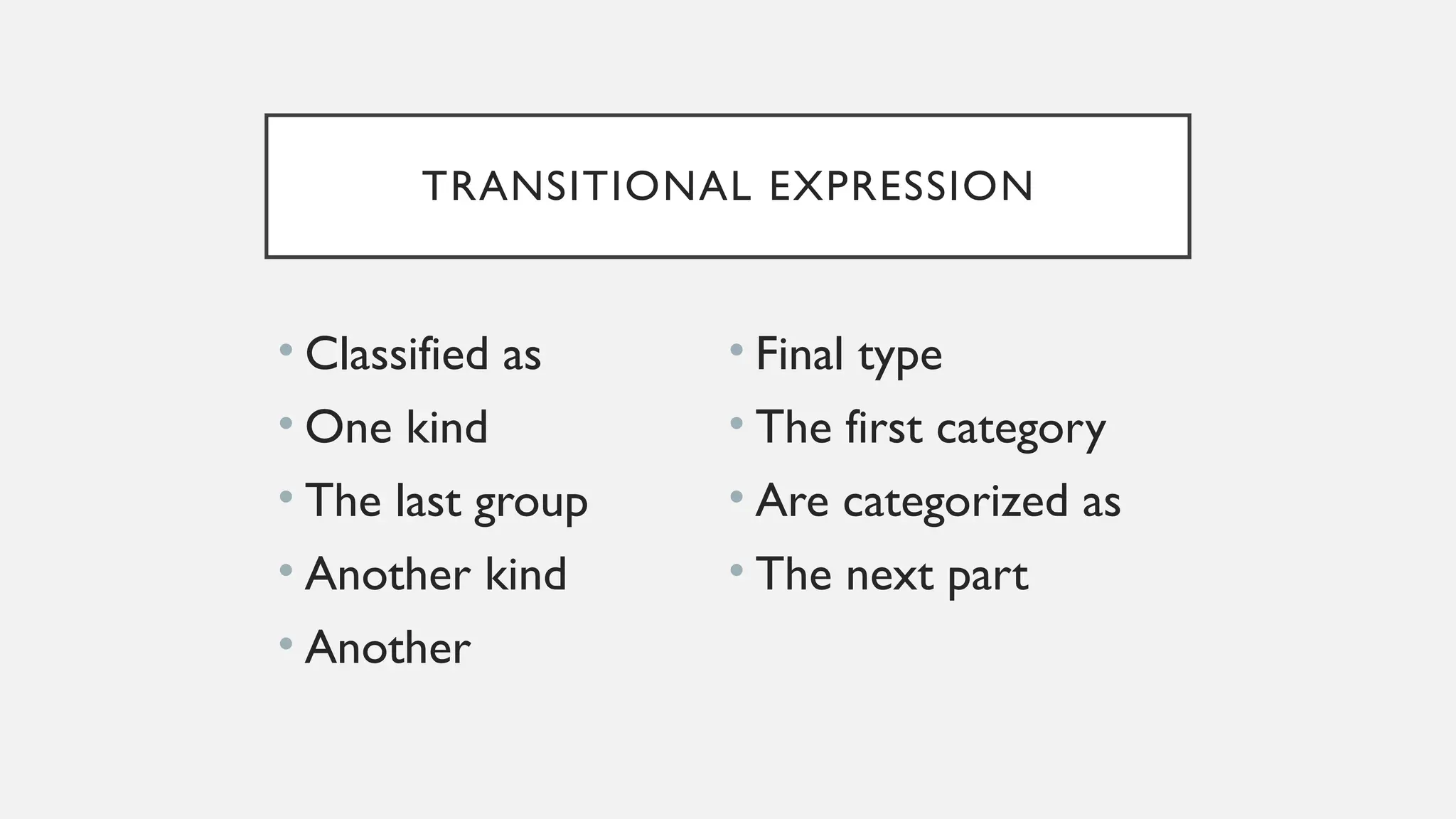
• Classified as
• One kind
• The last group
• Another kind
• Another
• Final type
• The first category
• Are categorized as
• The next part
COMPARISON AND CONTRAST

patterns of development in writing across discipline

  • 1.
  • 2.
    PATTERN OF DEVELOPMENTIN WRITING ACROSS DISCIPLINE • NARRATION • DESCRIPTION • DEFINITION • EXEMPLIFICATION/ CLASSIFICATION • COMPARISON AND CONTRAST • CAUSE AND EFFECT • PROBLEM-SOLUTION ESSAY • PERSUASION
  • 3.
    READ THE SETOF EVENTS AND REWRITE THE FOLLOWING DETAILS ON YOUR ANSWER SHEET TO CREATE A COHERENT STORY. 1. Finally, the old lady crossed the street safely and Juan was able to reach school on time. 2. One morning, Juan is in a hurry going to school. 3. Then, he thought of helping the old lady even though he will be late in school. 4. Suddenly, he saw an old lady, carrying a full of basket, crossing the street.
  • 4.
    NARRATION refers to theway that a story is told, and so belongs to the level of discourse (although in first- person narration it may be that the narrator also plays a role in the development of the story itself).
  • 5.
    • In developingnarration, sequential presentation of events plays an important role. Signal words help to create unified thought and to show the transition of events to the next.This leads us to focus on the use of the action words in the story. • The chronological ordering of events helps to show the reader how the story moves.
  • 6.
    SUBJECT SIGHT HEARINGSMELL TASTE TOUCH Ex. Beauty queen Long-legged Beautiful Soft voice Heavenly scent Smooth skin Concert Beachside Adobo
  • 7.
    SUBJECT SIGHT HEARINGSMELL TASTE TOUCH Ex. Beauty queen Long-legged Beautiful Soft voice Heavenly scent Smooth skin Concert Crowded Loud music Stinky Beachside Relaxing view Sounds of waves Fishy smell/ smell like salt salty Rough Adobo Mouth watering sizzling good Delicious Hot
  • 8.
    DESCRIPTION • The useof description plays an important role to elucidate the nature of people, places and things.A series of detailed observation about the subject can help you create a good descriptive paragraph. This involves the use of adjectives and adverbs in the paragraph.
  • 9.
    SENSORY LANGUAGE • Kindof words we used to describe how your subject looks, sounds, feels, smells or even tastes.
  • 10.
    TWO TYPES OFDESCRIPTION • Objective description -The writer presents impartial and actual picture of the subject without biases and excluding personal impression of the subject. • Subjective description -The writer gives personal impression of what is observed.This is often used in making fiction stories.
  • 11.
    TELL WHETHER THEDESCRIPTION IS SUBJECTIVE OR OBJECTIVE. 1. “This carpet is my favorite color of red.” 2. “I don’t like folk music.” 3. “This carpet is red.” 4. “Even though I don’t like folk music, many professional folk musicians are objectively skilled players.” 5. “Living in a place that doesn’t have cold winters is better than living in a place that does.”
  • 12.
    DEFINITION • It providesconcise but exact meanings of unfamiliar words and explain special meanings for familiar words.They are often used to explain technical words and concepts.
  • 13.
    TWO METHODS OFDEFINITION • INFORMAL DEFINITION - It could be denotation or connotation - Denotation- the meaning of the word is from the dictionary. - Connotation- it is the secondary meaning of the word and not necessarily included in dictionary. Rather it is how a writer understand a word based on their own personal or consensual experiences. • FORMAL DEFINITION - It consists ofThree principal parts: the species (WORD) + Genus (CLASS)+ Differentiae.The WORD is the name of the object, process, or concept defined.This is usually followed by “is” or “are” and the CLASS or general group to which the object belongs.
  • 14.
    EXEMPLIFICATION/CLASSIFICATION • Exemplification orIllustration is the common and effective pattern to explain an idea or point. In developing this kind or paragraph, the writer develops a general statement –the topic sentence, with one or more examples to support it.
  • 15.
    TRANSITIONAL EXPRESSION •For instance •Namely •Tobe specify •To clarify •To illustrate •For example •In short •As an example
  • 16.
    CLASSIFICATION •It is usedwhen a writer needs to sort out or arrange subjects to groups or categories based on their common and shared characteristics.
  • 17.
    TRANSITIONAL EXPRESSION • Classifiedas • One kind • The last group • Another kind • Another • Final type • The first category • Are categorized as • The next part
  • 18.